For most of human history, the sky has been a chapel ceiling.
Before telescopes, radar, satellites, and flight trackers, “unidentified” was not an embarrassment, it was the default. When something extraordinary appeared above a village, a battlefield, or a pilgrimage site, people reached for the most powerful interpretive technology they had: religion.
That does not mean every account is automatically “explained away” as belief, nor does it mean every account is automatically “proof.” It means the response is part of the data.
This article is a historical, data-first overview of how major religious traditions, institutions, and publics have reacted to UAP-like phenomena across time: from sacred “sky stones,” to medieval debates about aerial “ships,” to mass-vision events like Fátima, to modern theological fault lines around crash retrieval and alleged reverse-engineering programs.
Along the way we track a recurring pattern: the UAP stimulus stays strange, but societies build meaning-making machinery around it.
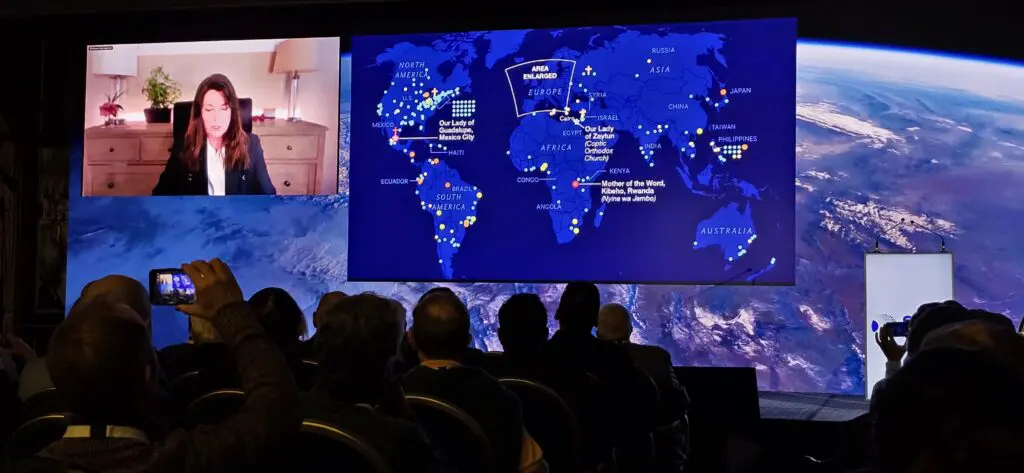
Mapping religious events to known anomalous phenomena, Dr. Diana Pasulka presentation at SOL Symposium Oct. 2025 (UAPedia)
What “data-first” means in a religious history of UAP
A rigorous UAP history of religion has to treat “belief” as an output, not a dismissal.
Methodology
This overview draws from four types of sources:
Primary historical documents (broadsheets, chronicles, religious polemics, canon law materials). For example, Agobard of Lyon’s On Hail and Thunder (9th century) is a direct window into how a bishop tried to suppress popular stories about “ships in the clouds.” (Internet History Sourcebooks)
Curated case catalogs that explicitly compile pre-modern anomalies. Jacques Vallée and Chris Aubeck’s Wonders in the Sky describes a selection of more than 500 reports from antiquity to 1879, emphasizing how each era interpreted phenomena through local religious and political language. (Jacques Vallée)
Institutional “discernment systems” that show how religious authorities decide what is spiritually meaningful, what is dangerous, and what is fraudulent. A modern example is the Vatican’s 2024 norms for evaluating alleged supernatural phenomena. (Vatican)
Modern ethnography and sociology of religion, which treats UAP as a living belief ecology. Diana Walsh Pasulka’s American Cosmic is explicitly framed as a multi-year ethnographic study of UAP-related belief, technology culture, and religious meaning-making. (Oxford University Press)
The recurring “religious response” pattern
Across centuries, religious responses cluster into five repeating behaviors:
Portent logic: the sky event is treated as warning, judgment, or omen (especially during social stress).
Messenger logic: the sky event is treated as an intelligence, angelic presence, or “otherworldly visitor.”
Ritual capture: the community builds a practice around the anomaly (pilgrimage, relic, shrine, feast day).
Material escalation: when physical residue is claimed, it becomes a sacred object, or a forbidden object, or both. In modern UAP culture this becomes crash retrieval debris and reverse-engineering narratives.
That last one is where “ancient religion” and “modern secrecy culture” unexpectedly rhyme.
Crash retrieval before crash retrieval: sacred stones from the sky
If you want the earliest template for “crash retrieval,” do not start in New Mexico. Start with rocks.
Baetyls: “houses of god” as fallen objects
In the ancient Mediterranean and Near East, sacred stones (sometimes believed to have fallen from the sky) were venerated as containers of divine presence. The historical category is often discussed under “baetyls,” though scholars debate how broadly that label should be applied. (Wikipedia)
This matters because it gives a repeatable social mechanism:
something falls or appears from “above”,
authorities secure it, and
the object becomes a legitimacy engine.
The Black Stone of the Kaaba
The Black Stone (al-Ḥajar al-Aswad) is an Islamic relic set in the Kaaba, associated with tradition tracing back to Adam in popular narratives, and embedded in the Hajj ritual life of the community. (Encyclopedia Britannica)
From a UAP-history lens, the key detail is not “what it is,” but what it does socially:
It anchors a global ritual circuit.
It concentrates meaning into materiality.
It survives historical rupture (including historical reports of removal and return). (Encyclopedia Britannica)
Was it a meteorite? That remains disputed. Britannica describes the stone primarily through its religious-historical role rather than a confirmed geologic origin. (Encyclopedia Britannica) Scholarly discussion exists around meteorite versus terrestrial stone hypotheses, including a 1974 proposal that it is likely not a meteorite (suggesting agate). (Astrophysics Data System)
The fact is, the Kaaba has not been analyzed with modern techniques, so scientific origin remains speculative.
What this shows, historically, is a stable cultural behavior: the “retrieved object” becomes more powerful than the “explanation.”
Cybele’s “black stone” and the transport of the sacred
Ancient sources and later scholarship discuss sacred stones associated with deities (for example, stones moved with ceremony into imperial centers).
A modern summary of baetyl traditions notes that the Roman cult of Cybele involved a stone effigy that was brought with great ceremony, and suggests meteoritic origin as a possibility, though not always confirmable. (Wikipedia)
UAPedia takeaway: the “crash retrieval” social pattern is ancient: elite custody, public awe, political use.
Medieval Europe: when bishops argued with “airship” folk religion
Agobard of Lyon and the ships of Magonia
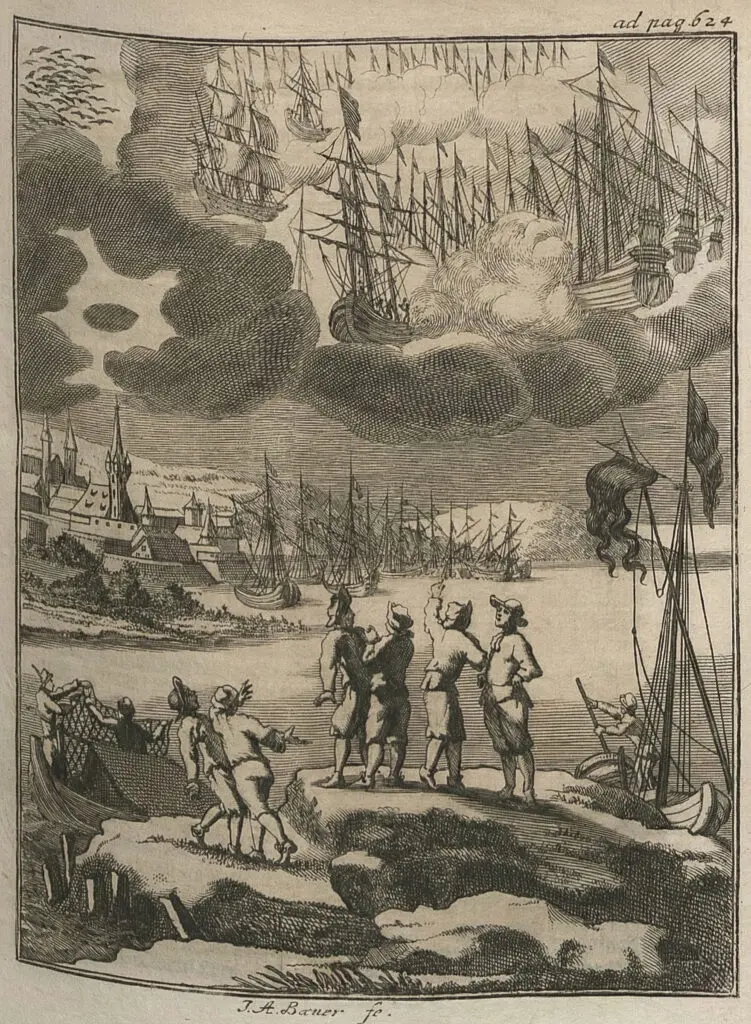
In the 9th century, Agobard, bishop of Lyon, wrote On Hail and Thunder, attacking a popular belief that weather disasters were caused by human magic and that “ships” came from a region called Magonia to collect crops. (Internet History Sourcebooks)
Ships from the sky in this german imprint of 1665 (Deutsche Fotothek | Public Domain)
Read it as a micro-history of UAP meaning-making:
The populace is already telling a “nonhuman visitors” story.
The institutional executive (Agobard) treats it as dangerous nonsense.
The conflict is not about physics, it is about authority: who gets to define the invisible.
This is one of the cleanest early examples of “religious executive filtering” applied to aerial anomaly narratives.
The printing press era: sky battles as warnings during social rupture
When pamphlets and broadsheets became mass media, UAP-like reports scaled with them.
Nuremberg 1561: a broadsheet of aerial conflict
In April 1561, an illustrated broadsheet by Hans Glaser described a dawn spectacle over Nuremberg featuring objects (spheres, rods, crosses, crescents) apparently “fighting,” followed by a large dark shape. The document survives and is associated with the Zentralbibliothek Zürich collection. (The Public Domain Review)
The Public Domain Review’s writeup emphasizes the key historical fact: Glaser produced a broadsheet with image and narrative, and the event was framed as a moral admonition to repent. (The Public Domain Review)
Religious response pattern: portent logic. The text is not neutral reportage. It is sky spectacle as sermon.
Modern interpretive split: Some modern readers argue UAP craft conflict; others point to atmospheric optics (for example, sundogs/parhelia) as a candidate. Contemporary historians treat the broadsheet genre itself as part of the interpretive distortion. (Wikipedia)
Basel 1566: another “battle,” another omen economy
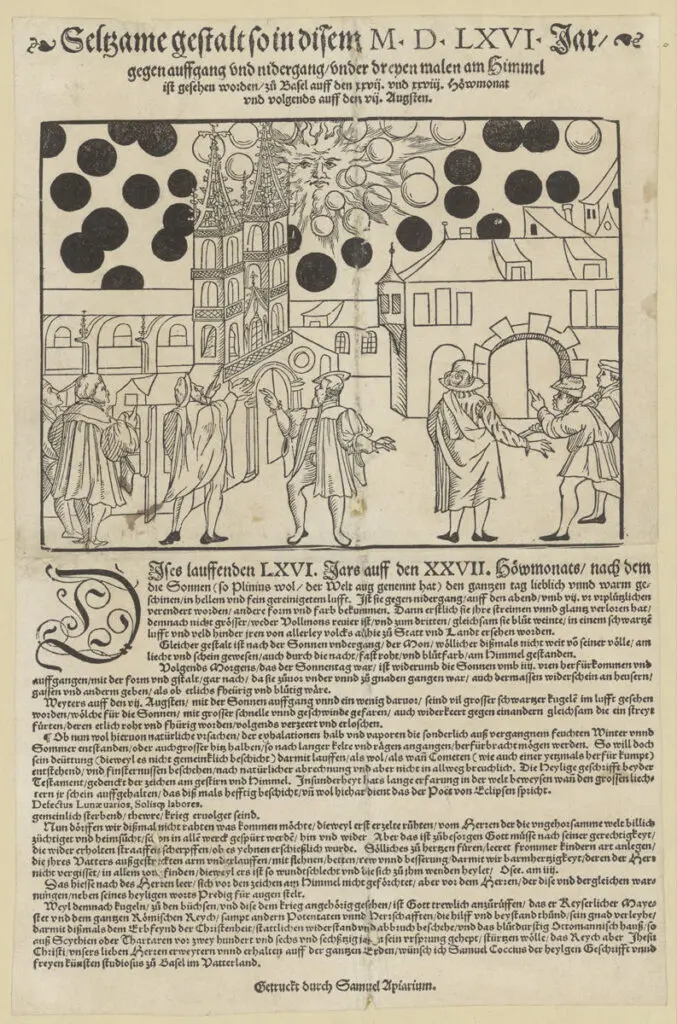
A Swiss National Museum article details how printers Samuel Apiarius and Samuel Coccius produced a broadsheet memorializing “otherworldly events” in Basel, including red and black spheres that appeared to clash in the sky. (Swiss History Blog)
Again, the key is not only the sighting. It is the publication pipeline:
witnesses report
printers monetize and disseminate
religious meaning saturates the interpretation
This is the early-modern ancestor of today’s social-media UAP amplification.
Celestial event of Basel reported in local news around Germany, 1566 (Public Domain)
1917 Fátima: mass witness, mass meaning, permanent infrastructure
If you want the clearest example of ritual capture around a sky anomaly, Fátima is unavoidable.
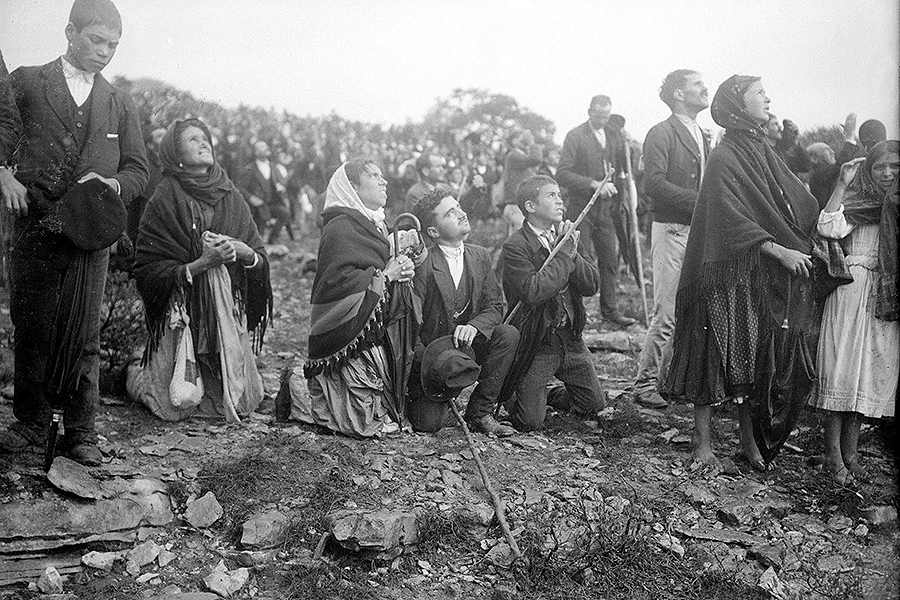
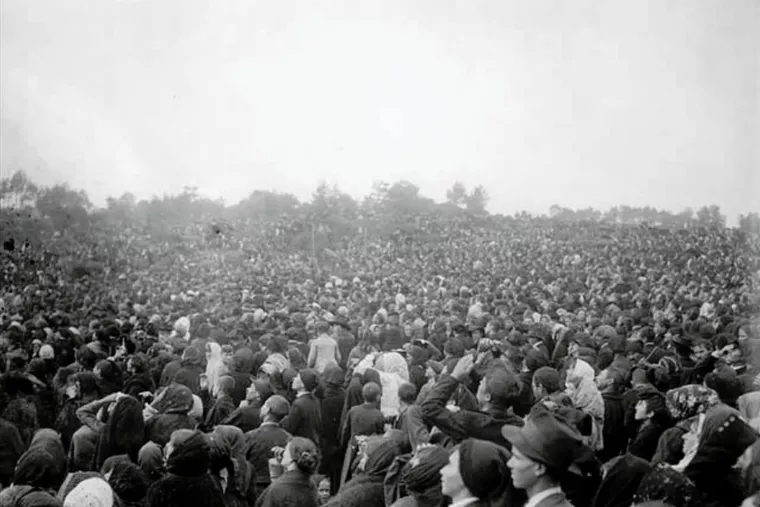
Britannica reports that on October 13, 1917, a crowd estimated at about 70,000 gathered at Fátima and witnessed what has been described as a “miraculous solar phenomenon,” often called the “Miracle of the Sun.” (Encyclopedia Britannica)
Crowd observing the last miracle of Fatima in Portugal 1917 (Public Domain)
From a UAP-history standpoint, Fátima is extraordinary for three reasons:
Publicity: newspapers reported witness testimony (including accounts by a journalist from O Século, per standard summaries of the event’s documentation). (Wikipedia)
Institutional processing: the Catholic Church treated it through investigatory mechanisms, and the wider religious system converted it into enduring devotional practice. (Wikipedia)
Whether one interprets the solar behavior as miracle, localized atmospheric optics, perceptual effects, or something else, Fátima demonstrates a durable sociological truth: a high-emotion, high-attendance anomaly can generate a permanent religious economy.
Pilgrimage, museums, calendars, theology, politics. A brief sky event becomes a centuries-long institution.
Crash retrieval enters modern religious space: from Texas burials to Vatican headlines
Aurora, Texas (1897): an alleged “not-of-this-world” burial
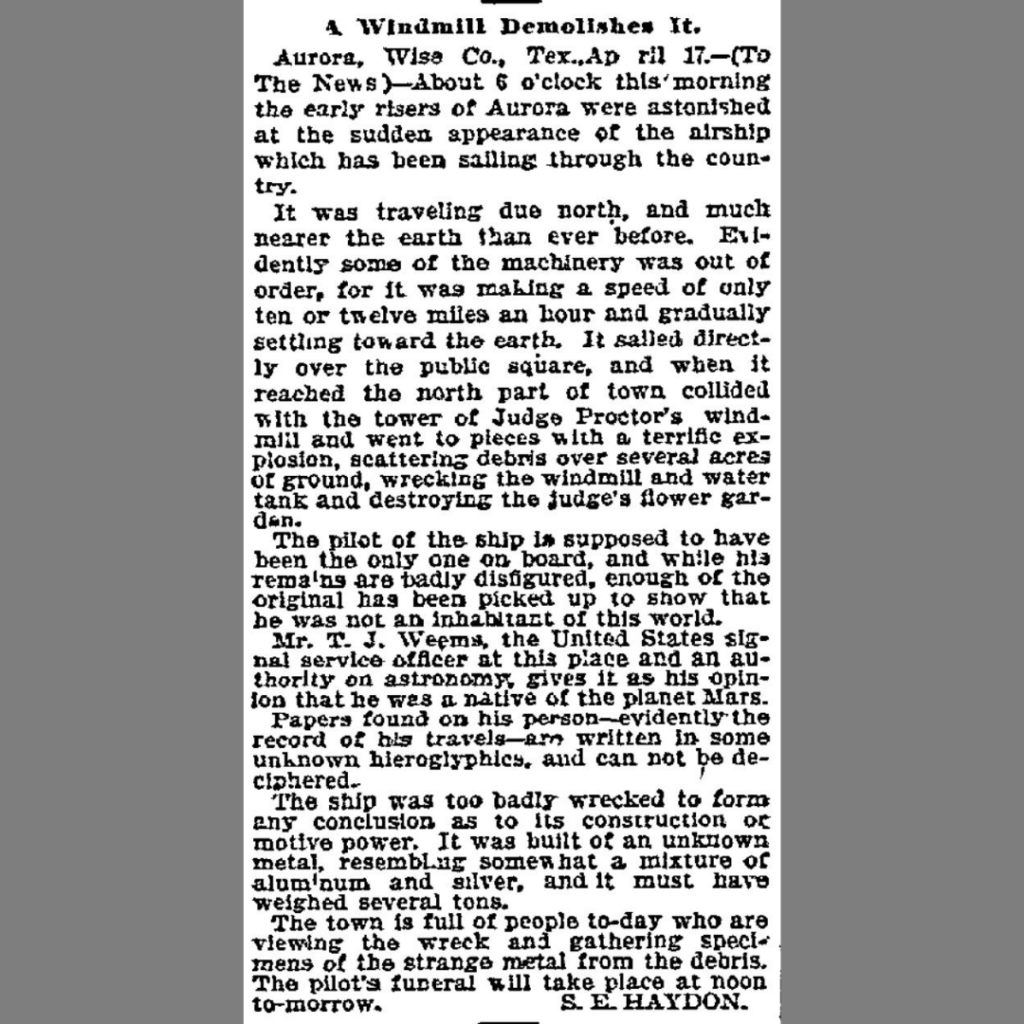
The Aurora story claims an airship crashed and a pilot was buried with Christian rites. It is a vivid example of how communities absorb an anomaly into existing ritual structures (burial, cemetery, clergy). (Wikipedia)
But it is also heavily contested. The Texas State Historical Association describes the Aurora report as a fictional “news” story released by S. E. Haydon to revive interest in the town. (Texas State Historical Association)
So Aurora is useful in two ways:
As a model of religious assimilation (even alleged NHI gets a Christian burial).
As a warning about media fabrication in UAP culture, which religious institutions have historically been forced to manage.
Original front page news about the Aurora crash on the Dallas Morning News, April 19, 1897 (Public Domain)
The Vatican and the 1933 Magenta, Italy crash claim
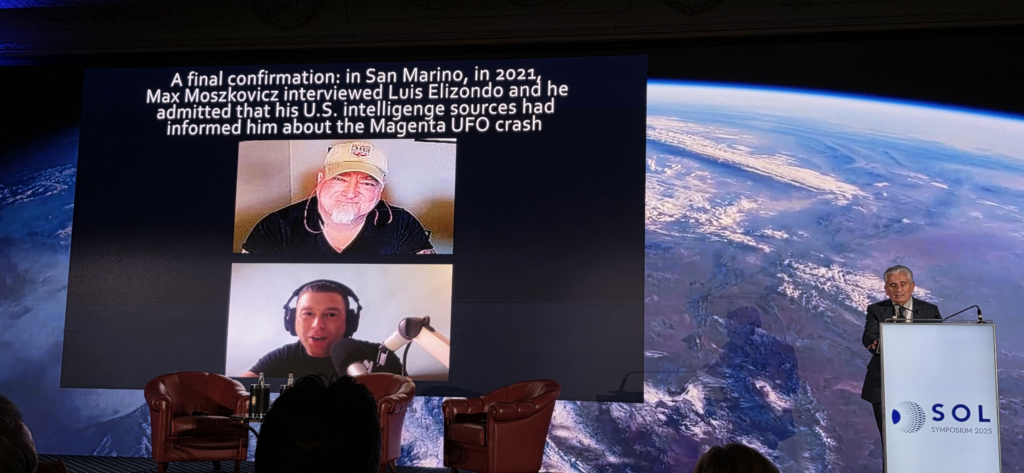
In 2023, former U.S. intelligence official David Grusch publicly claimed that a craft recovered in Magenta, Italy (1933) involved Vatican awareness and “backchanneling.” Catholic News Service reported the claim and also reported a Vatican archives official disputing that the archives contain documentation about extraterrestrial life, discouraging such searches. (USCCB)
This is a modern collision of:
crash retrieval narrative
religious executive authority (the Church as gatekeeper of archives and legitimacy)
media amplification
Popular Mechanics covered the broader “1933 Italy crash” research claims as part of the modern UAP discourse ecosystem. (Popular Mechanics)
Important: this is not a “verified” historical event in the public record. It is a probable claim circulating in the modern UAP space after the release of the investigation of Roberto Pinotti in the case, with several official verified with clear chain of custody documents about the craft but no verifiable hard evidence of the involvement of the Vatican.
Presentation by italian UAP investigator Roberto Pinotti at the SOL Symposium in Oct. 2025, about the Magenta Crash. (UAPedia)
Reverse engineering as modern alchemy: why religions care
Reverse engineering narratives are not just technical. They are theological, even when the people telling them do not think of them that way.
When a culture believes:
nonhuman craft exist
physical materials exist
hidden programs exist to study them
…then the culture has effectively reinvented a sacred-object tradition, but with labs instead of temples.
The “relic” logic of UAP debris
Dr. Dianna Pasulka’s work is relevant here not because it “proves” materials, but because it documents how UAP narratives generate:
sacred geographies (sites where people go to find “pieces”)
sacred objects (materials treated as transformative)
This is the modern echo of baetyl culture, translated into aerospace and the intelligence community.
Religious risk models
A significant subset of Christian thought interprets UAP not as extraterrestrial biology but as spiritual deception (often framed as demonic).
While popular articles exist, there is also scholarly treatment of “alien demonology” as a modern religious motif, including analysis of how Christian categories shape “malevolent alien” narratives. (ScienceDirect)
In that framework, “reverse engineering” becomes morally radioactive: forbidden knowledge, an inversion of divine order, or a temptation story.
The executives: who decides what the sky “means”?
In UAP history, executives are not only CEOs and generals. They are bishops, jurists, theologians, curators of archives, and the custodians of doctrinal boundaries.
Catholicism: centralized discernment in the internet age
In 2024, the Vatican published updated norms for discerning alleged supernatural phenomena, explicitly approved by Pope Francis and effective May 19, 2024. (Vatican)
Key operational implications (relevant to UAP-adjacent “apparitions,” lights, and visions):
Local bishops have constrained authority; the central doctrine office has structured involvement. (Reuters)
The process discourages rapid, definitive “supernatural” declarations, emphasizing caution and protection against exploitation. (AP News)
This is the institutional form of Agobard’s impulse: control the narrative channels that can hijack belief.
Catholic scientific posture: extraterrestrial life is not automatically heresy
In 2008, Vatican Observatory director Fr. José Gabriel Funes was reported (Reuters and other outlets) as saying belief in “extraterrestrial brothers” does not conflict with Christian faith. (Reuters)
In 2009, Vatican-linked scientific discussion of extraterrestrial life (through conferences and commentary tied to the Pontifical Academy of Sciences and Vatican Observatory ecosystem) entered mainstream coverage. (The Guardian)
The executive point: major religious institutions are already preparing conceptual “ports” for nonhuman life, even while remaining cautious about claims.
New religions as “UAP responses”: when the anomaly becomes the scripture
Historical religious response is not only about old traditions. It is also about new ones born directly from UAP narratives.
Heaven’s Gate
Oxford Academic coverage of the 1997 Heaven’s Gate event notes the group believed a spacecraft was traveling behind the Hale-Bopp comet, and members took their own lives seeking to reach an extraterrestrial “Kingdom of Heaven.” (OUP Academic)
The lesson is severe: UAP as religion can scale into lethal certainty.
Raëlism
A neutral factsheet summary describes Raëlism as a UAP-based new religious movement founded in the 1970s, centered on alleged contact with advanced beings and a “message” for humanity. (Religion Media Centre)
These movements matter historically because they show a full conversion:
UAP is not a sign inside religion
UAP becomes the religion
Implications: what historical religion teaches a future “planetary response”
If credible, high-confidence NHI evidence became public tomorrow, religion would not be a side show. It would be core infrastructure.
Religion can stabilize panic, or amplify it:
Stabilizing pathway: doctrinal frameworks that place nonhuman life inside creation and ethics (seen in Catholic openness to the possibility of extraterrestrial life). (Reuters)
Amplifying pathway: deception frameworks that interpret UAP as spiritual attack, which can radicalize communities against scientific and political institutions. (ScienceDirect)
Crash retrieval narratives are socially explosive because they imply elite custody of “relics”
The ancient baetyl pattern tells us what happens when societies believe elites possess sky-fallen objects: legitimacy struggles, pilgrimage economies, political myths, and contested priesthoods. (Wikipedia)
Modern “reverse engineering” claims plug directly into that ancient circuitry, but with national security added.
The most practical near-term need is interfaith contact ethics
Even without definitive NHI proof, UAP discourse is already shaping belief and behavior. Institutions that ignore it surrender the field to the loudest interpreters.
A mature “planetary response” would likely require:
interfaith protocols for public messaging (to reduce sectarian conflict)
psychological first aid and anti-exploitation safeguards (mirroring why modern discernment norms emphasize protection against manipulation) (AP News)
humility about interpretation: witnesses see something, then culture narrates it
Claims taxonomy
Because this is an overview spanning many eras, the taxonomy applies to clusters of claims, not one single case.
Verified
Religious institutions maintain formal discernment systems for alleged supernatural events, updated in 2024 by the Vatican with specific procedures and cautions. (Vatican)
Fátima’s October 13, 1917 event drew a crowd estimated around 70,000 and generated enduring institutional and devotional infrastructure. (Encyclopedia Britannica)
Probable
Early modern “sky battle” broadsheets reflect a mix of reported observation and genre-driven moral messaging, meaning the religious framing is intrinsic and not an afterthought. (The Public Domain Review)
Disputed
The physical origin of the Black Stone as meteorite versus terrestrial stone remains unresolved publicly; claims exist but modern analysis is not available. (Wikipedia)
The alleged 1933 Italy crash retrieval and Vatican involvement claims are contested and not established in the public record, with explicit Vatican-archives pushback reported. (USCCB)
Legend
“Magonia ships” in medieval folk belief are historically attested as beliefs reported by Agobard, but not evidence of literal craft; they represent a cultural narrative about aerial intelligences. (Internet History Sourcebooks)
Misidentification / Hoax:
The Aurora, Texas (1897) story is widely treated as fabricated in historical commentary, even though it remains influential in UAP lore. (Texas State Historical Association)
Speculation labels
Hypothesis
A persistent “single phenomenon” may underlie a subset of historical sky-encounter traditions, with cultures translating encounters into angels, djinn, gods, or omens depending on available language and power structures. Catalog-based approaches explicitly highlight how interpretation changes by epoch. (Apple)
Witness Interpretation
In mass events such as Fátima, witness testimony can describe extraordinary solar behavior while diverging on details, and many interpret the meaning through existing devotional expectations. (Wikipedia)
Researcher Opinion
Some researchers argue that modern crash retrieval claims involving religious institutions (for example, Vatican awareness of the alleged 1933 Italy recovery) represent a hidden interface between religious archives and state secrecy. At present, this remains disputed, with institutional denials and no public chain-of-custody evidence. (USCCB)
References
Agobard of Lyons. (9th century). On Hail and Thunder (De grandine et tonitruis). Medieval Sourcebook, Fordham University. (Internet History Sourcebooks)
Aubeck, C., & Vallée, J. (2010). Wonders in the Sky: Unexplained Aerial Objects from Antiquity to Modern Times. (Summary and catalog descriptions). (Jacques Vallée)
Catholic News Service. (2024, June 18). Reporting on claims about Vatican archives and UAP-related narratives, including Vatican-archives responses. (USCCB)
Dicastery for the Doctrine of the Faith. (2024, May 17). Norms for proceeding in the discernment of alleged supernatural phenomena. Vatican.va. (Vatican)
On 13 October 1917, tens of thousands of people stood in a rain-soaked field in central Portugal, staring at the sky. Some prayed. Some mocked. Some came to witness what three children had promised would happen: a sign “so everyone can believe.” The crowd did not leave with a single unified description. But they did leave with a shared conviction that something happened.
If you strip away later myth-making and focus on what we can actually inventory, Fátima becomes one of the most important early “mass event” dossiers for UAP studies. Not because it can be neatly solved, but because it gives us a rare, messy convergence of:
a predicted public event
a large multi-witness crowd
contemporary press coverage including skeptical outlets
institutional documentation and long-term social impact
a lasting interpretive fork: Marian miracle vs. natural phenomenon vs. anomalous aerial event
UAPedia’s editorial stance treats credible testimony as real data and does not default to prosaic dismissal. With Fátima, that means taking the record seriously without forcing it into a single frame.
Part of the near 100,000 people at Cova da Iria that witnessed the event known as the ‘miracle of the Sun’ on October 13, 1917. (Judah Ruah/O Seculo/Public Domain)
The data deck: what we can state before interpretation
Variable
What we can document
Why it matters for UAP analysis
Location
Shrine of Our Lady of the Rosary of Fátima, Cova da Iria region; GPS listed by the Shrine: 39º37’52.06″N, 8º40’23.47″W
A stable geo-anchor for mapping, sky modeling, and archival cross-checking.
Date range
Apparitions reported monthly May–October 1917 (with the culminating event on 13 Oct 1917); earlier “Angel” experiences in 1916 are part of the canonical narrative
A timeline with repeated events helps distinguish one-off rumor from persistent patterning.
Crowd size
Estimates vary; commonly ~70,000 cited in Church documentation and later summaries
Mass witness events are rare in the UAP record; they stress-test witness reliability models.
Contemporary press
Reported by O Século (15 Oct 1917), including journalist Avelino de Almeida’s eyewitness narrative (often noted as coming from an anticlerical paper)
A skeptical-leaning press witness reduces the “only believers saw it” objection.
Phenomenology reported
“Dull silver disk,” apparent rotation, color changes, “dancing,” sudden motions; mixed witness reports including “nothing unusual” from some observers
These descriptors overlap with modern UAP “luminous disk” reports, but may also match perception artifacts.
Long-term impact
Fátima becomes a global pilgrimage center; the Shrine reports 6.2 million participants in at least one celebration in 2024
Regardless of ontology, this is an enduring sociocultural aftereffect on the scale of major religions.
That’s the spine. Now we investigate.
Scene reconstruction: the field, the forecast, the expectation
The Shrine’s own materials preserve a crucial detail: people were not arriving at a neutral experiment. They arrived primed, wet, and emotionally loaded.
A Sister Lúcia memoir excerpt reproduced by the Shrine describes roads packed with people, “rain [falling] in torrents,” and the crowd kneeling in mud, umbrellas closed, praying the rosary. The meteorology matters less than the psychology: discomfort, anticipation, and collective focus.
In UAP research, you rarely get this level of situational context. Most sightings are sudden and private. Fátima is the opposite: a scheduled appointment with the unknown.
Crowds look at the ‘miracle of the sun’ that occurred during the Our Lady of Fátima apparitions in 1917. (Public Domain)
Witness accounts: three lanes of testimony
A data-first approach doesn’t treat “testimony” as one thing. Fátima gives us three distinct lanes:
The child seers: a sustained contact narrative
The official Catholic narrative centers on Lúcia dos Santos and her cousins Francisco and Jacinta Marto, who reported a series of encounters culminating in October 1917.
The Shrine’s “Narrative of the Apparitions” situates these events within a broader sequence that includes earlier anomalous experiences (including luminous phenomena and a figure framed as an “Angel”).
From a UAP perspective, this resembles a classic contact pattern: repeated encounters, messaging, behavioral instructions, prediction of a public sign, and the eventual emergence of a mass witness event.
The journalist witness: an observer who did not need to cooperate
Avelino de Almeida’s account is often treated as the “hardest-to-ignore” contemporary narrative because it is not easily reduced to devotional enthusiasm.
In a publisher-released excerpt of Luís Filipe Torgal’s historical work, Almeida’s description includes a key perception claim: the sun appeared like a dull silver plate and was possible to look at without strain, followed by a collective roar and cries of “milagre”. Another blunt phrase attributed to the same account, “it does not burn, it does not blind,” is a direct challenge to normal solar viewing conditions.
For UAP investigators, this is a familiar motif: a luminous object that is visually tolerable, as if filtered, structured, or perceptually altered.
The skeptical counter-witness: “we saw it too, and it wasn’t extraordinary”
A modern investigation also has to honor negative testimony. In the same excerpted dossier, Domingos Pinto Coelho (writing in A Ordem shortly after the event) claimed he observed the same successions of colors and rotational movement under similar conditions on another day, concluding that once the “extraordinary fact” is removed, you are left with “three children’s affirmations”.
This is not a trivial objection. It is a built-in control witness arguing for replicability under ordinary circumstances.
The investigative takeaway: the event produced both “something impossible happened” and “this can happen naturally” witness tracks immediately, not decades later.
What, exactly, was the “Miracle of the Sun” as a UAP-like report?
If you translate the press-era descriptions into modern UAP field categories, you get a striking cluster:
Apparent disk morphology (often described as plate-like)
The uncomfortable point for both skeptics and believers is that this list is interpretable in multiple ways:
A structured aerial phenomenon could create these perceptions.
Atmospheric optics plus mass sun-gazing could create these perceptions.
A consciousness-mediated event could create these perceptions.
Some mixture could create these perceptions.
A UAPedia-style approach is not to pick the most socially comfortable explanation. It is to map which hypothesis best accounts for the full pattern, including the prediction, the crowd, the press, and the aftereffects.
The “mass UAP” question: why crowd size both helps and hurts
A crowd is not a truth machine. But it is also not nothing.
What mass witnessing strengthens
You reduce single-witness idiosyncrasy.
You increase the odds of independent reporting.
You create immediate documentation pressure (press, clergy, officials, diaries).
Fátima did generate that pressure, including prominent newspaper coverage and later institutional documentation.
What mass witnessing weakens
Contagion effects: people copy attention and language.
Expectation bias: a predicted sign invites pattern-filling.
Perceptual convergence: if you stare at the sun, you can induce shared artifacts.
Fátima is the rare case where both sides can point to the same dataset and say: “See? This proves my model.” That is exactly why it remains useful.
Diana Pasulka’s bridge: “the event” vs. “the frame”
Diana Walsh Pasulka’s work is relevant to Fátima because she treats modern UAP narratives and historic religious miracle narratives as structurally similar human encounters with the anomalous, filtered through cultural permission.
In an interview conversation that explicitly references Fátima, Pasulka notes the 1917 Marian apparition report and the associated “miracle of the sun,” adding that it is plausible that something happened while emphasizing that people interpret extraordinary events through their available frameworks.
This is not a debunking move. It is an interpretive warning: the same stimulus can generate different realities depending on who is looking, what they believe is allowed to be real, and what language their culture provides.
In American Cosmic (Oxford University Press), Pasulka argues that UAP experiences can function like a new form of religiosity in a technologically saturated culture, with institutions and narratives forming around encounters that destabilize the everyday world.
Fátima may be the inverse: a technologically interpretable event embedded in a religious culture that already had an interpretive container ready.
The modern UAP reinterpretation literature: “the being who descended from the sky”
The strongest “explicit UAP” reading of Fátima is associated with Portuguese historians Joaquim Fernandes and Fina D’Armada, whose book Heavenly Lights: The Apparitions of Fátima and the UFO Phenomenon is marketed as an evidentiary analysis grounded in original case documents, with a foreword by Jacques Vallée.
Two points matter for investigators:
Their framing treats the central figure as an “unidentified being,” not automatically as a Marian entity.
Their table of contents shows a systematic attempt to map reported phenomena (lightning, buzzing, thunder, clouds) to what they call parallels in ufology.
You do not have to accept their conclusion to recognize the method: take the old dossier and re-read it using modern anomaly categories. This is exactly what UAP studies needs more of, provided it is done carefully and without cherry-picking.
Religious groups: who carried the signal forward, and why that matters
Even if you bracket the ontology, Fátima’s aftereffects are measurable at civilizational scale.
The institutional Church
The Vatican’s official materials situate the Fátima events as Marian apparitions tied to the lives of the three child witnesses and subsequent devotional developments. Church structures, by design, preserve continuity, not novelty. That means the archive is both a resource and a biasing instrument.
The Shrine as a living data engine
The Shrine of Fátima functions like a long-running observatory of belief-in-action. It produces calendars, pilgrim infrastructure, documentation, and, importantly, statistics.
In a 2025 report about the prior year, the Shrine stated that 6.2 million faithful participated in at least one celebration in 2024, with detailed breakdowns of registered groups and countries of origin. It also publishes logistical details like GPS coordinates and pilgrimage guidance, showing the scale and routinization of the phenomenon.
Lay movements
Fátima-inspired lay organizations (often international) have historically acted as amplifiers, translating the event into prayer programs, political meanings, and public ritual.
For UAP analysts, these movements are not side stories. They show how anomalous encounters, once culturally authorized, become self-sustaining.
This is one reason “mass UAP events” are strategically important: they do not only produce sightings; they produce institutions.
Aftereffects: the overlooked half of the case file
UAP case files often end at the sighting. Fátima begins there.
Individual aftereffects (micro scale)
The child witnesses became focal points of interrogation, reverence, skepticism, and institutional management (a pattern many modern experiencers recognize).
The event shaped life trajectories, health narratives, and identity in ways that are difficult to reduce to a single moment.
Cultural aftereffects (macro scale)
A rainy field becomes a devotional geography, then a global pilgrimage economy.
The event becomes a repeating calendar cycle, with anniversary pilgrimages drawing massive crowds across decades.
The Shrine’s own statistics show how the phenomenon persists into the present in quantifiable ways.
For UAPedia, this matters because the “reality” of a phenomenon is not only physical. It is also sociological. Some UAP events change the world even when the object remains undefined.
Implications: what Fátima teaches UAP research that sensor cases do not
Prediction is a rare and valuable variable
Most UAP events are unpredicted. Fátima’s core drama is a predicted sign and a crowd that arrives to test it. That is a structural advantage for any anomaly investigation, even if the event is contaminated by expectation.
“Religious vs. UAP” may be a false binary
Fátima is often treated as a battleground: miracle or misperception. A third option is that the event is genuinely anomalous while the “Mary” interpretation is a culturally available interface.
This is not an attempt to flatten Catholic meaning. It is an attempt to describe how anomalous encounters repeatedly acquire local identities across cultures.
Longitudinal impact is part of the evidence
In modern UAP studies, we often privilege “hardware” data. Fátima reminds us that enduring aftereffects, institutions, and repeat pilgrimage behavior are themselves a form of signal.
A phenomenon that can mobilize millions across a century is not nothing.
Mixed testimony is a feature, not a flaw
Fátima contains believers, skeptics, and witnesses who claim normality. That pattern is familiar in UAP events: a single stimulus can produce divergent reports, and the divergence itself can be diagnostic.
Claims taxonomy
Verified
A large-scale gathering occurred at Fátima in October 1917 and generated contemporary press accounts, including detailed descriptions of unusual solar-like visuals.
The Shrine of Fátima exists as a major global pilgrimage site and reports participation statistics in the millions, including 6.2 million participants in at least one celebration in 2024.
The Shrine publishes precise geographic coordinates for the site, anchoring it for mapping and study.
Probable
At least a substantial fraction of attendees experienced unusual visual phenomena described as a rotating, color-shifting disk with abnormal motion, with many reports converging on those motifs.
Interpretation was strongly shaped by expectation, ritual framing, and the cultural availability of Marian categories, as suggested by both historical context and modern analytical frameworks.
Disputed
Whether the observed phenomena were caused by atmospheric optics, perceptual artifacts from sun-gazing, a structured aerial object, or a consciousness-mediated anomaly remains unresolved in the historical record.
Whether the “being” reported by the children should be treated as a Marian entity, an unidentified intelligence, or a narrative interface is contested across religious and ufological literatures.
Legend
Later layers of Fátima interpretation that are primarily devotional or polemical, and which expand beyond contemporaneous documentation, should be treated as cultural narrative unless anchored to primary sources.
Misidentification
Not applicable as a definitive category at the whole-case level because no single prosaic identification is universally demonstrated across the dataset.
Hoax
Not established. The existence of skeptics and dissenting witnesses does not, by itself, demonstrate intentional fabrication, and the press record includes observers who did not have an incentive to stage belief.
Speculation labels
Hypothesis
A localized anomalous aerial phenomenon occurred over Cova da Iria on 13 October 1917, producing disk-like visuals, color cycling, and apparent motion consistent with modern UAP reports, and triggering large-scale collective response.
Witness Interpretation
The child seers and many in the crowd interpreted the phenomenon through Catholic Marian symbolism, framing the “being” as the Virgin Mary and the sky display as a miracle. Some observers interpreted similar visuals as ordinary atmospheric or perceptual effects, treating the event as non-anomalous.
Researcher Opinion
Pasulka’s framework suggests that extraordinary events can be real while interpretation is culturally shaped, and that modern UAP culture may be generating an equivalent “religious” infrastructure around anomaly today. Fernandes and D’Armada argue for an explicitly ufological reading, treating the central entity as unidentified and mapping reported effects to parallels in ufology.
Fátima UAP, Miracle of the Sun UAP interpretation, Marian apparitions and UAP, mass UAP sighting Portugal 1917, Cova da Iria anomaly, Diana Walsh Pasulka Fátima, American Cosmic Fátima, Jacques Vallée Fátima, Heavenly Lights Fernandes D’Armada, historical UAP religious encounters
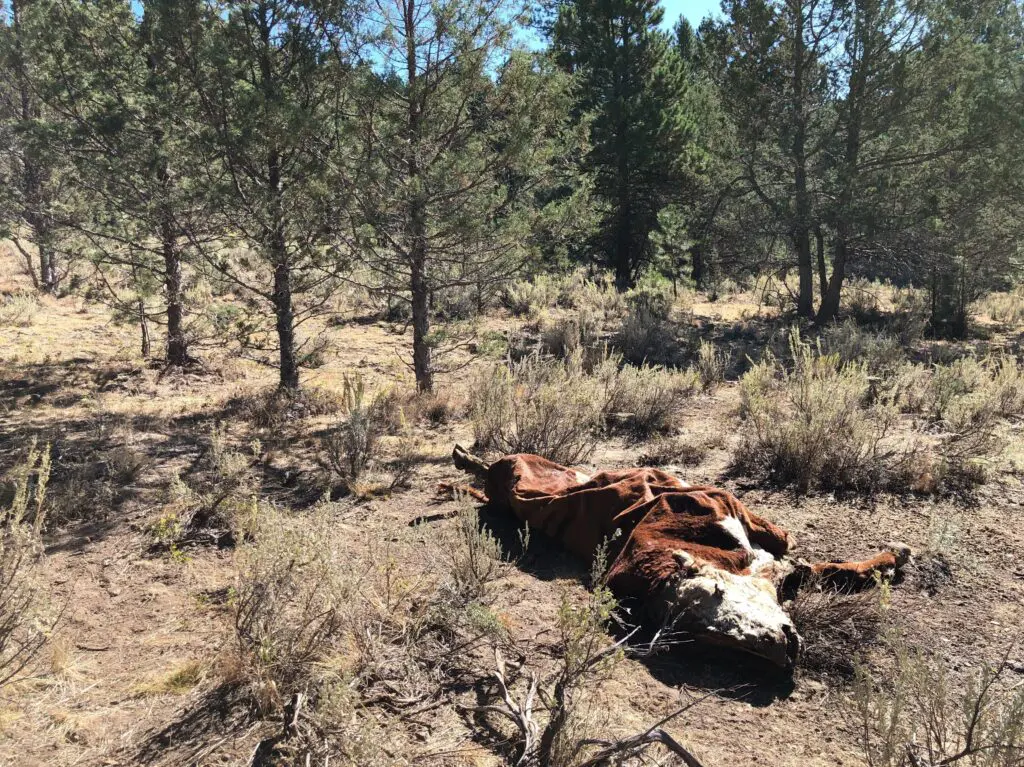
In the high desert of eastern Oregon, a breeding bull’s body lies crumpled in the scrub and pine, as if the animal simply deflated.
The scene feels staged, yet there is nothing obvious to stage with: no tire tracks, no bootprints, no drag marks, no telltale churn where a struggle happened. Witnesses keep coming back to the same unnerving phrases: “precisely removed,” “no blood,” “no scavengers.”
That vocabulary is not new. It is the same vocabulary ranchers used in Colorado in the 1970s. It resurfaced in Texas in 2023, when investigators described “straight, clean” facial excisions and tongues “completely removed” without visible blood spill.
And it persists because the core challenge persists: cattle deaths are common, but a subset of cattle deaths presents a repeating, forensic-looking pattern that rural communities experience as an intrusion.
No sign of blood anywhere around this crumpled carcass of a bull that lies on U.S. Forest Service ground. It was among several killed and mutilated on the summer of 2019 in eastern Oregon. (Anna King/Northwest News Network)
The data snapshot
Before theories, start with the measurable: reported clusters, repeated wound locations, reporting incentives, and the quality of postmortem documentation.
Clusters, not a steady baseline Cattle-mutilation reporting behaves like “waves.” In Colorado’s 1970s surge, journalists and investigators recorded hundreds of reports. One later review cites “nearly 200” Colorado cases in a single stretch of 1975. A separate report from 2009, referencing Colorado Bureau of Investigation material, describes “more than 200 mutilation reports” filed by ranchers in the 1970s.
Arkansas shows the same wave signature. State police records there indicate 39 reports of unexplained cattle deaths from April 1978 to September 1979, concentrated in northern regions of the state.
Modern clusters still occur. In 2019, eastern Oregon produced a tightly bounded set of cases on and around a major ranch, with five young purebred bulls found bloodless and missing tongues and genitals, according to local reporting.
In Texas (Madison/Robertson/Brazos area) in 2023, authorities reported seven mutilated cows across different locations and herds, while at least one postmortem exam attributed the cause of death to pneumonia even as “deformities” remained unexplained in the public-facing summary.
The repeated “target tissues” Across decades and states, the same body areas are described again and again: eyes, tongues, udders, sex organs, and anogenital tissue, often framed as “surgical precision.” This recurrence matters because it defines the phenomenon operationally. If you remove the repeating target tissues, you remove the pattern.
The “10,000 by 1979” number is real in the media record but weak as a dataset News-era estimates that “more than 10,000” incidents occurred by the end of the 1970s appear in secondary summaries of period reporting. The number is culturally influential, but it is not a clean count derived from a single, standardized reporting system. Treat it as an indicator of scale anxiety, not a precise statistic.
The single biggest data problem: postmortems are rare Even in later decades, officials noted that necropsies were often not ordered due to cost. Without a necropsy, you lose the ability to decisively separate if the animal died first, then scavenged, was wounded before death (antemortem), manipulated after death by tools (human or otherwise).
The signature pattern
What makes a rancher say: “This was done!”
When ranchers report mutilations, the claim is usually not “my cow is dead.” It is “my cow is dead in a way I recognize as wrong.”
From the Oregon reports, key signature elements include:
bloodlessness at the scene (“not one drop of blood”)
missing tongues/genitals/udders with “precise” cuts
pristine scenes: no tracks, no disturbed ground, no signs of struggle
claimed absence of scavengers in the early period after death
From Texas, investigators publicly echoed the same pattern: straight clean facial cut, tongue removed, undisturbed ground, no visible tracks.
From Colorado reporting, the same signature appears: “no tire tracks or footprints,” and “nor even bloodstains.”
This repeating signature is why the phenomenon endures. It reads like an operation, not like nature.
Witness testimony
What people said when they were not trying to entertain anyone
Oregon: “Everything you do leaves tracks”
In eastern Oregon, rancher Terry Anderson recalled an earlier incident in the 1980s, describing an udder removed with something “razor sharp” and emphasizing the absence of blood.
Nearby, Andie Davies described how she and her husband rode circles to find any sign of approach, concluding that in that terrain, “everything you do leaves tracks.”
On Silvies Valley Ranch, executive Colby Marshall described the bulls as found bloodless with tongues and genitals removed, and he framed the environment as rugged enough that a capable perpetrator would be dangerous to humans as well.
Law enforcement testimony from that same reporting illustrates how “UAP” becomes part of the social field: a deputy described receiving many calls, including claims about craft “beaming” animals and suggestions to use radiation detection.
Texas: “No footprints, tire tracks or blood”
In the Texas cluster, the public-facing description is unusually explicit for an active investigation: a “straight, clean cut” removing hide around one side of the mouth while leaving underlying tissue untouched, plus the tongue “completely removed” with no blood spill.
A local resident, Vernon Guidry, articulated the core cognitive shock plainly: no blood, no struggle, body position not making sense.
Colorado: “There’s nothing to go by”
A Colorado rancher, Manuel A. Sanchez, described the problem as the absence of actionable traces: “There’s nothing to go by.” That phrase is revealing. The terror is not simply the dead animal. It is the feeling that normal causal inference has been disabled.
New Mexico: official channels treated the reports as serious enough to circulate
In FBI-released material tied to New Mexico reporting, correspondence references requests for a government investigation into “mysterious livestock mutilations” in Rio Arriba County, with state police incident reports enclosed. Even when agencies later minimized the likelihood of human perpetrators, the administrative trail shows that officials recognized the intensity and persistence of complaints.
The biology
Why nature can look like a scalpel (and why that does not close the file)
A data-first investigation must confront the strongest prosaic mechanism head-on: postmortem scavenging and decomposition.
What veterinary science can explain well
Soft tissue goes first Veterinary and forensic commentary repeatedly notes that scavengers preferentially consume softer tissues first, which overlaps almost perfectly with the “target tissues” pattern (eyes, tongue, genitalia).
Bloodlessness can be an artifact of postmortem circulation stopping One mainstream explanation for “bloodless” appearance is gravitational pooling after death (livor mortis) rather than external drainage. This is not a hand-wave; it is a known postmortem process that can dramatically change what a carcass looks like to a non-pathologist.
Bloating and skin tears can mimic incisions A particularly important point, because it maps onto “clean cut” language: bacterial bloating and skin tension can produce splits that appear incision-like.
Controlled “look-alike” demonstrations exist In Arkansas, the Washington County Sheriff’s Department reportedly euthanized a heifer and observed the carcass, documenting that within roughly thirty hours it developed the same conditions reported as mutilations, with evidence that only scavengers interacted with it.
Mainstream historical summaries also describe a similar Arkansas experiment (a dead cow placed and later found to resemble “mutilation” conditions), reinforcing that law enforcement itself explored naturalistic mechanisms.
A peer-reviewed veterinary conclusion: exclude scavenging before claiming human involvement A Canadian Veterinary Journal paper reviewing Alberta reports concluded the “so-called ‘mutilation’” cases there were due to scavenging and emphasized that claims of human involvement require, as a first condition, excluding postmortem scavenging.
Why “straight-line cuts” happen in scavenging Veterinary pathologist Nick Nation described how coyotes can bite and pull, producing what appears to be a straight-line cut, and he noted that tracks are far less visible in summer conditions when many reports occur.
What biology does not resolve on its own
The biology explains “how the body can look,” not “why clusters spike” Even if many cases are misread scavenging, you still have to explain wave behavior: why certain years and regions light up socially and administratively while others do not. That is not a carcass question, it is a systems question involving economics, trust, media dynamics, and local enforcement capacity.
Biology does not reliably explain “pristine scenes” without additional context A scene can look pristine for mundane reasons: wind, hard ground, time delay, or observers focusing on large tracks while missing subtle ones. But when multiple witnesses and deputies repeatedly emphasize “no tracks,” the correct response is not dismissal. It is to design evidence collection that can test the claim (soil impressions, IR imaging, photogrammetry, camera traps).
The 1979 pivot point: when the federal record intersects the wave
What the FBI files actually show
In FBI-released documents, a multi-state livestock mutilation conference in Albuquerque (April 1979) is referenced, with an FBI agent assigned as a contact for reports and to organize the Bureau’s activities.
Those documents also preserve a key institutional stance: by January 15, 1980, retired FBI agent Kenneth M. Rommel advised that the cases he examined were consistent with common predators and that he had not found justification to believe animals were intentionally mutilated by human beings.
This is often treated publicly as closure. It is not closure. It is a conclusion reached under the constraints of the cases examined, the evidence submitted, and the jurisdictional boundaries of the Bureau. What it does do is define a baseline: the strongest official argument for “predators explain it.”
The investigative question then becomes sharper: Which cases, if any, survive that baseline with intact anomalies?
Theories
A disciplined map (with Speculation Labels)
This section separates evidence from interpretation. Each theory is presented with a Speculation Label and with the strongest points both for and against, based on the sources above.
1) Scavenger and taphonomy hypothesis
Speculation Label: Hypothesis
Claim: Many “mutilations” are ordinary deaths followed by scavenging, insect activity, and postmortem changes that mimic surgical cuts and blood loss.
Best supporting points
Peer-reviewed veterinary review concludes Alberta “mutilations” were scavenging and says human-involvement claims require excluding scavenging.
Law enforcement “look-alike” demonstrations in Arkansas reportedly reproduced the pattern with scavengers only.
Veterinary pathologist testimony describing how coyote bites and pulling can create straight-line wounds.
Explanations for bloodless appearance (postmortem pooling) and incision-like tears (bloating/skin tension).
Hard problems for this hypothesis
It must also explain why some scenes are repeatedly described as lacking scavenger activity early after death in certain clusters (for example Oregon reporting describes “no signs of buzzards, coyotes or other scavengers” at a carcass scene).
It does not fully address why the same “precise” signature reappears in modern timeframes with similar language from deputies and ranchers.
2) Human perpetrator hypothesis (criminal, experimental, or ritual motives)
Speculation Label: Hypothesis
Claim: A portion of cases involve humans using tools, with motives ranging from malicious vandalism to collection of tissues for testing, to ritualized acts.
Best supporting points
Multiple law enforcement voices have historically insisted the wounds looked tool-made rather than predator-made, and that they could “tell” the difference.
Some jurisdictions treated the problem as serious enough to convene multi-state meetings and discuss central coordination.
Arkansas accounts include claims of detected drugs in a cow’s bloodstream in a particular incident and physical objects found near carcasses.
Hard problems for this hypothesis
Human activity should often leave logistical signatures: access routes, vehicle traces, tool marks with consistent morphology, DNA, footprints, or repeatable timing patterns. Public reporting frequently stresses the absence of those signatures.
A significant official review (Rommel) concluded examined cases were consistent with predators and did not justify belief in intentional human mutilation.
3) Covert surveillance or biosampling hypothesis
Speculation Label: Researcher Opinion
Claim: Some subset of cases may represent tissue sampling connected to environmental monitoring, disease surveillance, or other clandestine programs.
Why it persists
The tissues reportedly removed (tongue tissue, reproductive organs, lymph-related areas) are biologically informative.
The wave behavior of reports and the appearance of organized capability in remote terrain keeps this hypothesis alive, especially when witnesses mention aircraft activity in the broader folklore record of the 1970s.
What the evidence actually shows (so far)
In the accessible sources above, this hypothesis appears mainly as community interpretation and historical context rather than as documented operational proof.
4) UAP biological sampling hypothesis
Speculation Label: Hypothesis
Claim: A portion of cattle mutilation cases are linked to UAP presence or activity, potentially as biological sampling, ecological reconnaissance, or a form of non-human interaction with terrestrial life.
Why UAPedia considers it non-dismissable
The persistent recurrence of the signature pattern across decades, combined with recurring “pristine scene” claims, forces openness to non-standard mechanisms.
The phenomenon’s cultural linkage to aerial anomalies is not just internet lore; it appears repeatedly in law enforcement call logs and public discourse around active cases.
What is missing
The strongest missing element is contemporaneous multi-sensor correlation: verified aerial track, physical trace data, and a medically robust necropsy showing tool-like excision with clear antemortem indicators, plus chain-of-custody intact from scene to lab.
5) “Laser cut” interpretation
Speculation Label: Witness Interpretation
Witnesses often use “laser” as shorthand for “unlike tearing.” Colorado reporting includes ranchers describing missing tissue “like a laser cut.” This is valuable testimony, but it is not a measurement of energy delivery. A “laser-like” edge can be produced by mundane mechanisms (skin tension, dehydration, scavenger pull), and it can also be produced by tools.
Implications for UAP research
Why cattle mutilations matter even if many are “just scavengers”
If 70 to 90 percent of reported cases reduce to normal deaths plus scavenging, the remaining fraction still matters, because:
A small anomalous residue can be operationally significant UAP research has the same structure: many reports resolve, but a smaller subset (with better data) drives the core question. The correct move is not to argue about the percentage. It is to improve evidence capture so the residue is measurable.
The phenomenon is an accidental sensor network Ranchers are distributed observers across vast terrain. When a pattern repeats across that human network, it is a signal worth instrumenting.
It intersects with biosecurity Even prosaic explanations point to a need for better rural necropsy access and standardized reporting. A “mutilation” wave can mask disease outbreaks or poisoning events if communities stop trusting official explanations.
What a modern investigative protocol looks like
Turning a dead animal into a usable dataset
If UAPedia could impose one standard across jurisdictions, it would be this:
Immediate scene capture
360-degree photos and video before anyone touches the carcass
scale markers on wounds
drone overhead images for approach routes and micro-disturbance patterns
Necropsy triage
If full necropsy is impossible, at least collect: tissue around excision margins, fluid samples, and insect activity samples (maggots can timestamp death)
document body temperature estimates and stage of decomposition
Antemortem vs postmortem determination
Look for “vital reactions” in tissue (evidence the animal was alive when injury occurred). This is where histology matters more than storytelling.
Camera traps and continuous monitoring
Nation notes that video evidence resolves many “who did it” disputes quickly in known scavenging contexts.
Put cameras where carcasses are most likely to be found: water troughs, gates, shade structures, and known bedding areas.
Correlation layer for UAP research
If aerial anomalies are reported, log time windows precisely and attempt correlation with radar records, satellite passes, weather, and any local sensor data.
This is how you move from “mystery” to “model.”
Claims taxonomy
UAPedia adjudication (case-type level, not single-case certainty)
Claim 1: A recurring mutilation signature exists (tongues/eyes/genitals/udders removed; reported bloodlessness; often described as precise). Assessment: Verified (as a reported and repeatedly documented pattern across multiple jurisdictions and eras).
Claim 2: Many reported mutilations can be explained by scavenging and postmortem processes. Assessment: Verified (as a strong explanatory framework supported by veterinary literature, interviews, and law enforcement experiments).
Claim 3: A non-trivial subset remains unresolved due to missing necropsies, weak chain-of-custody, and inconsistent evidence capture. Assessment: Verified (limitations explicitly described in reporting; necropsies often not done due to cost).
Claim 4: Human perpetrators are responsible for a substantial portion of cases. Assessment: Disputed (some localized evidence claims exist, but major official review and veterinary literature do not support broad human causation as the dominant driver).
Claim 5: UAP involvement is a causal driver in cattle mutilations. Assessment: Disputed (plausible within witness interpretation and cultural linkage, but lacks the consistent multi-sensor and forensic confirmation needed to elevate beyond dispute).
Claim 6: “No scavengers approach the carcass for weeks.” Assessment: Probable (as a reported observation), Disputed (as a generalized biological rule). The observation appears in public statements, but it requires controlled verification case-by-case.
Nation, P. N., & Williams, E. S. (1989). Maggots, mutilations and myth: Patterns of postmortem scavenging of the bovine carcass. The Canadian Veterinary Journal, 30(9), 742–747. (Abstract via PubMed) https://pubmed.ncbi.nlm.nih.gov/17423422/?utm_source=uapedia.ai
Edgar Mitchell is often remembered as an Apollo astronaut, the sixth person to walk on the Moon. Inside UAP studies, his more disruptive legacy is what he did after returning home: treating “contact” as a researchable human domain instead of a taboo punchline. This all stems from a powerful experience he claimed he had coming back from the Moon, which he described in a testimony to the Kennedy Space Center, and the work he did after his retirement from NASA: founding the Institute of Noetic Sciences (IONS), helping Stanford Research Institute (SRI) with the Remote Viewing project, helping secure funding for Project Stargate, and many more like initiatives.
Mitchell mentions his experience in this Consciousness video. (Kennedy Space Center)
Before he ever co-founded FREE, Mitchell had already crossed a line that most astronauts would not. During Apollo 14 he conducted private ESP tests in flight, then later helped found the Institute of Noetic Sciences, explicitly aiming to study mind, consciousness, and anomalous experience with scientific tools.
FREE, the Dr. Edgar Mitchell Foundation for Research into Extraterrestrial and Extraordinary Encounters, became a continuation of that trajectory: a large-scale attempt to collect data from people reporting contact with non-human intelligence (NHI), with or without UAP, and then quantify patterns that small case-series could never reliably surface. The choice of the words Extraterrestrial and Extraordinary was a deliberate pairing that captured both sides of his epistemic gamble. “Extraterrestrial” anchored the public-facing pillar: encounters conventionally framed as alien or UAP-related. “Extraordinary” widened the aperture, inviting inclusion of near-death experiences, out-of-body states, and other consciousness-related phenomena that fall outside laboratory norms but within human reportability. That dual mandate: empirical data on the “extraordinary” without presupposing extraterrestrial origin, was more than branding; it was the methodological hinge of the project.
This is a data-first explainer of what FREE actually did, who it was for, what it found (and what it did not), how it was received, and what its results imply for UAP research going forward.
FREE in 12 numbers
These are not “proof of NHI.” They are the measurable outputs of a very large self-report dataset collected under defined rules.
Sample size analyzed in the peer-reviewed paper: N = 3,256 contact experiencers.
Survey scope: two quantitative phases totaling 554 questions.
Phase sizes: Phase 1 N = 3,256; Phase 2 N = 1,919 (Phase 2 completed Phase 1 first).
Positive vs negative impact: ~70% (N = 2,279) reported life changed in a “positive way”; 15–20% reported negative impact.
“Craft/ship associated with the contact experience”: 64% (N = 993 of 1,556) answered yes.
Most common reported UAP shape (among those reporting shapes): circular 70%; then triangle 36%, oval 34%, cylindrical/cigar 28%, cloud-like 22%.
Country distribution in the Phase 1 dataset: United States 64.1%, Canada 8.4%, Australia 8.3%, UK 7.2% (88%+ combined).
Reported high-strangeness “home” effects (ranges across the four biggest country samples): telepathic messages 52–58%, appliance malfunctions 45–55%, “missing time” 40–48%, strange lights in home 36–48%.
“Sighting a UAP is not necessarily associated with a contact experience” and UAP-linked contact was not the predominant form in their dataset.
In a Phase 2 subgroup meeting criteria for “matrix reality” contact, ~80% reported consciousness separated from the body; 72% reported “expanded consciousness” during contact.
Only about one-quarter or fewer reported conscious recall of being onboard a UAP craft and physically interacting with NHI (in the analysis described).
Communication was common: >83% (N = 1,184) of those answering the question reported receiving some form of communication from NHI, and 67% reported “reassuring messages.”
If you only remember one thing, remember this: FREE’s flagship result was not “lots of abductions.” It was a patterned landscape where non-physical or altered-state contact modalities appear at least as prominent, often more prominent, than classic “nuts-and-bolts” onboard narratives.
What FREE was trying to do (and why Mitchell mattered)
FREE’s public framing was straightforward: build foundational data on contact experiences at a scale large enough to detect recurring structure, then compare “UAP contact” with other anomalous modalities (NDE, OBE, remote viewing, meditation, etc.) as part of a broader consciousness research program.
This matters because Mitchell’s post-Apollo orientation was never limited to “lights in the sky.” He was explicitly interested in non-locality, mind-to-mind transfer, and what he called non-local communication. In FREE’s own language, that became a working assumption: that multiple contact modalities may be interrelated through consciousness.
You do not have to accept the metaphysics to acknowledge the methodological pivot. Instead of starting with radar tracks and hoping they lead to meaning, FREE started with the experiencer population and asked: what actually clusters together, across thousands of narratives, when you force people to answer the same structured questions?
Audience: who FREE was built for
FREE’s work lands differently depending on what you are trying to do.
Researchers and method-builders The stated goal was baseline data that later teams could validate, falsify, and improve. The peer-reviewed paper even argues that future work needs validated psychological instruments to identify “true contact experiencers” and separate contact types cleanly.
Experiencers seeking context and reducing stigma FREE explicitly paired research with education and support, describing peer-to-peer support services for experiencers in its public materials.
Clinicians and counselors A quiet but important implication is triage: if many experiencers interpret contact as transformative and often positive, simplistic “pathology-only” models can fail them. At the same time, a meaningful minority reports harm, fear, or disruption, which requires competent care pathways.
UAP investigators who suspect “contact” is central The dataset challenges the older habit of treating “entities” as an embarrassing side-topic. The contact component is not a footnote here; it is the primary object of measurement.
Methodology: how the FREE study was built
Study design and phases
FREE’s quantitative program was built as phased, escalating depth:
Phase 1: N = 3,256 in the published analysis (described as completable in 45–60 minutes in one methodological report).
Phase 2: N = 1,919, only accessible after completing Phase 1, and described as taking 3–4 hours.
Phase 3 (qualitative): described as 70 open-ended questions plus additional quantitative questions, administered to those completing both phases, with total questions across surveys described as 705 in one report.
Tools: the surveys were administered online using SurveyMonkey.
What counted as “data” (a key constraint)
Participants were instructed to answer based on conscious explicit memory, not hypnosis, and not based on channeling or other memory-retrieval approaches.
This matters. It means FREE intentionally tried to avoid one of the most common critiques in abduction-era research: that hypnotic regression can introduce suggestion and confabulation. Whether you think hypnosis sometimes retrieves hidden truth or not, FREE’s dataset is anchored in conscious recall as a standard.
Recruitment and publicity
FREE’s methodology document describes aggressive outreach beyond traditional UAP groups: thousands of emails to prior registrants, weekly posts across hundreds of Facebook groups spanning UAP, parapsychology, spirituality, and related communities, plus extensive radio interviews to recruit globally.
This wide-net strategy is a double-edged blade:
It increases reach and diversity beyond one organization’s membership.
It also guarantees self-selection effects (people opt in because they identify with the topic).
A data-first read treats this as neither fatal nor trivial. It defines what the results can claim: patterns within a self-selected experiencer population, not prevalence rates in the general population.
Anonymity and ethics
FREE reports that responses were anonymous except for participant email addresses, and that no personally identifying information like names or addresses was collected in the survey record described.
Bias handling: “speeders” and response integrity
The peer-reviewed paper explicitly discusses response-quality concerns common to long online surveys. It tracks completion time and describes grouping respondents by how long they spent, noting that very fast completers (“speeders”) skipped more items and endorsed far fewer response opportunities.
This is a meaningful methodological detail: even in anomalous research, survey hygiene matters. Time-on-task is not a perfect filter, but it is a real attempt to quantify response integrity in an otherwise messy domain.
Findings: the signal inside the noise
FREE’s dataset is too large to summarize honestly as “people saw greys.” The more accurate framing is: the study describes a multi-modal contact ecology, with UAP sightings as one component, and altered states, communication, and aftereffects as major measurable dimensions.
UAP sightings look surprisingly consistent across countries
Across the four largest country samples (US, Canada, Australia, UK), roughly two-thirds reported seeing an “intelligently controlled craft,” and substantial proportions reported hovering, “impossible maneuvers,” and rapid disappearance, with multiple-observer sightings in more than a third of cases.
This is important even if you are primarily a “contact” researcher. It says: within this experiencer-defined sample, the UAP component is not random. The reported performance characteristics cluster in ways familiar to classic UAP case literature, and do so across multiple national contexts.
“Craft associated with contact” is common, but not universal
In one subset analysis: 64% (N = 993 of 1,556) answered yes to a craft/ship being associated with their contact experience.
The implication is subtle: UAP-linked contact is important, but a large minority reports contact without a craft anchor, which moves the research question away from “Where did the vehicle come from?” and toward “What is the mechanism of the experience itself?”
The “non-physical” and “matrix reality” layer is central
FREE’s flagship peer-reviewed framing states that many reported contact experiences are largely non-physical, occurring via telepathy, out-of-body experience, or a “matrix-like” reality, and that UAP-associated contact was not the predominant form of contact in their dataset.
In a Phase 2 subgroup meeting specific criteria related to “matrix reality,” the authors report high rates of altered-state features: around 80% reporting consciousness separated from the body, 72% reporting expanded consciousness, and high frequencies of time distortion and intensified perception.
They also report a striking inversion relative to pop culture expectations: experiences described as alternate realities, OBEs, and related phenomena were more frequent than claims of being physically brought onto a craft, with only about one-quarter or fewer reporting conscious recall of onboard interaction in that context.
You do not need to accept every interpretive leap to see the empirical point: when experiencers are asked the same structured questions, the “location” of contact is often not described as a physical room inside a physical vehicle.
Communication is common, and often framed as reassuring
The paper emphasizes communication as an “often-ignored aspect” of contact experiences. It reports that >83% (N = 1,184) of those responding to a specific question said they received some type of communication from NHI, and that 67% reported receiving “reassuring messages.”
This is not a minor detail. In many classic abduction-era narratives, communication is present but not always treated as the primary variable. FREE turns it into a measurable dimension that can be correlated with outcomes.
Aftereffects: mostly positive transformation, with a real minority reporting harm
In the abstract of the peer-reviewed paper, ~70% reported positive life change, while 15–20% reported negative impact.
Elsewhere, the analysis suggests that people’s framing of their experiences can shift over time. Among those reporting conscious recall of onboard craft experiences, the paper describes an increase in “positive, egalitarian” framing from first encounters to later encounters, interpreted as adaptation or integration.
The study also reports that the “type of being” correlates with reported emotional valence: “human looking” and “hybrid” categories were associated with more positive responses, while “reptilian” was associated with more negative responses in the reported data.
A rigorous interpretation here is not “these beings are objectively good or bad.” It is: experiencers report patterned emotional outcomes that track with the perceived character of the encounter.
The “high-strangeness household” cluster shows up repeatedly
Across country subsamples, the study reports relatively consistent rates of telepathic messages, missing time, electrical malfunctions, and lights in the home.
From a data-first perspective, this is one of FREE’s most operationally useful results. It identifies candidate variables that could be instrumented in future work (power quality monitoring, environmental sensors, sleep tracking, etc.), rather than remaining purely narrative.
What FREE does not prove (and what it does)
A disciplined explainer has to draw a boundary.
FREE proves:
A large, structured dataset exists from thousands of experiencers, collected under explicit constraints (conscious recall, long-form survey, phased design).
In that dataset, measurable patterns exist across countries, contact modalities, reported communications, and aftereffects.
The experiencer population, as sampled, reports far more variety than the classic “abduction only” frame, including strong altered-state components.
FREE does not prove:
That NHI is objectively present as a physical actor in each case.
That any specific consciousness model (quantum hologram, simulation model, etc.) is correct.
That these rates generalize to the public at large (self-selection makes that inference invalid without external sampling).
The honest conclusion is more interesting than either extreme. FREE provides a map of reported experience-space, showing where the “terrain” has ridges (clusters) and where it has valleys (rarer claims). It is a scaffolding for the next generation of instrumented, comparative research.
Reception: how the world met the data
Academic and scholarly reception
FREE’s central quantitative results were published as a peer-reviewed article in the Journal of Scientific Exploration in 2018.
The paper is indexed in philosophy-of-science and interdisciplinary listings such as PhilPapers, which at the time of the listing shows it as “cited by 18.”
This placement matters because it signals a particular kind of legitimacy: not mainstream consensus, but entry into the ecosystem of formal publication where methods can be scrutinized and debated.
Skeptical reception
A review in Skeptical Inquirer (January/February 2019) frames the contact accounts as experiences that may be sincerely reported, but questions the “UAP narrative” layer and emphasizes that the authors themselves concede the experiences are not provable “with any known methods.”
That critique is useful even for pro-contact researchers, because it targets the core vulnerability of experiencer datasets: without independent instrumentation, the evidentiary weight rests primarily on consistency, testimony, and patterns.
Community and alternative-media reception
FREE’s own media strategy leaned into podcasts, radio, and digital press. Its 2018 press release positioned its book (titled Beyond UFOs) as a detailed analysis of survey data from “over 4,200” individuals, and explicitly invited media outlets to request review copies.
That posture, “we have data, cover it,” helped push experiencer research into wider UAP discourse, even if many mainstream science outlets stayed away.
Implications
UAP research expands from objects to interfaces
If large portions of contact are reported as non-physical, the object-only paradigm becomes incomplete. Instrumentation still matters, but so does the human interface layer: perception, altered state markers, sleep physiology, trauma signatures, and long-term value shifts.
FREE’s own conclusion points toward building validated instruments and focusing on “frequent interactors” as a more homogeneous subgroup for deeper study.
Contact research becomes a public health and social systems question
A dataset where most respondents report positive transformation but a significant minority reports harm implies two simultaneous needs:
clinical competence (differential diagnosis, trauma care, sleep disruption evaluation)
Whatever “contact” ultimately is, the experiencer population is real as a social fact. The stigma costs are measurable in isolation and mis-treatment.
Policy and governance implications: “planetary adulthood” requires protocols
FREE does not create foreign policy. But it does argue that contact experiences are widespread enough to require seriousness.
If you treat experiencer testimony as you would in a courtroom, not as automatic proof but as admissible human evidence, then the policy implication is not immediate confirmation of NHI. It is the need for:
standardized reporting pathways
research funding that is insulated from ridicule
ethical guidelines for interaction narratives
international scientific cooperation, because the dataset itself is cross-national
Claims taxonomy
Verified
FREE conducted multi-phase online surveys of contact experiencers and analyzed a Phase 1 dataset of N = 3,256 in a peer-reviewed publication.
Respondents reported high rates of positive life impact (~70%) and lower rates of negative impact (15–20%) in that analysis.
The dataset includes measurable distributions of country-of-origin, reported UAP shapes, and reported “high-strangeness” effects.
Probable
Within a self-selected experiencer population, contact is frequently reported as non-physical or altered-state mediated, and not always tied to a visible UAP.
Communication content and affective outcomes show patterned structure that can guide future instrumented research.
Disputed
That reported contact experiences demonstrate objective NHI presence in physical reality in the majority of cases.
That any specific explanatory framework (quantum hologram consciousness, simulation model) correctly explains causality.
Legend
Not applicable in the narrow sense here, since this is modern survey research rather than a traditional cultural narrative.
Misidentification
Some experiences may be misattributed at the individual level (sleep-related states, memory errors), but FREE’s dataset does not adjudicate case-by-case ground truth.
Hoax
The study does not claim to detect hoaxes; it measures reported experience patterns. Skeptical reception often points to the lack of external validation as a limiting factor.
Speculation labels
This section separates interpretation from data, the way a careful newsroom separates “what happened” from “what it might mean.”
Hypothesis
Contact modalities as one underlying phenomenon: FREE’s framing proposes that UAP contact, NDE, OBE, remote viewing, and other modalities may be interrelated through non-local consciousness.
“Matrix-like reality” as a repeated phenomenological structure: the high rates of time distortion and disembodiment could indicate a distinct contact state rather than a location.
Witness interpretation
“NHI communication” is frequently reported as telepathic or non-verbal, and experiencers interpret it as intentional messaging.
“Craft” sightings are interpreted as intelligently controlled and not man-made by respondents, sometimes with multiple witnesses.
Researcher opinion
FREE authors argue that contact associated with UAP is not predominant and that focusing only on traces and sightings has not advanced understanding of what “governs and regulates” the phenomenon.
The study authors propose future work should prioritize frequent interactors, develop validated instruments, and design multidisciplinary follow-ups.
Below is a curated “who’s-who” of claimed Non-Human Intelligences, or NHI beings drawn from three overlapping testimony streams: (1) officials and military-linked insiders, (2) contactees and abductees, and (3) channelers. For this overview list we are treating credible testimony as meaningful, while still labeling what is being claimed vs. what is being inferred.
Cross-source entity archetypes that recur across testimony
Grey-type beings
Common labels: Greys, Zeta Reticulans, “small Greys,” “tall Greys,” biological “operators.” Claimed interaction: abductions, medical examinations, telepathy, hybridization programs, memory effects. Where the claims cluster: abductee/contactee testimony; hypnosis-mediated narratives; some “insider” frameworks; some military-adjacent secondhand briefings, Hopi tribe folklore flood narrative.
Nordic-type beings
Common labels: Nordics, Tall Blondes. Claimed interaction: face-to-face contacts, warnings about nuclear conflict or ecological disaster, spiritual and ethical messaging, occasional physical presence in craft windows/ports, guidance narratives, “human like” appearance. Where the claims cluster: 1950s–present contactee testimony; some officials repeating secondhand briefings; channeling lineages. A major channeling line explicitly frames “Pleiadians” as the communicators. (Simon & Schuster)
Richard Dolan on A52, recounts an encounter experience. (A52)
Reptilian-type beings
Common labels: Reptilians, Draconians, Draco group Claimed interaction: long-duration covert presence, influence operations, intimidation, hybridization, “underground” associations, and occasional abduction overlap. Where the claims cluster: contactee testimony; experiencer lore; some insider narratives, and a compiled roster describes “Reptilians” as long-present on Earth, technologically advanced, and sometimes shapeshifting.
Mantid / insectoid beings
Common labels: Mantids, Insectoids, “praying mantis” entities Claimed interaction: supervisory role during abductions, heightened telepathy, “clinical” detachment, sometimes perceived as higher-ranking than Greys Where the claims cluster: abductee testimony, especially later-era accounts (1980s onward)
“Tall White” / human-presenting beings
Common labels: Tall Whites, human-presenting NHI, “near-human” types Claimed interaction: base-adjacent encounters, structured contact protocols, occasional integration with military contexts, social rules governing proximity and behavior Where the claims clusters: contactee testimony centered on Charles J. Hall, reinforced bytalks, interviews, and a multi-volume memoir series, plus derivative documentaries and commentary based on those accounts. (AbeBooks, YouTube)
Hybrid beings
Common labels: human-Grey hybrids, reproductive or lineage claims, “training” and staged social scenes, “program children,” crossbreeds, intergenerational lines. Claimed interaction: reproductive agenda, staged social settings, “training” scenarios, long-term family-line monitoring Where the claims cluster: abductee testimony; researchers and investigators compiling family-line casework (often contested outside the experiencer community)
“Men in Black” style entities
Common labels: Men in Black, human-mimic visitors, “odd” officials, emotionless interrogators Claimed interaction: intimidation, message enforcement, evidence suppression, behavioral manipulation Where the claims cluster: close-encounter aftermath reports and experiencer narratives A compiled roster equates a “Tall White” group with “Men in Black” behaviors via shape-shifting claims.
Energy, “light-being,” or orb intelligences
Common labels: Orbs, plasma beings, light forms, non-corporeal intelligences Claimed interaction: signaling, escorting craft, appearing during altered states, “downloads” Where the claims cluster: contact modalities, meditation-based contact claims, some close encounters featuring luminous spheres
Folkloric-continuity beings (mapped to NHI)
Common labels: Fae, “little people,” elves, trickster entities Claimed interaction: abductions/missing time in pre-modern language, mind effects, taboo/threshold rules Where the claims cluster: experiencer interpretations and historical/anthropological continuity arguments – Jacques Vallée’s “Passport to Magonia” is a top reference here.
Named groups that dominate channeling and contactee lineages
These names often function like “exopolitical or political banners”, or affiliations, and sometimes overlap with the archetypes above.
Claimed interaction: “spiritual teachers,” advanced civilization framing, healing and consciousness-development claims – usually framed as benevolent, technology-plus-consciousness teachers. Primary testimony streams: channeling and initiated-contact groups.
Sirians
Claimed interaction: contact messages framed through ancient-cultural parallels connected to Earth, “teacher” narratives, occasional origin stories tied to mythology. Primary testimony streams: contactees and esoteric lineages.
Andromedans
Claimed interaction: typically framed as non-interference, telepathic, peace-oriented, non-interference ideology, “knowledge transfer” narratives. Primary testimony streams: contactee and channeling lines.
Higher Orion Group
Claimed interaction: “lovers of knowledge and structure,” often framed as orderly or civilization-building (frequently split into “higher” and “lower” factions in channeling taxonomies). Primary testimony streams: channeling cosmologies and contactee faction models.
Lower Orion Group
Claimed interaction: hostile or coercive encounters, “negative entity” framing, fear and manipulation motifs. Primary testimony streams: experiencer narratives and faction-based channeling taxonomies.
Lyran Beings
Claimed interaction: origin-civilization or ancestral narrative, cultural impact claims, “seed” lineages. (often presented as a “founder” or ancestral civilization in New Age cosmologies) Primary testimony streams: channeling and contactee mythos-building.
Zeta Reticuli connection to The Greys
Claimed interaction: same “Grey-type” morphology, but taller, with origin attribution to Zeta Reticuli, sometimes split into subtypes (small vs tall, etc.). Primary testimony streams: abductee accounts plus interpretive overlays from researchers and channelers.
Anunnaki
Claimed interaction: ancient intervention narratives, genetic manipulation motifs, civilizational “uplift” or control claims. Primary testimony streams: ancient-text interpretation, modern experiencer lore, and some channeling frameworks.
Blue Avians
Claimed interaction: visionary or “benevolent protector” narratives, often delivered via channeled cosmology rather than direct physical encounter claims. Primary testimony streams: New Age contact reports and channeling ecosystems.
Vega system Entities
Claimed interaction: origin-attribution claims (Vega), occasional “teacher” framing, sometimes linked to broader star-nation maps. Primary testimony streams: contactee and channeling narratives.
In two long-form interviews broadcast on Redacted (December 19 and 20, 2025), retired U.S. Army veteran Cpl. Jorge Pabon publicly identified himself and described alleged participation in classified multinational programs involving direct interaction and operational coordination with multiple NHI types. His testimony is notable for:
Being on-camera, named, and contemporaneous
Being a vetted and retired veteran
Providing role-specific descriptions of different NHI morphologies
Explicitly describing collaboration mechanics, not merely sightings
Aligning with long-standing contactee taxonomies already present in UAPedia
This testimony directly reinforces existing Nordic / Tall White overlap discussions, while distinguishing Nordics as decision-makers rather than auxiliaries.
Mantids / Insectoid / “Ant People”
Role described: Subterranean civilization and technical collaborators Interaction mode: Observed directly in underground or underwater contexts Operational context:
Inner-Earth or deep-facility environments
Historical continuity with Indigenous traditions (Hopi “Ant People”)
Pabon describes beings with:
Insectoid morphology
Large eyes
Head structures resembling antennae or tendrils
He explicitly connects them to ancient human survival narratives, placing Mantids as a long-term Earth-resident NHI, not a recent arrival.
Greys
Role described: Peripheral or limited-access entities Interaction mode: Observed at distance, unclear collaboration Operational context:
Security or transactional settings
Possible intermediaries rather than partners
Notably, Pabon states:
“I don’t think we have a connection with the Greys. I think they want a connection with us (the military).”
This positions Greys outside the core collaboration structure, aligning with other testimony that frames them as operators, petitioners, or constrained participants, rather than full partners.
Tall Whites / Human-presenting NHI
Role described: Integrated presence in shared facilities Interaction mode: Physical, visually indistinguishable from humans at times Operational context:
Underground cities and bases
Joint human-NHI work environments
While Pabon uses the term “Nordics” more frequently, his descriptions of height, appearance, integration, and adaptive presentation are fully consistent with the Tall White classification used in UAPedia and in the work of Charles J. Hall.
This allows Tall Whites to be cross-referenced as a sub-type or operational class within the broader Nordic/human-presenting category, rather than treated as an isolated case.
Reptilian beings (indirect governance reference)
Role described: Not directly encountered Interaction mode: Inferred through control structures and “bad actor” factions nomitation Operational context:
Coercive enforcement
Weaponized technology misuse
Intimidation of human personnel
Pabon repeatedly distinguishes between:
Cooperative, rule-bound NHI
Aggressive, coercive, human-aligned or non-aligned groups
While he does not explicitly name “Reptilians,” his descriptions map cleanly onto how Reptilian entities are framed elsewhere in the taxonomy: as non-transparent power actors, often associated with intimidation, secrecy enforcement, and predatory behavior.
For UAPedia purposes, this testimony should be cited as contextual reinforcement, not direct identification.
Comparative analysis of reported NHI species (Editorial)
This taxonomy entry is effectively the “bridge page” where we can harmonize contradictions: when two names may describe one morphology, when one “species” may be a role (operator, handler, messenger), and how contact modality (abduction vs channeling) shapes what witnesses think they met. We plan to keep this page updated with external and internal links to serve as this bridge to the subject.
Claims Taxonomy
Because this is a cross-tradition roster (not a single incident with chain-of-custody evidence), the cleanest classification is:
Grey-type beings: Probable (official first-hand witness testimony, high convergence across independent experiencer testimony)
Nordic/Pleiadian-type beings: Probable (direct encounters credible testimony, recurs strongly in contactee and channeling lines)
Mantid/insectoid beings: Probable (direct encounters credible testimony, recurs in modern abductee testimony, often as “supervisors”)
Folkloric-continuity beings (fae/jinn/elves like creatures mapped to NHI): Disputed (cases linked to ancient and modern UAP contact patterns)
Speculation Labels
Hypothesis
Many “species names” may be human-made labels for overlapping morphologies, roles, or presentation strategies rather than discrete biological civilizations.
NHI categories may reflect functional roles within a shared system rather than strictly biological “species.”
Witness Interpretation
“Spiritual teacher” vs. “predator” framing often tracks the experiencer’s context, perceived intent, and aftereffects as much as the entity’s objective behavior.
Spiritual framing may reflect how humans cognitively integrate high-strangeness encounters rather than literal theological identity.
Researcher Opinion
Where “factions” (Federation vs. Orion, Council vs. parasites) appear, it often mirrors human political metaphors that help witnesses describe asymmetric power relationships.
Pabon’s testimony provides one of the clearest role-based differentiation models yet described by a named, retired military witness.