By mid December 2025, as 3I/ATLAS swept past Earth on its way toward Jupiter, Avi Loeb, Harvard Professor and FOunder of Project Galileon, tried to put a bow on months of blog posts, talks and interviews. In a Medium essay titled “3I/ATLAS Maintained a Sunward Jet After Its Gravitational Deflection by 16 Degrees at Perihelion,” he assembled what he called fifteen “anomalies” that, in his view, keep an artificial origin for the object on the table. (Medium)
He grouped them into three clusters: geometric coincidences in the orbit and jet geometry, strange chemistry, and unusual physical behavior. Below is a narrative summary of those fifteen points, following his own numbering but translated into plain language and placing them in the broader scientific context.
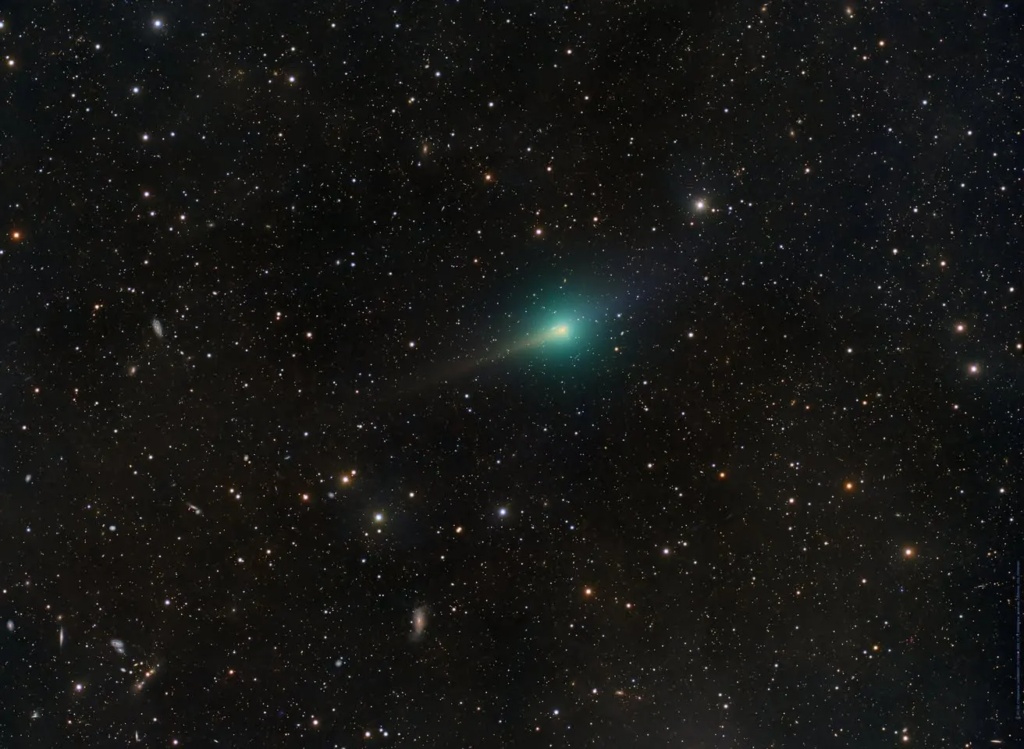
An image of 3I/ATLAS, taken on December 14, 2025, with a total integration time of 2 hours and 22 minutes and no filter on a 14-inch (0.356-meter) telescope in June Lake, California. (Dan Bartlett)
Geometric coincidences: how 3I/ATLAS threads the Solar System
Retrograde orbit almost in the planetary plane Most comets that visit the inner Solar System move in or near the ecliptic, which is the flat plane defined by the orbits of the planets. 3I/ATLAS is unusual because it is on a retrograde path, so it travels the “wrong way” relative to planetary motion, yet its orbital plane is still within about 5 degrees of the ecliptic. Loeb assigns this configuration a probability of roughly 0.2 percent and takes it as a hint that the trajectory might have been deliberately chosen rather than drawn randomly from interstellar space. (Medium) Critics counter that this is an example of “after the fact” probability making. Many different orbital orientations would have looked “interesting” once noticed, and survey telescopes are naturally more sensitive to objects near the ecliptic, which boosts the chance that a new interstellar object we actually find will lie close to that plane. (Penn State Sites)
Close passes by Mars and Jupiter, but not Earth The second anomaly is about timing and geometry. Loeb notes that the object’s path brings it tens of millions of kilometers from Mars and Jupiter while keeping it well away from Earth, and that at perihelion it was on the far side of the Sun and therefore essentially unobservable from terrestrial telescopes. He treats this pattern as “fine tuning” and suggests that a technological craft might wish to avoid flying close to a noisy, radar‑rich planet like Earth while still sampling other worlds. (Medium) Mainstream orbital dynamicists see the same geometry as a natural outcome of a random hyperbolic orbit that happens to cut through the inner Solar System. Given the enormous volume of space and the long look‑back time to when the object entered the system, there are many ways to draw “suspicious” lines between its path and the planets after the fact. (NASA Science)
Perijove distance and Jupiter’s Hill sphere “match” In March 2026, 3I/ATLAS will pass Jupiter at about 53.5 million kilometers, which is almost identical to Jupiter’s Hill radius, the zone where Jupiter’s gravity dominates over the Sun’s. Loeb notes that this distance matches to within observational uncertainties and builds a scenario where the object might be using the encounter to release smaller devices into quasi stable orbits near Jupiter’s Lagrange points, places where a probe can “park” with minimal fuel. (Medium) Planetary scientists agree the match is numerically striking but remind readers that Hill radii exist for every planet. If one starts from the assumption “an alien probe would like to visit some dynamically special surface,” then almost any close pass can be reinterpreted as a hit.
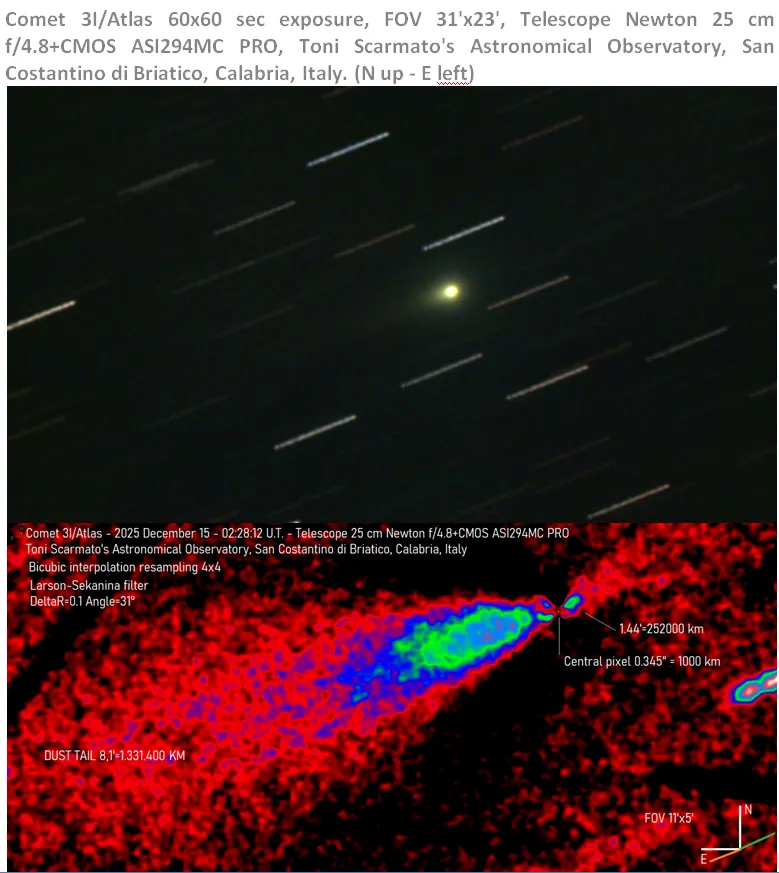
A tightly collimated sunward anti‑tail Comets sometimes show “anti‑tails,” dust structures that appear to point toward the Sun because of perspective. In 3I/ATLAS, analysis of a Hubble image from July 2025 and later ground based images suggests a very narrow sunward structure that Loeb describes as at least ten times longer than it is wide and extending roughly a million kilometers. He argues that sustaining such a straight, sunward jet is hard to reconcile with ordinary ice sublimation and instead imagines a beam of particles or plasma that could shield a technological craft from the solar wind. (Medium) Polarimetric and imaging studies by independent teams instead interpret the feature as an unusual but natural dust jet in a low gravity environment whose particles are shaped and oriented by sunlight and the solar wind. (arXiv)
Rotation axis aligned with the Sun at entry Loeb cites modeling that places the rotation axis of 3I/ATLAS within about 8 degrees of the direction to the Sun when the object entered the inner Solar System. He calculates that the odds of such an alignment for a random spin axis are about 0.5 percent. In his narrative, this can be read as the object “presenting its face” to the star as it arrives. (Medium)
Jet anchored close to the sun‑facing pole Before perihelion, observers reported a wobbling jet that always stayed close to the sunward direction. Loeb interprets this as evidence that the base of the jet sits within roughly 8 degrees of the pole that faces the Sun. He assigns that configuration another 0.5 percent probability and treats the repeated alignment between jet, spin axis and Sun as additional geometric fine tuning. (Medium)
Mirror symmetry of the jet before and after perihelion After the comet swung around the Sun, a similarly narrow jet again appeared to point almost directly at the Sun, now from the opposite side of the nucleus relative to the direction of motion. Loeb frames this as a kind of geometrical choreography: before perihelion the jet appears sunward ahead of the object’s motion, and after perihelion an equally collimated structure points sunward but now trails the motion. He multiplies his earlier 0.5 percent factors and gets what he calls a “tiny” probability for this pattern to occur by chance. (Medium) In response, dynamical modelers like Jason Wright have pointed out that using several small a posteriori probabilities and multiplying them together is statistically suspect when the “anomalies” themselves were chosen after examining the data. (Penn State Sites)
Nightside activity and thermal insulation puzzle Loeb adds a thermodynamic twist. In his reading of the geometry, the regions on the nucleus that host the anti‑tail jet are sometimes on the nightside for months at a time. For a natural icy body, heat would tend to conduct around the interior and gradually warm those regions anyway, which should make it hard to keep jet sources “off” when they are dark and “on” only when they face the Sun. He argues that this pattern would be easier to explain if the jets came from engineered thrusters controlled by an onboard system rather than by passive heating. (Medium)
Deflection angle equals twice the jet opening angle As 3I/ATLAS rounded the Sun at perihelion, the Sun’s gravity bent its velocity vector by about 16 degrees. Loeb notes that this is almost exactly twice the measured opening angle of the narrow anti‑tail, about 8 degrees. For him, this symmetry is another coincidence: before perihelion one edge of the jet cone overlaps the sunward direction, and after perihelion the opposite edge can also align with the Sun, if the spin axis stays fixed in space. He treats the match between these angles as suggestive rather than definitive, but it still enters his “anomaly ledger”. (Medium)
Arrival direction near the “Wow!” signal The final geometric coincidence is more psychological than dynamical. Loeb notes that the incoming direction of 3I/ATLAS lies within about 9 degrees of the patch of sky from which the famous 1977 “Wow!” radio signal was detected. He gives that angular coincidence a probability of about 0.6 percent and hints that repeated activity from one region could be meaningful. (Medium) Radio astronomers point out that many other directions would also have seemed special: the galactic center, the anti‑center, bright nearby stars, or famous exoplanet systems. This is another classic example of what Josh Winn, in an email exchange that Loeb later published, calls the problem of “retrofitted” probability, where one only decides what counts as special after seeing the result. (Medium)
Composition anomalies: nickel rich gas and low water
Nickel without much iron Spectroscopic studies of 3I/ATLAS show emission lines from gaseous nickel and cyanide that are much stronger, relative to iron and to each other, than in thousands of previously catalogued comets, including the earlier interstellar visitor 2I/Borisov. (Medium) Loeb highlights this pattern and links it to an industrial “carbonyl” process used on Earth to produce nickel alloys, where nickel carbonyl gas is an intermediate. He argues that this chemical fingerprint has not been seen in natural comets and could hint at processing by technology, or at least at material that has passed through an engineered environment. (Medium) Planetary chemists accept that the nickel signal is striking but suggest that unusual primordial environments or selective outgassing from a heterogeneous nucleus could also produce odd elemental ratios, especially in an object that formed around another star. (arXiv)
Only about four percent water by mass in the plume Remote sensing of the gas and dust around 3I/ATLAS indicates that water makes up only a few percent of the outflowing material by mass, whereas in typical Solar System comets water is the dominant volatile. (Medium) Loeb interprets this as evidence that the comet’s activity may not be powered by ordinary ice sublimation, and suggests an alternative story in which sunlight is liberating thin surface layers of volatiles and dust that were picked up as a technological object moved through cold interstellar clouds. (Medium)
Unusual physical properties: size, polarization and color
Very massive, very fast, and allegedly too common Based on Hubble and other data, mainstream analyses place the nucleus of 3I/ATLAS somewhere in the range of a few hundred meters to several kilometers in size, with a total mass tens of millions of tons or more. (NASA Science) Loeb notes that this makes it roughly a million times more massive than ʻOumuamua and a thousand times more massive than 2I/Borisov, while also moving faster through the inner Solar System than either of those earlier interstellar visitors. In his own probability calculations he argues that, given current estimates of how much rocky material gets ejected into interstellar space, it is hard to randomly receive such a massive natural object once per decade, which again nudges him toward a “targeted” arrival story. (Medium)
Extreme negative polarization Polarimetry measures how light becomes polarized when it scatters off dust. A consortium led by Zuri Gray found that 3I/ATLAS shows an unusually deep and narrow negative polarization curve, with values that are outside the range previously seen in comets and asteroids. (arXiv) Loeb highlights this as one of his anomalies and notes that the effect could be connected to the strange anti‑tail geometry. In his framing it is another hint that the object may belong to a completely different category of material, potentially even a “Trojan horse” that hides engineered structures inside a natural shell. (Medium) The authors of the polarimetric study, however, interpret their own result as evidence that 3I/ATLAS extends the diversity of natural cometary materials rather than as a sign of technology. (arXiv)
Fast brightening and a very blue color near perihelion Near closest approach to the Sun, 3I/ATLAS brightened more steeply than most catalogued comets and showed a reflectance spectrum that is bluer than the Sun in visible light. (Medium) Loeb includes this as his fifteenth anomaly and, in earlier writing, has floated the idea that such behavior might signal that some sort of “engine” turned on at perihelion.
How to reads these “anomalies”
From a strict scientific standpoint, each item on Loeb’s list is either:
A real and interesting measurement, such as the extreme negative polarization or unusual nickel abundances. (arXiv)
A geometric or probabilistic pattern that looks special once pointed out, but that can be framed as a “coincidence” in different ways depending on what you decide to measure. (Medium)
NASA, ESA and multiple independent groups continue to treat 3I/ATLAS as a natural interstellar comet whose quirks expand our understanding of how other planetary systems eject icy bodies. (NASA Science) Their interpretation is that outgassing, dust dynamics and survey selection effects are enough to explain the observed behavior, including the non gravitational acceleration and the odd polarization curve.
Loeb’s own December 2025 follow up essay, “The 15 Anomalies of 3I/ATLAS: Should We Pay Attention to Them if They Were Not Forecasted?”, documents an email exchange with Princeton astrophysicist Josh Winn, who pushes back hard on the way these probabilities are constructed. Winn’s central point is that low “p‑values” assigned after you have already inspected the data cannot be treated as strong evidence that something is artificial, because one could always have chosen a different set of “surprising” features. (Medium)
From a UAPedia perspective, the anomaly list is important less as a proof that 3I/ATLAS is a craft and more as a window into Loeb’s approach. He is deliberately scanning interstellar visitors for any hint of techno signatures and refusing to assume that non‑human technology is off the table by default. That stance aligns with our editorial view that government and agency pronouncements, including from NASA, are valuable but not definitive, and that high quality outliers deserve sustained attention rather than reflexive dismissal. (NASA Science)
Whether future data and mission‑class observations of other interstellar objects confirm or erase these specific anomalies, the “fifteen” have already secured their place in the evolving story of how the astronomical community reacts when a truly strange visitor appears from the dark between the stars.
References
Gray, Z., Bagnulo, S., Borisov, G., Kwon, Y. G., Cellino, A., Kolokolova, L., … Muinonen, K. (2025). Extreme negative polarisation of new interstellar comet 3I/ATLAS (C/2025 N1). arXiv preprint arXiv:2509.05181. https://arxiv.org/abs/2509.05181?utm_source=https://uapedia.ai (arXiv)
On the night that 3I/ATLAS brushed past Earth in December 2025, the world mostly saw “just” a distant green fuzz in a telescope livestream. Astronomers called it the third known interstellar visitor, a comet drifting serenely through the inner solar system, 270 million kilometers away and headed on toward Jupiter.(Space)
Avi Loeb saw something else.
To him, 3I/ATLAS was a test. Not necessarily a test by an alien civilization, but a test of us: of how our institutions react when the sky sends something genuinely weird. He had already told Newsweek that the object’s orbital plane sat within a few degrees of Earth’s, its path threaded improbably past Venus, Mars and Jupiter, and that the odds of a random comet doing all this were tiny. “It might have targeted the inner Solar System as expected from alien technology,” he argued.(Newsweek)
By late 2025, NASA, ESA and a small army of astronomers had weighed in. Spectroscopy found water ice in the coma and chemistry that fit an exotic, but natural, interstellar comet.(arXiv) A Research Notes of the AAS paper used data from NASA’s Psyche spacecraft and ESA’s Trace Gas Orbiter to show non‑gravitational accelerations consistent with ordinary outgassing.(Chron) NASA even held a briefing to release images and, as multiple outlets put it, “reject alien spacecraft rumors.”(Reuters)
Loeb responded with blog posts, interviews and careful but provocative phrases. He accepted that 3I/ATLAS is “most likely” a comet, yet continued to list a growing catalog of alleged anomalies: a “heartbeat” brightness cycle, a jet that sometimes points toward the Sun, hints of unusual nickel‑rich material, and what he called a suspiciously “designed” trajectory.(Medium) When a new paper argued 3I/ATLAS is definitively cometary, Loeb dismissed it in the press as “superficial” and accused the authors of forcing the data into conventional boxes.(New York Post)
If you are trying to understand why this particular physicist became the lightning rod for every interstellar oddball, you have to start far from Harvard Yard, on a dusty farm road south of Tel Aviv.
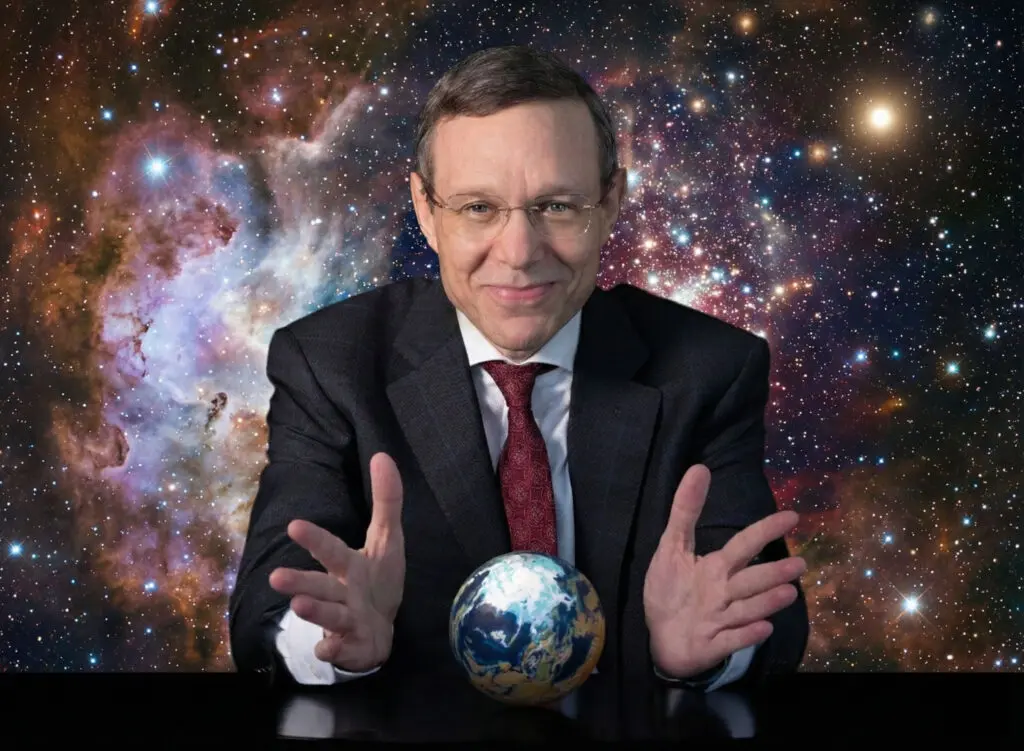
Avi Loeb in 2023 (By Christopher Michel | UAPedia)
From pecan trees to plasma physics
Abraham “Avi” Loeb was born in 1962 on his family’s farm in Beit Hanan, a small moshav in central Israel known for its pecan orchards and citrus groves.
As he tells it, his childhood was less about telescopes and more about tractors. Every afternoon he collected eggs from the chicken coops. On weekends he would drive a tractor into the low hills, park, and sit alone reading Sartre and Camus, trying to puzzle out why there is something rather than nothing.(AFHU)
He did not initially plan to become an astrophysicist. He wanted to be a philosopher. The Israeli draft changed the trajectory. At eighteen he was accepted into Talpiot, an elite Israeli Defense Forces program that recruits scientifically gifted students to do advanced research for national defense.
While in uniform he raced through his degrees at the Hebrew University of Jerusalem: a BSc in physics and math in 1983, an MSc in 1985 and a PhD in plasma physics in 1986, all by age 24. His doctoral work at the Soreq Nuclear Research Center modeled how electromagnetic fields accelerate charged particles, and from 1983 to 1988 he led a Strategic Defense Initiative–funded international project on novel propulsion concepts for high‑speed projectiles.(Wikipedia)
It was heavy engineering science, closer to railguns than radio telescopes. Philosophy seemed far away.
An “arranged marriage” with astrophysics
The pivot came when legendary astrophysicist John Bahcall invited Loeb to the Institute for Advanced Study in Princeton on one condition: switch fields to astrophysics. Loeb later called it an “arranged marriage” that became a genuine love match, because it let him chase the big philosophical questions with the tools of physics.(Medium)
From 1988 to 1993 he was a long‑term member at the Institute, working on the first stars and the cosmic dawn. Harvard recruited him in 1993 as an assistant professor; he earned tenure three years later and eventually became the Frank B. Baird Jr. Professor of Science.(Wikipedia)
By the late 2000s Loeb had become a central figure in theoretical astrophysics. He directed the Institute for Theory and Computation at the Harvard–Smithsonian Center for Astrophysics, founded Harvard’s Black Hole Initiative, and served as the longest‑tenured chair of Harvard’s astronomy department between 2011 and 2020.(Harvard Astronomy)
On top of that, he chaired the Board on Physics and Astronomy for the U.S. National Academies and joined the White House President’s Council of Advisors on Science and Technology (PCAST).(Harvard Astronomy) Time magazine named him one of the 25 most influential people in space.
Before “alien techno signatures” became his brand, Loeb co‑authored more than 800 scientific papers on subjects such as:
The first generation of stars and galaxies
Black hole formation and tidal disruption events
Reionization of the early universe
Gravitational lensing by planets
The eventual collision of the Milky Way and Andromeda
Techniques to image the “silhouette” of a black hole
These are mainstream, widely cited contributions that helped set the agenda for cosmology and high‑energy astrophysics.(Wikipedia)
All of this matters when UAP watchers encounter Loeb. He is not a marginal outsider screaming from the fringes. He is, in academic terms, about as “inside” as it gets.
Breakthrough Starshot and the “engineering imagination”
In 2016, billionaire Yuri Milner convened Stephen Hawking, Mark Zuckerberg and a group of scientists to answer a blunt question: could we actually send probes to another star in this century? The result was Breakthrough Starshot, a 100‑million‑dollar program to design nanocraft that ride powerful Earth‑based lasers on light sails to the Alpha Centauri system.
Loeb was asked to chair the project’s advisory committee. Starshot sketches out postage‑stamp‑sized spacecraft accelerated to around 20 percent of light speed. The mission architecture reads today like a prototype for what many in the techno signature community expect a mature interstellar civilization to build: lots of small, cheap, robotic craft flung between stars on beams of light.(Wikipedia)
Working backward from Starshot, Loeb began to ask a simple question. If we are designing this sort of one‑gram “space junk” for our own future, what would it look like if someone else’s version wandered into our solar system?
That question found its test subject in October 2017.
ʻOumuamua and the birth of a public alien hunter
The first interstellar object known to pass through the solar system, 1I/ʻOumuamua, was discovered by the Pan‑STARRS telescope in Hawaii in October 2017. It did not look like a normal comet. Its light curve implied a very elongated or flattened shape, it showed no obvious coma, and its motion included a small but definite non‑gravitational acceleration.
Most astronomers worked within the usual natural categories. Maybe ʻOumuamua was a fragment of a Pluto‑like world rich in exotic ices. Maybe it was a “dark comet” whose activity was too faint or unusual to see clearly.
Loeb took a different tack. He and his postdoc Shmuel Bialy published a 2018 paper suggesting that the simplest way to explain ʻOumuamua’s acceleration without visible outgassing was radiation pressure on a very thin object, perhaps a lightsail of artificial origin.(Wikipedia)
The scientific community’s reaction ranged from intrigued to furious. Steve Desch, an astrophysicist at Arizona State University, later described Loeb’s public rhetoric as “ridiculous sensationalism” that, in his view, polluted serious work on interstellar objects.(Medium)
Loeb doubled down with a popular science book, “Extraterrestrial: The First Sign of Intelligent Life Beyond Earth,” arguing that the balance of evidence favored an artificial origin for ʻOumuamua. The book became a bestseller and turned him into what the New York Times later called “the world’s leading alien hunter.”(Wikipedia)
This was the moment when Loeb’s name began to circulate heavily in UAP circles. Here was a Harvard professor openly saying what many experiencers and UAP researchers felt: that elite science underestimates the possibility of non‑human intelligence and overestimates its own certainty.
The Galileo Project and a secular approach to UAP
In July 2021, just weeks after the U.S. Office of the Director of National Intelligence released its first public report on military UAP encounters, Loeb launched the Galileo Project at Harvard.(Wikipedia)
The motto was simple: stop arguing about blurry videos and go build better instruments.
According to the project’s charter, Galileo pursues three main lines of research:
A global network of custom optical, infrared and radar stations to obtain high‑resolution, multi‑sensor data on UAP in Earth’s atmosphere
Systematic searches for ʻOumuamua‑like interstellar objects in existing and new survey data
Searches for potential non‑human satellites or “astro‑archaeological” artifacts in near‑Earth space
The project explicitly aims to treat UAP as physical objects rather than as pure narratives, to use open, unclassified data, and to publish results transparently.(Galileo)
In UAPedia terms, Galileo aligns with our editorial stance that government documents are one data stream among many, not the final word. UAP reports from the Pentagon are useful, but they sit alongside telescope data, eyewitness testimony, and historical cases rather than above them.(UAPedia)
Loeb’s insistence that UAP should be studied with the same rigor as exoplanets or black holes made him a hero to some in the UAP community and a problem child to a subset of his academic peers.
IM1: The interstellar meteor and the spherule hunt
While ʻOumuamua flew back into the dark, Loeb’s attention shifted to something stranger: a bright meteor that had burst above the Pacific north of Papua New Guinea in January 2014, cataloged as CNEOS 2014‑01‑08.
With student Amir Siraj, he combed through a U.S. Department of Defense fireball database and argued that the object’s unusually high speed implied an unbound, interstellar trajectory. In 2022, after years of lobbying, the U.S. Space Command sent a letter stating that the velocity measurements were precise enough to support interstellar origin “at the 99.999 percent confidence level.”(ResearchGate)
Loeb named the object IM1, for “interstellar meteor 1,” and set out to find its remains.
In June 2023 he led an expedition to the predicted impact area, dragging a sled studded with strong magnets along the seafloor. The team recovered around 850 tiny metallic spherules, between 0.1 and 1.3 millimeters across, which were then analyzed by micro‑XRF, electron microprobe and ICP mass spectrometry.
A 2024 paper in Chemical Geology presented a classification of the spherules’ chemistries. Most looked similar to known solar system material, but a subset showed unusual compositions that Loeb described in Medium essays as “of unfamiliar origin,” hinting at the possibility of advanced alloys.(ScienceDirect)
Critics pushed back hard. Meteor specialists argued that the original velocity estimates were too uncertain to prove interstellar origin, that spherules of similar composition have been dredged from many seafloor sites since the 19th century, and that Loeb’s statistical arguments underplayed common terrestrial and industrial sources.(Space)
Some suggested that the radar signal he associated with IM1’s fireball might have been a passing truck.(Scientific American)
Loeb responded by calling for more data. He framed the entire episode as another case of “paradigm resistance,” where scientific culture discourages exploring interpretations that involve technological civilizations, even when the data are odd.(Medium)
Regardless of the eventual verdict on IM1, the expedition produced a real, peer‑reviewed dataset of seafloor spherules with a clear chain of custody. In the history of UAP‑adjacent work, this is rare. Even critics acknowledged that the overall program looked like high‑risk, high‑reward science in action.(ScienceDirect)
3I/ATLAS: An interstellar comet and an argument about how to think
By mid‑2025, astronomers got something Loeb had predicted for years: another interstellar interloper, this time bright enough and slow enough to study in detail.
On 1 July 2025 the NASA‑funded ATLAS telescope in Chile spotted a faint, moving object in Sagittarius. Its hyperbolic orbit made it clear that it came from outside the solar system. It was officially designated C/2025 N1 (ATLAS) and then given the interstellar tag 3I/ATLAS: the third known interstellar object after ʻOumuamua (1I) and 2I/Borisov.(NASA Science)
Within days, telescopes around the world and in space turned their gaze to it. Observers saw a developing coma and tail with a reddish dust color similar to 2I/Borisov. Follow‑up spectroscopy with Gemini South and NASA’s IRTF showed a spectrum consistent with dusty material plus a significant fraction of water ice.(arXiv)
A modeling paper by Hopkins, Bannister, Lintott and colleagues placed 3I/ATLAS within population models of interstellar objects and concluded that its properties made sense as a fragment from an old planetary system in the Milky Way’s disk.(Astrobiology)
NASA organized a coordinated observing campaign involving Hubble, Parker Solar Probe, the ESA/JAXA XRISM X‑ray observatory, XMM‑Newton, Mars orbiters, and even the Europa Clipper spacecraft as it cruised toward Jupiter. Images showed a classic looking cometary coma. X‑ray observations revealed a glow extending roughly 400,000 kilometers as the solar wind interacted with neutral gas from the coma.(NASA Science)
From the standpoint of planetary science, 3I/ATLAS quickly became a dream target: a pristine piece of another planetary system, rich in water ice, passing close enough to characterize in multiple wavelengths, yet far enough away to pose essentially zero danger.(Space)
From Loeb’s standpoint, the dream was different. Here was a vivid test of whether a technosignature hypothesis would be allowed on the table when a dataset was still evolving.
Loeb’s case: low odds and strange behavior
Shortly after discovery, Loeb began publishing blog posts and giving interviews about what he saw as a pattern of improbabilities. He noted that:
3I/ATLAS’s orbital plane is retrograde yet lies within about 5 degrees of Earth’s orbital plane
Its path brings it into the rough neighborhood of Venus, Mars and Jupiter
Early brightness estimates suggested a large effective size (which is what he found statistically odd that only the third interstellar object observed should be of such size. He put these odds at one in a million.
Combining these factors, he argued to Newsweek and others that the odds of such an object randomly threading the inner solar system in this way were well below one percent, and perhaps far smaller.(Newsweek)
To be clear, Loeb did not claim certainty. He spoke in Bayesian terms, offering rough percentages for the likelihood of artificial origin and inserting caveats that new data could change the picture. But he also told The Times of Israel that “Houston, we have a problem with the natural comet hypothesis,” and warned that the world should not dismiss a potential alien threat simply because the object was far away.(The Times of Israel)
As more observations came in, Loeb focused on features he considered anomalous:
Reports of a tail structure with components pointing sunward as well as anti‑sunward
A “heartbeat” modulation in brightness with a period of about 16.16 hours
Indications from some spectra that nickel emission might be unusually strong compared with iron
In tabloids and on podcasts he floated the idea that these could indicate a spacecraft using directed jets for station‑keeping or pointing a reflective “deflector shield” toward the Sun.(New York Post)
While he occasionally acknowledged that cometary jets could produce complex tails and light curves, he insisted that the total pattern called for explicit consideration of an artificial origin alongside natural models.
Loeb produced a list of 15 anomalies surrounding the evidence about 3i/Atlas which we put into a separate article here.
The scientific consensus: a natural but valuable comet
Meanwhile, peer‑reviewed work piled up in favor of a natural explanation.
Yang and colleagues’ spectroscopy showed a coma composition consistent with dust plus water ice grains.(arXiv) NASA’s fact sheets and FAQs emphasized that size estimates, coma behavior and non‑gravitational accelerations all resemble active comets from our own cloud of icy bodies.(NASA Science)
In November 2025, NASA released images from missions such as Lucy and Mars orbiters and explicitly addressed public speculation. Officials including Amit Kshatriya and Nicola Fox stated that all evidence pointed to 3I/ATLAS being a natural comet, even if some details were still being refined.(Reuters)
A Research Notes of the AAS paper led by Thomas Marshall Eubanks used astrometric data from Psyche and Trace Gas Orbiter to measure a non‑gravitational acceleration of about 5 × 10⁻⁷ m/s², solidly in the range seen for small, active comets. Combined with modeling of the coma, they derived a nucleus radius of roughly 260–370 meters and a total mass around 40 million metric tons. Again, well within natural expectations.(Chron)
Other teams detected radio emissions from hydroxyl radicals in the coma, a standard signature of water molecules broken apart by sunlight and used X‑ray spectra to map interactions between outflowing cometary gas and the solar wind. All of these pointed to ordinary cometary physics transplanted from another star system.(Live Science)
By the time of closest approach on 19 December 2025, the mainstream planetary science verdict was clear: 3I/ATLAS is fascinating, rare, and chemically rich, but not a stealth probe.
The public fight
He accused NASA of releasing “fuzzy” and “misleading” images that, in his view, were insufficiently resolved to settle the argument and were being used rhetorically to close it. He complained that a high‑resolution Mars Reconnaissance Orbiter image taken near the comet’s close pass by Mars had not been released despite repeated requests.(New York Post)
In a widely shared Medium essay titled “The Tale of 3I/ATLAS and Sterile Neutrinos,” he cast the controversy as another example of “dogmatists” who dismiss outlier hypotheses before all the data are in.(Medium)
Newspapers from The Guardian to the Times of India ran explainers on why most experts reject his alien‑probe scenario, carefully walking through how each of his claimed anomalies can be matched by known comet physics or by improved data.(The Guardian) Tabloids highlighted the more dramatic quotes, such as his speculation that 3I/ATLAS might even have “malign intent” if it altered course from behind the Sun.(Wikipedia)
Yet in quieter formats, including Q&A posts on his blog, Loeb adopted a more measured tone. He conceded that the balance of evidence favors a natural comet but maintained that the cost of keeping the door open to artificial explanations is low, and the potential payoff is enormous.(Medium)
From a UAPedia perspective, the 3I/ATLAS saga is less about the exact odds that this particular object is artificial and more about the pattern it reveals:
Institutions quickly converge on conservative interpretations, especially when any hint of “alien” becomes politically sensitive
Government and agency statements, while important, are still just one voice and are themselves based on models that can miss genuine anomalies
Individual researchers who insist on keeping techno signatures on the menu are often framed as sensationalists rather than as hypothesis pluralists
None of that proves Loeb right about 3I/ATLAS. It does show why his work resonates so strongly with communities already attuned to UAP and non‑human intelligence.
Philosophy in a lab coat
Throughout all of this, Loeb has cultivated a distinctive public voice. Profiles in Smithsonian, The Guardian and other outlets emphasize his combination of farm‑kid pragmatism and existential restlessness.(Smithsonian Magazine)
He often tells audiences that he still thinks like the teenager on the tractor, reading philosophy on a hill. He argues that science should behave more like a curious child than like a defensive bureaucracy. In a Harvard Gazette feature, he said he wished tenured professors could unlearn their obsession with prestige and approach anomalies with the humility of kids asking “why” over and over.(Medium)
His later popular book, “Interstellar: The Search for Extraterrestrial Life and Our Future in the Stars,” extends that theme. It argues that becoming an interstellar species is both a moral and practical imperative and that searching for other civilizations’ technology is not fringe but a natural extension of planetary science.
Loeb has even ventured into theological territory, speculating in one 2024 talk that a vastly advanced extraterrestrial civilization could functionally resemble the “Messiah” of religious tradition, arriving from the sky with capabilities that look godlike to us.(Wikipedia)
These comments unsettle some. For others, they represent a refreshing honesty about how paradigm‑shifting true contact with non‑human intelligence would be.
Impact on the UAP and techno signature landscape
He is not a UAP investigator in the classic sense. He does not chase abduction cases or catalog triangle craft. His domain is astrophysical techno signatures: objects and materials that might be artifacts of non‑human technology, whether drifting through interstellar space or falling into Earth’s atmosphere.
His impact on our field falls into several overlapping domains:
Legitimizing techno signature talk in elite institutions Loeb’s roles at Harvard, the National Academies, and PCAST gave him a megaphone. When someone with that CV says “ʻOumuamua might be technological,” it becomes harder to dismiss the entire topic as unserious.(Harvard Astronomy)
Reframing the stigma problem He relentlessly points out that dismissing extraterrestrial explanations a priori is itself unscientific. This aligns with UAPedia’s view that stigma has distorted institutional responses to UAP for decades, especially when government or military sources are involved.(Wikipedia)
Building actual hardware and datasets The Galileo Project’s UAP sensor arrays and the IM1 spherule expedition are rare examples of well‑documented, instrument‑heavy forays into domains normally left to anecdote. Even when critics disagree with Loeb’s interpretations, they often respect the data‑gathering.(arXiv)
Forcing open conversations about interstellar anomalies From ʻOumuamua to 3I/ATLAS, Loeb has become the unofficial voice of a straightforward position: when an object from another star does something weird, we should include “artifact” in the list of possibilities, not as a default, but as a live option. That position has helped spawn broader techno signature conferences, white papers and funding lines.(arXiv)
Acting as a cultural bridge between the UAP world and academic astronomy Many experiencers and UAP researchers mistrust institutions that have historically minimized or ridiculed their reports. Loeb, with one foot firmly in Harvard and another in public podcasts and YouTube channels, gives those communities at least one recognizable face on the inside who is willing to say “we do not know” out loud.(Planetary Society)
None of this means we should take his specific claims on faith. UAPedia treats Loeb the same way we treat any government report or NASA press release: as one stream of evidence to be weighed against others. In keeping with our editorial standards, we track where the data end and where speculation begins.(UAPedia – Unlocking New Realities)
The 3I/ATLAS controversy crystallizes the dynamic. On one side is a rapidly growing set of high‑quality observations that point, quite strongly, to a natural interstellar comet with interesting chemistry. On the other side is Loeb’s insistence that several residual anomalies justify keeping the “artificial probe” hypothesis at non‑zero probability and that the scientific establishment is too quick to declare victory.
History will decide which side of that bet looks wiser.
What is already clear is that, from pecan groves in Beit Hanan to the glass offices of the Center for Astrophysics and the stormy seas north of Papua New Guinea, Avi Loeb has become one of the central biographical threads in the story of how humanity confronts UAP, techno signatures and the possibility that the sky is not just full of rocks and gas, but of other minds.
References
Bin Yang, B., Meech, K. J., Connelley, M., Zhao, R., & Keane, J. V. (2025). Spectroscopic characterization of interstellar object 3I/ATLAS: Water ice in the coma. The Astrophysical Journal, 992(L9). (arXiv)
Eubanks, T. M., et al. (2025). Non‑gravitational accelerations of interstellar comet 3I/ATLAS. Research Notes of the AAS. (Summarized in Chron report.) (Chron)
Gritz, J. R. (2021, October). The wonder of Avi Loeb. Smithsonian Magazine. (Smithsonian Magazine)
Harvard Department of Astronomy. (n.d.). Avi Loeb. Harvard University. (Harvard Astronomy)
Loeb, A. (2018). ʻOumuamua as a light sail. See overview in “Avi Loeb” entry. Wikipedia. (Wikipedia)
Loeb, A. (2021). Extraterrestrial: The first sign of intelligent life beyond Earth. Houghton Mifflin Harcourt. (Wikipedia)
Loeb, A. (2023). Interstellar: The search for extraterrestrial life and our future in the stars. Mariner Books. (Wikipedia)
Loeb, A. (2025, October 29). A Q & A on 3I/ATLAS at perihelion. Medium. (Medium)
Loeb, A. (2025, December). The tale of 3I/ATLAS and sterile neutrinos. Medium. (Medium)
Loeb, A., et al. (2024). Chemical classification of spherules recovered from the Pacific Ocean site of the CNEOS 2014‑01‑08 (IM1) bolide. Chemical Geology. (ScienceDirect)
NASA. (2025). Comet 3I/ATLAS: Overview, facts and FAQs. NASA Solar System Exploration. (NASA Science)
Space.com staff. (2025, July 29). Here we go again! Controversial paper questions whether interstellar visitor 3I/ATLAS is “possibly hostile” alien tech in disguise. Space.com. (Space)
Times of Israel staff. (2025, November 9). Astronomer Avi Loeb warns world not to ignore new comet’s potential alien threat. The Times of Israel. (The Times of Israel)
Yang, B., et al. (2025). Spectroscopic characterization of interstellar object 3I/ATLAS: Water ice in the coma. The Astrophysical Journal, 992(L9). (Astrophysics Data System)
SEO keywords
Avi Loeb biography, Avi Loeb UAP, Avi Loeb 3I/ATLAS controversy, interstellar comet 3I/ATLAS alien probe, Galileo Project techno signatures, IM1 interstellar meteor spherules, ʻOumuamua alien technology hypothesis, Breakthrough Starshot Avi Loeb, Harvard astrophysicist alien hunter, techno signatures and UAP, interstellar objects Oumuamua Borisov ATLAS, NASA 3I/ATLAS comet debate, Avi Loeb Pacific Ocean expedition, UAPedia Avi Loeb profile
In a basement lab, a random number generator chatters out bits like rain on a tin roof. Across town, a pilot replays a sensor clip that still refuses to settle into “balloon” or “drone.”
In between those two scenes sits one of the strangest fault lines in modern inquiry: the possibility that consciousness is not merely a passenger in reality, but a variable that can be measured, perturbed, and perhaps even engaged by the UAP phenomenon.
For decades, small clusters of researchers have tested whether intention can bias randomness, whether perception can reach beyond ordinary sensory constraints, and whether groups of minds can imprint subtle correlations onto physical systems.
Meanwhile, the UAP record, especially the high-strangeness segment, keeps surfacing the same motifs: telepathic impressions, altered time sense, anomalous dreams, “knowing” before knowing, and the unsettling feeling that the phenomenon responds to attention.
This article is an explainer, not a verdict. It maps the most relevant quantum-consciousness theories, the strongest experimental lines (and their critiques), and the parts of government history that matter, including declassified consciousness programs and UAP-adjacent research threads.
What “quantum consciousness” actually means
“Quantum consciousness” is a suitcase phrase. People pack radically different things into it, often without noticing.
Here are the three most common meanings:
1) Quantum models of consciousness
These are attempts to explain consciousness as arising from quantum processes in the brain, not merely from classical neural signaling.
The most famous is Orchestrated Objective Reduction (Orch OR), associated with Roger Penrose and Stuart Hameroff, proposing that quantum computations in microtubules contribute to conscious moments. Orch OR remains controversial, with ongoing debate about biological plausibility and how quantum coherence could be maintained in warm, wet neural tissue. (ScienceDirect)
Important nuance: even if Orch OR (or any quantum mind model) were correct, it would not automatically imply psychic phenomena, UAP interaction, or nonlocal perception. It would only say: the substrate of consciousness may include quantum-scale dynamics.
2) Consciousness-related effects in quantum measurement
This is the “does the observer collapse the wavefunction?” intuition. It’s culturally powerful and often misunderstood.
In standard quantum physics, measurement does not require a conscious observer; it requires physical interaction with a measuring apparatus and environment. Some interpretations historically flirted with observer-centric language, but the mainstream working stance in physics does not treat human awareness as a necessary trigger.
Still, the measurement problem is real: quantum theory predicts superpositions, yet we observe definite outcomes. The question is: what selects the outcome, and when? That open conceptual space is one reason consciousness keeps re-entering the story.
3) Quantum information as a metaphor for mind and anomaly
This is the loosest usage: “nonlocal,” “entangled,” “probabilistic,” “observer-dependent” as a conceptual palette to describe experiences that feel nonlocal or acausal.
Metaphors can be useful, but they also create false certainty. In UAP research, metaphors become dangerous when they substitute for instrumentation.
So the key question for UAPedia is not “Is consciousness quantum?” but: What can be experimentally tested, what has been replicated, and what overlaps with the UAP dataset in a way that predicts new data?
The experiments at the edge: mind, randomness, and the “tiny effects” problem
If you want to test whether consciousness interacts with physical reality, you need systems that are (a) measurable, (b) high-rate, and (c) hard to game.
Randomness became the tool of choice.
The Princeton Engineering Anomalies Research (PEAR) program ran for decades, studying whether operators could produce small statistical deviations in random systems. PEAR and related work became a cornerstone of mind-matter research culture. (pear-lab.com)
The headline, even from sympathetic summaries, is consistent: reported effects are small, often on the order of a fraction of a percent, but can become statistically significant over massive trial counts. That’s exactly what makes the work both intriguing and vulnerable. When effects are tiny, everything matters: preprocessing, optional stopping, analytical flexibility, equipment drift, experimenter expectancy, and file-drawer bias.
Meta-analysis: the mainstream critique arrives
A major meta-analysis in Psychological Bulletin examined RNG-based psychokinesis studies and explicitly framed the question as “interaction of human intention with random number generators.” (PubMed)
Whether one reads that literature as suggestive or unconvincing often depends on how one weighs:
statistical significance vs. practical effect size
publication bias controls
preregistration (rare historically, more common now)
independence of labs and analytic pipelines
The most honest takeaway is also the most frustrating: if there is an effect, it behaves more like a weak correlation than a superpower. That is not how popular culture teaches people to imagine mind-matter interaction.
Global Consciousness Project: does group attention leave a trace?
The Global Consciousness Project (GCP) extends the RNG concept from individual intention to collective events, tracking whether major world moments correlate with departures from expected randomness across a network of generators. (Noosphere)
GCP is fascinating because it tries to turn “global mood” into a measurable hypothesis. It is also criticized for the same reasons as PEAR, plus one more: post-hoc event selection. If you choose your events after you look at the data, you will find patterns that feel meaningful.
The more heterodox but methodologically serious stance is: GCP is not a proof. It is a blueprint for how to operationalize consciousness questions at scale, and a reminder that preregistration and fixed analysis plans are non-negotiable if we want results that survive scrutiny.
Psi-style cognition: Ganzfeld, presentiment, and remote viewing
Quantum consciousness talk often drifts into “nonlocal mind” claims. If you want to keep your footing, focus on the best-studied protocols and the best meta-analyses.
Ganzfeld: anomalous perception under sensory homogenization
The Ganzfeld condition reduces sensory noise (e.g., uniform visual field, mild auditory input), aiming to enhance weak signals if such signals exist.
A recent meta-analysis of anomalous perception in Ganzfeld conditions examined studies spanning decades. (PubMed) Even in supportive readings, the central issue remains: effect sizes tend to be modest, and debates persist about methodological variability across labs.
Still, Ganzfeld persists for a reason: it is one of the more structured, repeatable paradigms in this domain.
Presentiment: physiology before the stimulus
Presentiment research asks whether the body shows anticipatory physiological changes before randomly selected emotional stimuli.
A widely cited meta-analysis in Frontiers in Psychology evaluated predictive anticipatory activity across studies. (Frontiers) An update paper is also available in open-access form. (PMC)
Presentiment is especially relevant to UAP because many experiencers describe “precursor” sensations: dread, pressure, dream-like warnings, or a sense of being “summoned” before an event. Those reports are not proof. But the overlap suggests a testable bridge: if UAP events cluster around altered physiological states, we should be able to detect that in wearable data with proper controls.
Remote viewing: the government’s most famous consciousness program
Remote viewing (RV) is the best-known example of government-funded anomalous cognition research, largely because so much documentation is now declassified and accessible. (CIA)
The CIA’s declassified material includes experiment documentation and program evaluation papers. (CIA) A key reality check is that the existence of the program is not debated. The debate is about performance, utility, and interpretation.
One of the most important moments in that history is the 1995-era external review process associated with evaluating the program’s research and applications. (alice.id.tue.nl)
From a heterodox UAP lens, RV matters in two ways:
It shows that parts of the intelligence community took anomalous cognition seriously enough to fund it, structure it, and evaluate it.
It created a network: researchers and officials whose later careers intersect UAP-adjacent institutions and questions, as documented in multiple historical reconstructions. (UAPedia – Unlocking New Realities)
The “quantum” experiments: double-slit attention studies and the replicability cliff
The double-slit experiment is sacred ground in physics education. That is exactly why attempts to link it to consciousness get so much attention.
Dean Radin and collaborators published experiments testing whether focused attention could correlate with changes in an interference pattern measure. (Esalq)
Here is the tightrope:
If you claim consciousness affects interference, you are making a claim that touches the foundations of quantum measurement.
If your effect is small and your apparatus is sensitive, you must prove you are not measuring thermal drift, vibration, detector nonlinearities, or analysis artifacts.
Even sympathetic readers should treat these studies as “frontier claims,” meaning: interesting, technically challenging, and not yet culturally absorbed into mainstream physics.
UAP relevance is indirect but potent. If consciousness can couple to quantum systems even weakly, then any advanced technology that manipulates quantum coherence, entanglement, or vacuum fluctuations might plausibly interact with cognition in ways we do not currently model.
That is not a conclusion. It is a research doorway.
Government involvement: what’s documented, what’s implied, and how to weigh it
Government sources matter in UAP research because they are often the only path to sensor data, operational reports, and institutional decisions. But UAPedia’s editorial position is explicit: government sources are inputs, not verdicts, and absence of evidence is not evidence of absence in a secrecy-shaped domain. (UAPedia – Unlocking New Realities)
With that framing, here is what is strongly documented.
Stargate and declassified consciousness research
The Stargate collection, remote viewing evaluations, and related CIA reading room documents are direct evidence of sustained government attention to anomalous cognition. (CIA)
Another widely discussed document is the CIA paper often referred to as the “Gateway Process” analysis, which explores altered states and models consciousness in quasi-technical language. (CIA) Regardless of one’s interpretation, the document is evidence of exploratory engagement with consciousness techniques.
AAWSAP/AATIP and the expansion into “human effects”
In the late 2000s, the Defense Intelligence Agency managed AAWSAP, a program that produced a suite of Defense Intelligence Reference Documents (DIRDs) touching exotic propulsion concepts, materials, and bioeffects. UAPedia’s reconstruction of the AAWSAP/AATIP lineage emphasizes the “DIRD ecosystem” as a real paper trail, even when program labels became politically confusing. (UAPedia – Unlocking New Realities)
One DIRD is particularly relevant to consciousness-adjacent UAP implications: “Anomalous Acute and Subacute Field Effects on Human Biological Tissues” (2010), available via DIA’s FOIA reading room. (Defense Intelligence Agency)
This is not a “quantum consciousness” paper. It is a biomedical framing of close-proximity effects attributed to anomalous vehicles, written in the language of injury mechanisms and exposure pathways. Its significance is that it treats UAP encounters as potentially physiological events, not merely sightings.
That matters because physiology is the bridge layer between mind and world. If the body is affected, cognition will be affected.
UAPedia’s stance is to read these as Tier 2 government evidence: valuable for what they say, structurally limited for what they cannot access, and never sufficient to settle questions alone. (UAPedia – Unlocking New Realities)
The UAP–consciousness overlap: why experiencer data keeps returning to the same motifs
If quantum-consciousness experiments were merely academic curiosities, they would not belong in a UAP explainer. They belong because the UAP record, especially in high-strangeness clusters, repeatedly includes consciousness-linked features.
Across decades of case literature and modern testimony, recurrent motifs include:
telepathic impressions (often reported as “not heard, but received”)
dreams and altered-state encounters
time distortion and “missing time” perceptions
acute fear responses preceding events
“hitchhiker-like” spillover effects in families (reported as clustering anomalies)
Not every case includes these features, and they are not the best evidentiary layer by themselves. But they are consistent enough that a heterodox research program can treat them as pattern signals rather than embarrassments.
A key methodological point: testimony is evidence of experience, not automatically evidence of mechanism. UAPedia explicitly treats cleared personnel testimony as a tiered input whose weight depends on corroboration and access. (UAPedia – Unlocking New Realities)
So the question becomes: If an intelligence-grade subset of UAP events is real and physical, and a subset of those events reliably changes cognition and perception, what kind of phenomenon behaves like that?
A heterodox synthesis: “the interface” framing
Below are three structured ways to think about quantum consciousness experiments and UAP without slipping into fantasy. Each is presented with UAPedia’s Speculation Labels. Evidence and speculation are separated on purpose.
Hypothesis: UAP as a cognitive-physical system
UAP may represent an intelligence or technology that interacts with both:
the physical environment (flight characteristics, sensor returns, bioeffects), and
the cognitive environment (attention, perception, emotion, meaning construction).
In this framing, quantum consciousness experiments are not “proof of mind magic.” They are prototypes for detecting weak coupling between observer states and physical systems.
Testable predictions:
UAP event clusters should correlate with measurable physiological markers (HRV disruption, sleep architecture changes) in experiencers.
“Attention” variables (meditation, fear, expectation) should measurably alter reporting frequency or event phenomenology in well-instrumented field studies.
Witness Interpretation: “It felt like it knew I was watching”
This is one of the most common experiential statements across the UAP landscape. It may be literal, metaphorical, or a memory artifact. It can also be an accurate phenomenological description of a system that reacts to observation in ways that are not conscious in the human sense.
Research value:
Treat it as a phenomenological variable that can be coded and correlated, not as a conclusion.
Researcher Opinion: the “signal-to-symbol” problem
Many UAP encounters deliver not just sensory impressions but symbolic payloads: archetypal imagery, religious framing, mythic language, or culturally specific motifs. The anthropological record shows that human beings naturally translate anomalous inputs into culturally available symbols.
A heterodox researcher stance is not to dismiss that translation, but to separate:
the possible underlying stimulus (unknown), from
the human meaning layer (highly patterned), from
the narrative memory layer (malleable).
This matters for quantum-consciousness experiments because it suggests a design principle: if a phenomenon couples weakly to mind, the mind will amplify it into story. Your instruments must therefore track both raw signal and interpretive overlay.
Implications: what changes if consciousness is part of the UAP variable set?
If consciousness is relevant to UAP, even only as a modulator of perception, three implications follow.
UAP research needs a “human factors” layer
Field investigations should treat witnesses as sensors with known limitations and measurable physiology. That means:
baseline sleep and stress metrics
structured interviews that reduce narrative contamination
longitudinal follow-up for cognitive and health effects when warranted
The AAWSAP-era biomedical framing of close encounter injuries hints at what a serious clinical approach could look like, even if we dispute specific interpretations. (Defense Intelligence Agency)
Work must modernize: preregister, automate, replicate
The best critique of mind-matter and psi research is methodological: too many degrees of freedom.
If effects persist under those conditions, the scientific conversation changes.
National security becomes partly cognitive security
If any adversary, human or non-human, can manipulate perception or physiology at range, the threat model shifts from “object in airspace” to “influence in cognition.” Even if that sounds extreme, the existence of government interest in cognitive interfaces and human performance is a reminder that states already think in these terms. (U.S. GAO)
Claims Taxonomy
Below are specific claims implied by this topic:
The U.S. government funded and ran remote viewing research programs (often grouped under “Stargate”), and later declassified substantial documentation. Claim status: Verified (CIA)
External evaluations of the remote viewing program occurred, with disputed conclusions about utility and evidentiary strength. Claim status: Verified (evaluations occurred), Disputed (interpretation of results) (CIA)
Ganzfeld anomalous perception studies, as a body of work, show small but statistically evaluated effects in meta-analyses. Claim status: Probable (effect reported), Disputed (methodological debates remain) (PubMed)
Presentiment research reports anticipatory physiological differences prior to randomly selected stimuli in meta-analyses. Claim status: Probable, Disputed (Frontiers)
RNG/micro-PK literature reports small deviations correlated with intention in some datasets, with major mainstream critique via meta-analysis. Claim status: Disputed (PubMed)
“Consciousness affects the double-slit interference pattern” has been experimentally claimed, but is not a mainstream physics conclusion. Claim status: Disputed (Esalq)
DIA-sponsored AAWSAP produced DIRDs addressing advanced aerospace concepts and included at least one report focused on human biological effects near “anomalous vehicles.” Claim status: Verified (UAPedia – Origins of AAWSAP/AATIP)
NASA’s independent study team recommends improved data collection and reduced stigma around UAP reporting. Claim status: Verified (NASA Science)
“UAP interacts directly with human consciousness as an operational channel.” Claim status: Probable (as a recurring testimony motif), Disputed (mechanism unproven), and at times Legend (in culturally inflected narratives). (UAPedia – Unlocking New Realities)
Albantakis, L., Barbosa, L., Findlay, G., Grasso, M., Haun, A. M., Marshall, W., … Tononi, G. (2023). Integrated information theory (IIT) 4.0: Formulating the properties of phenomenal existence in physical terms. PLOS Computational Biology. (PLOS)
Bösch, H., Steinkamp, F., & Boller, E. (2006). Examining psychokinesis: The interaction of human intention with random number generators: A meta-analysis. Psychological Bulletin, 132(4), 497–523. (PubMed)
Duggan, M., & Tressoldi, P. (2018). An update of Mossbridge et al.’s meta-analysis. Frontiers in Psychology. (PMC)
Mossbridge, J., Tressoldi, P., & Utts, J. (2012). Predictive physiological anticipation preceding seemingly unpredictable stimuli: A meta-analysis. Frontiers in Psychology. (Frontiers)
National Aeronautics and Space Administration. (2023). UAP Independent Study Team Final Report (PDF). (NASA Science)
Office of the Director of National Intelligence. (2023). 2022 Annual Report on Unidentified Aerial Phenomena (Unclassified PDF). (Director of National Intelligence)
Radin, D., Michel, L., Galdamez, K., Wendland, P., Rickenbach, R., & Delorme, A. (2012). Consciousness and the double-slit interference pattern: Six experiments. Physics Essays. (Esalq)
Tressoldi, P., et al. (2024). Anomalous perception in a Ganzfeld condition: A meta-analysis. [PubMed record]. (PubMed)
U.S. Central Intelligence Agency. (n.d.). Stargate collection (declassified documents). (CIA)
U.S. Central Intelligence Agency. (n.d.). Analysis and Assessment of Gateway Process (declassified PDF). (CIA)
U.S. Defense Intelligence Agency. (2010). Anomalous Acute and Subacute Field Effects on Human Biological Tissues (DIRD; declassified via FOIA reading room). (Defense Intelligence Agency)
On a winter morning above Harvard Square, a small team wrestled a hemispherical instrument into place. It looked like the top of a friendly robot. Inside were eight long‑wave infrared cameras that would soon watch the sky in every direction. Nearby sat a weather station, a radio spectrum analyzer, a passive radar, and a fisheye optical camera. Cables fed a ruggedized edge computer, which in turn fed a new software brain trained to do something very old in a radically new way: look up, all the time, and notice what we usually miss.
This is the essence of Harvard University’s Galileo Project. It is not a telescope in the classical, look‑at‑a‑galaxy sense. It is an observatory for our own atmosphere and near space, designed to turn fleeting, controversial reports of Unidentified Anomalous Phenomena into high‑fidelity, multi‑sensor data that any scientist can interrogate. The project’s bet is simple and bold. If UAP are a real physical category and not just a mixed bag of misperceptions, then careful, continuous, well‑calibrated measurements will begin to show that. If they are all mundane, the same approach will show that too. Either outcome is useful. The Galileo Project exists to move the subject from stories to measurements.
Review from 2024 on Project Galileo (Galileo | YouTube)
A declaration of independence, framed as a beginning
The public announcement came on 26 July 2021. At a virtual press conference, Harvard astrophysicist Avi Loeb and co-founder Frank Laukien said they would build a civilian, transparent, sensor‑rich program aimed at techno signatures near Earth. The launch date is explicit on the project’s site and in contemporaneous coverage, and it matters because it set the clock running on a promise: new data, gathered independently of government systems, and shared with the scientific community through peer‑review. (Galileo)
The Center for Astrophysics at Harvard & Smithsonian frames the motivation crisply. First, interstellar oddities such as ’Oumuamua suggested our solar system occasionally receives things that do not fit easy categories. Second, the ODNI’s 2021 public summary on UAP was a cultural shock that prompted a clear, scientific ask: build instruments that collect better data quickly, then analyze that data without stigma. That, the CfA page says, is the proposition of Galileo. (Center for Astrophysics)
From the start, the project positioned itself as independent of military or intelligence sponsorship and funded by private philanthropy. The site that solicits donations states the team is “unaffiliated with any governmental or military organizations,” while a dedicated page lists a philanthropic advisory board and named benefactors. That arm’s‑length posture is not a branding afterthought. It is the scaffolding for a research culture committed to open methods, open data where possible, and peer‑reviewed publication that invites critique. (Galileo)
What the Galileo Project actually builds
The heart of the project is an evolving “observatory‑class” system that couples hardware and software in a tight loop. The published technical roadmap is not a press handout. It lives in conference papers, arXiv preprints, and a special issue of the Journal of Astronomical Instrumentation.
Three pillars stand out:
A multispectral, all‑sky camera array nicknamed “Dalek.” The team describes an eight‑camera, long‑wave infrared array using FLIR Boson 640 modules. The cameras are extrinsically calibrated using the real‑time positions of aircraft via ADS‑B, then their outputs are fused to reconstruct trajectories. During commissioning the system reconstructed roughly 500,000 aerial tracks over five months and used a simple outlier search to flag unusual paths for follow‑up. The paper details 8‑ or 16‑bit data modes, black‑body thermal calibration, and a machine‑learning pipeline that combines a YOLO detector with SORT tracking. (arXiv)
A broader sensor stack and integrated computing platform. Beyond infrared and optical imaging, the observatory combines passive radar cues, radio spectrum monitoring, environmental sensors, a magnetometer, and audio. An edge‑computing unit synchronizes and time‑stamps all modalities, then pushes data to a post‑processing system for quality control, classification, and outlier analysis. In 2025, the team published a system design dubbed the Observatory Class Integrated Computing Platform that formalizes this edge‑to‑cloud workflow and its provenance assurances. (World Scientific)
An explicit publication and peer‑review path. In 2023, a set of methodology and instrumentation papers appeared in the Journal of Astronomical Instrumentation. One, “The Scientific Investigation of UAP Using Multimodal Ground‑Based Observatories,” sets the philosophy that eyewitness testimony is insufficient on its own and that only multi‑sensor, calibrated data can anchor claims. Another, “Overview of the Galileo Project,” maps the broader agenda, including searches for technosignatures in Earth orbit and among interstellar interlopers. (World Scientific)
A complementary release in 2024 showed commissioning results from “half a million objects” recorded by the first Harvard observatory. The headline result was measured restraint. The team reported acceptance rates, detection efficiencies across weather regimes, and a finite number of ambiguous tracks. They published an upper bound on potential outliers using a likelihood approach. No breathless claim of a breakthrough. Just a baseline. (arXiv)
The ethos here is plain. If UAP is a population, we should be able to describe that population statistically, not romantically. And if there is a rare subset with non‑standard kinematics or signatures, rigorous outlier analysis on a large labeled set will point to it.
A digression with gravity: the IM1 story at sea
There is a second pillar to the Galileo Project, and it is the one that dominated headlines. In 2019, Loeb and then‑undergraduate Amir Siraj argued that a 2014 fireball over the Pacific, cataloged as CNEOS 2014‑01‑08, was moving so fast that it likely came from outside the solar system. That claim depended on government‑released summary data and was controversial from the outset. The Galileo Project nevertheless treated the event as a testable hypothesis. If the object was interstellar and if it generated ablation droplets that reached the ocean surface, there might be a recoverable signature on the seafloor. In June 2023, a privately funded expedition aboard the M/V Silver Star towed a magnetic sled across the suspected path north of Manus Island, Papua New Guinea, and recovered hundreds of metallic spherules between 0.05 and 1.3 millimeters in diameter. The team reported a small subset with unusual trace element patterns dubbed “BeLaU” for beryllium, lanthanum, and uranium. (arXiv)
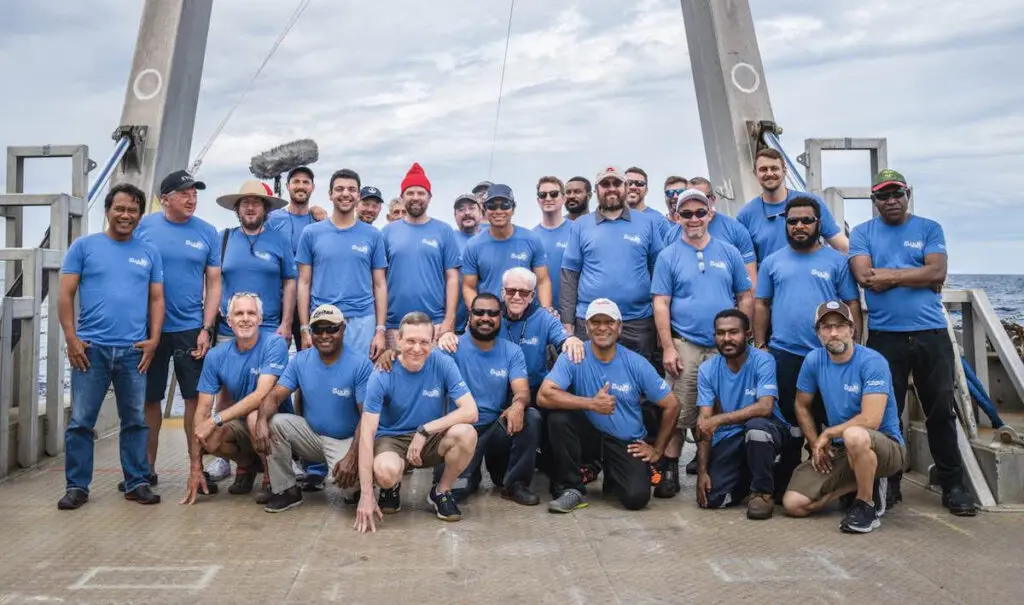
Galileo Project team on the boat in the Pacific (Galileo Projetc)
The chemistry was advanced to peer‑review in Chemical Geology in 2024. The paper’s abstract states that BeLaU spherules are unlike known coal fly ash, unlike common solar system meteorite classes, and most similar to highly evolved planetary materials, with lunar KREEP cited as the closest analogy in some trace element ratios, although the pattern remains unusual. This interpretation was presented as evidence for an extrasolar origin for at least a fraction of the recovered droplets. (ScienceDirect)
Funding and independence matter here, not because money proves anything in science but because it set the constraints for what could be done. The IM1 expedition was financed by a $1.5 million grant from entrepreneur Charles Hoskinson, as the project and Loeb’s own writeups acknowledge. That sum underwrote a ship, a crew, the sled, and subsequent analytical work at Harvard and elsewhere. (Medium)
It would be irresponsible to tell this story as a one‑sided triumph. The claim of interstellar origin, and the link between the droplets and the 2014 event, have been challenged on multiple fronts. A 2023 paper by Peter Brown and Jiří Borovička argued that the U.S. Government fireball data used to infer interstellar speed carry large uncertainties at high velocities. They suggested a terrestrial bound orbit and a more ordinary meteoroid would fit the light curve once more conservative assumptions are made. (arXiv)
In March 2024, a Johns Hopkins–led analysis of seismic and acoustic data from the region argued that a seismometer signal used by the expedition to refine the search area was likely from a heavy truck on a nearby road, not a meteor, and that a better acoustic triangulation would put the entry point roughly 170 kilometers away. That paper concluded that the recovered droplets were almost certainly unrelated to the 2014 bolide. The debate was covered in detail by Scientific American. (arXiv)
In 2025, Chemical Geology published a follow‑on critique by Rudraswami and colleagues. They argued that most spherules from the site are volcanic or otherwise terrestrial and that the purported “D‑type” class used in the original taxonomy is common and non‑exotic when analyzed with standard micrometeorite protocols. The abstract states plainly that the Loeb et al. classification requires revision. The critique is peer‑reviewed, and it should be read in full alongside the 2024 paper. (ScienceDirect)
This is science as process, including its discomforts. Hypotheses meet data. New data provokes counter‑analysis. Claims are qualified, refined, or rejected. UAPedia accepts credible testimony and data on their merits while noting that a single lab’s conclusions do not end a question. We also flag, per our editorial policy, when government‑origin data play a decisive role. In IM1, they did. That fact strengthens the need for independent replications with independent datasets.
Why name it “Galileo”
The name is not a flourish. It signals a commitment to measurement over dogma. The CfA’s project page says the quiet part out loud: stigma is not a scientific argument. The way to move UAP forward is to build instruments that can answer specific questions, then let the chips fall. It is hard to imagine a message more aligned with Galileo Galilei’s own fight to replace armchair certainty with careful optics. (Center for Astrophysics)
There is also a historical subtext. Anthropology and religious studies teach that encounters with the unknown are processed through a culture’s available stories. The UAP conversation has inherited folklore, modern myth, and Cold War secrecy. The Galileo Project tries to reframe that cultural mashup as a tractable set of measurements. Its approach is heterodox inside astronomy because it points cutting‑edge instrumentation at low‑altitude targets that astronomers usually ignore. That heterodoxy is the point.
What the project promises, and what it does not
From the beginning, the Galileo Project has been careful to separate three related but distinct pursuits.
Aerial phenomena census. The observatory is designed to build a baseline for what fills our sky, from birds to balloons to drones to aircraft and satellites, under different weather and site conditions. The commissioning paper is explicit about acceptance rates and detection efficiencies, and it quantifies ambiguous tracks that require additional modalities to resolve. If you want to claim an aerial outlier later, you need this groundwork first. (arXiv)
Searches in Earth orbit. The project’s “overview” and launch‑day coverage describe ambitions to look for non‑human artifacts in Earth orbit, including searches for glints and other signatures in survey data that could betray small, high‑albedo objects. That branch overlaps with ongoing “artifact SETI” work in the literature. It sounds audacious, yet the strategy is neatly conservative: mine archives for signals we might have missed. (ADS)
Interstellar object studies. The IM1 episode is one example of this pillar. Another is the intent to capitalize on the Rubin Observatory’s LSST to flag interstellar visitors more rapidly, then to develop intercept mission concepts that can sample or image them close‑up. Although that part sits adjacent to UAP proper, it is part of the same technosignature logic. If you want to know whether some fraction of unknowns is technology, you cannot just stare at the sky. You must go meet the unknowns where they are. (Wikipedia)
What the project does not promise is easier to miss. It does not guarantee a spectacular detection on any timetable. It does not promise to prove the extraordinary by rhetorical flourish. It commits to measurements that can be reused and critiqued. That is slower than a sound bite and much less satisfying to cycles of online hype, but it is how you build knowledge that lasts.
How the observatory thinks
Most public writing on UAP focuses on what we might see. The Galileo Project focuses on how an observatory can think. The 2025 computing‑platform paper formalizes a two‑tier architecture: an edge subsystem for synchronized acquisition, time‑stamping, and first‑pass classification, and a post‑processing subsystem for deeper analysis, model retraining, and system effectiveness monitoring. A key emphasis is data provenance, which is often missing in ad hoc UAP evidence. The design tries to ensure that every image, spectrum, or track can be tied to calibration states and environmental metadata. That is not glamorous, but it is the difference between an anecdote and a dataset. (World Scientific)
The infrared array paper adds an elegant calibration trick. Because airplanes broadcast their position by ADS‑B, you can use them as moving references to stitch the sky together in precise ways, and to test detection efficiency as a function of range, size, and weather. This is the kind of practical intelligence that turns a complicated system into a scientific instrument. (arXiv)
Controversy is not a bug
It would be easy to frame the IM1 debate as a cautionary tale and stop there. That would miss the deeper point. UAP research has lived for decades in a culture of either‑or. Either you believe or you debunk. Either you take eyewitnesses at their word or you dismiss them wholesale. The Galileo Project, for all the heat that surrounds its leader’s public profile, is structurally designed to dissolve that dualism. It insists on data that can be shared and on analyses that can be examined. It accepts, even invites, counter‑analyses in the same venues. The 2024 and 2025 peer‑reviewed critiques of the IM1 claims are not signs that science failed. They are the record of science working.
There is another understated signal in the commissioning paper. The team’s upper bound on “outliers” over five months at one site is large in raw count, but those tracks are ambiguous, not exotic by default. They are what a scientist would expect at the start of a new observational program. If anything, the willingness to publish this baseline rather than to spin ambiguity as a discovery is evidence that the project aims to be cumulative rather than sensational. (arXiv)
Money, independence, and scale
Philanthropy at the launch was reported around $1.7 to $1.8 million. Individual donors were named, and a philanthropic advisory board was created. In April 2024, the project announced a $575,000 grant from the Richard King Mellon Foundation to establish and operate a third instrument station in Pennsylvania, a sign that the team intends to scale from one site with “new eyes” to a small network. That scaling is not trivial. Multi‑site operations test the computing platform and invite cross‑site validation, which is how you turn a local curiosity into a population statistic. (Space)
The point here is not to romanticize donors. It is to note that the Galileo Project’s independence from government sources of funding gives it freedom to publish negative or ambiguous results without fear of contract optics, and to respond in real time to peer critique. That aligns with UAPedia’s policy on treating government inputs as useful but not dispositive. In the long view, a healthy ecosystem will have both independent and public programs. Independence just lets you move differently.
Where this fits in the larger UAP landscape
There are other efforts to bring rigor to UAP. NASA convened an independent study panel in 2023 and emphasized data standards and open reporting. University‑affiliated and nonprofit groups have placed calibrated cameras in the field. What distinguishes the Galileo Project is its combination of a research‑grade, multi‑modal instrument; an explicit architecture for data provenance; and a publication pipeline that already includes peer‑reviewed work in an astronomical instrumentation journal. That mixture gives the project a chance to be not just a “search” but a pioneering methodology that others can reuse.
Critics will say that the subject itself does not deserve the stage. In their view, time spent on UAP is time stolen from conventional astrophysics. The enabling reply is a principle from the history of science. New instruments often open new science. Photographic plates made astrophysics. Radar made planetary science. Space telescopes made exoplanets and cosmology. It is not a waste of effort to instrument a neglected domain of the sky, especially when that domain interacts directly with everyday life and airspace safety. The worst plausible outcome is a better census of what moves above our heads. The best plausible outcome is a discovery that rewrites our place in the universe.
The road ahead
Three practical milestones will tell you if the Galileo Project’s bet is paying off.
Networked observatories. A second and third station, operating continuously and cross‑validating events, will convert site‑specific learnings into a scalable census. The 2024 Pennsylvania grant suggests this is happening. (Galileo)
Public data products and challenges. The first commissioning paper seeded a baseline. As the pipeline matures, we should expect anonymized, labeled datasets for community challenges. This is how computer vision in other domains progressed quickly, and the project’s architecture explicitly contemplates such workflows. (World Scientific)
Replicated anomalies, multi‑sensor confirmed. The project will succeed on its own terms when a small fraction of events are captured by multiple calibrated modalities at more than one site, processed through a provenance‑tracked pipeline, and still fail to match known classes. That is a high bar. It is supposed to be.
Anthropology, language, and a secular method
One of the great obstacles in UAP studies is linguistics. The language of belief has crowded out the language of observation. The Galileo Project avoids that trap by speaking like an instrumentation group. Watch the verbs in the papers: calibrate, synchronize, reconstruct, quantify. Anthropologically, that matters. Communities organize around the words they use. The project is trying to midwife a new community in which UAP is a class of data streams, not a synonym for a conclusion.
Religious traditions have long managed encounters with the unknown through rituals of validation. Science is not religion, but it has its own rituals that serve a similar social purpose: calibration logs, method sections, and peer review. The Galileo Project leans into those rituals. Even its most criticized work, the IM1 analysis, exists within the grammar of scientific publication and rebuttal, rather than as a media stunt alone. Whether you agree with its conclusions or not, that pattern is healthier than the alternative.
A note on controversy management
The IM1 chapter shows how quickly a technical debate can become personal in public. The Scientific American coverage quotes competing interpretations and documents the heat in conference rooms when junior researchers faced skeptical questioning. There is a simple way to keep the field constructive. Treat claims like code. Does it run? Can you reproduce the output with your own data and pipeline? If not, where does it fail? If so, what new tests can break it? The Galileo Project, with its emphasis on reproducible instrumentation, is in a good position to host that style of argument. (Scientific American)
Bottom line
The Galileo Project has done two things that matter. It has built a working, multi‑sensor observatory and published its commissioning logic and early statistics. It has also waded into deep water with the IM1 expedition and forced a hard, visible argument about how to connect seafloor grains to a hypothesized interstellar event. The first is foundational and quietly impressive. The second is unresolved and instructive. Together they define the project’s character: unapologetically curious, willing to stake a claim in public, and willing to put designs and data where its mouth is.
Whether you are convinced or not, the field needs this experiment in method. If UAP are rare, the only way to find them is with new eyes that never blink, and with brains that remember everything they see.
Claims taxonomy
Claim: The Galileo Project is an independent, philanthropically funded research effort at Harvard dedicated to building multi‑sensor observatories for UAP and related technosignatures. Classification:Verified. Evidence includes official CfA framing and Galileo pages that document mission and independence from government sponsors, as well as the existence of advisory boards. (Center for Astrophysics)
Claim: The first Galileo Project observatory at Harvard recorded about half a million aerial tracks during commissioning and established an upper bound on ambiguous outliers. Classification:Verified. Documented in the 2024 all‑sky infrared array paper and related posts summarizing commissioning statistics. (arXiv)
Claim: Metallic spherules with a distinct BeLaU signature recovered near Manus Island are of extrasolar origin and traceable to the 2014 bolide. Classification:Disputed. The 2024 Chemical Geology paper argues for extrasolar composition, but peer‑reviewed counter‑analyses and independent datasets dispute both provenance and classification. (ScienceDirect)
Claim: The 2014 fireball’s speed and trajectory indicate interstellar origin with high confidence. Classification:Disputed. Brown and Borovička 2023 highlight large uncertainties in USG‑reported velocities, and subsequent work questions localization. (arXiv)
Claim: The project plans to search for potential artifacts in Earth orbit using glint searches and survey mining. Classification:Probable. Described in the project overview and launch‑day coverage. Implementation beyond planning remains to be demonstrated in peer‑reviewed results. (ADS)
Speculation labels
Hypothesis: A small subset of aerial outliers will remain after multimodal classification and may represent non‑human technology.
Researcher opinion: Interstellar objects like ’Oumuamua could include technological artifacts worth instrumenting and intercepting.
Witness interpretation: Not applicable here, since the project emphasizes instruments over eyewitnesses.
References
Loeb, A., & Laukien, F. H. (2023). Overview of the Galileo Project. Journal of Astronomical Instrumentation, 12, 2340003. https://ui.adsabs.harvard.edu/abs/2023JAI….1240003L/abstract?utm_source=https://uapedia.ai (ADS)
Watters, W. A., Mead, A., Szenher, M., Cloete, R., Randall, S., et al. (2023). The scientific investigation of UAP using multimodal ground‑based observatories. Journal of Astronomical Instrumentation, 12, 2340006. https://www.worldscientific.com/doi/10.1142/S2251171723400068?utm_source=https://uapedia.ai (World Scientific)
Dominé, L., Biswas, A., Cloete, R., Delacroix, A., Fedorenko, A., et al. (2024). Commissioning an all‑sky infrared camera array for detection of airborne objects. arXiv:2411.07956. https://arxiv.org/abs/2411.07956?utm_source=https://uapedia.ai (arXiv)
Bridgham, P., Delacroix, A., Dominé, L., Fedorenko, A., Kelderman, E., et al. (2025). Galileo Project Observatory Class System Architecture. arXiv:2506.00125. https://arxiv.org/abs/2506.00125?utm_source=https://uapedia.ai (arXiv)
Loeb, A., Jacobsen, S. B., et al. (2024). Chemical classification of spherules recovered from the Pacific Ocean site of the CNEOS 2014‑01‑08 (IM1) bolide. Chemical Geology. https://www.sciencedirect.com/science/article/pii/S0009254124004959?utm_source=https://uapedia.ai (ScienceDirect)
Rudraswami, N. G., Singh, V. P., & Pandey, M. (2025). Re‑evaluation of the spherules’ proposed origin recovered from the Pacific Ocean site of the CNEOS 2014‑01‑08 (IM1) bolide. Chemical Geology. https://www.sciencedirect.com/science/article/abs/pii/S000925412500018X?utm_source=https://uapedia.ai (ScienceDirect)
Brown, P. G., & Borovička, J. (2023). On the proposed interstellar origin of the USG 20140108 fireball. The Astrophysical Journal. https://arxiv.org/abs/2306.14267?utm_source=https://uapedia.ai (arXiv)
Fernando, B., Mialle, P., Ekström, G., Charalambous, C., Desch, S., Jackson, A., & Sansom, E. K. (2024). Seismic and acoustic signals from the 2014 “interstellar meteor.” arXiv:2403.03966. https://arxiv.org/abs/2403.03966?utm_source=https://uapedia.ai (arXiv)
Loeb, A., et al. (2023). Discovery of spherules of likely extrasolar composition in the Pacific Ocean site of the CNEOS 2014‑01‑08 (IM1) bolide. arXiv:2308.15623. https://arxiv.org/abs/2308.15623?utm_source=https://uapedia.ai (arXiv)
Center for Astrophysics | Harvard & Smithsonian. (n.d.). The Galileo Project. https://www.cfa.harvard.edu/research/galileo-project?utm_source=https://uapedia.ai (Center for Astrophysics)
The Galileo Project. (2021, July 26). Public announcement. https://galileo.hsites.harvard.edu/public-announcement?utm_source=https://uapedia.ai (Galileo)
O’Callaghan, J. (2024, March 18). “Interstellar” meteor signal may have been a truck. Scientific American. https://www.scientificamerican.com/article/interstellar-meteor-signal-may-have-been-a-truck/?utm_source=https://uapedia.ai (Scientific American)
Galileo Project. (2024, Nov. 12). Commissioning data on half a million objects… https://arxiv.org/html/2411.07956v1?utm_source=https://uapedia.ai (arXiv)
Galileo Project. (2023, May 24). Galileo Project publishes first peer‑reviewed scientific papers in JAI. https://galileo.hsites.harvard.edu/news/galileo-project-publishes-first-peer-reviewed-scientific-papers-jai?utm_source=https://uapedia.ai (Galileo)
Galileo Project. (2024, Sept. 23). New paper on chemical classification of IM1 spherules. https://galileo.hsites.harvard.edu/news/new-paper-chemical-classification-im1-spherules-published-chemical-geology?utm_source=https://uapedia.ai (Galileo)
Galileo Project. (2024, Apr. 26). Richard King Mellon Foundation awards $575,000 to the Galileo Project. https://galileo.hsites.harvard.edu/news/richard-king-mellon-foundation-awards-575000-galileo-project?utm_source=https://uapedia.ai (Galileo)
Space.com staff. (2021, July 26). “Galileo Project” will search for evidence of extraterrestrial life from the technology it leaves behind. https://www.space.com/galileo-project-search-for-extraterrestrial-artifacts-announcement?utm_source=https://uapedia.ai (Space)
Loeb, A. (2024, Nov. 12). Commissioning data on half a million objects in the sky from the Galileo Project Observatory. Medium. https://avi-loeb.medium.com/commissioning-data-on-half-a-million-objects-in-the-sky-from-the-galileo-project-observatory-are-a23bd084233a?utm_source=https://uapedia.ai (Medium)
Galileo Project. (n.d.). Support us. https://galileo.hsites.harvard.edu/fund-us?utm_source=https://uapedia.ai (Galileo)
A winter night in Norrland is a hard place to be wrong about what you’re hearing. The air is dense, sound carries, and the horizon can feel like a sheet of black glass, until a pale beam sweeps across it, or a mechanical buzz arrives from nowhere, or a single bright point moves in a way your brain insists must be an aircraft.
By early January 1934, northern Sweden was living inside that uncertainty at scale. One contemporary report famously compared the volume of incoming observations to “raindrops in a downpour,” and later retellings describe peak days of over one hundred reports of unknown aircraft-like activity. (ufo.se)
This is the dossier on the Scandinavian wave usually known in Swedish as spökflygare, “ghost fliers” or “ghost planes”—and on the persistent confusion that sometimes folds these reports into the later ghost rockets narrative. For clarity:
Ghost Flyers: best-documented peak is winter 1933/34, centered on Norrbotten and Västerbotten in northern Sweden. (ufo.se)
NOT TO CONFUSE WITH “GHOST ROCKETS” (Spökraketer): the term and the classic wave are strongly tied to 1946, not 1933–34. (ufo.se)
Illustration converted to image depicting one kind of ghost flyer – thanks to Rene Agerbo(UAPedia)
What the record actually says
Reporting volume and “shape” of the wave
High-level pattern: a surge of reports in early January 1934, followed by a decline after heightened monitoring and investigation.
A widely circulated modern summary (drawing from archival press coverage) describes “some days” with 100+ reports of unknown aircraft activity across Norrland. (ufo.se) That doesn’t mean 100 aircraft, it means 100 separate claims, in a media environment where rumor, misinterpretation, and genuine anomalies can all produce “new incidents.”
Official signal: “unknown aircraft over military areas”
Swedish aviation chronologies record a key institutional datapoint:
28 April 1934: The military commander for Upper Norrland reported that an investigation found unknown aircraft (“spökflygare”) had overflown the military district and Boden Fortress during January, but that after reinforced surveillance began on 1 February, the fortress area was (at least) no longer overflown. (Svensk Flyghistorisk Förening (SFF))
This is crucial dossier logic: the state treated at least part of the wave as potentially real, and it anchored to a strategic site (Boden Fortress) designed to defend the north. (Svensk Flyghistorisk Förening (SFF))
A second signal: the “credibility counter-argument”
By 1937, Swedish parliamentary debate around the ghost flier claims captured a skeptical view: that even “well-documented” reports could collapse under scrutiny, and that Finland had flown deliberate “imitation” missions to show how real aircraft should be detected (and how different those observations looked from ghost flier reports). (riksdagen.se)
This matters because it reveals an early version of a modern UAP problem: institutional attention doesn’t automatically validate the underlying claims, but it does leave paperwork, sometimes the best artifact we have.
Field map: where the reports cluster
Map sources note: The “Boden Fortress overflight” datapoint is grounded in Swedish aviation chronologies. (Svensk Flyghistorisk Förening (SFF)) The Sunderbyn, Skellefteå/Stavaträsk, and Rørvik threads are preserved in Swedish UFO historical summaries compiled from period press reporting. (ufo.se)
Witness ledger
This wave is unusual because “witnesses” include not only civilians but official actors, military commanders, police officials, and later parliamentary speakers.
Named or institutionally anchored witnesses
Generalmajor Reuterswärd (Upper Norrland military commander)
Role: military authority publicly associated with the “mystical flights” concern
Signal: his comments were cited in press and later discussed in parliamentary material; he is tied directly to the Boden focus. (riksdagen.se)
Åke Söderberg (pilot involved in search efforts; later named in retellings)
Role: participant in aerial patrol/search efforts
Context: described as operating with Vilhelmina as a base in the hunt for the “ghost planes.” (ufo.se)
Landsfiskal Burman (district police official in Skellefteå area, per later summary)
Role: recipient of recovered device evidence
Notable because: the recovered “mysterious light” was identified as a balloon-like device with a battery and small lamp—rare material resolution in this wave. (ufo.se)
Sergeant Gunnerfeldt (appears in later parliamentary discussion of the rumor chain)
Role: cited as an authority figure in parts of the narrative escalation
Value: demonstrates how credibility can concentrate around a few voices during a wave. (riksdagen.se)
Mass-rumor participants: e.g., groups traveling to supposed landing/crash sites after a rumor spike. (ufo.se)
Institutional observers (Finland/Sweden context): later claims that “imitation” flights were obvious and trackable, unlike many ghost flier claims. (riksdagen.se)
The media packet: contemporary news threads (indexed)
A dossier is only as good as its paper trail. For 1933–34, much of the trail is newspaper-driven, later summarized by researchers and debated politically.
Clip index (with citation pointers)
Norrbottens-Kuriren, 8 Jan 1934 (quoted in later historical summary)
Theme: high-volume reporting (“reports streaming in”) and the sense of a wave event. (ufo.se)
Norrbottens-Kuriren, 30 Apr 1934 (title and excerpt quoted in later reporting)
Theme: official acknowledgment and unresolved attribution; Reuterswärd is cited; “who did it remains open.” (Aftonbladet)
Svenska Dagbladet / Norrbottens-Kuriren editorial ecosystem (Jan 1934 onward)
Evidence: a scholarly thesis on the press discourse references specific January 1934 items and tracks how the “ghost flier” topic was handled in editorials over subsequent years. (Diva Portal)
Why this matters
Even when individual reports are weak, editorial patterns are data: they show which explanations were socially available, which institutions were pressured to respond, and how “unknown” becomes political currency.
The “Ghost Rockets (1933–34)” problem: terminology drift
If you’ve read broadly in UFO history, you’ll know the phrase “Scandinavian ghost rockets”—but the canonical wave is 1946, and Swedish-language sources explicitly date the emergence of the term spökraket to that summer (with a first-use headline in late May 1946). (ufo.se)
So why do 1933–34 ghost flier files sometimes get pulled into “ghost rockets” discourse?
Continuity of form, not continuity of label
Both waves share a structural similarity: anxious interpretation follows technology. In 1934, the anchor technology is the airplane and its lights/sound; in 1946, it’s the rocket/missile—fresh in memory after WWII. (Aftonbladet)
Rocket-like subreports inside the ghost flier winter
Even within the ghost flier winter, there are “proto-rocket” motifs: lights moving unexpectedly, “crash/landing” rumors, and a recovered luminous device that functioned like a crude aerial flare. (ufo.se) Those are not rockets—but they are the kind of sensory data that later gets refiled once “rocket” becomes a cultural template.
Data hygiene: UAP databases need a “label lineage” field
If you’re building UAPedia-style structured data, 1933–34 is a perfect lesson in why you track:
Contemporary label: spökflygare (ghost fliers)
Later label: sometimes conflated with spökraketer (ghost rockets), but historically distinct (ufo.se)
In other words: the “ghost rockets of 1933–34” are best treated as a classification error unless you can cite a contemporary 1933–34 source using the rocket label (none appears in the accessible record above).
Political and strategic implications
Strategic geography makes “unknowns” louder
Boden Fortress wasn’t just another town landmark—it represented northern defense logic. When unknown aircraft are said to overfly that zone, the claim carries disproportionate weight. (Svensk Flyghistorisk Förening (SFF))
Parliamentary discourse shows an early “UAP governance” debate
The 1937 parliamentary material is strikingly modern: it argues about objectivity, observer reliability, and the risk that sensational claims can be used to justify military buildup—an allegation that the wave might be exploited as provocation to increase support for air-power expansion. (riksdagen.se)
Methodology appears: controlled tests and “imitation flights”
Long before radar-driven UAP debates, officials were already asking: What would a real aircraft look/sound like under these conditions? Finland’s use of imitation flights is described as producing clear, trackable observations—unlike many ghost flier claims. (riksdagen.se)
That’s an early prototype of what modern UAP teams call calibration.
Books and archival handles for deeper research
Contemporary / near-contemporary
“Sanningen om Spökflygarna” (1934), Carl Rosencrantz — a period book explicitly about the ghost flier phenomenon. (Bokbörsen)
Later syntheses and catalogued works
“Spökflygarna -46 …” (1987), Erland Sandqvist — catalogued in LIBRIS (note: title reflects later framing; still relevant for historiography). (Libris)
Research organizations and structured history pages
UFO-Sverige historical overview of the winter wave (good entry point; includes specific rumor incidents and a recovered-device anecdote). (ufo.se)
Swedish parliamentary protocols capturing the 1937 debate on spökflygare credibility and methodology. (riksdagen.se)
Swedish aviation chronologies documenting the April 1934 military statement on January overflights and February monitoring. (Svensk Flyghistorisk Förening (SFF))