Across decades and continents, sensitive nuclear sites have generated an outsized share of credible UAP reporting. Some of these episodes are tied to military nuclear weapons storage and missile fields.Others involve civilian nuclear power plants.
The public record now includes National Military Command Center memoranda from the nineteen seventies, a large Air Force case file from a B-52 intercept near Minot, recent files and news on unknown drones swarming the largest nuclear plant in the United States and multiple stations in France and Belgium.
Historians such as Richard M. Dolan and Robert L. Hastings have long argued that nuclear infrastructure sits at the center of the UAP story. Official bodies today emphasize that most incidents resolve to conventional explanations when better data arrives. Both threads matter.
What follows is an investigative map of the facts, the best primary sources, and the security implications, with speculation clearly labeled.
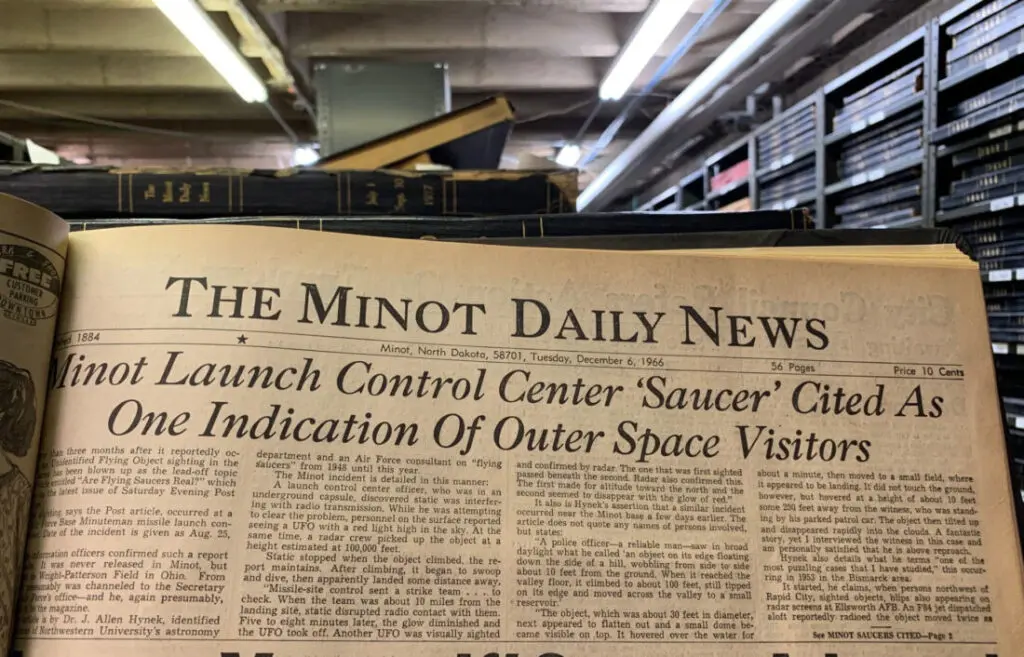
The Minot Daily News carried a front page story, “Minot Launch Control Center ‘Saucer’ Cited As One Indication Of Outer Space Visitors,” published on Dec. 6, 1966. (Minot Daily News)
Why nuclear facilities should be ground zero for a serious UAP inquiry
Nuclear sites concentrate on three ingredients that reliably attract intelligence collection and public anxiety: strategic value, complex infrastructure, and thick sensor coverage.
During the Cold War, UAP reports clustered around air defense and nuclear forces. A growing body of declassified records shows senior attention inside the Pentagon’s command hub in late 1975 after multiple intrusions over Strategic Air Command bases that stored nuclear weapons. In the twenty-first century the pattern revived in the form of unknown drones over nuclear power stations from Arizona to Tihange and Doel in Belgium and a dozen plants across France.
Regardless of origin, the overlap between UAP and the nuclear enterprise is no longer a rumor. It lives in memos, logs, and regulatory files. (Defense Security Service)
The documentary backbone, case by case
United States, Minot Air Force Base, October 24, 1968
The Minot case stands out for evidence volume.
A returning B-52 crew tracked an unknown target on the onboard radar while base personnel reported close visuals across the missile field. The case file includes radar scope film references, transcriptions, and a formal Project Blue Book final report.
Independent scholars have collated hundreds of primary pages for open review. Whatever the origin, this is a deep dataset tied to a base with nuclear missions. (minotb52ufo.com)
United States, Northern Tier overflights, October–November 1975
Declassified memoranda from the National Military Command Center record senior attention to repeated UAP reports over Strategic Air Command installations, including Loring in Maine and Wurtsmith in Michigan.
One NMCC memo explicitly notes that the Chairman of the Joint Chiefs wanted atmospheric data collected when UAPs were reported and questioned the advisability of scrambles in response.
Independent investigators and journalists have connected these logs to base security reports during the same window. This set of documents is one of the clearest official acknowledgments that nuclear bases were the focus of anomalous reporting and command level tasking in that period. (Defense Security Service)
United States, Malmstrom Air Force Base, March 1967
Malmstrom’s missile shutdowns figure centrally in nuclear themed UAP debates.
FOIA records confirm a simultaneous loss of strategic alert status in Echo Flight and the absence of unusual radar returns. More recently AARO’s 2024 historical report assessed the case and concluded there is no evidence of UAP causation.
Multiple former officers, including Robert Salas, have made consistent public claims of UAP involvement for decades.
This is a classic example where the official analysis and veteran testimony diverge. We classify it below as disputed. (The Black Vault Documents)
United States, Palo Verde Nuclear Generating Station, September 2019
America’s largest nuclear plant reported multiple incursions by unknown drones over several evenings, with site security and federal agencies unable to attribute or intercept the aircraft.
Portions of the correspondence made it into the Nuclear Regulatory Commission’s document system and additional details were pried loose by FOIA reporters.
No adversary, hobbyist group, or contractor has been identified. Whatever these platforms were, the event exposed detection gaps and legal constraints around counter drone mitigation at civilian plants. (The War Zone)
France, wave of nuclear plant overflights, autumn 2014
Over the span of weeks, unidentified small aircraft overflew at least a dozen French nuclear sites. The state utility EDF filed complaints and government authorities opened an investigation.
Press and parliamentary attention was intense. Arrests near one plant did not explain the broader pattern.
To this day, there is no public attribution for the full series. Even if some sorties were hobby drones, the scope and persistence suggested organized probing of critical infrastructure. (The Guardian)
Belgian public broadcaster VRT reported a mystery drone over the Doel nuclear power station. Authorities launched an investigation. Belgium has since hardened policy and invested more in counter drone measures around critical sites. The 2020 episode marked a European echo of the French 2014 pattern.
United Kingdom, Rendlesham and the nuclear question
The Rendlesham Forest events of December 1980 occurred adjacent to RAF Bentwaters and RAF Woodbridge, then used by the United States. The United Kingdom has released extensive files on the case. Whether nuclear weapons were present at the time remains a matter of competing claims by former personnel and careful wording by authorities. The events themselves did not occur at a power plant, but at a base with a nuclear mission footprint according to several researchers and veterans. We include it as international context and classify the nuclear dimension as disputed.
At a 2010 National Press Club event organized by researcher Robert Hastings, former officers asserted that an anomalous object appeared over a Soviet site and that a launch sequence was briefly initiated without human command.
Western media covered the claims at the time. Soviet era documentary corroboration is not in open sources. We list the case as testimony based and disputed, with significance for patterns rather than as a settled fact. (ABC News)
What the historians argue, and what the documents say
No one has written more about nuclear linked UAP than Robert L. Hastings, whose book UFOs and Nukes and related documentary work compiles more than a hundred interviews with American veterans, plus selected declassified records.
Hastings is explicit in his thesis that an intelligence with unknown origin monitors and sometimes tampers with strategic nuclear systems. Whether one agrees, the factual contribution is the preservation of testimony and the indexing of records that might otherwise remain scattered. (IAEA INIS)
Historian Richard M. Dolan has focused on the intersection of national security policy and UAP, emphasizing violations of restricted airspace and the response by the security state.
His two volume UFOs and the National Security State does not exclusively focus on nuclear facilities, but nuclear incidents recur because of their strategic weight in the archives he mined.
Dolan’s core argument is that many agencies took UAP seriously and that documentary evidence shows repeated incursions over sensitive bases, including those with nuclear roles. (Google Books)
Data centric nonprofits have added broader pattern work. The Scientific Coalition for UAP Studies published a pattern recognition study that mapped 590 incidents from 1945 to 1975 and found clustering around the American atomic warfare complex, including materials production, weapons assembly, stockpiles, and deployment bases.
The methods and the final word will continue to be debated, but the trend line aligns with what the older archival narratives imply. (Zenodo)
The modern wrinkle: unknown drones are now part of the picture
Incursions at nuclear plants today are often small, multi rotor aircraft with unclear attribution.
That complicates the UAP conversation because drones can be adversary probes, criminal tools, hobbyists in violation, or misidentified conventional traffic. It also raises risk regardless of origin.
The US Nuclear Regulatory Commission now requires licensees to report drone sightings and has issued public facing briefings as the pace of reports increased.
Independent reporters using FOIA have documented large spikes in plant reports in late 2024, and a broader wave of mystery drones over US military sites that triggered federal tasking.
These episodes demonstrate how quickly a modern UAP narrative can merge with real world counter drone policy. (Nuclear Regulatory Commission)
Europe faces the same challenge. France’s 2014 wave remains unresolved in public. Belgium’s 2020 case and later episodes at sensitive military bases reinforce the point that attribution can remain murky for years. In wartime, the danger is obvious.
The IAEA has repeatedly warned about drones detonating near nuclear plants in Ukraine. This is not evidence of exotic craft. It is evidence that any unidentified aircraft near a nuclear site carries disproportionate risk.
Distinguishing the rare anomalous case from the many prosaic ones is now a mission essential task. (The Guardian)
Evidence ledger
Below is a compact ledger that separates what is on the record from what is claimed. It also identifies the document type behind each entry.
Nuclear plants are now a contested low altitude environment Civilian licensees face growing numbers of unknown small aircraft. They have limited legal authority to detect and mitigate compared with military bases. The NRC has updated reporting rules and continues to evaluate technology and policy options, while independent analyses document surges in sightings within short windows that suggest organized probing. A coherent national framework for counter small UAS at critical infrastructure remains a moving target. (Nuclear Regulatory Commission)
Attribution is hard without synchronized multi sensor Confusion between anomalous phenomena and conventional drones is guaranteed when only single channel sensors or human observation are available. NASA’s panel and AARO’s review point repeatedly to sensor calibration, metadata, and synchronized time bases. For nuclear sites this means integrating optical tracks, radar, radiofrequency intercepts, and thermal signatures under a shared clock. This is the only path to separating unusual kinematics from ordinary platforms and to making any resulting data defensible in regulatory or judicial settings. (NASA Science)
Wartime lessons matter even in peace The IAEA has warned about drones detonating near Ukrainian plants. Some incidents occurred within a kilometer of reactors. The security community must assume that unknowns near any plant are potentially hostile. The onus is on detection and rapid attribution, not on speculative narratives. (Reuters)
Historical patterns justify focused tasking The documented attention at Minot, Loring, Wurtsmith, and others in the nineteen sixties and seventies, combined with modern intrusions, supports a standing requirement to prioritize nuclear sites for advanced UAP collection campaigns. This is independent of any hypothesis about origin. It is simply where the risk and the historical signals overlap. (Defense Security Service)
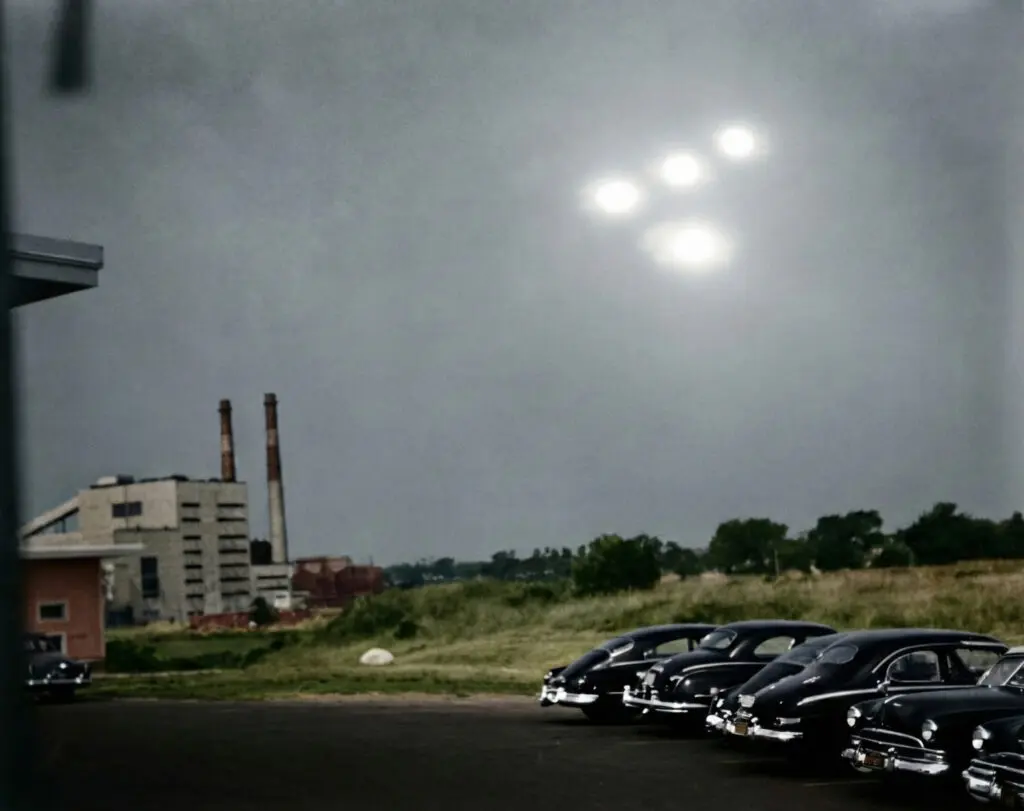
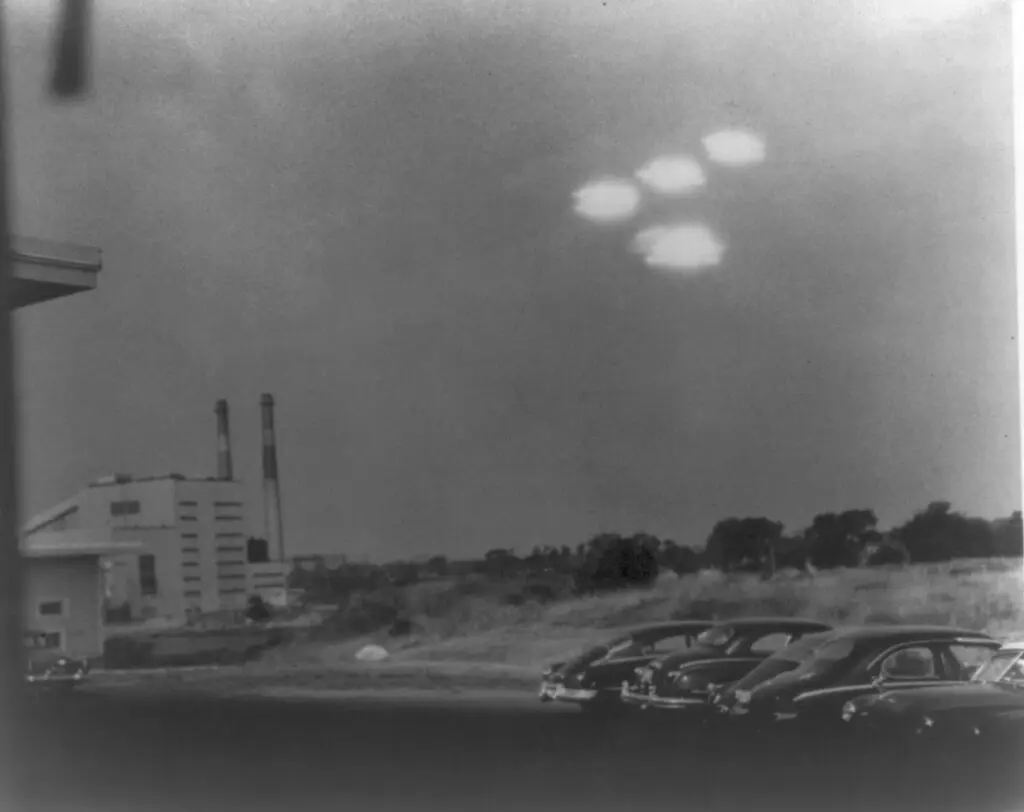
Digitally Restored and Enhanced ImageOriginal ImageUnited States Coast Guard photographer Shell R. Alpert took a photograph through a window screen that allegedly showed unidentified flying objects flying in a “V” formation at the Salem, Massachusetts, Air Station at 9:35 a.m. on 16 July 1952 (LOC | UAPedia).
How to investigate this properly, site by site
Data architecture Every civilian plant and military nuclear site should field a baseline kit that records synchronized optical, radar, and RF data with time stamps at the millisecond level. Thermal cameras should log to the same clock.
All channels should generate standard metadata needed for reproducibility. This is straight from NASA and AARO’s playbooks and adapted to a higher threat context. (NASA Science)
Playbooks for rapid attribution Unknown drones are not the same as UAP with unusual kinematics. A best practice is a two lane triage: Lane one is attribution of known platforms using RF fingerprinting, ADS-B correlation, and short baseline passive radar.
Lane two is escalation to high cadence multi sensor when any track exceeds established performance envelopes or exhibits emission control patterns consistent with deliberate obfuscation.
Open but protected reporting Plants should continue to push anonymized incident summaries into NRC channels and public dashboards where feasible. Public confidence is part of security. The more that communities see a credible, consistent process, the less room remains for rumor that can paralyze operators.
What Dolan, Hastings, and other historians add
Richard M. Dolan maps how UAP reports repeatedly intersect with restricted defense airspace.
He builds his case using declassified records and agency actions to argue that the phenomenon was taken seriously at high levels, particularly when strategic assets were involved.
Dolan’s work gives readers the bureaucratic context that shows why nuclear incidents were, and are, different from lights over a pasture. (Google Books)
Robert L. Hastings contributes the deep oral history of nuclear weapons veterans, some of whom include names and dates that can be cross checked in official files. Even where official analyses disagree with witness interpretations, the testimonies identify where to look for logs, rosters, and archival crumbs. That function is invaluable. (IAEA INIS)
Other researchers and groups now extend those efforts with structured analyses. The Scientific Coalition for UAP Studies has put numbers and geographies to the nuclear correlation across 1945–1975, which is exactly the kind of falsifiable claim that can be pressure tested by independent teams. (Zenodo)
Implications for policy and operations
Harden detection and the legal lane for mitigation Plants need clear authority to use detection and defeat tools against unknown aircraft that enter prohibited airspace. Federal authorities should close gaps where operators can see but not act. The law is evolving in this space, and guidance from the NRC and CISA should be harmonized with state and local enforcement so that response time matches the threat. (Nuclear Regulatory Commission)
Two tier investigative doctrine Treat any unknown at a nuclear site first as a plausible conventional platform until proven otherwise. In parallel, preserve every frame and packet for later physics analysis. This approach honors both the drone risk and the possibility of an anomalous residual.
International information sharing The 2014 French wave and the 2020 Belgian case show that coordinated probing can cross borders. Nuclear regulators and operators should share incident metadata through IAEA channels and peer networks in near real time. In wartime, the IAEA’s warnings about drones near plants should trigger immediate elevation across NATO and partner grids. (Reuters)
Public transparency without compromising security After action summaries that scrub sensitive details but disclose timing, duration, and resolution status build trust. They also make life harder for repeat intruders who count on secrecy to mask what they are testing.
Bottom line
The nuclear enterprise has been entangled with UAP reporting for as long as there have been missiles in silos and reactors on the grid.
The documentary record confirms that senior officials were concerned about unusual intrusions in the nineteen seventies and that modern operators confront a persistent wave of unknown drones.
The central question is not whether nuclear sites attract unknowns. They do.
The question is how many of those unknowns reflect ordinary platforms behaving suspiciously and how many remain, after rigorous collection and analysis, genuinely anomalous.
The only responsible answer is to instrument the problem, share the data where possible, and harden the sites regardless.
Claims taxonomy
Verified
National Military Command Center memoranda from November 1975 note repeated UAP reports over Strategic Air Command bases and discuss collection and response. (Defense Security Service)
The Minot Air Force Base incident of October 24, 1968 generated a substantial Project Blue Book file with radar and witness materials. (minotb52ufo.com)
The NRC acknowledges and tracks drone reports over civilian nuclear power stations and updated reporting expectations. (Nuclear Regulatory Commission)
Probable
The rise in unknown drone incursions at or near nuclear plants represents a growing security challenge that exceeds hobbyist noise and will persist without stronger detection and mitigation authorities. (The War Zone)
Disputed
The 1967 Malmstrom missile shutdowns were caused by UAP. AARO’s official review disputes a UAP link while veteran testimony asserts it. (AARO)
Rendlesham’s proximity to nuclear weapons storage in 1980 is supported by some personnel statements but is not formally acknowledged in released MoD files.
Legend
Claims that luminous UAP shielded reactors from accidents or displayed benevolent intent around nuclear sites are cultural narratives not supported by primary documents.
Misidentification
Many recent nuclear plant intrusions are attributable to conventional drones, and some historical cases likely reflect aviation or astronomical sources. NASA and AARO emphasize this while calling for better data to separate the remainder. (NASA Science)
Speculation labels
Hypothesis Some fraction of unresolved nuclear site encounters may reflect a foreign or non-state intelligence collection campaign meant to probe defenses and electromagnetic signatures of reactors and storage sites. The pattern of multi-night drone incursions is compatible with this. Some fractions may also reflect genuinely anomalous phenomena, as suggested by multi-channel datasets like Minot that resist easy reduction. Distinguishing the two demands strict instrumentation and data sharing.
Witness interpretation Veterans who recall unusual lights and simultaneous equipment anomalies understandably link the two. In some periods, such as Malmstrom in 1967, official records cite technical causes and deny a link. Memory and inference can drift over decades. The answer will come from documents and hard data, not intent.
Researcher opinion A sustained, funded program to collect calibrated, multi sensor data around nuclear sites will reduce the noise floor and likely diminish the number of unresolved anomalies. It will also harden plants against deliberate probes by conventional drones. The cost is modest compared with the risk.
General Nathan Farragut Twining occupies a uniquely important place at the crossroads of American airpower history and the origins of official UAP inquiry.
He rose from National Guard private to four-star general, led combat air forces in two theaters of the Second World War, served as Chief of Staff of the United States Air Force from 1953 to 1957, and then became the third Chairman of the Joint Chiefs of Staff from 1957 to 1960.
Inside UAP history, he is best known for a pivotal memorandum of September 23, 1947, written while he commanded Air Materiel Command at Wright Field.
That document asserted that the “flying discs” being reported were “something real,” recommended a structured investigation, and effectively set the tone for the first wave of formal United States military study of unidentified aerial phenomena.
Later, when the controversial Majestic 12 documents surfaced in the 1980s, Twining’s name appeared among the alleged members, which deepened his place in UAP debates.
The authenticated government record places Twining at the administrative birth of official UAP study. It also shows that federal agencies have rejected the famous MJ-12 papers that include his name. (Air Force)
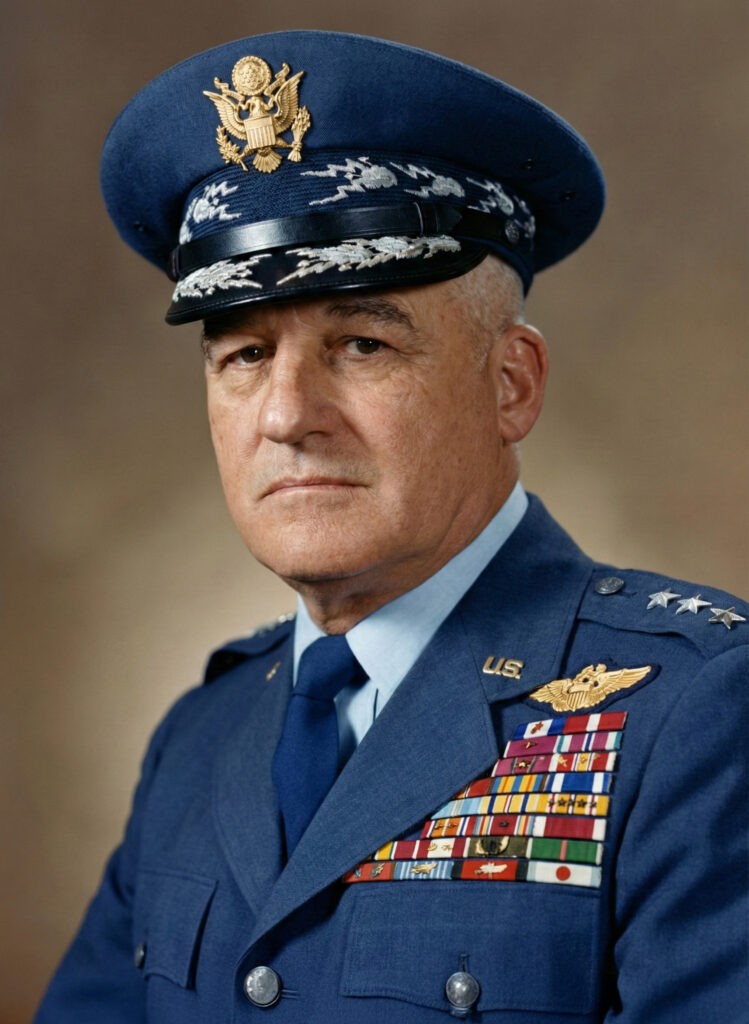
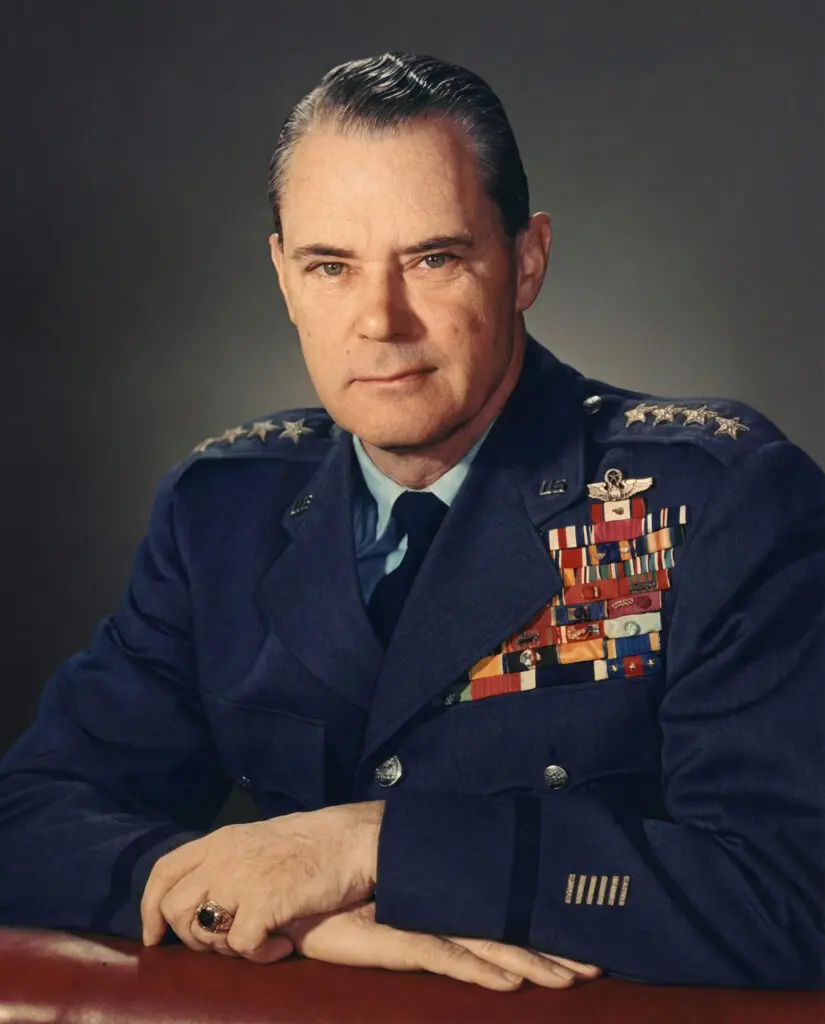
General Nathan F. Twining – U.S.A.F. – 1966 (US Army | UAPedia)
Early life, training, and ascent through airpower
Twining was born in Monroe, Wisconsin, on October 11, 1897. He joined the Oregon National Guard while still a teenager, saw border service in 1916, and gained an appointment to the United States Military Academy the following year.
After accelerated wartime graduation in 1918, he moved from the Infantry into flying, completing Primary and Advanced Flying School in Texas in the early 1920s, and transferring into the Air Service in 1926.
His interwar career mixed instructor duty, staff work in Washington, and field assignments in the continental United States and Hawaii, punctuated by professional education at the Air Corps Tactical School and the Command and General Staff School. These milestones are established in the official U.S. Air Force biography and in the Joint Chiefs of Staff historical profile. (Air Force)
World War II placed Twining on a steeper trajectory. He went to the South Pacific as Chief of Staff to the theater air commander, then in January 1943 took command of the Thirteenth Air Force. Later that year he became Commander, Aircraft, Solomon Islands, one of the first combined air commands with tactical control across Army, Navy, Marine, and Allied air arms.
In late 1943 Twining shifted to the Mediterranean to command the Fifteenth Air Force and the Mediterranean Allied Strategic Air Forces, helping direct strategic bombing of Axis targets in southern Europe. After Germany’s defeat he returned to the Pacific to command the Twentieth Air Force, which flew B-29 operations against Japan. The JCS historical profile notes that aircraft under his command dropped the atomic bombs as the war reached its end. (Joint Chiefs of Staff)
After the war, Twining commanded Air Materiel Command (AMC) at Wright Field, the Air Force’s nexus for engineering, logistics, technical intelligence, and materiel. With the creation of the independent U.S. Air Force in 1947, he briefly led the new Alaskan Command, returned to Washington as Vice Chief of Staff in 1950, then became Chief of Staff of the Air Force from 1953 to 1957.
President Dwight D. Eisenhower selected him as Chairman of the Joint Chiefs of Staff in 1957. The JCS timeline emphasizes his leadership during the missile and Sputnik shocks of 1957 and his work to integrate nuclear strike planning across bombers and the emerging missile forces. (Air Force)
The 1947 Twining memorandum and the birth of formal UAP inquiry
On September 23, 1947, as commander of Air Materiel Command, Twining signed a three-page letter for Brig. Gen. George F. Schulgen, the Army Air Forces Assistant Chief of Staff for Intelligence.
The subject line reads “AMC Opinion Concerning ‘Flying Discs.’”
The memo states that the “phenomenon reported is something real and not visionary or fictitious” and proceeds to summarize operating characteristics seen in credible reports. The letter lists high rates of climb, unusual maneuverability “particularly in roll,” level flight speeds above 300 knots, circular or elliptical shapes, domed tops, metallic or light-reflective surfaces, and typically no associated sound.
It also calls for the Army Air Forces to issue a directive assigning a priority, security classification, and code name for a detailed study and proposes a complete, interagency circulation of data across the Army, Navy, Atomic Energy Commission, RAND, NACA, and related bodies.
This document, preserved in the National Archives and widely reproduced, bears Twining’s signature block and AMC file markings.
The Twining memo mattered for three reasons.
First, it acknowledged the reality of an observed phenomenon while disclaiming certainty about origin.
Second, it urged the creation of a centralized, methodical project to analyze cases and exchange findings across government and scientific partners.
Third, it put Wright Field’s AMC at the center of that analytic effort by default, given its technical intelligence, engineering laboratories, and ties to the Air Institute of Technology.
Within months the Air Force created Project Sign, with AMC’s Air Technical Intelligence Center as a key node. Contemporary government histories, including the All-domain Anomaly Resolution Office’s (AARO) consolidated report, place the 1947 to 1949 period as the foundational moment for U.S. military UAP analysis and trace the succession from Sign to Grudge to Blue Book. (U.S. Department of War)
The Twining memo also shows what investigators did not have in 1947.
It explicitly notes the lack of physical evidence “in the shape of crash recovered exhibits” and flags the possibility of rare natural phenomena, as well as the possibility of domestic or foreign programs unknown to AMC and Air Staff intelligence. In short, the letter balanced a clear call to investigate with an honest appraisal of uncertainty about cause.
Twining’s senior leadership years and UAP policy context
Twining’s rise to Chief of Staff in 1953 and Chairmanship in 1957 put him at the top of a national security system that still grappled with UAP reports.
In January 1953 the Central Intelligence Agency convened a Scientific Advisory Panel headed by physicist H. P. Robertson to assess the phenomenon after a summer of high-profile sightings.
The declassified “Durant Report,” the CIA’s record of the panel’s work, concluded that UAP did not present a direct national security threat and emphasized potential indirect risks to air defense through the clogging of reporting channels.
The panel recommended an educational program to reduce misidentifications and proposed improved screening of reports. The panel’s conclusions shaped the posture that the Air Force would carry into the Blue Book era, which formally closed in 1969.
During Twining’s years as Chief and Chairman, the service refined this approach in step with the broader Cold War focus on strategic deterrence, missiles, and nuclear command and control. (CIA)
The AARO historical synthesis confirms the basic arc. It highlights how Project Sign began in 1948, how the rumored “Estimate of the Situation” that allegedly favored an interplanetary explanation was not adopted, and how Project Grudge and later Blue Book carried the work forward with increasing standardization.
At closure, the Air Force recorded 12,618 cases, 701 of which remained unidentified by contemporary standards. (U.S. Department of War)
Majestic 12 and Twining: documents, judgments, and historiography
What the MJ-12 materials allege
Twining’s name appears among the alleged members in the so-called “Briefing Document: Operation Majestic 12,” dated November 18, 1952, one of several papers that emerged in the mid-1980s.
A companion one-page “Cutler to Twining” memorandum dated July 14, 1954, also appears in those collections and refers to an “NSC/MJ-12 Special Studies Project.” These items have circulated for decades and spurred extensive investigation and debate. (Wikisource)
What federal repositories and investigators concluded
The public position of the U.S. National Archives and Records Administration (NARA) is unambiguous.
After extensive searches across Air Force, Joint Chiefs of Staff, National Security Council, and presidential library records, NARA reported negative results for MJ-12 except for the single “Cutler to Twining” sheet. NARA then listed multiple reasons that the document is problematic.
It bears no Top Secret register number in a series filed by those numbers.
It lacks standard White House letterhead or the expected watermarks used in the Eisenhower period.
The “Top Secret Restricted Information” marking is anachronistic for that era.
There is no NSC meeting record matching the briefing it references.
Eisenhower’s appointment books contain no entry for such a session.
Finally, Robert Cutler was overseas on the day the memo is dated. (National Archives)
The FBI’s FOIA-released “Vault” file on Majestic 12 records the Bureau’s conclusion, based on an Air Force inquiry, that the MJ-12 materials provided to the FBI were “completely bogus.”
The Government Accountability Office, in a 1995 note associated with its Roswell records audit, reported that relevant entities found no evidence MJ-12 originated in the executive branch and that a related message was determined to be a forgery.
These institutional judgments remain the most authoritative assessments in the public domain. (FBI)
Where that leaves Twining and MJ-12
The MJ-12 papers link Twining to a secret committee. The record held by NARA, the FBI, and the GAO does not support the authenticity of those papers.
Twining’s verified archival footprint is immense, including official military biographies and the JCS historical profile, which make no mention of MJ-12. This does not disprove the existence of highly compartmented programs that might never surface in standard record groups, but it sets the evidentiary bar.
Any claim that Twining served on MJ-12 rests on contested documents that federal custodians have rejected. (Air Force)
What Twining actually said about UAP
Unlike many figures whose names are invoked in UAP lore, Twining left us a signed, dated, declassified statement that directly addresses the phenomenon.
The 1947 AMC memo is the clearest example. He described the reported objects as real, recorded their common descriptions as “metallic or light reflecting,” often circular or elliptical, and sometimes capable of speeds above 300 knots in level flight.
He recommended a directed, interagency, priority study to collect and analyze all available data. He also flagged the lack of crash-recovered hardware, a point that framed expectations for further inquiry.
The memo is reproduced in multiple reputable archival repositories and bears National Archives copy markings.
Beyond that letter, there is no authenticated public speech or published statement by Twining that advances specific claims about the origin of UAP.
As Chief and then as Chairman, his official focus was the broad architecture of American defense. His 1966 book, Neither Liberty nor Safety, critiques U.S. strategy in the nuclear and missile age rather than addressing anomalous phenomena.
The Library of Congress finding aid and contemporary reviews confirm the nature of that volume. (Library of Congress Handle)
Influence and legacy in UAP history
He catalyzed the first formal program
The most direct influence Twining had on UAP history is administrative and catalytic.
His 1947 analysis and recommendations helped legitimize the need for an organized government response when the modern wave of sightings began. Project Sign followed, then Grudge and Blue Book. Whatever one’s view of those programs’ thoroughness or biases, the lineage traces back to AMC’s call for a structured approach.
The AARO historical report codifies that timeline and confirms the scale of the effort through 1969. (U.S. Department of War)
He set a tone that mixed curiosity with rigor
Twining’s memo strikes a balance that resonates today.
It accepts that pilots and sensors were reporting something that justified attention. It inventories performance characteristics that demanded serious engineering scrutiny. It recommends sharing information across the military, science, and industry to accelerate understanding.
It also states that natural phenomena or unknown domestic and foreign programs might account for some cases and that no crash-recovered evidence had been obtained.
The memo models sober curiosity, which is arguably the healthiest posture for any government confronted by anomalous aerospace observations.
He became a touchstone for authenticity debates
Twining’s name is tethered to the Cutler to Twining memorandum in the MJ-12 set and to the Eisenhower Briefing Document. Because his real 1947 memo carries such weight, later attempts to forge Twining-related papers had a ready-made aura.
That makes the institutional analyses by NARA and the FBI especially important. For historians, the contrast between an authenticated, operational document from 1947 and contested papers from the 1980s illustrates the value of provenance, context, and markings in document authentication. (National Archives)
He influenced the environment in which UAP policy matured
As Chief of Staff and then Chairman, Twining presided over an Air Force and a joint apparatus dominated by nuclear deterrence, missile development, and air defense modernization.
The CIA’s Robertson Panel and the Air Force’s post-1953 posture toward UAP reflected this environment, which prioritized clearing the radar picture and avoiding distraction from real threats. Blue Book’s eventual closure and the Air Force’s standing fact sheet on UAP would formalize that position for decades.
Twining’s strategic priorities helped frame how UAP were treated across the 1950s. (CIA)
Controversies
Did Twining’s 1947 memo endorse a specific extraordinary hypothesis?
No. The letter describes a real phenomenon and calls for a rigorous investigation.
It does not ascribe a definitive origin to that phenomenon.
The AARO history addresses the later, rumored “Estimate of the Situation” that allegedly endorsed an interplanetary explanation and observes that senior leadership rejected it as unproven.
Confusing the balanced tone of the Twining memo with any singular extraordinary claim misreads the record. (U.S. Department of War)
Was Twining a member of a secret crash retrieval committee?
The only documents that explicitly say so are the MJ-12 materials that federal agencies have assessed as inauthentic.
The National Archives documents multiple anomalies in the Cutler to Twining paper. The FBI records the Air Force assessment that the briefing document was a fake.
The GAO reported no evidence of MJ-12 in executive branch files during its audit work. Absent authenticated records, historians treat claims of Twining’s MJ-12 membership as unproven. (National Archives)
Did the Air Force underplay UAP because of institutional bias during Twining’s tenure?
Project Grudge has long been criticized for an attitude that many researchers view as dismissive.
The AARO history acknowledges assertions that Grudge possessed a debunking bias while also highlighting the scale and complexity of the broader effort across two decades.
Blue Book’s own published totals show that hundreds of cases resisted explanation at the time, yet the Air Force concluded there was no demonstrated national security threat or evidence of exotic technology beyond contemporary science.
The policy judgments can be debated, but the program’s documentation is extensive and publicly accessible at the National Archives. (U.S. Department of War)
A UAP-focused reading of Twining’s career
A heterodox analysis of the Twining record does not require inflating contested evidence. It requires looking squarely at what the authenticated documents say and then asking what they imply.
In 1947, the commander of AMC had access to engineering expertise, intelligence summaries, and lab-level discussions of aeronautical performance. With that vantage, he concluded the phenomenon was real, that some reports described performance outside the envelope of known aircraft, and that a formal, interagency investigation was warranted. He did not have crash-recovered material.
He did not endorse an extraordinary origin. He did insist on seriousness, coordination, and sustained reporting. That framing remains useful today.
Twining’s later senior roles also matter.
As the Air Force professionalized around jets, ICBMs, and a global air defense net, the institution tended to interpret UAP through the lenses of strategic warning, sensor fidelity, and misidentification management.
The CIA’s Robertson Panel recommended education and filter improvements, which aligned with a deterrence-first mindset. The result was a durable doctrinal posture that kept UAP within the intelligence and scientific periphery and outside the center of defense planning. Twining was one of the principal architects of that overall environment. (CIA)
For ufology, Twining’s legacy operates on two tracks. The first is evidentiary. His 1947 memo is a rare case where a senior commander told the Air Staff that something anomalous was being observed and that it needed an organized response. That sentence still anchors many arguments that the U.S. military recognized the phenomenon’s reality very early.
The second is symbolic. Once MJ-12 materials began to circulate, attaching Twining’s name to them offered an irresistible hook, since he was both a founder of official inquiry and later the nation’s top military officer. The symbols are powerful, but the historian’s task is to prefer authenticated records over magnetizing narratives.
1916–1918. Oregon National Guard service and accelerated graduation from West Point. (Air Force)
1923–1926. Flying training at Brooks and Kelly Fields; transfer to the Air Service. (Air Force)
1942–1943. Chief of Staff, South Pacific area, then Commander, Thirteenth Air Force and Commander, Aircraft, Solomon Islands. (Joint Chiefs of Staff)
1943–1945. Commander, Fifteenth Air Force and Mediterranean Allied Strategic Air Forces; then Commander, Twentieth Air Force in the Pacific. (Joint Chiefs of Staff)
October 1945. Takes command of Air Materiel Command at Wright Field. (Air Force)
September 23, 1947. Signs “AMC Opinion Concerning ‘Flying Discs’,” calling the phenomenon real and recommending a formal program.
1950–1953. Vice Chief of Staff, then Chief of Staff of the Air Force from June 30, 1953. (Air Force)
January 1953. CIA Robertson Panel convenes; its conclusions and the Durant Report shape U.S. UAP policy. (CIA)
August 15, 1957–September 30, 1960. Chairman of the Joint Chiefs of Staff. (Joint Chiefs of Staff)
1982. Dies at Wilford Hall Medical Center, Lackland AFB, Texas. (Joint Chiefs of Staff)
1984–1987. MJ-12 documents emerge, later judged inauthentic by federal agencies. (FBI)
Balanced conclusions
Nathan F. Twining’s place in UAP history is secure even when one filters out later, contested documents.
In 1947 he left a precise, operationally focused record that accepted the reality of a fraction of well-attested sightings and demanded a serious, data-driven program to resolve them. That memo seeded a lineage of Air Force projects that defined the official approach to UAP for the next two decades.
As Chief and Chairman he then helped shape the Cold War defense environment in which UAP were managed, monitored, and often minimized as a priority compared to nuclear and missile realities.
On Majestic 12, Twining’s name is prominent, yet the authenticated government evidence does not validate those papers. Researchers who build around the MJ-12 corpus must reckon with the National Archives’ detailed critique of the Cutler to Twining sheet and the FBI’s “completely bogus” judgment.
The historian’s through-line is therefore clear. Twining’s proven impact lies in what he wrote in 1947, the institutions he built, and the investigative posture he modeled.
From a UAPedia perspective that resists the reflex to explain away the unexplained, Twining’s dossier is both bracing and instructive. It shows that at the very moment the modern UAP era began, a senior commander with unmatched technical reach told the Air Staff that something anomalous was present in the sky, that it deserved priority study, and that the United States should bring the full weight of its scientific and military apparatus to bear. That is a foundation worth building on with new data, new methods, and new transparency.
Note on MJ-12 sources: Researchers often consult copies of the “Eisenhower Briefing Document” and the “Cutler to Twining” memo that circulate online. These are cited here only via official custodial assessments. The National Archives reference report and the FBI Vault represent the current institutional positions. (National Archives)
SEO keywords
Nathan Twining biography; Nathan F. Twining UAP; Twining memo 1947; AMC Opinion Concerning “Flying Discs”; Majestic 12 Twining; MJ-12 authenticity; Project Sign origins; Air Materiel Command Wright Field; Robertson Panel Durant Report; Project Blue Book statistics; Chairman of the Joint Chiefs of Staff Twining; Cutler to Twining memo; AARO historical report UAP; early military UAP investigations
Hoyt Sanford Vandenberg (1899–1954) stands at the crossroads of several formative stories in U.S. military and intelligence history, and by extension, at the heart of early United States engagement with what we now call UAP.
He was the second Director of Central Intelligence in 1946–47 and the second Chief of Staff of the U.S. Air Force in 1948–53, a period that coincided with the first major UAP flaps, the creation of Project SIGN and its successors, and a public reckoning after the 1952 Washington, D.C. radar-visual incidents.
His name later became entangled in the Majestic 12 narrative and in lore surrounding a lost “Estimate of the Situation,” which many in the field still treat as a keystone moment in the government’s early encounter with anomalous technology.
As a figure, Vandenberg embodies the tensions of the era: the need to create new institutions, the instinct to control narratives in a Cold War, and the pressure to find unambiguous explanations for ambiguous data. (Air Force)
Gen. Hoyt S. Vandenberg circa 1946 (US Army | UAPedia)
Early life, training, and rise through the Air Arm
Vandenberg was born in Milwaukee, Wisconsin, on January 24, 1899. He graduated from the U.S. Military Academy in 1923, trained as an Army Air Service pilot at Brooks and Kelly Fields, then cycled through operational and instructional posts that shaped him into a planner and a commander comfortable with both cockpit and staff.
His first unit command came at the 90th Attack Squadron, followed by a key tour in Hawaii with the 6th Pursuit Squadron. He then taught at the Air Corps Tactical School and completed the Command and General Staff School and the Army War College just as global tensions were hardening into a world war.
These details matter for UAP history because they produced a general who valued disciplined analysis and cross-branch coordination, the same skills he would later bring to bear on the early UAP problem. (Air Force)
World War II command experience
During the war, Vandenberg helped organize the air campaign in the Mediterranean, served as chief of staff of the Twelfth Air Force and of the Northwest African Strategic Air Force, and in August 1944 took command of the U.S. Ninth Air Force in Europe.
That command provided tactical air support across France and into Germany, giving him direct experience synchronizing intelligence, operations, and technology in dynamic conditions. For this work he received multiple decorations and a reputation as an exacting, modern air commander.
The way the Ninth Air Force integrated radar, observation, and rapid decision-making would echo later in how the Air Force framed and centralized UAP reporting. (Air Force)
Architect of modern U.S. intelligence
Second Director of Central Intelligence (1946–1947)
After the war, Vandenberg became Director of Central Intelligence when the Central Intelligence Group (CIG) was still evolving toward the CIA.
Under his tenure the CIG secured its own budget and personnel authority, assumed responsibility for collecting foreign intelligence across the government, and coordinated interdepartmental intelligence activities.
Those reforms crystallized a community approach that, for better or worse, later shaped how UAP cases were triaged between the services and the intelligence agencies.
Chief of Staff of the U.S. Air Force (1948–1953)
With the independent U.S. Air Force formed in 1947, Vandenberg became Vice Chief that October and then Chief of Staff in April 1948. His tour spanned the Berlin Crisis aftermath, the Korean War, and an arms race that prioritized strategic warning and air defense.
The Air Force’s policy approach to aerial anomalies matured during these same years, as institutional energy moved from ad hoc case files to named projects with mission statements, reporting rules, and public-affairs guidance. (Air Force)
This silent footage shows President Harry S. Truman signing the Armed Forces Unification Bill at his desk in the Oval Office of the White House, August 10, 1949. Among those accompanying the president are Senator Richard B. Russell, General Omar Nelson Bradley, Secretary of Defense Louis A. Johnson, General Hoyt Sanford Vandenberg, Senator Styles Bridges, Chief Justice Fred M. Vinson, Secretary of the Air Force Stuart Symington, Deputy Secretary of Defense Stephen T. Early, and Secretary of the Treasury John W. Snyder. (Harry Truman Library)
Vandenberg and the birth of official UAP inquiry
From Project SAUCER/SIGN to GRUDGE and BLUE BOOK
A Department of Defense historical review in 2024 laid out the early government lineage of UAP inquiries. It described a loose “Project SAUCER” evolving into the formal Project SIGN in January 1948 at the Air Technical Intelligence Center.
SIGN reviewed 243 cases and in early 1949 concluded that while many reports were misinterpretations, a small remainder lacked an ordinary explanation, and it kept extraterrestrial possibilities on the table.
Crucially for Vandenberg’s biography, that review also recounted the oft-told story that a late-1948 “Estimate of the Situation,” arguing some UAP were interplanetary, was forwarded up the military chain and was rejected by the Chief of Staff, General Hoyt S. Vandenberg, as lacking proof.
The account flagged this “Estimate” as unsubstantiated in the surviving record, yet it repeated the central point: the Air Force Chief was not persuaded by the evidence presented at the time.
Following SIGN, the Air Force rebranded the effort as Project GRUDGE in 1949. GRUDGE recommended de-emphasizing the topic publicly to reduce “war hysteria,” but reporting and analysis continued inside the Air Force.
The next substantive reorganization came with the revival of GRUDGE under Capt. Edward Ruppelt in late 1951, which in 1952 became Project BLUE BOOK. Over 1947–1969 BLUE BOOK cataloged 12,618 cases, with 701 officially listed as “unidentified.”
These numbers anchor the quantitative backbone of the era and show that Vandenberg’s years coincided with the period when the Air Force moved from scattered files to professionalized case handling.
The 1952 Washington “flap” and the press-policy inflection
In July 1952, while Vandenberg was Chief of Staff, radar and visual sightings over the nation’s capital produced a political and public communications crisis.
The Pentagon convened what became the largest Air Force press conference since World War II, led by Director of Intelligence Maj. Gen. John Samford, who emphasized that the Air Force had found no threat to national security and that many radar returns were consistent with temperature inversions.
The transcript and film of Samford’s statements remain key primary sources for the government’s public stance during Vandenberg’s tenure. The incident also catalyzed a CIA-sponsored scientific review known as the Robertson Panel in early 1953, whose recommendations included improved data vetting and media handling.
Vandenberg’s fingerprints do not appear on the transcripts, yet the event unfolded within a service culture and leadership team he steered. (Wikimedia Commons)
Reporting rules and institutional posture
Across these years, U.S. Air Force policy on “unidentified flying objects” hardened into standardized reporting and triage.
The Air Force’s later public fact sheets summarize that across 22 years of official study the service found no evidence of a national security threat from the unidentified subset, and no confirmed signs of technology beyond contemporary scientific knowledge.
Although those statements were drafted after Vandenberg retired, they describe an institutional through-line that began during his stewardship and that shaped how later generations encountered early case files. (Air Force)
The “Estimate of the Situation” and Vandenberg’s judgment
No document has had a longer afterlife in ufology than the rumored 1948 “Estimate of the Situation.” The basic story holds that analysts in Project SIGN assembled a case that some UAP were “interplanetary” and that the paper went up the chain to the Chief of Staff.
According to multiple retellings, Vandenberg rejected the Estimate for insufficient proof. A 2024 Department of Defense historical review summarized this tradition, flagged the Estimate’s documentary status as unsubstantiated, and nonetheless recorded the core memory within the Air Force: the Chief of Staff was not convinced by the evidence.
For historians of UAP, that single sentence fixes Vandenberg at the hinge of early institutional skepticism.
It is fair to say there is no verifiable copy of the Estimate today, yet the narrative has shaped interpretations of the entire 1947–49 period.
Ruppelt’s later book, based on his experience leading BLUE BOOK, also recounts tensions between field investigators who sometimes favored extraordinary hypotheses and senior leadership who demanded robust, shareable proof.
Whatever the precise fate of the Estimate, Vandenberg’s stance, as remembered by those who worked the problem, reinforced a high evidentiary bar and a preference for measured public messaging. That posture influenced the culture of GRUDGE and BLUE BOOK that followed. (Project Gutenberg)
Majestic 12 and Vandenberg’s posthumous entanglement
What the MJ-12 papers claim
Beginning in the mid-1980s, a set of anonymously circulated papers asserted that President Truman had created a secret oversight group, “Majestic 12,” in 1947 to manage crash recoveries and exploitation of non-human technology.
The so-called Eisenhower Briefing Document lists twelve members said to include Hoyt S. Vandenberg. In 1985, researchers also publicized a “Cutler to Twining” memo referencing “MJ-12,” and later documents, such as the alleged “Interplanetary Phenomenon Unit” report, placed Vandenberg in briefings connected to 1947 events.
These texts would recast Vandenberg from a demanding skeptic into a central insider tasked with coordinating a clandestine program. (Majestic Documents)
What the archives and agencies say
The FBI reviewed MJ-12 materials in 1988 and reported that an Air Force inquiry had determined the documents to be fake.
The National Archives built a dedicated reference page in which archivists recorded extensive negative searches for “MJ-12” across the Eisenhower and Truman holdings, enumerated anomalies in the “Cutler/Twining” memo’s format and timing, and noted that Cutler was overseas on the day the memo was supposedly written.
A 1995 GAO letter to Congress summarized interagency views: there were no executive-branch records supporting the MJ-12 materials, and agencies advised they should not be treated as documents that had ever been properly classified by the government. That is the official posture. (FBI)
Why the controversy persists
Proponents point to stylistic details, cross-document echoes, and the early timing of some releases.
Detractors stress the historical and documentary problems archived by NARA and the FBI. Vandenberg’s presence on the alleged membership list is a major reason the controversy endures in ufology, since his real-world roles in intelligence and Air Force leadership would have made him an obvious choice for such an inner circle if it existed.
The result is a peculiar biographical afterimage. In the authenticated record, Vandenberg appears as a proceduralist insisting on proof. In the MJ-12 corpus, he appears as a custodian of a secret. The weight of public documentation favors the former picture, yet the latter continues to animate debate, precisely because it draws on a plausible casting of the man. (National Archives)
Claims he made, and claims made about him
Direct statements from Vandenberg on UAP
There is no documented, on-the-record public statement by Vandenberg endorsing extraordinary hypotheses about UAP. His connection to the topic in the official record is through institutional decisions and the chain of command.
The 2024 historical review attributes the rejection of the rumored 1948 Estimate to him, noting a lack of proof. That is more a procedural decision than a public “claim.”
At the height of the 1952 wave, it was his Director of Intelligence who spoke to the press, underlining that unidentified reports did not imply a threat and could often be explained by ordinary effects like inversions.
Vandenberg left behind no press conference of his own about UAP, and his official biographies contain no quoted belief statements on the subject.
Claims about Vandenberg’s role
Two important claims about Vandenberg circulate widely.
First, that he “ordered all copies” of the 1948 Estimate destroyed. The surviving record does not verify destruction orders, although Ruppelt and others described a climate in which the Estimate did not survive, and AARO cautions that the Estimate itself remains unconfirmed in the archives.
Second, he was a member of MJ-12. The FBI, NARA, and GAO material above shows why the government treats the MJ-12 papers as non-authentic. These clarifications do not settle the debate for everyone, but they set the evidentiary baseline. (Project Gutenberg)
Influence and impact on ufology
Setting the evidentiary threshold
Because Vandenberg was cited as the senior who rejected an interplanetary Estimate, he has become emblematic of an evidentiary line in early UAP analysis.
His approach arguably preserved analytic discipline during a period of public excitement. It also encouraged later critics to view the Air Force’s early programs as culturally biased toward dismissing extraordinary interpretations.
The 1952 communications pivot
The Washington radar-visual incidents forced the Air Force to balance transparency and reassurance.
The Samford press conference set a template for public responses that persisted through the 1960s: acknowledge an unexplained residue, emphasize conventional explanations where available, assert no threat to national security, and underscore that the Air Force would continue to investigate.
That posture influenced not only public opinion but also how future researchers read BLUE BOOK files. Vandenberg’s leadership context frames this pivot in communications policy, which remains part of his indirect impact on the field. (Wikimedia Commons)
MJ-12 and the magnetism of plausible casting
Vandenberg’s insertion into MJ-12 lists gave those papers a seductive plausibility, precisely because his résumé fits the role the documents imagine.
As a result, his name still anchors many discussions about U.S. crash retrieval and reverse-engineering claims.
Even researchers who doubt the documents’ authenticity often use “Would Vandenberg have been on such a committee?” as a thought experiment for how a real oversight group might have looked. That persistent gravitational field around his name is itself an impact on ufology. (Majestic Documents)
Other legacies, and why they matter to the UAP story
Vandenberg’s biography is not coterminous with UAP, and the broader picture informs how we read his actions. He helped build the modern intelligence community in 1946–47 and led the Air Force through a transformation that included nuclear posture, continental defense, and the institutionalization of scientific advising.
The California missile and space base at Camp Cooke was renamed for him in 1958, and in 2021 it was redesignated Vandenberg Space Force Base, a symbolic connection between his legacy and space-domain operations that now host many of the sensors relevant to modern UAP detection.
His and his wife Gladys’s role in starting the Arlington Ladies tradition reflects a leadership ethos attentive to institutional dignity and public trust. Those threads, taken together, complicate any simplistic portrait of him as either a “debunker” or a “keeper of secrets.” (Vandenberg Space Force Base)
Controversies and contested interpretations
The “Estimate of the Situation.” The claim that Vandenberg rejected an interplanetary Estimate is widely repeated. The AARO report treats the Estimate as a single-source, unverified historical account, yet it records the tradition that Vandenberg turned it back for insufficient proof. For historians, the episode illuminates how institutional memory can outlive documents and shape a field’s mythology.
The MJ-12 corpus. The strongest arguments for authenticity are internal stylistic cues and the “plausible cast” of signatories, including Vandenberg. The strongest arguments against are documentary anomalies, archival negatives, and agency judgments recorded by NARA, the FBI, and the GAO. Vandenberg’s presence in the alleged membership is thus a Rorschach test. Believers view him as the natural choice for a crash-retrieval committee. Skeptics cite the lack of provenance and the official determinations. Any balanced biography should present both aspects, while noting where the public record currently stands. (National Archives)
Public messaging in 1952. Some researchers argue that the Samford press conference sanded down anomalies too quickly. Others note that BLUE BOOK left hundreds of cases unidentified and that data quality, not dismissal, was the limiting factor. In either reading, the event under Vandenberg’s watch helped codify how the Air Force would speak about UAP, and how the public would expect the government to speak. (Wikimedia Commons)
Assessment
From a UAPedia perspective, Vandenberg is best understood as a builder and a gatekeeper.
As DCI he built mechanisms for centralized collection and analysis. As Air Force Chief he presided over the professionalization of UAP handling, where analytical rigor and public communications became policy matters rather than curiosities. He appears in the AARO historical survey as the senior officer who was unwilling to endorse extraordinary conclusions without extraordinary evidence.
That decision point still reverberates in the community’s memory. Simultaneously, his posthumous appearance in MJ-12 lists keeps him at the center of a parallel, highly charged narrative in which the government did recover craft and bodies, then placed oversight in the hands of men exactly like him.
Vandenberg died on April 2, 1954, after retiring the previous year. The Air Force named its West Coast missile and space base in his honor in 1958, and in May 2021 it was redesignated Vandenberg Space Force Base, which keeps his name attached to the frontier where modern sensor systems, space operations, and UAP detection increasingly meet. His complex legacy, both documented and disputed, has made him one of the defining personalities in the origin story of U.S. UAP study. (Air Force)
Note on contested sources. MJ-12 related PDFs are cited above to document what the texts claim about Vandenberg’s role. Official positions from the FBI, NARA, and GAO are also cited to show why U.S. agencies do not accept those documents as authentic. Readers should weigh these pairs together.
SEO keywords
Hoyt S. Vandenberg biography, Majestic 12 Vandenberg, Vandenberg UAP history, Project SIGN Estimate of the Situation, 1952 Washington radar visual incidents, Project GRUDGE, Project BLUE BOOK statistics, Cutler Twining memo analysis, AARO Historical Record Report, Vandenberg Space Force Base history.
Lloyd Viel Berkner (1905–1967) was that rare figure whose life intersected with nearly every frontier of mid twentieth century science and national security.
As a pioneering radio and ionospheric engineer, an architect of the International Geophysical Year, the first chair of the National Academy of Sciences’ Space Science Board that helped guide NASA, and a trusted governmental science advisor, he moved easily among laboratories, universities, and cabinet level meeting rooms.
In January 1953, he sat on the CIA’s Robertson Panel, the secret scientific committee that reviewed the then called “UFO” problem at the height of Cold War anxiety.
Three decades later, his name surfaced again in the controversial Majestic 12 papers that claimed a hidden interagency group managed crash recoveries and policy.
The open record establishes Berkner’s scientific eminence and his role in defining official attitudes toward Unidentified Anomalous Phenomena.
The same record shows that the Majestic 12 documents remain unverified by official repositories. Understanding Berkner requires both narratives to be told clearly and carefully.
Lloyd V. Berkner circa 1961 (NRAO/AUI/NSF | UAPedia)
Early life and formation of a radio-scientist
Berkner was born in Milwaukee on 1 February 1905 and raised in Sleepy Eye, Minnesota, where an early obsession with amateur radio foreshadowed a career spent listening to the sky.
He earned a B.S. in electrical engineering from the University of Minnesota in 1927, joined the Naval Aviation Reserve, and quickly moved into applied radio work at the U.S. Bureau of Lighthouses and then the National Bureau of Standards.
In 1928 he supported Amelia Earhart’s pioneering transatlantic aircraft radio installation and soon after served as a radio engineer on Richard E. Byrd’s first Antarctic expedition, experience that cemented his interest in the far reaches of Earth and its upper atmosphere. (Naval History and Heritage Command)
By the early 1930s Berkner’s path bent toward the ionosphere, the high atmospheric plasma that bends and reflects radio waves around the world.
At the Carnegie Institution’s Department of Terrestrial Magnetism he worked on ionosphere-sounding programs and continuous recording equipment that evolved into standard instruments at ionospheric stations, enabling height and electron density measurements that underpinned a more complete theory of shortwave propagation.
Photographs from Carnegie archives show Berkner at the racks of multifrequency ionospheric equipment in 1937, a working image of the era’s rapidly maturing radio geophysics. (NAS)
Contemporary summaries credit Berkner with first reliable measurements of ionospheric heights and densities and with key early papers on the F-region’s seasonal and diurnal variability. These studies seeded an international network of observatories and made the ionosphere an everyday tool for communication engineers and researchers.
Wartime and immediate postwar service
World War II drew Berkner’s expertise into national service. He contributed to radar and navigation systems and then, in 1946, was appointed executive secretary of the new joint Research and Development Board, chaired by Vannevar Bush.
The RDB was the apex mechanism that coordinated the services’ science and technology programs during the postwar transition from the Manhattan Project and into the Cold War. Berkner’s portfolio put him at the center of committees, panels, and information flows that linked scientists to the military in the nation’s most sensitive programs. He subsequently served as special assistant to the Secretary of State, chaired a committee on military assistance planning for NATO, and led a National Academy of Sciences study on science and foreign relations.
These assignments foreshadowed the 1950 “Berkner Report,” which urged stronger science advising within the Department of State and helped seed the science attaché program.
The International Geophysical Year and the Space Age
Berkner’s most enduring scientific legacy began at a small 1950 gathering at James Van Allen’s home. He argued that the world should not wait fifty years for another International Polar Year.
Instead, new technologies and an approaching solar maximum called for a global geophysical effort in 1957–1958. That suggestion catalyzed the International Geophysical Year, an 18-month worldwide campaign that mobilized 67 nations and fourteen Earth science disciplines, from aurora studies to rocket and satellite observations. Berkner helped design the IGY’s international and U.S. structures, served as a leader in its international committees, and pressed for a nonmilitary U.S. satellite program to support upper-atmosphere science.
When Sputnik and then Explorer I flew, the Space Age arrived inside the project he had helped imagine.
The National Academy of Sciences created the Space Science Board in 1958 to provide continuing scientific guidance for the new era. Berkner became its first chair and, by contemporaneous accounts, reorganized the board into an effective advisory engine for the newly formed NASA and other agencies.
Early board memoranda and histories underscore how quickly the group identified exobiology, planetary exploration, and space physics as core lines of scientific inquiry. (National Academies)
In these same years Berkner served as president of multiple scientific unions that embodied his commitment to international cooperation. He was president of the International Council of Scientific Unions in the mid-1950s, then led the International Union of Radio Science in 1957, and became president of the American Geophysical Union in 1959.
He also served on President Eisenhower’s Science Advisory Committee and chaired a panel whose rapid report became a blueprint for modern seismology.
Berkner’s administrative reach extended to big research infrastructure. As the first full-time president of Associated Universities, Inc. from 1951 to 1960, he was instrumental in establishing the National Radio Astronomy Observatory at Green Bank, West Virginia.
The NRAO timeline records him signing the NSF–AUI agreement in November 1956 and acting as the observatory’s first director during start-up.
The breadth of his influence can be measured from Antarctica to West Virginia. An ice rise discovered during IGY work was named Berkner Island in his honor. (National Radio Astronomy Observatory)
The Robertson Panel and the making of official UAP posture
The wave of high-profile sightings in 1952, including the July incidents in the skies over Washington, D.C., forced a policy response. The CIA’s Office of Scientific Intelligence convened a “Scientific Advisory Panel on Unidentified Flying Objects” that met 14–18 January 1953 under physicist Howard P. Robertson.
Berkner was a member of this “Robertson Panel,” alongside Thornton Page, Luis Alvarez, and Samuel Goudsmit, with J. Allen Hynek briefing from Project Blue Book. Declassified notes and the so called Durant report capture the sequence of briefings, film analyses, and debates, including reviews of the Tremonton, Utah and Great Falls, Montana motion picture cases. (CIA)
Two conclusions from the panel would echo for decades in UAP history.
First, the panel judged unanimously that there was no evidence of a direct national security threat in the objects then being reported.
Second, it warned that the subject could nonetheless overload communications and create vulnerabilities during a real crisis, so education and better filtering were important. The panel explicitly recommended a broad training and public information effort whose second aim was “debunking,” and it discussed the monitoring of civilian UAP groups.
The committee also urged improved field investigation processes and more disciplined data collection. These positions framed the government’s posture for years to come. (The Black Vault Documents)
For UAP researchers, Berkner’s presence on the panel matters. He was not a peripheral figure. He represented the mainstream of American science, already central to upper-atmosphere studies and soon to be central to NASA’s scientific direction.
His participation helped legitimize a policy line that treated UAP as a manageable air defense nuisance rather than an urgent technical mystery. That tone, set in 1953, influenced how later offices and projects approached the subject.
The Majestic 12 episode: Berkner’s name in the controversial papers
In the mid-1980s, a packet of film reportedly delivered to a television producer yielded copies of “Top Secret/Eyes Only” documents.
The most famous of these, the “Eisenhower Briefing Document” dated November 1952, lists “Majestic-12” members said to have been designated to manage extraordinary recoveries and policy. The list includes Admiral Roscoe Hillenkoetter, Vannevar Bush, James Forrestal, Nathan Twining, Hoyt Vandenberg, Detlev Bronk, Jerome Hunsaker, Sidney Souers, Gordon Gray, Donald Menzel, Robert Montague, and “Dr. Lloyd V. Berkner.”
That roster was tailor made to feel plausible because it gathered figures who sat at the nexus of atomic stewardship, air defense, and elite science. (Archive.org)
Official repositories, however, have not verified the authenticity of the Majestic 12 materials. The FBI’s public Vault summarizes an Air Force determination that the “Operation Majestic-12” briefing was bogus.
The National Archives’ MJ-12 reference note details problems with the associated “Cutler–Twining” memo, including the absence of required Top Secret register markings and the fact that Robert Cutler was out of the country on the date of the purported memorandum.
The U.S. Government Accountability Office reported in 1995 that agencies’ knowledge of “Majestic 12” was limited to the contested documents themselves. These points anchor the historical consensus in the archival record. (FBI)
Berkner’s appearance in the list remains a curiosity that says more about his real-world credibility than about the papers’ provenance. As executive secretary of the Research and Development Board under Vannevar Bush and later as a central figure in geophysics and space policy, Berkner belonged to the small world of people who plausibly might have been consulted if the United States had created a tiny, compartmented panel about unknown aerospace materials.
That plausibility is exactly why the MJ-12 story attached to him so easily and why it persists in popular discourse despite the documentary anomalies.
What Berkner himself claimed about UAP
There is no public record of Berkner advocating extraordinary explanations for UAP or making personal claims about crash recoveries, technologies, or nonhuman intelligence.
His on-the-record involvement is the Robertson Panel, whose report he helped shape. The panel’s conclusions and recommendations are clear in the declassified documents. They emphasize national security workflow risks, improved investigation, and a public education effort that would train observers and reduce confusion.
Beyond that committee work, Berkner’s published scientific output and public roles centered on radio science, atmospheric evolution, international scientific cooperation, and space policy. (The Black Vault Documents)
Influence and impact on ufology
Setting the tone for official engagement. The Robertson Panel gave federal agencies a coherent framework for handling UAP reports in the 1950s.
It helped justify a shift from urgent threat assessment to procedural management. Berkner’s participation meant that mainstream scientific authority endorsed that shift, which, in turn, shaped how data were collected and what counted as worthy of deep analysis.
The Air Force’s Project Blue Book later logged 12,618 cases between 1947 and 1969 and left 701 “unidentified,” but institutional conclusions steadily moved toward prosaic explanations absent exceptional evidence. (Air Force)
Reverberations into the Space Age. Berkner’s leadership of the Space Science Board and his advocacy for satellites and exobiology created an intellectual pathway where rigorous space science could flourish without reference to UAP.
That separation of domains had lasting effects. NASA and the academy built durable programs to study life’s origins, planetary environments, and near-Earth space, while intelligence and defense communities handled UAP as an air defense and information-management problem.
The bifurcation reduced opportunities for sustained, cross-domain study of anomalies. (National Academies)
A touchstone for competing stories.
The later appearance of Berkner’s name in the MJ-12 list made him a symbolic figure for two narratives that still compete. In one, an interagency inner circle managed a profound, hidden technical discovery starting in 1947.
In the other, the papers are crafted forgeries that parasitized the reputations of exactly the kinds of people who would have been consulted if such a group had existed. Institutional assessments by the FBI, National Archives, and GAO align with the latter view, even as public fascination with the former persists.
For ufology, Berkner stands at the hinge between these possibilities. (FBI)
Context from today’s official reviews. The Department of Defense’s All-domain Anomaly Resolution Office, in its 2024 historical report, stated that it found no verifiable evidence of extraterrestrial technology in U.S. government holdings and no substantiated crash retrieval or reverse-engineering programs.
That conclusion does not negate a residual core of intriguing cases. It does establish the present institutional baseline that researchers must address when revisiting the choices made in 1953 and the legacies of figures like Berkner. (U.S. Department of War)
Other achievements that defined his stature
A full appreciation of Berkner’s UAP significance rests on his broader career.
Ionosphere and radio science. Berkner’s work on ionospheric sounding and on F-region variability became pillars of mid-century radio propagation theory and practice.
The global ionosonde networks that his generation helped pioneer remain core infrastructure for space-weather operations and research. (NAS)
International cooperation. As ICSU president in the 1950s, URSI president in 1957, and AGU president in 1959, Berkner was a diplomatic heavyweight for science.
His collaborative approach carried real policy consequences, from the Antarctic Treaty’s scientific regime to multilateral space science.
Institution building. At Associated Universities, Inc., he drove the creation of the National Radio Astronomy Observatory. NSF and AUI records show him signing the foundational agreement in 1956 and serving as acting director during the observatory’s launch. (National Radio Astronomy Observatory)
Space policy leadership. As the first chair of the Space Science Board, Berkner helped set the scope for NASA’s scientific portfolio, including committees on exobiology and planetary missions.
This was the scientific governance architecture of the early space program. (National Academies)
Later years. In the 1960s he helped found what became The University of Texas at Dallas, serving as the first president of the Graduate Research Center of the Southwest, while remaining active in national and international scientific associations.
He died in Washington, D.C., on 4 June 1967. (nasa.gov)
Controversies
The Robertson Panel’s “debunking” recommendation.
The panel’s advice to undertake an educational program with a debunking component remains one of the most criticized choices in the U.S. government’s engagement with UAP. Supporters argue the recommendation was pragmatic in a tense Cold War context that demanded communications discipline.
Critics argue that it created a culture of ridicule that discouraged careful study and drove some witnesses underground.
The historical record shows that the panel explicitly used the word “debunking” within an education framework, which is why the controversy endures. (The Black Vault Documents)
Berkner’s inclusion in the MJ-12 list. The Eisenhower Briefing Document’s membership roster places Berkner among twelve luminaries charged with managing the most sensitive technical matter imaginable.
The FBI and National Archives findings, along with the GAO’s 1995 note, count heavily against the authenticity of those documents.
Yet the list was crafted with an insider’s understanding of who actually sat near the center of postwar science and security. That design choice kept the story alive. (Archive.org)
Science versus secrecy. Berkner operated at the seam between open science and closed national security.
In practice, this meant he used scientific authority in support of policies that balanced transparency against perceived threat.
For UAP historians, that dual role is both admirable and fraught. It explains how a builder of global scientific cooperation could also help author a policy that filtered and deemphasized anomalous reports. The tension is real and cannot be reduced to a single motive.
A UAPedia synthesis of Berkner’s impact
Berkner’s biography reframes a familiar debate.
He was not a shadowy spymaster. He was a nation-building scientist who believed that coordinated, international research could answer big questions.
The same competencies that made him indispensable to IGY planning and to NASA’s early advisory structure made him a natural choice for the 1953 panel that sought to bring discipline to the UAP problem.
In the archival record, Berkner’s UAP footprint consists of the Robertson Panel’s proceedings and conclusions. Those conclusions reduced perceived threat and urged public education that included debunking.
That advice shaped an era.
The later MJ-12 papers tried to draft him into a very different story. The FBI’s and National Archives’ assessments point strongly to inauthenticity. Yet the choice to include Berkner was savvy because it recognized where power and knowledge actually sat in the late 1940s and early 1950s.
He was the kind of person you would ask if you needed a small, trusted group to study something astonishing.
The fact that he was precisely that kind of person tells us as much about the architecture of American secrecy as it does about UAP. (The Black Vault Documents)
Today’s official reviews, including AARO’s 2024 historical volume, put a clear marker down. They report no verified evidence of extraterrestrial technology in U.S. government holdings. That institutional position is the starting point for current research.
It does not drain the mystery from complex cases, nor does it end public interest. It does help explain why Berkner’s practical, systems-level approach has had such a long half-life in policy.
He helped build structures that assume better data and better processes will resolve most cases, and he prioritized the protection of national networks over the exploration of anomalies.
Whether one applauds or laments that outcome, it is crucial to understanding how the United States learned to live with unanswered questions in its skies. (U.S. Department of War)
Chronology
1905–1927 Born in Milwaukee, raised in Minnesota, and graduates from the University of Minnesota in electrical engineering. Early amateur radio accomplishments and Naval Aviation Reserve service point him toward applied radio work. (UT Dallas Magazine)
1928–1933 Works at the National Bureau of Standards on radio propagation, serves as radio engineer with Byrd’s Antarctic expedition, and deepens his atmospheric interests. (Naval History and Heritage Command)
1933–1946 At Carnegie’s Department of Terrestrial Magnetism, advances ionospheric sounding and publishes widely on ionospheric structure and variability. (NAS)
1946–1950 Executive secretary to the joint Research and Development Board under Vannevar Bush, then special assistant to the Secretary of State; leads NAS study “Science and Foreign Relations,” producing the 1950 Berkner Report.
1950–1958 Proposes the International Geophysical Year; helps organize international and U.S. structures; sees IGY through Sputnik and Explorer I.
1951–1960 First full-time president of Associated Universities, Inc.; signs the 1956 agreement to build and operate the National Radio Astronomy Observatory and serves as acting director during start-up. (National Radio Astronomy Observatory)
January 1953 Serves on the CIA’s Robertson Panel reviewing UAP. Panel concludes no direct threat and recommends training and debunking within a broader education program. (The Black Vault Documents)
1955–1959 Leads international scientific unions and becomes AGU president in 1959; serves on President Eisenhower’s Science Advisory Committee.
1958 onward First chair of the Space Science Board, shaping early NASA science advisory processes. (National Academies)
1961–1967 Founding president of the Graduate Research Center of the Southwest, the seed of The University of Texas at Dallas; dies in Washington, D.C., on 4 June 1967. (nasa.gov)
Carnegie Science. (n.d.). Observing Earth and Atom [DTM photo collection, including 1937 photo of Berkner with ionospheric equipment]. https://collection.carnegiescience.edu/
Note: The “Majestic 12” materials are cited solely for documentary reference while acknowledging the official assessments listed above. Where government or institutional sources provide the core fact pattern, general encyclopedic sources are used only to supplement dates or background context.
SEO keywords
Lloyd V. Berkner biography, Berkner and Majestic 12, Berkner Robertson Panel 1953, Lloyd Berkner UAP history, International Geophysical Year origins, Space Science Board first chair, AUI NRAO Green Bank history, MJ-12 Eisenhower Briefing Document Berkner, FBI and National Archives on MJ-12, Project Blue Book statistics, AARO 2024 UAP historical report, ionospheric sounding and Berkner, Byrd Antarctic expedition Berkner
Sidney William Souers occupies a pivotal yet often under-told position at the moment the modern U.S. national security system took shape and the modern UAP story began.
A St. Louis business executive turned naval intelligence officer, Souers became the first Director of Central Intelligence in early 1946, then the first Executive Secretary of the National Security Council in 1947.
In those roles, he stood next to President Harry S. Truman as the United States designed the architecture that still handles intelligence, secrecy, and science policy.
The same résumé later placed Souers’s name on the membership lists circulated in the Majestic 12 papers that appeared in the 1980s, which claimed the existence of a secret group overseeing crash recoveries and analysis. Federal custodians later concluded those MJ-12 documents were not authentic government records.
The combination of Souers’s real importance and his appearance in those later claims keeps him at the center of ufology’s debates about early U.S. government knowledge of UAP. (Truman Library)
Sidney W. Souers circa 1947 (Harry S. Truman Library and Museum | UAPedia)
Early life and entry into public service
Sidney W. Souers was born in Dayton, Ohio, on March 30, 1892. He studied at Purdue University and graduated from Miami University in 1914, then built a successful business career that included banking and executive positions in retail and insurance before World War II drew him into full-time service.
These formative decades matter for understanding his later style in Washington. Souers brought to government the habits of a private-sector organizer who prized discretion, budgets, and crisp lines of responsibility.
The Truman Library’s summary of his papers and the CIA’s historical profiles confirm this trajectory, placing him at the junction of business acumen and wartime intelligence. (Truman Library)
Souers joined the Naval Reserve as an intelligence officer in 1929 and was called to active duty in 1940.
His wartime record included service in the Tenth Naval District at San Juan, Puerto Rico, command roles linked to district intelligence and security, and senior positions inside the Office of Naval Intelligence.
He was appointed assistant director of ONI in July 1944 and promoted to rear admiral as deputy chief of Naval Intelligence in late 1945. Those assignments established him as a trusted intelligence professional with unusual fluency in both operations and policy. (CIA)
First Director of Central Intelligence
On January 22, 1946, Truman designated Souers as the first Director of Central Intelligence, inaugurating the short-lived Central Intelligence Group and the National Intelligence Authority. He served as an interim director for several months, setting in motion daily intelligence briefings for the President and helping knit together the disparate wartime intelligence components into a postwar framework. As one CIA retrospective puts it, Truman even teased Souers by presenting him with a black hat and cloak the day he took the job, a gesture that acknowledged both the novelty and the ambiguity of the new role. Souers himself signaled that the position needed clear authorities, which would only arrive with the National Security Act the following year.
The State Department’s “Foreign Relations of the United States” (FRUS) volumes anchor Souers’s early role in the documentary record. They show him navigating the transitional months between ad hoc wartime arrangements and statutory authorities, then handing the CIG to Lt. Gen. Hoyt Vandenberg in June 1946 when a longer-term director was ready. (CIA)
Executive Secretary of the National Security Council
With the National Security Act of 1947, Souers returned to the center of power as the first Executive Secretary of the National Security Council. In that post he became Truman’s daily coordinator for the new national security machinery, working across State, Defense, and the intelligence elements to prepare agendas, track decisions, and turn presidential guidance into formal policy.
FRUS documents highlight how his office shaped the policy instruments of the early Cold War, and how Souers himself sometimes wrote the memoranda that carried the Council’s collective judgments to the President.
A July 1949 memorandum to Truman on the importance of continuity and independence for the director of central intelligence captures both his tone and his institutional concerns. (Office of the Historian)
Souers’s name also appears on the paperwork that built the early covert action framework. A June 15, 1948 “Note by the Executive Secretary” transmitted NSC 10/1 to establish the Office of Special Projects under the DCI.
This document sits at the birth of organized covert operations as a presidential tool. The CIA’s analytic history later stressed how Souers’s quiet brokerage among senior officials helped translate Truman’s intent into practice.
That episode defines one of the controversies of his career, since it married the NSC’s new process with covert capabilities that, by design, operated behind classification walls. (Office of the Historian)
Truman valued Souers’s judgment and discretion. In December 1952 the President awarded him the Distinguished Service Medal for “keen foresight and tireless efforts toward fulfillment of a strong and effective security program.”
The Truman Library and the Presidency Project preserve the citation and a photograph of the ceremony. Souers continued to advise Truman as a special consultant until January 1953. (Truman Library)
The official UAP landscape during Souers’s service
Understanding Souers’s link to UAP requires a timeline.
The modern UAP era began with the 1947 wave of “flying disc” reports. In September of that year, Air Materiel Command chief Gen. Nathan Twining wrote that the phenomenon reported was “something real,” a finding that pushed the Army Air Forces toward a formal program. In 1948 the newly independent U.S. Air Force created Project Sign, followed by Project Grudge in 1949 and Project Blue Book from 1952 to 1969.
When Blue Book closed, the Air Force tallied 12,618 cases, with 701 categorized as “unidentified” by the program’s standards. These program histories and numbers are summarized in official U.S. government sources, including the National Archives and the Air Force fact sheet. (National Archives)
This unfolded while Souers was either Executive Secretary of the NSC or a close presidential adviser.
There is no surviving, authenticated United States record that shows him authoring a UAP-specific policy directive. Yet his office managed the very interagency processes that coordinated defense and intelligence priorities, and he was present when UAP reporting became formalized inside the Air Force and when public communications about the topic became a policy concern after the 1952 Washington incidents.
The institutional proximity is undisputed. The question is how much can be said about Souers and UAP beyond that. (Office of the Historian)
What Sidney Souers actually said about UAP
The simplest answer is also the most important. There is no verified public statement by Sidney Souers on UAP in his speeches, published memoranda, or the accessible portions of his papers.
The Truman Library’s holdings and FRUS compilations show him writing on organization, intelligence authorities, and national security staffing rather than on anomalous aerial phenomena.
CIA histories of the early years echo that focus.
UAP researchers sometimes infer that Souers must have been aware of reports that ascended the chain during 1947 to 1952, and that is reasonable given his roles, but inference is not evidence. In the authenticated record, Souers is silent on UAP. (Truman Library)
Majestic 12 and the Souers question
What the MJ-12 papers claim
In the mid-1980s, a set of anonymously sourced documents surfaced that became famous as the “Majestic 12” papers.
The centerpiece was the “Eisenhower Briefing Document,” dated November 1952, which presented a roster of twelve men said to form “Operation Majestic-12,” a secret group created by President Truman in 1947 to manage crash recoveries and analysis.
That roster includes “Sidney W. Souers.”
Copies of the briefing circulate widely online. In addition, lists of alleged members quoted in overviews of MJ-12 consistently name Souers alongside scientists and senior military leaders. (Archive.org)
Influence on the evolution of U.S. secrecy and how that shaped UAP handling
Souers’s lasting impact on UAP history is indirect but profound.
He helped design the mechanisms by which the U.S. government handles sensitive scientific and intelligence questions.
As Executive Secretary of the NSC, he transformed the Council from a statutory idea into a working process.
That process featured agenda preparation, carefully minuted decisions, and follow-up through staff notes and presidential directives. When anomalous aerial reports began to challenge air defense and intelligence, they encountered a system of interagency coordination that Souers had helped refine. FRUS and National Archives guides to NSC records illustrate the emergence of that system in the late 1940s. (Office of the Historian)
Another aspect of his influence lies in the early covert action framework. NSC 10/1, transmitted by Souers in June 1948, formalized an Office of Special Projects to conduct discrete operations authorized at the highest level.
The CIA’s own scholarship credits Souers with enabling the compromises that made covert action a presidential instrument.
For UAP researchers, this is relevant not because it proves an anomalous program existed, but because it shows how White House-level compartments were structured in this era. If an extraordinary program had taken shape, it would have been nested inside policy and covert action mechanisms that Souers helped legitimize. (Office of the Historian)
Impact on ufology’s narratives
Even if Souers never wrote a sentence about UAP, he has become an enduring figure in ufology for three reasons.
He stood at the creation of the modern intelligence community. His five-month interim as DCI in 1946 and later role as NSC Executive Secretary put him at the table when the United States designed its postwar secrecy and intelligence regimes. Ufology often reads the late 1940s as a hinge when government attitudes toward anomalies hardened. Souers’s presence in that very moment is part of why his name endures.
He fits the plausible-casting test for a crash-retrieval overseer. The Eisenhower Briefing Document lists names that make intuitive sense to anyone who knows the period. Scientists such as Vannevar Bush and Detlev Bronk made real contributions to wartime research policy. Military leaders such as Twining and Vandenberg ran the relevant commands. An NSC insider like Souers is exactly who an author or a hoaxer would include to give the roster credibility. This is a narrative effect worth acknowledging even as one accepts the custodians’ view that the documents are not authentic.
He symbolizes the tension between open science and protected compartments. The same era saw advisory panels managing sensitive technical questions, from nuclear issues to reconnaissance. Blue Book’s public posture after 1952, the CIA-sponsored Robertson Panel in 1953, and the emergence of covert capabilities all formed a climate in which ambiguous data could be triaged and communications tightly managed. Souers embodied that balancing act. (CIA)
Controversies associated with Souers
The MJ-12 corpus with Souers on the roster. The controversy is not whether his name appears on the alleged list, since the circulated scans show it. The controversy is whether the papers are genuine. The FBI, the National Archives, and the GAO provide the official baseline that they are not authentic government records. Because Souers is a plausible member either way, the debate seldom fades. (Archive.org)
Covert action authority and democratic oversight. NSC 10/1 is a landmark in the history of covert action. Scholars of intelligence policy often argue about the long-term implications of that decision. The CIA’s “Silent Warrior” study credits Souers with implementing Truman’s vision through quiet compromise, which makes him a central figure in the birth of a powerful instrument that operated with minimal public awareness.
The controversy here is constitutional rather than UAP-specific, but it sets the context for how secret programs could be managed. Public communications in the early UAP years. During Souers’s tenure at the NSC and as Truman’s consultant, the Air Force moved from Sign and Grudge into Blue Book and the CIA convened the Robertson Panel. The official summaries that emerged over the following decade emphasized the absence of a demonstrated threat and the likelihood that most reports had conventional explanations. (Office of the Historian)
Reading of Souers’s role
Our approach is intentionally heterodox about the phenomenon. We do not accept the reflex that “most” cases can be waved away, because the historical dataset contains known gaps and because official reviews themselves concede a residual category that resisted explanation.
Within that frame, Souers’s biography offers two lessons.
First, he reminds us that the story of UAP inside the government is inseparable from the story of organization. Souers’s genius was process. He helped make the NSC a working engine. He helped translate presidential intent into institutional habit. If there were ever to be an honest and exceptionally rigorous government investigation of truly anomalous incidents, it would require exactly the kind of disciplined interagency machinery that Souers spent his life building.
Second, his disputed place in MJ-12 lore demonstrates why personnel lists can have such magnetic power.
The roster in the “Eisenhower Briefing Document” aligns with what any close reader of 1947 to 1952 would expect.
Scientists, service chiefs, and the NSC’s inside man.
It is good casting because it matches real roles. The federal record, however, requires us to stop where the authenticated evidence stops.
The FBI Vault and National Archives position carry weight. There is no verified government record that shows Souers in a crash-retrieval committee. Researchers should keep the plausibility in mind without substituting it for proof. (FBI)
1914. Graduates from Miami University and begins a business career. (Wikipedia)
1929. Commissioned as a Naval Reserve intelligence officer. (CIA)
1940–1945. Active duty in naval intelligence; service in the Tenth Naval District and at the Office of Naval Intelligence; promoted to rear admiral and deputy chief of Naval Intelligence. (CIA)
Jan–Jun 1946. First Director of Central Intelligence, heading the new Central Intelligence Group. (CIA)
Jul 1947. Becomes first Executive Secretary of the National Security Council under the National Security Act. (Office of the Historian)
Jun 1948. Transmits NSC 10/1, creating the Office of Special Projects and establishing the covert action framework. (Office of the Historian)
1948–1949. Air Force Projects Sign and Grudge operate as the first formal UAP programs. (U.S. Department of War)
1952. Project Blue Book begins; Washington, D.C. radar-visual incidents drive a press-policy inflection. (Air Force)
Dec 1952. Receives the Distinguished Service Medal from President Truman for national security service. (Truman Library)
1953. Continues as Truman’s special consultant until the end of the administration. (Truman Library)
1984–1987. MJ-12 papers surface with rosters that include “Sidney W. Souers”; federal custodians later conclude the papers are not authentic government records. (FBI)
1973. Souers dies in St. Louis after a long private-sector career and public service at the highest levels. (Wikipedia)
Balanced conclusions
Sidney W. Souers shaped the way the United States organizes secrecy, intelligence, and high-level deliberation. That is his undisputed legacy.
He also served at the precise moment when UAP reporting became a formal military concern. That proximity, combined with his inclusion in the MJ-12 rosters that federal custodians deem inauthentic, has kept his name alive inside ufology.
What can be said with confidence is that Souers built processes that would have been necessary for any rigorous, compartmented scientific investigation of anomalous technology.
What cannot be said, based on verified public records, is that he personally ran or even belonged to such a program.
The federal position on MJ-12 is clear. The FBI judged the key document set to be fake, and the National Archives found no corroborating records.
At the same time, government histories acknowledge that hundreds of cases in the early decades resisted prosaic explanation, and AARO’s synthesis admits data shortcomings that complicate verdicts.
From a UAPedia perspective that keeps an open mind without abandoning standards of evidence, Souers is best read as a builder whose work explains how mysteries could be managed. If the United States ever reveals an authenticated, historical program of extraordinary recovery or analysis, it would be no surprise to find that the paperwork moved through mechanisms he championed.
Until such records are produced, the fairest biography ties Souers to UAP through the structures he created and through the later narratives that borrowed his credibility, while keeping our footnotes anchored to what the archives actually show. (U.S. Department of War)
Note on contested sources. The two “Eisenhower Briefing Document” links reproduce the MJ-12 material to document what those papers claim about Souers. Official judgments from the FBI and the National Archives, cited above, conclude that those papers are not authentic government records.
SEO keywords
Sidney Souers biography; Sidney W. Souers UAP; Majestic 12 roster Souers; MJ-12 authenticity; Executive Secretary NSC 1947; first Director of Central Intelligence; NSC 10/1 covert action; Project Sign and Blue Book timeline; AARO historical report; Truman Souers Distinguished Service Medal; Souers and UAP history.