
The Alan Steinfeld Interviews at UAPedia
UAPedia is launching the Alan Steinfeld Archives at UAPedia, a major archival initiative preserving and organizing decades of interviews, media, and public conversations from Alan Steinfeld’s New Realities body of work.
What's Really Happening with UAPs and NHIs?
Discover Verified Reports, Witness Accounts, Historical Cases, Biographies, and Expert Analysis.
Follow our work here
- Taxonomy and Articles List 97%
- Research Generated 42%
- Reviewed or in Revision 38%
- Ingested or Published 31.5%
Time until 1410 articles
Day(s)
:
Hour(s)
:
Minute(s)
:
Second(s)
Highlights


Featured Article

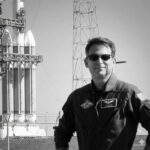
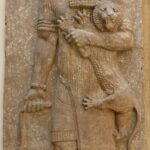
From WW II Foo Fighters to Vietnam War Spheres: a UAP Shadow History
Highlights
Perspectives

The Cartography of High Strangeness
Experiencer narrative by Richard Monck
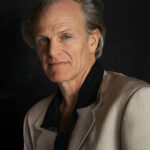
At Our Wits’ End: UAP aren't the threat, we are!
An opinion piece by Alan Steinfeld
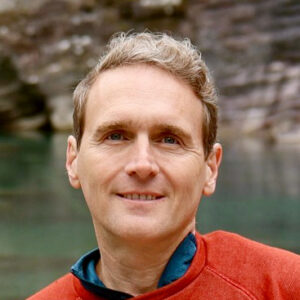
Who Is Afraid Of The Big Bad NHI?
An perspective article by Daniel Branco, PhD.

The Five Stages of Mindful Disclosure
A white paper by Dr. Tara, PhD.
Editorials
Why are we obsessed with UAP and unidentified anomalous phenomena? Explore the psychology, culture, and evidence behind modern UFO fascination.
By Tim Spenny – Co-founder UAPedia

An in-depth analysis of why AARO failed to earn public trust, examining structural limits, transparency gaps, and the growing UAP credibility crisis.
By Eduardo Mace – Co-Founder UAPedia
Featured Categories

Historical Context & Notable Cases
From ancient accounts to trace verified sightings and declassified reports from all over the world. (51 Articles)

Non-Human Intelligence (NHI)
From definitions, to technologies of unknown origin, meta-materials and hypothesis. (11 Articles)

Consciousness & High-Strangeness
From research to government programs, religious experiences and hotspots. (33 Article)

Archives, Data & Sensor Analysis
From sensor systems and plaforms to multimodal data, reporting standards and databases. (6 Articles)
Abductions & Contact Experiences
From explainers to investigative articles we cover everyting from classic abduction Cases, to common elements in abduction narratives, experiencer research & investigators, contact modalities, social Stigma, ontological Shock, and classic UAP contact experiences and experiencers.
(23 Articles)
Deep Dive
Media Partnership

Archives
The Alan Steinfeld Archive at UAPedia
Biographic
Explore seventy of the biggest names in UAP history.

Explainers
Breaking down the findings, what is and isn’t.
We have started a partnership with WOW! Signal News, expanding our role as a media-connected knowledge platform. The partnership will support broader access to UAP-related reporting, analysis, interviews, and cross-platform content.

WATCH NOW UAPCon 2
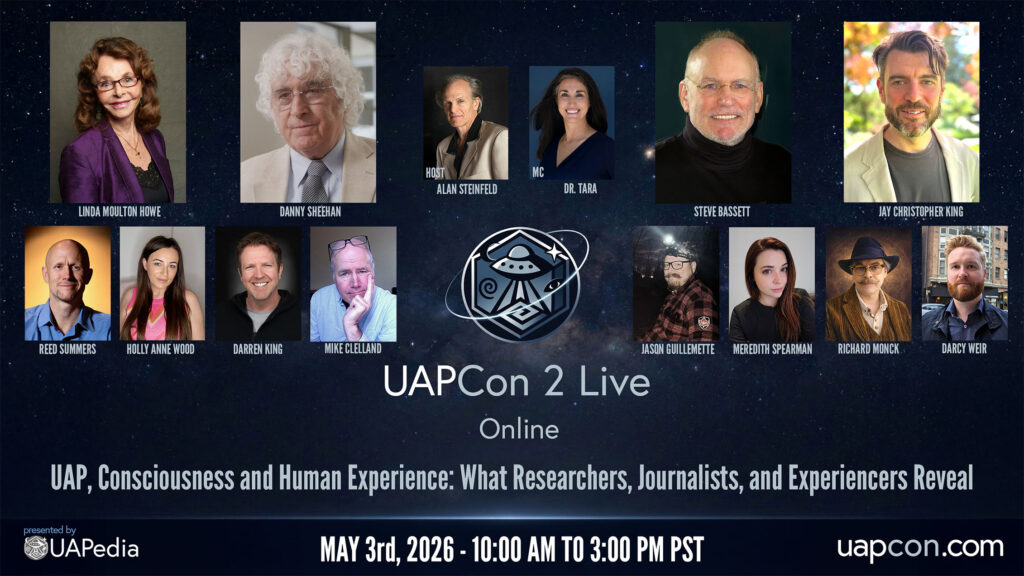
UAPCon 2 was a huge succcess! Thank you speakers, audience and crew for making this happen!
With 12 speakers, UAPCon 2 Live Online invites those who perceive the UAP phenomenon as a threshold for humanity.
What Researchers, Journalists, and Experiencers Reveal
UAPCon 2 builds on the first UAPCon by turning toward one of the most complex and consequential dimensions of the phenomenon: its relationship to consciousness. Through keynotes, research spotlights, and moderated panels, this second edition brings together researchers, journalists, and experiencers to examine where observation ends, where interpretation begins, and what patterns may emerge when testimony is taken seriously but assessed with care.
Latest Articles
Interfacing with ET Realities: A Conversation with Tim Tactical
Explore Alan Steinfeld’s interview with Tim Tactical on ET contact, breakaway groups, light dimensions, and humanity’s consciousness shift.
William Linville’s Mission to Assist Humanity’s Spiritual Evolution
Alan Steinfeld interviews William Linville on his walk-in soul experience, spiritual awakening, ego release, and humanity’s shift to unity consciousness.
Bridging Neuropsychology and Spirituality: A Conversation with Tom Kenyon
Explore Tom Kenyon’s insights on consciousness evolution, Hathor channeling, neuropsychology, spirituality, and personal transformation.
Grant Cameron discusses John Podesta, WikiLeaks, and UFO Disclosure
Alan Steinfeld interviews Grant Cameron on John Podesta’s WikiLeaks emails, UFO disclosure, Tom DeLonge, and the consciousness behind UAPs.
Phantom Airships Over North America, 1913
Explore the 1913 phantom airship wave, when a rare Great Meteor Procession sparked UAP-like reports across North America.
After the Deluge: Flood Myths as Earth Memory
Explore how ancient flood myths may preserve real memories of sea-level rise, tsunamis, and megafloods through geology and cultural history.