
For more than five decades Hal Puthoff has occupied a rare intersection where controversial ideas meet government interest.
He trained and worked as a physicist in lasers and quantum electronics, then became known in the 1970s for pioneering and polarizing research at SRI into anomalous cognition, followed by decades of theoretical work on the quantum vacuum, “metric engineering,” and advanced propulsion concepts.
In the modern UAP era he served as a senior scientific voice for the Defense Intelligence Agency’s AAWSAP reference studies and later as cofounder and Vice President for Science and Technology at To The Stars Academy, helping connect UAP “observables” to testable physics and defense relevance.
Admirers see a boundary-pushing scientist who gave UAP a coherent technical vocabulary.
Critics see speculative physics and earlier parapsychology that did not replicate. Either way, Puthoff’s imprint on the UAP conversation is unusually deep and still growing. (EarthTech)
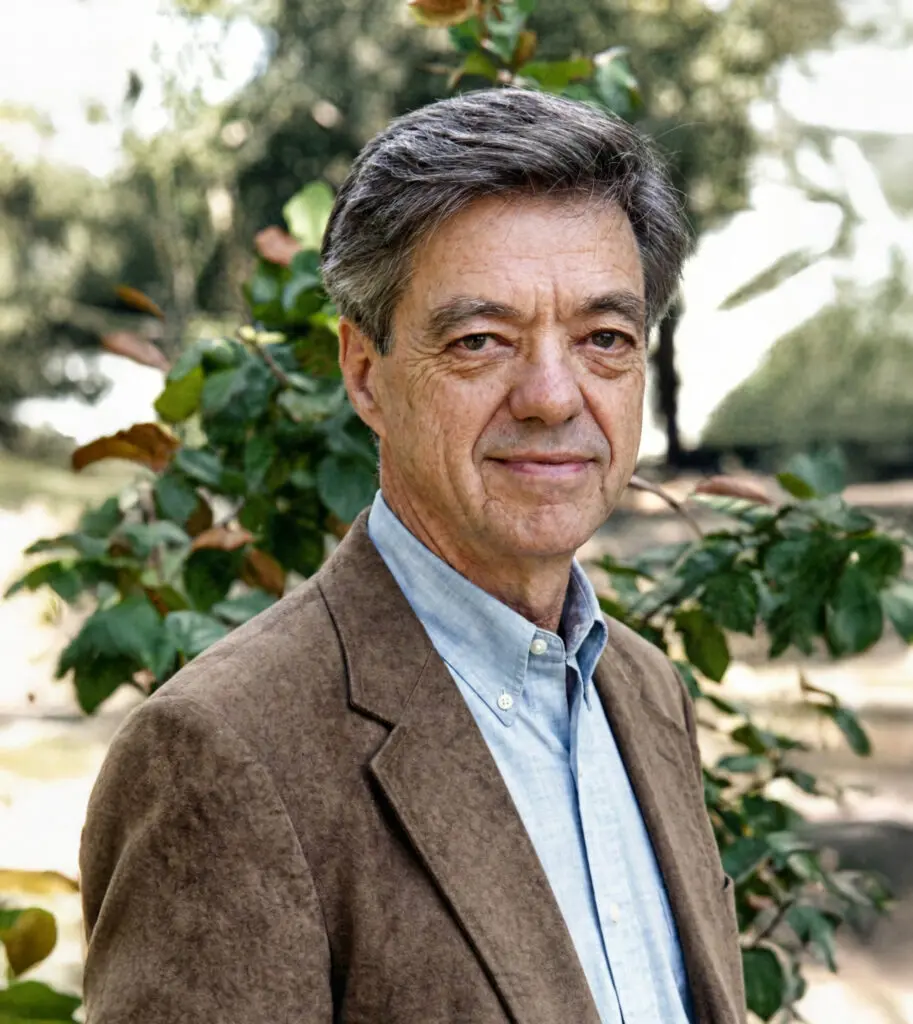
Origins, training, and early career
Puthoff earned a PhD at Stanford in 1967 in electrical engineering and co-authored a widely used text, Fundamentals of Quantum Electronics (Wiley, 1969).
He worked in industry and government, including early optoelectronic and laser systems, before moving into research roles that set the stage for a career at the edge of conventional physics.
Official biographies at EarthTech and IRVA summarize his training, government consulting, and the creation of the Institute for Advanced Studies at Austin in the 1980s. (EarthTech)
SRI and anomalous cognition
From the early 1970s into the 1980s, Puthoff and Russell Targ led CIA and DIA-funded experiments at SRI on what they called “remote viewing.”
Their 1974 Nature paper, “Information transmission under conditions of sensory shielding,” became a lightning rod, as did follow-up exchanges about methodology and replication.
Whatever one’s conclusion, these experiments drew sustained government attention and launched what later became known as the Stargate program.
The original paper and later discussions are preserved in the CIA reading room and PubMed indexes. (PubMed)
The SRI work immediately faced critiques, especially claims that sensory cues in transcripts could allow judges to match descriptions to targets.
David Marks and Richard Kammann’s analyses in Nature argued that when cueing was removed, significance disappeared.
Puthoff and colleagues replied in Nature that the critique focused on protocol artifacts rather than content correlations, and the debate persisted for years.
These exchanges remain a central part of how historians evaluate the SRI chapter. (Nature)
Puthoff’s supporters emphasize that classified sponsors maintained the program for decades, which they take as a proxy for perceived utility.
Skeptics counter that utility claims were not sustained under independent replication and that cueing risks were real. The enduring value of the SRI era for UAP is twofold.
It shows Puthoff’s willingness to attack taboo questions with formal protocols, and it introduced him to the intelligence and defense ecosystem he later engaged on UAP.
Primary documents and later reviews outline both sides of the record. (PMC)
From lasers to the vacuum: zero-point energy and “polarizable vacuum” models
In the late 1980s and 1990s Puthoff turned to the quantum vacuum as a potential driver of inertia and, ultimately, propulsion.
Key papers with Bernhard Haisch and Alfonso Rueda proposed that inertia could emerge as a Lorentz-force reaction to the electromagnetic zero-point field.
Later, Puthoff developed a “polarizable vacuum” (PV) representation of general relativity, recasting spacetime curvature in optical-medium language. These ideas are laid out in peer-reviewed venues and popular summaries, and they underpin his later “metric engineering” proposals. (APS Link)
The work drew criticism.
Physicist Yefim Levin examined the Haisch-Rueda-Puthoff inertia model and argued that the derivation did not support the claimed mechanism.
Others challenged parameter choices and the feasibility of extracting useful work or thrust from the vacuum without violating known constraints.
These debates in Physical Review A and related literature form the open scientific context for Puthoff’s proposals. (APS Link)
Even critics acknowledge that the PV formalism can be a pedagogical tool for thinking about metric effects. Puthoff’s argument is that if spacetime can be modeled as a variable-index medium, then in principle engineering the medium could alter inertial and gravitational characteristics.
That hypothesis later informed Defense Intelligence Agency (DIA) studies and public talks about how unconventional craft might display their “five observables.” (SpringerLink)
NIDS, Bigelow, Skinwalker, and the AAWSAP/AATIP era
By the mid-1990s Puthoff was part of the science orbit around Las Vegas entrepreneur Robert Bigelow, who formed the National Institute for Discovery Science (NIDS).
NIDS examined UAP and other anomalies, including fieldwork at Utah’s Skinwalker Ranch.
The NIDS period connected Puthoff with investigators such as Colm Kelleher and Eric W. Davis and with aerospace and intelligence contacts who later intersected with AAWSAP, AATIP, and To The Stars.Contemporary and retrospective reporting outlines that network. (WIRED)
In 2008–2010 the Defense Intelligence Agency funded the Advanced Aerospace Weapon System Applications Program (AAWSAP), administered through Bigelow Aerospace Advanced Space Studies. As part of that program DIA commissioned 38 Defense Intelligence Reference Documents (DIRDs) on forward-leaning aerospace topics.
Puthoff authored at least one DIRD, “Advanced Space Propulsion Based on Vacuum (Spacetime Metric) Engineering,” which elaborates on “engineering the vacuum” for propulsion.
The DIA’s FOIA reading room and congressional records host versions or references to these documents. (Public Intelligence |)
The DIRDs do not claim that UAP are definitively explained. They outline theoretical frameworks and survey literature relevant to extreme propulsion, energy, materials, sensors, and human effects.
A separate DIRD, “Anomalous Acute and Subacute Field Effects on Human Biological Tissues,” by Christopher “Kit” Green, reviewed reported injuries in proximity to anomalous systems and suggests mechanisms worth study.
The DIA has released this document under FOIA, and press coverage summarized it for lay readers. These AAWSAP outputs, together with AATIP’s later focus on military incidents, are the context in which Puthoff’s physics proposals became relevant to UAP. (dia.mil)
To The Stars Academy and the modern UAP wave
In October 2017 Tom DeLonge announced To The Stars Academy of Arts & Science (TTSA) as a public-benefit corporation blending media, science, and aerospace. Puthoff was a cofounder and served as Vice President for Science and Technology, alongside Jim Semivan, Luis Elizondo, Christopher Mellon, and Steve Justice.
The launch showcased a team whose backgrounds in CIA, DoD, and Skunk Works altered how mainstream outlets framed UAP. (PR Newswire)
TTSA’s strategy had two planks that drew on Puthoff’s background.
First, public communication. The History Channel series Unidentified: Inside America’s UFO Investigation put pilots and former officials on record and situated their accounts within a national-security frame. Puthoff appeared as one of the scientific voices on the series’ cast pages.
Second, science and materials. TTSA created the ADAM project to acquire and test “metamaterials” linked by provenance claims to UAP incidents, and then announced a 2019 cooperative R&D agreement with the U.S. Army to evaluate potential defense applications of any unusual properties. (aegm.com)
The “metamaterials” story became one of the era’s focal controversies.
TTSA said that layered Mg-Zn-Bi material and other samples warranted structured analysis. Independent reporting documented that the company paid for certain samples, including pieces previously held by journalists, and that skeptics suggested industrial byproduct explanations.
In 2024, AARO released a synopsis of Oak Ridge National Laboratory testing of a layered Mg-Zn-Bi specimen with a long and contested chain of custody.
ORNL concluded the specimen was terrestrial, showed no exotic isotopic signatures, and was unsuitable as a terahertz waveguide in the configuration tested.
That finding does not foreclose the existence of other unusual materials, but it raised the evidentiary bar for provenance claims. (VICE)
TTSA’s Army CRADA was significant in the process. Defense journalists emphasized that the agreement did not validate extraordinary claims, but it did commit an Army lab to verify whether any reported properties were real and relevant to ground systems, for example in signature control or sensors.
In that sense it reflected Puthoff’s long stance that audacious claims should be pulled into the lab and tested against instrumented reality. (The War Zone)
Books, papers, and talks
Puthoff’s bibliography spans three distinct threads that together shaped how UAP is discussed today.
- Quantum electronics and optics. With Richard H. Pantell he co-authored Fundamentals of Quantum Electronics (1969). This text anchored his early career in mainstream physics and lasers. (Google Books)
- Anomalous cognition. With Russell Targ he co-authored Mind-Reach: Scientists Look at Psychic Abilities (1977), a book that narrates the SRI remote-viewing program for a general audience. Declassified and reprint editions remain available via CIA archives, Google Books, and commercial publishers. (CIA)
- Vacuum physics and metric engineering. Seminal papers include “Inertia as a zero-point-field Lorentz force” (with Haisch and Rueda, Phys. Rev. A, 1994) and the “Polarizable Vacuum” representation of general relativity (Foundations of Physics, 2002).
He later wrote “Advanced Space Propulsion Based on Vacuum (Spacetime Metric) Engineering,” both in the Journal of the British Interplanetary Society and as a DIA reference document, and co-authored “Engineering the Zero-Point Field and Polarizable Vacuum for Interstellar Flight.”
These texts are dense, speculative, and central to his argument that some UAP performance might be explained by future reachable physics. (APS Link)
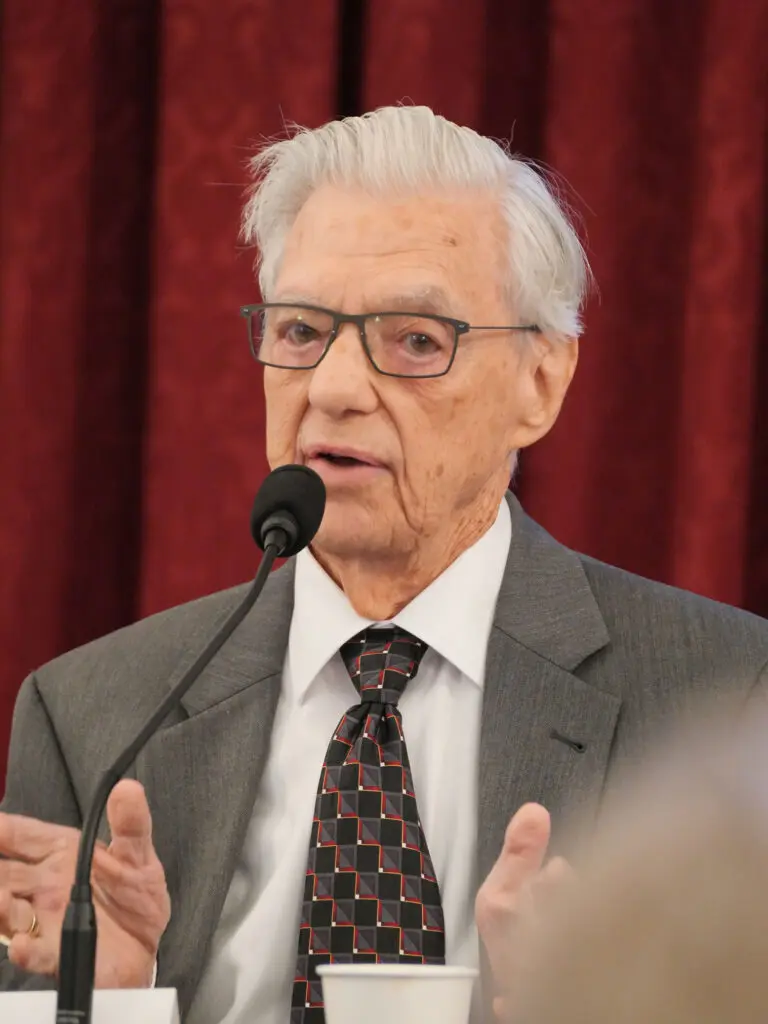
Puthoff has also presented public lectures that bring these strands together for a UAP-curious audience.
His 2018 plenary at the joint Society for Scientific Exploration and IRVA conference in Las Vegas outlined programmatic interest inside government and walked through “five observables” reported in multiple military incidents: instantaneous acceleration, hypersonic velocity without signatures, low observability, trans-medium travel, and positive lift without discernible means.
TTSA codified these observables for outreach and analysis. (YouTube)
In the 2020s he continued to discuss these topics in interviews and long-form conversations.
Recent appearances include roundtable discussions on the physics of UAP, a 2025 episode of The Joe Rogan Experience and a major role in The Age Of Disclosure (Nov. 2025) documentary film by Dan Farah.
Although interviews are not peer review, they document how Puthoff frames both the promise and limitations of present theory.
Known public connections and collaborators
- Russell Targ, co-principal at SRI’s remote viewing research and co-author of Mind-Reach. (PubMed)
- Ingo Swann, Pat Price, Joseph McMoneagle, SRI subjects whose reported abilities became central to the remote-viewing narrative. Primary experiment records and later reviews discuss their sessions and controversies. (CIA)
- Bernhard Haisch and Alfonso Rueda, collaborators on zero-point physics and inertia. (APS Link)
- Robert Bigelow and Colm Kelleher, NIDS and later BAASS leadership on anomaly research with whom Puthoff worked during the Skinwalker and AAWSAP period. (WIRED)
- Eric W. Davis, long-time colleague at EarthTech and contributor to AAWSAP DIRDs on wormholes and energy, frequently co-located with Puthoff on research initiatives. (Wikipedia)
- Christopher “Kit” Green, author of the AAWSAP DIRD on human biological effects, a frequent presence in the same research ecosystem. (dia.mil)
- Tom DeLonge, Jim Semivan, Luis Elizondo, Christopher Mellon, Steve Justice, TTSA cofounders and advisers who, with Puthoff, helped push UAP into mainstream policy and media. (PR Newswire)
Controversies and criticism
Replication and cueing in SRI experiments
SRI studies are a permanent controversy in the literature. Marks and Kammann’s critiques in Nature argued that sensory leakage could account for significant results.
Puthoff and colleagues rebutted, and the debate continued.
Beyond individual experiments, meta-claims about operational utility remain disputed.
The strongest take-away for UAP biography is that this chapter established Puthoff’s style: formalize bold claims, invite government sponsors, and face hard-edged critique. (Nature)
Zero-point physics and PV gravitation models
The HRP inertia hypothesis and PV formalism attracted critical analysis from multiple physicists who argued that derivations or parameter choices failed to establish the claimed mechanisms.
Puthoff has responded over the years with refinements and heuristic framing.
These debates matter because they undergird proposals that UAP performance might be explainable via advanced “metric engineering,” an assertion that is provocative and not yet supported experimentally. (APS Link)
Metamaterials and provenance
TTSA’s ADAM program revived a decades-old lore of layered magnesium-bismuth artifacts.
Vice and defense outlets reported on the acquisitions and questioned whether samples were exotic or industrial slag.
In 2024, AARO sponsored ORNL testing of a well-known specimen and reported that the material was terrestrial and did not function as a waveguide in the relevant configuration.
Advocates say one null result does not close the case for all materials. Critics respond that the burden of proof is squarely on chain-of-custody and peer-reviewed tests with transparent data. (VICE)
Religion and personal beliefs in early career
Public sources note Puthoff’s involvement with Scientology in the late 1960s and 1970s and say he severed ties decades ago.
This history surfaces in profiles because it intersects with the SRI period. Reputable biographies focus on his later decades of physics and aerospace consulting.
Claims and predictions
Across papers, talks, and interviews, several recurring claims and forecasts define Puthoff’s UAP posture.
- Metric engineering may someday be practical. Puthoff predicts that manipulating the vacuum or spacetime metric, while beyond present engineering, is a legitimate pathway for breakthrough propulsion research.
He frames this as a long-term bet that threads through DIA DIRDs and JBIS papers. (arXiv)
- The “five observables” are a real technical signature set.
He argues that multiple military cases exhibit a repeating cluster of performance characteristics that should drive sensor fusion, modeling, and adversary assessment. TTSA popularized this framework, and Puthoff’s 2018 lecture placed it in a programmatic context. (YouTube)
- Some UAP may represent nonhuman intelligence.
In documentary and panel settings he has occasionally speculated about multiple nonhuman types or long-standing interactions. Journalism that covers recent films and conferences attributes such statements to him. He typically couples such comments to calls for transparent science and careful data handling. (The Washington Post)
- Materials and bioeffects can be tested. Through AAWSAP’s DIRDs, TTSA’s ADAM program, the Army CRADA, and advocacy for laboratory study, he has consistently predicted that empirical work on samples and human effects would clarify which claims are real.
Impact on the UAP community and policy discourses
Puthoff’s impact is less about a single proof and more about institutional posture.
- He gave UAP a physics vocabulary.
By translating performance claims into metric engineering, zero-point considerations, and optical-medium analogies, he offered conceptual handles for engineers and defense planners to talk about UAP without defaulting to ridicule. The JBIS and DIA texts are reference points for that conversation. (arXiv)
- He bridged communities.
From SRI and CIA contracts to NIDS and AAWSAP to TTSA and cable television, he connected lab, policy, and public. This bridge helped normalize pilot testimony and moved “UAP” from taboo into policy channels where the Navy, DoD, and Congress created reporting processes and task forces. While many actors contributed, Puthoff’s role as a technical explainer was distinctive. (aegm.com)
- He insisted on instrumented tests.
Whether one agrees with his starting hypotheses, he consistently pushed to bring samples, cases, and models to the lab. The Army CRADA and AARO’s ORNL work exemplify his preferred direction of travel. The UAP field benefits when bold claims meet world-class measurement. (The War Zone)
Film and television
Puthoff is a subject rather than a filmmaker.
His role in Unidentified: Inside America’s UFO Investigation put a career’s worth of ideas before a mainstream audience and implicitly argued that UAP deserves both policy and technical attention.
Interview series and podcasts in 2022–2025 expanded his reach to audiences of scientists, technologists, and popular media consumers. (Sky HISTORY TV channel)
He was one of the main interviewees in The Age of Disclosure (2025), as chief scientist to the AATIP program.
A selective timeline
- 1967–1969. Completes PhD at Stanford, co-authors Fundamentals of Quantum Electronics. (EarthTech)
- 1972–1985. At SRI, directs CIA/DIA-funded remote-viewing research with Russell Targ, culminating in the 1974 Nature paper and sustained debate. (PubMed)
- 1985–present. Founds the Institute for Advanced Studies at Austin (later within EarthTech International), consulting for government and industry on advanced concepts. (EarthTech)
- 1994–2002. Publishes zero-point inertia and PV representations of GR with Haisch and Rueda, then solo, setting up later “metric engineering” work. (APS Link)
- 1990s–2000s. Associated with NIDS and Bigelow’s anomaly research programs, building networks that feed into AAWSAP. (WIRED)
- 2009–2010. Authors a DIA Defense Intelligence Reference Document: “Advanced Space Propulsion Based on Vacuum (Spacetime Metric) Engineering.” Related AAWSAP DIRDs include Kit Green’s human-effects survey. (Public Intelligence |)
- 2017. Co-founds TTSA as VP for Science and Technology. (PR Newswire)
- 2019. Appears in Unidentified as a scientific voice. TTSA announces metamaterials acquisition and later a CRADA with the U.S. Army. (Sky HISTORY TV channel)
- 2024. AARO releases ORNL synopsis on a layered Mg-Zn-Bi specimen with a contested provenance, concluding terrestrial origin and no waveguide function. (AARO)
- 2025. Continues public engagement on the physics and policy of UAP in long-form interviews.
Balanced assessment
Puthoff is among the few figures whose careers span all three pillars of the modern UAP landscape: intelligence programs, laboratory and theoretical research, and mainstream cultural communication.
The costs and benefits of that breadth are visible in the record.
On the plus side, he made it easier for insiders to talk about UAP in technical terms and for the public to see UAP as a legitimate subject of inquiry. He pushed for cooperative research, persuaded an Army lab to take a look at disputed materials, and helped frame a set of “observables” that journalists and policymakers now recognize.
On the cautionary side, some of his most publicized research threads are unproven or strongly contested. SRI experiments met rigorous challenges about cueing and replication.
The inertia-from-zero-point derivation and PV approach are still debated in physics journals.
The metamaterials that captivated public imagination have so far yielded terrestrial explanations in the most publicized test.
None of that negates the value of asking big questions. It does demand that UAP science raise its standards of data custody, instrument calibration, and publication.
One can disagree with particular claims and still conclude that Puthoff’s method of tackling taboo questions, then inviting the lab and the lab’s critics, moved the field forward.
His career is a case study in how UAP makes science and policy uncomfortable, and why the right response is more measurement rather than less.
References
EarthTech. (n.d.). Principal team: Harold (Hal) Puthoff, PhD.
https://earthtech.org/team/ (EarthTech)
Pantell, R. H., & Puthoff, H. E. (1969). Fundamentals of quantum electronics. Wiley.
https://books.google.com/books/about/Fundamentals_of_Quantum_Electronics.html?id=9feYnQEACAAJ (Google Books)
Targ, R., & Puthoff, H. (1974). Information transmission under conditions of sensory shielding. Nature, 251(5476), 602–607.
https://pubmed.ncbi.nlm.nih.gov/4423858/
Declassified copy: CIA FOIA Reading Room.
https://www.cia.gov/readingroom/document/cia-rdp96-00787r000100220001-8 (PubMed)
Marks, D. (1981). Sensory cues invalidate remote viewing experiments. Nature, 292(5818), 177–179.
https://www.nature.com/articles/292177a0 (Nature)
Puthoff, H. E. (1981). Rebuttal of criticisms of remote viewing experiments. Nature, 292, 388–389.
https://www.nature.com/articles/292388a0 (Nature)
Haisch, B., Rueda, A., & Puthoff, H. E. (1994). Inertia as a zero-point-field Lorentz force. Physical Review A, 49(2), 678–694.
https://link.aps.org/doi/10.1103/PhysRevA.49.678 (APS Link)
Levin, Y. S. (2009). Critical analysis of the Haisch-Rueda-Puthoff inertia theory. Physical Review A, 79(1), 012114.
https://link.aps.org/doi/10.1103/PhysRevA.79.012114 (APS Link)
Puthoff, H. E. (2002). Polarizable-vacuum approach to general relativity. Foundations of Physics, 32, 927–943.
https://link.springer.com/article/10.1023/A:1016011413407
Preprint: https://arxiv.org/abs/gr-qc/9909037 (SpringerLink)
Puthoff, H. E. (2010). Advanced space propulsion based on vacuum (spacetime metric) engineering. Defense Intelligence Agency, DIRD.
https://info.publicintelligence.net/DIA-AdvancedSpacePropulsion.pdf
Congressional copy: https://www.congress.gov/118/meeting/house/116282/documents/HHRG-118-GO06-20230726-SD005.pdf (Public Intelligence |)
Puthoff, H. E., & Little, S. R. (2010). Engineering the zero-point field and polarizable vacuum for interstellar flight. arXiv.
https://arxiv.org/abs/1012.5264 (arXiv)
Green, C. (2010). Anomalous acute and subacute field effects on human biological tissues (DIRD). Defense Intelligence Agency FOIA Electronic Reading Room.
https://www.dia.mil/FOIA/FOIA-Electronic-Reading-Room/FileId/170026/ (dia.mil)
To The Stars Academy of Arts & Science. (2017, October 11). TTSA launches today [press release].
https://www.prnewswire.com/news-releases/to-the-stars-academy-of-arts–science-launches-today-300534912.html (PR Newswire)
To The Stars. (2019, July 25). TTSA makes groundbreaking metamaterials acquisition.
https://tothestars.media/blogs/press-and-news/to-the-stars-academy-of-arts-science-makes-groundbreaking-metamaterials-acquisition (To The Stars*)
To The Stars. (n.d.). Research: ADAM overview and “five observables” explainer.
https://tothestars.media/pages/research
https://tothestars.media/blogs/press-and-news/five-characteristics-unique-to-uaps (To The Stars*)
The War Zone. (2019, Oct. 18–20). What we know about the Army teaming up with TTSA and The Army wants to verify TTSA’s mystery material claims.
https://www.twz.com/30481/what-we-know-about-the-army-teaming-up-with-rockstar-tom-delonges-ufo-research-company
https://www.twz.com/30498/the-army-wants-to-verify-to-the-stars-academys-fantastic-ufo-mystery-material-claims (The War Zone)
Banias, M. J. (2019, Oct. 4). Tom DeLonge’s UFO research company paid $35,000 for exotic metals that might just be bismuth. VICE.
https://www.vice.com/en/article/tom-delonges-ufo-research-company-paid-dollar35000-for-exotic-metals-that-might-actually-just-be-bismuth/ (VICE)
AARO. (2024, July 10). Synopsis: Analysis of a metallic specimen (ORNL).
https://www.aaro.mil/Portals/136/PDFs/Information%20Papers/ORNL-Synopsis_Analysis_of_a_Metallic_Specimen.pdf (AARO)
A+E/History via Apple TV. (2019). Unidentified: Inside America’s UFO Investigation [series listing].
https://tv.apple.com/us/show/unidentified-inside-americas-ufo-investigation/umc.cmc.4pg3zounqd9jsmx1pkrbgxxq2
History UK cast page for Hal Puthoff:
https://www.history.co.uk/shows/unidentified/cast/hal-puthoff (Apple TV)
OpenMinds. (2017, Oct. 11). Transcript of the To The Stars Academy press conference.
https://openminds.tv/transcript-of-to-the-stars-academy-press-conference/ (openminds.tv)
IRVA. (n.d.). Hal Puthoff, PhD [speaker profile].
https://www.irva.org/speaker/puthoff-hal
The Portal Group. (2022, Feb. 11). American Alchemy: The Physics of UFOs, Eric Weinstein + Hal Puthoff.
https://theportal.group/american-alchemy-the-physics-of-ufos-eric-weinstein-hal-puthoff/
iHeart. (2025, May 1). The Joe Rogan Experience #2314 — Hal Puthoff [podcast listing].
https://www.iheart.com/podcast/1057-the-joe-rogan-experience-27959911/episode/2314-hal-puthoff-273873571/
Wired. (2018, Feb. 24). Inside Robert Bigelow’s decades-long obsession with UFOs.
https://www.wired.com/story/inside-robert-bigelows-decades-long-obsession-with-ufos/ (WIRED)
Psi Encyclopedia. (2022). Harold E. Puthoff. Society for Psychical Research.
https://psi-encyclopedia.spr.ac.uk/articles/harold-puthoff (Psi Encyclopedia)
SEO keywords
Hal Puthoff UAP biography, AAWSAP DIRD vacuum engineering, zero-point energy inertia HRP, polarizable vacuum general relativity, To The Stars Academy VP Science, TTSA metamaterials ADAM project, Army DEVCOM TTSA CRADA, SRI remote viewing Nature 1974, five observables UAP physics, AARO ORNL layered magnesium bismuth analysis, EarthTech Institute for Advanced Studies at Austin, Robert Bigelow NIDS Skinwalker, Eric Davis Kit Green collaborators