
UAP investigations live or die on data hygiene. The fastest way to preserve truly anomalous signals is to quickly and fairly eliminate known environmental/atmospheric causes without defaulting to them as an ideology. This catalog is a working reference for the four most commonly implicated classes in modern UAP casework:
- TLEs (Transient Luminous Events) sprites, ELVES, blue jets, gigantic jets, etc.
- Ball lightning rare, luminous, near-thunderstorm phenomena with competing models.
- Atmospheric ducting refractive “waveguides” that bend radio/radar (and sometimes light) beyond normal horizons.
- Mirages inferior/superior/Fata Morgana distortions from thermal inversions and ducts.
For each, you’ll find definitions, observables, instrument signatures, known pitfalls, and links to primary or authoritative sources. Our editorial stance remains open to authentic anomalies; this catalog is a noise filter, not a verdict.
Transient Luminous Events (TLEs)
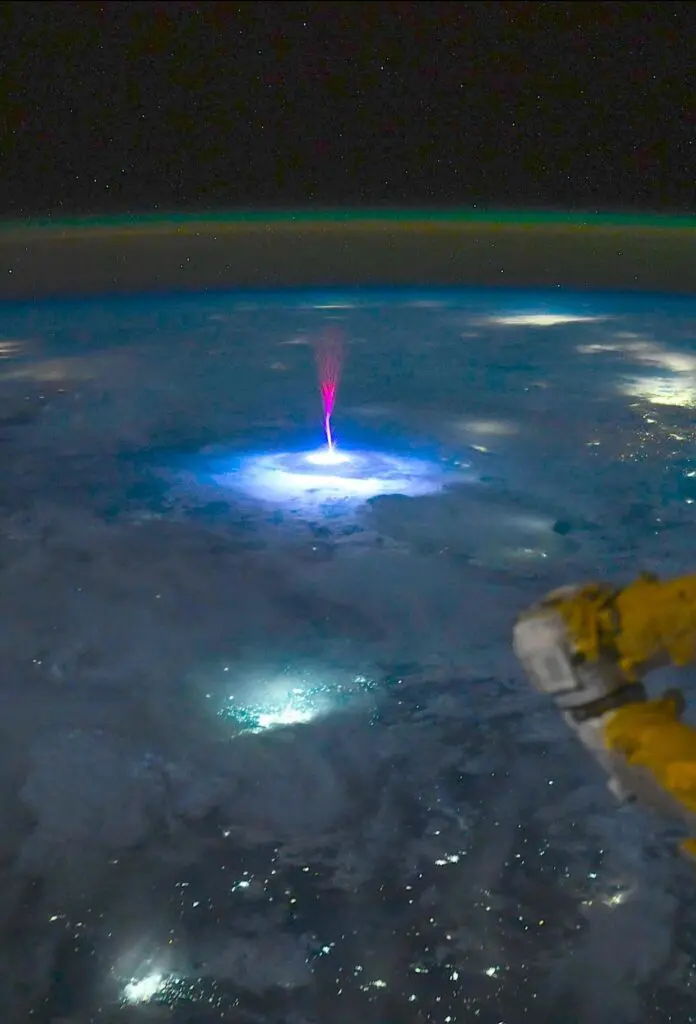
TLEs are fast, lightning-related electrical discharges above thunderstorms, not inside them, occurring from the upper troposphere into the mesosphere/ionosphere (e.g., ~40–100+ km). Named classes include sprites (often red, jellyfish/column forms), ELVES (rapid, expanding rings at ~90–100 km), blue jets and gigantic jets (upward, cone-shaped discharges from thundercloud tops). Modern spaceborne and ground campaigns have directly recorded, characterized, and modeled these events. Nature
- Sprites were first confirmed on video in 1989; the literature since has detailed triggering conditions, heights, and optical morphology. Vaisala
- Blue jets/gigantic jets have been imaged from aircraft and the ISS; recent Nature work captured the onset of a jet into the stratosphere with multi-instrument data, improving models of leader/streamer development. Nature
- ELVES are ionospheric-scale rings excited by the electromagnetic pulse (EMP) from powerful lightning; they can reach hundreds of kilometers in diameter and last <1 ms. Skybrary
Space platforms (e.g., ISS/ASIM) now provide vantage points and timing that correlate TLEs with underlying storm electrification, giving altitude-calibrated datasets for validation. EO Portal
How they behave
- Optical: From ground level, sprites/ELVES may appear as brief red flashes or arcs above distant storms, sometimes at the horizon; long-lens videos can accentuate “structured” shapes that look engineered.
- Temporal: They are fleeting (ms–tens of ms), so witnesses may report “instantaneous craft.”
- Geospatial: Observations align with deep convection, but may appear far from local weather if seen over the horizon.
What the data look like
- Video/photography: High-frame-rate, low-noise sensors; red-dominant spectra for sprites (N₂ band emissions), faint blue for jets. Skybrary
- EM signatures: Correlate with VLF/LF radio from parent lightning; ELVES tie to EMP timing. Vaisala
- Geometry: Height retrievals via triangulation or star-field registration; ASIM datasets provide constraints. EO Portal
Analyst checklist
- Check lightning networks (WWLLN/GLD360/regional) and satellite storm products for time-locked correlation.
- If imagery shows expanding ring high above storms within ~1 ms → ELVES candidate. If red, tendriled, jellyfish forms → sprite candidate. If upward blue cone from cloud top → blue/gigantic jet candidate. Nature
Ball Lightning
Ball lightning (BL) refers to rare, luminous spherical or spheroidal events near thunderstorms, typically 5–50 cm in diameter, lasting seconds to tens of seconds, moving erratically or drifting. It remains uncommon and poorly predictable, but there are instrumented observations and lab analogs that anchor the discussion. PMC
The first optical spectrum of a natural event (recorded in China) showed lines consistent with silicon, iron, and calcium, elements abundant in soil, pointing to a chemical-energy model for at least some BL cases. Physical Review
A leading hypothesis (Abrahamson & Dinniss, 2000) posits that lightning striking soil creates silicon-rich nanoparticles; oxidation of this aerosol “network” produces light and longevity. Laboratory work has produced ball-like fireballs via silicon discharges and microwave-driven plasmoids, supporting families of models though not closing the case. PubMed Physical Review
State of play: The literature supports that some BL reports have physical bases with spectra/chemistry consistent with soil-derived aerosols and/or microwave/plasma mechanisms. No single model explains all reports. Physical Review
How it behaves
- Morphology: Small, bright spheres seen near power lines/windows or indoors (microwaves can penetrate glass), reported to pass through apertures, leading to “intelligent orb” narratives.
- Kinematics: Slow drift, sudden vanishing or explosive end; in low-frame-rate video, motion can appear “non-ballistic.”
- Context: Thunderstorm proximity is common but not universal in reports.
What the data look like
- Spectra: Soil-linked Si/Fe/Ca lines (field spectrum example: PRL 2014). Physical Review
- RF/EM: Mixed; some lab plasmoids radiate microwaves, but field EM data are sparse.
- Environment: Correlate with cloud-to-ground strikes or intense local fields.
Analyst checklist
- Was there recent lightning within minutes/kilometers? Check networks and time-sync.
- Any spectral or polarimetric data? (Even smartphone diffraction gratings can help.)
- Don’t overfit: BL is rare. Many “orbs” are insects/bokeh near focus or LED artifacts.
Atmospheric Ducting (Radio/Radar & Optical Implications)
Atmospheric ducting occurs when sharp vertical gradients in temperature and moisture (often a low-level inversion) create layers where the refractive index traps electromagnetic waves, guiding them like a waveguide. In the troposphere, ducting can push radar and radio beyond normal line-of-sight, producing over-the-horizon returns, false targets, and “ghost tracks”. National Weather Service
- Anomalous Propagation (AP) in weather radar: beams bent downward (super-refraction) illuminate the surface and return as false echoes, contaminating products. NOAA and academic tutorials explicitly warn operators and users about AP artifacts. NOAA
- Maritime/Coastal radar: Surface-based or elevated ducts are seasonal and diurnal; peer-reviewed climatologies show spring–summer maxima in some regions, yielding frequent over-range contacts. American Meteorological Society Journals
- Propagation physics & defense relevance have been deeply studied (NTIA, Navy/AREPS): performance and false-track risk depend on duct height, radar frequency, antenna height, elevation angle. Higher microwave frequencies are more susceptible. its.ntia.gov met.nps.edu
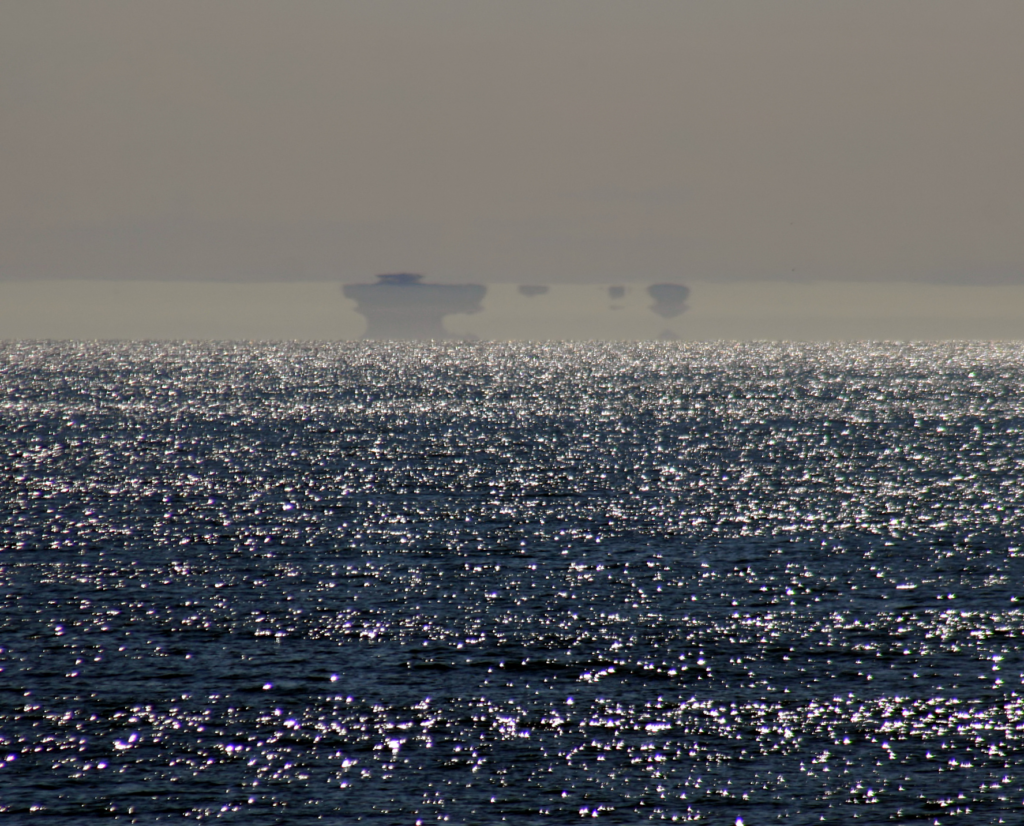
Optical link: When ducting forms in the visible regime (strong inversion), it supports superior mirages and Fata Morgana, see Section 4. aty.sdsu.edu
How it behaves
- Radar: Ducting can “paint” coastlines, ships, wind farms, or terrain as moving plots at unexpected ranges/altitudes; AP can also drop real targets (sub-refraction) or fragment tracks. Dipòsit Digital
- Comms/ADS-B: VHF/UHF radios, AIS, and secondary surveillance can experience skip/interference, creating phantom or distant signals.
- Optical: Superior mirage regimes create apparent hovering/stacked objects near the horizon.
What the data look like
- Radar: Widespread ground-like speckle (“radar blooms”), fixed-bearing arcs, or ranged-aliased returns, in time loops, AP expands and contracts with inversion strength and often fades after sunrise. NOAA
- Meteorology: Surface obs + radiosonde/reanalysis show inversions or strong refractivity gradients coincident with events. American Meteorological Society Journals
Analyst checklist
- Pull upper-air or refractivity profiles for the time/place; check sea-surface temperature vs. air over water (classic marine ducting set-up). secwww.jhuapl.edu
- Review coastal radar logs for AP flags; NOAA training pages explain signatures. NOAA
- For case narratives with long-range radar tracks hugging the surface or targets flickering in and out with stable bearings, consider ducting.
Mirages (Inferior, Superior, Fata Morgana)
Mirages are real atmospheric-optics phenomena, not hallucinations, produced by strong refractive gradients in air from thermal inversions or heated surfaces. Inferior mirages (the “water on the road” effect) place an inverted image below the object; superior mirages place it above, often with multiple layers; Fata Morgana is a complex, rapidly changing stack of erect/inverted images in a ducted layer just above the horizon. aty.sdsu.edu
Authoritative optics references (Andrew Young, SDSU) and WMO Cloud Atlas give rigorous, image-rich explanations and simulations. International Cloud Atlas
- Inferior mirage: hot surface lenses light upward; common over asphalt, deserts, or sunlit water edges. Hong Kong Observatory
- Superior mirage: thermal inversion aloft bends rays downward; appears over cold water or polar environments. Often stable yet can shift within minutes. Skybrary
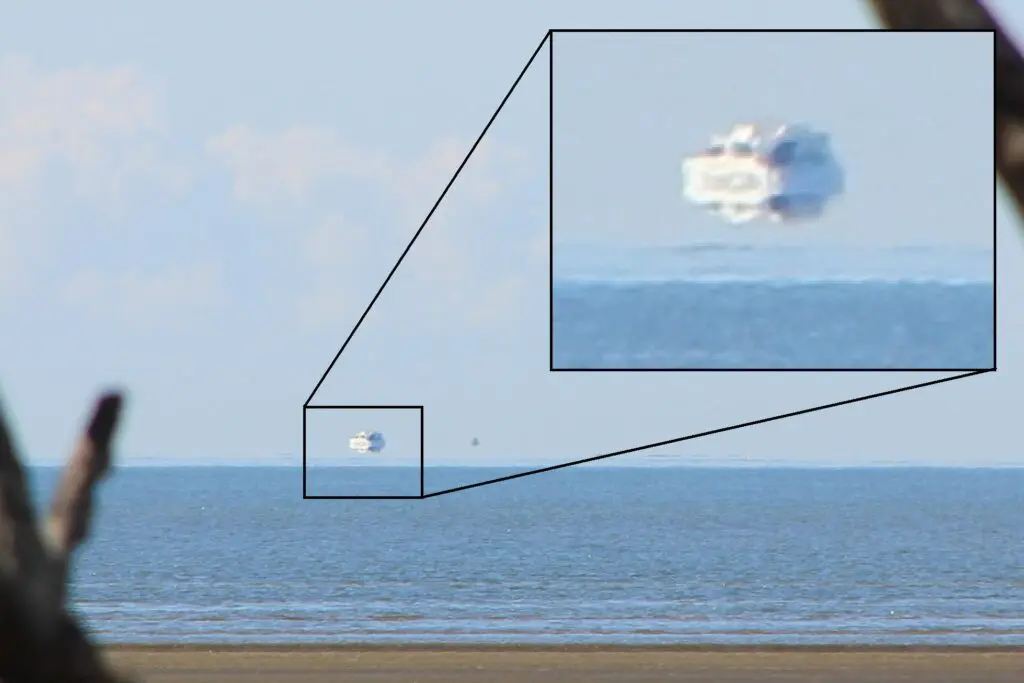
- Fata Morgana: requires a duct; produces stacked, stretched, compressed imagery; commonly misread as “floating ships” or “islands in the sky.” Peer-reviewed optics work has documented Fata Morganas (e.g., Lake Geneva). Optica Publishing Group
How mirages behave
- Shape-shifting silhouettes near the horizon (ships, islands, platforms) can look like hovering craft with straight edges and angular superstructures.
- Rapid morphing as the duct evolves creates “intelligent maneuvering” illusions.
- Telephoto compression turns small angular changes into dramatic geometry.
What the data look like
- Optics: Multiple, alternating erect/inverted image bands; edge tearing and vertical stretching/compression. aty.sdsu.edu
- Meteorology: A confirmed inversion/duct in profiles; maritime conditions strongly supportive. aty.sdsu.edu
Analyst checklist
- Confirm thermal inversion via sonde or nowcasting tools; ask witnesses about horizon distance and telephoto use.
- Compare with SDSU mirage simulations and WMO examples for pattern-match. aty.sdsu.edu
Putting it together: Case triage logic
- Meteorology first: Was there deep convection (TLE risk) or strong inversion (ducting/mirage risk)? Pull profiles; check lightning networks. EO Portal
- Time-lock: Do reported flashes align within milliseconds of lightning (ELVES/sprites)? Or within minutes of CG strikes (ball lightning)? Vaisala
- Sensor stack:
- Optical only, horizon-hugging with stacked shapes → mirage. aty.sdsu.edu
- Radar-only long-range “targets,” variable with diurnal heating → ducting/AP. NOAA
- Brief red tendrils over storms at altitude → sprites. Ring flash → ELVES. Upward blue cone → (gigantic) jet. Nature
- Small, drifting luminous sphere near recent lightning with soil chemistry signature → ball lightning candidate. Physical Review
Criticisms & Cautions (keeping intellectual honesty)
- Over-attribution risk: In eagerness to “explain,” analysts sometimes force-fit UAP reports to mirage/ducting/TLE labels absent time-locked meteorology or sensor data. Our stance: use these mechanisms as tests, not assumptions.
- Ball lightning exceptionalism: BL is rare and poorly sampled; invoking it to explain “every orb” is unwarranted. Reserve for thunderstorm-proximal events with credible instrument data (ideally spectra). Physical Review
- Ducting ≠ always false: Ducting can both create and mask targets. Some genuine aerial objects can appear displaced in range/altitude under ducting; treat radar/ADS-B anomalies carefully. Dipòsit Digital
Implications for UAP Research & Policy
- Standard operating filters
- Integrate lightning/TLE checks and refractivity/ducting indices into UAP intake portals so triage is automatic and transparent. (Public-facing dashboards can cite NOAA/AMS definitions to preserve trust.) NOAA
- Open data snippets
- Encourage witnesses to share raw video, exif/timestamps, location, and sky conditions; pair with open lightning and soundings so third parties can replicate the triage.
- Instrumentation
- Citizen groups should add low-cost VLF receivers (for lightning timing) and optical diffraction gratings (for simple spectra) when feasible. TLE correlations get stronger with timing and spectra. Vaisala
- Education
- Provide concise guides to Fata Morgana and AP radar artifacts so the public understands why some jaw-dropping visuals are refractive optics or bent beams, without dismissing the possibility of real anomalies elsewhere. aty.sdsu.edu
Quick Reference Tables
TLEs
- Where/When: Above storms; ms scales (ELVES fastest).
- Look-fors: Red tendrils (sprites), expanding ring at ~100 km (ELVES), upward blue cone (jets).
- Correlates: Lightning timing (VLF), ASIM/space datasets. EO Portal
Ball Lightning
- Where/When: Near recent cloud-to-ground lightning; indoors occasionally reported.
- Look-fors: Small luminous sphere, seconds-long lifetime; if possible, spectrum showing Si/Fe/Ca. Physical Review
Ducting (Radar/Radio)
- Where/When: Coastal/over water; inversions; spring/summer peaks in some regions.
- Look-fors: Over-horizon radar contacts, fixed-bearing “blooms,” diurnal variability.
- Check: NOAA AP training; regional soundings. NOAA
Mirages
- Where/When: Horizon; strong thermal inversion (often maritime).
- Look-fors: Stacked/inverted bands (Fata Morgana), apparent hovering/elongation.
- Check: SDSU mirage pages; WMO Cloud Atlas. aty.sdsu.edu
Relevant, Active Links
- ISS/ASIM overview of spaceborne TLE investigations. EO Portal
- Nature: Blue-jet onset into the stratosphere (instrumented case). Nature
- NOAA JetStream: Anomalous propagation primer for radar users. NOAA
- NWS Glossary: AP definition & super-refraction. National Weather Service
- AMS Journal: AP/ducting climatology papers (e.g., Mesnard 2010; Utö coastal radar statistics). American Meteorological Society Journals+1
- NTIA Technical Report: Propagation via strong surface ducts (classic). its.ntia.gov
- SDSU (Andrew Young): Mirage types & Fata Morgana exposition. aty.sdsu.edu
- WMO Cloud Atlas: Mirage entry for operational meteorology. International Cloud Atlas
- PRL 2014: Field spectrum of ball lightning (soil-element signature). Physical Review
- Nature (2000): Silicon aerosol oxidation hypothesis for ball lightning. PubMed
Conclusion
Natural environmental and atmospheric phenomena are not “the explanation” for UAP, but they are the first explanation to test. TLEs, ball lightning, ducting, and mirages each have strong, testable signatures across optical, EM, and meteorological data. By building these tests into our standard triage, with open methods and shared datasets, we lower the noise floor. That elevates the truly hard residuals where UAP may represent new physics, novel platforms, or poorly documented natural classes. The disciplined way to find them is to rule out nature’s best imitations with data.
Speculation Labels
Hypothesis – Some “orbs” recorded near storms that show soil-element spectra and non-ballistic drift represent genuine ball lightning, a family of chemically sustained plasma structures. Competing models (silicon aerosol oxidation, microwave-trapped plasmoids) likely describe subsets of BL rather than a single universal mechanism. Further field spectra and RF measurements are needed. Physical Review
Witness Interpretation – Horizon-line videos during strong inversions can produce Fata Morgana stacks that look like structured craft with crisp edges; telephoto compression and minor camera motion amplify the illusion of maneuvering. This honest perceptual misread is common and resolves with profile data and comparative simulations. aty.sdsu.edu
Researcher Opinion – UAP intake should default to a parallel-track approach: (A) rapid, automated elimination of TLE/ducting/mirage/BL where warranted; (B) escalation of residuals into multi-sensor, calibrated follow-ups. The goal is not to prove prosaicness, but to turn down the noise so authentic anomalies, if present, are easier to see.
Claims Taxonomy
Verified:
- TLEs (sprites, ELVES, blue/gigantic jets) are observed and characterized from ground/air/space with established physics linking them to thunderstorms and ionospheric interactions. Nature
- Anomalous Propagation (AP)/ducting produces false radar echoes and over-range returns; NOAA/AMS resources and peer-reviewed climatologies document mechanisms and frequencies. NOAA
- Mirage physics (inferior/superior/Fata Morgana) is well established; duct requirement for Fata Morgana is documented in optics literature. aty.sdsu.edu
Probable:
- A subset of “luminous orbs” near lightning represents ball lightning, consistent with field spectra and laboratory analogs; however, not all “orbs” are BL. Physical Review
Disputed:
- Unified models of ball lightning: multiple theories compete (silicon aerosol oxidation vs. microwave/plasma cavity models); existing evidence supports plural mechanisms rather than a single cause. PubMed
Legend:
- Viral “summoned lights” and “floating cities” videos shared without meteorology or geometry often conflate Fata Morgana with constructed craft; treat as narrative until profiles and triangulation are provided. aty.sdsu.edu
Misidentification:
- ELVES/sprites misread as “instantaneous craft,” ducting/AP as “radar swarms,” and superior/Fata Morgana mirages as “hovering ships” represent well-documented confounds in UAP casework. NOAA
References
Blue jets / TLEs (instrumented science): Neubert et al., “Observation of the onset of a blue jet into the stratosphere,” Nature (2021). Nature
ISS/ASIM mission page (sprites, ELVES, jets from orbit). EO Portal
TLE background & history (review white papers and technical briefs). Vaisala
Ball lightning spectrum (field): Cen et al., Phys. Rev. Lett. 112, 035001 (2014). Physical Review
Ball lightning silicon aerosol hypothesis: Abrahamson & Dinniss, Nature 403, 519–521 (2000); lab analogs in PRL (2006). PubMed
NOAA JetStream: Anomalous propagation/AP primer. NOAA
NWS Glossary: AP definition, super-refraction. National Weather Service
AMS Journal studies: Mesnard & Sauvageot (2010) AP echoes climatology; Rautiainen et al. (2025) coastal ducting stats. American Meteorological Society Journals
NTIA (Dougherty 1976): Propagation via strong surface ducts. its.ntia.gov
SDSU (Andrew Young): Mirage introductions, types, and Fata Morgana page. aty.sdsu.edu aty.sdsu.edu
WMO Cloud Atlas: Mirage entry for operational reference. International Cloud Atlas
SEO Keywords
UAP environmental explanations, Transient Luminous Events, sprites ELVES blue jets, gigantic jets, ball lightning spectrum, atmospheric ducting radar, anomalous propagation AP, superior mirage, Fata Morgana, inferior mirage, refractivity inversion, maritime radar ducting, ISS ASIM, Nature blue jet, NOAA JetStream radar, WMO Cloud Atlas mirage, UAP misidentification filters, UAP data triage, horizon illusions.