
Misidentifications are not a sideshow in UAP research; they’re an essential control group. As skywatching apps proliferate and constellations like Starlink crowd low Earth orbit, reports of “strange lights” have surged. Meanwhile, brilliant planetary apparitions, especially Venus, continue to fool even trained observers under certain conditions. And after the 2023 Chinese high-altitude balloon incident, public sensitivity to balloons reached a peak, with everything from hobby payloads to radiosondes drawing scrutiny. This article builds a data-first reference for investigators and the public, showing how Starlink satellite trains, Venus, and balloons look, move, and behave, and how to rapidly differentiate them from genuinely anomalous cases. We also include links to forecasting tools and official documents, plus a claims taxonomy and speculation labels to keep evidence and hypothesis cleanly separated. eCFR Space NASA Science
Why these three?
Across official records and contemporary reporting, these signatures recur:
- Starlink satellite trains: chains of point-like lights, often evenly spaced, seen shortly after launch while satellites are still low and closely phased. They can be dazzlingly bright at civil/nautical twilight and reappear every ~90 minutes. Space
- Venus: the brightest starlike object after the Sun and Moon (peak apparent magnitude ~ −4.7), often low over the horizon where atmospheric refraction and scintillation produce dramatic effects, sometimes prompting persistent “hovering light” reports.
- Balloons (weather, research, surveillance, hobby): slow drift at high altitude, sometimes nearly stationary relative to ground observers, with notable size/shape changes as they ascend and later descent under parachute; radiosondes routinely reach 30–35 km (100k–115k ft). National Weather Service
The DoD’s AARO explicitly lists micro-satellite trains, balloons, and astronomical bodies among recurrent sources of UAP reports, and has published primers on parallax and forced perspective that explain why “fast” or “maneuvering” behavior can be an illusion in some sensor videos. U.S. Department of War
How to read the sky
When an unusual object appears:
- Time of day & Sun angle:
- Satellites are brightest when they’re sunlit against a dark sky, typically within 1–3 hours after sunset or before sunrise. Planetary apparitions are similar; Venus never strays more than ~47° from the Sun. Space
- Angular motion (degrees per second) & duration:
- Starlink: steady, straight-line motion across tens of degrees in a few minutes; “trains” may last 3–10 minutes.
- Venus: appears fixed over short intervals; position changes perceptibly only over tens of minutes/hours.
- Balloons: can appear nearly stationary or drifting slowly relative to ground; apparent speed depends on wind and distance. Space NASA Science
- Light behavior:
- Satellites: steady or slowly brightening/dimming (“flare”/phase angle) without anti-collision strobes.
- Venus: steady, very bright; can scintillate (“twinkle”) when low.
- Balloons: may show specular glints from the envelope or payload, sometimes with a dangling line/parachute visible through optics. Space
- Tracking cross-check (live):
- Starlink/other satellites: Heavens-Above and FindStarlink provide location-customized pass predictions.
- Planets: any planetarium app or almanac; NASA provides authoritative facts on Venus.
- Balloons: in the U.S., FAA Part 101 governs unmanned free balloons; ATC may post NOTAMs/TFRs during special operations. eCFR Heavens-Above Heavens-Above
- Sensor artifacts & geometry (advanced):
- From aircraft or gimbaled sensors, parallax and forced perspective can produce apparent high velocity or “impossible turns” for slow/nearby objects (including balloons and birds). AARO’s technical notes detail the math and examples. AARO
Starlink satellite trains
The signature
Newly launched Starlink batches often appear as a string of pearls, dozens of equally spaced lights on the same track, especially within days of deployment when the satellites are still low and closely phased. Typical orbital period is ~90 minutes, so observers can sometimes catch multiple passes in a single evening or morning. Trains are most visible at twilight when satellites are sunlit but the observer’s sky is dark. Space
Data points that matter
- Brightness: strongly phase-angle dependent; individual satellites can approach or exceed naked-eye threshold easily.
- Pass timing: clusters of launches create “waves” of public reports clustered within 24–72 hours of deployment.
- Reentries: deorbiting satellites can produce spectacular, slow fireball-like events with multiple fragments, distinct from natural meteors (faster, shorter). The American Meteor Society frequently logs such events. Space American Meteor Society
How to verify in the moment
- Heavens-Above provides “Starlink launch passes” for your exact location; FindStarlink offers quick-look timing. Starwalk and other apps also track visibility. Use them to predict or confirm sightings. Star Walk Heavens-Above Heavens-Above
Common confusion patterns
- “Formation lights”: evenly spaced points can be misread as a coordinated craft formation. In reality it’s a phasing train on a single orbit track.
- “Bright objects that vanish”: satellites enter Earth’s shadow, fading out abruptly mid-pass, this is diagnostic.
- “Slow meteor” videos”: satellite reentries drift more slowly and fragment extensively compared to meteors; they can traverse large arcs over tens of seconds to minutes. Recent West Coast reports attributed to Starlink deorbits illustrate this. Yahoo News
Visual reference & tools (active links)
- Starlink pass predictions (your location): Heavens-Above | Starlink launch passes | FindStarlink | Live satellite maps. Starlink satellite tracker Heavens-Above Heavens-Above
Venus
The signature
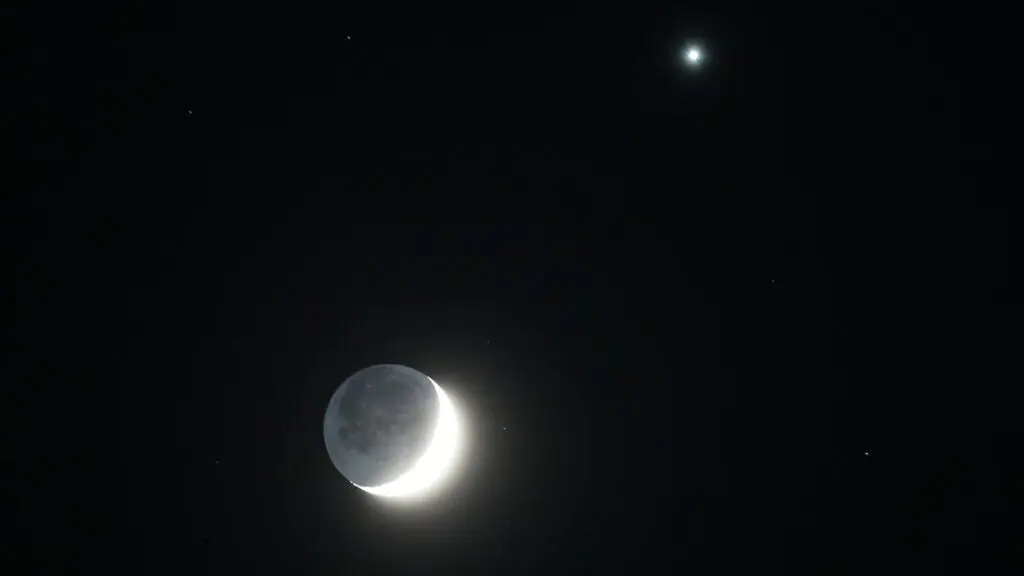
Venus is the brightest planet, ranging roughly from magnitude −3 to −4.9, and it never strays more than ~47° from the Sun. As a result it’s a quintessential “Evening Star” or “Morning Star”, hugging the twilight. Low altitude views through thick atmosphere make it shimmer, change color, appear extended, or seem to “pace” a moving observer, especially for drivers and pilots. This combination has fueled UAP reports since the earliest Air Force files.
Data points that matter
- Maximum elongation: defines how far Venus gets from the Sun in the sky, crucial for timing evening vs. morning apparitions.
- Apparent magnitude: near greatest illuminated extent, Venus can reach ≈ −4.7 and cast shadows under dark skies; it is readily visible in daylight if you know where to look.
- Persistence: unlike satellites, Venus will remain in roughly the same azimuth/elevation for many minutes, changing slowly as Earth rotates.
What the records say
USAF Project Blue Book closed many reports as “astronomical, Venus,” and AARO continues to note astronomical bodies among frequent non-anomalous sources. While Blue Book’s million-page archive is broad rather than indexed by keyword online, the National Archives hosts the official overview and finding aids for researchers; individual case files routinely chalk bright evening or morning lights to Venus after triangulation. AARO’s Historical Record Report likewise cites astronomical misidentifications as common. National Archives
How to verify in the moment
- Open any planetarium app or Heavens-Above “live sky” and check the brightest object near the Sun’s direction after sunset or before sunrise. NASA’s Venus portal provides authoritative facts and learning resources. Heavens-Above Heavens-Above
Balloons (weather, research, surveillance, hobby)
The signature
Weather balloons (radiosondes) are released twice daily by national meteorological agencies. A typical latex balloon, ~1.5–2 m at launch, ascends at ~250–350 m/min, expands to ~10 m at burst around 30–35 km altitude (≈100k–115k ft), and descends under a bright parachute. To a ground observer with modest optics, the envelope can appear as a bright disk, with a small payload and line beneath. Drift aligns with winds aloft; near jet streams, motion can be substantial, even when the object seems to “hover.” National Weather Service
Beyond radiosondes, balloons span hobby payloads, scientific flights, and, rarely, surveillance platforms. In January–February 2023, the U.S. tracked and later shot down a PRC high-altitude balloon off South Carolina; close-up U-2 imagery released by DoD circulated globally. The incident catalyzed public attention to high-altitude objects, leading to additional shootdowns of smaller objects (later unrecovered) in the following days.
Data points that matter
- Altitude: many balloons operate well above typical civilian aircraft; at 60k–100k+ ft, even large envelopes subtend only arcminutes and can be mistaken for a “star” through binoculars.
- Shape change with altitude: the expanding envelope becomes more spherical and reflective before burst, a cue sometimes visible in long-focal-length imagery.
- Regulatory trail: In the U.S., 14 CFR Part 101 Subpart D sets operating limitations and position-reporting obligations for unmanned free balloons; FAA guidance for controllers addresses coordination and reporting. eCFR Legal Information Institute
What the records say
- Meteorological factsheets from NWS/NOAA quantify ascent rates, burst altitudes, and recovery practices, useful for matching witness timelines against plausible balloon performance. National Weather Service
- Defense/press releases during the 2023 incident documented the U.S. response, with U-2 cockpit images capturing the balloon at close range. AP News
The most common explanation side-by-side
| Feature | Starlink train | Venus | Balloon |
|---|---|---|---|
| Typical duration | 3–10 min (single pass) | Hours (slow sky motion) | Minutes to many hours (visibility dependent) |
| Apparent motion | Steady, straight, constant angular speed; train may “march” across sky | Nearly fixed on short timescales; drifts slowly with Earth’s rotation | Slow drift or near-stationary; can “pace” observer due to parallax |
| Brightness behavior | Gradual bright/dim; abrupt fade entering Earth’s shadow | Very bright (up to ~−4.7 mag); can scintillate low on horizon | Specular glints; envelope grows with altitude; payload line may be visible |
| When most visible | 1–3 hours after sunset / before sunrise, esp. days after launch | After sunset or before sunrise, never > ~47° from Sun | Daytime or twilight (depends on size/altitude/reflectivity) |
| Distinguishers | Even spacing; reappears ~90 minutes later; prediction sites match | Planet positions match ephemerides exactly; consistent night-to-night | Slow parallax-like motion; ATC/FAA involvement; NWS launch windows |
| Good tools | Heavens-Above, FindStarlink, Live satellite maps | Planetarium apps; NASA Venus | FAA Part 101 refs; NWS upper-air schedules; local ATC/TFRs |
Sources: Heavens-Above; FindStarlink; NASA Venus; NOAA/NWS radiosonde references; FAA Part 101; AARO primers. eCFR Heavens-Above
Field checklists (fast differentials)
If you suspect Starlink
- Note start time, direction of travel, number of lights, and spacing.
- Check Heavens-Above (Starlink launch passes) and FindStarlink for your location within ±10 minutes.
- Look for second pass ~90 minutes later. Heavens-Above
If you suspect Venus
- Check: Is the light due west after sunset or due east before sunrise and blindingly bright?
- Use any sky app: if Venus is plotted at that az/el, you’ve found your culprit.
- Observe for 5–10 minutes, no meaningful change in azimuth/elevation implies a planet, not a satellite/aircraft.
If you suspect a balloon
- Try optical zoom: look for a spherical/tear-drop envelope plus a dangling line/payload/parachute.
- If near a weather office or known release time, cross-check NWS upper-air schedule; in unusual cases, look for local TFRs/NOTAMs or media/agency posts.
- Remember typical radiosonde ascent rates (250–350 m/min) and burst altitudes (~30 km) to sanity-check timelines. National Weather Service
Edge cases & sensor geometry
Parallax and forced perspective explain many “impossible” motions in airborne/sensor videos: a slow, nearby object (balloon/bird) can appear to race across the background when filmed from a fast-moving platform with a narrow field of view. AARO’s technical papers walk through examples and vector diagrams. This doesn’t resolve all cases, but it’s a rigorous first test before invoking performance beyond known aerodynamics. AARO
Policy & research implications
- Better triage → cleaner datasets: Rapid, data-driven elimination of Starlink/Venus/balloons ensures that what remains in the UAP corpus is higher signal, accelerating serious analysis. AARO’s Historical Record Report (Vol. 1) explicitly warns that misidentifications, including micro-satellite trains, are a persistent confounder. U.S. Department of War
- Public tools reduce false positives: Widespread use of Heavens-Above/FindStarlink and basic planetaria would prevent large waves of false UAP reports after launches or during peak Venus apparitions. Heavens-Above
- Regulatory clarity for balloons: FAA Part 101 sets expectations for unmanned free balloons; updates and enforcement (including the past Part 101 ARC) help mitigate safety/identification issues in a denser sky. eCFR
- Communications during sensitive incidents: The 2023 high-altitude balloon episode demonstrated that timely, authoritative releases (e.g., the U-2 photo) can stabilize public interpretation while forensic work proceeds. AP News
Practical reporting template
- Timestamp (local & UTC) and location (lat/long or nearest town).
- Observation window (start/end time; continuous or intermittent).
- Direction (azimuth estimate) & elevation (fist/hand estimates accepted).
- Motion (track across background; any acceleration/turns).
- Appearance (count of lights; spacing; color; steady vs. blinking).
- Media (video with EXIF time; keep raw/original).
- Cross-checks done: Heavens-Above/FindStarlink screenshots; planetarium screenshot showing Venus/Jupiter; local ATC TFR/NOTAM check if relevant. Heavens-Above
Visual cues gallery (what to look for)
- Starlink train: evenly spaced points on a straight path, steady brightness with occasional slow fades; often reported at civil/nautical twilight. (See image carousel above.)
- Venus: a single, piercingly bright “star” near the Sun’s direction, especially impressive near crescent Moon conjunctions; steady light, no strobe. (See image carousel above.)
- Weather/other balloons: pale sphere with dangling line/payload; in telephoto it looks like a round envelope with a small box and parasail. (See image carousel.)
- High-altitude surveillance balloon (2023 case): large white envelope with substantial payload platform; iconic U-2 cockpit perspective image was released by DoD. (See image carousel.)
What this doesn’t explain
A principle: ruling out the common strengthens the uncommon. Precious, high-strangeness cases demand rigor. This guide removes three high-volume confounders without claiming they explain most UAP. It’s a sieve, what passes through merits deeper, multidisciplinary scrutiny.
Further reading
- Predict satellites & Starlink: Heavens-Above main | Starlink launch passes | FindStarlink | Live satellite map. Starlink satellite tracke Heavens-Above Heavens-Above
- Venus facts & visibility: NASA Venus overview; background on brightness and observability. NASA Science+1
- Balloons, operations & law: FAA 14 CFR Part 101 Subpart D; FAA controller guidance; NOAA/NWS radiosonde factsheet and ascent-rate paper. National Weather Service eCFR Federal Aviation Administration
- Official U.S. UAP materials: AARO Historical Record Report (Vol. 1); AARO parallax/forced-perspective primer. U.S. Department of War
- 2023 Chinese balloon imagery/timeline: DoD-released U-2 photo coverage (AP/ABC). AP News
Speculation labels
Hypothesis
Widespread post-launch Starlink visibility explains the sharp, synchronized spikes in regional UAP reports within 24–72 hours after particular Falcon 9 deployments. (Correlational studies using report timestamps vs. Heavens-Above pass windows could test this at scale.)
Researcher Opinion
Teaching parallax as a first-principles concept to pilots, law enforcement, and journalists would significantly reduce misinterpretations of sensor videos that otherwise look “impossible.”
Witness Interpretation
Reports of a “silent formation of lights” marching across the sky are often Starlink trains seen shortly after launch; “hovering bright star at dusk” is often Venus; “silver orb that stayed for hours” can be a balloon at high altitude.
Claims taxonomy
Verified:
- Regulatory frameworks and agency practices (FAA Part 101; NWS radiosonde operations) are fully documented in official publications. eCFR
Probable:
- Reentry fireballs attributed to Starlink or other space hardware based on timing, speed, fragmentation patterns, and third-party orbital decay predictions (e.g., AMS logs and satellite trackers), when not yet laboratory-confirmed. Space
Disputed:
- Surveillance balloons vs. weather platforms: 2023 PRC balloon’s precise mission characterization remains contested diplomatically even as the U.S. released imagery and recovered debris.
Legend:
- Not applicable in this reference entry.
Misidentification:
- Starlink trains identified via predictive passes and characteristic train morphology; multiple public cases confirmed by timing data. Heavens-Above
- Venus: astronomical ephemerides matched; brightness and sky position consistent.
- Weather balloons / radiosondes: ascent rate, burst altitude, and payload visuals match NWS/NOAA documentation. National Weather Service
References
Space.com, “Starlink satellite train, how to see and track it.” Space
National Archives, “Project BLUE BOOK, Unidentified Flying Objects (UFOs).” National Archives
NOAA/NWS, “Radiosonde Observation Factsheet”; “Radiosonde Ascent Rates” (PDF). National Weather Service
AARO (DoD), Historical Record Report Vol. 1 (2024); Effect of Forced Perspective and Parallax (2024). U.S. Department of War
NASA Science, Venus overview. NASA Science
Heavens-Above (Starlink & live sky), FindStarlink, SatelliteMap. Starlink satellite tracker+3Heavens-Above+3Heavens-Above+3
FAA, 14 CFR Part 101 Subpart D – Unmanned Free Balloons; FAA ATC Handbook Section 9-6; Part 101 ARC Charter (PDF). eCFR Federal Aviation Administration
AP/DoD image coverage, U-2 close-up photo of Chinese balloon (Feb 2023). AP News
Space.com & AMS coverage of reentry fireballs and satellite decays. Space
SEO keywords
UAP misidentifications, Starlink train UAP, Venus mistaken for UAP, weather balloon UAP, radiosonde altitude, FAA Part 101 balloons, Heavens-Above Starlink predictions, FindStarlink tracker, AARO parallax, Chinese balloon U-2 photo, differentiate UAP from satellites, twilight satellite visibility, UAP report checklist.