
If even a fraction of the most resilient UAP performance reports are accurate, the vehicles implied would demand energy densities and power levels far beyond chemical propulsion or today’s batteries. Fusion sits alone as a physically plausible energy source that could pack such power into compact volumes.
In recent years, declassified government documents, Navy patents, and mainstream fusion breakthroughs have collectively pushed this conversation from science fiction into the realm of testable engineering questions.
This article maps the data landscape and shows how fusion could fit into an integrated picture of UAP energy and propulsion, while clearly separating evidence from hypothesis.
Why energy density is the hinge
Contested radar tracks and cockpit videos are often debated, but energy math is indifferent to belief. To understand what kind of power plant a high-performance craft would need, start with two simple ideas:
- Specific energy tells how much total energy per kilogram a source can store or release.
- Power tells how fast that energy can be delivered.
Best of breed jet fuel is about 43 megajoules per kilogram.
Today’s lithium-ion batteries deliver roughly 0.72 to 0.9 megajoules per kilogram at the pack level, which is why electric airliners are so hard, even with exceptional aerodynamics.
By contrast, nuclear fission and fusion live in the terajoule per kilogram regime. The deuterium tritium fusion reaction releases 17.6 megaelectronvolts per event and is often quoted at about 3.4 × 10^14 joules per kilogram of reactants.
On a mass basis, that is more than four times uranium fission and orders of magnitude above chemical fuels. (DOE)
Quick reference table
| Energy source | Specific energy (approx.) | Notes |
|---|---|---|
| Lithium ion battery pack | 0.72–0.90 MJ/kg | Representative pack level values used in aviation studies. (DOE) |
| Jet fuel | ~43 MJ/kg | Standard figure used by DOE and aviation literature. (DOE) |
| Uranium 235 fission | ~8.2×10^13 J/kg | World Nuclear Association synthesis. (World Nuclear Association) |
| D–T fusion | ~3.4×10^14 J/kg | IAEA and WNA summaries aligned with 17.6 MeV per reaction. (IAEA Publications) |
These numbers tell a blunt story. To sustain high acceleration while executing sharp maneuvers, any craft heavier than a small drone would need tens to hundreds of megawatts on tap.
At aircraft scale, only fission or fusion can plausibly supply that without hauling impractical mass.
A simple back of the envelope: let a 5,000 kg craft accelerate at ten g. Force is m·a ≈ 5,000 × 98 ≈ 490,000 newtons. Instantaneous power at 300 m/s is P = F·v ≈ 147 megawatts. Even allowing for pulsed operation and energy buffering, you quickly arrive at grid scale power. Chemical stores cannot feed this without enormous tanks. Fusion could, in principle.
The fusion baseline in real laboratories
Fusion is not hypothetical. In December 2022 the National Ignition Facility reported the first laboratory shot that produced more energy from the target than the energy delivered to it by lasers, 3.15 megajoules output for 2.05 megajoules in.
Ignition has been repeated in subsequent campaigns and remains a rapidly evolving story line. While wall plug efficiency is far from practical, the physics milestone matters, because it tightened the loop between theory and achieved energy densities. (Lawrence Livermore National Laboratory)
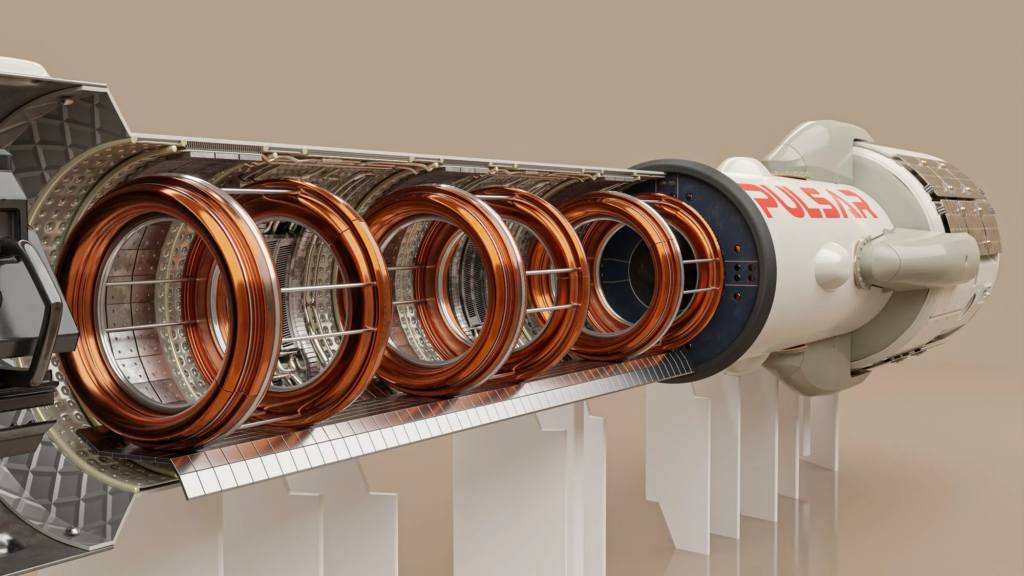
Magnetic confinement also advanced.
In 2024 the Joint European Torus reported a 69 megajoule five second pulse, an experimental record that stressed real world plasma control in reactor relevant conditions. These achievements are not compact power plants, but they calibrate how close fusion is to routine energetics. (The Guardian)
Aneutronic routes are rising as well.
In 2023 researchers reported diagnostically significant alpha production from proton boron 11 reactions inside a magnetically confined plasma, a first in that class of machine. Proton boron 11 does not throw hard neutrons in its primary reaction and produces three energetic alpha particles totaling about 8.7 megaelectronvolts, which makes direct energy conversion and reduced shielding conceptually attractive if the high temperature burden can be met. (Nature)
What the declassified record shows the government asked for
From 2008 to 2010 the Defense Intelligence Agency funded a slate of Defense Intelligence Reference Documents, now released under FOIA, covering advanced propulsion topics.
Among them are entire monographs on aneutronic fusion propulsion and inertial electrostatic confinement fusion.
These are not internet rumors. They are DIA labeled products, stamped as unclassified but previously controlled, written to give acquisition and threat analysts a rigorous primer on future flight physics.
The aneutronic fusion volume lays out why helium and boron fuel cycles are attractive from a radiation standpoint and how direct conversion might work if you can reach the required temperatures.
The inertial electrostatic confinement report surveys approaches like Polywell, field reversed configurations that favor beam like ion distributions, and possible space propulsion applications if net energy could be achieved. Neither document claims operational vehicles. Both show the problem was being scoped in detail for aerospace analysts.
It is equally important to include the present official view. In 2024 the Pentagon’s All domain Anomaly Resolution Office published its historical volume stating it had found no empirical evidence of extraterrestrial technology in UAP cases to date.
That conclusion coexists with the fact that DIA did invest in serious horizons studies of fusion powered propulsion and vacuum engineering ideas. The two facts are not logically exclusive. One speaks to current evidence assessments, the other to technology scouting. (AARO)
Where Eric W. Davis and Hal Puthoff fit
The declassified DIA catalog includes a report on warp drives and related metric engineering coauthored by Eric W. Davis, a physicist long associated with EarthTech. The FOIA copy is public.
Separately, Davis wrote an Air Force Research Laboratory survey titled Teleportation Physics Study in 2004, which examined speculative transport concepts through the lens of mainstream physics bounds. These works do not claim operational devices. They map the theory landscape and the energy conditions a real device would face. (Defense Intelligence Agency)
Hal Puthoff, who leads the Institute for Advanced Studies at Austin, published peer reviewed and archived papers on engineering the quantum vacuum and polarizable vacuum representations of general relativity, along with a widely cited overview titled Advanced Space Propulsion Based on Vacuum Engineering.
Whether one agrees with the optimism, the technical writing treats the vacuum as a polarizable medium and explores how altering boundary conditions might change effective inertia and energy extraction pathways.
None of this eliminates the need for large energy flows. If anything, it underlines that truly exotic spacetime architectures would require energy densities that look fusion class at minimum. (arXiv)
Active reading links
- [DIA Warp Drive study PDF] (FOIA copy). (Defense Intelligence Agency)
- [Teleportation Physics Study] (AFRL special report). (I.R.C.)
- [Advanced Space Propulsion Based on Vacuum Engineering] (arXiv). (arXiv)
- [Engineering the Zero Point Field and Polarizable Vacuum] (arXiv). (arXiv)
Compact fusion architectures that look aerospace relevant
Even without UAP in the conversation, multiple programs are targeting compact fusion for propulsion.
Direct Fusion Drive is a Princeton Satellite Systems and Princeton Plasma Physics Laboratory concept that uses a field reversed configuration and deuterium helium 3 fuel.
Published studies discuss thrust to power of about five to ten newtons per megawatt and specific impulse near ten thousand seconds with hundreds of kilowatts of electric power co generated. NASA’s innovation program has supported mission studies to Pluto and Mars using the concept. (bp-pub.pppl.gov)
Magneto inertial fusion for rockets was examined in NASA funded work led by John Slough. The published Phase II report discusses compression of field reversed plasmoids by liners and direct magnetic nozzles. The engineering is formidable, but the reason it persists is the unmatched energy per kilogram at the system level. (NASA)
Inertial electrostatic confinement and Polywell remain controversial but were significant enough to merit an entire DIA survey, in part because their beam-like distributions could better access aneutronic branches such as deuterium helium 3 and proton boron 11.
Aneutronic routes tempt aerospace designers because they offer reduced activation and the possibility of direct conversion of charged particle energy to electricity. The hurdle is reactivity.
Proton boron 11 needs conditions above two hundred keV equivalent temperature in much of phase space, and bremsstrahlung losses penalize electron rich plasmas.
Recent measurements inside a stellarator class machine show alpha production is tractable to diagnose, but net power remains a research frontier.
This is why UAP origin claims tied to aneutronic fusion must be labeled carefully as hypothesis unless or until there is multi sensor hardware evidence. (Nature)
A quick power budget and why fusion fits the envelope
Take a notional craft of ten thousand kilograms conducting a steady level flight lateral acceleration of ten g at 300 m/s. Force is roughly 980,000 newtons and instantaneous power about 294 megawatts.
If the craft instead uses burst maneuvers with duty cycle ten percent, the time averaged power might settle near 30 megawatts, while peak draws still touch hundreds of megawatts. High temperature superconducting buffers and flywheels could shave peaks, but the primary source must still be in the tens of megawatts class.
A D–T fusion core producing 200 megawatts thermal with thirty percent conversion to electric would net 60 megawatts shaft or bus power. That is aircraft scale.
A deuterium helium 3 engine at similar thermal power would reduce shielding mass but imposes more difficult plasma conditions or the need for helium 3 supply.
The numbers do not prove any UAP uses fusion. They show why fusion is the only known energy process that matches the magnitude without unworkable mass. (NASA Technical Reports Server)
The Navy patents and what they do and do not imply
Between 2016 and 2019 inventor Salvatore Cezar Pais, then working with Navy organizations, filed a series of patents that include a plasma compression fusion device and a craft using an inertial mass reduction device.
The fusion patent describes counter rotating conical structures and a cross-duct chamber. The filings generated extensive media coverage and skepticism from many plasma physicists.
There are also articles and a peer reviewed paper outline by the same author. The key point for a data first analysis is that patents by themselves are not evidence of function.
They are claims lodged with an examiner. The most useful information in the public record is that Navy entities were willing to paper the concepts, and some correspondence about operability and foreign interest exists. That is noteworthy, but it is not a working reactor. (Google Patents)
UAP and the nuclear connection
Declassified logs from the mid-1970s document unusual aerial intrusions near nuclear alert facilities like Loring Air Force Base, with National Military Command Center traffic requesting extra atmospheric analysis during those periods.
These records do not establish propulsion type or origin. They do show why defense analysts would be keen to understand compact high energy power sources and why AAWSAP’s documents logically included fusion propulsion. (Defense Security Service)
A coherent fusion powered UAP architecture, if one existed
Evidence based elements
- Power needs in the tens to hundreds of megawatts for agile flight at aircraft mass scales are consistent with high g maneuvers often described in pilot accounts, if those accounts reflect hard kinematics.
- Nothing in known chemistry or battery technology can deliver those sustained levels at workable mass. Fusion is the closest physics consistent option.
Hypothesis
- A compact fusion primary (D–T, deuterium helium 3, or proton boron 11) feeding a combined electric and directed plasma propulsion suite could deliver both thrust and enormous electrical power for active field control and sensors. Charged particle capture and direct conversion would improve efficiency and reduce thermal rejection problems compared with pure thermal cycles. This could be paired with magnetic nozzles for variable specific impulse and with advanced radiators that transform heat into tightly collimated photon streams for stealthy rejection.
Researcher opinion
- For transmedium performance, electric propulsors that couple magnetohydrodynamically to ionized boundary layers could help water to air transitions. A fusion core adds the electrical headroom for such systems. Evidence is still lacking that any observed UAP uses such methods, but the underlying physics literature is mature enough to warrant systematic testing.
Witness interpretation
- Reports of silent hovering at high mass are sometimes taken to imply reactionless thrust. A fusion electric system with high area ion drives and tailored exhaust could appear acoustically quiet at altitude, even while expelling momentum. Silence alone does not diagnose new physics.
What Davis and Puthoff change in the frame
Eric Davis’ DIA report on warp drives and his AFRL study do not claim functioning drives. They quantify the energy and exotic matter constraints any spacetime manipulation concept would face.
When one runs those constraints honestly, the numbers point back to energy sources on the fusion or beyond class.
Hal Puthoff’s vacuum engineering papers explore a picture where the vacuum behaves like a polarizable medium. Even if one adopts that picture, practical devices will still need prodigious energy flows.
In short, the work of Davis and Puthoff narrows the plausible energy source for any radical craft to something fusion-like at minimum. (Defense Intelligence Agency)
Implications if fusion power is part of UAP technology
- Strategic energy
Civil fusion would pass from a climate solution to a dual use technology with aerospace leverage. Nation state investment would spike, and export control regimes would be revised to include aneutronic fuel cycle components and direct energy converters. - Sensor design
If compact fusion cores are real in advanced craft, multi sensor suites should look for narrowband x-ray and neutron signatures, for alpha induced secondary emissions, and for thermal rejection patterns consistent with high power density. Field campaigns can be designed with that in mind. - Nonproliferation
A militarized compact fusion power plant would not be a weapon by itself, but it would enable directed energy systems and extreme kinematics. Verification regimes would need new inspection hooks around aneutronic fuel supply chains and high power superconducting components. - Transmedium safety
If fusion level power is available onboard, interactions with the ionosphere, with seawater, and with sensitive radar apertures must be understood to avoid unintended effects. This is relevant even if the vehicles are ours.
What to watch next
- Aneutronic milestones inside magnetic or magneto inertial machines, especially sustained alpha production from proton boron 11 in reactor class plasmas. (Nature)
- Direct conversion demonstrators that can turn charged particle flux into clean electric power at high efficiency.
- NASA and DOD mission studies that thread fusion propulsion with realistic mass budgets for radiators and shielding. (bp-pub.pppl.gov)
- Sensor campaigns that put calibrated x ray, neutron, and radiofrequency diagnostics on synchronized platforms to probe power signatures in true anomalies. (NASA Science)
Bottom line
When stripped of rhetoric and anchored in numbers, fusion is the only mature physical energy process that both fits inside an aerospace volume and can, in principle, deliver the high and rapid power flows implied by the strongest UAP performance narratives.
The declassified government record does not prove fusion powered vehicles exist.
It does prove that the responsible analytic community has enumerated the same physics constraints and has explored fusion propulsion options that look directly relevant to what UAP would need.
That is why a data first approach keeps pointing back to compact fusion as the prime candidate if the most challenging UAP reports stand up to multi-sensor scrutiny in the years ahead.
Claims Taxonomy for this topic
Verified:
- The D–T reaction releases 17.6 MeV per event and on a mass basis exceeds fission specific energy. (World Nuclear Association)
- NIF achieved target gain greater than one with a 3.15 MJ shot. (Lawrence Livermore National Laboratory)
- DIA commissioned and released Defense Intelligence Reference Documents on aneutronic fusion propulsion and inertial electrostatic confinement fusion.
Probable:
- Compact fusion offers the only physically plausible path to sustained multi tens of megawatts for aircraft scale agile motion without extreme propellant mass, given current energy density data. (Derived from the energy table and power budget above.)
Disputed:
- Navy “Pais effect” patents describe practical fusion or inertial mass modification devices. There is no public test data that demonstrates operational performance, and many domain experts remain skeptical. (Google Patents)
- Historical nuclear site UAP incursions indicate technology beyond contemporary aerospace. Logs exist, but causation and performance remain debated. (Defense Security Service)
Legend:
- Religious or folkloric accounts that equate lights in the sky with cosmic visitors. Presented here only as cultural context, not as evidence.
Misidentification:
- Some high-speed observables are consistent with sensor parallax, atmospheric ducting, or camera artifacts.
Speculation labels gathered
- Hypothesis
Fusion powered UAP could combine a compact aneutronic core with magnetic nozzles, direct conversion, and boundary layer control for transmedium operation. - Researcher opinion
The most credible near term fusion fit for aerospace is a magneto inertial or field reversed configuration with deuterium helium 3, because of reduced shielding mass and potential for direct conversion. Proton boron 11 remains attractive but very challenging in steady state. - Witness interpretation
Reports of instantaneous ninety degree turns could reflect short duty cycle impulses combined with sensor timing artifacts. Fusion class power makes impulses possible in principle, but kinematic reconstructions must be multi sensor before any conclusion.
References
LLNL. “Press materials on fusion ignition.” [llnl.gov] (Lawrence Livermore National Laboratory)
DOE Office of Science. “Deuterium tritium fusion fuel.” [energy.gov] (The Department of Energy’s Energy.gov)
World Nuclear Association. “Nuclear fusion power” and “Physics of nuclear energy.” [world-nuclear.org] (World Nuclear Association)
IAEA. “Fundamentals of Magnetic Fusion Technology.” [iaea.org] (IAEA Publications)
DIA FOIA. “Aneutronic Fusion Propulsion.” [dia.mil]
The Black Vault FOIA. “Inertial Electrostatic Confinement Fusion.” [theblackvault.com]
DIA FOIA. “Warp Drive, Dark Energy, and the Manipulation of Dimensions.” [dia.mil] (Defense Intelligence Agency)
AFRL. “Teleportation Physics Study.” [public copies] (I.R.C.)
Puthoff H. “Advanced Space Propulsion Based on Vacuum Engineering.” [arXiv] (arXiv)
Nature Communications. “First measurements of p 11 B fusion in a magnetically confined plasma.” [nature.com] (Nature)
PPPL and PSS. “Direct Fusion Drive studies.” [pppl.gov, psatellite.com] (bp-pub.pppl.gov)
NASA NIAC. “Fusion Driven Rocket Phase II report.” [s3-us-west-2.amazonaws.com/pnwmsnw] (Amazon Web Services, Inc.)
Google Patents. “US20190295733A1 Plasma Compression Fusion Device.” [patents.google.com] (Google Patents)
AARO. “Report on the Historical Record of U.S. Government Involvement with UAP, Volume 1.” [aaro.mil] (AARO)
NASA. “UAP Independent Study Team final report.” [science.nasa.gov] (NASA Science)
Guardian coverage of JET 69 MJ pulse. [theguardian.com] (The Guardian)
NREL and DOE aviation studies on energy density. [nrel.gov; energy.gov] (NREL Docs)
NMCC reading room document set on 1975 northern border unusual phenomena tasking. [esd.whs.mil] (Defense Security Service)
SEO keywords
UAP fusion, aneutronic fusion propulsion, proton boron 11, deuterium helium 3, inertial electrostatic confinement, Direct Fusion Drive, Eric W. Davis, Hal Puthoff, AAWSAP DIRD, Navy fusion patent, NIF ignition, JET fusion record, compact fusion reactor, transmedium UAP, quantum vacuum engineering, polarizable vacuum, AARO report, NASA UAP study, multi sensor UAP analysis.