
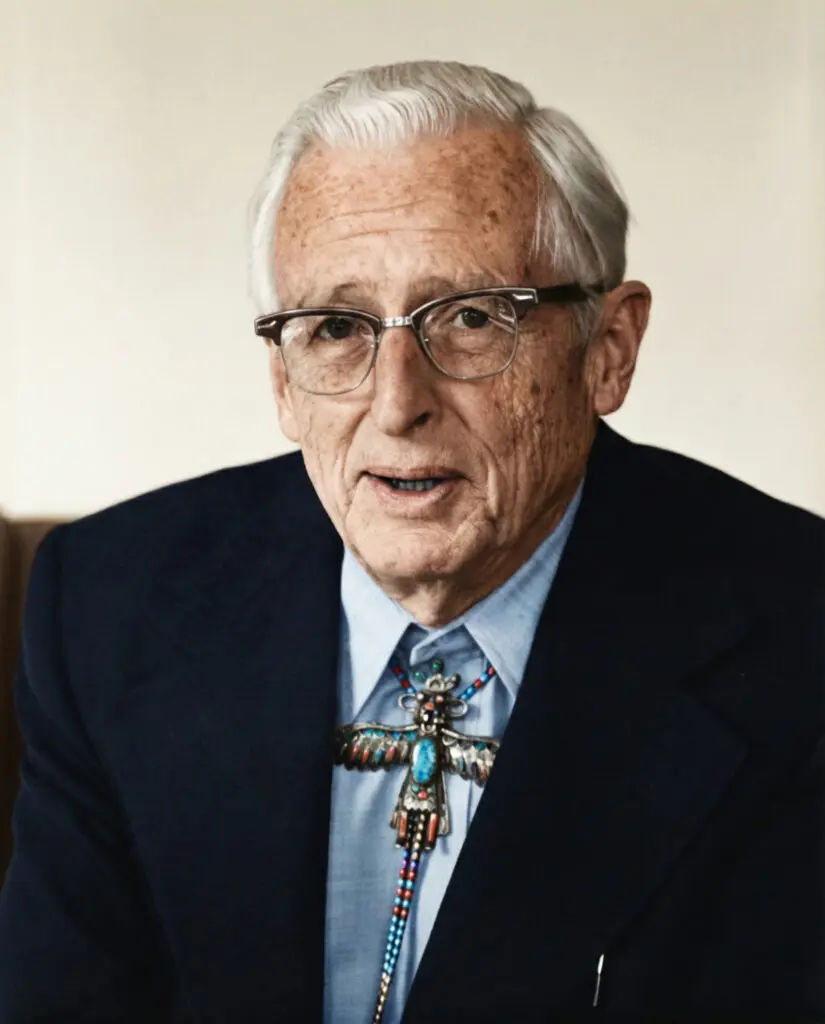
Donald Howard Menzel (1901–1976) stands at a rare pivot point in the history of UAP.
In open scientific life he was a towering astronomer and Harvard leader whose work in solar physics and gaseous nebulae helped define mid-century astrophysics. In parallel he served in wartime intelligence and cryptology, obtained high-level clearances, and, beginning in the early 1950s, became the most prominent scientific voice arguing that UAP reports could be explained as misperceptions of natural and technological phenomena.
In 1987, more than a decade after his death, his name appeared on the purported “Majestic 12” roster, thrusting him posthumously into the center of a debate over authenticity, secrecy, and the early U.S. government response to the UAP problem. The record that emerges is paradoxical. Menzel was both an establishment scientist and a behind-the-scenes national-security figure; a lucid explainer and a combative polemicist; a man who gained full access to Air Force UAP files, yet whose sweeping conclusions galvanized a generation of researchers precisely because they felt vital cases remained unanswered. (National Academies)
Early life, education, and the making of a public scientist
Menzel was born in Florence, Colorado, on 11 April 1901, and died in Boston on 14 December 1976. He studied chemistry and mathematics at the University of Denver, completed a second master’s and then a Ph.D. in astrophysics at Princeton under the renowned Henry Norris Russell, and held early posts at Iowa, Ohio State, and Lick Observatory before moving to Harvard in 1932.
He rapidly distinguished himself as one of the United States’ first major theoretical astrophysicists, with foundational work on the solar chromosphere, stellar spectroscopy, Martian atmosphere, and the physics of gaseous nebulae. (National Academies)
At Harvard, Menzel became both a scientist and an institution builder. He chaired the Department of Astronomy, then directed the Harvard College Observatory from 1952 to 1966, a period in which he helped bring the Smithsonian Astrophysical Observatory to Cambridge and encouraged a modern research and teaching program that would evolve into today’s Center for Astrophysics | Harvard & Smithsonian. (Center for Astrophysics)
One controversy from his directorship has shadowed his legacy among historians of astronomy.
In 1953, as a cost-saving measure, he suspended the observatory’s photographic plate-making program. The resulting 1953–1968 gap in sky coverage is still known in the field as the “Menzel Gap.” The Center for Astrophysics acknowledges this hiatus in its official institutional history. (Harvard College Observatory)
Alongside research, Menzel wrote prolifically for specialists and the public. His best-selling A Field Guide to the Stars and Planets introduced generations to backyard astronomy, and his beautifully illustrated general-audience books on the Sun and eclipses cemented a public persona as astronomy’s patient, plain-spoken explainer. (AbeBooks)
War work, intelligence ties, and cryptology
Beneath the public surface of academic life, Menzel stepped into national service during World War II. He enrolled in Navy cryptanalysis studies and, in collaboration with Naval Communications, taught a secret Radcliffe course that recruited mathematically adept young women for American codebreaking. A Harvard Crimson retrospective captures the atmosphere and criteria of this covert wartime classroom. (Encyclopedia.com)
Postwar, his intelligence linkage did not fade. Declassified National Security Agency material shows Menzel on a cleared list for cryptologic work in the early 1950s, with “Crypto” and “Adv Bd” notations consistent with advisory roles that required indoctrination into communications intelligence practices. The primary document is stark and bureaucratic but decisive. (National Security Agency)
These credentials matter for UAP history because they establish that Menzel was not merely a public commentator. He moved within the secure world that handled classified technical questions, and he was exactly the sort of scientist a secret interagency committee would consult if such a committee existed.
This amplification of his national-security profile would later fuel debate over his alleged Majestic 12 membership. (National Security Agency)
Menzel enters the UAP debate
When the postwar UAP wave crested in 1947 and rose again in 1952, the Air Force launched and then formalized an investigative apparatus that evolved into Project Blue Book. USAF’s own summary makes clear the scope: 12,618 cases logged between 1947 and 1969, with 701 remaining “unidentified.” That simple residue is one reason the subject never died. (Air Force)
Menzel became the most visible scientific voice addressing the phenomenon in three widely read books and in Congressional testimony.
His core thesis was consistent from the start: UAP reports were best understood as a mixture of misperceived celestial objects, weather and balloon phenomena, atmospheric optics, radar propagation effects, and human perceptual/psychological factors.
His second book, The World of Flying Saucers (1963, with Lyle Boyd), is now public domain and shows his method in full, chapter by chapter, as he attributed famous cases to balloons, bright planets or stars under unusual atmospheric conditions, fireballs, birds, temperature inversions affecting radar, and so on. (TWFS)
The 1968 House Committee on Science and Astronautics held a landmark Symposium on UAP. Menzel’s prepared statement is revealing two points that bear directly on his authority in the debate.
First, he wrote that “the Air Force has given me full access to their files,” a remarkable admission that explains both his confidence and the fierce pushback he received from civilian researchers who lacked comparable access.
Second, he argued that Project Blue Book should be ended because two decades of investigation had produced nothing of scientific value that pointed to extraterrestrial craft. The document stands as the most distilled official expression of his stance. (NCAS Files)
A few examples illustrate his explanatory framework:
Atmospheric optics and bright stars or planets. In his 1963 book, Menzel devoted an entire section to “A Mirage of Sirius,” using physics of refraction and scintillation to show how the brightest star can appear to maneuver, change color, or grow disk-like to the naked eye in temperature-inversion conditions. He frequently applied similar reasoning to Venus, Jupiter, and Mars when near opposition. (TWFS)
Balloons and misestimated distance or speed. He cataloged dozens of cases where high-altitude Skyhook and radiosonde balloons produced striking visual and even radar tracks that mimicked deliberate motion or formation flight, especially when winds shifted with altitude or payloads gave strong returns. (TWFS)
Radar “angels” and temperature inversions. On the heavily publicized 1952 Washington, D.C. episodes, he emphasized weather-related propagation and ground clutter as the simplest and, to him, sufficient explanation of the radar-visual mix that had alarmed the public. (TWFS)
Menzel’s larger influence came as much from tone as content. He was witty, forceful, and occasionally caustic in dismissing what he saw as error chains. He insisted that good science begins with known physics rather than leaps to unknown craft, and he took square aim at the opinion that trained observers could not make large identification errors.
In the 1968 statement he went further, volunteering that he had helped USAF improve its eyewitness questionnaire because it failed to probe basic perceptual pitfalls. That made him, in his own telling, both critic and advisor to Air Force methodology. (NCAS Files)
The establishment listened.
The CIA-convened Robertson Panel in 1953 had already recommended reducing the burden of low-quality UAP reports on intelligence channels and encouraged an explanatory campaign through credible scientists and media.
That institutional logic rhymed with Menzel’s own. Whether by design or convergence, his voice became the scientist’s face of that approach. (FAS Project on Government Secrecy)
Impact on ufology and the counter-movement he helped create
Because UAP communities trace their modern genealogy to the very years Menzel dominated public debate, his impact is hard to overstate. For readers new to the era, a few structural outcomes stand out.
He set the public’s default frame. In the 1950s and 1960s, when Americans heard a scientist talk about UAP, the scientist was often Menzel. His books appeared with major publishers and were reviewed in mainstream venues; his 1953 work was treated in the general press as the sensible corrective to a sensational topic.
That visibility shaped how journalists wrote, how officials answered questions, and how schoolchildren learned to think about strange lights in the sky. (Project Gutenberg)
He hardened a line that others pushed against. Authors such as Donald Keyhoe and later academic critics of Blue Book seized on that 701-case residue and on specific radar-visual, pilot, and multiple-witness events that Menzel treated as solved or soluble.
A 1969 Library of Congress annotated bibliography captures the period’s polemics, noting USAF statements used to refute Menzel’s balloon-and-atmospheric explanations and the emergence of official voices who quietly disagreed with him.
His steadfastness produced a dialectic: the more emphatic his dismissal, the more determined his critics became to scour case files, subpoena data, and argue for serious study. (Government Attic)
His style foreshadowed the later “nothing to see here” reading of Blue Book.
By 1969 Blue Book closed, citing the Condon Report and National Academy of Sciences review, and the USAF fact sheet made three flat conclusions that rejected national-security threat, exotic technology, and extraterrestrial explanation. Menzel had been rhetorically out in front of those statements for years. (Air Force)
At UAPedia we reject the assertion that most UAP reports are trivial once properly analyzed. A durable remainder has resisted explanation for decades, even as better sensors and analytic methods arrive. That said, to understand why the remainder continues to matter, one must grasp the context Menzel helped build.
He made the case for error, refraction, misperception, and radar quirks so forcefully that any event surviving those filters today commands attention by definition. Menzel inadvertently elevated the significance of the best-documented anomalies. (Air Force)
Claims he made about UAP, in his own words and actions
From 1953 through his 1968 House statement and into his final 1977 book with Ernest Taves, Menzel’s claims were consistent:
- Naturalistic sufficiency. Every class of UAP report has a plausible natural or mundane explanation when the data are complete. He cataloged examples where improved information collapsed mysteries and treated the remaining “unknowns” as artefacts of missing data. (Project Gutenberg)
- Perception matters as much as physics. He emphasized afterimages, autokinesis, color scintillation, angular-size illusions, and the way inversion layers transform points of light into moving shapes. His House statement contains practical experiments he said anyone could perform to replicate such effects. (NCAS Files)
- Radar is not a trump card. He argued that propagation-path quirks and anomalous returns could produce “phantoms on radar.” When paired with excited observers scanning the sky, that mix could simulate simultaneous visual and radar confirmation. (Project Gutenberg)
- Institutional recommendation. He explicitly urged Congress to terminate Blue Book because it produced “little of scientific value,” adding that keeping the office alive misled the public into thinking something extraordinary must be hidden there. (NCAS Files)
- Authority by access. In the same 1968 statement he stressed that he had “full access” to Air Force files and had advised on questionnaire redesign. This claim of access set him apart and explains both his certainty and the resentment it provoked in researchers who believed crucial cases deserved fuller external scrutiny. (NCAS Files)
We find his catalog of atmospheric optics and radar propagation invaluable as boundary conditions for UAP analysis. We also find his generalization that all UAP would dissolve with better data too strong for the surviving residue, a view that many in the scientific community now share when calling for calibrated sensor data across multiple modalities. (Air Force)
The Majestic 12 controversy: Menzel’s name on a list, and what the records say
In 1984–1987 a cache of documents surfaced that purported to show a top-secret interagency group known as “Majestic 12,” allegedly created in 1947 to manage crashed craft and extraterrestrial materials. Donald Menzel’s name appears among the twelve on the so-called Eisenhower Briefing Document. If genuine, the document would place him squarely inside the most sensitive UAP compartment in U.S. history. (Archive.org)
Two independent facts keep the debate alive. First, his intelligence and cryptology ties are no longer speculative; NSA’s declassified material documents his cryptologic clearances and advisory board role in 1952–1953.
Second, his assertion of “full access” to Air Force UAP files is in the Congressional record. Proponents argue that this pairing of clearance history and privileged access aligns with the kind of profile one would expect for MJ-12. Skeptics reply that many scientists held high clearances during the Cold War and that documentary anomalies are decisive. Both claims are worth understanding; neither, by itself, resolves the MJ-12 question in the affirmative. (National Security Agency)
Controversies beyond MJ-12
Harvard “Menzel Gap.” As noted earlier, his suspension of plate-making operations remains controversial because it disrupted a historic sky record that later researchers would have found useful for long-baseline studies.
The CfA history treats it as an institutional fact; historians have debated its long-term impact. (Harvard College Observatory)
Access without transparency. Menzel’s privileged access to Air Force files in the 1950s and 1960s created a trust gap with civilian organizations and independent scientists who suspected that selection effects and public-relations priorities shaped Blue Book’s outputs.
His own call to close Blue Book in 1968 reinforced the impression of a foregone conclusion. (NCAS Files)
Tone and public influence. Admirers saw a scientist using physics, optics, and instrument knowledge to purge error from a sensitive subject. Critics saw a combative gatekeeper whose rhetorical confidence sometimes outran the data, especially for multi-sensor or close-encounter reports that resisted reduction.
Contemporary bibliographies reveal how often his specific explanations became the target of detailed rebuttals by pilots, radar operators, and civilian analysts. (Government Attic)
Legacy in the UAP era
Menzel’s scholarly legacy in astronomy is secure: eclipse expeditions, a modernized observatory, a generation of students, a classic field guide, and work in solar and nebular astrophysics that still earns respectful citation in the history of science. (National Academies)
His UAP legacy is more complex and, in a way, more profound. He taught institutions how to argue against exotic conclusions with technical specificity. He demonstrated that atmospheric physics and human perception can imitate spacecraft. He pushed investigators to treat radar as a fallible instrument and to tighten eyewitness protocols. He also helped draw clear battle lines.
The cases that remain unexplained after passing through Menzel’s sieve are the cases that matter most to serious inquiry.
Even the sober USAF accounting of 701 “unidentified” events has become a touchstone precisely because voices like Menzel’s insisted that good data would strip that number to near zero. That did not happen. (Air Force)
What, then, of the man whose name later appeared on a shadow list of twelve?
Menzel’s real clearance history, his secret teaching of cryptanalysis, his advisory work, and his admitted full access to Air Force UAP files show that he was a genuine insider to mid-century national-security science. For historians and investigators, that is the essential frame.
One does not need MJ-12 to see that Donald Menzel belongs at the very center of the story of how America’s scientific and defense establishments first attempted to bound, explain, and manage the UAP problem. (National Security Agency)
Chronological capsule
- 1901–1924. Born in Colorado; undergraduate and master’s studies at Denver; master’s and Ph.D. at Princeton under H. N. Russell. Moves through early academic posts into Lick Observatory and then Harvard. (National Academies)
- 1930s–early 1940s. Builds reputation in solar physics and gaseous nebulae; helps lead multiple eclipse expeditions. (National Academies)
- World War II. Undertakes cryptanalysis training and instruction; collaborates with Naval Communications; enters the intelligence world. (Encyclopedia.com)
- 1952–1966. Acting director, then director, Harvard College Observatory; orchestrates the Smithsonian Astrophysical Observatory’s move to Cambridge; suspends plate-making program in 1953. (Center for Astrophysics)
- 1953–1977. Publishes three major books arguing naturalistic explanations for UAP; testifies to Congress in 1968; calls for ending USAF UAP studies. (Project Gutenberg)
- 1984–1987, posthumous. Name appears on the MJ-12 roster in disputed documents; FBI and NARA highlight anomalies and Air Force assessment that the documents are fake. (FBI)
Bottom line
Menzel is indispensable reading. His catalog of physical and perceptual mechanisms is part of the modern UAP investigator’s toolkit. One should expect cases to be pushed through his gauntlet and survive. Those that do deserve resources.
References
All-domain Anomaly Resolution Office. (2024, March 8). Report on the historical record of U.S. government involvement with UAP, Vol. 1. Department of Defense. https://media.defense.gov/… (U.S. Department of War)
American Air Force. (n.d.). Unidentified flying objects and Air Force Project Blue Book [Fact Sheet 95-03]. https://www.af.mil/… and NSA mirror. (Air Force)
CIA. (n.d.). CIA’s role in the study of UFOs, 1947–90. Federation of American Scientists mirror. https://sgp.fas.org/library/ciaufo.html (FAS Project on Government Secrecy)
Harvard Center for Astrophysics. (n.d.). About Harvard College Observatory. https://www.cfa.harvard.edu/about/about-hco (Center for Astrophysics)
Harvard College Observatory. (n.d.). About – Harvard College Observatory. https://hco.cfa.harvard.edu/about/ (Harvard College Observatory)
Menzel, D. H., & Boyd, L. G. (1963). The world of flying saucers: A scientific examination of a major myth of the space age. Doubleday. Public domain edition: Project Gutenberg. https://www.gutenberg.org/ebooks/66639 (Project Gutenberg)
Menzel, D. H. (1968). UFO: Fact or fiction? Prepared statement to the U.S. House Committee on Science and Astronautics, Symposium on UFOs (July 29, 1968). National Capital Area Skeptics archive. https://files.ncas.org/ufosymposium/menzel.html (NCAS Files)
Menzel, D. H., & Taves, E. H. (1977). The UFO enigma: The definitive explanation of the UFO phenomenon. Doubleday. (Catalog listing) https://www.amazon.com/dp/0385035969 (Amazon)
National Academy of Sciences. (1991). Biographical memoirs: Volume 60 [Chapter: Donald Howard Menzel]. National Academies Press. https://www.nationalacademies.org/read/6061/chapter/11 (National Academies)
National Archives and Records Administration. (2018, February 9). Do records show proof of UFOs? https://www.archives.gov/news/articles/do-records-show-proof-of-ufos (National Archives)
National Archives and Records Administration. (2024, June 25). Project BLUE BOOK – Unidentified Flying Objects [includes MJ-12 reference report]. https://www.archives.gov/research/military/air-force/ufos (National Archives)
NSA. (1952–1954, declassified). Personnel security clearance file – Letters A through K [includes entries for Donald H. Menzel, cryptologic clearances]. National Security Agency FOIA. https://www.nsa.gov/…/FOLDER_378/41896239093516.pdf (National Security Agency)
The FBI Vault. (n.d.). Majestic 12. https://vault.fbi.gov/majestic-12 (FBI)
U.S. GAO. (1995, July 28). Comments on Majestic 12 material [B-260087]. https://www.gao.gov/products/154832 and PDF. (Government Accountability Office)
U.S. Government Printing Office. (1968). Symposium on unidentified flying objects [Hearing before the House Committee on Science and Astronautics]. Reprint via NICAP. https://nicap.org/books/1968Sym/1968_UFO_Symposium.pdf (NICAP)
The New Yorker (1953). Review notice of Menzel’s first UAP book (contextual reference). https://www.newyorker.com/books/double-take/flying-saucers-by-donald-h-menzel (Project Gutenberg)
The Harvard Crimson. (1992, June 2). Radcliffe and the war. https://www.thecrimson.com/article/1992/6/2/radcliffe-and-the-war/ (The Harvard Crimson)
U.S. National Archives, Eisenhower Briefing Document copy (disputed). “Operation Majestic 12” briefing document. Archive reproduction for research use. https://archive.org/…/Eisenhower%20Briefing%20Document_text.pdf (Archive.org)
SEO keywords
Donald H. Menzel biography, Donald Menzel Majestic 12, Menzel cryptology NSA, Harvard College Observatory history, Menzel UAP books, Robertson Panel and UAP, Project Blue Book 701 unknowns, Menzel Gap photographic plates, 1968 House UFO Symposium, Eisenhower Briefing Document analysis, UAP history, UAPedia profile