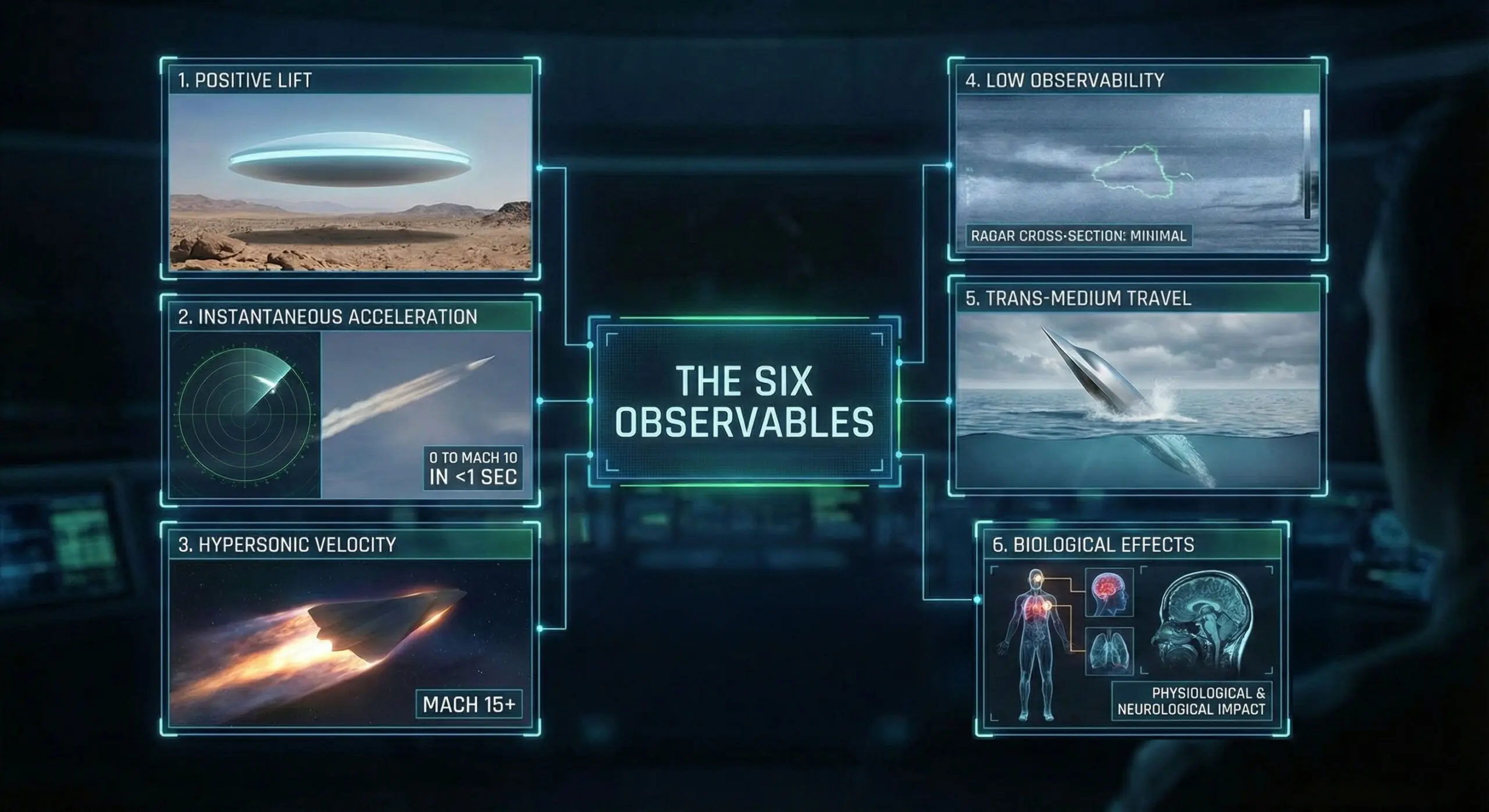
What moves a UAP is the central research question that ties together aerial encounters, undersea observations, and space-adjacent anomalies.
A data-first view starts from what instruments and witnesses report, maps those observables to the minimum physics required, and then sorts candidate propulsion models by how well they match the data with the fewest assumptions.
The public record contains multi-sensor cases with radar, FLIR, and eyewitness testimony, along with technical and theoretical literature ranging from classical fluid dynamics to general relativity.
Government reporting has grown, but its official summaries emphasize that most military-collected cases resolve prosaically once data are sufficient. That stance coexists with a persistent remainder of unresolved reports and an expanding research conversation about field propulsion, metric engineering, and vacuum physics. (Director of National Intelligence)
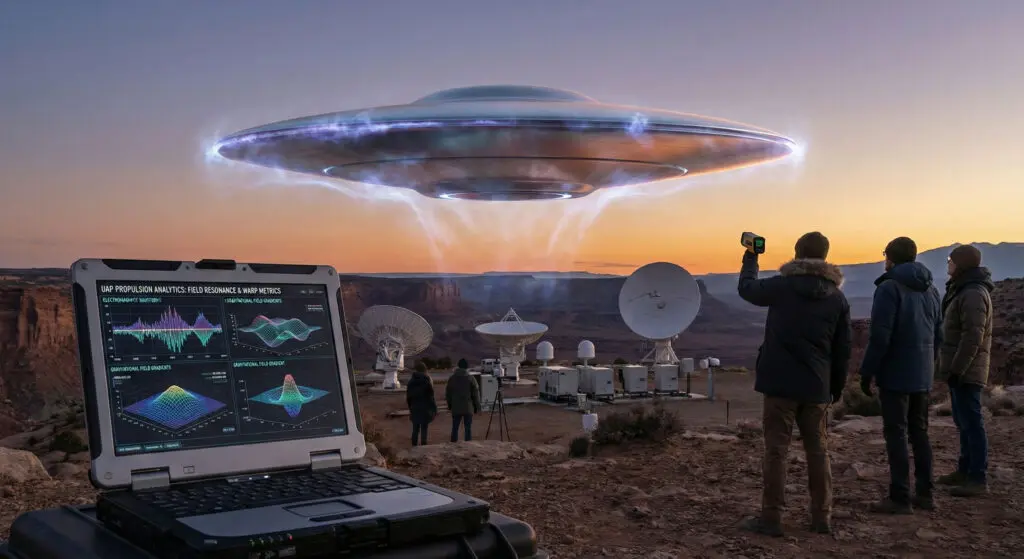
What the data say before any theory
A compact way to map observations to minimum propulsion implications is to align frequently reported performance characteristics with the physics they would require if literally true.
| Observable (frequently alleged) | Measurement mode | Minimal propulsion implication | Representative public datasets |
|---|---|---|---|
| Stationary hover for extended periods with no visible control surfaces | FLIR, eyewitness, sometimes radar | High power-density energy source with thrust vectoring or buoyant/field effect able to cancel gravity; minimal hot exhaust signature | Navy “Gimbal” and “GoFast” FLIR sequences; AARO’s 2025 “GoFast” case card constrains speeds to 5–92 mph and puts the object at ~13,000 ft, consistent with mundane motion under wind. |
| Rapid accelerations and direction changes that appear to exceed aerodynamic limits | Radar tracks and pilot accounts | Either very high thrust-to-mass with extreme structural margins or an effective reduction of apparent inertia; otherwise observational artifact | 2004 Nimitz “Tic Tac” dossier by SCU, with calculations and sensor context; competing analyses caution about parallax and track correlation limits. |
| Trans-medium behavior from air to water with small splash or continued track | Thermal IR and visual, sometimes radar correlation | Slippery boundary layer or sheath that suppresses cavitation and shock; shape and surface physics matter | 2013 Aguadilla IR video analysis by SCU; alternative hypothesis papers propose sky lanterns; the debate turns on wind and range estimates. |
| Low or ambiguous thermal signature | IR, EO | Non-chemical energy conversion, radiative camouflage, or small cross-section emitter; or simply distance and sensor settings | NASA UAP Study calls for calibrated, radiometrically useful data to adjudicate these claims. |
Key citations supporting the specific points above: AARO “GoFast” case resolution card placing the object at ~13,000 ft and 5–92 mph, with parallax driving the speed illusion. SCU’s Nimitz monograph compiling radar, ATFLIR, and pilot testimony for 2004. SCU’s Aguadilla report with counter-analyses about lanterns, range, and wind.
Data-first takeaway: some headline videos resolve to conventional dynamics after proper geometry and wind fields are applied, while other instrumented events retain genuine unknowns.
This mixed picture argues for careful case-by-case physics inferences rather than one-size answers.
The propulsion problem restated
A craft that hovers without obvious propulsors, maneuvers without control surfaces, and transitions across media would need at least one of the following:
- a way to generate momentum exchange without hot working fluid
- a way to reduce effective inertia or otherwise decouple internal loads from external accelerations
- a way to engineer the near-field environment so the medium “gets out of the way,” in air or water
- a way to control signature in multiple bands
The literature splits along those lines into field-propulsion concepts, plasma or MHD boundary control, and metric engineering. Below is an organized tour of the main families, anchored to publications and test reports. We include speculation labels with each where appropriate.
Field and boundary-layer engineering candidates
Magnetohydrodynamic and plasma-aerodynamic control
Core idea: use strong electromagnetic fields to ionize and push the nearby medium, reducing skin friction and delaying shock or cavitation. This is classical MHD and plasma-aerodynamics applied aggressively.
Data hooks: Alleged trans-medium entries with minimal splash and stable trajectories motivate curiosity about sheath-like boundaries. The Aguadilla analysis uses a thermal IR track consistent with a compact emitter, but the interpretation is contested. (Zenodo)
Publications worth knowing: AAWSAP’s Defense Intelligence Reference Documents included “Advanced Space Propulsion Based on Vacuum (Spacetime Metric) Engineering” and other plasma-adjacent topics in its 38-paper survey series. These are literature reviews and theoretical explorations, not validated propulsion demos.
Status: laboratory-scale flow control works in limited regimes; full trans-medium suppression remains unproven.
Speculation label: Hypothesis.
Zero-Point Field and vacuum engineering
Core idea: inertia and perhaps gravity emerge from interactions with the vacuum electromagnetic field. Modulate that field and you could modulate inertia or extract reaction forces.
Data hooks: “High-g without airframe breakup” claims would be easier to reconcile if effective inertia is reduced relative to structural loads.
Publications worth knowing: Haisch, Rueda, and Puthoff (1994) in Physical Review A proposed inertia as a Lorentz force arising from the zero-point field in accelerated frames. NASA’s Breakthrough Propulsion Physics program (1996-2002) cataloged such ideas and urged falsifiable tests. White’s “Warp Field Mechanics 101” summarizes warp-metric energetics, including vacuum considerations. (ResearchGate)
Status: no peer-reviewed, repeatable demonstration of net thrust from the quantum vacuum exists in the open literature.
Speculation label: Researcher opinion.
Reactionless microwave cavities and “EMDrive”-like claims
Core idea: a closed radio-frequency resonant cavity produces a net thrust without expelling reaction mass, perhaps by interacting with a quantum vacuum or by asymmetric fields.
Publications worth knowing: NASA’s Eagleworks team reported micro-Newton-scale thrust signals in vacuum tests with a dielectric-loaded RF cavity, with a reported 1.2 mN/kW figure of merit and extensive discussion of thermal systematics. The result remains controversial and has not been confirmed by independent labs to a consensus standard.
Status: disputed, with multiple null tests and alternative explanations proposed.
Speculation label: Disputed.
Mach-effect thrusters
Core idea: if mass fluctuates in an object whose internal energy is changing under acceleration, a phased push-pull might integrate to net thrust. James Woodward and collaborators have pursued this for decades.
Publications worth knowing: Theory and experiment have been presented in conference papers and journals, along with NASA NIAC-supported roadmaps. Independent groups have reported both small thrusts and nulls. (arXiv)
Status: unresolved at low signal levels.
Speculation label: Hypothesis.
Electrogravitics and Townsend Brown
Core idea: high-voltage asymmetric capacitors appear to generate lift beyond ion wind. Historical claims link this to gravity coupling.
Publications worth knowing: Mid-century industry briefs and later retrospectives in the public domain. Controlled experiments typically attribute forces to ion wind and corona discharge rather than gravity. (Wikipedia)
Status: misattribution to electrohydrodynamic effects explains most demonstrations.
Speculation label: Misidentification.
Metric-engineering concepts
Alcubierre-type warp metrics
Core idea: the ship stays locally inertial inside a “bubble” while spacetime contracts in front and expands behind. Travel can be effectively superluminal as seen from the outside.
Publications worth knowing: Alcubierre’s 1994 paper; Bobrick and Martire’s 2021 “Introducing Physical Warp Drives,” which formalizes subluminal, positive-energy classes and reframes warp drives as shells that still need conventional propulsion; Lentz’s 2021 work on positive-energy warp solitons; follow-up critiques noting energy conditions and stress-tensor issues. (Instituto de Física UFRJ)
Status: this is rigorous general relativity. It is not a blueprint. No engineered metric has been realized.
Speculation label: Researcher opinion.
Pais patents and “polarized vacuum” craft
Core idea: a resonant cavity, driven at microwave and acoustic frequencies, polarizes the local vacuum and reduces inertia or generates high-frequency gravitational waves. The result is a hybrid aerospace-undersea craft concept with a “polarized vacuum” outside its shell.
Publications worth knowing: Several U.S. patents assigned to the Navy, public FOIA releases, and a conference paper trail. These documents are legal claims, not experimental replications. (Google Patents)
Status: claims remain unvalidated in independent laboratories.
Speculation label: Hypothesis.
Case studies as propulsion testbeds
The 2004 Nimitz encounters
The SCU monograph integrates radar tracks, pilot debriefs, and ATFLIR to bound size, speeds, and maneuvers of the “Tic Tac.” Its appendices detail alternate reconstructions and power estimates. While the public does not have all raw radar files, the report is a benchmark in how to turn testimonies and partial telemetry into falsifiable physics claims. (The SCU)
Propulsion inference: if the strongest acceleration inferences are taken at face value, conventional aerostructures are insufficient. Candidates become field-effect inertia mitigation or misestimation of geometry. A cautious reading leaves the case as a probable anomaly in performance, pending release of original, synchronized sensor data.
The 2013 Aguadilla trans-medium video
SCU’s analysis argues for a compact, fast target with anomalous water entry and a split into two returns. Critics propose lanterns linked by string and wind drift. The dispute reduces to range, wind, and parallax math. The case is a clean example of how propulsion inferences collapse if the target was much smaller and closer than assumed. (The SCU)
Propulsion inference: if the object truly entered water at high speed and continued with minimal loss, the boundary-layer hypothesis gains weight. If it was lanterns, the propulsion inference disappears. Current status: Disputed.
The 2015 “GoFast” FLIR clip
AARO’s 2025 case card re-analyzed the video display readouts and historical winds to constrain intrinsic speed and altitude, attributing apparent high speed to motion parallax. The assessed speed range is 5–92 mph at roughly 13,000 ft. (AARO)
Propulsion inference: conventional.
Government reporting, weighed carefully
ODNI’s 2021 preliminary assessment and subsequent annual reports describe a growing catalog and emphasize safety of flight. AARO’s 2023 consolidated report and 2024 historical review assert no evidence of off-world technology in government holdings available to those offices. UAPedia records such statements, applies a “secrecy environment modifier,” and cross-checks against independent evidence and testimony. This avoids both credulity and premature dismissal. (Director of National Intelligence)
Policy implication: better instrumented data and transparent case files are prerequisites for propulsion inferences that stand outside the rumor mill.
Publications and resources to know
- NASA UAP Independent Study Team Final Report. Recommendations for data standards, calibration, and stigma reduction in UAP research. (NASA Science)
- SCU Monographs. Nimitz (2004) and Aguadilla (2013). Detailed reconstructions with explicit assumptions. (The SCU)
- AARO Case Resolution Cards. Worked examples that sometimes resolve pop-icon videos into ordinary dynamics. (AARO)
- AAWSAP/AATIP DIRDs. Surveys that inventory theoretical options such as warp metrics, wormholes, and metamaterials. They are not proof of capability.
- NASA Breakthrough Propulsion Physics documents. Lessons on how to test extraordinary claims with modest budgets and falsification first. (NASA Technical Reports Server)
- Warp-metric literature. Alcubierre 1994; Bobrick & Martire 2021; Lentz 2021; critiques on energy conditions. (Instituto de Física UFRJ)
- Vacuum and inertia literature. Haisch, Rueda, Puthoff 1994; White 2011 overview. (ResearchGate)
- EMDrive-type tests. NASA Eagleworks 2016 test report with discussion of thermal confounders and null approaches.
- Pais patents. Hybrid aerospace-undersea craft and high-frequency gravitational wave generator. FOIA trail provides context. (Google Patents)
Implications if even a subset is true
- Energy systems: Hover and rapid maneuver without reaction mass imply power densities far beyond chemical propulsion. That would redefine aviation, shipping, and space access.
- Fluid-structure engineering: A robust boundary-layer control that eliminates cavitation and shock would transform vehicle design and ocean engineering.
- Sensing and countermeasures: Field-based propulsion likely couples to the environment and may leave distinctive electromagnetic or gravitational signatures. That sets clear targets for next-gen sensors.
- Policy and safety: The number of unresolved military and civilian reports with near-miss potential justifies standardized sensor capture and analytic pipelines irrespective of origin hypotheses. (Director of National Intelligence)
What to watch next
- Laboratory falsification: Repeatable null-bound experiments on EM cavities, Mach-effects, and plasma sheath dynamics will prune or validate hypotheses. NASA’s BPP playbook is relevant. (NASA Technical Reports Server)
- Metric engineering theory: Continued work on positive-energy, subluminal warp constructs clarifies what would be required if nature allows metric control at any scale. (arXiv)
Bottom line
A propulsion overview anchored in public data yields a clear research program. Build better datasets with synchronized, calibrated sensors. Prefer quantitative reconstructions over narratives.
Explore boundary-layer and field-propulsion hypotheses in parallel with null-bound laboratory testing. Track metric-engineering theory as a long-horizon path that is mathematically rigorous but experimentally distant. Accept credible testimony as inputs and weigh it against sensors and physics. This is how a science of UAP propulsion can advance.
Claims taxonomy
Verified:
- AARO’s “GoFast” analysis constrains speed and altitude using video readouts and winds, showing non-anomalous speeds given parallax. (AARO)
Probable:
- The Nimitz encounter’s unusual kinematics relative to contemporaneous fleet training patterns look anomalous in the SCU reconstruction, though key raw sensor sets are not public. (The SCU)
Disputed:
- Aguadilla 2013 as a trans-medium demonstration. SCU argues for an anomalous target. Others propose lanterns and wind. Status remains contested pending full, calibrated, synchronized data. (The SCU)
Legend:
- Mid-century electrogravitics as a field-coupled gravity technology. Most demonstrations reduce to ion wind or corona. (Wikipedia)
Misidentification:
- Many FLIR clips that appear supersonic resolve to parallax plus wind when aircraft geometry is modeled. AARO’s “GoFast” is the canonical example. (AARO)
Hoax:
- Not applicable to the specific technical sources cited in this overview.
Speculation labels
Hypothesis
- MHD or plasma sheath enabling trans-medium travel.
- Mach-effect thrusters.
- Pais “polarized vacuum” cavity craft.
Witness interpretation
- Pilot impressions of “instant acceleration” without instruments can be colored by parallax and situational stress. Instrumented reconstructions are required, as “GoFast” illustrates. (AARO)
Researcher opinion
- Vacuum engineering and metric-engineering as ultimate solutions. There is a long arc of serious theory, but no lab-grade propulsion yet. (Instituto de Física UFRJ)
References
Alcubierre, M. (1994). The warp drive: Hyper-fast travel within general relativity. Classical and Quantum Gravity, 11(5), L73–L77. https://www.if.ufrj.br/~mbr/warp/alcubierre/cq940501.pdf?utm_source=https://uapedia.ai (Instituto de Física UFRJ)
All-domain Anomaly Resolution Office. (2025, February 6). Case: “GoFast” Case Resolution Card. https://www.aaro.mil/Portals/136/PDFs/case_resolution_reports/AARO_GoFast_Case_Resolution_Card_Methodology_Final.pdf?utm_source=https://uapedia.ai (AARO)
Bobrick, A., & Martire, G. (2021). Introducing physical warp drives. Classical and Quantum Gravity, 38(10), 105009. https://arxiv.org/abs/2102.06824?utm_source=https://uapedia.ai (arXiv)
Haisch, B., Rueda, A., & Puthoff, H. E. (1994). Inertia as a zero-point-field Lorentz force. Physical Review A, 49(2), 678–694. https://www.researchgate.net/publication/13379419_Inertia_as_a_zero-point-field_Lorentz_force?utm_source=https://uapedia.ai (ResearchGate)
Millis, M. G. (2004). Breakthrough Propulsion Physics Project: Project management methods (NASA/TM-2004-213406). https://ntrs.nasa.gov/citations/20050041926?utm_source=https://uapedia.ai (NASA Technical Reports Server)
NASA. (2023, September 14). UAP Independent Study Team final report. https://science.nasa.gov/wp-content/uploads/2023/09/uap-independent-study-team-final-report.pdf?utm_source=https://uapedia.ai (NASA Science)
NASA Science. (2023). UAP hub page. https://science.nasa.gov/uap/?utm_source=https://uapedia.ai (NASA Science)
Office of the Director of National Intelligence. (2021). Preliminary assessment: Unidentified Aerial Phenomena. https://www.dni.gov/files/ODNI/documents/assessments/Prelimary-Assessment-UAP-20210625.pdf?utm_source=https://uapedia.ai (Director of National Intelligence)
ODNI. (2023, January 12). 2022 Annual Report on UAP. https://www.dni.gov/files/ODNI/documents/assessments/Unclassified-2022-Annual-Report-UAP.pdf?utm_source=https://uapedia.ai (Director of National Intelligence)
AARO. (2023, October). FY23 Consolidated Annual Report on UAP. https://www.aaro.mil/Portals/136/PDFs/UNCLASSIFIED-FY23_Consolidated_Annual_Report_on_UAP-Oct_25_2023_1236.pdf?utm_source=https://uapedia.ai (AARO)
AARO. (2024, March 8). Historical Record Report, Vol. 1. https://media.defense.gov/2024/Mar/08/2003409233/-1/-1/0/DOPSR-CLEARED-508-COMPLIANT-HRRV1-08-MAR-2024-FINAL.PDF?utm_source=https://uapedia.ai (U.S. Department of War)
Scientific Coalition for UAP Studies. (2019). A forensic analysis of Navy Carrier Strike Group Eleven’s encounter with an Anomalous Aerial Vehicle. https://www.explorescu.org/post/2004-uss-nimitz-strike-navy-group-incident-report?utm_source=https://uapedia.ai (The SCU)
Scientific Coalition for UAP Studies. (2015, updated 2024). 2013 Aguadilla Puerto Rico UAP Incident: A detailed analysis. https://www.explorescu.org/post/2013-aguadilla-puerto-rico-uap-incident-report-a-detailed-analysis?utm_source=https://uapedia.ai; archival copy: https://zenodo.org/records/7844175?utm_source=https://uapedia.ai (The SCU)
The Black Vault. (n.d.). AATIP/AAWSAP: 38 Defense Intelligence Reference Documents. https://www.theblackvault.com/documentarchive/aatip-related-defense-intelligence-reference-documents-dirds/?utm_source=https://uapedia.ai
White, H. (2011). Warp field mechanics 101. NASA Technical Reports Server. https://ntrs.nasa.gov/api/citations/20110015936/downloads/20110015936.pdf?utm_source=https://uapedia.ai (NASA Technical Reports Server)
White, H., March, P., Lawrence, J., Vera, J., Sylvester, A., Brady, D., & Bailey, P. (2016). Measurement of impulsive thrust from a closed RF cavity in vacuum. NASA JSC Technical Report. https://ntrs.nasa.gov/api/citations/20170000277/downloads/20170000277.pdf?utm_source=https://uapedia.ai
Lentz, E. (2021). Hyper-fast positive energy warp drives. World Scientific, Gravity and the Quantum. https://www.worldscientific.com/doi/pdf/10.1142/9789811269776_0061?utm_source=https://uapedia.ai (World Scientific)
Pais, S. C. (2018). Craft using an inertial mass reduction device (US10144532B2). https://patents.google.com/patent/US10144532B2/en?utm_source=https://uapedia.ai; High frequency gravitational wave generator (US10322827B2). https://patentimages.storage.googleapis.com/21/5a/a6/c9ad768eb3a443/US10322827.pdf?utm_source=https://uapedia.ai (Google Patents)
UAPedia Editors. (2025, Dec. 5). How UAPedia treats government sources. https://uapedia.ai/wiki/how-uapedia-treats-government-sources/?utm_source=https://uapedia.ai (UAPedia – Unlocking New Realities)
Internal cross-link for UAPedia readers
- The Six Observables (Elizondo Model) → map each observable to propulsion implications
- NUFORC & MUFON: Civilian Data Sources → pipelines for calibrated cases
- Project Sign/Grudge/Blue Book → early propulsion inferences and missteps
- GEIPAN: France’s Official UAP Unit → open methodology comparisons
- FOIA & The Black Vault: How to Read Docs → source handling for propulsion claims
- Tic Tac: Shape & Performance Claims → case-specific physics mapping
SEO keywords
UAP propulsion, UAP propulsion technologies, trans-medium craft, field propulsion, zero-point field inertia, EMDrive, Mach effect thruster, warp drive Alcubierre, Bobrick Martire warp, Lentz warp soliton, AARO case card GoFast, SCU Nimitz report, SCU Aguadilla report, AAWSAP DIRDs, Pais patents polarized vacuum, NASA UAP independent study, Breakthrough Propulsion Physics, UAP boundary layer plasma, magnetohydrodynamics UAP, UAP metric engineering