
UAPedia Research Desk
The Artemis Accords are a US-led, non-binding framework intended to shape norms and best practices for civil exploration and use of the Moon, Mars, comets, and asteroids. Since their initial signing in October 2020, the Accords have expanded to a large coalition of signatory states, positioning the document as one of the most influential “soft law” instruments in contemporary space governance. This review paper synthesizes the Accords’ core principles, situates them within existing treaty law (especially the 1967 Outer Space Treaty), and evaluates major points of controversy: (a) whether space resource extraction can be reconciled with the non-appropriation principle; (b) whether “safety zones” for deconfliction risk becoming de facto territorial control; and (c) whether club-based rulemaking accelerates practical governance or fragments multilateral legitimacy. The paper further considers how the Accords interact with parallel international efforts, including UN COPUOS work on the legal aspects of space resource activities, and compares Artemis governance dynamics with the China–Russia International Lunar Research Station (ILRS) initiative. The review concludes that the Artemis Accords are best understood as a pragmatic, operationally oriented governance prototype. They can reduce uncertainty and improve coordination in the near term, but their long-run legitimacy will depend on transparent implementation, meaningful interoperability with UN processes, and credible mechanisms to protect equitable access, scientific openness, and heritage and environmental values on celestial bodies.
Introduction
The return of sustained human and robotic activity to the Moon is no longer a distant prospect. Multiple state and commercial actors are planning missions that require long-duration surface operations, complex logistical supply chains, and eventually in situ resource utilization (ISRU) to reduce dependence on Earth. This operational shift stresses a legal architecture largely written for a different era: one in which scientific exploration dominated, and permanent installations, large-scale resource extraction, and dense operational traffic around lunar regions were not imminent.
Against this backdrop, the Artemis Accords (hereafter, “the Accords”) emerged in 2020 as a set of principles designed to guide cooperation among states participating in, or aligning with, NASA’s Artemis program. A central feature of the Accords is their attempt to convert high-level treaty obligations into implementable operational norms: transparency measures, interoperability expectations, protocols for emergency assistance, registration practices, data-sharing commitments, heritage protection, and practices for deconflicting activities on and around celestial bodies (including the concept of “safety zones”). Scholars characterize the Accords as a “political commitment” rather than a binding treaty, and debate whether they represent evolutionary implementation of existing law or a more disruptive shift toward club-based rulemaking in outer space governance. (Cambridge University Press & Assessment)
This paper reviews the content and governance logic of the Accords, then evaluates the most consequential controversies and future pathways for convergence with multilateral rulemaking.
Review Method
This is a narrative review drawing on: (a) primary text and explanatory materials related to the Artemis Accords; (b) peer-reviewed legal and policy scholarship on space resource governance, safety zones, and soft law; (c) UN documentation from COPUOS-related processes addressing the legal aspects of space resource activities and long-term sustainability guidelines; and (d) reputable science-policy journalism capturing early critiques and geopolitical context. The emphasis is on cross-source synthesis rather than exhaustive cataloging.
Background: The Treaty Baseline and the Governance Gap
The Outer Space Treaty as constitutional scaffolding
The 1967 Outer Space Treaty (OST) establishes the foundational principles still widely treated as constitutional scaffolding for space law. The non-appropriation principle in Article II provides that outer space, including the Moon and other celestial bodies, is not subject to national appropriation by sovereignty claim, use, occupation, or any other means. (UNOOSA) This provision has become the central interpretive anchor for modern debates about whether extracting and using space resources amounts to prohibited appropriation, or can be treated as a lawful “use” distinct from territorial sovereignty.
Sustainability and operational density
As space activity expands, sustainable operations and debris mitigation become governance priorities. UN COPUOS adopted guidelines for the long-term sustainability (LTS) of outer space activities in 2019, framing sustainability as a voluntary, consensus-based approach to maintaining space as a stable and safe environment. (UNOOSA) While LTS guidelines focus heavily on Earth orbital operations, the same logic increasingly applies to cislunar space and lunar surface activity, especially where hazards or interference risks rise with mission density.
Space resources: renewed urgency and institutional response
In the last decade, domestic legislation and policy signals have increasingly treated space resource extraction as technically plausible and economically meaningful. This has pushed the international system to revisit resource governance questions that were left unsettled after the Moon Agreement failed to gain broad ratification. The UN COPUOS Legal Subcommittee created a working group on the legal aspects of space resource activities in 2021, and the group has continued to develop draft recommended principles, including updated drafts circulated and discussed through 2025.
What the Artemis Accords Are: Structure and Core Principles
The Accords are commonly described as a set of 13 provisions (or sections) establishing principles and best practices for civil exploration and use of the Moon and other specified celestial bodies. (Cambridge University Press & Assessment) They include commitments that largely mirror or operationalize existing treaty obligations and established practices, alongside a smaller set of innovations (notably around resources and deconfliction).
A helpful way to interpret the Accords is to group their content into four functional pillars: (1) transparency and interoperability, (2) safety and emergency support, (3) science, heritage, and sustainability, and (4) resource utilization and operational deconfliction.
Transparency and interoperability
The Accords emphasize transparency of policies and plans and encourage interoperable systems and standards, reflecting a practical reality: deep-space operations are inherently risky, and rescue, docking, communications, and logistical support become far more reliable when systems are designed to work together. Deplano’s analysis notes that many provisions transpose or refine existing obligations rather than invent new legal principles, with interoperability serving humanitarian and operational safety functions as much as scientific cooperation. (Cambridge University Press & Assessment)
Emergency assistance and registration practices
The Accords reiterate expectations about rendering assistance to personnel in distress and about registering space objects. These reflect long-standing treaty commitments and help reduce ambiguity about responsibility, liability exposure, and operational coordination when missions involve multiple states and commercial actors. (Cambridge University Press & Assessment)
Scientific data release and heritage protection
The Accords include a commitment to release scientific data, aligning with broader norms of open science and public benefit. They also introduce explicit language on preserving “outer space heritage,” including historically significant sites and artifacts. Deplano argues this heritage provision is a meaningful innovation because the OST does not provide detailed mechanisms for heritage protection, even though heritage protection can be framed as compatible with treaty principles. (Cambridge University Press & Assessment)
Orbital debris and sustainable practices
The Accords address orbital debris mitigation and sustainable practices, reinforcing the logic of LTS guidelines and reflecting an awareness that sustainability is now a core governance priority, not an optional add-on. (UNOOSA)
Adoption, Scale, and Coalition Dynamics
Growth in signatories
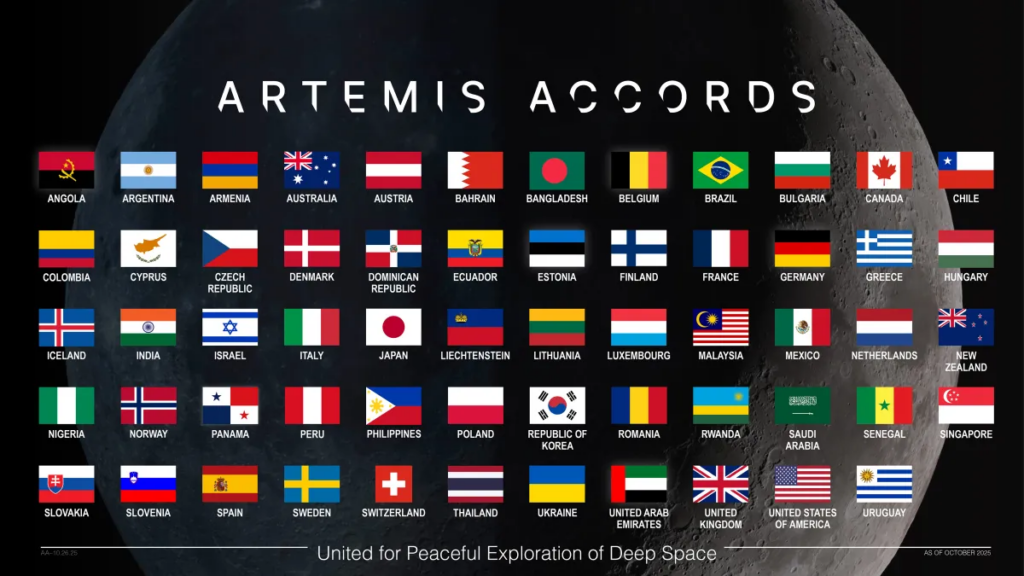
The Accords began with eight initial signatories in October 2020 (including the United States, United Kingdom, Japan, Canada, Italy, Australia, Luxembourg, and the UAE). (Cambridge University Press & Assessment) Over time, the coalition expanded substantially. NASA materials indicate that by late 2025, the Accords had reached at least 59 signatories, with Hungary, Malaysia, and the Philippines among the most recent additions recognized in NASA’s “five years” milestone coverage and its signatory list by date.
Some sources report 60 signatories by November 2025, including Latvia. The modest discrepancy across public-facing trackers appears consistent with the timing differences that can occur between announcement, signature ceremony, and subsequent updates to official lists.
Parallel governance blocs: Artemis versus ILRS
The Accords’ geopolitical significance is sharpened by the presence of an alternative lunar coalition centered on China and Russia: the International Lunar Research Station (ILRS). In an April 23, 2025, Reuters report, China’s lunar program leadership framed the ILRS as developing well with 17 participating countries and organizations, while contrasting it with the larger Artemis Accords coalition (then described as “over 50” signatories). The same report referenced China–Russia cooperation and interest in “moon-based nuclear energy,” illustrating how lunar governance is entangled with long-horizon infrastructure strategy and geopolitical alignment. (Reuters)
Central Legal and Policy Debates
1) Space resources and the non-appropriation principle
The most cited controversy concerns how the Accords treat space resource extraction. The OST bans national appropriation of territory, but it does not explicitly ban extraction or ownership of resources once removed. The Accords take a clear interpretive position: resource extraction does not inherently constitute national appropriation under Article II, and resource activities should be conducted consistent with the OST.
From a review perspective, two points matter.
First, the Accords’ interpretive move is not purely theoretical. It aims to lower investment uncertainty for governmental and non-governmental entities by signaling that signatories intend to authorize and supervise extraction activities rather than treat them as presumptively unlawful. This is aligned with scholarship emphasizing the urgent need for clarity regarding the legal frameworks applicable to space mining. (ScienceDirect)
Second, the interpretive move is contested because Article II’s scope is not settled, and state practice is not uniform. Deplano argues the Accords are “highly innovative” yet “not revolutionary,” and suggests that, while the Accords can contribute to emerging subsequent practice, they do not automatically become an authoritative interpretation accepted by all OST parties. (Cambridge University Press & Assessment)
In short, the Accords reduce uncertainty for signatories and partners, but they do not by themselves resolve the underlying global interpretive dispute.
2) Safety zones and deconfliction: governance tool or de facto territoriality?
“Safety zones” are among the Accords’ most debated innovations. In concept, a safety zone is a temporary, operationally justified buffer around activities that could cause harmful interference or hazards, designed to reduce collision risk, contamination risk, or operational conflict. Scholarly analysis emphasizes that safety zones are controversial because a poorly designed or strategically abused zone could operate like an exclusionary claim, undermining the non-appropriation principle and free access norms. (ScienceDirect)
The literature converges on several implementation conditions that separate legitimate deconfliction from de facto appropriation:
- Non-exclusionary design: Zones should not become blanket prohibitions on access.
- Temporariness and review: Zones should be limited in duration and tied to clear operational hazards.
- Notice and transparency: Public notice, location disclosure, and consultation reduce ambiguity and reduce the chance that zones become stealth territorial claims.
- Proportionality: The zone’s size should be justified by technology and hazard models, not strategic advantage. (ScienceDirect)
McKeown, Dempster, and Saydam add a further critical angle: even if safety zones are workable for small-scale ISRU, they may be impractical as governance tools for large-scale commercial extraction in constrained high-value regions (for example, areas associated with water ice), potentially creating pressure for more robust multilateral governance frameworks. (ScienceDirect)
A useful synthesis is that safety zones are not inherently incompatible with the OST, but their legitimacy depends on disciplined implementation rules, credible transparency, and an accountability pathway for overlap disputes.
3) Soft law, legitimacy, and the forum question: COPUOS versus club governance
A recurring critique is procedural: critics argue the Accords attempt to develop international space law outside the UN system, potentially fragmenting legitimacy. The AJIL Contemporary Practice discussion captures this tension by noting that commentators and opponents have argued the Accords seek to build consensus around a US-friendly interpretation of resource ownership and governance, and that China and Russia have criticized the Accords as consolidating rules outside traditional multilateral lawmaking forums. (Cambridge University Press & Assessment)
From a governance standpoint, the procedural critique has two layers:
- Speed and operational relevance: Club-based instruments can move faster than multilateral treaty negotiation, which has been slow for decades on resource issues. Practical norms may be needed before the first serious disputes occur.
- Representativeness and universality: A coalition instrument risks embedding rules favored by early movers, potentially marginalizing states that lack near-term lunar capability but remain OST parties with legal interests in “use” and access.
The UN COPUOS space resources working group’s draft recommended principles explicitly situates Artemis as one of several international efforts (alongside the Hague Building Blocks) and expresses interest in principles with “wider acceptance among the global space community.” This is an important convergence signal: it suggests a pathway where Artemis practices can inform, but not replace, multilateral norm-building.
4) Heritage, science, and the problem of enforceability
The Accords’ heritage language is widely viewed as normatively valuable but practically underspecified. Unlike environmental treaties on Earth, lunar heritage has no mature compliance apparatus. Even if all signatories endorse heritage protection, commercial and national prestige incentives can erode restraint in high-interest areas.
The same applies to open scientific data. Scientific American’s early critique framed the Accords as participation conditions for NASA partnership and raised concerns that the framework could function as a way to route around preexisting treaty norms rather than deepen them, even while acknowledging the Accords contain widely agreeable “self-evident” principles about transparency, assistance, and publication of findings. (Scientific American)
A review conclusion here is that heritage and data-sharing commitments are governance “high ground,” but they require implementation detail: what counts as protected heritage, what stand-off distances apply, what timelines govern data release, and how proprietary or security-sensitive information is balanced against open science norms.
Interaction with Other International Frameworks
The Hague Building Blocks as a conceptual bridge
The Hague International Space Resources Governance Working Group’s “Building Blocks” provide a structured set of governance concepts intended to support the development of an international framework on space resource activities. The Building Blocks include due regard concepts and contemplate area-based safety measures and consultation mechanisms, including attention to overlapping safety zones and public notice. (Leiden University)
Importantly, the Building Blocks have been introduced into COPUOS-related documentation and discussion, indicating they serve as a bridge between technical policy design and multilateral processes. (UNOOSA)
COPUOS draft recommended principles and the “wider acceptance” aim
The COPUOS working group’s updated draft recommended principles (July 2025 version) explicitly references Artemis and the Hague Building Blocks as prior efforts, then frames the UN effort as producing high-level principles with wider acceptance, implemented voluntarily through national mechanisms. This creates a plausible convergence model:
- Artemis functions as an operational testbed among willing partners.
- COPUOS distills broadly acceptable principles and harmonization guidance.
- National regulations, bilateral arrangements, and standards bodies operationalize the principles into enforceable practice.
This layered approach may be the most realistic path to reducing dispute risk while preserving multilateral legitimacy.
Implications for Future Governance
Reducing ambiguity before the first major lunar disputes
A core pragmatic argument for the Accords is that norms must exist before resource extraction and high-density operations produce the first serious “harmful interference” disputes. Once capital-intensive assets are deployed, incentives shift toward unilateral defensive postures. Pre-agreed deconfliction and transparency practices can reduce the risk of misinterpretation and escalation.
Equity, access, and “province of all humankind” concerns
While the OST frames exploration and use as for the benefit and interests of all countries, critics worry that the Accords’ coalition model could tilt governance toward first-mover advantage. A key challenge for legitimacy is demonstrating that the Accords do not merely protect technologically advanced actors’ access to high-value lunar regions but also create pathways for meaningful participation and benefit-sharing for states with emerging capacity.
Private actors and regulatory capture risk
Because resource extraction is likely to be driven by commercial entities operating under state authorization and supervision, governance outcomes will be shaped by domestic licensing regimes and contractual architectures as much as by international principles. The Accords can encourage compatible domestic approaches, but they do not themselves prevent a race to permissive licensing standards. This is another area where COPUOS-recommended principles could serve as a harmonization anchor.
Relevance to anomalous observations and data governance
While the Accords are not a UAP-focused instrument, their emphasis on transparency, scientific data release, and deconfliction has an indirect relevance to how future lunar and cislunar sensor networks handle unexpected observations. Notably, the Accords’ deconfliction language anticipates scenarios where operations or “anomalous” events could cause harmful interference, underscoring that governance frameworks must be robust to the unexpected, not only to planned activity. From a UAPedia perspective, any governance regime that expands open scientific reporting and reduces information silos can improve the quality of anomaly triage, regardless of whether anomalies are ultimately attributable to mundane or genuinely novel causes.
For the implications of the Artemis Accords for a potential discovery of NHI read here our Brief here.
Conclusion
The Artemis Accords represent one of the most consequential recent developments in space governance, not because they are legally binding, but because they operationalize treaty-era principles into implementable norms at the precise moment when sustained lunar activity is becoming real. The Accords clarify expectations around transparency, interoperability, emergency assistance, registration, scientific data release, heritage protection, sustainability, and, most controversially, space resources and safety zones.
The review literature supports a balanced conclusion. The Accords are broadly rooted in the OST and other established instruments, and they can plausibly reduce uncertainty and improve safety for participating missions. (Cambridge University Press & Assessment) Yet their most consequential interpretive moves (resources and safety zones) face persistent legitimacy challenges unless they are implemented in clearly non-exclusionary, transparent, and consultative ways, and unless they remain interoperable with multilateral norm-building. (ScienceDirect)
The long-run success of the Accords, as a governance prototype, will likely depend on whether their coalition practices can be translated into principles with wider acceptance through forums like COPUOS, and whether they can demonstrate credible commitments to equitable access, scientific openness, and protection of shared heritage in the first real era of lunar permanence.
References
American Journal of International Law. (2023). Signatories of the U.S.-Led Artemis Accords meet in person for the first time. American Journal of International Law, 117(1), 133–139. (Cambridge University Press & Assessment)
Baptista, E. (2025, April 23). China lunar chief accuses US of interfering in joint space programmes with other nations. Reuters. (Reuters)
Deplano, R. (2021). The Artemis Accords: Evolution or revolution in international space law? International & Comparative Law Quarterly, 70(3), 799–819. (Cambridge University Press & Assessment)
European Space Agency. (2025). Artemis Accords: What are they? Who has signed? FAQs. (ESA)
Gilbert, A. Q. (2023). Implementing safety zones for lunar activities under the Artemis Accords. Journal of Space Safety Engineering, 10(1), 103–111. (ScienceDirect)
McKeown, B., Dempster, A. G., & Saydam, S. (2022). Artemis Accords: Are safety zones practical for long term commercial lunar resource utilisation? Space Policy, 62, 101504. (ScienceDirect)
NASA. (2020). Artemis Accords: Principles for cooperation in the civil exploration and use of the Moon, Mars, comets, and asteroids for peaceful purposes (NASA PDF).
NASA. (n.d.). Artemis Accords: List of the signatories by date (PDF). Retrieved December 20, 2025, from (NASA)
NASA. (2025, November 20). NASA celebrates five years of Artemis Accords, welcomes 3 new nations. (NASA)
Stirn, A. (2020, November 12). Do NASA’s lunar exploration rules violate space law? Scientific American. (Scientific American)
The Hague International Space Resources Governance Working Group. (2019). Building blocks for the development of an international framework on space resource activities (Revised April 2019) (PDF). Leiden University. (Leiden University)
United Nations Office for Outer Space Affairs. (2021). Guidelines for the long-term sustainability of outer space activities (Publication) (PDF). (UNOOSA)
United Nations Office for Outer Space Affairs. (2025, July 7). Updated initial draft set of recommended principles for space resource activities (Working Group on Legal Aspects of Space Resource Activities) (UNOOSA PDF).
United Nations Office for Outer Space Affairs. (n.d.). Outer Space Treaty. (UNOOSA)
de Zwart, M., Henderson, S., & Neumann, M. (2023). Space resource activities and the evolution of international space law. Acta Astronautica, 211, 155–162. (ScienceDirect)
Suggested internal crosslinks for UAPedia
SEO keywords
Artemis Accords review; Artemis Accords APA paper; space law Artemis Accords; Outer Space Treaty Article II; lunar safety zones; deconfliction of space activities; space resource extraction legality; COPUOS space resources working group; Hague Building Blocks space resources; ILRS vs Artemis Accords; lunar governance norms; space sustainability guidelines