
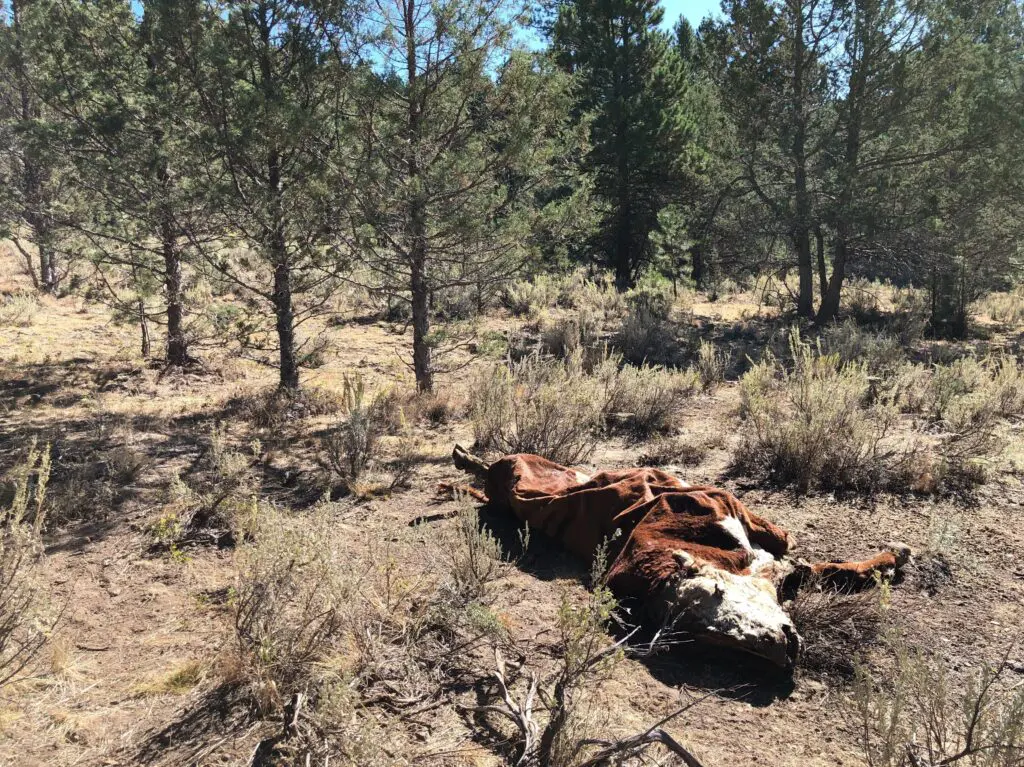
In the high desert of eastern Oregon, a breeding bull’s body lies crumpled in the scrub and pine, as if the animal simply deflated.
The scene feels staged, yet there is nothing obvious to stage with: no tire tracks, no bootprints, no drag marks, no telltale churn where a struggle happened. Witnesses keep coming back to the same unnerving phrases: “precisely removed,” “no blood,” “no scavengers.”
That vocabulary is not new. It is the same vocabulary ranchers used in Colorado in the 1970s. It resurfaced in Texas in 2023, when investigators described “straight, clean” facial excisions and tongues “completely removed” without visible blood spill.
And it persists because the core challenge persists: cattle deaths are common, but a subset of cattle deaths presents a repeating, forensic-looking pattern that rural communities experience as an intrusion.
The data snapshot
Before theories, start with the measurable: reported clusters, repeated wound locations, reporting incentives, and the quality of postmortem documentation.
Clusters, not a steady baseline
Cattle-mutilation reporting behaves like “waves.” In Colorado’s 1970s surge, journalists and investigators recorded hundreds of reports. One later review cites “nearly 200” Colorado cases in a single stretch of 1975. A separate report from 2009, referencing Colorado Bureau of Investigation material, describes “more than 200 mutilation reports” filed by ranchers in the 1970s.
Arkansas shows the same wave signature. State police records there indicate 39 reports of unexplained cattle deaths from April 1978 to September 1979, concentrated in northern regions of the state.
Modern clusters still occur. In 2019, eastern Oregon produced a tightly bounded set of cases on and around a major ranch, with five young purebred bulls found bloodless and missing tongues and genitals, according to local reporting.
In Texas (Madison/Robertson/Brazos area) in 2023, authorities reported seven mutilated cows across different locations and herds, while at least one postmortem exam attributed the cause of death to pneumonia even as “deformities” remained unexplained in the public-facing summary.
The repeated “target tissues”
Across decades and states, the same body areas are described again and again: eyes, tongues, udders, sex organs, and anogenital tissue, often framed as “surgical precision.” This recurrence matters because it defines the phenomenon operationally. If you remove the repeating target tissues, you remove the pattern.
The “10,000 by 1979” number is real in the media record but weak as a dataset
News-era estimates that “more than 10,000” incidents occurred by the end of the 1970s appear in secondary summaries of period reporting. The number is culturally influential, but it is not a clean count derived from a single, standardized reporting system. Treat it as an indicator of scale anxiety, not a precise statistic.
The single biggest data problem: postmortems are rare
Even in later decades, officials noted that necropsies were often not ordered due to cost. Without a necropsy, you lose the ability to decisively separate if the animal died first, then scavenged, was wounded before death (antemortem), manipulated after death by tools (human or otherwise).
The signature pattern
What makes a rancher say: “This was done!”
When ranchers report mutilations, the claim is usually not “my cow is dead.” It is “my cow is dead in a way I recognize as wrong.”
From the Oregon reports, key signature elements include:
- bloodlessness at the scene (“not one drop of blood”)
- missing tongues/genitals/udders with “precise” cuts
- pristine scenes: no tracks, no disturbed ground, no signs of struggle
- claimed absence of scavengers in the early period after death
From Texas, investigators publicly echoed the same pattern: straight clean facial cut, tongue removed, undisturbed ground, no visible tracks.
From Colorado reporting, the same signature appears: “no tire tracks or footprints,” and “nor even bloodstains.”
This repeating signature is why the phenomenon endures. It reads like an operation, not like nature.
Witness testimony
What people said when they were not trying to entertain anyone
Oregon: “Everything you do leaves tracks”
In eastern Oregon, rancher Terry Anderson recalled an earlier incident in the 1980s, describing an udder removed with something “razor sharp” and emphasizing the absence of blood.
Nearby, Andie Davies described how she and her husband rode circles to find any sign of approach, concluding that in that terrain, “everything you do leaves tracks.”
On Silvies Valley Ranch, executive Colby Marshall described the bulls as found bloodless with tongues and genitals removed, and he framed the environment as rugged enough that a capable perpetrator would be dangerous to humans as well.
Law enforcement testimony from that same reporting illustrates how “UAP” becomes part of the social field: a deputy described receiving many calls, including claims about craft “beaming” animals and suggestions to use radiation detection.
Texas: “No footprints, tire tracks or blood”
In the Texas cluster, the public-facing description is unusually explicit for an active investigation: a “straight, clean cut” removing hide around one side of the mouth while leaving underlying tissue untouched, plus the tongue “completely removed” with no blood spill.
A local resident, Vernon Guidry, articulated the core cognitive shock plainly: no blood, no struggle, body position not making sense.
Colorado: “There’s nothing to go by”
A Colorado rancher, Manuel A. Sanchez, described the problem as the absence of actionable traces: “There’s nothing to go by.” That phrase is revealing. The terror is not simply the dead animal. It is the feeling that normal causal inference has been disabled.
New Mexico: official channels treated the reports as serious enough to circulate
In FBI-released material tied to New Mexico reporting, correspondence references requests for a government investigation into “mysterious livestock mutilations” in Rio Arriba County, with state police incident reports enclosed. Even when agencies later minimized the likelihood of human perpetrators, the administrative trail shows that officials recognized the intensity and persistence of complaints.
The biology
Why nature can look like a scalpel (and why that does not close the file)
A data-first investigation must confront the strongest prosaic mechanism head-on: postmortem scavenging and decomposition.
What veterinary science can explain well
Soft tissue goes first
Veterinary and forensic commentary repeatedly notes that scavengers preferentially consume softer tissues first, which overlaps almost perfectly with the “target tissues” pattern (eyes, tongue, genitalia).
Bloodlessness can be an artifact of postmortem circulation stopping
One mainstream explanation for “bloodless” appearance is gravitational pooling after death (livor mortis) rather than external drainage. This is not a hand-wave; it is a known postmortem process that can dramatically change what a carcass looks like to a non-pathologist.
Bloating and skin tears can mimic incisions
A particularly important point, because it maps onto “clean cut” language: bacterial bloating and skin tension can produce splits that appear incision-like.
Controlled “look-alike” demonstrations exist
In Arkansas, the Washington County Sheriff’s Department reportedly euthanized a heifer and observed the carcass, documenting that within roughly thirty hours it developed the same conditions reported as mutilations, with evidence that only scavengers interacted with it.
Mainstream historical summaries also describe a similar Arkansas experiment (a dead cow placed and later found to resemble “mutilation” conditions), reinforcing that law enforcement itself explored naturalistic mechanisms.
A peer-reviewed veterinary conclusion: exclude scavenging before claiming human involvement
A Canadian Veterinary Journal paper reviewing Alberta reports concluded the “so-called ‘mutilation’” cases there were due to scavenging and emphasized that claims of human involvement require, as a first condition, excluding postmortem scavenging.
Why “straight-line cuts” happen in scavenging
Veterinary pathologist Nick Nation described how coyotes can bite and pull, producing what appears to be a straight-line cut, and he noted that tracks are far less visible in summer conditions when many reports occur.
What biology does not resolve on its own
The biology explains “how the body can look,” not “why clusters spike”
Even if many cases are misread scavenging, you still have to explain wave behavior: why certain years and regions light up socially and administratively while others do not. That is not a carcass question, it is a systems question involving economics, trust, media dynamics, and local enforcement capacity.
Biology does not reliably explain “pristine scenes” without additional context
A scene can look pristine for mundane reasons: wind, hard ground, time delay, or observers focusing on large tracks while missing subtle ones. But when multiple witnesses and deputies repeatedly emphasize “no tracks,” the correct response is not dismissal. It is to design evidence collection that can test the claim (soil impressions, IR imaging, photogrammetry, camera traps).
The 1979 pivot point: when the federal record intersects the wave
What the FBI files actually show
In FBI-released documents, a multi-state livestock mutilation conference in Albuquerque (April 1979) is referenced, with an FBI agent assigned as a contact for reports and to organize the Bureau’s activities.
Those documents also preserve a key institutional stance: by January 15, 1980, retired FBI agent Kenneth M. Rommel advised that the cases he examined were consistent with common predators and that he had not found justification to believe animals were intentionally mutilated by human beings.
This is often treated publicly as closure. It is not closure. It is a conclusion reached under the constraints of the cases examined, the evidence submitted, and the jurisdictional boundaries of the Bureau. What it does do is define a baseline: the strongest official argument for “predators explain it.”
The investigative question then becomes sharper: Which cases, if any, survive that baseline with intact anomalies?
Theories
A disciplined map (with Speculation Labels)
This section separates evidence from interpretation. Each theory is presented with a Speculation Label and with the strongest points both for and against, based on the sources above.
1) Scavenger and taphonomy hypothesis
Speculation Label: Hypothesis
Claim: Many “mutilations” are ordinary deaths followed by scavenging, insect activity, and postmortem changes that mimic surgical cuts and blood loss.
Best supporting points
- Peer-reviewed veterinary review concludes Alberta “mutilations” were scavenging and says human-involvement claims require excluding scavenging.
- Law enforcement “look-alike” demonstrations in Arkansas reportedly reproduced the pattern with scavengers only.
- Veterinary pathologist testimony describing how coyote bites and pulling can create straight-line wounds.
- Explanations for bloodless appearance (postmortem pooling) and incision-like tears (bloating/skin tension).
Hard problems for this hypothesis
- It must also explain why some scenes are repeatedly described as lacking scavenger activity early after death in certain clusters (for example Oregon reporting describes “no signs of buzzards, coyotes or other scavengers” at a carcass scene).
- It does not fully address why the same “precise” signature reappears in modern timeframes with similar language from deputies and ranchers.
2) Human perpetrator hypothesis (criminal, experimental, or ritual motives)
Speculation Label: Hypothesis
Claim: A portion of cases involve humans using tools, with motives ranging from malicious vandalism to collection of tissues for testing, to ritualized acts.
Best supporting points
- Multiple law enforcement voices have historically insisted the wounds looked tool-made rather than predator-made, and that they could “tell” the difference.
- Some jurisdictions treated the problem as serious enough to convene multi-state meetings and discuss central coordination.
- Arkansas accounts include claims of detected drugs in a cow’s bloodstream in a particular incident and physical objects found near carcasses.
Hard problems for this hypothesis
- Human activity should often leave logistical signatures: access routes, vehicle traces, tool marks with consistent morphology, DNA, footprints, or repeatable timing patterns. Public reporting frequently stresses the absence of those signatures.
- A significant official review (Rommel) concluded examined cases were consistent with predators and did not justify belief in intentional human mutilation.
3) Covert surveillance or biosampling hypothesis
Speculation Label: Researcher Opinion
Claim: Some subset of cases may represent tissue sampling connected to environmental monitoring, disease surveillance, or other clandestine programs.
Why it persists
- The tissues reportedly removed (tongue tissue, reproductive organs, lymph-related areas) are biologically informative.
- The wave behavior of reports and the appearance of organized capability in remote terrain keeps this hypothesis alive, especially when witnesses mention aircraft activity in the broader folklore record of the 1970s.
What the evidence actually shows (so far)
- In the accessible sources above, this hypothesis appears mainly as community interpretation and historical context rather than as documented operational proof.
4) UAP biological sampling hypothesis
Speculation Label: Hypothesis
Claim: A portion of cattle mutilation cases are linked to UAP presence or activity, potentially as biological sampling, ecological reconnaissance, or a form of non-human interaction with terrestrial life.
Why UAPedia considers it non-dismissable
- The persistent recurrence of the signature pattern across decades, combined with recurring “pristine scene” claims, forces openness to non-standard mechanisms.
- The phenomenon’s cultural linkage to aerial anomalies is not just internet lore; it appears repeatedly in law enforcement call logs and public discourse around active cases.
What is missing
- The strongest missing element is contemporaneous multi-sensor correlation: verified aerial track, physical trace data, and a medically robust necropsy showing tool-like excision with clear antemortem indicators, plus chain-of-custody intact from scene to lab.
5) “Laser cut” interpretation
Speculation Label: Witness Interpretation
Witnesses often use “laser” as shorthand for “unlike tearing.” Colorado reporting includes ranchers describing missing tissue “like a laser cut.” This is valuable testimony, but it is not a measurement of energy delivery. A “laser-like” edge can be produced by mundane mechanisms (skin tension, dehydration, scavenger pull), and it can also be produced by tools.
Implications for UAP research
Why cattle mutilations matter even if many are “just scavengers”
If 70 to 90 percent of reported cases reduce to normal deaths plus scavenging, the remaining fraction still matters, because:
- A small anomalous residue can be operationally significant
UAP research has the same structure: many reports resolve, but a smaller subset (with better data) drives the core question. The correct move is not to argue about the percentage. It is to improve evidence capture so the residue is measurable. - The phenomenon is an accidental sensor network
Ranchers are distributed observers across vast terrain. When a pattern repeats across that human network, it is a signal worth instrumenting. - It intersects with biosecurity
Even prosaic explanations point to a need for better rural necropsy access and standardized reporting. A “mutilation” wave can mask disease outbreaks or poisoning events if communities stop trusting official explanations.
What a modern investigative protocol looks like
Turning a dead animal into a usable dataset
If UAPedia could impose one standard across jurisdictions, it would be this:
- Immediate scene capture
- 360-degree photos and video before anyone touches the carcass
- scale markers on wounds
- drone overhead images for approach routes and micro-disturbance patterns
- Necropsy triage
- If full necropsy is impossible, at least collect: tissue around excision margins, fluid samples, and insect activity samples (maggots can timestamp death)
- document body temperature estimates and stage of decomposition
- Antemortem vs postmortem determination
- Look for “vital reactions” in tissue (evidence the animal was alive when injury occurred). This is where histology matters more than storytelling.
- Camera traps and continuous monitoring
- Nation notes that video evidence resolves many “who did it” disputes quickly in known scavenging contexts.
- Put cameras where carcasses are most likely to be found: water troughs, gates, shade structures, and known bedding areas.
- Correlation layer for UAP research
- If aerial anomalies are reported, log time windows precisely and attempt correlation with radar records, satellite passes, weather, and any local sensor data.
This is how you move from “mystery” to “model.”
Claims taxonomy
UAPedia adjudication (case-type level, not single-case certainty)
Claim 1: A recurring mutilation signature exists (tongues/eyes/genitals/udders removed; reported bloodlessness; often described as precise).
Assessment: Verified (as a reported and repeatedly documented pattern across multiple jurisdictions and eras).
Claim 2: Many reported mutilations can be explained by scavenging and postmortem processes.
Assessment: Verified (as a strong explanatory framework supported by veterinary literature, interviews, and law enforcement experiments).
Claim 3: A non-trivial subset remains unresolved due to missing necropsies, weak chain-of-custody, and inconsistent evidence capture.
Assessment: Verified (limitations explicitly described in reporting; necropsies often not done due to cost).
Claim 4: Human perpetrators are responsible for a substantial portion of cases.
Assessment: Disputed (some localized evidence claims exist, but major official review and veterinary literature do not support broad human causation as the dominant driver).
Claim 5: UAP involvement is a causal driver in cattle mutilations.
Assessment: Disputed (plausible within witness interpretation and cultural linkage, but lacks the consistent multi-sensor and forensic confirmation needed to elevate beyond dispute).
Claim 6: “No scavengers approach the carcass for weeks.”
Assessment: Probable (as a reported observation), Disputed (as a generalized biological rule). The observation appears in public statements, but it requires controlled verification case-by-case.
Speculation labels index
Hypothesis
- Scavenger and taphonomy hypothesis
- Human perpetrator hypothesis
- UAP biological sampling hypothesis
Researcher Opinion
- Covert biosampling hypothesis
Witness Interpretation
- “Laser cut” framing
References
Anna King. (2019, September 13). ‘Not One Drop Of Blood’: Cattle are being mysteriously mutilated and killed in eastern Oregon. Northwest Public Broadcasting. https://www.nwpb.org/national/2019-09-13/not-one-drop-of-blood-cattle-are-being-mysteriously-mutilated-and-killed-in-eastern-oregon?utm_source=uapedia.ai
Riddell, M., & Merritt, H. (2023, April 24). New information shared Monday about cow deaths in the area. KBTX. https://www.kbtx.com/2023/04/24/madison-robertson-county-authorities-confirm-2-cow-mutilation-incidents/?utm_source=/uapedia.ai
Correll, D. (2009, December 14). Cattle mutilations baffle Colorado ranchers. Los Angeles Times. https://www.latimes.com/archives/la-xpm-2009-dec-14-la-na-dead-calves14-2009dec14-story.html?utm_source=uapedia.ai
Federal Bureau of Investigation. (1979–1980). Animal Mutilation (Parts 3–5) [FOIA reading room PDFs]. The Vault. https://vault.fbi.gov/Animal%20Mutilation/Animal%20Mutilation%20Part%2003?utm_source=uapedia.ai
https://vault.fbi.gov/Animal%20Mutilation/Animal%20Mutilation%20Part%2004/at_download/file?utm_source=uapedia.ai
https://vault.fbi.gov/Animal%20Mutilation/Animal%20Mutilation%20Part%2005%20%28Final%29?utm_source=uapedia.ai
Nation, P. N., & Williams, E. S. (1989). Maggots, mutilations and myth: Patterns of postmortem scavenging of the bovine carcass. The Canadian Veterinary Journal, 30(9), 742–747. (Abstract via PubMed) https://pubmed.ncbi.nlm.nih.gov/17423422/?utm_source=uapedia.ai
McClain, S. D. (2021, September 9). Cattle mutilations: One researcher’s theory on what’s happening. Capital Press. https://capitalpress.com/2021/09/09/cattle-mutilations-one-researchers-theory-on-whats-happening/?utm_source=uapedia.ai
Janos, A. (2021, updated 2025). The mysterious history of cattle mutilation. HISTORY. https://www.history.com/articles/cattle-mutilation-1970s-skinwalker-ranch-ufos?utm_source=uapedia.ai
Cole, K. T. (2025, updated). Cattle Mutilations. Encyclopedia of Arkansas. https://encyclopediaofarkansas.net/entries/cattle-mutilations-8577/?utm_source=uapedia.ai
Denkmann, L., & Cowan, A. (2025, February 13). The hunt for truth behind Oregon’s mysterious cattle mutilations. KUOW. https://www.kuow.org/stories/the-hunt-for-truth-behind-oregons-mysterious-cattl?utm_source=uapedia.ai
Internal crosslink suggestions for UAPedia
- https://uapedia.ai/wiki/animal-mutilations
- https://uapedia.ai/wiki/biological-effects
- https://uapedia.ai/wiki/radiation-and-uap
- https://uapedia.ai/wiki/close-encounters
- https://uapedia.ai/wiki/high-strangeness
- https://uapedia.ai/wiki/rancher-testimony
- https://uapedia.ai/wiki/uap-and-wildlife
- https://uapedia.ai/wiki/forensic-protocols
SEO keywords
cattle mutilations, cattle mutilation investigation, UAP cattle mutilations, animal mutilations, bloodless cattle, missing tongue cattle, Oregon cattle mutilations, Texas cattle tongues removed, forensic necropsy cattle, scavenger taphonomy, Kenneth Rommel Operation Animal Mutilation, FBI animal mutilation files, rancher testimony UAP, biological sampling hypothesis, science of cattle mutilation weaponized, linda moulton howe cattle mutilations