The Secret Space Program (SSP) is best understood not as a proven hidden space empire, far from that, but as a modern belief system that combines real government secrecy, unresolved UAP cases, and insider testimony into a coherent, though largely unverified, parallel narrative. Its most measurable impact so far is cultural rather than evidentiary: shaping disclosure debates, influencing public expectations, and blurring the line between investigation, mythmaking, and monetized revelation. This article analyzes SSP as a cultural and claimed participants narrative phenomenon, not as an established reality.

Introduction
If you want to understand why the “Secret Space Program” (SSP) refuses to die, start by noticing what kind of story it is.
It is not simply “we went to space in secret.” It is an attempt to explain the UAP problem as the visible edge of an invisible political economy, a parallel civilization with fleets, budgets, treaties, and rivalries. In SSP narratives, UAP are not only mysterious craft, they are also the receipts of a hidden world where aerospace contractors, covert military units, and non-human intelligences negotiate over territory, technology, and time itself.
That scope is the point. SSP offers something many UAP researchers quietly hunger for: not just sightings, but an overarching map that makes the last 80 years of rumor, whistleblower testimony, and institutional opacity snap into a single picture. Whether that picture is accurate is a separate question. The more revealing question is why so many people find it plausible enough to orient their lives around, and why it has repeatedly collided with the modern disclosure movement in ways that are impossible to ignore.
This is a field guide to SSP as it exists in the public arena: the core claims, the factions (both “in story” and in the community), the signature “20-and-back” duty model, the key figures who shaped the movement, and the cultural impact that SSP has had on disclosure.
Two meanings hiding inside one phrase
“Secret space program” can refer to two very different categories.
One category is uncontroversial: classified or compartmented space activity. Space reconnaissance, signals intelligence payloads, certain launches, and some military space capabilities are not fully public. The existence of secrecy in space is real, and it creates a psychological and investigative “permission structure.” If some space activity is hidden, then perhaps the most extraordinary space activity is hidden too.
The second category is what most people mean by SSP today: claims of sustained, covert, off-world operations involving human crews, advanced propulsion, non-human contact, and in some versions, the existence of industrial bases or colonies on the Moon, Mars, asteroids, or beyond. This is the SSP movement’s primary focus, and it is where the “20-and-back” service model becomes central.
The SSP movement thrives in the gap between those two categories: the proven reality of classified programs, and the unproven possibility of civilization-scale secrecy.
How secrecy in space became an invitation
SSP did not appear out of nowhere. It condensed from older ingredients:
- Cold War secrecy and the genuine history of deep compartmentalization.
- The contactee and abductee traditions, where people report humanlike entities, medical procedures, missing time, and journeys.
- The black-budget imagination, where “missing money” is treated as a cipher for hidden infrastructure.
- The UAP mystery itself, which still contains cases that resist easy reduction.
SSP is best understood as a synthesis. It takes the felt reality of UAP encounters, adds the architecture of covert programs, then scales the whole thing into a parallel space age.
A single cultural artifact illustrates the “seed crystal” dynamic. In 1977, a British TV mockumentary called Alternative 3 was produced as an elaborate hoax, originally intended for April Fools’ Day, and later broadcast in June. Its premise involved elite escape plans and off-world survival scenarios. Decades later, it remains a recurring reference point in discussions of SSP as a modern myth engine. (ITVX)
The significance is not that Alternative 3 was “true.” The significance is that it demonstrated how a plausible-seeming documentary format, welded to existing distrust of institutions, can generate an afterlife more durable than the original broadcast.
The SSP canon – What the movement generally claims exists
Across dozens of SSP-adjacent testimonies and “insider” accounts, a recognizable canon emerges. Not every claimant endorses all of it, but the recurring components are striking:
1) Multiple programs, not one
SSP narratives often insist there is no single SSP. Instead, there are overlapping programs, sometimes cooperative, sometimes hostile. The story becomes a jurisdictional maze by design, which makes accountability impossible.
2) A supply chain rooted on Earth
The SSP mythos is intensely material. Craft have crews, crews need logistics, logistics need funding, funding needs procurement, and procurement needs institutional cover. In many versions, this is where aerospace contractors and “corporate space” factions become decisive.
3) Advanced propulsion and trans-medium capability
SSP accounts typically involve propulsion far beyond public rocketry, often framed as field-based, electromagnetic, gravity manipulation, or exotic energy. This merges easily with broader UAP “nuts-and-bolts” conversations and with UAPedia’s own debates around advanced propulsion and reverse-engineering narratives.
4) Human factions and non-human factions
The most common “in-story” factions include labels such as:
- Solar Warden: often framed as a human military fleet, frequently linked in the public imagination to U.S. Navy style command culture.
- Corporate interplanetary blocs: sometimes described as a breakaway commercial empire, focused on labor, mining, and trade.
- Dark Fleet: a more militarized, secretive faction, sometimes linked (in narrative form) to post-war survival networks and off-world alliances.
- Earth-based “Alliance” counter factions: often positioned as reformists trying to force disclosure or end exploitative practices.
Alongside these, SSP narratives frequently integrate non-human groups, sometimes as allies, sometimes as adversaries, sometimes as patrons who “seed” technology.
5) A cosmology that doubles as a moral system
SSP is rarely just geopolitics. It is also a moral drama about sovereignty, consent, spiritual development, or liberation from hidden control. This is why SSP spreads like a worldview, not merely a claim-set.
The signature mechanism – The “20-and-back” duty model
No element is more defining, or more controversial, than “20-and-back.”
In its most repeated form, 20-and-back describes a covert duty cycle in which a person is recruited (or taken), serves roughly 20 years in an off-world program, and is then returned to the same approximate point in their original life, with memory suppression and some form of age regression or biological restoration.
Within SSP culture, the “how” varies, but the process is often described in a consistent sequence:
1) Selection and recruitment
Claimants often describe being selected due to perceived traits: cognitive flexibility, unusual resilience, psychic sensitivity, childhood trauma patterns (sometimes framed as “screen memories”), or prior contact experiences. Some describe recruitment during adolescence; others describe adult selection through military channels.
2) Removal from baseline life
This is described either as physical extraction, staged reassignment, or a breakaway “handoff.” In the narrative logic, extraction is the first layer of plausible deniability: if you can’t easily prove you were gone, you can’t easily prove where you went.
3) Training and conditioning
This stage is described as a cross between special operations training and industrial onboarding. In some accounts, it includes trauma conditioning; in others, a more conventional chain-of-command environment.
4) Twenty years of service
The service itself is described across a wide spectrum:
- security operations,
- shipboard duty,
- base operations,
- pilot or technical roles,
- labor or “indenture” scenarios in darker tellings.
This is also where “factional” narratives proliferate, because the same duty model can be slotted into different story-worlds: Mars defense, lunar bases, asteroid mining, diplomacy, or covert conflict.
5) Memory suppression and reintegration
Nearly all versions include memory manipulation: wiping, partitioning, or burying the service memory. The reintegration step often includes a trigger concept, where certain events later in life cause partial recall.
6) Age regression or temporal return
This is the hinge that makes 20-and-back unique. The idea is that the participant returns to their prior life without obvious aging. Some accounts describe this as biological restoration; others describe it as time manipulation. Either way, it is the narrative mechanism that protects the program from the simplest kind of evidentiary check: “Where are the people who disappeared for 20 years?”
A note on language and ownership
In the public SSP ecosystem, “20 and back” is not merely a phrase. It has been treated as intellectual property in legal disputes tied to SSP media, including trademark-related claims. Court filings in litigation involving Gaia’s Cosmic Disclosure reference purported marks including “20 and Back” and describe opposition filings at the Trademark Trial and Appeal Board. (Internet Archive)
That matters culturally because it signals a shift: SSP moved from rumor to brand, from testimony to monetized identity.
Key figures – The people who shaped the SSP movement
It is impossible to cover SSP seriously without naming the figures who functioned as accelerants. This does not mean their claims are verified. It means their role in shaping the ecosystem is undeniable.
Corey Goode
Goode is one of the most central and controversial SSP figures of the streaming era, in large part due to his role on Gaia’s series Cosmic Disclosure and his associated narrative elements.
Court filings in Goode v. Gaia describe Goode’s on-camera testimony on topics including “Blue Avians,” “20 and Back,” and the “Sphere Being Alliance,” and reference the production of 128 episodes of Cosmic Disclosure in total. (Internet Archive)
In the broader SSP community, Goode’s narrative served as a gravitational center that other testimonies orbited around, either as corroboration, divergence, or rebuttal.
David Wilcock
Wilcock is frequently positioned as a platforming figure and narrative interpreter, and he is also named in court documents tied to Cosmic Disclosure era disputes. (GovInfo)
In movement terms, Wilcock represents a key factional tendency: disclosure framed as spiritual awakening and civilizational transformation, where SSP becomes less about hardware alone and more about meaning.
William “Bill” Tompkins
Tompkins is often treated by SSP audiences as an “aerospace elder” whose autobiography-like claims provide an anchoring effect. His prominence in SSP discussion stems from the way his story is framed: proximity to high-level aerospace work, plus extraordinary claims about non-human involvement in the development environment. (craftsmanshipmuseum.com)
Within SSP culture, Tompkins often functions as a bridge between real-world aerospace history and the SSP mythos.
Randy Cramer
Cramer is a prominent “20-year service” claimant within SSP culture, often framed as a Mars-related veteran figure in the public ecosystem. Even mainstream entertainment listings summarize his persona in those terms, describing 20 years of service connected to SSP claims. (imdb.com)
Cramer’s role in the movement is not only his content, but the archetype he embodies: the space marine narrative that translates cosmic scope into familiar military identity.
Jason Rice and other replacement-era witnesses
Legal filings involving Gaia reference other figures who appeared on Cosmic Disclosure, including Jason Rice and Emery Smith. (Internet Archive)
This matters because SSP media did not remain fixed to one storyteller. It developed a bench of “insiders,” which created both amplification and internal competition.
Michael Salla and the “exopolitics” frame
Salla’s work is often cited in SSP circles as an organizing framework that treats insider testimony as geopolitical intelligence. Listings and event pages around Salla emphasize his role as an author focused on “secret space programs” and related alliances. (brava.org)
Richard Dolan and the “breakaway civilization” hypothesis
Dolan is significant because he helped popularize, for wider UAP audiences, the concept that a “breakaway” technological civilization could exist alongside the public one. Even in contexts where Dolan’s approach differs from the more elaborate SSP canon, his framing provides a semi-respectable conceptual doorway for SSP thinking: the notion that secrecy can scale to civilization-level outcomes. (amazon.com)
Gary McKinnon as a recurring seed story
McKinnon’s case is often invoked not because it proves SSP, but because it supplies a vivid, widely circulated anecdote: he claimed to have seen a spreadsheet titled “Non-Terrestrial Officers” and references to transfers between ships while accessing U.S. military or NASA-related systems. (WIRED)
In SSP culture, McKinnon functions as a “thin place” between the normal world and the hidden one: a fragment that feels like it should connect to a larger puzzle.
Catherine Austin Fitts and the “where did the money go?” argument
Fitts enters SSP discourse through a financial doorway. A Michigan State University news release about academic work on undocumented adjustments in federal spending describes findings totaling trillions in such adjustments across a period and notes collaboration between economist Mark Skidmore and Fitts in investigating the issue. (Michigan State University)
Newcomers like Jorge Pabon, who went live on the YouTube channel Redacted (see below), and Captain Randy Cramer, who went live on Gaia in Coast-to-coast (see above), bare witness to the conflicting stances in the SSP story.
Within SSP culture, this becomes a rhetorical engine: if extraordinary sums move in opaque ways, SSP proponents argue, then extraordinary infrastructure could be funded. The evidence for the spending adjustments does not, by itself, demonstrate off-world programs, but it is repeatedly used as “budget plausibility.”
The factions – Two different meanings of “factions” in SSP
When people ask about SSP factions, they usually mean one of two things.
1) Factions inside the SSP story-world
This is the “Solar Warden vs corporate blocs vs darker fleets vs reform alliances” structure described earlier. It behaves like a geopolitical model.
2) Factions inside the SSP community
This is just as important, because it explains why SSP repeatedly fractures and regenerates.
A useful map looks like this:
- The military-veteran style faction: emphasizes chain of command, duty, trauma, and conflict narratives (space marines, base defense, covert wars).
- The aerospace-insider faction: emphasizes think tanks, contractors, design programs, and “insider history.”
- The spiritual-evolution faction: frames SSP as a symptom of consciousness development, disclosure as awakening, and non-human intelligences as moral agents.
- The investigative-journalist and legal faction: focuses on contracts, intellectual property, media disputes, and credibility economics.
- The disclosure-adjacent mainstream faction: interested in UAP transparency and oversight, but wary of SSP’s scale and evidentiary weakness.
These factions overlap, and they compete. The competition is not only about truth. It is about narrative ownership, audience trust, and the moral prestige of being “early” to a revelation.
Specific extraterrestrial groups that are frequently cited in narratives
It is important to note that these descriptions largely stem from the testimony of specific figures like Corey Goode, William Tompkins, and Randy Cramer.
1. The Sphere Being Alliance (The “Guardians”)
This group is central to the “20 and Back” narrative espoused by Corey Goode. They are described as highly advanced, 6th-to-9th density beings who act as mentors to the SSP Alliance.
- Blue Avians: 8-foot-tall, bird-like humanoids with blue feathers and no wings. They communicate telepathically and advocate for a “Service to Others” philosophy.
- Golden Triangle Head Beings: Described literally as having an inverted golden triangle for a head. They appear rarely and are associated with high-level physics or consciousness interactions.
- Blue Orbs: Massive spheres (sometimes the size of planets) that allegedly entered our solar system to buffer high-energy cosmic waves.
2. The Draco Empire (The Ciakahrr)
The primary antagonists in many SSP narratives. They are often depicted as a vast, intergalactic empire focused on conquest and hierarchy.
- Ciakahrr (Royal White Dracos): The ruling caste. Described as 14-to-20-foot tall, white-scaled winged reptilians. They are alleged to be the “hidden hand” controlling the Dark Fleet and influencing terrestrial elites.
- Reptoids: The warrior/soldier class. Smaller, green or brown-scaled reptilians often seen guarding bases or ships.
3. The “Nordics” / Tall Whites
Alleged human-looking extraterrestrials that could pass for Scandinavian humans. Their role varies heavily depending on the narrator.
- The Federation: Often described as a “Galactic Federation of Worlds.” They are generally viewed as benevolent cousins to humanity who want to help us evolve but are bound by a “Prime Directive” of non-intervention.
- Deceptive/False Nordics: Some narratives warn that Reptilian groups can use “screen memories” or holographic technology to appear as Nordics to trick humans.
4. The Pre-Adamites
A group described as “fallen angels” or ancient refugees who crash-landed on Earth thousands of years ago.
- Appearance: Humanoid giants (10-12 feet tall) with elongated skulls (associated with the Paracas skulls found in Peru).
- Narrative: Allegedly, their main ship is buried under the ice in Antarctica. SSP factions like the ICC are said to be excavating their technology. They are often described as the genetic architects of modern human ruling bloodlines.
5. Insectoids / Mantids
Beings that resemble large Earth insects.
- Mantids: Resemble giant Praying Mantises. In abduction lore and SSP narratives, they are often seen as the “doctors” or “scientists.” They are usually described as neutral, emotionless, and highly intelligent, often overseeing complex medical or genetic procedures.
- Ant-People: Sometimes referenced in relation to Hopi legends and underground bases.
6. The Greys (Zeta Reticulans)
While the most common alien in pop culture, in SSP lore they are often downgraded in importance.
- Biological Androids: Many SSP whistleblowers claim that the “Greys” are not a biological race but programmable life-forms (PLFs) or biological drones manufactured by the Draco or the ICC to perform menial tasks or abductions.
7. Agarthans / Inner Earth Civilizations
Technically “terrestrial” rather than “extraterrestrial,” but they function similarly in the narratives.
- The Anshar: A group of humans living in crystal cities deep within the Earth’s crust (honeycomb Earth theory). They claim to be humans from our future who have traveled back to preserve their own timeline.
Platforms, trademarks, and the economics of revelation
SSP is inseparable from the platforms that amplified it.
Gaia’s Cosmic Disclosure is an obvious example because it industrialized SSP storytelling into episodic streaming content, with recurring “insider” guests and a format that trained audiences to treat testimony as serialized intelligence.
That visibility also helped generate legal conflict. In court filings, Gaia describes contractual relationships around Cosmic Disclosure, disputes over transcripts, and friction around purported trademarks linked to SSP narrative elements. (Internet Archive)
A separate legal-industry summary of related litigation also discusses trademark claims around marks such as “Blue Avian” and “20 and Back,” framing them as connected to Goode’s recounting of alleged close encounters and SSP-related testimony. (JD Supra)
From a cultural standpoint, this marks a turning point. Once a revelation becomes a brand asset, the audience is forced to navigate a new question: where does testimony end and commerce begin?
That question does not automatically falsify a witness. It does, however, alter incentives, and incentives shape ecosystems.
SSP and the disclosure movement – Amplification, fracture, and backlash
The disclosure movement is not a single organization. It is an ecosystem: legislators, journalists, advocates, experiencers, pilots, scientists, and audiences trying to normalize the idea that UAP deserves serious attention.
SSP has interacted with that ecosystem in three main ways.
1) SSP expands the Overton window
Even people who reject SSP often admit it accomplished something: it made the public imagination big enough to consider that the UAP mystery might involve not just unknown objects, but unknown institutions.
When people get used to the idea of hidden fleets and off-world bases, it becomes easier to talk about less extreme, but still consequential possibilities: hidden materials programs, contractor compartmentalization, or misused classification.
2) SSP creates a credibility tax
The downside is that SSP’s most expansive claims can be used as a rhetorical solvent that dissolves more grounded disclosure efforts. Critics can point to the most elaborate SSP narratives and imply that all UAP disclosure advocacy is equally unmoored.
You can see this tension in the way “pushback” narratives frame the broader UAP debate as populated by mythmaking, hoaxes, and monetized storytelling. One investigative piece, written in the context of government pushback and media controversy, explicitly lumps UAP advocacy into an environment of lurid tales and commercial incentives, while describing the Pentagon’s response as newly aggressive. (Washington Spectator)
Regardless of whether you agree with that framing, it highlights the practical effect: SSP increases polarization inside disclosure culture.
3) SSP functions as a parallel disclosure track
In the mainstream disclosure lane, people argue over sensor data, legislation, oversight, whistleblower protections, and classification reform.
In the SSP lane, people argue over factions, treaties, off-world geography, time-return mechanisms, and narrative continuity across witnesses.
These lanes sometimes overlap, but they often move at different speeds and demand different standards of proof. This mismatch creates recurring conflict, especially online, where audiences are forced to choose which lane “feels” more complete.
What would evidence look like? A serious question, asked without contempt
If SSP were real in the strong form, what evidence would we expect that could survive public scrutiny?
Not “a blurry photo” and not “someone said so,” even if the person is sincere.
You would expect, at a minimum, some combination of:
- Procurement anomalies with clear programmatic signatures that map to physical deliverables.
- Industrial artifacts: materials, engineering drawings, components with provenance that can be traced.
- Multi-witness convergence where witnesses do not share monetized platforms, managers, or narrative incentives.
- Document trails that can be authenticated without circular sourcing.
- Physical or biomedical markers that are not easily explained by mundane means, if age regression or temporal return is claimed.
- Jurisdictional leakage: court cases, audits, contractor disputes, or regulatory artifacts that point to space-scale infrastructure.
It is telling that the strongest public documentation tied to SSP in recent years has often been legal and media documentation about branding, contracts, and platform disputes, rather than engineering evidence of off-world operations. (Internet Archive)
That does not settle the question. It clarifies where the public record is thick, and where it is thin.
Hoaxes, Fabrication, and the Problem of Provenance
SSP’s most persistent challenge is not only lack of verifiable evidence but also the contamination of its source stream through deliberate hoaxes, embellished memoirs, and commercially incentivized storytelling. In almost every major “insider wave,” moments of exposure or contradictory detail eventually surface – sometimes revealing narrative borrowing from science fiction, sometimes showing closed‑loop citation chains in which one claimant references another as corroboration. These feedback loops turn rumor into apparent consensus, while the evidentiary ground remains unchanged.
Historically, SSP-adjacent hoaxes often follow a familiar pattern: a charismatic witness, a sympathetic platform, selectively unverifiable documents, and escalating claims that blend soft disclosure with spectacle. Some are outright inventions like recycled photographs labeled as “classified operations,” falsified unit patches, or digitally edited “solar fleet” imagery that later trace back to stock renderings and video‑game assets. Each exposure does little to diminish the allure; instead, debunked material frequently re‑enters circulation under new branding with the caveat that “the original leak was suppressed.” In this way, disproven elements become proof of conspiracy resilience rather than failure.
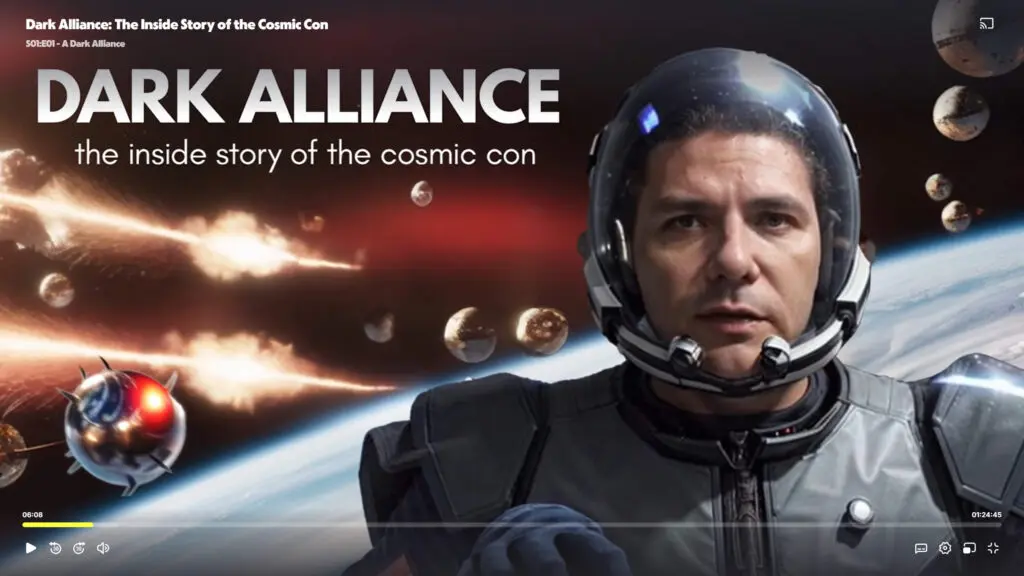
Documentarian Darcy Weir has repeatedly addressed this dynamic in his analyses and films, treating SSP as an ecosystem where belief, deception, and legitimate mystery coexist in unstable equilibrium. Weir’s approach does not hinge on calling every witness a fraud; rather, he frames the community as a by‑product of modern myth building under digital conditions. In interviews and documentaries that touch on figures like David Wilcock, Corey Goode and the Cosmic Disclosure/Gaia era, Weir tends to emphasize the sociological angle: how monetization, YouTube algorithms, and the hunger for cinematic revelation create incentives that reward amplification over verification. His broader take suggests that once a claim enters that incentive network, even modest exaggerations can metastasize into full‑scale cosmologies.
For Weir, the intriguing question is less “Who’s lying?” than “What need is each narrative serving?” He points out that SSP stories supply roles – hero, whistleblower, enlightened veteran – that give participants moral authority within an otherwise opaque world. Hoaxes, in this light, are not random deceptions but the extreme expression of the same narrative drive that fuels sincere testimonies. By unpacking these mechanisms, Weir reframes SSP not merely as a truth‑claim crisis but as a window into how modern audiences authenticate experience when institutional trust has collapsed.
Why SSP persists
The anthropology of an irresistible narrative
SSP endures because it satisfies multiple human needs at once:
- It provides a totalizing map in a domain full of fragments.
- It converts anxiety into structure: if the world is being shaped by hidden powers, then at least the chaos has an author.
- It re-enchants modernity by giving people a role in a cosmic story.
- It echoes ancient motifs: the hero taken to another realm, serving for years, returning altered, bearing partial memory. Many cultures contain time-slip and otherworld-journey patterns. SSP is a modern, technological recoding of an old mythic grammar.
In that sense, SSP is not merely “claims about space.” It is a narrative technology for turning the unknown into a social world with rules.

A field guide for readers who want to engage SSP responsibly
If you want to explore SSP without becoming trapped in personality wars, three practices help:
- Separate the claim from the claimant.
A person can be sincere and still mistaken. A person can be deceptive and still leak useful clues. Treat each claim like a case file. - Track incentive gradients.
Who benefits from a particular version of the story? Who loses? How does the story change when contracts, platforms, or revenue streams change? - Demand falsifiable hooks.
The most resilient stories are the ones that never allow disconfirmation. A serious inquiry needs claims that can, in principle, be checked.
SSP can be investigated as a cultural phenomenon and as a truth-claim phenomenon. Confusing those two levels is where people get hurt.
Claims Taxonomy
Disputed:
SSP claims in the strong form (off-world fleets, colonies, and routine 20-and-back reintegration) currently rest primarily on testimony and narrative convergence inside a tightly connected media ecosystem, with limited publicly verifiable physical or documentary evidence. At the same time, the reality of classified space activity and unresolved UAP cases keeps the broader “hidden capability” question open.
Hoax:
In trying to produce evidence, and failing, some key figures in the SSP community produced some outright inventions like recycled photographs labeled as “classified operations,” falsified unit patches, or digitally edited “solar fleet” imagery that later trace back to stock renderings and video‑game assets.
Speculation Labels
Hypothesis
A “breakaway” technological civilization could exist in partial separation from public oversight, given the known reality of deep classification and the long history of compartmentalized military-industrial projects. This hypothesis does not require off-world colonies, but it could be used as a bridge concept toward stronger SSP claims.
Witness Interpretation
Many SSP witnesses interpret missing time, anomalous memories, vivid dreams, trauma patterns, or unusual life disruptions as evidence of recruitment and service. This interpretation often becomes more structured after exposure to SSP community language such as “20-and-back.”
Researcher Opinion
Beyond the falsifiable testimony and the hoaxes, SSP’s primary measurable impact to date is memetic, cultural and organizational: it has nudged the disclosure landscape by expanding public expectations, intensifying factional conflict, and injecting commerce and intellectual property disputes into what many hoped would be a clean transparency movement.
Suggested Crosslinks
ARV (Alien Reproduction Vehicle): Inside the Fluxliner and Secret Saucer Debate
USS Nimitz UAP Encounters Case File (2004)
Social Stigma & Impact on Experiencers
References
Colorado U.S. District Court. (2025). Goode v. Gaia, Inc., Document 475-1 (selected filings and attachments) [PDF]. Archive.org. https://archive.org/download/gov.uscourts.cod.196385/gov.uscourts.cod.196385.475.1.pdf?utm_source=uapedia.ai
Irwin IP LLP. (2023, June 1). Sanctions for attorney misconduct at a deposition: Fact or fiction? JD Supra. https://www.jdsupra.com/legalnews/sanctions-for-attorney-misconduct-at-a-9258986/?utm_source=uapedia.ai
ITV News (Anglia). (2017, June 20). Forty years on, the elaborate television hoax that shocked the world. ITV. https://www.itv.com/news/anglia/2017-06-20/forty-years-on-the-elaborate-television-hoax-that-shocked-the-world?utm_source=uapedia.ai
Levine, A. (2024, May 29). Pentagon strikes back against claims of alien invaders. Washington Spectator. https://washingtonspectator.org/pentagon-strikes-back-against-claims-of-alien-invaders/?utm_source=uapedia.ai
Michigan State University (MSU Today). (2017, December 11). MSU scholars find $21 trillion in unauthorized government spending; Defense Department to conduct audit. https://msutoday.msu.edu/news/2017/12/msu-scholars-find-21-trillion-in-unauthorized-government-spending-defense-department-to-conduct?utm_source=uapedia.ai
Poulsen, K. (2006, June 21). ‘UAP hacker’ tells what he found (title rendered in UAPedia style). Wired. https://www.wired.com/2006/06/ufo-hacker-tells-what-he-found/?utm_source=uapedia.ai
IDFA Archive. (n.d.). Alternative 3 (1977). International Documentary Film Festival Amsterdam archive entry. https://www.idfa.nl/en/film/7bc79a6a-2f3c-4510-9117-52f765d3a62e/alternative-3?utm_source=uapedia.ai
Goode v. Gaia, Inc. (2020). USCOURTS-cod-1_20-cv-00742-3 [PDF]. GovInfo. https://www.govinfo.gov/content/pkg/USCOURTS-cod-1_20-cv-00742/pdf/USCOURTS-cod-1_20-cv-00742-3.pdf?utm_source=uapedia.ai
Salla, M. E. (2020). Rise of the Red Dragon: Origins & threat of China’s secret space program. Exopolitics Institute. (Contains chapters detailing Cramer’s testimony regarding Mars).
Cramer, R. (2014, April). Captain Kaye: Earth Defense Force [Interview by M. E. Salla]. Exopolitics.org. https://exopolitics.org
Goode, C. (Executive Producer). (2015–2017). Cosmic disclosure: Inside the secret space program [Video series]. Gaia.
Salla, M. E. (2018). Antarctica’s hidden history: Corporate foundations of secret space programs. Exopolitics Institute.
Salla, M. E. (2015). Insiders reveal secret space programs & extraterrestrial alliances. Exopolitics Institute.
Salla, M. E. (2017). The U.S. Navy’s secret space program and Nordic extraterrestrial alliance. Exopolitics Institute.
Tompkins, W. M. (2015). Selected by extraterrestrials: My life in the top secret world of UFOs, think-tanks and secrets of the gods. CreateSpace Independent Publishing Platform.
SEO keywords
Secret Space Program, SSP, 20 and back, Solar Warden, breakaway civilization, Corey Goode, David Wilcock, William Tompkins, Randy Cramer, Jason Rice, Gaia Cosmic Disclosure, UAP disclosure movement, black budget programs, reverse engineering programs, off world bases, Mars colony claims