Yorgos Lanthimos’ 2025 film Bugonia is not a typical “aliens in flying saucers” story. No shining discs over cities, no heroic fighter jets. Instead we get a warehouse worker, a basement, a pharmaceutical CEO, a lunar eclipse and a planet quietly stripped of humans while bees return to work.
For UAPedia, Bugonia is a crucial cultural text. It blends three strands that have defined the modern UAP conversation:
- the fear that non-human intelligences walk among elites in disguise
- the sense that ecological collapse is a judgment on humanity
- the way online conspiracy culture colonizes any talk of UAP
This article looks at Bugonia as a UAP narrative, situates it alongside earlier UAP films and religious motifs, and proposes a reusable UAP movie rating system that UAPedia can apply across our “UAP in popular culture” coverage.
Our thesis is simple: Bugonia imagines what happens when some of the wildest UAP beliefs about alien infiltrators, ancient creators and last-day judgment are absolutely true, yet the humans who glimpse that truth are so damaged and misdirected that they trigger exactly the catastrophe they fear.
Bugonia in the record: what we can say as fact
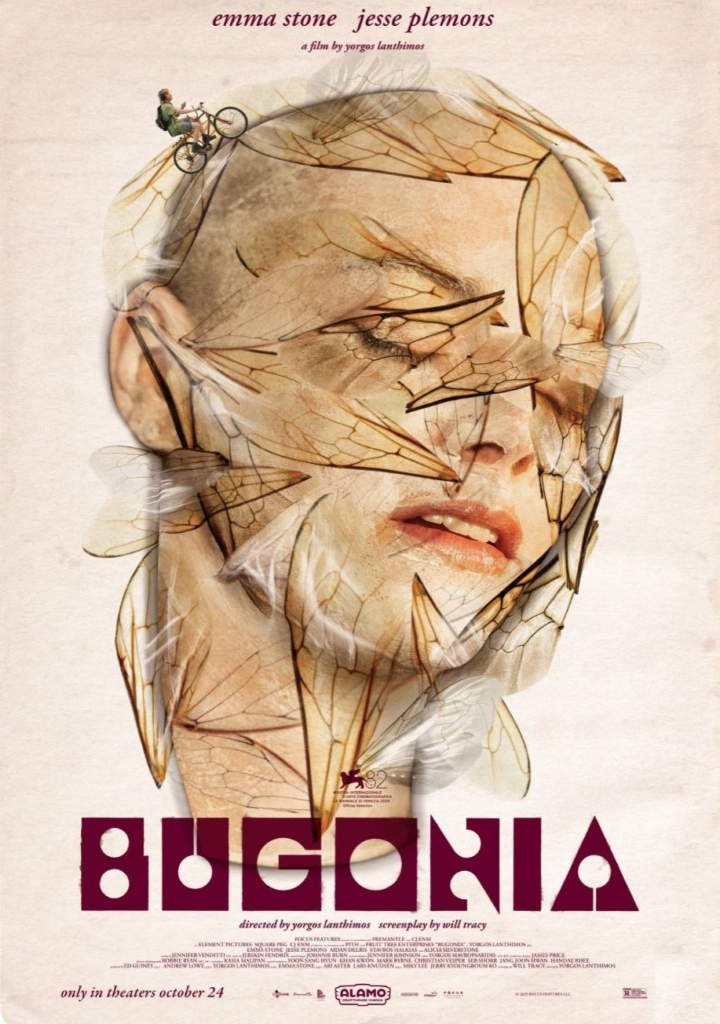
Bugonia is a 118-minute English-language black comedy with science-fiction and thriller elements, directed by Yorgos Lanthimos and written by Will Tracy.
It is an officially credited remake of Jang Joon-hwan’s 2003 South Korean cult film Save the Green Planet!, though Tracy has said he deliberately allowed the stories to diverge rather than copying scene for scene.
The film is an international co-production between the United Kingdom, Ireland, South Korea and the United States, with an estimated budget between 45 and 55 million dollars, making it Lanthimos’ most expensive project to date.
Key points from the production and release record:
- Stars Emma Stone as Michelle Fuller, CEO of the pharma conglomerate Auxolith, and Jesse Plemons as Teddy Gatz, a conspiracist warehouse worker and beekeeper.
- Premiered in competition at the 82nd Venice International Film Festival on 28 August 2025, with wide release in the United States on 31 October 2025 after a limited opening.
- Box office as of December 2025 is just over 39–40 million worldwide, slightly below its production budget.
- Critical reception has been largely positive, with praise for Stone and Plemons and frequent discussion of the film’s alien narrative, climate themes and portrayal of modern conspiracist thinking. (The Atlantic)
These facts matter, because UAPedia treats media artifacts as data points in the history of how societies think about non-human intelligence.
Bugonia is not just a story. It is a widely seen, award-nominated narrative about aliens deciding to terminate the human experiment, released into a culture.
Plot in focus: from human resistance to Andromedan verdict
The core story, distilled from the film and multiple independent summaries:
Teddy Gatz is an anxious rural worker who keeps bees and cares for his mother, Sandy. After Sandy falls into a coma during an Auxolith drug trial, Teddy convinces himself that the company is part of an Andromedan invasion plan that is killing bees, poisoning people and preparing to dominate Earth during an upcoming lunar eclipse.
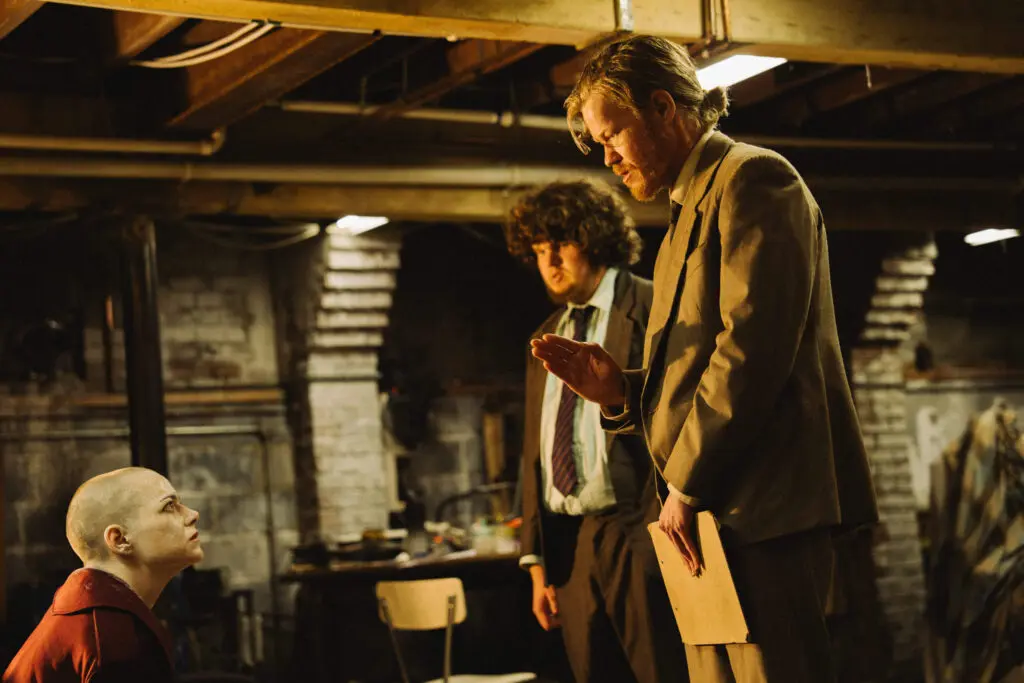
With the help of his cousin Don, Teddy kidnaps Auxolith CEO Michelle Fuller, chains her in his basement, shaves her head and covers her in antihistamine cream to block imagined alien telepathy. He tortures her with electricity, interprets her pain tolerance as proof that she is a high-ranking Andromedan, and demands a meeting with the Andromedan emperor.
While Teddy is away trying to “cure” his mother, Michelle escapes her chains and discovers jars of severed human body parts and photos of previous victims, all ordinary people Teddy had misidentified as aliens. After a series of traumatic events, Teddy returns, broken and grieving, Michelle tells him an alternate story:
- The Andromedans accidentally caused the dinosaur extinction.
- Out of guilt they created humanity “in their own image” and nurtured a peaceful civilization in Atlantis.
- Humans then modified their own genome, became aggressive and triggered a nuclear war that destroyed Atlantis and reset history.
- Modern violent humanity is the damaged remnant, and Auxolith’s drugs were an attempt to suppress that inherited violence.
She offers Teddy a deal. If he accompanies her to Auxolith headquarters and enters a teleportation closet, he can meet the Andromedans and force them to spare Earth. Teddy straps on a home-made explosive vest as a “failsafe” and steps into the closet. The vest detonates prematurely and kills him.
Later, Michelle re-enters the same closet, now revealed as a genuine teleportation device, and arrives on an Andromedan mothership. There she is acknowledged as the Andromedan leader.
After reviewing humanity’s record, she decides the “human experiment” has failed and disables a protective bubble around Earth that instantly kills every human being while leaving other life untouched. Bees return to Teddy’s apiary and the film ends with quiet images of non-human life continuing.
Lanthimos has publicly described this ending as hopeful in its own way, because it imagines a planet finally free to heal. (AP News)
For UAPedia,we consider if a non-human intelligence judged us purely by our environmental record and treatment of each other, would we deserve to continue? Bugonia’s answer is a brutally clear, no.
Conspiracy culture meets UAP myth
In Bugonia, UAP belief is routed through the mind of Teddy, a man who spends his nights absorbed in fringe media, image boards and homemade resistance websites. Media coverage has repeatedly described him as an avatar of modern conspiracist culture: a person whose world is stitched together from half-understood science, genuine institutional failures and imaginative leaps. (WAMC)
The film carefully shows Teddy starting from real signals:
- Bee colony collapse, a documented environmental crisis
- A mother injured in a clinical drug trial
- Corporate power operating far beyond democratic oversight
Those data points are not imaginary. Yet Teddy welds them into a cosmology where an Andromedan aristocracy, secret pharmaceutical poisons, lunar eclipses and basement torture chambers all form one total explanation.
This is where the film intersects UAP discourse. For seventy-plus years, governments and militaries have demonstrably withheld or distorted data on anomalous aerial encounters, often in the name of national security. UAPedia’s editorial “At Our Wits’ End: UAPs are not the Threat, We Are!” notes that the military’s obsession with potential “threat” from UAP hides a deeper danger: our own nuclear stockpiles, fossil fuel addictions and scientific arrogance.
Secrecy and selective disclosure create fertile soil for grand connecting narratives. When people notice that something real is being hidden, they often overcorrect and assume that everything hidden belongs to one vast plot. Bugonia exaggerates this dynamic to the edge of horror. Teddy is right that something non-human is present and that Auxolith is entangled with it. He is catastrophically wrong about almost every operational detail, and his violent, unilateral action triggers the extinction he hoped to prevent.
In that sense, Bugonia is a cautionary tale for the UAP community itself. Data and pattern recognition are essential. So are epistemic humility and ethics. Without them, raw anger at secrecy can mutate into the kind of basement tribunal Teddy runs, where every person who looks “off” is reclassified as alien and punished.
Religious and mythic layers: Andromedans as failed gods
Michelle’s monologue about Andromedan history is among the most overtly religious speeches in recent science-fiction cinema. She claims that:
- Andromedans created humans in their own image after destroying the dinosaurs
- They built Atlantis as a peaceful model civilization
- Human self-tinkering turned us violent and led to nuclear cataclysm
- The modern human race is a traumatized remnant watched over by their makers
This story closely mirrors long-standing religious and mythological motifs:
- Ancient Near Eastern and biblical traditions describe “watchers” or angels who descend, shape humanity and later judge it for corruption.
- The Babylonian flood and later Noah narratives tell of a divine reset after human violence and hubris overwhelm the Earth.
- Gnostic cosmologies describe a flawed creator or demiurge whose botched creation traps divine sparks in a broken world.
Bugonia merges these strands into a sleek Andromedan storyline.The aliens are guilty creator-gods, torn between compassion and disgust, who finally decide that mercy lies in ending the human experiment.
UAP lore already contains an Andromedan thread. Contactee literature from the late twentieth century describes Andromedan beings as advanced, often benevolent teachers focussed on telepathy, ecology and spiritual evolution. Bugonia twists that tradition by making its Andromedans both sophisticated and ruthlessly utilitarian.
The film’s title adds another ritual layer. Bugonia refers to an old Mediterranean belief that bees could arise from the corpse of a sacrificed bull. (TIME) In the film, humanity collectively plays the sacrificial animal, and the returning bees in the final shots echo a grim rebirth: life from our carcass.
Bugonia therefore belongs squarely in UAPedia’s category of religious, spiritual and mythological interpretations of UAP. It is less about hardware in the sky and more about how a civilization imagines judgment from above.
From a UAP research stance, Michelle’s Atlantidean myth sits in our Claims Taxonomy as Legend. It may encode symbolic truths about human self-destruction, but there is no independent evidence that an Andromedan council literally engineered our genome or detonated a dinosaur-killing weapon.
From Klaatu to Michelle Fuller: where Bugonia sits in UAP cinema
Bugonia is part of a cinematic lineage that uses non-human intelligence to hold up a mirror to humanity.
- The Day the Earth Stood Still framed an alien visitor as a warning envoy about nuclear weapons.
- Close Encounters of the Third Kind reframed contact as a quasi-religious symphony of light and music.
- Invasion stories and shows like The X-Files explored secret alien infiltration within governments and corporations.
Bugonia updates all three:
- Like Klaatu, Michelle arrives as a figure of judgment on a violent civilization, but she renders sentence instead of delivering a warning.
- Like Close Encounters, there is a sense of cosmic scale, yet the tone is claustrophobic, almost stage-bound, as if the contact drama has retreated from Devil’s Tower to a broom closet in a corporate office.
- Like classic “aliens-among-us” tales, it imagines non-humans embedded in corporate power structures, but the focus is on the corrosive psychology of the human who notices, not on the aliens’ master plan.
For UAPedia’s cultural section, Bugonia is a high-impact example of “UAP in popular culture” because it cross-contaminates alien contact with climate horror and distrust of Big Pharma. It suggests that in the twenty-twenties, when filmmakers reach for alien imagery, they are just as likely to be talking about ecological collapse and corporate capture as about radar tracks and lights in the sky.
A UAPedia rating system for UAP cinema
To compare Bugonia with other films that touch UAP themes, UAPedia can adopt a simple rating framework that looks beyond box office and star power. The aim is to assess how a movie engages with the phenomenon and the cultural questions around it.
UAPedia UAP Cinema Rating (UCR)
Each film is scored from 0 to 5 on five axes, then summed for a total out of 25.
- Phenomenon fidelity
How closely does the film’s portrayal of craft, entities or encounters match credible UAP data: unusual motion, trans-medium behavior, non-lethal interaction patterns, sensor corroboration and so on. - Mythic and religious depth
Does the story seriously explore the spiritual, mythological or existential dimensions of non-human intelligence, rather than using “aliens” purely as monsters or jokes. - Conspiracy realism
How plausibly does it depict secrecy, state and corporate interests, media narratives and the psychology of suspicion, without collapsing into cartoonish villains or omnipotent cabals. - Experiencer empathy
Does it treat witnesses, contactees or obsessed investigators with psychological nuance and basic human dignity, even when they act destructively or hold incorrect beliefs. - Cultural impact
Has the film clearly influenced, or is it likely to influence, public conversations about UAP, disclosure, non-human life or related topics like climate and existential risk.
These scores are interpretive, but they give a reusable template for articles on films from The Day the Earth Stood Still to modern streaming series.
Bugonia through the UAPedia Cinema Rating:
Phenomenon fidelity – 2.5 / 5
Bugonia features advanced technology like teleportation, an orbital craft and rapid planetary terraforming. Yet it offers almost no observational detail about UAP flight profiles, sensor returns or structured craft, so the match to documented UAP observables is partial at best. The aliens function more like metaphysical auditors than studied pilots.
Mythic and religious depth – 5 / 5
Here the film excels. The Andromedan creation story, Atlantis, nuclear cataclysm, judgment during an eclipse and the bugonia bee-from-carcass motif form a dense web of myth. The final extermination of humanity mirrors apocalyptic literature, while the bees’ return evokes resurrection in a non-human key.
Conspiracy realism – 4 / 5
Bugonia’s portrayal of online paranoia, rural precarity and corporate opacity closely tracks real social dynamics. (Atmos) The only reason it falls short of a perfect score is that, in reality, almost no one’s wild alien suspicions are vindicated as directly as Teddy’s are in the film.
Experiencer empathy – 2 / 5
The film invites some sympathy for Teddy’s pain yet never excuses his brutality. Viewers are left uncertain whether to see him as tragic, monstrous or both. That ambivalence is artistically powerful but offers limited empathy for the broader population of anomalous-event witnesses who are neither torturers nor bomb-vest fanatics.
Cultural impact – 4 / 5
Between festival buzz, awards chatter and debate around its ending, Bugonia has already become a conversation piece about climate, conspiracy and alien judgment. (Wikipedia) Its exact long-term influence on UAP narratives is still unfolding, so we stop short of 5.
Total Bugonia UCR score: 17.5 / 25
In UAPedia terms, that places Bugonia as a significant entry in UAP-related cinema, especially on the mythic and ethical dimensions, but not a primary reference for craft behavior or encounter phenomenology.
Claims taxonomy
Even though Bugonia is fiction, it makes recognizable claims about non-human intelligence and the human condition. Applying UAPedia’s Claims Taxonomy helps clarify which ideas should be treated as symbolic, speculative or grounded.
Claim: Non-human intelligences may judge humanity primarily on our ecological record and propensity for violence.
Classification: Probable
Rationale: This follows logically from many ethical frameworks in astrobiology and UAP discussion. If a technologically advanced species values biospheric stability, humanity’s nuclear, industrial and military behavior would indeed raise red flags. This is a reasonable extrapolation, not an established fact.
Claim: A specific Andromedan civilization engineered humanity, built Atlantis and later destroyed it after a genetic misstep.
Classification: Legend
Rationale: The film’s narrative merges existing myths about creators, floods and lost civilizations. It resonates with ancient astronaut ideas and contactee lore, including reports of Andromedan beings. There is no empirical evidence that this literal sequence occurred.
Claim: Modern conspiracy-driven lone actors can both glimpse elements of real non-human activity and catastrophically misinterpret those signals.
Classification: Probable
Rationale: We know that classified aerospace programs and genuine UAP encounters exist alongside misinformation and imaginative frameworks. It is entirely plausible that some individuals will mix true anomalies with inaccurate frameworks, especially under psychological stress.
Claim: If UAP or non-human intelligences are present, they are more likely to be ecological auditors or gardeners than open invaders.
Classification: Disputed
Rationale: Bugonia presents Andromedans as judgmental stewards. Some UAP witness testimony and spiritual interpretations echo this “guardian” concept, while other research points toward more neutral surveyor roles or multiple factions. Evidence is insufficient to settle the question.
Claim: Alien infiltration of corporate and governmental elites is a plausible current reality.
Classification: Disputed
Rationale: This is a central trope of Bugonia and decades of UAP-adjacent culture, but there is no verified, publicly available evidence that any specific industrial or political leaders are non-human. At the same time, absence of evidence is not definitive evidence of absence.
No elements of Bugonia fall neatly into Misidentification or Hoax within our taxonomy, since the work is openly fictional rather than a falsified “real” case file.
Speculation labels
Because Bugonia touches so directly on UAP themes, it is useful to separate speculation types.
Hypothesis
If non-human intelligences with the ability to reshape ecosystems are monitoring Earth, their primary decision about us might be ecological rather than theological. They could be less concerned with what we believe and more concerned with whether we leave any room for other life to flourish. Bugonia dramatizes this by tying extinction not to doctrine or allegiance, but to our collective track record on war and environmental damage.
Witness interpretation
Many UAP experiencers report messages about environmental stewardship, nuclear danger and the need to “change course”. Those accounts vary widely in detail and cannot yet be cross-validated, but they form a recurring pattern. Bugonia’s Andromedan speech can be read as a fictional amplification of that pattern: a stern cosmic parent saying “we warned you, you ignored us, now we intervene”.
Researcher opinion
From a UAP research standpoint, Bugonia should be approached as a cultural artifact, not as secret disclosure. It tells us more about how humans currently feel about themselves than about how any real non-human species behaves. Yet it also underlines a core insight that UAPedia’s editorial board has emphasized: UAP are not automatically the threat. We are very capable of being the existential risk all by ourselves, and any advanced intelligence will see that clearly.
References
AP News. (2025, August 31). For Yorgos Lanthimos, new Emma Stone film “Bugonia” isn’t a dystopia. It’s real. Retrieved from https://apnews.com/article/2209e525505aa4e88bf8c431c6efe81f?utm_source=uapedia.ai (AP News)
Cosmopolitan. (2025, November 1). The “Bugonia” ending has a major twist – here’s exactly what those final moments mean. Retrieved from https://www.cosmopolitan.com/entertainment/movies/a69230567/bugonia-ending-explained/?utm_source=uapedia.ai (Cosmopolitan)
Harris, M. (2025, October 31). OK, let’s talk about that “Bugonia” ending. GQ. Retrieved from https://www.gq.com/story/ok-lets-talk-about-that-bugonia-ending?utm_source=uapedia.ai (GQ)
Li, S. (2025, October 31). “Bugonia” is an intimate portrait of humanity at its worst. The Atlantic. Retrieved from https://www.theatlantic.com/culture/2025/10/bugonia-movie-review-emma-stone/684789/?utm_source=uapedia.ai (The Atlantic)
Tagat, A. (2025, October 23). “Bugonia” turns conspiracy culture into a climate horror story. Atmos. Retrieved from https://atmos.earth/art-and-culture/bugonia-turns-conspiracy-culture-into-a-climate-horror-story/?utm_source=uapedia.ai (Atmos)
Time Magazine. (2025, October 31). Breaking down the comically bleak ending of Yorgos Lanthimos’ “Bugonia”. Retrieved from https://time.com/7328938/bugonia-ending-explained/?utm_source=uapedia.ai (TIME)
Wikipedia contributors. (2026). Bugonia (film). In Wikipedia, the free encyclopedia. Retrieved January 19, 2026, from https://en.wikipedia.org/wiki/Bugonia_(film)?utm_source=uapedia.ai (Wikipedia)
UAPedia Editorial Board. (2025). At our wits’ end: UAPs are not the threat – we are. UAPedia. https://uapedia.ai/wiki/at-our-wits-end-uaps-are-not-the-threat-we-are/?utm_source=uapedia.ai
SEO keywords
Bugonia UAP analysis, Bugonia Andromedans Atlantis, Yorgos Lanthimos Bugonia climate horror, Bugonia ending explained alien judgment, Bugonia conspiracy culture pharmaceutical CEO, Andromedan creation myth UAP, UAPedia rating system for UAP movies, religious symbolism in Bugonia bees bugonia ritual, Bugonia ecological apocalypse bees return, UAP in popular culture Bugonia film, non human intelligence cinema climate collapse, Emma Stone Michelle Fuller alien empress, Teddy Gatz beekeeper conspiracist UAP, Andromedans in modern UAP lore, Bugonia and At Our Wits’ End UAPedia.