
A cigar‑shaped craft, a windmill, a Martian pilot buried with Christian rites, and a farming town fighting for its life at the edge of the frontier.
The Aurora, Texas airship crash of April 1897 has all the ingredients of a classic UAP legend. It is also one of the earliest cases where locals claimed not only a strange object in the sky, but an impact, a body, and a burial. That combination makes Aurora one of the oldest proto “crash retrieval” stories in the UAP record, predating Roswell by half a century. (The Portal to Texas History)
This article revisits the case with UAPedia’s data‑first lens, leaning on original newspaper accounts, regional history, MUFON’s 1970s investigation, later journalistic work, books, and modern podcasts.
Early morning, broken windmill
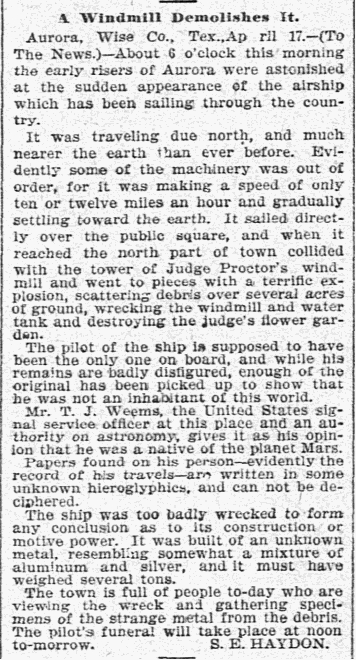
On 19 April 1897, the Dallas Morning News printed a short front‑page piece by Stringer S. E. Haydon titled “A Windmill Demolishes It.” (Meander and Gander)
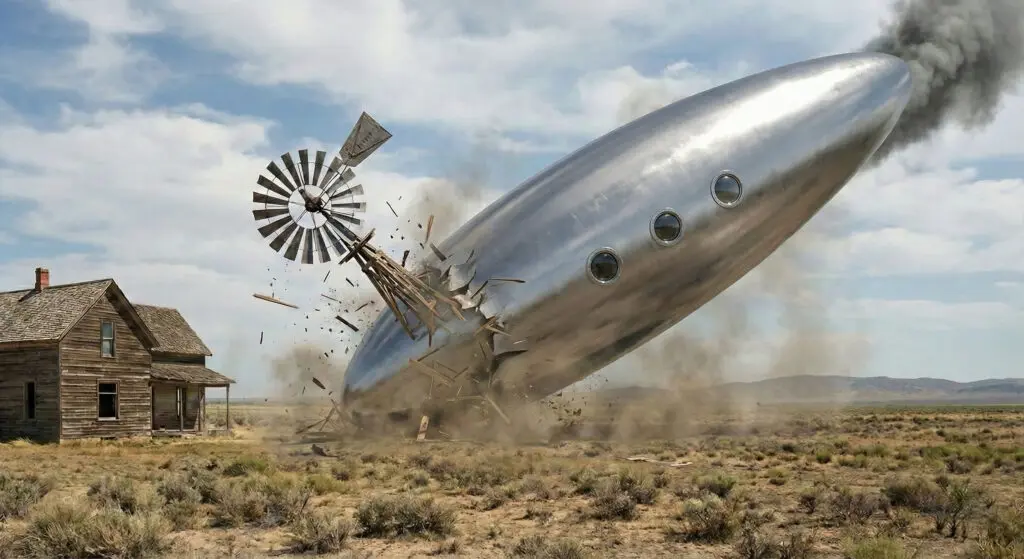
In Haydon’s telling, at about six in the morning two days earlier, the people of Aurora watched an airship limping low across the sky. The craft moved slowly, seemed to be losing altitude, passed over the town square, then struck the windmill on the property of Judge J. S. Proctor and exploded. Debris rained down over several acres. Among the wreckage, townspeople found a badly mangled body described as “not of this world,” along with papers in an unknown script and strange metal that looked like a lightweight alloy rather than familiar iron or silver. (Meander and Gander)
Haydon wrote that a local man named T. J. Weems, described as a “signal service officer” and astronomy enthusiast, speculated that the pilot came from Mars, reflecting the period’s popular fascination with Martian canals. The body, according to the article, was buried that same day in Aurora Cemetery with Christian rites. Wreckage was reportedly dumped into a nearby well under the damaged windmill. (The Traveling Fool)
A mystery airship in a wave of mystery airships
It helps to remember that Aurora was not an isolated oddity.
In the spring of 1897, newspapers across the United States, and especially across Texas, were full of reports of mysterious “airships” seen at night: cigar‑shaped craft with bright lights, often said to carry human or human‑like pilots. (TX Almanac)
The Texas Almanac notes that between 13 and 17 April 1897, there were thirty‑eight reported airship sightings in twenty‑three Texas counties, most in the north‑central region. Aurora sits right in that cluster. The Almanac calls the Aurora crash story “the most celebrated” of those encounters, adding that twentieth‑century historians tended to label it a hoax, even as UAP researchers kept coming back to it. (TX Almanac)
Modern podcasts like Buried Secrets and Conspiracy Theories frame Aurora as part of a larger 1896–97 “mystery airship” flap, highlighting how Victorian readers were already primed to interpret strange lights as experimental flying machines or visitors from other worlds. (Buried Secrets Podcast)
In that context, Haydon’s piece looks less random and more like an escalation of an ongoing story: not just a sighting, but a crash, a body and a burial.
Aurora’s slow decline and a town that needed a story
By the late 1890s, Aurora was hurting. The railroad had bypassed the town, a boll weevil infestation and fire had hit hard, and the population was shrinking. (Texas State Historical Association)
That background is central to the later “publicity stunt” explanation. In a 1980 Time magazine piece, local resident Etta Pegues, then in her eighties, is quoted as saying that Haydon invented the story to attract attention and revive a dying town. (The Ordinary, Extraordinary Cemetery)
Modern cemetery blogs, genealogical essays, and Texas history pieces often repeat this claim, pointing to Aurora’s troubles as motive. (The Ordinary, Extraordinary Cemetery)
On the other hand, writers like E. R. Bills, whose book Texas Obscurities: Stories of the Peculiar, Exceptional & Nefarious devotes a chapter to Aurora, notes that even if Haydon exaggerated, he was drawing on a broader pattern of airship stories circulating in the region that spring. (Amazon)
From a UAPedia perspective, Aurora’s economic distress is an important “push factor,” but it does not by itself resolve whether Haydon embroidered a real strange event or manufactured one from whole cloth.
From newspaper legend to living folklore
For decades after 1897, the Aurora crash lived mainly as local talk and a fading newspaper clipping. That changed in the late 1960s and 1970s, when authors and UFO organizations rediscovered the case during renewed interest in both the airship wave and crash‑retrieval stories. (AURORA)
Several threads converge here:
- Regional writers began compiling Texas oddities, including the Aurora burial story, into collections of folklore and mystery. (Amazon)
- UAP organizations such as MUFON noticed the case and dispatched investigators. (Mufon)
- National media picked up the story as an “Old West Roswell,” often emphasizing the buried “Martian.” (Hangar1publishing)
By the late twentieth century, the legend had seeped into films and television. The 1986 movie The Aurora Encounter dramatized an alien visitation in the town. Later, History Channel shows like UFO Files and UFO Hunters revisited the case, sometimes bringing new attention to physical sites like the cemetery and the old Proctor property. (TX Almanac)
Today, Aurora leans into the story with tongue partly in cheek. KERA and Texas Standard reported on “Aurora Alien Encounter” conferences where vendors sell alien‑themed cupcakes and the supposed pilot is affectionately called “Ned.” (KERA News)
At the entrance to Aurora Cemetery, a Texas Historical Commission marker mentions the “legend that a spaceship crashed nearby in 1897 and the pilot, killed in the crash, was buried here.” (The Ordinary, Extraordinary Cemetery)
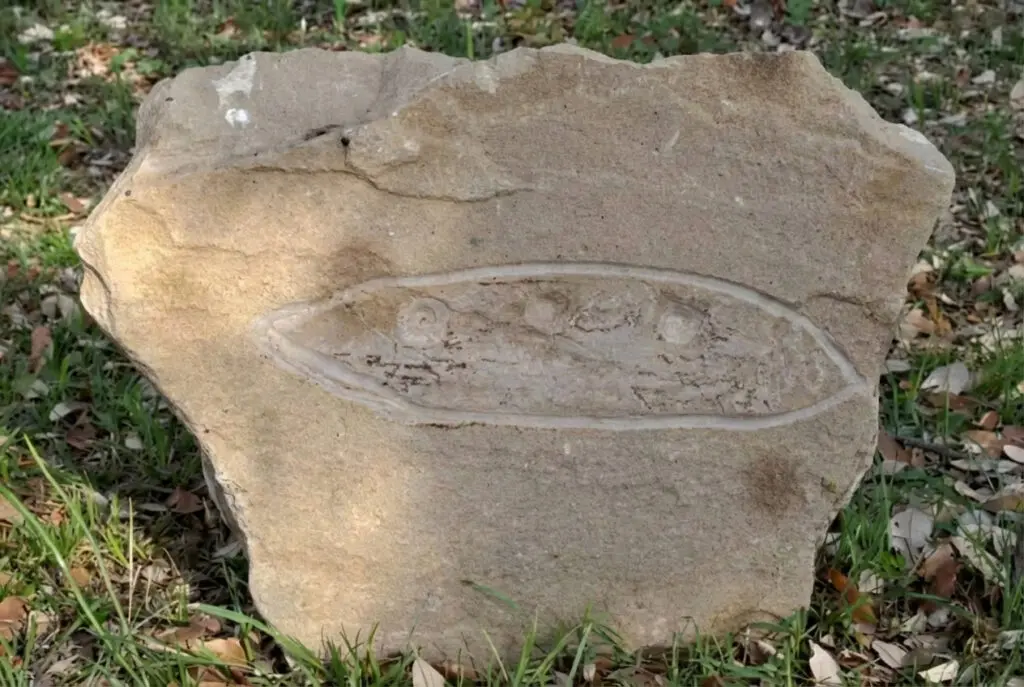
The stone that once marked the alleged alien grave is gone, removed in the 1970s after repeated vandalism and souvenir hunting, but the story is embedded now in signage, tourism, and the town’s public identity. (The Ordinary, Extraordinary Cemetery)
Witnesses, families, and the long shadow of memory
One of the most important developments came in 1973, when aviation writer and MUFON Texas director Bill Case led a detailed on‑site investigation. (Mufon)
Case and colleagues interviewed elderly locals who had grown up hearing about the incident, including:
- Mary Evans, who in the 1970s recalled being a teenager in 1897. She said her parents forbade her from going to the crash site, but told her that an airship had hit Proctor’s windmill and that the pilot’s body was buried in the cemetery. (The Traveling Fool)
- Charlie Stephens, who as a boy claimed to have seen a smoking object pass overhead and later heard his father describe wreckage in town the next day. (Mufon)
Case used metal detectors in the cemetery and identified an unmarked grave near 1890s burials, marked by a small stone engraved with a symbol that investigators interpreted as a stylized flying craft. Soon after, the stone disappeared. A length of pipe later appeared in the soil where the marker had been, and metal‑detector readings that once showed metal beneath the grave no longer did. (Mufon)
The Aurora Cemetery Association refused permission for exhumation, citing respect for the dead and legal constraints. A court injunction from the 1970s required notification of next of kin before any grave could be opened, and nobody knows who, if anyone, lies in that plot. (The Ordinary, Extraordinary Cemetery)
Case reported his findings to MUFON. The organization’s conclusion was cautious: evidence was inconclusive and a hoax could not be ruled out, but the group did not feel able to dismiss the case outright either. (Mufon)
From a data standpoint, these 1970s accounts are clearly memory‑filtered and legend‑coloured. Yet they are specific, named testimonies and they re‑anchor the story in living families rather than in an anonymous “they say.”
The well, the windmill, and Brawley Oates
Another thread that keeps investigators returning to Aurora is the story of the well under Judge Proctor’s windmill.
According to local accounts, when wreckage was cleared in 1897, much of it was thrown into a well located beneath the broken windmill. In the 1930s, a man named Brawley Oates bought the property. He later cleaned out the well to restore it as a water source. Not long afterward, he developed severe arthritis, which he blamed on contaminated water. In the mid‑1940s he sealed the well with a concrete slab and built a small structure over it. (The Traveling Fool)
When the History Channel series UFO Hunters visited Aurora in 2008, Oates’ grandson Tim allowed investigators to unseal and inspect the well. They found no obvious structural debris but did detect elevated aluminum levels in the water. They also located the remains of an old windmill base nearby, a physical detail that undercuts Etta Pegues’ later claim that Proctor never had a windmill at all. (Mufon)
The aluminum finding is suggestive rather than definitive. By itself it does not prove anything about an airship, but it shows that something metallic spent time in that well.
Researchers and writers who keep returning to Aurora
Although Aurora is often treated as a one‑page curiosity, it has attracted serious attention from both sides of the UAP debate.
E. R. Bills, in Texas Obscurities (The History Press), devotes a well‑researched chapter to the town and its 1897 incident. He places the story within a landscape of Texas oddities and emphasizes how the crash narrative shaped local identity more than local economics. (Amazon)
Jim Marrs, the late Fort Worth journalist best known in UAP circles for Alien Agenda, argued that something anomalous likely did occur in Aurora, even if myth has overwhelmed detail. Marrs championed the case in a 1998 KDFW television report and in his books, positioning it as an early American crash retrieval. (Fort Worth Magazine)
Other authors have explored Aurora in more focused ways:
- Stan Haydon, Aurora Texas 1897 UFO Crash: The Real Story?, offers a short book‑length review of the case from a local history angle, weighing hoax and non‑hoax scenarios. (Goodreads)
- George Dudding, in The Aurora 1897 UFO‑Alien Encounter, retells the story for a popular audience and ties it to the broader airship wave. (Amazon)
On the audio side, several podcasts have taken Aurora seriously enough to dig into original sources:
- Buried Secrets Podcast’s “The UFO crash in Aurora, Texas” walks through the Dallas Morning News article, the 1897 airship context, MUFON’s work, and Jacques Vallée’s interest in pre‑20th century sightings, framing the incident as a blend of urban legend and possible anomaly. (Buried Secrets Podcast)
- Conspiracy Theories’ “Roswell of Texas – The Aurora UFO” highlights later investigations and the contested grave, as well as the way the story refuses to die. (Shortform)
- Castle of Spirits and The Anecdotalist fold Aurora into broader episodes on UFO legends and Texas folklore, pointing listeners to MUFON documents and Texas history links rather than just re‑telling the legend. (Apple Podcasts)
These sources are not primary data about 1897, but they map the modern interpretive field and show how much of the serious discussion is grounded in old newspaper scans, MUFON files, and local history rather than in anonymous internet lore.
Skeptical readings and the “heavenly hoax” frame
On the skeptical side, the best‑known deep dive is Carlton Stowers’ “Heavenly Hoax” in the Dallas Observer. Stowers reviews the original article, Pegues’ testimony, the town’s decline, and the lack of contemporaneous follow‑up reporting, concluding that the story was almost certainly a hoax crafted by Haydon. (Dallas Observer)
The Texas Almanac and other statewide references also reflect the conventional view that the Aurora crash is folklore, not fact, though they acknowledge ongoing UAP research efforts and the case’s cultural impact. (TX Almanac)
More recent essays, like “The Legend of the Aurora, Texas UFO Crash” on The Ordinary Extraordinary Cemetery and genealogy blogs like Ancestral Findings, tend to land in a middle position: likely hoax, but unresolved. They emphasize the town’s motives, the absence of verifiable physical evidence, and the difficulty of testing the grave claim without exhumation. (The Ordinary, Extraordinary Cemetery)
From a data‑first standpoint, those critiques are real constraints. There is no surviving, authenticated debris with provenance back to 1897. No independent 1897 coroner’s report, no church burial record that clearly refers to a non‑human pilot, no military telegram.
UAP‑relevant observables in the Aurora file
Even if one remains cautious about the literal truth of Haydon’s story, the case still carries several UAP‑relevant features.
Structured craft
The 1897 article describes a structured vehicle with “machinery,” not just a vague light. Later retellings often specify a cigar‑shaped airship with metallic skin and mechanical components. (Meander and Gander)
Impact and debris
Many witnesses, even in secondhand accounts, stress a violent impact, scattered metal, and a destroyed windmill. Later investigations found remnants of a windmill base on the Proctor property, suggesting that at least that aspect of Haydon’s story matches the landscape. (Mufon)
Biological occupant
The idea of a small body “not of this world,” later nicknamed “Ned,” introduces an early claim of non‑human biologics associated with a crash. That is one reason UAP researchers continue to treat Aurora as relevant to alleged “earliest recovery” timelines. (The Portal to Texas History)
Burial and memorialization
The burial narrative has left its mark on the physical and administrative record: missing grave markers, a court injunction limiting exhumation, and a state historical marker that codifies the story as legend. (The Ordinary, Extraordinary Cemetery)
These observables do not prove that an off‑world pilot crashed in Aurora. They do, however, show that the story is not a pure modern internet invention. It is rooted in a specific 1897 text, a real cemetery, and decades of on‑the‑ground investigation.
Data‑first evaluation
If we separate “what is documented” from “what it means,” the Aurora file looks like this.
Well‑anchored facts
- The Dallas Morning News did publish S. E. Haydon’s “A Windmill Demolishes It” on 19 April 1897, describing an airship crash, a non‑human pilot, unknown writing, and a burial in Aurora Cemetery. (Meander and Gander)
- Aurora was part of a genuine late‑1890s “airship” newspaper wave, especially intense in Texas, where dozens of reports appeared over a few days. (TX Almanac)
- The town was in economic decline at the time, having been bypassed by the railroad and hit by agricultural and fire losses. (Texas State Historical Association)
- A Texas Historical Commission marker at Aurora Cemetery explicitly mentions the legend of a crashed spacecraft and a buried pilot. (The Ordinary, Extraordinary Cemetery)
- MUFON’s 1970s investigation, led by Bill Case, documented late‑life testimony from residents like Mary Evans and Charlie Stephens, an unmarked grave with an unusual marker later removed, and resistance to exhumation. (Mufon)
Partially supported claims
- The story that Proctor’s well was filled with crash debris and that later owner Brawley Oates developed arthritis after cleaning it is well attested in local tradition and in modern programing. The 2008 well tests show elevated aluminum but no exotic material. (The Traveling Fool)
- The existence of a windmill on Proctor’s property, questioned by Etta Pegues decades later, is supported by physical remains found during later investigations. (Locktopia Escape Room Houston)
Weakly supported or contested claims
- The assertion that Haydon fabricated the entire story as a joke or a publicity stunt relies heavily on Pegues’ late‑in‑life recollection and on the absence of follow‑up reporting, rather than on independent evidence of intent. (The Ordinary, Extraordinary Cemetery)
- The claim that the pilot was genuinely non‑human, that the craft represented non‑human technology, and that unknown writing was recovered all rest on the 1897 article and retellings, with no physical samples preserved for modern analysis. (Meander and Gander)
On balance, the Aurora incident cannot be classed as a “Verified” non‑human crash retrieval under UAPedia standards. It is stronger than a modern internet hoax because it is rooted in a historical newspaper report and long‑standing local tradition, yet weaker than cases with multi‑sensor data or multiple independent contemporary documents.
Claims taxonomy
Claim: A cigar‑shaped airship crashed into Judge Proctor’s windmill near Aurora on 17 April 1897.
- Classification: Disputed
- Basis: Described in a single contemporary article; supported by later testimony and physical windmill remains; questioned by historians who see it as a crafted story during an airship newspaper craze. (Meander and Gander)
Claim: The pilot’s body was clearly non‑human and was buried in Aurora Cemetery.
- Classification: Legend
- Basis: Based on Haydon’s wording and oral tradition; no exhumation permitted; grave marker missing; no independent medical or anatomical records. (Meander and Gander)
Claim: Unknown writing and metals of unusual composition were recovered from the wreckage.
- Classification: Disputed
- Basis: Described in 1897 article and repeated in later works; no samples with secure provenance survive; later metal fragments found on site test as aluminum or simple alloys. (Meander and Gander)
Claim: The entire story was a deliberate hoax by S. E. Haydon to attract attention to a dying town.
- Classification: Disputed
- Basis: Based mainly on late testimony by Etta Pegues and town economic context; alternative explanations include embellishment of a real event or partial fabrication over a genuine local accident. (The Ordinary, Extraordinary Cemetery)
Claim: Brawley Oates’ arthritis was caused by exposure to crash‑contaminated well water.
- Classification: Misidentification
- Basis: Medical causality is unproven; many alternative explanations exist; well tests only show elevated aluminum, not clear toxins; story functions mainly as folklore. (The Traveling Fool)
Claim: Aurora represents the earliest documented recovery and burial of a non‑human entity linked to a UAP crash.
- Classification: Probable as narrative status, not as established fact
- Basis: Among known pre‑1900 stories, Aurora is the clearest crash‑and‑body narrative tied to a specific date and place, but the non‑human identity of the pilot remains unverified. (The Portal to Texas History)
Speculation labels
To keep interpretation separate from evidence, UAPedia tags the main interpretations as follows:
Hypothesis
Aurora was an early non‑human crash retrieval. A structured vehicle of unknown origin, already observed during the 1897 airship wave, malfunctioned and struck Proctor’s windmill. The pilot’s body, clearly not human, was buried, and subsequent removal of grave markers and resistance to exhumation reflect unofficial efforts to manage uncomfortable evidence.
Witness Interpretation
Residents in 1897, immersed in sensational airship stories and ideas about Martian canals, may have experienced a more mundane event: a meteor airburst, an experimental terrestrial craft, or even a local accident involving machinery. Haydon and others interpreted that event through the airship narrative, projecting a “not of this world” pilot where there may have been only rumor and debris. Later witnesses like Mary Evans and Charlie Stephens remembered their parents’ stories rather than the event itself. (TX Almanac)
Researcher Opinion
Skeptical journalists and many historians see Aurora as a cleverly timed fabrication, or at best a tall tale, born from economic desperation and a playful newspaper culture. UAP investigators and some local historians treat it instead as an unresolved case whose hard edges have been worn down by time but which may still encode a genuine anomalous incident. The divide is less about the basic facts of what is documented and more about how much weight to give an old newspaper, local folklore, and late testimony in the absence of lab‑grade physical evidence. (Dallas Observer)
UAPedia does not collapse these into a single verdict. Aurora is kept in the “pre‑20th century UAP” archive as a living case study in how early crash stories form and persist.
References
Bills, E. R. (2013). Texas obscurities: Stories of the peculiar, exceptional & nefarious. The History Press.
Example listing: www.amazon.com/Texas-Obscurities-Peculiar-Exceptional-Nefarious/dp/1626192812?utm_source=uapedia.ai (Amazon)
Case, B. (1973). Aurora, TX crash – 1897. MUFON case file summary. Retrieved via archived MUFON site: oldmufon.weebly.com/aurora-tx-crash—1897.html?utm_source=uapedia.ai (Mufon)
Connelly, C. (2016, April 18). Nearly 120 years after alleged UFO crash, small Texas town is all about aliens. KERA News / Texas Standard. www.kera.org/keranewsaudio/nearly-120-years-after-alleged-ufo-crash-small-texas-town-is-all-about-aliens?utm_source=uapedia.ai (KERA News)
Macon, A. (2021, June 10). North Texas’ greatest UFO story lives on. D Magazine. www.dmagazine.com/frontburner/2021/06/aurora-ufo-crash-texas/?utm_source=uapedia.ai (D Magazine)
Stowers, C. (2003, April 3). Heavenly hoax. Dallas Observer. www.dallasobserver.com/news/heavenly-hoax-6389024?utm_source=uapedia.ai (Dallas Observer)
Texas Almanac. (n.d.). When airships invaded Texas. www.texasalmanac.com/articles/when-airships-invaded-texas?utm_source=uapedia.ai (TX Almanac)
Amandier, C. (2023, March 31). The UFO crash in Aurora, Texas. Buried Secrets Podcast. www.buriedsecretspodcast.com/a-ufo-crash-in-aurora-texas/?utm_source=uapedia.ai (Buried Secrets Podcast)
Westfield, E. (2025). The Aurora, Texas UFO incident: Crash, alien burial, and lingering mystery. Hangar 1 Publishing blog. hangar1publishing.com/blogs/ufos-uaps-and-aliens/aurora-texas-ufo-incident?srsltid=AfmBOopPN9i9Btbeo0QFTmTURjeOkdgH9VCVBVFrAQYfRulzR9KjTD0i&utm_source=uapedia.ai (Hangar1publishing)
“The Legend of the Aurora, Texas UFO Crash.” (2024, April 2). The Ordinary Extraordinary Cemetery. www.theordinaryextraordinarycemetery.com/blog/the-legend-of-the-aurora-texas-ufo-crash/?utm_source=uapedia.ai (The Ordinary, Extraordinary Cemetery)
“The 1890s alien gravesite: A curious tale from Aurora Cemetery, Texas.” (2024). Ancestral Findings. ancestralfindings.com/the-1890s-alien-gravesite-a-curious-tale-from-aurora-cemetery-texas/?utm_source=uapedia.ai (Ancestral Findings)
“AURORA – A Texas Legend from 1897.” (2024). AuroraLegend.com. auroralegend.com/?utm_source=uapedia.ai (AURORA)
Haydon, S. E. (1897, April 19). A windmill demolishes it. Dallas Morning News. Scanned at: http://www.ufocasebook.com/haydonarticle.jpg?utm_source=uapedia.ai (Reddit)
Suggested internal UAPedia crosslinks
The American Airship Wave (1896–1897) – contextual cluster for mystery airships across the United States.
Nuremberg 1561 / Basel 1566 sky phenomena – earlier mass sightings with structured objects.
Pre‑20th century accounts – Wonders in the Sky cluster – Jacques Vallée’s catalogue of early sightings.
SEO keywords
Aurora Texas airship crash 1897; Aurora Texas UAP incident; Ned the alien Aurora cemetery; A Windmill Demolishes It Dallas Morning News; 1897 mystery airship wave Texas; Bill Case MUFON Aurora investigation; Brawley Oates well arthritis story; Texas Historical Commission Aurora UFO marker; E R Bills Texas Obscurities Aurora; Aurora Encounter 1986 film; Aurora Texas alien grave missing headstone; Buried Secrets podcast Aurora crash; Conspiracy Theories Roswell of Texas episode; pre‑Roswell crash retrieval claims; Aurora Texas spaceman legend