Carl Sagan’s name is usually invoked when we talk about wonder. Billions of stars, the pale blue dot, our “cosmic address” in a vast universe. Less often do people remember that Sagan spent a surprising amount of intellectual energy wrestling with the UAP question that gripped the same public he enchanted.
To a mass audience he was the scientist who told them the universe was likely teeming with life. In back rooms, hearings and symposia he was also one of the most visible referees in the argument over whether some of the odd lights in our skies might already be visitors.
This biography follows Sagan from Brooklyn to Blue Book, from Cosmos to Contact, and traces how one of the twentieth century’s most famous astronomers helped shape the modern conversation about UAP without ever embracing an extraterrestrial explanation for the sightings themselves.
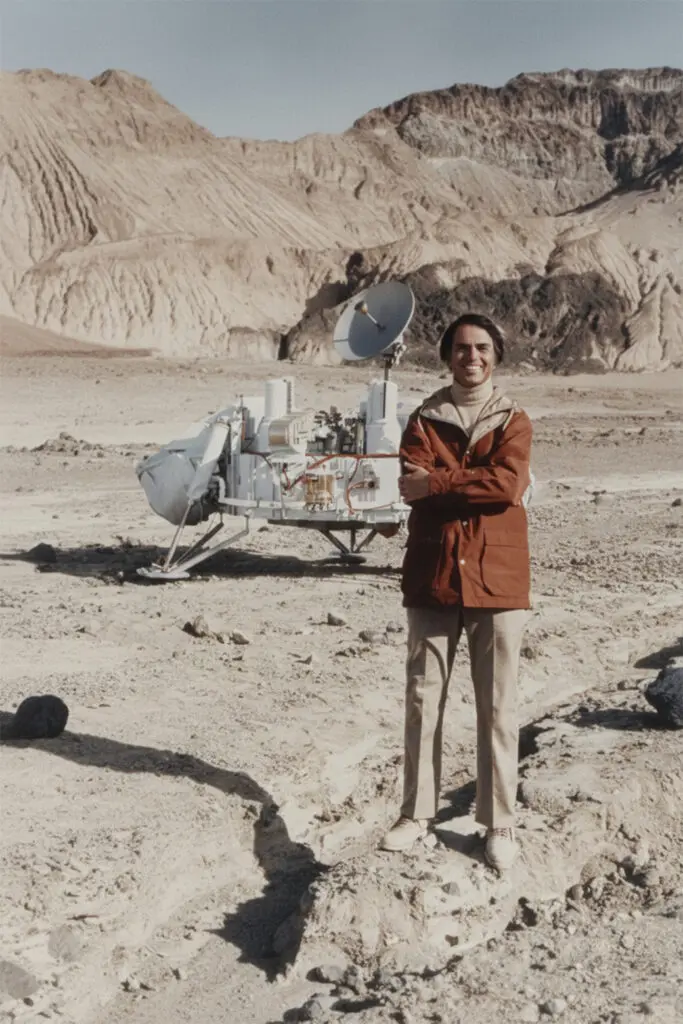
(Ray, Bill | LOC)
Early life and the making of a cosmic popularizer
Carl Edward Sagan was born in Brooklyn on 9 November 1934 to a working class Jewish family, the son of a garment cutter and a homemaker who loved the movies and Broadway.
The New York World’s Fair of 1939 ignited his fascination with science. Exhibits of futuristic cities and space travel convinced the young Sagan that humans might someday leave Earth. His parents fed that curiosity with trips to the library and encouragement that went well beyond their own formal education. (EBSCO)
Sagan studied at the University of Chicago, racing through a bachelor’s degree in physics, a master’s degree, and finally a PhD in astronomy and astrophysics. During a Miller Fellowship at Berkeley and later at Harvard, he developed the work that would make his scientific name: explaining the searing greenhouse conditions on Venus, reinterpreting the shifting colors of Mars as dust storms rather than vegetation, and exploring the chemistry that could produce life from simple molecules.
In 1968 Sagan accepted a position at Cornell University, where he would spend the rest of his life, eventually directing the Laboratory for Planetary Studies. Cornell is where “Carl Sagan” becomes not just a researcher but an institution. He advised NASA missions to Venus, Mars and the outer planets, helped design the Pioneer plaque and Voyager Golden Record, and served as a public face for the new discipline of exobiology.
His career arc matters for UAP because it sets up a tension that will define his stance. Sagan is the scientist most responsible for convincing the public that intelligent non-human life is likely somewhere out there. Yet he is also one of the most prominent critics of claimed encounters here.
Sagan and the search for other minds
Before the term “astrobiology” existed, Sagan was asking what planetary atmospheres, chemistry and statistics said about life in the universe. He co-authored “Life in the Clouds of Venus?” proposing that Venusian clouds might host microbial life, and he worked with Edwin Salpeter on imaginative models of life in the atmosphere of Jupiter. (Nature)
With Soviet astrophysicist Iosif Shklovskii he co-wrote Intelligent Life in the Universe (1966), a landmark synthesis that took seriously both the probability of other civilizations and the technical challenges of interstellar travel. (Internet Archive)
Sagan helped Frank Drake draft the iconic Arecibo radio message in 1974 and was a driving force behind SETI petitions in Science that made listening for artificial signals academically respectable.
He also served as the guiding spirit behind two major artifacts aimed explicitly at hypothetical extraterrestrial finders:
- The Pioneer plaques, simple line drawings of humans and a map of our solar location, flown on Pioneer 10 and 11.
- The Voyager Golden Record, assembled with Ann Druyan and others, which carries a curated sample of Earth’s sounds, images and music out into interstellar space. (Pitchfork)
All of this reinforces a central point for any UAP history. Sagan was not a closet believer secretly squashing evidence of visitors, nor a dogmatic materialist who dismissed life elsewhere. He was arguably the twentieth century’s most persuasive advocate of the idea that the universe is full of other minds.
Early fascination with “flying saucers”
When the first “flying saucer” wave hit the United States in 1947, Sagan was a teenager. Biographers note that he initially wondered whether these might indeed be alien craft.
By 1952 he had taken the idea seriously enough to write to Secretary of State Dean Acheson asking how the US government might respond if the discs proved to be extraterrestrial.
That youthful curiosity hardened into a more systematic interest. In the early 1960s Sagan wrote an encyclopedia article on unidentified flying objects, corresponded with French astronomer and UAP researcher Jacques Vallée, and began to collect letters from the public describing strange sightings. (ESS Open Archive)
The Library of Congress analysis of his personal files notes that the letters often blurred together UAP, spiritual experiences and paranormal claims, and that Sagan saw pedagogical value in addressing them. (ESS Open Archive)
Inside government UAP work – the Blue Book review
In 1966 the US Air Force convened a special Ad Hoc Committee of the Scientific Advisory Board to review Project Blue Book, its long running UAP investigation program. The panel was chaired by physicist Brian O’Brien and included Sagan as one of six members. (NCAS Files)
The committee concluded that Blue Book had little scientific rigor and recommended that a university take over a more focused study of selected high quality cases. (NCAS Files)
That recommendation directly led to the University of Colorado project directed by physicist Edward Condon. The Condon Committee eventually issued a report that found no compelling evidence of technological devices of non-human origin and no threat to national security, which the Air Force used as justification to close Blue Book in 1969.
Sagan’s participation is important for UAPedia’s editorial lens. It shows a scientist embedded in official UAP evaluation, but his own conclusions were more nuanced than later debunking narratives. In a later summary of the Blue Book review he wrote that while a threat seemed unlikely, a more thorough scientific investigation of selected cases was still warranted, even if the probability of major discovery was small. (NCAS Files)
Consistent with UAPedia’s editorial policy, the Blue Book and Condon findings are treated as government sponsored analyses that form one evidentiary stream, not a final verdict.
The 1968 Congressional symposium – defining UAP in public
On 29 July 1968 Sagan testified at the House Committee on Science and Astronautics’ Symposium on Unidentified Flying Objects, alongside J. Allen Hynek, James McDonald and other key figures. (NICAP)
In his written statement, “Unidentified Flying Objects,” Sagan offered one of the cleaner scientific definitions of what we would now call UAP, describing them as moving aerial or celestial phenomena detected visually or by radar whose nature is not immediately understood. (NCAS Files)
He acknowledged that hundreds of thousands of reports existed and argued that the subject could not simply be ignored. But he emphasized that almost all cases with good data succumbed to prosaic explanations, and that the remaining unknowns were not automatically evidence of visiting spacecraft. (NCAS Files)
This appearance cemented Sagan as the respectable scientist willing to talk about UAP on Capitol Hill. It also previewed the line he would walk for the rest of his life: demanding better data, resisting premature extraterrestrial conclusions, yet refusing to treat the phenomenon as beneath scientific attention.
“UFO’s: A Scientific Debate” and the Sagan probability argument
The high point of Sagan’s direct engagement with UAP came the following year. At the 1969 American Association for the Advancement of Science (AAAS) meeting in Boston he co organized a major symposium on UAP with astrophysicist Thornton Page. (Science)
The meeting gathered a broad spectrum of views. On one side were Hynek and McDonald, who argued that a cohort of cases demanded serious scientific investigation and might signal something extraordinary. There were also skeptics such as Donald Menzel and William Hartmann, who saw no need to invoke exotic explanations.
The proceedings were published as UFO’s: A Scientific Debate, edited by Sagan and Page. (Internet Archive)
Sagan contributed a concluding essay, “The Extraterrestrial and Other Hypotheses,” where he tried a quantitative approach to the idea that some UAP are visiting craft.
Using what he admitted were crude estimates, he walked through variables like the number of technological civilizations, the likelihood of interstellar travel, and the frequency of visits, and then compared that with the kind of evidence actually on offer. (Dokumen)
His bottom line: extraterrestrial visitation is not impossible, but given our current knowledge and the quality of UAP reports, the probability that we are being “frequently visited by extraterrestrial beings” is extremely low. (Internet Archive)
Yet in the same book he championed the need to study the phenomenon as a social and psychological puzzle, and encouraged improved instrumentation and standardized reporting so that future data would be more decisive. (Internet Archive)
For the UAP community this dual stance often felt unsatisfying. Believers wanted him to endorse the extraterrestrial hypothesis; while debunkers preferred that he dismiss the topic entirely.
Sagan insisted on a third path: “widely open minds strictly attached to critical scrutiny,” as one commentator summarized his approach. (Skeptical Inquirer)
Cosmos, abductions and the Sagan standard
In the 1980 television series Cosmos: A Personal Voyage, Sagan spoke directly to a global audience about UAP in Episode 12, “Encyclopaedia Galactica.” He noted that since 1947 there had been hundreds of thousands of reports of unidentified objects in the sky and suggested that the topic had more to do with religion and superstition than with science. (Organism Earth)
In that same episode he delivered the phrase that would become his calling card: “extraordinary claims require extraordinary evidence.”
The line crystallized a principle dating back to David Hume and Pierre-Simon Laplace, but Sagan’s delivery made it part of popular culture. It was aimed in part at claims of alien visitation and abduction.
In later works such as Broca’s Brain and The Demon-Haunted World he returned repeatedly to this evidential standard when evaluating UAP narratives.
In The Demon-Haunted World he devoted several chapters to modern abduction accounts, arguing that they reflected a mix of cultural motifs, sleep paralysis and suggestive hypnosis rather than literal encounters with non-human intelligence.
In one oft quoted passage he points out that the supposed aliens closely mirror human expectations and obsessions, and he contrasts that with the genuine diversity of life forms on Earth. (Goodreads)
Importantly, he did not claim that all UAP reports are hoaxes or mistakes, merely that none yet had the kind of instrumented, multiple witness, independently corroborated data that would satisfy his standard for revolutionary claims.
Publications touching UAP and ET
While only a fraction of Sagan’s books focus directly on UAP, several are central to the subject.
- The Cosmic Connection: An Extraterrestrial Perspective (1973) gathered essays that ranged from planetary science to the Drake equation and the philosophical consequences of contact. One chapter develops the probability argument against frequent secret visits, while still entertaining the possibility that rare contacts might have occurred in deep history. (Internet Archive)
- Intelligent Life in the Universe (1966, with Shklovskii) became a touchstone for serious discussion of extraterrestrial civilizations. The book briefly entertains the idea that ancient myths or astronomical anomalies might encode traces of contact, but Sagan later emphasized that these were clearly labeled as speculative scenarios rather than evidence. (Springer Link)
- Broca’s Brain (1979) and The Demon-Haunted World (1995) offer his most sustained critique of UAP and abduction claims as examples of how human cognition can misfire. (Wikipedia)
- Pale Blue Dot (1994) revisits the question of alien visitors and urges readers to distinguish between our emotional desire for contact and the actual strength of the evidence. (The Library of Congress)
- The novel Contact (1985) imagines a richly detailed scenario of interstellar communication via radio messages and engineered wormholes. It is a work of fiction but functions as a manifesto for Sagan’s preferred route to contact: transparent, physics respecting, and documented in ways any civilization could scrutinize.
Collectively, these works position him as a thinker who sees UAP as part of a broader question about intelligence in the universe, not an isolated curiosum.
Public appearances and known associates in the UAP orbit
Sagan’s influence on the UAP debate is not just textual. It plays out in highly visible public fora.
- He appeared at least two dozen times on The Tonight Show Starring Johnny Carson, often fielding audience questions about life on other worlds and sometimes about flying saucer reports. (flapperpress)
- His 1977 Royal Institution Christmas Lectures in London, The Planets, devoted significant time to the possibility of life on Mars and the outer solar system and demonstrated how scientists approach extraordinary claims. (Royal Institution)
- In his final year he sat for a widely replayed interview with Charlie Rose, warning that scientific thinking itself was under threat and noting that belief in astrology, miraculous cures and alien visitations was rising even as scientific literacy fell. (Speakola)
In the UAP specific community his interactions are more complex. He respected and sometimes clashed with J. Allen Hynek, shared private exchanges with Jacques Vallée in the 1960s, and gave both Hynek and James McDonald prominent platforms in the AAAS symposium even when he disagreed with their conclusions.
He also moved increasingly in skeptical circles as a co-founder of the Committee for the Scientific Investigation of Claims of the Paranormal (CSICOP, now CSI), alongside figures like James Randi and Isaac Asimov.
This network meant that by the 1980s Sagan occupied a unique position. For many scientists he was the friendly explainer of why most UAP claims did not hold up; for experiencers and some researchers he became a symbol of the establishment’s reluctance to seriously consider high strangeness.
Controversies and critiques
Sagan’s handling of UAP has generated criticism from multiple directions.
- Ancient astronauts and shifting tone
Early in his career, in the essay “Direct Contact among Galactic Civilizations by Relativistic Interstellar Spaceflight,” Sagan suggested that if interstellar travel were feasible we might reasonably search myth and history for hints of past contact. (The Library of Congress)
This nuance was later stripped away by popular writers in the ancient astronaut genre. When Erich von Däniken’s Chariots of the Gods? exploded in popularity, Sagan wrote a scathing foreword to Ronald Story’s rebuttal The Space Gods Revealed, accusing von Däniken of attributing anything he did not understand to extraterrestrials.
Some in the UAP community see this as an about face; the Library of Congress framing is more charitable, arguing that speculative imagination and stringent skepticism were two sides of the same coin for Sagan. (The Library of Congress) - Did skepticism dampen serious UAP research?
Sociologist Ron Westrum and later commentators have praised the AAAS symposium for airing diverse views, yet some researchers argue that Sagan’s authority and the dominance of the “extraordinary claims” standard helped marginalize anomalous cases that did not fit mainstream expectations. (Goodreads)
On the other hand, the same standard underpins modern scientific approaches to UAP data, including recent statistical and sensor based studies that work to quantify observables rather than rely solely on narrative testimony. (Limina)
- Alignment with government conclusions
Sagan’s role in the Blue Book review and his acceptance of the Condon Committee’s broad conclusion that UAP posed no obvious national security threat are sometimes cited by critics who suspect deeper knowledge was being downplayed.
UAPedia treats these reports as important but non decisive. They reflect mid twentieth century sensor capabilities, institutional incentives and Cold War politics, and must be weighed alongside later declassified material, testimonies from other countries and independent investigations.
From UAPedia’s vantage point, Sagan’s controversies mostly trace the tension between his enthusiasm for the possibility of cosmic neighbors and his insistence that any claim of contact clear a very high evidential bar.
Impact on UAP discourse
Sagan died in 1996, long before “UAP” replaced “UFO” in official language and decades before the current wave of military reporting and whistleblower claims. Yet his fingerprints are everywhere.
- The “Sagan standard”
The aphorism that extraordinary claims demand extraordinary evidence has become a default reference point in modern debates over Navy encounters, legacy crash retrieval allegations and exotic propulsion claims. (Wikipedia) - Normalizing scientific talk about ET life
By grounding the discussion of extraterrestrials in planetary science and statistics rather than mythology, Sagan helped make it intellectually respectable to talk about non human intelligence while still being sharply critical of specific UAP stories. (Wikipedia) - Inspiring both skeptics and experiencers
Skeptical organizations explicitly credit him for shaping their approach to paranormal claims. (Skeptical Inquirer) At the same time, many experiencers and UAP enthusiasts grew up watching Cosmos, absorbing his sense of awe and later looking for answers he did not think the current evidence justified. - Influence on today’s scientific UAP work
Recent academic treatments of UAP frequently cite UFO’s: A Scientific Debate as the last major attempt, before the 2010s, to integrate social science, psychology and hard data in one framework. (Limina)
Sagan’s legacy may ultimately be that he forced both believers and debunkers to sharpen their arguments. He insisted that the universe is likely full of neighbors, that contact would be the most important event in human history, and that precisely because of that, we should be uncompromising about evidence.
Implications for contemporary UAP research
Reading Sagan from a UAPedia vantage point, three implications stand out:
- Method over conclusion
Sagan’s enduring gift is less any specific answer and more a process: quantify where possible, admit ignorance explicitly, and separate emotional appeal from evidential strength.
That process can be applied to Navy sensor tracks, archival nuclear incidents and modern experiencer databases as readily as to 1960s flying saucer tales. - Beware false dichotomies
Sagan’s own life rebuts the idea that you must choose between believing in a populated universe and being skeptical of current UAP evidence. UAP researchers can be both: open to non human intelligence and ruthless about standards. - Nuclear stakes and the UAP connection
His work on nuclear winter and existential risk intersects uncomfortably with the pattern of UAP reports near nuclear weapons complexes. (The New Yorker)
Sagan’s worry was that civilizations tend to self-destruct before they master interstellar distances. Modern dossiers on UAP near strategic sites make that warning feel even sharper in a post Cold War, post disclosure context.
References
Library of Congress. (n.d.). UFOs and aliens among us. In Finding our place in the cosmos: From Galileo to Sagan and beyond. www.loc.gov/collections/finding-our-place-in-the-cosmos-with-carl-sagan/articles-and-essays/life-on-other-worlds/ufos-and-aliens-among-us?utm_source=uapedia.ai (The Library of Congress)
Sagan, C. (1973). The cosmic connection: An extraterrestrial perspective. Anchor Press. www.worldcat.org/title/918637?utm_source=uapedia.ai (Internet Archive)
Sagan, C. (1980). Cosmos. Random House. www.penguinrandomhouse.com/books/160000/cosmos-by-carl-sagan?utm_source=uapedia.ai (Wikipedia)
Sagan, C. (1994). Pale blue dot: A vision of the human future in space. Random House. www.penguinrandomhouse.com/books/160002/pale-blue-dot-by-carl-sagan?utm_source=uapedia.ai (The Library of Congress)
Sagan, C. (1995). The demon-haunted world: Science as a candle in the dark. Random House. www.penguinrandomhouse.com/books/160001/the-demon-haunted-world-by-carl-sagan?utm_source=uapedia.ai (Library of Congress Tile)
Sagan, C. (1985). Contact. Simon and Schuster. www.simonandschuster.com/books/Contact/Carl-Sagan/9781501197987?utm_source=uapedia.ai (Wikipedia)
Sagan, C., & Page, T. (Eds.). (1972). UFO’s: A scientific debate. W. W. Norton. www.abebooks.com/servlet/BookDetailsPL?bi=31944282956&utm_source=uapedia.ai (WorldCat)
Terzian, Y., & Trimble, V. (1997). Carl Sagan (1934–1996). Bulletin of the American Astronomical Society, 29(4), 1352–1353. (Wikipedia)
United States Air Force Scientific Advisory Board. (1966). Special report of the USAF Scientific Advisory Board Ad Hoc Committee to Review Project “Blue Book”. files.ncas.org/condon/text/appndx-a.htm?utm_source=uapedia.ai (NCAS Files)
U.S. House of Representatives, Committee on Science and Astronautics. (1968). Symposium on unidentified flying objects. U.S. Government Printing Office. files.ncas.org/ufosymposium/1968_UFO_Symposium.pdf?utm_source=uapedia.ai (NICAP)
Westrum, R. (2004). Social intelligence about anomalies: The case of UFOs. In Handbook of science and technology studies (2nd ed.). (Referenced via later summaries). (Goodreads)
SEO keywords
Carl Sagan UAP, Carl Sagan UFOs, Carl Sagan extraterrestrial life, Carl Sagan Project Blue Book, Carl Sagan Condon Committee, Carl Sagan UFOs A Scientific Debate, Carl Sagan Demon Haunted World aliens, Carl Sagan ancient astronauts, Carl Sagan SETI, Carl Sagan Contact novel, Sagan standard extraordinary claims, Carl Sagan AAAS UFO symposium, Carl Sagan House UFO hearing, Carl Sagan UAP skepticism.