
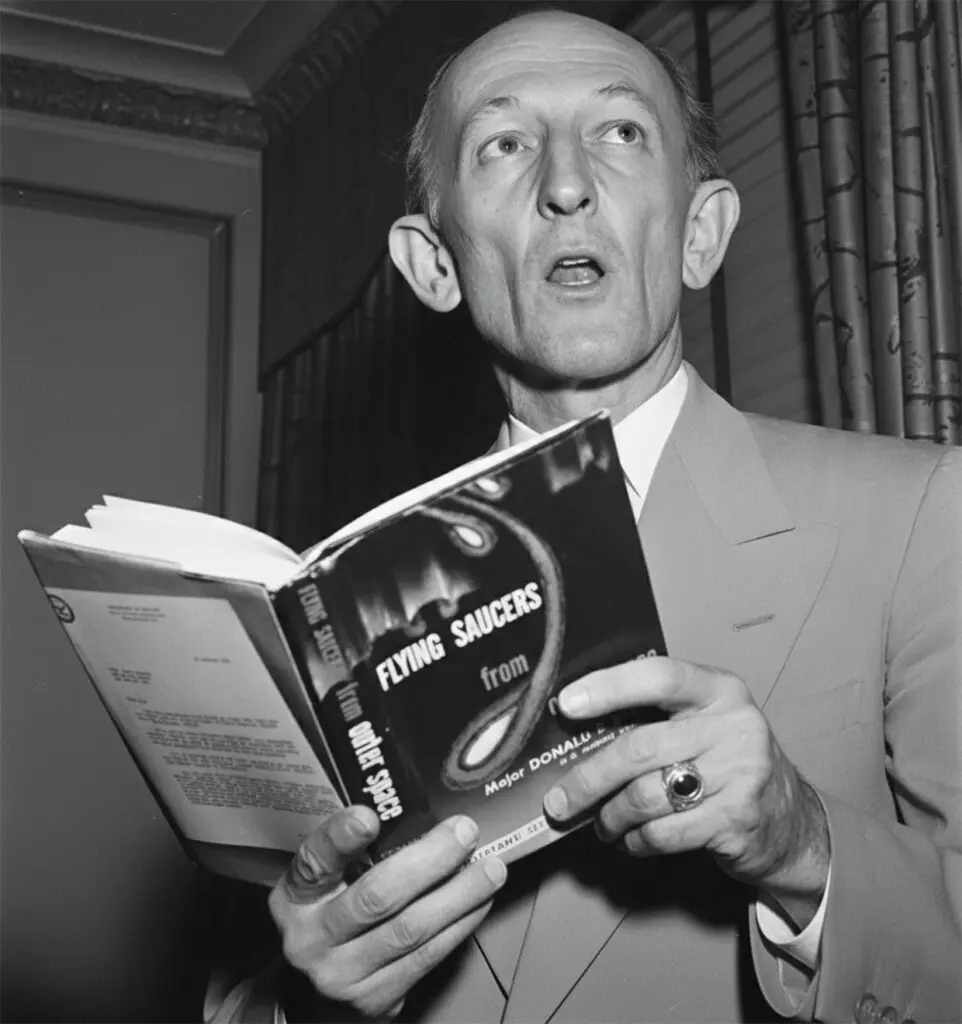
When a retired Marine Corps major sits across from Mike Wallace on live television in 1958 and calmly says that the United States government is hiding evidence that “flying saucers are real machines under intelligent control”, you are no longer in the realm of pulp magazines. You are in the middle of the first great public fight over UAP secrecy.(jungianjournal.ca)
Major Donald Edward Keyhoe, former naval aviator, aide to Charles Lindbergh, and Washington insider, spent nearly three decades arguing that a real, non prosaic UAP phenomenon existed and that elements of the U.S. government were managing it behind a wall of silence.(Wikipedia)
This article treats Keyhoe as a case study in how one determined individual can bend the narrative around a mystery. We take a data first view: mapping his work history, publications, television appearances, allies, enemies, and the documentary trail he left in FBI, CIA and NICAP files.(FBI)
Data snapshot: a structured timeline
Basic facts
- Born 20 June 1897 in Ottumwa, Iowa. Died 29 November 1988 in New Market, Virginia, age 91.(Wikipedia)
- Graduate of the U.S. Naval Academy, class of 1920.(Wikipedia)
- Marine Corps naval aviator in the 1920s until injured in a crash in Guam, then shifted to ground duties and writing.(Wikipedia)
- Government posts in the interwar years included editor with the Coast and Geodetic Survey and information officer and later chief of information for the Aeronautics Branch (later Civil Aeronautics Authority) of the Department of Commerce.(The Washington Post)
- Managed the U.S. tour of the Bennett–Byrd North Pole flight aircraft and served as aide and business manager to Charles Lindbergh during his 1927 U.S. tour promoting aviation.(ageofaces.net)
- Recalled to active duty during World War II, serving at the Pentagon and retiring as a major.(Wikipedia)
Writing and UAP milestones
- 1920s–40s: Prolific pulp and aviation writer, with adventure and weird science stories in Weird Tales, Flying Aces and other magazines.(Wikipedia)
- 1949: Asked by True magazine editor Ken Purdy to investigate “flying saucers” using his Pentagon contacts. Initially skeptical, he changed his view after interviewing pilots and officers.(Wikipedia)
- December 1949: Article “Flying Saucers Are Real” in True becomes a sensation and is later described by Air Force captain Edward Ruppelt as one of the most widely read and discussed magazine pieces ever.(Wikipedia)
- 1950: Expands the article into the book The Flying Saucers Are Real, arguing that some UAP are extraterrestrial craft and that the Air Force is managing information rather than telling the full story.(Wikipedia)
- 1953: Publishes Flying Saucers from Outer Space, drawing heavily on Air Force case files and interviews.(Amazon)
- 1955: Publishes The Flying Saucer Conspiracy, introducing his “silence group” concept for the core of officials controlling UAP information.(Wikipedia)
- 1960: Publishes Flying Saucers: Top Secret, describing his battles with the Air Force and adding more recent cases.(jungianjournal.ca)
- 1973: Publishes Aliens from Space: The Real Story of Unidentified Flying Objects, his last major UAP book, including his “Operation Lure” idea to invite landings.(Wikipedia)
NICAP era
- October 1956: Co founder and early board member of the National Investigations Committee on Aerial Phenomena (NICAP).(Wikipedia)
- Early 1957: Replaces T. Townsend Brown as NICAP director after the board removes Brown over finances.(Wikipedia)
- 1957–1969: Serves as director and public face of NICAP, lobbying Congress for hearings and collecting thousands of UAP reports.(nicap.org)
- December 1969: Forced to step down by NICAP’s board amid financial problems and internal revolt, although nominally allowed to “resign”.(nicap.org)
This skeleton is important, because almost every one of Keyhoe’s UAP claims is tightly tied to a particular role, publication or network node.
From Annapolis to the Pentagon: a career that made UAP access possible
Before he ever wrote a word about UAP, Keyhoe lived inside the American aviation establishment.
After graduating from the Naval Academy in 1920 he became a Marine Corps pilot, flying both aircraft and balloons until a crash in Guam ended his flight status.(Wikipedia)
Grounded, he moved into aviation promotion and administration:
- He helped manage the U.S. tour of the Bennett–Byrd North Pole flight aircraft, a major publicity event for aviation.(Project Gutenberg)
- In 1927 he served as aide and business manager to Charles Lindbergh on the triumphant American tour following the New York–Paris flight, working under the Aeronautics Branch of the Commerce Department.(ageofaces.net)
- He became chief of information for the Aeronautics Branch, the precursor to the Civil Aeronautics Administration and later the Federal Aviation Administration.(Wikisource)
During the 1930s and 40s he wrote aviation features and fiction for The Saturday Evening Post, The Nation, Reader’s Digest and a slew of pulps, building a reputation as someone who understood aircraft performance and military culture.(Wikipedia)
World War II pulled him back into uniform. Recalled as a Marine major, he served in Pentagon roles linked to aviation information and public communication.(Wikipedia)
All of this matters for UAP because:
- He already knew many pilots, engineers and officers personally.
- He understood how military bureaucracy handled embarrassing incidents.
- He carried legitimate security clearances and could walk Pentagon corridors in a way ordinary writers could not.
When True asked him in 1949 to look into “flying saucers,” they were effectively hiring an insider to investigate an insider phenomenon.(Wikipedia)
“The Flying Saucers Are Real”: how Keyhoe reframed the mystery
The 1949 article that detonated
In late 1949 True magazine published “The Flying Saucers Are Real,” a long piece in which Keyhoe laid out a startling conclusion:
- Some reported discs and objects were “real machines” showing performance beyond known aircraft.
- They were probably interplanetary, not Soviet.
- The Air Force knew far more than it was saying and was quietly studying the problem.(Wikipedia)
The article drew on Air Force incident summaries, pilot interviews and conversations with Pentagon officers. Ruppelt later wrote that it was “one of the most widely read and widely discussed magazine articles in history”, a signal that public appetite for a serious UAP narrative already existed.(Wikipedia)
The book and its core claims
The 1950 book version, The Flying Saucers Are Real, is short but structurally important for the modern UAP conversation. Key claims, restated in UAP language, include:(Wikipedia)
- Reality claim: A subset of UAP reports from trained observers, often with radar support, describe structured objects under intelligent control.
- Origin claim: These objects are most likely craft from other planets, based on their apparent performance and long historical record.
- Nuclear trigger claim: Visits increased sharply after 1945, suggesting interest in human nuclear activity.
- Managed secrecy claim: The Air Force has adopted a policy of gradual, carefully controlled revelation, while publicly dismissing the issue.
Two follow up books elaborated this framework:
- Flying Saucers from Outer Space (1953) used specific Air Force cases, such as radar visuals and pilot encounters, to argue that even official files contained strong unknowns.(Amazon)
- The Flying Saucer Conspiracy (1955) shifted emphasis from the discs to the people controlling information, coining his “silence group” idea for the cluster of officials managing UAP secrecy.(Wikipedia)
In UAPedia terms, these books are where several enduring motifs crystallize: extraterrestrial craft, nuclear monitoring, and deliberate but not necessarily malevolent official secrecy.
NICAP: building a civilian shadow program
From co founder to “spiritual leader”
By 1956, Keyhoe’s books had made him the best known civilian voice on UAP in the United States. Richard Hall, later NICAP’s assistant director, wrote that in the previous half decade “he had done more than any other single individual to attract interest in UAP and to counter Air Force claims that there was nothing to them.”(nicap.org)
When inventor T. Townsend Brown incorporated NICAP in late 1956 as a Washington based, membership supported UAP investigation group, Keyhoe joined the board. After Brown’s removal in early 1957 over financial issues, Keyhoe became director and, in Hall’s words, NICAP’s “spiritual leader” through the 1960s.(Wikipedia)
Under his leadership NICAP:
- Built a network of local and regional investigation subcommittees.
- Recruited a board heavy with retired military and intelligence names, including former CIA director Roscoe Hillenkoetter and guided missile pioneer Delmer S. Fahrney.(Wikipedia)
- Published The UFO Investigator newsletter and special reports.
- Collected thousands of signed reports, many from pilots and service personnel.(Encyclopedia.com)
NICAP consciously positioned itself as a conservative, data driven alternative to more speculative contactee groups, focusing on case documentation and political lobbying rather than visionary messages.(Encyclopedia.com)
Lobbying Congress and confronting the Air Force
Keyhoe’s explicit strategic goal was to pressure Congress into holding public hearings and wresting control of the UAP investigation away from the Air Force.(nicap.org)
Tactics included:
- Sending NICAP’s 1964 report The UFO Evidence, compiled by Richard Hall, to every member of Congress. The report summarized 746 strong cases and argued for formal scientific study.(nicap.org)
- Providing background briefings and case files to selected House and Senate staffers.
- Publicly highlighting contradictions between Air Force statements and internal case data, especially around radar visual incidents.(nicap.org)
CIA histories acknowledge that NICAP has a nuanced officialdom, and FBI files show the Bureau tracking his media activities and membership list as early as the 1950s.(CIA)
NICAP’s internal memorandum trail, now partly preserved in archives, shows Keyhoe and Hall certifying case reports, including a 1961 missile base encounter that NICAP forwarded as a “confidential” report.(CIA)
Public appearances and managed censorship
If his books made him famous, television made him dangerous, at least in the eyes of some officials.
Armstrong Circle Theatre: the mic that went silent
On 22 January 1958, CBS broadcast a live Armstrong Circle Theatre program titled “U.F.O. – Enigma of the Skies,” featuring Air Force representatives and Major Keyhoe as NICAP director.(Wikipedia)
The script had been heavily negotiated. Producer Irve Tunick later recalled staying up until 4 a.m. trying to reconcile what Keyhoe wanted to say with what the Air Force would tolerate, under pressure from the sponsor.(Wikipedia)
On air, Keyhoe deviated from the approved script and began to say that a Senate committee had evidence that would “absolutely prove that the UAP are machines under intelligent control.” At that moment CBS cut the audio level. Viewers suddenly heard nothing while he kept talking.(Wikipedia)
CBS later said the program had been “carefully cleared for security reasons.” The incident triggered protests and helped cement the idea that UAP information was being actively managed on national television.(Wikipedia)
Mike Wallace and the mainstream interrogation
Less than two months later, on 8 March 1958, Keyhoe appeared on ABC’s The Mike Wallace Interview. Wallace grilled him about:(jungianjournal.ca)
- His claim that UAP were extraterrestrial craft.
- His assertion that contactee stories of friendly space brothers were disinformation or fantasy.
- The Armstrong Circle censorship he blamed on Air Force pressure.
The transcript shows Keyhoe holding his ground, refusing to retreat on the core claim that UAP represent intelligently controlled technology not belonging to any known nation.(Norman HRC)
Jung’s letter and intellectual endorsement
In August 1958, Swiss psychologist C. G. Jung wrote a letter to Keyhoe after NICAP published a misinterpretation of Jung’s views on UAP. Jung clarified that his interest in the symbolic dimension did “neither preclude the physical reality of the UAP nor their extraterrestrial origin” and expressed sympathy for Keyhoe’s efforts to establish the truth.(jungianjournal.ca)
NICAP front paged the letter under the headline “Dr. Jung Sets Record Straight,” using it as evidence that a major intellectual did not see UAP as mere hallucinations.(Academia)
Known associates and networks
Keyhoe’s position at the intersection of aviation, government and civilian research created a web of allies and antagonists.
Key associates
- Charles Lindbergh: As Lindbergh’s aide and tour manager, Keyhoe learned how media and public narratives around aviation could be shaped, a skill he later applied to UAP.(ageofaces.net)
- Admiral Richard Byrd: Through managing the tour of the Bennett–Byrd aircraft, he gained further prestige in exploration circles.(Project Gutenberg)
- T. Townsend Brown: Co founder of NICAP and electrogravitics experimenter who initially led the organization before being removed; Brown’s departure opened the door for Keyhoe’s directorship.(Wikipedia)
- Rear Admiral Delmer S. Fahrney: Guided missile pioneer who briefly chaired NICAP and gave a famous 1957 press conference asserting that some UAP were under intelligent control and beyond U.S. and Soviet capability.(Wikipedia)
- Roscoe H. Hillenkoetter: First CIA director, who joined NICAP’s board and wrote that there was a “serious possibility” we were being visited by interplanetary devices, lending weight to Keyhoe’s coverup arguments.(Wikipedia)
- Richard H. Hall: NICAP assistant director and compiler of The UFO Evidence, whose structured approach to data gave substance to Keyhoe’s claims.(nicap.org)
Government involvement: cooperation, resistance and files
Letters to Langley
Declassified CIA documents show that Keyhoe repeatedly pressed the Agency in the 1950s for information on UAP and on specific individuals he suspected of intelligence ties. A 1959 internal memo titled “Inquiry by Major Donald E. Keyhoe on John Hazen’s Association with the Agency” illustrates how seriously his questions were taken inside Langley.(CIA)
CIA’s official historical review of its role in UAP notes that Keyhoe and NICAP were among the most persistent external critics and that the Agency sometimes tracked NICAP publications for public sentiment.(FAS Project on Government Secrecy)
FBI attention
The FBI Vault release “Donald Keyhoe – Miscellaneous” describes how the Bureau had known of him since the 1930s as a writer and later as NICAP director. Internal notes flagged his books and public claims, often via press clippings, but concluded that he and NICAP were not a subversive threat.(FBI)
Air Force: both source and adversary
Keyhoe’s early work relied heavily on Air Force case summaries and interviews obtained through contacts. Later, as Blue Book hardened its public stance, he became one of its fiercest critics.(Wikipedia)
He accused the Air Force of:
- Misclassifying strong cases as “identified” to reduce the number of unexplained incidents.
- Pressuring witnesses, especially pilots, not to speak openly.
- Using public relations tactics to minimize public interest.(Wikipedia)
Declassified Blue Book files do confirm internal concern about public relations and the need to avoid panic, but they do not openly admit the level of knowledge Keyhoe attributed to them. As per UAPedia’s editorial stance, these official files are treated as informative but not definitive, especially in light of clear historic examples of misleading statements about aerial programs.(Naval History and Heritage Command)
Controversies and criticisms
Financial mismanagement and NICAP’s fall
By the late 1960s, NICAP was in trouble. Membership had declined, The UFO Investigator was chronically late, and money was short.(Wikipedia)
An internal review led by Colonel Joseph Bryan III found:
- Social Security taxes had been withheld from employee pay but not correctly reported to the government.
- Some members were still receiving full benefits despite not paying dues for years.(Wikipedia)
In December 1969, after what a CIA summary called a “stormy meeting,” the board forced Keyhoe to retire as NICAP director. He was “allowed” to resign rather than publicly fired.(nicap.org)
Critics inside NICAP accused him of authoritarian management, poor financial oversight and an over focus on Air Force hostility at the expense of broader research.(Wikipedia)
Sensationalism and narrative overreach
Scholars like Curtis Peebles and later cultural historians have argued that Keyhoe’s 1955 book The Flying Saucer Conspiracy marked a shift from evidence based argument to a more narrative centered focus on a “silence group.”(Wikipedia)
Examples of overreach include:
- Suggesting, with minimal evidence, that lost aircraft in the Bermuda Triangle might have been taken by saucers.(Wikipedia)
- Speculating about possible “moon bases” and orbiting stations tied to unknown intelligences.(Wikipedia)
From UAPedia’s standpoint these are best classified as speculative extrapolations layered on top of stronger core claims about UAP reality and secrecy.
Did he help or hurt serious research?
Some scientists and skeptical commentators argued that Keyhoe’s tone, especially in later books, risked undermining serious analysis by leaning into dramatic framing. Yet others, including Jung, explicitly recommended his work as comparatively sober compared to more fanciful writers.(Wikipedia)
The fairest judgment is probably that he broadened the audience for UAP concerns, at the cost of introducing a more polarized “coverup” framing that later writers made more extreme.
Implications for today’s UAP debate
Strip away the period language and some dated assumptions, and Keyhoe leaves several enduring signals in the noise.
- Persistent non prosaic core
He argued, over thousands of pages, that after misidentifications and hoaxes were removed there remained a consistent core of high quality UAP reports that demanded explanation. Modern sensor based cases from Navy pilots suggest that core still exists.(nicap.org) - Government as both gatekeeper and witness
His career highlights a structural tension that has not gone away. The same institutions best able to gather UAP data are also those most constrained by classification and risk management. UAPedia’s editorial stance on government sources grows directly out of this paradox.(Encyclopedia.com) - Narratives matter as much as data
Keyhoe understood early that how UAP were talked about would affect what data could be collected at all, from pilots and from the public. Today’s disclosure advocates and skeptics alike still operate inside story templates he helped define, whether they realize it or not.(University of Colorado Boulder) - Non prosaic explanations deserve serious treatment
He rejected the idea that almost all sightings could be written off as natural or man made. Modern physics may offer more hypotheses than he had, including advanced human tech, interdimensional models and non human intelligence, but the underlying insistence that something genuinely anomalous is present remains one of his key contributions that aligns with UAPedia’s own analytical stance.(Wikipedia)
Relevant external links
- The Flying Saucers Are Real full text at Project Gutenberg
www.gutenberg.org/ebooks/5883?utm_source=uapedia.ai (Project Gutenberg) - The Flying Saucers Are Real article preface at Sacred Texts (biographical note)
sacred-texts.com/ufo/fsar/index.htm?utm_source=uapedia.ai (Internet Sacred Text Archive) - Flying Saucers from Outer Space PDF (NICAP online books)
www.nicap.org/books/fsfos/fsfos_fulltext.htm?utm_source=uapedia.ai (nicap.org) - The Flying Saucer Conspiracy PDF (NICAP online books)
www.nicap.org/books/fsc/flying-saucer-conspiracy.pdf?utm_source=uapedia.ai (nicap.org) - Aliens from Space scanned PDF
s3.us-west-1.wasabisys.com/luminist/EB/I-J-K/Keyhoe%20-%20Aliens%20from%20Space.pdf?utm_source=uapedia.ai (Wasabi Technologies) - NICAP history article (1976)
www.nicap.org/articles/Nicap_history_1976.htm?utm_source=uapedia.ai (nicap.org) - Richard Hall’s NICAP history essay
www.nicap.org/papers/hall-IUR1994.htm?utm_source=uapedia.ai (nicap.org) - NICAP tribute to Donald E. Keyhoe
www.nicap.org/tribute.htm?utm_source=uapedia.ai (nicap.org) - CIA reading room document “The National Investigations Committee on Aerial Phenomena”
www.cia.gov/readingroom/document/cia-rdp81r00560r000100010001-0?utm_source=uapedia.ai (CIA) - FBI Vault: “Donald Keyhoe”
vault.fbi.gov/donald-keyhoe?utm_source=uapedia.ai (FBI) - Washington Post obituary “UFO Investigator, Author Donald E. Keyhoe, 91, Dies”
www.washingtonpost.com/archive/local/1988/12/02/ufo-investigator-author-donald-e-keyhoe-91-dies/02503786-9a47-49cb-b93a-e4d372a960fa/?utm_source=uapedia.ai (The Washington Post) - Wikipedia overview of Donald Keyhoe (for quick reference)
en.wikipedia.org/wiki/Donald_Keyhoe?utm_source=uapedia.ai (Wikipedia)
References
Age of Aces. (2017, July 20). Flying with Lindbergh by Donald E. Keyhoe. Retrieved from www.ageofaces.net/2017/07/flying-with-lindbergh-by-donald-e-keyhoe/?utm_source=uapedia.ai (ageofaces.net)
Fike, M. A. (2022). Jung’s letter to Major Donald E. Keyhoe. Journal of Jungian Scholarly Studies, 17, 32–38. Retrieved from jungianjournal.ca/index.php/jjss/article/view/176?utm_source=uapedia.ai (jungianjournal.ca)
Hall, R. H. (1994). The quest for the truth about UFOs: A personal perspective on the role of NICAP. International UFO Reporter. Reprinted at NICAP. Retrieved from www.nicap.org/papers/hall-IUR1994.htm?utm_source=uapedia.ai (nicap.org)
Keyhoe, D. E. (1950). The flying saucers are real. New York, NY: Fawcett. Public domain text at Project Gutenberg. www.gutenberg.org/ebooks/5883?utm_source=uapedia.ai (Wikipedia)
Keyhoe, D. E. (1953). Flying saucers from outer space. New York, NY: Henry Holt. Online text: www.nicap.org/books/fsfos/fsfos_fulltext.htm?utm_source=uapedia.ai (Amazon)
Keyhoe, D. E. (1955). The flying saucer conspiracy. New York, NY: Holt. NICAP PDF: www.nicap.org/books/fsc/flying-saucer-conspiracy.pdf?utm_source=uapedia.ai (Wikipedia)
Keyhoe, D. E. (1973). Aliens from space: The real story of unidentified flying objects. Garden City, NY: Doubleday. Scan at s3.us-west-1.wasabisys.com/luminist/EB/I-J-K/Keyhoe%20-%20Aliens%20from%20Space.pdf?utm_source=uapedia.ai (Wasabi Technologies)
NICAP. (1976). The history of NICAP. Retrieved from www.nicap.org/articles/Nicap_history_1976.htm?utm_source=uapedia.ai (nicap.org)
Rojas, R. (1988, December 2). UFO investigator, author Donald E. Keyhoe, 91, dies. The Washington Post. Retrieved from www.washingtonpost.com/archive/local/1988/12/02/ufo-investigator-author-donald-e-keyhoe-91-dies/02503786-9a47-49cb-b93a-e4d372a960fa/?utm_source=uapedia.ai (The Washington Post)
U.S. Central Intelligence Agency. (n.d.). The National Investigations Committee on Aerial Phenomena. CIA Reading Room. Retrieved from www.cia.gov/readingroom/document/cia-rdp81r00560r000100010001-0?utm_source=uapedia.ai (CIA)
Wikipedia contributors. (2025). Donald Keyhoe. In Wikipedia, The Free Encyclopedia. Retrieved from en.wikipedia.org/wiki/Donald_Keyhoe?utm_source=uapedia.ai (Wikipedia)
SEO keywords
Donald Keyhoe UAP, Major Donald E. Keyhoe NICAP, Flying Saucers Are Real analysis, silence group UAP cover up, Armstrong Circle Theatre censorship UAP, Mike Wallace Donald Keyhoe interview, NICAP history and Congress, Donald Keyhoe CIA FBI files, Flying Saucer Conspiracy book, Aliens from Space Donald Keyhoe, early UAP disclosure advocate, Marine aviator UFO researcher, UAP secrecy narrative origins, Richard Hall and Keyhoe, UAPedia Donald Keyhoe biography