The RAND Corporation has published work that treats UAP as a practical problem of airspace management, public reporting, and national security signal detection.
This explainer does something unfashionable in UAP discourse. It starts with what RAND has actually put in print, what appears in primary historical memos that explicitly name RAND, and what the wider ecosystem claims, including congressional testimony, while clearly separating evidence from interpretation.

The quick data snapshot
RAND’s most data-forward UAP publication is a 2023 geographic analysis of civilian reports:
- 101,151 public reports of UAP sightings
- 12,783 U.S. Census Bureau “census designated places” (CDPs) included in analysis
- Time window: 1998–2022
- 751 statistically significant sighting clusters identified
- The study’s most consistent statistically significant association: reports were more likely within 30 km of Military Operations Areas (MOAs)
This is not a sensor dataset. It is not a DoD classified database. It is a structured analysis of civilian narratives, mapped and modeled to ask: “Where do reports cluster, and what nearby features might explain reporting patterns?”
That distinction matters, because it tells you what RAND’s UAP research can legitimately support, and what it cannot.
A short timeline: RAND and UAP, on the record
A declassified 1947 Air Materiel Command memo (“AMC Opinion Concerning ‘Flying Discs’”) includes three points that still feel like live wires today:
- It states that “the phenomenon reported is something real,” not “visionary or fictitious.”
- It explicitly notes the “lack of physical evidence in the shape of crash recovered exhibits” as a limiting factor.
- It recommends a directive that would share compiled data with multiple entities, including “the RAND and NEPA projects” for “comments and recommendations.”
This is not proof of a crash retrieval. It is proof that RAND was on an early distribution list for analysis and recommendations around the “flying discs” problem set.
1968: RAND publishes an internal-style policy piece, later released publicly
RAND also hosts a 1968 draft by George Kocher titled “UFOs: What to Do?” The cover and preface emphasize it was an internal document, unreviewed, not prepared for RAND clients, and released later as a matter of public interest.
Within the document, Kocher describes how reports were routed for study and discusses institutional handling of the topic, including a claim that the CIA recommended debunking and discouraging public interest.
2023–2024: RAND returns with a public-data mapping project and a public event
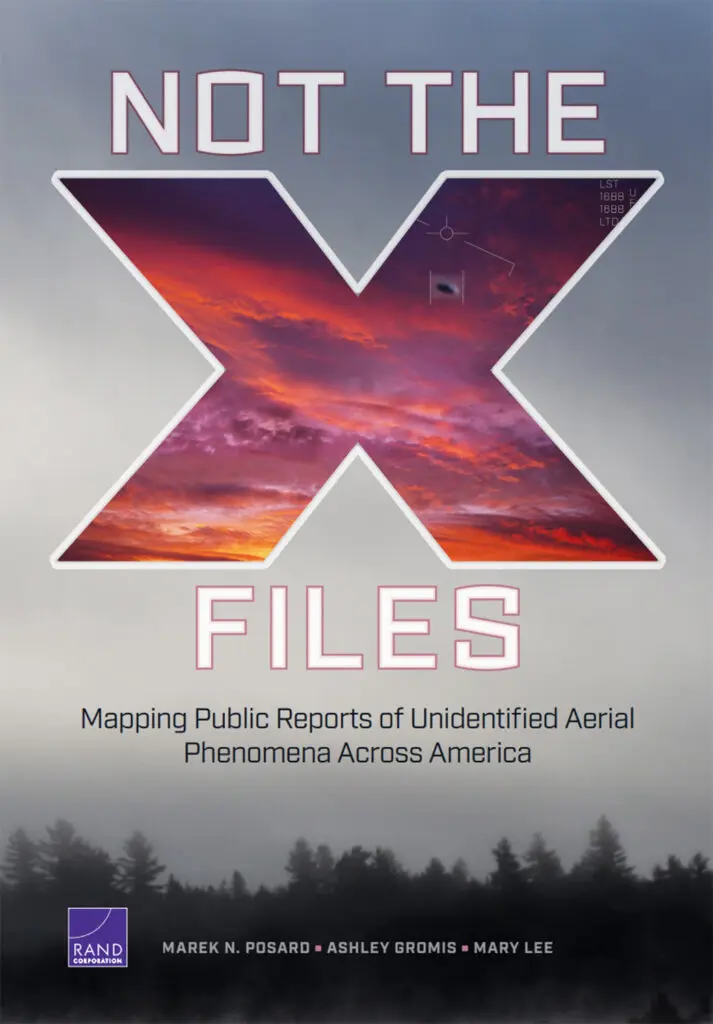
RAND’s modern UAP “flagship” is Not the X-Files (2023), and it was followed by a RAND Policy Lab event in January 2024, framed around crowded skies, drones, and public reporting as a potential early-warning layer.
The core RAND product: “Not the X-Files” (2023)
Audience and purpose
RAND’s stated audience is policy and security stakeholders who have to govern airspace with finite monitoring resources, in an era where commercial drones and proliferating aerial activity change the baseline. RAND explicitly frames public UAP reporting as potentially useful for identifying threats, while warning that the data itself is not “truth” and must be handled carefully.
The data
RAND used NUFORC reports as its primary raw input and notes that NUFORC is one of the nongovernmental entities the FAA has referenced in official contexts for reporting unexplained phenomena. RAND also states clearly: the analysis should not be interpreted as endorsing the accuracy of individual NUFORC reports or the database as a literal record of objective events.
This is a crucial methodological posture:
- NUFORC narratives contain noise, hoaxes, misidentifications, and storytelling artifacts.
- But large-scale patterns in where and when people report can still be meaningful, especially when compared against infrastructure, airspace features, and population variables.
UAPedia’s editorial stance is that civilian reporting pipelines are the front door of modern UAP research, but they must be triangulated with better-instrumented evidence, credible witness testimony, and chain-of-custody documentation where available.
Methodology
RAND’s method is best understood as a pipeline:
- Normalize and geocode reports so they can be mapped to U.S. places (CDPs).
- Detect statistically significant clusters across space and time. RAND reports identifying 751 statistically significant clusters.
- Model associations between reporting rates and nearby features such as military installations, MOAs, civilian airports, and weather stations.
- Check robustness, including varying cluster radii and alternative regression approaches.
- Assess coding reliability for categorized interpretations of reports. RAND reports average interrater reliability scores of 1.214 for the full dataset and 1.474 for clusters, calling that “good.”
The methodological vibe is epidemiology-meets-threat-assessment: treat reports like “incidence data,” then test what environmental variables predict higher reporting.
Findings: what RAND found, and what it carefully did not claim
1) Clusters are real, in the statistical sense
RAND found clustering across the United States, including persistent coastal clusters in parts of the Pacific Northwest (among others), and notes cluster sizes ranged from small (2–4 sightings) to very large (over 100 in some clusters).
This does not prove UAP concentrate there as objects. It proves reporting concentrates there.
2) The MOA signal is the strongest and most consistent association
RAND’s key finding is that reports were more likely within 30 km of military operations areas where routine training occurs.
RAND frames one plausible interpretation: some reports may be authorized aircraft and the public may not realize they live near MOAs, so outreach could reduce misreporting.
3) Other associations were inconsistent or pointed away from common assumptions
RAND reports an inconsistent relationship between reporting and proximity to military installations and weather installations, and notes some models suggest reports were less likely near weather stations and civilian airports, and less likely in more densely populated areas.
This matters because a simplistic story like “people see weird stuff near airports” does not automatically hold up under their modeling.
Implications: what RAND is really pushing toward
RAND’s recommendations move toward a public reporting architecture that is more structured, validated, and less vulnerable to hoaxes, while preserving signal value for aviation safety and security monitoring.
In 2024, RAND’s Policy Lab event description makes this explicit: crowded skies, finite monitoring resources, and the idea that public reports could help identify threats from above, especially in a drone-saturated environment.
This is not glamorous “reverse engineering” work. It is governance work: how to turn messy public inputs into something decision-useful.
How the media read RAND’s UAP moment
Mainstream coverage tended to translate RAND’s findings into a simple headline: “Many sightings are probably military aircraft.”
For example, WIRED summarized the RAND report as mapping over 100,000 reports and described a “prosaic conclusion,” while also quoting RAND’s Marek Posard about MOAs and public awareness.
This is a predictable media move: compress a multi-step statistical study into one memorable line. But it also risks flattening the story. RAND’s work does not demonstrate “the phenomenon is solved.” It demonstrates that reporting behavior is patterned and that airspace context matters.
RAND’s public posture: keep it data-centered, avoid narrative collapse
RAND authors Marek Posard and Caitlin McCulloch also published a commentary warning that the policy conversation around UAP could be derailed if it becomes dominated by hostile rhetoric and unsubstantiated allegations, potentially reducing institutional willingness to share information and stigmatizing reporting.
Even if you disagree with the tone, the strategic point is important: if UAP becomes a public-policy issue, it needs durable institutions and repeatable methods, not only viral clips and episodic outrage.
Why RAND leadership and governance matter, without turning it into innuendo
RAND is not a monolith. It is a large institution with leadership, boards, and advisory bodies that include figures with deep national security and defense backgrounds.
RAND’s leadership page lists key executives including:
- Jason Matheny (President and CEO)
- Andrew R. Hoehn (Senior Vice President, Research and Analysis)
- Eric Peltz (Senior Vice President and Chief Financial and Operations Officer)
…and others, with board listings updated as recently as 2025.
RAND’s Board of Trustees includes individuals with backgrounds spanning defense, intelligence, academia, and media, including (among others) Michael E. Leiter (Chair), Teresa Wynn Roseborough (Vice Chair), Chuck Hagel, Janet Napolitano, and others.
Two grounded implications follow:
- RAND can convene serious cross-domain expertise quickly, which is useful if UAP shifts from “weird sightings” to “persistent airspace governance problem.”
- RAND’s incentives are institutional and reputational, so what it chooses to publish will skew toward problems that can be addressed with open methods and defensible data, like the public-reporting layer.
Neither implication suggests hidden crash retrieval work. It suggests what RAND is most likely to do in public: build frameworks, evaluate reporting systems, and quantify risk.
What to take from RAND, and where it diverges
RAND’s UAP work is valuable because it introduces:
- a scalable approach to spatial clustering,
- a discipline of explicitly stating limitations,
- a policy-relevant angle on public reporting systems.
But UAPedia diverges on a key philosophical point:
Civilian report clusters near MOAs can be partly explained by training activity and misidentification. At the same time, high-quality UAP cases with credible witnesses and multi-sensor components, plus long-running testimony about recovery and exploitation programs, indicate that the UAP problem is larger than civilian misidentifications.
RAND studied one layer of the phenomenon: public reporting in the era of drones and crowded skies. That layer matters. It just isn’t the whole story.
Speculation labels
Hypothesis
- The MOA proximity signal is partly driven by civilians observing routine military training and interpreting unfamiliar flight profiles as anomalous.
- A subset of clusters may represent recurrent UAP presence that co-locates with training areas for reasons that are not reducible to misidentification (for example, sustained observation behavior). This remains unproven and would require prospective instrumentation.
Witness interpretation
- Grusch’s public statements imply a multi-decade crash retrieval and reverse engineering program exists and has involved injuries. This is testimony that remains contested in the public evidentiary record.
Researcher opinion
- A serious crash retrieval claim cannot be resolved by “belief vs disbelief.” It requires a reproducible evidentiary pathway: provenance, materials analysis, program documentation, and multi-witness convergence with role specificity.
- RAND’s demonstrated strengths (methods, convening power, policy implementation thinking) make it a plausible participant in future public UAP governance architecture, even if it remains peripheral to alleged “legacy” claims.
Claims taxonomy
Verified
- RAND analyzed 101,151 NUFORC-derived public reports across 12,783 CDPs (1998–2022).
- RAND identified 751 statistically significant clusters in that period.
- The 1947 Air Materiel Command memo states the phenomenon was considered “real” and explicitly names “the RAND and NEPA projects” as recipients for comment and recommendations.
- RAND’s leadership and board listings include the executives and trustees shown on its official leadership page (updated 2025).
Probable
- A meaningful portion of NUFORC-style reports are misidentifications, especially in contexts like MOAs and crowded skies, consistent with RAND’s outreach recommendations and the general nature of civilian reporting.
Disputed
- Claims of a U.S. crash retrieval and reverse engineering program involving non-human materials and biologics, as discussed in congressional testimony, remain unresolved in public evidence.
- Official statements asserting no evidence of reverse engineering are themselves part of the contested record, because the public cannot independently audit the underlying classified access and scope.
Legend
- Claims that RAND is directly running, managing, or hiding crash retrieval and reverse engineering programs lack publicly verifiable documentation in RAND’s published record.
Misidentification
- Many individual sighting narratives in civilian databases will resolve to mundane objects when sufficient context exists. RAND’s work implicitly supports this for some fraction of cases, though it does not validate individual reports.
Hoax
- Any public reporting system at scale will contain deliberate hoaxes. RAND explicitly recommends designing systems to minimize hoaxes and misidentified reports.
Relevant active links
RAND “Not the X-Files” report page:
www.rand.org/pubs/research_reports/RRA2475-1.html?utm_source=uapedia.ai
RAND “Not the X-Files” PDF:
www.rand.org/content/dam/rand/pubs/research_reports/RRA2400/RRA2475-1/RAND_RRA2475-1.pdf?utm_source=uapedia.ai
RAND Policy Lab event (Jan 25, 2024):
www.rand.org/events/2024/01/not-the-x-files.html?utm_source=uapedia.ai
RAND commentary (Posard & McCulloch, 2023):
www.rand.org/pubs/commentary/2023/09/ufo-research-is-only-harmed-by-antigovernment-rhetoric.html?utm_source=uapedia.ai
George Kocher (RAND draft): “UFOs: What to Do?” (1968):
www.rand.org/content/dam/rand/pubs/drafts/2007/DRU1571.pdf?utm_source=uapedia.ai
1947 Twining memo PDF (DocumentCloud file):
s3.documentcloud.org/documents/20797978/twining-memo.pdf?utm_source=uapedia.ai
Congress.gov hearing transcript (July 26, 2023):
www.congress.gov/event/118th-congress/house-event/116282/text?utm_source=uapedia.ai
Reuters coverage of the 2024 Pentagon historical report:
www.reuters.com/technology/space/pentagon-ufo-report-says-most-sightings-ordinary-objects-phenomena-2024-03-08/?utm_source=uapedia.ai
WIRED coverage referencing RAND’s UAP mapping:
www.wired.com/story/nasa-ufos-aliens-report-2023/?utm_source=uapedia.ai
References
Kocher, G. (1968). UFOs: What to do? (DRU-1571) [Unreviewed draft]. RAND Corporation.
Posard, M. N., Gromis, A., & Lee, M. (2023). Not the X-Files: Mapping public reports of unidentified aerial phenomena across America (RR-A2475-1). RAND Corporation.
Posard, M. N., & McCulloch, C. (2023, September 22). UFO research is only harmed by antigovernment rhetoric [Commentary]. RAND Corporation.
Reuters. (2024, March 9). Pentagon UAP report says most sightings ordinary objects and phenomena.
U.S. Congress. (2023, July 26). Unidentified anomalous phenomena: Implications on national security, public safety, and government transparency [Hearing transcript]. Congress.gov.
U.S. Army Air Forces, Air Materiel Command. (1947, September 23). AMC opinion concerning “flying discs” (Twining memo) [Declassified memo].
Zorbaugh, B. (2023, September 14). NASA didn’t find aliens, but if you see any UAPs, holler. WIRED.
Internal crosslinks
- AARO and Disinformation
- David Grusch dossier
- NUFORC & MUFON: Civilian Data Sources
- Project Sign/Grudge (early government posture, includes Twining memo context)
- Global High-Strangeness Hotspots (geospatial clustering as a research strategy)
- The 2022 Gillibrand–Rubio UAP Amendment (data-first oversight context)
SEO keywords
RAND UAP research; Not the X-Files RAND; UAP sighting clusters; NUFORC data analysis; military operations areas MOA UAP; UAP public reporting system; UAP threat assessment; Twining memo RAND; 1947 flying discs memo; George Kocher UFOs what to do; crash retrieval claims; UAP reverse engineering program; David Grusch testimony; AARO historical record report; UAP policy analysis; UAP data-first explainer