Electromagnetic propulsion sits at a strange crossroads. On one side are quiet blue ion plumes pushing probes through the Solar System. On the other side are classified studies of warp bubbles, reactionless drives, and speculation that at least some UAP are already flying with technologies that bend spacetime itself.
This article maps that landscape in a data-first way. We start from what is already flying, move through serious but speculative research, then connect those ideas to UAP cases where electromagnetic effects appear to be part of the story.
What counts as electromagnetic propulsion?
In mainstream aerospace engineering, electromagnetic propulsion usually means any system where electric and magnetic fields do the work of accelerating propellant, rather than hot combustion gases.
At its core is the Lorentz force. In simple form:
Force on a charged particle = charge × (electric field + velocity × magnetic field)
(University of Colorado Boulder)
If you can create a controlled plasma and shape its charged particles with fields, you can propel a spacecraft. In practice this splits electric propulsion into three broad families. (S3VI)
- Electrostatic thrusters
- Gridded ion engines
- Hall effect thrusters
- Electrospray thrusters
- Electromagnetic thrusters
- Magnetoplasmadynamic (MPD) thrusters
- Pulsed inductive thrusters (PIT)
- Some types of plasma accelerator concepts
- Electrothermal thrusters
- Arcjets
- Resistojets
The first two rely directly on electric and magnetic fields to accelerate ions; the third uses electricity to heat gas more efficiently but still behaves like a very efficient rocket. (S3VI)
For UAP studies, electromagnetic propulsion is interesting for two reasons:
- It is the only family of currently operational propulsion systems that already uses field interactions rather than just hot gas.
- Several advanced theoretical efforts, including government-funded studies, specifically explore electromagnetic or vacuum-based propulsion as a pathway toward the kind of performance reported for some UAP. (arXiv)
What we already fly: the electric workhorses
A surprising amount of spaceflight is already electric.
Ion engines and Hall effect thrusters
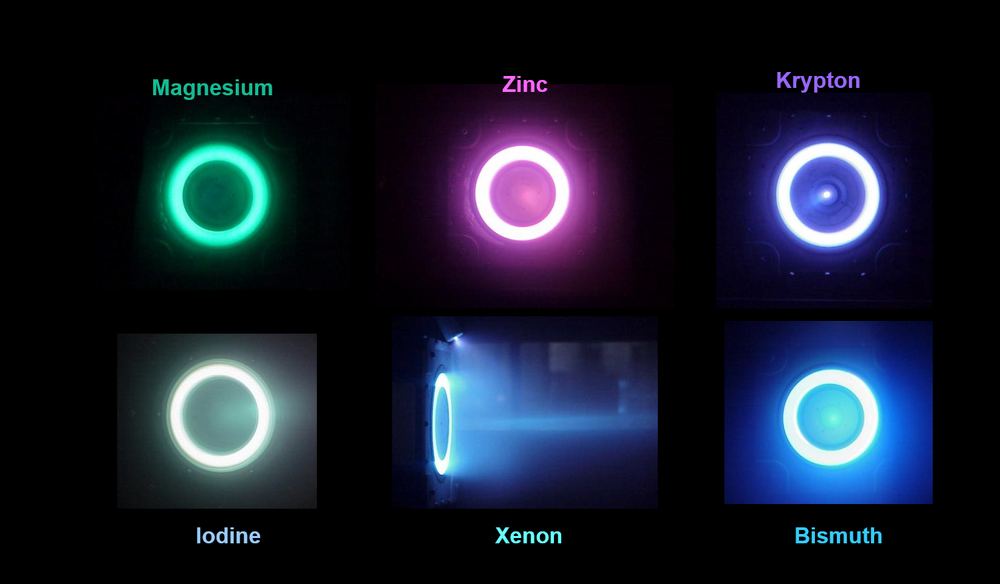
Ion and Hall thrusters are now standard for deep space probes and high-efficiency satellite station keeping. Over 500 spacecraft have flown with electric propulsion, according to recent industry reviews. (EDI Weekly)
Key data points:
- Typical ion thrusters achieve specific impulse (Isp) of 3,000 seconds or more, compared to roughly 450 seconds for the best chemical rockets.
- Thrust is tiny, usually millinewtons, but applied for months, which slowly builds up enormous velocity. (Descanso)
- Missions like NASA’s Deep Space 1, Dawn, ESA’s SMART-1 and JAXA’s Hayabusa probes have all used ion or Hall effect propulsion successfully. (Wikipedia)
The physics is well understood. Standard textbooks like Goebel and Katz’s “Fundamentals of Electric Propulsion: Ion and Hall Thrusters” derive performance directly from plasma physics and Lorentz forces. (Descanso)
From a UAP perspective, these systems are conservative and prosaic. They do not explain instant accelerations or silent hypersonic right-angle turns. What they prove is that field-driven propulsion is not science fiction. We already fly spacecraft where almost all of the “push” comes from electric and magnetic field geometry rather than hot gas.
MPD and pulsed inductive thrusters
Magnetoplasmadynamic thrusters and pulsed inductive thrusters (PIT) are the heavy lifters in the electromagnetic class.
- MPD thrusters send huge currents through a plasma to produce Lorentz forces on that plasma, generating higher thrust than ion engines at the cost of demanding power levels. (University of Colorado Boulder)
- Pulsed inductive thrusters use a fast-rising current in a flat coil to induce currents in a propellant sheet or puff, then eject it as plasma. NASA’s pulsed inductive thruster work at the end of the 1990s showed promising efficiency across a wide range of specific impulses. (Electric Rocket)
These technologies are experimental but grounded. They still need propellant. They do not break known conservation laws. They occupy the gray space between today’s satellite thrusters and more exotic ideas.
On the frontier: EMDrive, Mach effects and vacuum engineering
Beyond mainstream electric propulsion lies a set of more radical electromagnetic concepts. These are where UAP propulsion hypotheses often get their vocabulary: reactionless thrust, warp bubbles, metric engineering.
The EMDrive controversy
The EmDrive is perhaps the most famous, and contentious, claim of an electromagnetic propulsion breakthrough.
Originally proposed by Roger Shawyer in 2001, it is a conical microwave cavity that allegedly produces thrust without propellant by bouncing microwaves inside the cavity.
Key timeline events:
- Inventor tests claimed small thrusts.
- NASA’s Eagleworks lab later reported micronewton-level thrust in a vacuum chamber and published a careful but cautiously worded paper in 2016.
- Media outlets highlighted the result as a potential game changer, but physicists immediately pointed out that any real reactionless thrust would violate conservation of momentum.
- Independent tests by Martin Tajmar’s group at TU Dresden showed that apparent thrust signals disappeared once thermal expansion and subtle electromagnetic forces on cables were properly accounted for. The group concluded that all reported EmDrive thrusts can be explained by experimental artifacts.
- A widely cited summary now states that all EmDrive claims have been refuted by at least three orders of magnitude.
Critics in venues like Wired have been blunt, describing media enthusiasm for the EmDrive as misplaced and noting that extraordinary claims demand far more robust data. (WIRED)
In terms of UAP research, EmDrive is a warning. Not every “impossible” thrust claim survives independent measurement, even when backed by a NASA logo.
Mach effect thrusters and mass fluctuation concepts
James Woodward’s Mach effect thrusters (MET) propose something subtler. Instead of violating conservation laws, these devices claim to exploit tiny transient mass fluctuations predicted in some interpretations of Mach’s principle and general relativity.
Woodward’s book “Making Starships and Stargates” is a thorough survey of such ideas, including MET tests that claim small but repeatable thrust when capacitors are cycled in particular ways. (Google Books)
Independent experiments have reported mixed results. Tajmar’s SpaceDrive project has tested both EmDrive and Mach effect prototypes, with data still being debated in the advanced propulsion community. (Wikipedia)
Speculation label – Researcher opinion: If any Mach effect device is ever validated well above noise level, it would still be a field-drive that obeys conservation laws, not a magical reactionless engine. It would move momentum exchange from propellant to interaction with the global mass-energy distribution of the universe.
Vacuum and metric engineering
Perhaps the most relevant body of work to UAP propulsion conjectures sits under “metric engineering”: the idea that the vacuum or spacetime metric can be shaped to allow novel propulsion.
Harold Puthoff, a long-time figure at the intersection of defense research and frontier physics, authored “Advanced Space Propulsion Based on Vacuum (Spacetime Metric) Engineering”, first as a peer reviewed paper and then as a Defense Intelligence Reference Document (DIRD) funded under the AAWSAP program. (arXiv)
The core argument:
- Quantum vacuum and spacetime metric are treated as a physical medium that can, in principle, be engineered.
- Known solutions in general relativity, such as Alcubierre warp drives and traversable wormholes, show that with exotic energy densities one can drastically alter effective travel times without locally breaking the speed of light.
- If suitable “metric engineering” technology existed, a craft might surf a spacetime bubble rather than pushing against propellant.
These ideas are also surveyed in the mainstream advanced propulsion compendium “Frontiers of Propulsion Science”, edited by Marc Millis and Eric Davis, which catalogs published work on warp drives, gravity control, and vacuum energy. (AIAA Journal)
Speculation label – Hypothesis: Metric engineering is mathematically consistent within general relativity, but the required energy densities and exotic matter appear far beyond present human engineering. Whether some other civilization or hidden program has solved this is an open question that current public data cannot answer.
Electromagnetic signatures in UAP encounters
If UAP are using advanced electromagnetic or metric engineering propulsion, we might expect strong side effects: intense fields, ionization, or radiation. Witness testimony and case files do in fact report a cluster of electromagnetic phenomena around certain UAP encounters.
Below are some of the better documented patterns.
Vehicle interference cases
There is a multi-decade pattern of UAP incidents where vehicles stall, headlights die, and radios fill with static as an object approaches, only to return to normal when it departs. (Mark Foster)
Two classic examples:
- Levelland, Texas (1957). Multiple drivers reported an egg-shaped glowing object near the road. Each time it approached, car engines died, headlights went dark, and radios went to static. When the object departed vertically, systems spontaneously came back to life. Technical reviewers have pointed out that this pattern is more consistent with a strong external electromagnetic field than with ball lightning or weather. (Headcount Coffee)
- Loch Raven Reservoir, Maryland (1958). A patrol car’s electrical system allegedly failed as a luminous object hovered ahead, then restarted on its own after the object departed. Contemporary writeups explicitly describe this as electromagnetic interference. (The Towson Torch ©)
These cases predate modern electronic ignition and solid state control, which reduces the chance of mundane software glitches. They are interesting as early, independent hints that some UAP manifestations carry strong electromagnetic fields that couple to vehicle systems.
Injury cases with possible EM or RF exposure
Some of the most disturbing UAP reports feature human injury consistent with intense heat or radiation.
- Colares, Brazil (Operation Prato, 1977–1978). Residents reported being struck by beams from small luminous objects. Doctors documented burns and symptoms that Brazilian and later foreign investigators compared to microwave or other non-ionizing radiation effects. The Brazilian Air Force conducted a formal investigation, then closed it without a clear explanation.
- Cash–Landrum, Texas (1980). Three witnesses reported a large, fiery diamond-shaped object radiating extreme heat, followed by a formation of helicopters. In days and weeks after the encounter, they suffered skin damage, hair loss, gastrointestinal distress and long term health problems that some physicians and investigators likened to radiation sickness, although the exact cause remains contested.
A DIA-commissioned DIRD, “Anomalous Acute and Subacute Field Effects on Human Biological Tissues”, reviews reported injuries in several anomalous cases and examines possible mechanisms involving radiofrequency and other directed energy exposures. It notes that RF deposition patterns can heat deeper tissues more than surface fat, which fits some witness medical reports. (Defense Intelligence Agency)
Speculation label – Witness interpretation: Injured witnesses and some investigators interpret these events as side effects of advanced propulsion or energy systems, possibly EM field or plasma related. The data support intense field exposure of some sort; they do not yet reveal the specific mechanism.
Mapping electromagnetic case clusters
If one plotted a world map of UAP incidents with strong electromagnetic or radiation-like effects, several clusters would stand out:
- 1950s North America, especially the Levelland region and other stalled-engine waves. (Headcount Coffee)
- The Brazilian Amazon coast around Colares in the late 1970s.
- The American South, centered on the Cash–Landrum case and a handful of others involving burns or intense heat. (Wikipedia)
A modern UAP observatory design, such as those described by Knuth and colleagues in “The New Science of Unidentified Aerospace-Undersea Phenomena (UAP)”, explicitly calls for magnetometers, RF sensors and even gravimeters to catch such anomalies instrumentally rather than just through anecdotes. (arXiv)
For a full treatment, an accompanying map visualization would show these clusters over time, tied to case files and witness medical reports, with filters for type of electromagnetic effect (vehicle interference vs injury vs instrument anomalies).
Documents that bridge UAP and electromagnetic propulsion
Several government and quasi-government documents explicitly connect advanced propulsion theory, electromagnetic phenomena and UAP.
AAWSAP/AATIP DIRDs
Under the Defense Intelligence Agency’s Advanced Aerospace Weapon System Applications Program (AAWSAP), later entangled with AATIP, at least 38 Defense Intelligence Reference Documents were commissioned. These include: (National Taxpayers Union)
- “Advanced Space Propulsion Based on Vacuum (Spacetime Metric) Engineering” (Puthoff)
- Studies on warp drives and manipulation of extra dimensions
- The already mentioned “Anomalous Acute and Subacute Field Effects on Human Biological Tissues”
These reports are not UAP case studies. They are horizon scans asking what is physically possible if one treats the vacuum and spacetime as engineering media. For UAP scholars, they matter because:
- They show that at least part of the defense establishment takes advanced field propulsion seriously enough to pay for serious review.
- They provide a technical vocabulary that later appears in disclosure-focused works and media, including the “Age of Disclosure” documentary where Puthoff and Eric Davis describe UAP as operating inside spacetime “bubbles”. (Reddit)
Academic and technical overviews
Beyond classified material, several mainstream technical works map the same territory from a more neutral standpoint:
- “Fundamentals of Electric Propulsion: Ion and Hall Thrusters” explains known electric propulsion in exhaustive detail, including electromagnetic thrusters. (Descanso)
- “Frontiers of Propulsion Science” catalogs theoretical work on warp drives, gravity control and vacuum engineering in a sober, critical way, separating mathematical possibility from engineering reality. (AIAA Journal)
- Woodward’s “Making Starships and Stargates” examines Mach effect thrusters and other unconventional schemes with careful attention to both theory and experiment. (Google Books)
- Recent reviews of electric propulsion for small satellites summarize the current state of electrostatic, electrothermal and electromagnetic thrusters and note rapid growth in on-orbit use. (S3VI)
Taken together, these documents form an important context: the propulsion community acknowledges that exotic field drives are mathematically interesting, but until experimental evidence clearly exceeds noise, such concepts remain speculative.
Experts, critics and the UAP propulsion debate
A non-exhaustive list of figures who shape the conversation:
- Dan Goebel and Ira Katz: Leading experts on ion and Hall thrusters, authors of the standard textbook used by NASA and ESA engineers. (Descanso)
- Marc Millis: Former head of NASA’s Breakthrough Propulsion Physics Program, co-editor of “Frontiers of Propulsion Science”.
- Eric Davis: Co-editor of the same volume, and contributor to AAWSAP/AATIP DIRDs on exotic propulsion. (AIAA Journal)
- Harold Puthoff: Physicist behind vacuum engineering work and a lead author of several propulsion-related DIRDs. (arXiv)
- James Woodward: Proponent of Mach effect thrusters. (Google Books)
- Kevin Knuth and collaborators: Authors of “The New Science of Unidentified Aerospace-Undersea Phenomena (UAP)”, which calls for multi-sensor UAP observatories to empirically measure fields, including magnetic anomalies. (arXiv)
These individuals differ on how far physics can be pushed, but they largely agree that any real breakthrough must survive serious experimental scrutiny.
Skeptical counterweights
Criticism is part of the story, and in line with UAPedia’s policy we treat it as one stream of evidence among many, not as a final arbiter.
- The EmDrive has been labeled “pseudoscience” in mainstream physics discussions, with detailed critiques showing that all claimed thrusts can be reproduced through thermal or electromagnetic artefacts. (Wikipedia)
- Commentators in National Geographic and physics outlets have emphasized that peer review alone does not prove a device works; it only means the methods and reporting met basic standards. (National Geographic)
- Reviews of the “Age of Disclosure” film from skeptical organizations and outlets argue that while warp bubble talk is fascinating, the documentary offers testimony but no new hard data on propulsion systems. (Skeptic)
What does all this imply about UAP propulsion?
Putting the data streams together, we can outline a cautious but heterodox picture.
- Established electromagnetic propulsion is real, widely used, and efficient, but does not remotely reach the performance envelope of high-strangeness UAP reports. (S3VI)
- Serious theoretical work, some of it government funded, explores metric/vacuum engineering and unusual field-drive concepts as future possibilities. (arXiv)
- A subset of UAP cases show patterns of electromagnetic interference and probable field or radiation exposure that go beyond ordinary aircraft or weather phenomena. (Headcount Coffee)
Claims Taxonomy
Verified
- Electric propulsion using electromagnetic and electrostatic principles (ion and Hall thrusters, some MPD and PIT configurations) is operational on hundreds of spacecraft, with well characterized performance and physics. (EDI Weekly)
- Historical UAP case files contain multiple, independent reports of vehicle electrical interference and instrument anomalies coincident with close UAP encounters. (Headcount Coffee)
- Government agencies have commissioned formal studies on advanced propulsion concepts involving warp drives, vacuum engineering and field effects on human tissues. (National Taxpayers Union)
Probable
- Some UAP incidents involve strong electromagnetic fields capable of affecting vehicle systems or human physiology, beyond what is known from routine aviation or weather. (Wikipedia)
- If any advanced field propulsion exists in classified or non-human platforms, it likely uses metric or vacuum engineering rather than simple reactionless electromagnetic gadgets like the EmDrive. (arXiv)
Disputed
- Claims that the EmDrive or similar reactionless electromagnetic drives work have been strongly challenged and are not supported by independent replications. (Wikipedia)
- Publicly accessible data do not yet prove that metric engineering or warp bubbles have been achieved in hardware, despite theoretical and documentary interest. (arXiv)
Legend
- Narratives that all spectacular UAP maneuvers can be achieved by simple Earth-built electromagnetic gadgets of the “garage EmDrive” type, requiring no new physics or energy sources. These make good folklore but are not supported by the engineering literature. (Wikipedia)
Misidentification
- Some vehicle interference stories likely arise from prosaic sources such as nearby power lines, faulty ignition systems, or weather-related electrical phenomena, especially when no structured object (UAP) is seen. (Mark Foster)
Hoax
- Commercial “reactionless” tabletop devices marketed as having EMDrive-like physics but providing no tested thrust data and relying on perpetual motion claims. These should be treated as consumer fraud, not as propulsion research.
Speculation label
Hypothesis
One coherent way to synthesize these threads is that some UAP platforms may use a layered system, where:
- Inner systems manipulate spacetime or vacuum properties to create a local “bubble” with altered inertia and refractive index, consistent with Puthoff’s metric engineering framework and warp bubble narratives. (arXiv)
- Outer systems manage electromagnetic fields and plasmas at the bubble boundary, which might account for vehicle interference, RF-like injuries, and ionization effects observed as glowing orbs or structured plasma envelopes.
Researcher opinion
- The healthiest stance is to keep advanced propulsion concepts on the table as hypotheses while demanding instrumented, reproducible evidence for any claimed implementation, human or non-human.
- This model remains speculative. It has the virtue of explaining several disparate data points without demanding outright violation of known physics. It also motivates specific instrumented tests, like simultaneous RF, magnetometer and optical measurements at future UAP observatories, of the kind advocated in Knuth et al.’s new UAP science framework. (arXiv)
References
Goebel, D. M., & Katz, I. (2008). Fundamentals of electric propulsion: Ion and Hall thrusters. JPL Space Science and Technology Series. descanso.jpl.nasa.gov/SciTechBook/st_series1_chapter.html?utm_source=uapedia.ai (Descanso)
Millis, M. G., & Davis, E. W. (Eds.). (2009). Frontiers of propulsion science. American Institute of Aeronautics and Astronautics. arc.aiaa.org/doi/book/10.2514/4.479953?utm_source=uapedia.ai (AIAA Journal)
O’Reilly, D., et al. (2021). Electric propulsion methods for small satellites: A review. Aerospace, 8(1), 22. s3vi.ndc.nasa.gov/ssri-kb/static/resources/aerospace-08-00022-v3.pdf?utm_source=uapedia.ai (S3VI)
Puthoff, H. E. (2012). Advanced space propulsion based on vacuum (spacetime metric) engineering. Physics Essays, 25(2). arxiv.org/abs/1204.2184?utm_source=uapedia.ai (arXiv)
Defense Intelligence Agency. (2009). Advanced space propulsion based on vacuum (spacetime metric) engineering (DIRD). info.publicintelligence.net/DIA-AdvancedSpacePropulsion.pdf?utm_source=uapedia.ai (Public Intelligence |)
Defense Intelligence Agency. (2010). Anomalous acute and subacute field effects on human biological tissues. www.dia.mil/FOIA/FOIA-Electronic-Reading-Room/FileId/170026/?utm_source=uapedia.ai (Defense Intelligence Agency)
Drake, N., & Greshko, M. (2016, November 21). NASA team claims “impossible” space engine works: Get the facts. National Geographic. www.nationalgeographic.com/science/article/nasa-impossible-emdrive-physics-peer-review-space-science?utm_source=uapedia.ai (National Geographic)
EmDrive. (2025). In Wikipedia. en.wikipedia.org/wiki/EmDrive?utm_source=uapedia.ai (Wikipedia)
Riley, T. (2016). Electric propulsion. NASA student report. www.colorado.edu/faculty/kantha/sites/default/files/attached-files/159915-172568_-_thomas_riley_-_may_10_2017_430_pm_-_final_project_riley.pdf?utm_source=uapedia.ai (University of Colorado Boulder)
Knuth, K. H., Ailleris, P., Agrama, H. A., et al. (2025). The new science of unidentified aerospace-undersea phenomena (UAP). Progress in Aerospace Sciences, 156, 101097. arxiv.org/abs/2502.06794?utm_source=uapedia.ai (arXiv)
Operation Saucer (Operação Prato). (2025). In Wikipedia. en.wikipedia.org/wiki/Opera%C3%A7%C3%A3o_Prato?utm_source=uapedia.ai (Wikipedia)
Cash–Landrum incident. (2025). In Wikipedia. en.wikipedia.org/wiki/Cash%E2%80%93Landrum_incident?utm_source=uapedia.ai (Wikipedia)
Levelland UFO case: Texas drivers and the night of stalled engines. (2025, November 28). Headcount Coffee blog. www.headcountcoffee.com/blogs/coffee-news/the-1957-levelland-ufo-case-texas-drivers-and-the-night-of-stalled-engines?srsltid=AfmBOoqVfVzMsxM6UliHVJ1CYo_qk6whzdhA-AzV1RxX30YMZGnajCPo&utm_source=uapedia.ai (Headcount Coffee)
McCampbell, J. (1983). UFO interference with vehicles and self-starting engines. MUFON 1983 UFO Symposium Proceedings, 45–59. http://www.nicap.org/papers/ufointerf.htm?utm_source=uapedia.ai (Mark Foster)
Millis, M. G., & Davis, E. W. (2009). Breakthrough propulsion physics overview. In Frontiers of propulsion science (pp. 1–30). AIAA. nss.org/frontiers-of-propulsion-science-by-marc-g-millis-and-eric-w-davis/?utm_source=uapedia.ai (NSS)
Woodward, J. F. (2012). Making starships and stargates: The science of interstellar transport and absurdly benign wormholes. Springer Praxis. www.springer.com/gp/book/9781461456223?utm_source=uapedia.ai (Google Books)
SEO keywords
electromagnetic propulsion UAP, electric propulsion ion thrusters, Hall effect thruster overview, magnetoplasmadynamic thruster, EMDrive controversy, warp drive metric engineering, Hal Puthoff vacuum engineering, Mach effect thruster Woodward, UAP electromagnetic interference, vehicle stall UFO cases, Colares Cash-Landrum radiation injuries, AAWSAP AATIP DIRD propulsion, New Science of UAP Knuth, Age of Disclosure warp bubble, advanced propulsion and UAP