
The Allagash Wilderness Waterway is a chain of lakes, streams, and forest that, in the 1970s, was even more remote than today. Eagle Lake and its surroundings are known for cold, deep water and long stretches of uninhabited shoreline, with minimal light pollution and vast, dark skies.
This context matters. The Allagash case is not an urban light-in-the-sky report. It is a multi-witness UAP encounter in an environment with:
- very few artificial light sources
- excellent night-sky visibility
- no nearby airports or highways that would routinely mimic such a structured, multicolored object
That environmental simplicity strips away many of the usual “it was just…” explanations and makes this sighting unusually clean from a data standpoint.
Timeline of the events
The trip
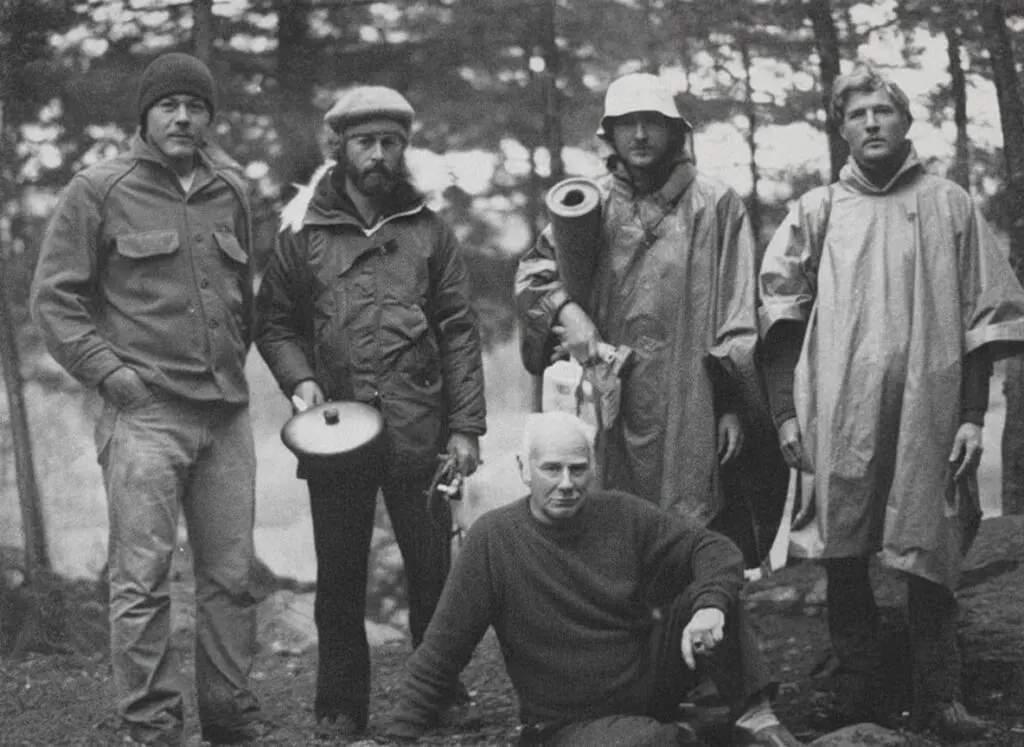
In August 1976, the four men – twins Jim and Jack Weiner, their friend Chuck Rak, and guide/US Navy veteran Charlie Foltz – headed north from Boston for a two-week canoe expedition. They climbed Mount Katahdin, then flew into the wilderness by float plane, putting in on Telos Lake and working their way through the interconnected Allagash lakes. (Journal of Scientific Exploration)
All four were art students, used to close visual observation and sketching. That detail later became important because they produced detailed drawings of both the craft and entities.
First UAP: Chamberlain / Mud Brook
Several days into the trip, at a campsite often described as Mud Brook on Chamberlain Lake, the group noticed a “blazingly bright star” that looked wrong. Through binoculars, Jim concluded it was an object a few miles away hovering roughly 200 feet above the treetops. After a short time, the light simply blinked out. (Strange New England)
They discussed it, found no prosaic explanation, then essentially shrugged and continued their journey.
The main event on Eagle Lake
Two nights later, the group camped at a remote Eagle Lake site near Smith Brook. They decided to go night fishing on a moonless night and, before pushing off, built what all but one later described as a very large bonfire specifically as a navigational beacon. (UFO Casebook)
Once on the water:
- They paddled out perhaps a quarter mile.
- Rak felt “an uncomfortable feeling of being stared at” and looked back toward the campsite. (The County)
- He saw a brilliant, silently hovering sphere or oval of light over the southeastern rim of the cove, estimated 200–300 feet above the trees and perhaps 80 feet across, “about the size of a two-story house in circumference.” (UFO Casebook)
- The light cycled through white, green, red, and yellow in a fluid, almost liquid, gyroscope-like pattern. (UFO Casebook)
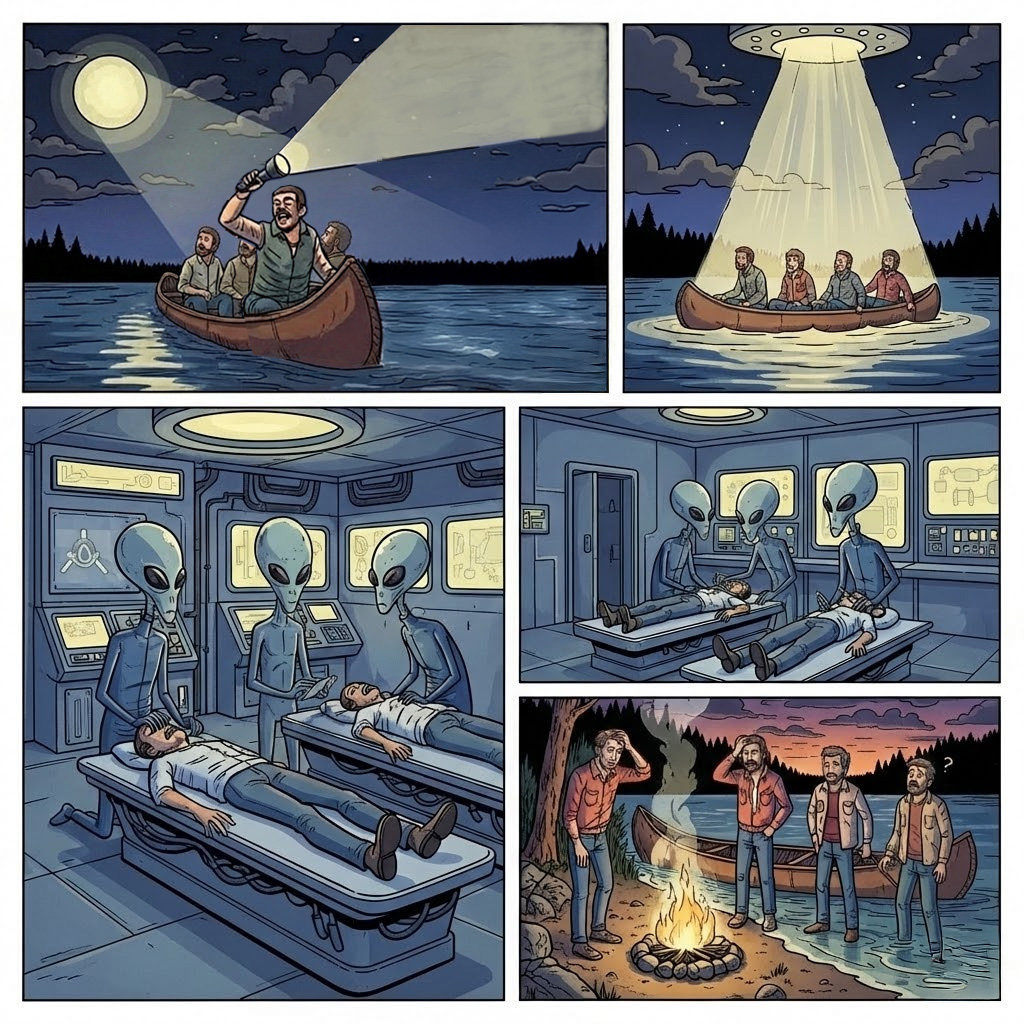
Charlie, in an almost impulsive move, raised his flashlight and signaled an SOS toward the object. According to all four, the sphere immediately changed behavior, stopped its oscillation, then began a direct, silent approach toward their canoe with a cone-shaped beam of light probing the water. (UFO Casebook)
Panic hit. They paddled furiously toward shore, but the beam “hunted” their canoe, then engulfed it.
The next conscious memory all four share is being near the shoreline, no longer in the middle of the cove, watching the object from land as it tilted, emitted a vertical beam of light, then shot upward and disappeared into the night sky. (UFO Casebook)
Then they noticed something odd about the bonfire.
Missing time and the burned-down fire
The fire, which they believed had been laid with large logs to burn for several hours, was now mostly coals and embers. Jim later said the entire canoe outing felt like 15–20 minutes, yet the fire looked as if hours had passed. (UFO Casebook)
That mismatch between subjective time and physical evidence is the core of the “missing time” claim.
In 2016, Rak disputed this element, arguing that the logs were not huge and would have burned quickly, and calling earlier claims about log size “complete manure.” (The County)
Foltz countered that some logs were “about the diameter of my leg,” closer to 10 inches, which should indeed have burned for much longer. (The County)
Whatever the true dimensions of the firewood, all four initially agreed that something about the elapsed time felt wrong. They were tired, confused, and went to sleep without discussing it deeply. The next day they continued their canoe route.
The ranger and the “searchlight” explanation
The group reported the strange lights to a ranger. According to Rak’s later account, the ranger quickly dismissed the sighting as promotional searchlights from a hardware store grand opening in Millinocket, roughly 70–75 miles away. (The County)
Even after Rak’s later skepticism about the abduction, he maintained that this searchlight explanation was impossible given distance, brightness, and apparent structured movement of the light. (The County)
No official investigation followed. The incident quietly faded into the background of their lives.
Witnesses and later experiences
The Allagash Four
- Jim Weiner: Later suffered a head injury that triggered temporal lobe epilepsy, associated with memory disturbances, sensory anomalies, and vivid imagery. (Strange New England)
- Jack Weiner: Reported recurring nightmares of being examined by non-human beings, seeing his brother and friends on a bench unable to help him. (UFO Casebook)
- Charlie Foltz: A commercial artist and experienced outdoorsman; often served as spokesman for the group in media appearances. (The Portland Press Herald)
- Chuck Rak: Artist and later caricaturist, initially fully supportive of the abduction narrative but decades later became the principal dissenter. (UFO Casebook)
All four were visually trained and comfortable working from memory to create detailed sketches, which is part of why this case grew so iconic: the entity drawings are unusually precise and stylized compared to many abduction cases. (UFO Casebook)
Nightmares, seizures, and emerging memories
Years after the trip, Jack began experiencing recurrent nightmares of long-armed, big-headed beings manipulating his body on a table while his companions sat nearby. Jim and the others also reported disturbing dreams and visions of similar creatures. (UFO Casebook)
Jim’s temporal lobe epilepsy made his neurologists particularly attentive to unusual perceptual experiences. According to multiple retellings, one physician either suggested or did not discourage the idea of contacting a UAP researcher, though some authors have rightly questioned whether any mainstream clinician would actually recommend that path. (Strange New England)
In 1988, Jim attended a UAP conference where Raymond Fowler was speaking. After the lecture, he approached Fowler with the story of Eagle Lake, the missing time, and the subsequent nightmares. Fowler immediately recognized parallels with other New England abduction cases and arranged for a more formal investigation. (Journal of Scientific Exploration)
Reporter Matt Byrne of the Portland Herald interviews them on September 7th, 2013.
Hypnosis, testimony, and “what really happened”
The Constantino sessions
Fowler engaged hypnotist and high-school teacher Anthony Constantino to conduct regression sessions with each of the four men separately in 1988–1989. Constantino described these sessions as “the most intense experience” of his career. (UFO Casebook)
Under hypnosis, all four independently described:
- being caught in the beam of light,
- levitated into a craft,
- separated and examined on metallic tables in a sterile, diffusely lit environment,
- monitored by spindly, long-fingered humanoids with large heads and prominent, reflective eyes,
- telepathic communication rather than spoken language. (UFO Casebook)
The men reported skin and fluid samples being taken, including genital procedures that they described as painful and humiliating. The interior of the craft was compared to a veterinary clinic, and Rak later said the exam room reminded him of a “vet’s office” with a silvery table. (UFO Casebook)
Constantino later stated that he believed the men and was personally shaken by their accounts, likening the scenario to humans tagging and releasing wild animals for research. (UFO Casebook)
Polygraph and psychiatric evaluations
According to Fowler and Ufocasebook summaries, the men underwent:
- psychiatric evaluations that found no signs of psychosis or major mental illness,
- polygraph tests that they reportedly passed when questioned about their experiences. (Wikipedia)
Polygraph results treat honesty, not objective reality, but they are consistent with the view that at least some of the witnesses sincerely believe their narrative.
The power and pitfalls of regression
The Journal of Scientific Exploration essay on three New England abduction narratives including Allagash explicitly notes that hypnosis can create both false and recovered memories and stresses that much depends on the ethics and skill of the hypnotist. (Journal of Scientific Exploration)
Strange New England’s skeptical review goes further, arguing that:
- Jim’s temporal lobe epilepsy complicates the picture,
- the others might have been influenced by knowing his recalled narrative before undergoing their own sessions,
- consistent stories could reflect suggestion rather than independent memory. (Strange New England)
UAPedia’s own taxonomy flags “Hypnotic regression and false memory formation” as a major caution in abduction research, highlighting the risk of confabulation, suggestion, and cultural scripting.
From a data-first perspective, this means the abduction content deserves a lower evidentiary weight than the consciously remembered multi-witness sighting and physical surroundings (canoe position, fire state, etc.).
What was seen: craft and entities
UAP characteristics
Across sources and sessions, the UAP over Eagle Lake is described with a surprisingly stable set of features:
- Shape: spherical or oval, sometimes “split into four quadrants like a gyroscope.” (Strange New England)
- Size: roughly 80 feet in diameter, comparable to a two-story house. (UFO Casebook)
- Motion: initially hovering motionless; then responsive motion toward the canoe immediately after the SOS signal; later a rapid departure trajectory with vertical tilt and upward beam. (UFO Casebook)
- Light behavior: cycling between white, red, green, and yellow with a fluid, “metallic liquid” quality; projecting a coherent beam that tracked the canoe. (The County)
- Sound: consistently described as silent. (UFO Casebook)
This combination of structured, controlled motion, color-changing luminosity, responsive behavior to signaling, and silence is inconsistent with known aircraft, satellites, or ordinary searchlights, particularly in a remote region 70+ miles from the suggested Millinocket source. (The County)
Entity descriptions
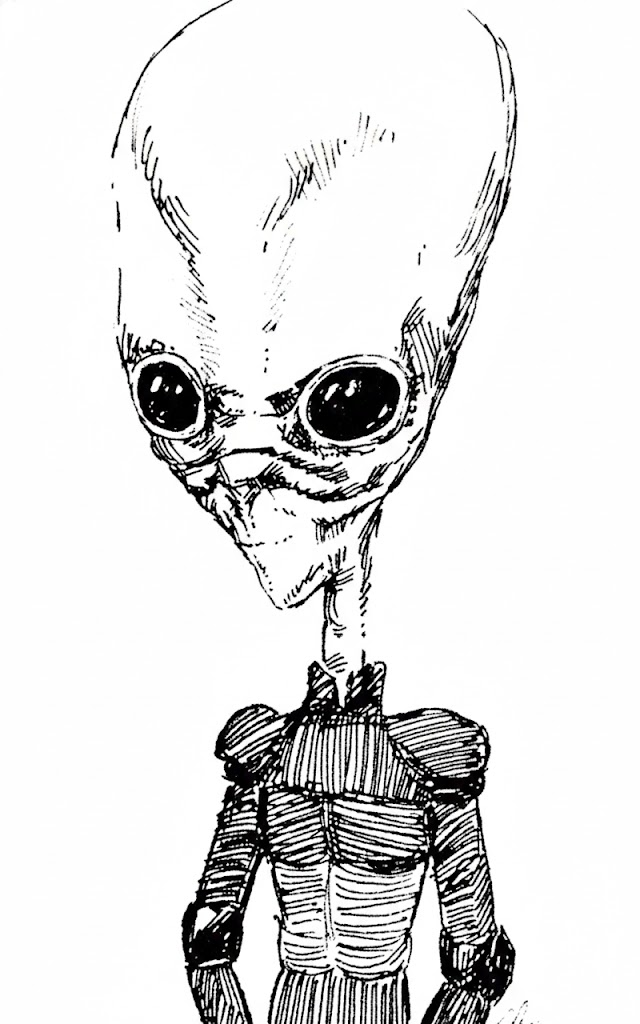
Under hypnosis and in later sketches, the entities are described as:
- bipedal humanoids with thin torsos and limbs,
- large, hairless heads,
- huge, sometimes metallic or reflective eyes without visible eyelids,
- long, insect-like hands with four fingers,
- greyish or pale skin, no visible clothing in some accounts. (UFO Casebook)
These descriptions fit closely within the wider “Greys” pattern in global UAP contact literature, which the UAPedia taxonomy treats as a recurring entity type with consistent reported characteristics.
Whether this reflects a real non-human population or a powerful shared cultural schema is exactly what cases like Allagash are meant to help us evaluate.
Physical, psychological, and follow-on effects
The fire and missing time as “touchstones”
The Journal of Scientific Exploration essay uses the concept of “touchstones” from scientific intelligence analysis: physically grounded, well-attested elements that anchor a narrative in external reality. For Allagash, it identifies:
- the consciously remembered close encounter on the lake,
- the missing time between beam-engulfment and reaching shore,
- the unexpectedly burned-down bonfire as physical corroboration,
- the group’s shared conscious recollection of the departing object from shore. (Journal of Scientific Exploration)
Those elements are considered more robust than hypnotically recovered material and are key to any serious assessment.
Nightmares, health, and life changes
Jack’s nightmares and Jim’s seizures are not unique in abduction literature. Many experiencers report:
- intrusive imagery of similar entities,
- sleep disturbances,
- long-term shifts in worldview and career choices. (Journal of Scientific Exploration)
Jack reported a later, separate abduction from his home in Vermont in which he and his wife Mary were allegedly taken. As physical evidence he pointed to burns on the soles of his feet after being returned. (Strange New England)
That later episode is far less documented than the 1976 event and remains mostly within the circle of believer literature. It is best treated as an associated but secondary claim.
No official case file
Beyond the ranger’s shrug and an off-hand “searchlight” explanation, there is no evidence of official U.S. government investigation. The case has been driven almost entirely by civilian researchers, local journalists, and the witnesses themselves. (The County)
In line with UAPedia’s editorial stance, absence of official validation is not taken as evidence against the reality of the event. Government silence frequently reflects institutional risk-aversion rather than data quality.
Conflict inside the case: Rak’s reversal and “Allagash Truth”
For decades the Allagash Four presented a united front. That changed dramatically in 2016, when The County published a two-part feature timed to the 40th anniversary.
Rak stated bluntly:
- “The reason I supported the story at first was because I wanted to make money.” (The County)
- He affirmed the reality of seeing a structured object twice, on Chamberlain and Eagle Lakes, but denied any memory of abduction, even under hypnosis. (The County)
- He claimed the others used recreational hashish on the night in question and that they later lied about this on shows such as The Joan Rivers Show. (The County)
Rak portrayed the Allagash Abductions as “brilliant storytelling” rather than outright hoax, but still “not the truth” in his view. (The County)
Jim, Jack, and Charlie responded forcefully, denying drug use, defending the size and burn-time of the fire, and characterizing Rak as angry, self-aggrandizing, and ethically compromised. They also recounted an episode in which Rak allegedly proposed that all four publicly attack the handling of the case to create lucrative controversy, a proposal they say they rejected. (The County)
In 2024, a press release announced Chuck Howard’s book Allagash Truth, describing him as “a gifted caricature artist and alleged eyewitness” to the Allagash trip who now aims to “challenge the legitimacy of an iconic alien abduction tale.” The narrative clearly parallels Rak’s role and suggests a further, more formal effort to refute the abduction component while still acknowledging unusual events and strange lights.
From a data standpoint, this internal split is central:
- UAP sighting: all sides, including Rak/Howard, still affirm a bright, structured, anomalous object.
- Abduction narrative: three witnesses and the hypnotist treat it as real; one witness now rejects it and frames motivations partly in terms of hoped-for income and media attention.
This is why UAPedia classifies the sighting and the abduction as separate claims with different confidence levels.
Comparative context: New England’s “catch and release” pattern
The Journal of Scientific Exploration essay explicitly evaluates three New England abduction narratives as a cluster:
- Betty and Barney Hill (New Hampshire, 1961),
- Buff Ledge Camp (Vermont, 1968),
- Allagash (Maine, 1976). (Journal of Scientific Exploration)
It argues that:
- all three involve conscious close encounters with structured craft,
- all three exhibit missing time and later recall (often under hypnosis) of medical-style examinations,
- all three are documented by investigators with some professional credibility (Fuller, Webb, Fowler),
- the repetition of “touchstones” across witnesses and decades suggests an underlying external reality rather than purely psychological fantasy. (Journal of Scientific Exploration)
The same essay openly rejects the assumption that all UAP are misperceptions or human artifacts and concludes that some are best understood as genuine extraterrestrial vehicles engaged in “catch and release” studies of humans, a conclusion it argues is supported on at least the “balance of probabilities” standard familiar from civil court. (Journal of Scientific Exploration)
This is not a government position; it is an explicit Researcher Opinion that happens to align with much of the abduction literature and with UAPedia’s openness to non-prosaic explanations when evidence justifies them.
Claims taxonomy
Using UAPedia’s Claims Taxonomy:
- Multi-witness sighting of a large structured luminous object over Eagle Lake (1976).
- Evidence: four primary witnesses, consistent early descriptions, conscious recall, earlier “Mud Brook” sighting of a similar object, ranger notification, long-term consistency. (UFO Casebook)
- Classification: Probable (borderline to Verified). No sensor data, but multi-witness consistency and environmental context make misidentification unlikely.
- Missing time and unexpectedly burned-down bonfire as physical corroboration of an anomaly.
- Evidence: all four reported subjectively short fishing trip; fire state inconsistent with their expectation; later used by investigators as a “touchstone.” (UFO Casebook)
- Counter-evidence: Rak’s 2016 claim that the logs were smaller and would burn quickly; absence of recorded start/end times. (The County)
- Classification: Disputed.
- Abduction aboard the craft and medical examination by non-human entities.
- Evidence: consistent hypnosis narratives across four witnesses, detailed entity and interior descriptions, supporting nightmares, polygraph and psychiatric evaluations, long-term insistence by three witnesses and hypnotist. (UFO Casebook)
- Counter-evidence: heavy reliance on hypnosis, risk of suggestion and false memories, Jim’s temporal lobe epilepsy, Rak’s explicit denial and later book project, significant time gap between event and regression. (Strange New England)
- Classification: Disputed.
- Not classified as Hoax because one key witness explicitly avoids that term and others clearly appear sincere.
- Drug use (hashish) on the night of the encounter, affecting perception.
- Evidence: Rak’s 2016 statement that the group was “definitely stoned,” including specific mention of Afghan temple ball hashish. (The County)
- Counter-evidence: emphatic denials from Foltz and the Weiner brothers; lack of corroboration; decades of earlier silence on this detail. (The County)
- Classification: Disputed.
- Story invented or embellished “to make money.”
- Evidence: Rak’s own later admission that hoped-for income motivated his early cooperation; description of plans to “make a million dollars” off the case. (The County)
- Counter-evidence: others report modest financial return and continued commitment despite ridicule; polygraph results; long-term consistency; no independent evidence of deliberate fraud. (The Portland Press Herald)
- Classification: Disputed.
- Later home abductions and physical burns on Jack Weiner’s feet.
- Evidence: reported by Jack and Mary; cited in some secondary sources. (Strange New England)
- Counter-evidence: minimal documentation, no independent medical records released, no corroborating witnesses beyond couple’s testimony.
- Classification: Probable as sincere testimony, but Disputed in terms of objective physical cause (UAP vs mundane).
- Overall case status.
- Evidence: partial recantation and financial-motive statements by Rak/Howard. (The County)
- Counter-evidence: Rak himself explicitly resists calling it a hoax; three witnesses maintain their story at significant personal cost; independent investigators like Constantino say they found the men credible; consistent multi-witness sighting remains unexplained. (The County)
- Classification: Not supported as Hoax. Overall case belongs in Disputed rather than Misidentification or Hoax, with the sighting portion elevated to Probable.
Speculation labels
Below are interpretations separated from the factual and testimonial record.
Hypothesis
Hypothesis: The Allagash Four were part of a longitudinal “tag and study” program by a non-human intelligence.
Constantino’s own analogy, echoed by several witnesses, compares the event to wildlife biologists darting, tagging, and releasing animals. (UFO Casebook)
If we treat that as more than metaphor, a coherent (though unproven) hypothesis emerges:
- Non-human operators appear intermittently over remote natural areas.
- They select small human groups, immobilize them via light or altered consciousness,
- perform medical, reproductive, or neurological sampling,
- then return them with minimal conscious memory to preserve study conditions.
The recurrence of similar patterns across New England cases, and globally, lends some weight to this model, but it remains an interpretive framework, not a demonstrated mechanism.
Witness Interpretation
Witness Interpretation: The entities were scientists, not predators.
Foltz explicitly frames the abduction as analogous to humans tranquilizing and studying animals in the wild “to see how we impact their world and what their purpose is.” (The County)
For him and the Weiner brothers:
- The beings are methodical and clinical.
- The experience is deeply violating yet not sadistic.
- The purpose seems observational, perhaps ecological or genetic.
This interpretation shapes how they present their story at conferences and in interviews: less as horror and more as unwanted inclusion in someone else’s research program.
Researcher Opinion
Researcher Opinion 1: Fowler’s stance.
Fowler’s book subtitled Undeniable Evidence of Alien Intervention reflects his conviction that the case demonstrates genuine non-human contact, integrating it into a larger pattern of New England abductions. (Strange New England)
Researcher Opinion 2: Scientific Exploration essay.
The JSE essay claims that some UAP are extraterrestrial vehicles as a conclusion “established beyond reasonable doubt” at a criminal-trial standard, and that the catch-and-release abduction pattern is established on a civil “balance of probabilities” standard. (Journal of Scientific Exploration)
Researcher Opinion 3: Strange New England critique.
Tom Burby, writing for Strange New England, argues that the entire abduction narrative is fatally compromised by reliance on hypnosis plus Jim’s temporal lobe epilepsy. For him, only the original light in the sky and the fishing-trip context remain persuasive; the rest is layered suggestion. (Strange New England)
UAPedia’s editorial approach is to present these divergent opinions side by side, then return to the core data and testimony rather than defaulting to denial or automatic belief.
Implications for UAP research
For UAP studies, the Allagash case remains important because it sits exactly at the crossroads where: high-quality multi-witness UAP sightings, missing-time episodes, hypnosis-derived abduction narratives, and internal witness conflict all converge.
It challenges simple dismissal as misidentification, yet also warns against uncritical acceptance of regression narratives. Within UAPedia’s framework for “Prosaic vs non-prosaic attribution,” it exemplifies a case where the aerial phenomenon itself leans non-prosaic, while the deeper abduction content remains evidentially fragile.
If even a fraction of the Allagash abduction narrative reflects external reality, then non-human actors are conducting long-term biological and psychological studies of humans in remote areas with sophisticated control over perception and memory. That is a profound conclusion, which is precisely why the data and testimony deserve ongoing analysis rather than reflexive dismissal.
References
Booth, B. J. (n.d.). The Allagash Abduction. UFO Casebook. Retrieved from https://www.ufocasebook.com/Allagash.html?utm_source=https://uapedia.ai (UFO Casebook)
Fowler, R. E. (1993). The Allagash Abductions: Undeniable Evidence of Alien Intervention. Wild Flower Press. (Referenced via summaries in case literature and media reporting.) (Strange New England)
Journal of Scientific Exploration. (2014). Three New England abduction stories and one new reality. Journal of Scientific Exploration, 28(2), 361–372. Retrieved from https://journalofscientificexploration.org/index.php/jse/article/view/724?utm_source=https://uapedia.ai (Journal of Scientific Exploration)
Potila, J. (2016, September 21 & 28). How much of a famed 1976 UFO abduction is true? Parts 1–2. The County. Retrieved from https://thecounty.me/2016/09/21/houlton/how-much-of-a-famed-1976-ufo-abduction-is-true-4/?utm_source=https://uapedia.ai and https://thecounty.me/2016/09/28/community/how-much-of-a-famed-1976-ufo-abduction-is-true-3/?utm_source=https://uapedia.ai (The County)
Rapimento alieno di Allagash. (2025, November 14). Wikipedia (Italian edition). Retrieved from https://it.wikipedia.org/wiki/Rapimento_alieno_di_Allagash?utm_source=https://uapedia.ai (Wikipedia)
Strange New England. (2015, August 5). The Allagash Abductions – Maine’s most famous UFO case. Retrieved from https://strangenewengland.com/podcast/the-allagash-abductions-maines-most-famous-ufo-case/?utm_source=https://uapedia.ai (Strange New England)
Byrne, M. (2013, September 7). Unafraid of alienating themselves. Portland Press Herald. Retrieved from https://www.pressherald.com/2013/09/07/unafraid-of-alienating-themselves_2013-09-07/?utm_source=https://uapedia.ai (The Portland Press Herald)
Howard, C. (2024, January 12). Chuck Howard’s new book Allagash Truth. Press release via PR.com. Retrieved from https://www.pr.com/press-release/903744?utm_source=https://uapedia.ai
SEO keywords
Allagash Abductions, Allagash Four, Eagle Lake Maine UAP, 1976 Maine abduction case, Raymond Fowler Allagash, Anthony Constantino hypnosis, New England UAP encounters, missing time phenomenon, Greys alien type, temporal lobe epilepsy and UAP, wilderness UAP sightings, Allagash Truth book, Chuck Rak Charles Rak Chuck Howard