
After his alleged encounters, between 1952 and 1955, George Adamski turned a roadside café below California’s Palomar Observatory into the unlikely launchpad for a global narrative about human-looking “Space Brothers” from Venus. His story fused telescopic photos, desert encounters, spiritual teachings and bestselling books into a template that would shape the entire contactee movement.
Today, the Venusian contacts are among the most contested episodes in UAP history. Skeptics see an elaborate performance wrapped around homemade models and recycled metaphysics, others see a pioneering disclosure effort by a flawed but sincere experiencer.
Either way, the Adamski case is data rich. It offers photos, named witnesses, mapped locations, sworn affidavits, book sales figures and decades of follow-up investigation that can be treated as a proper dataset rather than a campfire tale.
This article walks through that data: what Adamski claimed actually happened between 1952 and 1955, what was published and filmed, who else was involved, how the evidence has been evaluated, and why the “Venusians” still matter in the wider story of UAP and non-human intelligence.
Context: from flying discs to Space Brothers
The modern UAP era is conventionally dated to pilot Kenneth Arnold’s June 24, 1947 report of fast-moving objects near Mount Rainier, which seeded the “flying saucer” label in newspapers across the United States. (Department of Physics)
By the early 1950s, the United States was in a full saucer wave, with Air Force Project Blue Book trying to track and categorize thousands of reports and the 1952 Washington, D.C. “flap” keeping the topic on front pages.
In this climate, a new type of witness emerged. Rather than brief sightings, these figures claimed extended, often spiritual contact with benevolent, human-looking visitors from planets within our own solar system. Sociologists and historians now refer to them collectively as the “contactees”, and most academic surveys treat George Adamski as the archetype and starting point.
The contactees’ narratives typically shared several motifs that Adamski helped codify:
- Nordic or “Space Brother” entities, often tall, handsome, light-haired and human in appearance
- Warnings about nuclear weapons, ecological damage and humanity’s spiritual immaturity
- Rides aboard craft, including “scout ships” and larger mother ships
- An emphasis on universalist spirituality rather than invasive abduction
Adamski’s 1950–1952 Venusian contacts sit right at the hinge where postwar UAP anxiety, Cold War fear, Theosophical spirituality and emerging New Age currents began to fuse into something new. (Chapman University Digital Commons)
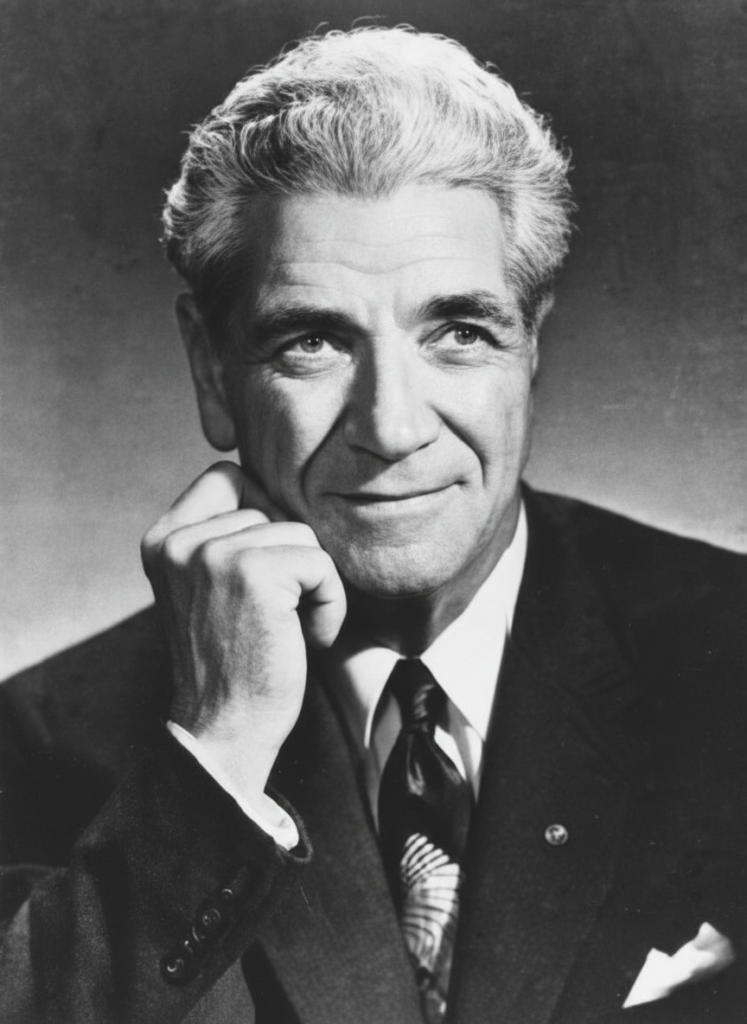
George Adamski before the Venusians
The data on Adamski’s life before 1952 is extensive and fairly consistent across friendly and critical sources.
- Born 17 April 1891 in Bromberg, then in the German Empire, he emigrated to the United States as a child and grew up in New York. (Wikipedia)
- In the 1920s and 1930s he became involved in occult and Theosophical circles in California and founded the “Royal Order of Tibet”, a small esoteric group blending Eastern-sounding teachings with Western esotericism. (Department of Physics)
- By the late 1930s his community had relocated to the slopes of Mount Palomar, where they operated the Palomar Gardens Café and a small campground and maintained a private “observatory” with a 15-inch telescope and a portable 6-inch Newtonian reflector. (Department of Physics)
Adamski’s first foray into space-themed storytelling was not “non-fiction” but a 1949 science-fiction novel titled “Pioneers of Space: A Trip to the Moon, Mars and Venus”.
The book follows explorers who discover advanced, human-like civilizations on nearby planets, whose philosophical and spiritual teachings closely mirror Adamski’s own earlier “Royal Order of Tibet” doctrines. (Department of Physics)
From 1946 onward he also began reporting telescopic sightings of large “cigar-shaped” and disc-like craft over Palomar Gardens and started photographing them through his telescopes. His first national exposure came in a 1951 issue of Fate magazine, which showcased some of these early photos. (Department of Physics)
By 1952, therefore, Adamski was already:
- A minor regional lecturer on saucers and metaphysics
- A self-styled “professor” with a small spiritual following
- A photographer of anomalous or at least unusual aerial images
The Venusian contacts did not arrive in a vacuum. They amplified an existing personal mythos that already connected nearby planets, enlightened teachers and advanced craft.
The photographs that made a movement
Although the November 1952 contact in the desert is the narrative centerpiece, Adamski’s photos arguably did more to cement his status.
Key data points:
- Adamski claimed to have taken his most famous “Venusian scout ship” photograph on 13 December 1952 through his 6-inch telescope at Palomar Gardens. (Wikipedia)
- By Adamski’s count, he released sixteen photographs and illustrations of scout ships and larger mother ships by 1955, many of them reproduced in “Inside the Space Ships”. (The Great Republic)
- The images show a structured, bell-shaped craft with portholes and three rounded “landing spheres” beneath the hull, sometimes with light reflections apparently coming from these spheres.
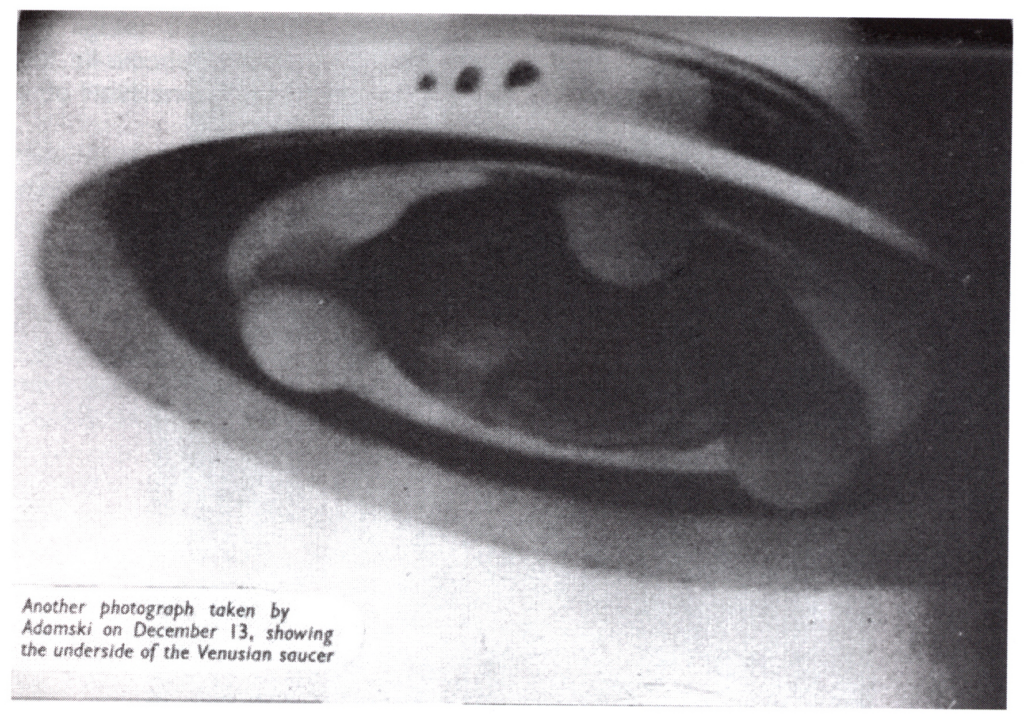
Supporters and Adamski himself frequently cited early, positive evaluations of the photos. He claimed that J. Peverell Marley, a prominent Hollywood cinematographer, and experts from the J. Arthur Rank film company had examined the originals and found no evidence of fakery.
Later investigations complicated that picture:
- In 1953 ufologist James W. Moseley interviewed Marley, who denied having done the detailed analyses Adamski attributed to him or having found a “spaceman” in the enlargements.
- German rocket engineer Walther Riedel told Moseley that microscopic examination showed the “landing spheres” to be ordinary light bulbs and that he could even make out the “GE” logo on at least one of them.
- Later photographic comparison work by researchers such as Joel Carpenter suggested the main saucer body was visually identical to the reflector shade of a commercially available 1930s pressurized-gas lantern.
- Other analyses noted that the object resembles the top of a chicken brooder or a street light, which fits with the visible hardware elements in some prints. (Kiddle)
By the 2000s and 2010s, Adamski’s photos routinely appeared in surveys of classic photographic hoaxes, with consensus among most technical reviewers that the images depict small, nearby models rather than large, distant craft. (New Space Economy)
Even so, for the 1950s audience the photos had immense evidentiary weight. They appeared to show crisp, structured machines against the sky at a time when home darkrooms were rare and compositing was nontrivial. They circulated as 8×10 glossy prints at Palomar Gardens and as plates in his books and became the visual template for “scout ships” in comics, pulp covers and contactee art worldwide. (Department of Physics)
20 November 1952: the Desert Center encounter
The core Venusian contact story begins on 20 November 1952 in the Colorado Desert near Desert Center, California.
The witness group and location
According to Adamski’s own account and later reconstructions, the party included: (Chapman University Digital Commons)
- George Adamski
- His secretary, Lucy McGinnis
- Alfred and Betty Bailey of Winslow, Arizona
- George Hunt Williamson (a fellow contactee) and his wife Betty
- Alice K. Wells, a Palomar Gardens associate
Newspaper reports and later testimonies place the site roughly ten miles from Desert Center, on the road toward Parker, Arizona, in open desert with low hills and ravines nearby. (Newspapers)
If you plot the route from Palomar Gardens to Desert Center on a map, you sketch a southwest-to-northeast line from the Palomar foothills out toward the Colorado River corridor. The Desert Center site sits along a sparsely populated stretch of U.S. Route 60/70 (now I-10), bounded by low ranges that match surviving photographs of the landscape. (Denver Public Library)
The sighting and Adamski’s approach
As the group parked and set up telescopes to look for UAP activity, several witnesses reported a large, cigar-shaped craft hovering high in the sky. Adamski interpreted this as a “mother ship” searching for him specifically. In “Flying Saucers Have Landed” he recalls shouting to McGinnis:
“Take me down the road, quick! That ship has come looking for me, and I don’t want to keep them waiting!” (Denver Public Library)
McGinnis reportedly drove him a short distance away and dropped him off. He then walked alone into a shallow ravine, carrying a camera and tripod.
According to the combined witness accounts:
- The remaining six witnesses stayed behind at a distance estimated between 100 and 200 yards, occasionally watching Adamski through binoculars.
- They observed a small disc-like object in the vicinity and could see Adamski apparently interacting with someone, though without enough resolution to see features.
No one besides Adamski claimed a close-range, face-to-face interaction with the alleged entity.
Orthon, the Venusian
Adamski described the visitor as follows:
- Medium height, youthful, with long blond hair and tanned skin
- Wearing a one-piece suit and reddish-brown footwear that left unusual symbols in the sand
- Communicating via a mixture of telepathy and expressive hand gestures
- Identifying himself as from Venus and named (by Adamski) “Orthon”
The core content of the alleged telepathic exchange was a warning about nuclear testing and the danger posed to Earth and nearby planets by atomic weapons. Adamski later framed Orthon and his people as “Space Brothers” concerned with humanity’s spiritual evolution and the need for peace.
Two specific data points have often been highlighted:
- Orthon reportedly refused to be photographed, motioning that cameras were not appropriate. Instead he asked for a photographic plate, which Adamski said he gave him. Weeks later, Adamski claimed that a developed plate mysteriously returned to him contained “strange symbols”, treated as a written message.
- After the craft departed, Williamson and others said they made plaster casts of the footprints, which showed intricate patterns that Adamski associated with a Venusian sigil. (Alien Species)
The photographs that later became famous were not, by Adamski’s own story, taken at this moment on the desert floor. Instead he said he captured Orthon’s scout ship several weeks later when it flew over Palomar Gardens and he photographed it through his telescope.
From a strict data standpoint, the November contact can be broken down as:
- Multiple-witness sighting of an aerial object of some kind at distance
- Single-witness claim of close contact with a humanoid entity
- Multi-witness observation of Adamski interacting with “someone” or something far away
- Physical trace claims (footprints, plaster casts, symbolic script) without surviving, publicly testable originals
Publications and public appearances, 1953–1955
The Venusian contacts did not stay in the desert. They were quickly translated into print, lectures and, eventually, geopolitically awkward royal audiences.
“Flying Saucers Have Landed” (1953)
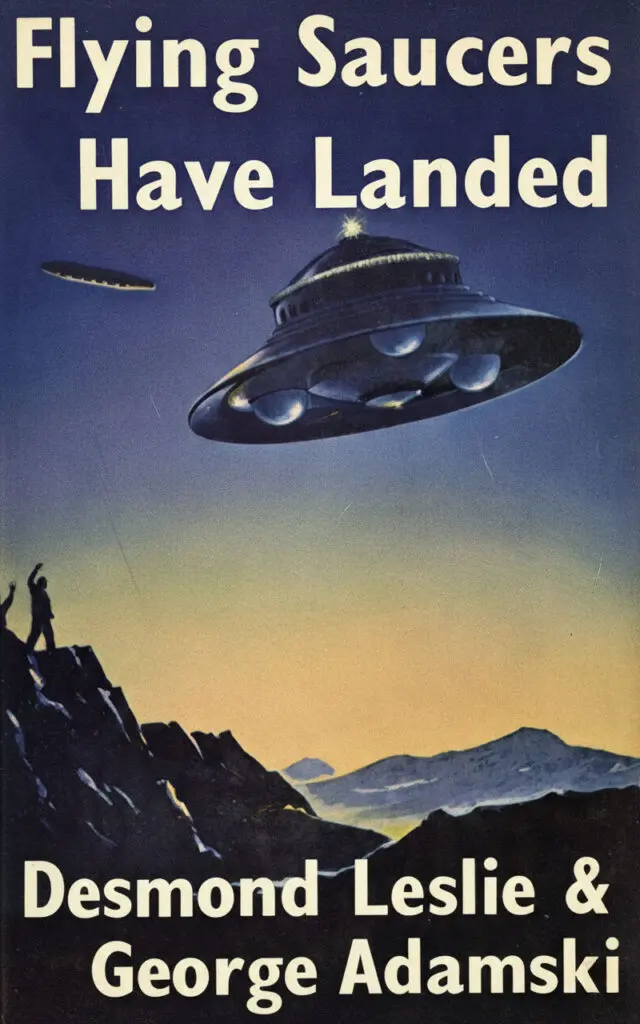
Co-authored with Irish writer Desmond Leslie, “Flying Saucers Have Landed” combines two quite different texts. Leslie’s long introductory section surveys anomalous aerial phenomena in religious, mythic and historical sources, influenced by Theosophy and “ancient astronaut” ideas. Adamski’s portion, by contrast, is a narrative of his Palomar sightings and the Desert Center meeting with Orthon. (Baha’i Studies)
Key data points:
- First published in 1953, the book became a commercial success, and together with Adamski’s later “Inside the Space Ships” sold around 200,000 copies by 1960. (University of Southern Mississippi)
- It introduced millions of readers to the idea of Nordic-type “Space Brothers” from Venus and Mars and strongly emphasized nuclear disarmament and spiritual renewal.
Visually, “Flying Saucers Have Landed” also disseminated the first of the scout-ship images, which soon appeared in newspapers and magazines worldwide.
“Inside the Space Ships” (1955)
In 1955 Adamski released “Inside the Space Ships”, which expands the story dramatically. He now claimed: (The Great Republic)
- Orthon had arranged further meetings after 1952
- Adamski had been taken aboard Venusian, Martian and Saturnian scout ships and mother ships
- He had traveled through space and visited the far side of the Moon, as well as Venus and other planets
- He had received extended philosophical teachings from a “Master” said to be nearly a thousand years old
The book includes additional photos and drawings of alleged craft interiors and more stylized mother ships, presented as documentation of these voyages. Later critics pointed out that many of the space-travel descriptions closely echo episodes from “Pioneers of Space”, suggesting that the earlier fiction served as a template for the “non-fiction” journeys.
Early media appearances and the road to royal palaces
From late 1953 onward Adamski embarked on intensive lecture tours across the United States, speaking at civic halls, metaphysical centers and UAP conferences such as the Giant Rock gatherings. (Department of Physics)
By 1959 he was on a world tour that included Australia, Europe and South Africa. During the European leg he was invited to an audience with Queen Juliana of the Netherlands, which took place in May 1959 and was widely reported at the time. The Dutch government reportedly expressed concern, but the Queen proceeded, later remarking that “a hostess cannot slam the door in the face of her guests”. (The GEORGE ADAMSKI Case)
Although these high-profile contacts fall just outside the 1952–1955 window, they illustrate the speed with which a desert contact story moved into diplomatic space. Adamski’s narrative was persuasive enough, or at least culturally compelling enough, to bring a claimed Venusian emissary’s human spokesperson to royal and, later, Vatican circles. (Denver Public Library)
Evaluating the data: a structured look
UAPedia takes a data-first approach. That means separating personality and belief from what we can actually count, test and cross-reference.
Timeline snapshot, 1949–1955
| Year | Event | Data type |
|---|---|---|
| 1949 | “Pioneers of Space” published, depicting human life on Venus, Mars and Moon | Textual fiction, later used for comparison (Project Gutenberg) |
| 1951 | Adamski saucer photos appear in Fate magazine | Photographs, press coverage (Department of Physics) |
| 20 Nov 1952 | Desert Center sighting and alleged Orthon contact | Multi-witness UAP sighting, single-witness close encounter (Wikipedia) |
| 13 Dec 1952 | Scout-ship photos taken through telescope at Palomar, according to Adamski | Photographs, later expert criticism (Wikipedia) |
| 1953 | The book “Flying Saucers Have Landed” becomes a bestseller | Publishing records, sales est. 200,000 by 1960 (University of Southern Mississippi) |
| 1953–1954 | Adamski lecture circuit expands across the US | Press reports, lecture flyers, later biographies (Department of Physics) |
| 1955 | “Inside the Space Ships” published, detailing trips to Venus, Mars, Saturn | Book, 16 photos, narrative continuity with 1949 novel (The Great Republic) |
This timeline already shows one key analytical point. Claims about habitable Venus, Moon cities and peaceful planetary federations appear first in admitted fiction, then re-emerge as asserted fact. That does not automatically falsify them, but it does shift the burden of proof.
Planetary habitability: Venus as a test case
Adamski insisted that Venus was home to human-like beings living in cities among forests and oceans. Later he claimed to have visited this world physically.
Modern planetary science presents a very different Venus:
- Surface pressure approximately 92 times Earth’s
- Atmosphere primarily carbon dioxide, with sulfuric acid clouds
- Average surface temperature around 464 °C
- No evidence of a breathable atmosphere, liquid water oceans or surface biosphere compatible with human life
These conditions are drawn from decades of space probe measurements and are summarized in almost any modern astronomy reference.
From a strict empirical standpoint, this makes literal, surface-dwelling human Venusians extremely implausible. Supporters sometimes respond that “Venus” might be a cover name for an exoplanet or that beings could inhabit higher, cooler cloud layers. These reinterpretations are interesting, but there is no sign in Adamski’s own 1950s texts that he meant anything other than our physical neighboring planet.
Speculation label: Hypothesis
Some contemporary researchers treat the planetary attributions in contactee narratives as coded references to nonlocal intelligence or interdimensional regions rather than literal Solar System bodies. This re-reading keeps the contact content while discarding outdated astronomy. It is a hypothesis about symbolism, not a claim supported directly by Adamski’s words.
Testimony patterns
The Desert Center event gives us several classes of testimony:
- Six witnesses who affirm seeing a large aerial object and later a smaller one, plus Adamski interacting with “someone” at a distance
- One primary witness (Adamski) claiming detailed, face-to-face interaction with a named entity
- Secondary claims about plaster casts and returned photographic plates
Notably:
- The corroborating witnesses did not themselves report clear observation of a humanoid. Their distance and vantage point limited them to describing shapes and the fact of Adamski’s interaction. (Department of Physics)
- Affidavits exist that support Adamski’s general account, but these were produced within his circle of belief and do not include high-resolution physical evidence for the entity itself. (Chapman University Digital Commons)
This pattern is common in contact narratives. The experiencer has the close-in details and the group provides a lower-resolution contextual frame. It is consistent with a real encounter that not everyone sees well, but it is also consistent with a staged event in which only one person approaches a prepared prop.
Speculation label: Witness Interpretation
Some of the supporting witnesses later built their own contactee careers or remained within Adamski-aligned spiritual circles. Their initial observations may have been colored, on later retelling, by shared cosmology and loyalty. That does not negate their sincerity, but it does limit evidentiary weight.
Photographic evidence in context
As noted earlier, there is now broad technical agreement that the scout-ship photos are very likely images of small, close objects such as light fixtures or lantern parts, rather than large craft in the sky.
From a data-science perspective, this does several things:
- It significantly lowers the probability that the Palomar photos document non-prosaic craft.
- It raises the prior probability that Adamski was willing to stage or enhance “evidence” in service of a message, whether he considered that justified or not. (Department of Physics)
- It means that later, less well-documented claims by Adamski generally require stronger independent corroboration than they might otherwise.
At the same time, the intense public reaction to the images illustrates how visual data, even when later undermined, can seed long-lasting archetypes that shape subsequent authentic experiences and reports. Many later witnesses described UAP that resembled Adamski-style craft, either because they actually saw similar objects or because cultural expectation shaped their memory and language.
Speculation label: Researcher Opinion
Some analysts argue that non-human intelligences may deliberately co-opt human visual tropes, including earlier fictional or hoaxed imagery, to communicate within our symbolic vocabulary. Under this lens, the persistence of Adamski-type discs in later reports is not automatically evidence that Adamski’s specific photos are genuine, but it might indicate a feedback loop between media imagery and whatever is behind a subset of UAP manifestations. This is an interpretive framework rather than a directly testable claim here.
Cultural, religious and policy implications
Even if we bracket the literal truth of Venusian cities and Saturn conferences, the Adamski case had measurable impacts across several domains.
Religious and spiritual cross-currents
Scholars of religion such as Michael Barkun and Christopher Partridge have pointed out how closely Adamski’s “lessons from the Space Brothers” mirror his pre-saucer Theosophical and occult teachings.
Key continuities:
- An emphasis on a “Creator of All” accessible through inner development rather than dogmatic religion
- A hierarchy of advanced beings guiding human evolution
- A blending of Eastern and Western metaphysical concepts
Historically, Adamski’s books and lectures helped push this blended worldview into the mainstream and are often cited as early seeds of what later became the New Age movement. (Denver Public Library)
Sociological footprint: the contactee movement
Sociologist Christopher Bader’s study “The UFO Contact Movement from the 1950’s to the Present” treats Adamski as the founding case in a wave of contactees that included Truman Bethurum, Daniel Fry, Orfeo Angelucci, Howard Menger and others. (Chapman University Digital Commons)
Data points that demonstrate scale:
- Multiple annual “Spacecraft Conventions” at Giant Rock in California, drawing thousands at their peak
- A proliferation of contactee books, newsletters and tape-recorded “messages”
- Emergence of small groups and proto-religions organized around specific contactee teachings
Bader notes that the early contact movement focused on benevolent, human-like visitors giving spiritual instruction, in contrast to later abduction narratives that emphasize fear and invasive procedures. That shift in “who the aliens are” is crucial when modeling UAP experiences as a cultural system. Adamski stands at the root of the optimistic branch. (Chapman University Digital Commons)
Policy and perception
Adamski’s claims posed an early challenge to both scientific and governmental narratives.
- Project Blue Book’s scientific consultant J. Allen Hynek and other Air Force-aligned reviewers dismissed his photos as crude fakes, adopting them as textbook examples of unreliable evidence. (HISTORY)
- Serious civilian investigators such as Donald Keyhoe considered the contactee wing an embarrassment that threatened to discredit more evidential radar and pilot cases. (Reasons to Believe)
Yet the fact that a European monarch invited Adamski to discuss his experiences shows that, at least briefly, his narrative penetrated even high policy circles as a lens for thinking about humanity’s place in the cosmos. (HISTORY)
From a modern disclosure perspective, the Adamski era is a reminder that information ecosystems around UAP have always included charismatic, data-light but emotionally powerful stories alongside more instrumented cases. Future policy will have to manage that mix rather than pretending it does not exist.
Claims taxonomy
- Appearance of an anomalous aerial object near Desert Center, California on 20 November 1952, witnessed by seven people.
- Evidence: Multiple testimonies, internal consistency on general description, but no independent sensor data or photographs from that specific moment.
- Assessment: Disputed
- Close encounter between Adamski and a humanoid entity named “Orthon” from Venus.
- Evidence: Single-witness detailed narrative; corroborating witnesses at distance; philosophical content aligns with Adamski’s prior teachings; planetary origin conflicts with modern Venus data.
- Assessment: Legend
- Scout-ship and mother-ship photographs depict technologically advanced craft of unknown origin.
- Evidence: Numerous photos; chain of custody largely within Adamski’s control; later technical analyses indicate small models, probable use of light-fixture parts and chicken brooder components; contradictory “expert endorsement” claims.
- Assessment: Hoax / Misidentification
- Physical travel by Adamski aboard Venusian, Martian and Saturnian craft, visiting habitable surfaces of these planets between 1952 and 1955.
- Evidence: Self-report in “Inside the Space Ships”; strong narrative overlap with 1949 science-fiction novel; planetary conditions now known to be incompatible with human life as described. (The Great Republic)
- Assessment: Legend / Hoax
- “Space Brother” spiritual message emphasizing nuclear disarmament, ecological care and spiritual unity originated from a non-human intelligence rather than from Adamski’s own prior beliefs.
- Evidence: Content continuity with Royal Order of Tibet doctrines; strong fit with Theosophical and 1950s pacifist concerns; later resonance in New Age currents independent of Adamski. (Department of Physics)
- Assessment: Disputed
Overall case rating
Taking all components together, UAPedia assigns the Adamski Venusian contact narrative this overall classification:
- Case status: Disputed
There is substantial evidence that specific physical “proofs” were fabricated or misrepresented, and key astronomical claims are incompatible with well-established planetary science. At the same time, the case has had major historical influence, and there remains a small but persistent corpus of researchers and experiencers who defend at least some aspects as genuine contact.
Speculation labels
Hypothesis
- The idea that “Venus” and other planetary labels in contactee lore may function as symbolic or coded references to nonlocal realities rather than literal Solar System worlds.
Witness Interpretation
- The way Adamski’s co-witnesses framed their observations in light of shared spiritual expectations.
Researcher Opinion
- The suggestion that non-human intelligences, if real, might co-opt human-generated imagery and hoaxes as part of a feedback-based “control system” that shapes perception, as some Vallée-inspired frameworks propose.
References
Adamski, G. (1953). Flying saucers have landed (with D. Leslie). London: Werner-Laurie.
Example edition (University of Southern Mississippi)
Adamski, G. (1955). Inside the space ships. New York: Abelard-Schuman.
Publisher details and contents summary at AbeBooks listing (AbeBooks)
Adamski, G. (1949). Pioneers of space: A trip to the Moon, Mars and Venus. Los Angeles: Professor George Adamski. Public domain text available via Project Gutenberg.
Online text (Project Gutenberg)
Bader, C. (1995). The UFO contact movement from the 1950s to the present. Sociology of Religion, 56(2), 163–180.
Archived PDF via Chapman University. Abstract and access page (Chapman University Digital Commons)
Daugherty, G. (2020, January 9). George Adamski got famous sharing his UFO photos and alien “encounters”. History.com.
Article (HISTORY)
“George Adamski.” (n.d.). Wikipedia.
Entry (Wikipedia)
Kiddle Encyclopedia. (2025). George Adamski Facts for Kids.
Entry (Kiddle)
“UFO photographs.” (n.d.). Wikipedia.
Entry (Wikipedia)
“The man who met a Venusian (allegedly).” (2022, August 30). Denver Public Library Western History blog.
Article (Denver Public Library)
“The Netherlands: The Queen & the Saucers.” (1959, June 1). Time magazine.
Archived summary via Time. Article (TIME)
“Venusians.” (n.d.). Encyclopedia MDPI.
Entry (Encyclopedia)
The Adamski Case. (n.d.). World tour and Vatican visit pages.
World tour 1959 (The GEORGE ADAMSKI Case)
UT Austin Physics. (n.d.). George Adamski profile.
Profile page (Department of Physics)
SEO keywords
George Adamski, Venusian contact, Orthon, Desert Center 1952, contactee movement, Space Brothers, Inside the Space Ships, Flying Saucers Have Landed, Palomar Gardens, classic UAP contact experiences, UAP history, 1950s saucer era