
Read time:
Last Update:
Picture a future grad student in a sleek field-research pod, dialling in coordinates not to another star, but to Arizona in 1977 or Belgium in 1989. She is not an alien. She is us, a descendant running a long-baseline anthropology experiment on her own species.
That is the core of the Anthropological Time-Travel Hypothesis. It claims that at least some UAP and their occupants are not extraterrestrials or interdimensional entities, but humans who have mastered practical time travel and come back for research, tourism or intervention.
In mainstream physics, travel into the future is already baked into relativity. Travel to the past is harder. It requires exotic spacetime geometries such as wormholes or closed timelike curves, which are mathematically allowed in general relativity but appear to demand impossible energies or matter with negative energy density.
Within UAP studies, the time-travel idea has gone from a fringe speculation in the 1970s to a coherent anthropological model in the 2010s, largely due to one academic: Dr Michael P. Masters.
This article takes a data-first look at how the hypothesis formed, what evidence it draws on, what critics say and where it sits in UAPedia’s claims taxonomy.
From H. G. Wells to “extratempestrials”: a short history
Literary and scientific antecedents
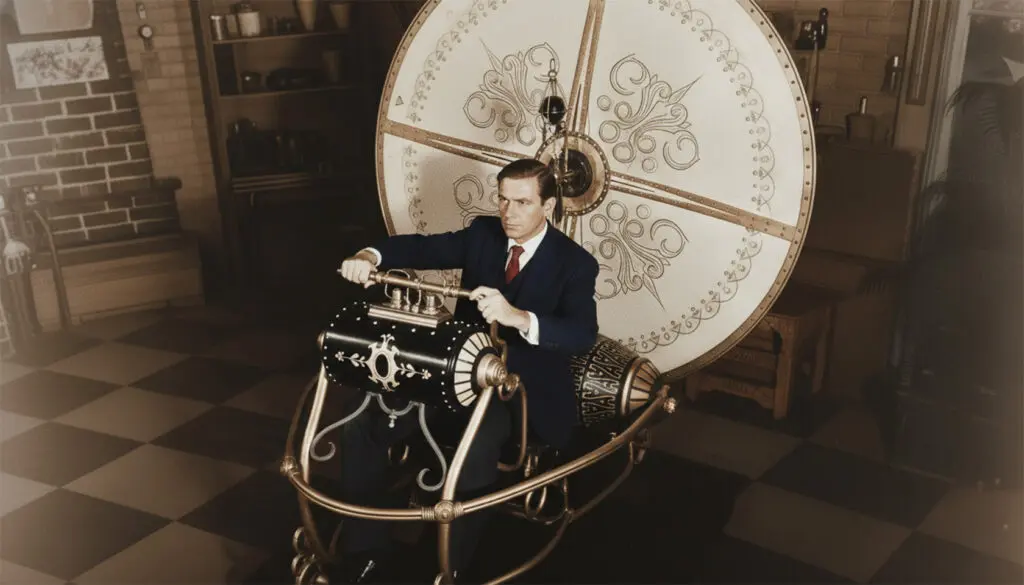
Time travel from the future into the past appears in nineteenth-century fiction before it appears in science. French scientist Pierre Boitard imagines a man sent to prehistoric Earth in 1861, while H. G. Wells’ 1895 novella The Time Machine becomes the template for future human evolution and temporal tourism.
By the mid-twentieth century, general relativity has matured into a framework where time is a dimension of spacetime:
- J. Richard Gott’s Time Travel in Einstein’s Universe (2001) surveys how near-light travel, cosmic strings and specific cosmological solutions might permit time travel within Einsteinian physics. (Lyon College Online Bookstore)
- Kip Thorne’s Black Holes and Time Warps (1994) popularizes wormholes and their possible use as time machines, though he stresses the extreme engineering challenges. (Wikipedia)
- Paul Nahin’s Time Machines (2001) maps the landscape of time travel in physics, metaphysics and science fiction, including paradoxes and self-consistency conditions. (Google Books)
The upshot is clear. Physics does not rule out certain forms of backward time travel in principle, but the practical constraints make it deeply speculative.
Early UAP-linked time-travel ideas
The idea that “aliens” might actually be time travellers appears sporadically in twentieth-century UAP discourse:
- Jacques Vallée wrote in 1975 that if time and space are more complex than assumed, asking “where do they come from” might be meaningless and that they could come “from a place in time”.
- Contactee and abduction lore increasingly features humanoid entities with oddly familiar features, which some authors argue are easier to explain as modified humans than as convergent alien evolution.
By the late 1990s, books like Jenny Randles’ Time Storms and James Herbert Brennan’s Time-travel: A New Perspective explicitly connect UAP, time anomalies and temporal visitors.
In 1998, Philip Corso and William Birnes reported that rocketry pioneer Hermann Oberth speculated the Roswell craft might have been a time machine.
These are scattered clues rather than a coherent theory. That arrives with Masters.
Michael P. Masters and the “extratempestrial model”
Dr Michael P. Masters is a biological anthropologist at Montana Technological University who specializes in hominin evolution. In 2019 he self-published Identified Flying Objects: A Multidisciplinary Scientific Approach to the UFO Phenomenon, which argues that UAP occupants are “our distant human descendants, returning from the future to study their own hominin evolutionary past”. (Digital Commons)
In 2022 he followed with The Extratempestrial Model, refining and extending the argument. (ResearchGate)
Key pillars of Masters’ case
Morphology of reported entities
Masters notes that the classic “Grey” archetype is bipedal, upright, bilaterally symmetrical, with a large cranium, reduced face, large eyes and small mouth. He argues that this aligns with long-term trends in human evolution such as increasing brain size, facial flattening, reduced dentition and a shift toward paedomorphic (more juvenile) traits in adults. (ResearchGate)
He suggests that continuing technological mediation of our environment, indoor living and perhaps future genetic engineering could accentuate these trends, yielding something very much like abduction-report entities.
Anthropological fieldwork analogy
Masters frames UAP encounters as time-directed fieldwork: future researchers conducting participant-observation, sampling and longitudinal studies of ancestral populations at key historical inflection points. (Digital Commons)
From this view, abduction narratives involving medical procedures, reproductive sampling or information downloads look less like random predation and more like formal research protocols mapped badly into our cultural vocabulary.
Technological convergence
He notes that UAP performance characteristics such as silent propulsion, extreme acceleration and apparent manipulation of spacetime may be more naturally reachable by a technological civilization that continues on our path for centuries, compared with an unrelated species starting from different biology and engineering constraints. (Digital Commons)
Temporal motives
Masters and sympathetic commentators outline likely motives for such time travel:
- Paleoanthropological research on hominin evolution and cultural transitions.
- Tourism or “heritage trips” to famous epochs and events.
- Intervention to prevent catastrophic outcomes, for example ecological collapse or nuclear war.
He coins the term “extratempestrial” to emphasize time rather than space as the key axis and explicitly positions his model as a subcategory of interdimensional hypotheses, where moving to the past may also involve shifting timelines or branches.
The broader “Time-Traveler UAP Hypothesis” in ufology
The proposal that UAP are humans traveling from the future using advanced technology has been discussed by figures including retired NASA engineer Larry Lemke, US congressman Mike Gallagher and filmmaker Steven Spielberg.
Media coverage has amplified this:
- Space.com ran a 2020 feature titled “Are the aliens us? UFOs may be piloted by time-traveling humans”, summarizing Masters’ ideas and quoting his caution that the model is one hypothesis among several. (Space)
- Futurism, Popular Mechanics and other outlets have framed the concept as a thought experiment that might be “no stranger than the extraterrestrial hypothesis” given the humanoid nature of many reported entities. (Futurism)
Within ufology, former MUFON executive director Jan Harzan used “time-traveler hypothesis” as an umbrella term for Masters’ “extratempestrial” model and related ideas.
Harold Puthoff, in his “Ultraterrestrial Models” paper, lists time travellers as one of several non-standard possibilities for UAP, overlapping with interdimensional and cryptoterrestrial ideas.
This shows how the anthropological time-travel idea is now one node in a web of alternative explanations that try to interpret humanoid entities without invoking classic extraterrestrial visitors.
What data does the hypothesis actually appeal to?
A data-first approach asks: what observations look different if we assume the visitors are future humans?
Humanoid bias in entity reports
Abduction and close-encounter literature shows a strong bias toward humanoid entities, especially in the “Grey” archetype. Evolutionary biologists like Stephen Jay Gould and Jack Cohen have argued that this is extremely unlikely as a convergent outcome on a truly alien world.
Masters and other time-travel advocates flip the problem. They say the easiest explanation for humanoid entities is that they are human or post-human, not that evolution has produced near-humans elsewhere.
Critics respond that witness and cultural bias can easily push unknown entities into human-like templates, so humanoid reports cannot carry much weight on their own.
Abduction procedures
When abduction narratives are coded by folklorists and psychologists, recurring motifs include:
- Physical examination and medical procedures.
- Reproductive interventions and hybridization themes.
- Communication via telepathy or downloads of information.
Masters treats these as consistent with research protocols for biological sampling, reproductive health and cognitive testing of ancestral populations by future fieldworkers. (ResearchGate)
Skeptics counter that they are equally compatible with psychological archetypes, medical anxieties and sleep-paralysis hallucinations. This is a classic case where the same dataset supports very different interpretive frameworks.
Spatial and temporal clustering of UAP events
Time-travel advocates sometimes note that UAP flaps tend to cluster around:
- Periods of technological transition, such as the post-World War II era and the nuclear age.
- Geopolitical hotspots and test ranges.
- Culturally symbolic sites, from ancient monuments to modern mega-events.
Masters and others suggest that these might be “fieldwork hotspots” chosen by future researchers. (Medium)
However, UAP reporting also correlates strongly with media coverage, war jitters and radar deployments, which offers more prosaic explanations for clustering.
No obvious future tourists
One powerful negative data point remains. Despite decades of UAP reports, we do not see casual future tourists on every street corner, which some physicists expect if time travel to our era becomes cheap and common.
Advocates reply with several possibilities:
- Time travel may be expensive and tightly controlled.
- Paradoxes may enforce self-consistency or branching timelines that restrict interventions.
- We may misinterpret time travellers as UAP occupants, “angels” or other phenomena, a possibility Carl Sagan once raised in a PBS interview.
Physics reality check: can future humans actually come back?
A serious investigative piece has to ask whether the required technology is physically possible.
Time travel to the future is trivial
Special relativity guarantees that clocks moving at high speed or in strong gravitational fields run slower than ones at rest. Astronauts who spend months in orbit already experience microseconds of extra time. This is uncontroversial.
A sufficiently advanced spacefaring civilization could use near-light travel to “jump” forward decades or centuries. This does not help them visit us from the future. It just lets us visit their future.
Time travel to the past is hard but not forbidden on paper
General relativity admits solutions with closed timelike curves (CTCs), where an object’s worldline loops back to its own past:
- Rotating black holes and Gödel’s rotating universe are classic examples.
- Wormholes, if they can be created and stabilized with exotic matter, can in principle be turned into time machines by accelerating one mouth relative to the other.
- Recent work has modelled how macroscopic objects might behave on CTCs without obvious paradox, though this remains highly theoretical. (arXiv)
Physicists like Ronald Mallett have proposed ring-laser devices that twist spacetime into loops, but independent analyses suggest the required energies and scales are far beyond practical reach. (Popular Mechanics)
In short: the laws of physics do not conclusively ban backward time travel, yet they make it extraordinarily difficult to realize.
Quantum and multiverse loopholes
Some time-travel advocates lean on quantum ideas:
- The many-worlds interpretation offers one way to avoid paradoxes: traveling to the past moves you into a different branch of the timeline.
- Novel quantum gravity models are still emerging, and some might change what is feasible in extreme spacetime engineering. (arXiv)
Time-travel believers sometimes push these open questions as permission to posit arbitrarily advanced future technologies. Critics argue that this is a leap from “not disproven” to “therefore likely,” which is not justified.
Speculation label: Hypothesis. Relativistic and quantum models leave a small opening for engineered time travel but no roadmap for building such devices.
Experts and critics: who thinks what?
Supportive or open-minded voices
- Michael P. Masters: Treats the extratempestrial model as “the best explanation” for certain aspects of UAP, especially humanoid occupants, while acknowledging that the data remain ambiguous. (Digital Commons)
- Harold Puthoff: Lists time travellers as one possibility in his “Ultraterrestrial Models” paper and suggests that UAP might exploit physics we only dimly understand.
- Carl Sagan: In a PBS interview he speculated that if time travel is possible, time travellers might already be here under other labels such as “UFOs or ghosts”, without endorsing any specific case.
Mainstream media pieces by Leonard David, Caroline Delbert and others treat the hypothesis as an intriguing but unlikely alternative to extraterrestrial visitors. (Space)
Skeptical assessments:
- Neil deGrasse Tyson has referred to the time-traveller UAP idea as illogical, arguing that it compounds unknowns and ignores the lack of clear evidence for any form of time travel. (Wikipedia)
- Robert Sheaffer, a long-time UAP skeptic, criticizes Masters’ work for depending on the assumption that time travel is already real rather than possible in principle. (Wikipedia)
- Fabio Costa, a quantum physicist, told Popular Mechanics that backward time travel requires a “door in the future and one in the past” and that people from the future cannot visit us unless such a machine already exists, which raises the question of where that initial machine is. (Wikipedia)
Science writers like David J. Darling and others categorize both extraterrestrial and time-travel interpretations as “highly unlikely and unnecessary” given the lack of compelling evidence that any UAP are artificial craft at all.
UAP-focused skeptics on platforms like Metabunk argue that the hypothesis is unfalsifiable in practice, since any anomaly can be explained as an unseen future technology. (Metabunk)
Speculation label: Researcher Opinion and critical analysis. There is no consensus; the hypothesis is broadly viewed as unorthodox or pseudoscientific in academic circles.
How the hypothesis colonizes our visual imagination
The Anthropological Time-Travel Hypothesis is sustained not just by books and equations, but by images.
Light-cone diagrams and spacetime art
Popular explainers on spacetime depict future and past light cones rising and falling from a present point. These images, like the ones shown above, offer intuitive “maps” of where time travel might occur by bending or connecting cones.
In UAP media, these diagrams are often juxtaposed with:
- Photographs or illustrations of classic flying-saucer craft.
- Morphing animations of an anatomically modern human into a Grey-like figure.
- Timelines of UAP waves overlayed on world maps and historical events.
Such visuals implicitly argue that UAP clusters mark “fieldwork insertions” by future humans at specific world-historical nodes.
Anthropological imagery: from cave art to abduction sketches
Ancient cave paintings and rock art showing unusual beings are frequently repurposed in documentaries as visual “evidence” of time-travel or ancient-astronaut entities.
Serious archaeologists caution against reading modern narratives into Paleolithic art. These figures likely encode myth, hunt magic or shamanic motifs rather than literal time-travellers.
Modern abduction cases generate their own visual archive:
- Witness sketches of entities and craft.
- Reconstructed scenes based on hypnotic regression.
- Forensic-style diagrams of medical procedures.
Masters mines this imagery as a kind of “future-human concept art” generated through direct encounters, while critics treat it as cultural artefact.
Speculation label: Witness Interpretation for abduction imagery, Hypothesis for time-traveller reinterpretations of ancient art.
How it fits with other UAP origin frameworks
Within UAPedia’s Section G, the Anthropological Time-Travel Hypothesis sits in a crowded field.
- Extraterrestrial Hypothesis (ETH): UAP as craft from other star systems.
- Ultraterrestrial / Inter-dimensional models: UAP as manifestations of non-human intelligences sharing our spacetime or accessing it from adjacent dimensions. (ResearchGate)
- Cryptoterrestrial Hypothesis: UAP as concealed Earth-based intelligences such as hidden human or non-human lineages. (ResearchGate)
The Anthropological Time-Travel Hypothesis has two distinctive claims:
- The intelligences are human or post-human rather than alien.
- Time, not space, is the key separation.
This has philosophical implications that UAPedia will explore in related entries under “Long-term evolutionary and civilizational considerations” and “Impacts on religion and society”.
If UAP are future humans, then:
- They are subject to our ethical frameworks about human rights.
- Their actions raise questions about consent, intervention and the ethics of experimenting on ancestors.
- Our choices today literally shape the beings making those choices tomorrow, closing a moral loop.
Speculation label: Hypothesis and Researcher Opinion. The civilizational implications are large, but entirely dependent on the hypothesis being correct.
Claims taxonomy
1. Time dilation into the future is real and routinely observed.
- Category: Verified
- Evidence: Relativistic time dilation measured in satellites, GPS corrections and high-speed particle experiments. (Wikipedia)
2. General relativity permits mathematical solutions that allow closed timelike curves and theoretical time travel to the past.
- Category: Verified (mathematically)
- Evidence: Gödel metric, rotating black holes, wormhole solutions and recent work on CTCs. (Wikipedia)
3. Practical backward time travel by engineered devices is achievable by human civilization.
- Category: Disputed
- Evidence: Theoretical work by Gott, Thorne, Mallett and others shows no fundamental ban, but energy requirements and quantum-gravity unknowns are enormous. (Lyon College Online Bookstore)
4. Reported UAP occupants are best explained as future humans (extratempestrials) rather than extraterrestrials or other entities.
- Category: Disputed
- Evidence: Masters’ anthropological analysis of humanoid morphology and abduction motifs; opposing views emphasize witness bias and lack of hard physical evidence. (Digital Commons)
5. At least some UAP events represent time-directed anthropological fieldwork conducted by future humans.
- Category: Disputed
- Evidence: Interpretive fit with sampling and observational motifs in close-encounter cases; no independent confirmation. (ResearchGate)
6. The Anthropological Time-Travel Hypothesis is a fully scientific, testable explanation of UAP.
- Category: Disputed tending toward Legend in its stronger forms
- Evidence: Critics highlight unfalsifiability and reliance on speculative technologies; supporters argue that it is constrained by known physics and anthropology, but no decisive tests exist. (Wikipedia)
Speculation labels
Hypothesis
- Engineered wormholes or other structures allow macroscopic time travel to our era.
- UAP flaps cluster around “fieldwork hotspots” selected by future researchers.
- Advanced quantum or multiverse physics permits paradox-free travel and timeline branching.
Researcher Opinion
- Masters’ argument that entity morphology aligns with future human evolution.
- Puthoff and others listing time travellers among ultraterrestrial possibilities.
- Media and commentator suggestions that the time-travel model is no stranger than ETH.
Witness Interpretation
- Abductees and contactees who interpret medical procedures and downloads as actions by future humans.
- Retrospective reading of ancient art and mythology as time-traveller encounters.
References
David, L. (2020, January 20). Are the aliens us? UFOs may be piloted by time-traveling humans, book argues. Space.com. (Space)
Delbert, C. (2023, February 17). Are UFOs just future humans watching us? Popular Mechanics. (Popular Mechanics)
Gott, J. R. (2001). Time travel in Einstein’s universe: The physical possibilities of travel through time. Houghton Mifflin. (Lyon College Online Bookstore)
Masters, M. P. (2019). Identified flying objects: A multidisciplinary scientific approach to the UFO phenomenon. Butte, MT: Masters. (Digital Commons)
Masters, M. P. (2022). The extratempestrial model. Full Circle Press. i (ResearchGate)
Nahin, P. J. (2001). Time machines: Time travel in physics, metaphysics, and science fiction (2nd ed.). Springer. (Google Books)
Thorne, K. S. (1994). Black holes and time warps: Einstein’s outrageous legacy. W. W. Norton. (Wikipedia)
Time-traveler UFO hypothesis. (2024). In Wikipedia. (Wikipedia)
Lomas, T., Case, W., & Masters, M. P. (2023). The cryptoterrestrial hypothesis: A case for scientific openness to a concealed earthly explanation for UAP. Philosophy and Cosmology, 33. (ResearchGate)
SEO keywords
Anthropological time travel hypothesis, time traveler UAP hypothesis, extratempestrial model, Michael Masters future humans, UAPs as time machines, future human evolution and Greys, closed timelike curves UAP, wormholes and time travel, Carl Sagan time traveler quote, Neil deGrasse Tyson UAP time travel criticism, Ronald Mallett ring laser time machine, anthropological fieldwork future humans, UAP abductions time travel, human origin theories UAP, chrononaut UFO hypothesis