
On a quiet August night in 1956, Eastern England’s air defenses did something they almost never do in peacetime: they behaved like it was wartime.
Radar rooms at U.S. and British installations began calling each other with a question that still reads like science fiction, even in a decade saturated with UAP headlines: are you seeing targets moving at extraordinary speed, stopping dead, and then moving again?
The event that followed is now commonly labeled the “Lakenheath-Bentwaters” case, but the investigative heart of the story lives in the Lakenheath radar room and the scramble that followed. It is one of the rare Cold War UAP incidents that combines a paper trail, multiple military witnesses, and the kind of sensor-witness interplay that makes analysts sweat: radar guidance, pilot reactions, and visual reports that do not line up neatly with conventional expectations.
Below is a data-first reconstruction: what is documented, what is claimed, what is disputed, and why Lakenheath remains a benchmark case for modern “multi-sensor” standards.
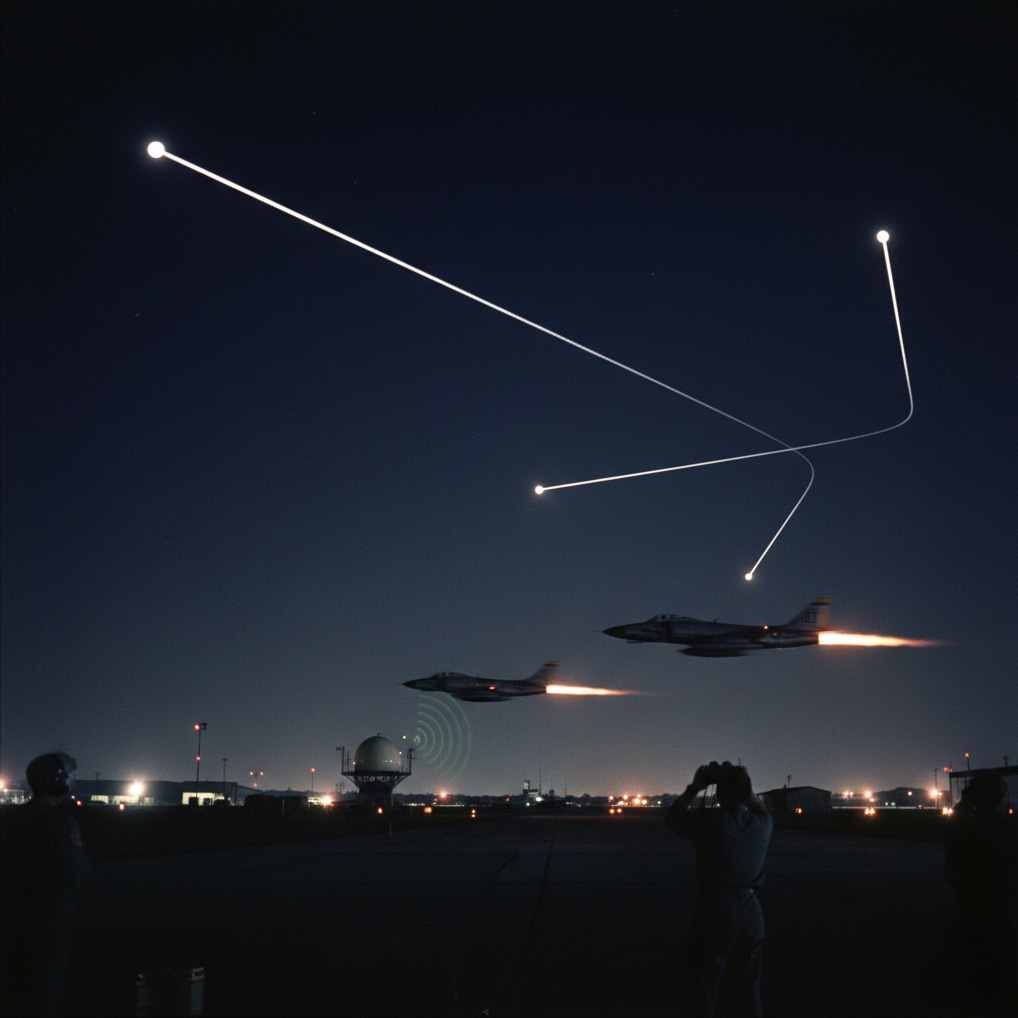
Incident brief
The Lakenheath-Bentwaters incident of August 13–14, 1956, is one of the most well-documented military UFO encounters, involving both radar tracking and visual sightings from ground personnel and pilots. (CIA)
Aircraft Involved
Several military aircraft were involved in the attempt to identify the objects:
- de Havilland Venom: Two RAF Venom night fighters were scrambled from RAF Waterbeach to intercept the objects. One pilot famously reported that the UFO performed a maneuver to get directly behind his aircraft, “tailing” him despite his attempts at evasive action.
- T-33 Shooting Star: Two USAF lieutenants, Charles Metz and Andrew Rowe, took off in a T-33 jet trainer to inspect the initial targets, though they were unable to make contact.
- C-47 Skytrain: A C-47 flying at 4,000 feet over Bentwaters reportedly sighted a fast-moving white light at the same time radar detected a target.
Key Events
Initial Radar Contact: At approximately 9:30 PM, radar at RAF Bentwaters tracked an object traveling at speeds exceeding 1,000 mph – far faster than any aircraft of that era.
The “Mother Ship” Maneuver: A group of 12 to 15 objects was tracked moving toward the northeast; they eventually appeared to converge into a single large radar echo described as several times larger than a B-36 Peacemaker bomber.
Extreme Performance: Targets were tracked at speeds ranging from 2,000 to 12,000 mph, performing sudden stops and rapid accelerations.
Date and location: Night of 13–14 August 1956, over/near RAF Lakenheath and RAF Bentwaters in East Anglia, England.
Witness profile: Military radar operators, ground observers, and aircrew involved in an attempted intercept, with later retrospective accounts adding complexity.
Core documented features:
- radar targets described as showing very high speed, abrupt stopping, and course changes
- visual reports of luminous objects (including reports of two objects “joining”)
- a fighter intercept guided toward a radar target, with a “chase” narrative in at least one major account
Why it matters: The U.S. Air Force–commissioned Condon Committee (whose overall report leaned strongly toward conventional explanations in most cases) treated this case as unusually difficult and, in its case narrative, indicated that ordinary explanations could not be confidently preferred.
The setting
In 1956, East Anglia was a tightly watched slice of NATO geography: coastal approaches, strategic air bases, and overlapping radar coverage. That matters because this isn’t a single witness on a country road. It’s a defense ecosystem: operators trained to distinguish aircraft tracks from weather, clutter, and noise, making real decisions under real constraints.
Two locations anchor the story:
- RAF Lakenheath (Suffolk), the site of the radar room whose watch supervisor later wrote a detailed letter that helped trigger renewed scientific attention.
- RAF Bentwaters (Suffolk), a U.S.-tenanted base roughly 67 km (about 42 miles) from Lakenheath, frequently cited in the early-phase radar narrative.
Schematic distances (approximate, based on published coordinates):
- Lakenheath ↔ Bentwaters: ~67 km
- Lakenheath ↔ Waterbeach: ~29 km
- Bentwaters ↔ Neatishead: ~65 km
What counts as “documentation” in this case
A major strength of the Lakenheath incident is that it is not built from a single narrative source. The modern researcher typically works from four “document pillars”:
- Condon Report Case 2 (USAF/RAF Radar Sighting, 1956)
- includes a detailed narrative and reproduces key materials (including a pivotal witness letter)
- Project Blue Book-era reporting
- referenced across summaries and later technical discussions as a primary case file backbone
- Later UK archival discussion and witness resurfacing
- including references to additional radar-controller testimony (notably Freddie Wimbledon) in National Archives-related material
- Critical and skeptical technical commentary
- especially discussions that argue the case can be “cracked” via radar effects plus misidentified astronomical/meteor phenomena
A UAPedia rule of thumb: treat government paperwork as valuable, not sacred. Here, the best practice is to triangulate official documents with independent technical critique and later witness retrieval efforts.
A very detailed timeline for a UAP incident
Most operational reporting for this case uses Z time (Zulu), effectively UTC/GMT. UK civilian local time in East Anglia on these dates was British Summer Time (BST), UTC+1. In practical terms: BST = Z + 1 hour for 13–14 August 1956. Where a source labels a time “local” or mixes conventions, this timeline keeps the original intent but flags the ambiguity.
Sensors and assets referenced in the primary record
From the redundancy table compiled in later technical review, the incident’s core sensor stack includes:
- RAF Bentwaters GCA radar (AN/MPN-11A)
- RAF Lakenheath RATCC radar (CPS-5)
- RAF Lakenheath GCA radar (CPN-4)
- Airborne interceptor (RAF de Havilland Venom night fighter, with airborne radar referenced as “A-1” in later summaries)
The Blue Book case file also explicitly frames the sources as ground radar observers, ground observers, and pilots, and logs the overall observation windows used by investigators.
Timeline
Monday, 13 August 1956 (evening phase: Bentwaters radar contacts)
~2120–2220Z (reported “local” window in Blue Book summary):
- Project Blue Book’s record-card summary groups Bentwaters activity into a roughly one-hour evening window, stating Bentwaters radar reported multiple separate targets that appeared and disappeared.
2130Z (2230 BST): Bentwaters URE contact No. 1
- Radar: Bentwaters GCA (AN/MPN-11A) logs a first unusual radar echo (“URE”).
- Visual: Not confirmed in the technical redundancy table.
~2135Z–2155Z (2235–2255 BST): Bentwaters URE contact No. 2
- Radar: Bentwaters GCA continues with a second episode lasting about 20 minutes.
- Remarks in later analysis: flagged as the most plausible candidate for anomalous propagation among the Bentwaters episodes, but not treated as definitively explained.
2200Z (2300 BST): Bentwaters URE contact No. 3
- Radar: Bentwaters GCA logs a third URE event.
- Remarks: later summaries note it may be related to, or confused with, the next event (No. 4).
2255Z (2355 BST): Bentwaters URE contact No. 4 with concurrent visuals
- Radar: Bentwaters GCA logs URE No. 4.
- Visual redundancy noted in later review:
- Bentwaters control tower reports a bright light traversing the field rapidly.
- A C-47 aircraft in the area reports a bright light “streaking” beneath it at roughly the same time.
- Interpretive note in the technical table: URE No. 4 is treated as not anomalous propagation, and later reviewers suggest it could have been the same object as the later Lakenheath track (No. 5), though that remains a linkage hypothesis rather than a proven identity.
2130Z–2215Z (2230–2315 BST): unsuccessful interceptor search (US aircraft)
- The University of Colorado “Condon Report” text indicates intercept attempts by an American T-33 in this evening window were unsuccessful.
- A separate Blue Book analytical section also mentions two pilots vectored to the area for a ~45-minute search with no result, and notes a bright astronomical object could have influenced visual impressions in at least one sub-episode.
Context during the evening phase: heightened meteor activity reported
- The Blue Book file explicitly notes that ground observers reported many “shooting stars” during the period.
- Later analysts treated meteor activity as a relevant confound for some visual reports, but it does not directly account for the radar track continuity at Lakenheath later in the night.
Tuesday, 14 August 1956 (after midnight phase: Lakenheath multi-radar track and fighter intercept)
0010Z–0330Z (0110–0430 BST): Lakenheath UAP track No. 5 (primary incident window)
- Later technical reviews and Blue Book summarization converge on this as the core tracking period for the Lakenheath phase, with multiple radar channels involved and an airborne intercept occurring during the track.
Shortly after alerting call: Lakenheath initiates full-scope search using MTI filtering
- In a detailed “sighting letter” preserved in the Blue Book file, the Lakenheath watch supervisor describes receiving an alert call from a regional radar unit reporting an extremely fast target and a coincident visual light report, prompting an immediate sweep with full MTI (moving target indicator).
- The same account emphasizes that MTI should suppress stationary returns, which becomes important because the first Lakenheath contact appears stationary.
Initial Lakenheath contact: stationary radar target ~20–25 miles southwest of Lakenheath
- The watch supervisor reports a stationary echo at about 20–25 miles SW, seen on multiple scopes and confirmed by the Lakenheath GCA unit on a separate radar chain.
- This “stationary then move” structure is also referenced in technical summaries as central to why simple anomalous propagation arguments struggle, since discrete start-stop maneuvers and consistent multi-radar concurrence are atypical for classic AP artifacts.
Abrupt acceleration without “build-up”: ~400–600 mph toward the NNE, then stop
- The Blue Book-preserved Lakenheath account states the target transitions from stationary to ~400–600 mph immediately, without gradual acceleration, traveling toward a point roughly north-northwest of Lakenheath before stopping again.
Repeated maneuver pattern: straight-line runs at ~600 mph, then stationary pauses
Across the next phase, the watch supervisor describes:
- Multiple position changes, always in straight lines
- Typical run speed around ~600 mph
- Run lengths varying roughly 8–20 miles
- Stationary pauses typically 3–6 minutes (reported as variable)
- No consistent “pattern” that would suggest standard aircraft holding procedures
Command escalation: conference line established with higher headquarters
- The same account describes notification up the chain (including 7th Air Division and 3rd Air Force command structures) and the creation of a monitored conference line to coordinate the situation.
Decision to scramble interceptors: approximately 30–45 minutes into the Lakenheath tracking sequence
- The watch supervisor estimates that after roughly 30–45 minutes, it was decided to scramble RAF interceptors.
- Later technical review notes a discrepancy in which base launched the interceptor (one account places it at Waterbeach, another suggests a station “near London”), but both agree on the intercept attempt itself.
Vectoring the first interceptor onto a stationary target
- During vectoring, the target is described as stationary, allowing controllers to issue frequent range/bearing corrections.
- The watch supervisor reports they could not confidently fix altitude but inferred a band roughly above ~1,500 ft and below ~20,000 ft, tied to radar operational characteristics and coverage assumptions.
Close approach and “gun lock”: interceptor reports a lock at ~0.5 mile
- The interceptor is guided to within about half a mile, at which point the pilot reports he has his gunsight or fire-control radar locked.
- Seconds later, he reports the target “went” somewhere, asking ground control if it is still present.
Key maneuver: unknown shifts behind the interceptor; ground radar resolves two distinct targets in close trail
- Ground controllers report that the unknown performs a fast maneuver into a tailing position.
- Critically, they maintain that they could see two distinct targets, with separation at least on the order of radar resolution in that sector and range.
~10-minute tail-chase: interceptor cannot shake the trailing target
- The watch supervisor describes an approximate 10-minute period where the pilot climbs, dives, and circles unsuccessfully while the unknown remains close behind.
- He characterizes the pilot’s radio tone as increasingly stressed.
Fuel constraint: interceptor returns; unknown follows briefly, then stops and resumes a stationary posture
- The first interceptor breaks off due to fuel state.
- Controllers report the unknown follows for a short distance, then stops and becomes stationary again at a position roughly south of Lakenheath.
Second interceptor attempt: aborted due to aircraft malfunction
- The second interceptor is brought toward the last known position, but the watch supervisor reports the pilot experiences engine trouble and returns to base.
Post-intercept tracking: additional short moves; departure to the north; loss of contact at ~50–60 miles
- After intercept attempts, the target reportedly makes a few additional short moves and then departs northbound at about ~600 mph.
- The watch supervisor reports loss at about 50–60 miles, consistent with radar geometry if the target is below about 5,000 ft.
0330Z (0430 BST): end of radar episode
- The Blue Book case materials and later technical summaries cite around 0330Z as the time targets disappear from scopes.
- The Condon Report analysis notes an apparent coincidence between changing cloud conditions and the timing of radar loss, while still emphasizing that reported track behavior is not typical of classic AP false targets.
Thursday, 16 August 1956 (documentation phase)
Teleprinter message “BOL-485” summarizing the case
- The Blue Book record card references a TT message BOL-485 (16 Aug 1956) as an early formal summary artifact.
Tuesday, 21 August 1956 (documentation phase)
TD-1313 and detailed report AIR-1-56 (dated 21 Aug 1956)
- The Blue Book record card references TD-1313 and a detailed report AIR-1-56 dated 21 Aug 1956, noting that early messaging could give a misleading impression that all observations were concurrent, whereas the detailed report implies otherwise.
- A companion analysis memo in the file frames the then-current working explanation as anomalous propagation with meteor activity as a contributing factor, while also emphasizing the need for further review based on original data.
Confidence notes on timing and sequencing
- The Bentwaters micro-sequence (2130Z, 2135–2155Z, 2200Z, 2255Z) is strongly anchored by the later AIAA technical table.
- The Lakenheath window (0010–0330Z) is independently anchored by both the AIAA table and the Blue Book record card.
- Exact minute-by-minute timestamps inside the Lakenheath window are not consistently provided in the surviving narrative letters, so this timeline preserves the best-supported “hard” time brackets and uses relative ordering within those brackets for the intercept and tail-chase sequence.
Witness testimony that shaped the case
The watch supervisor letter
A core piece of testimony comes from Technical Sergeant Forrest Perkins, identified as watch supervisor in the Lakenheath Radar Air Traffic Control (RATCC) center. His letter (reproduced in the Condon case narrative) describes a fighter being vectored toward a radar target and the pilot’s rising anxiety as the target maneuvered relative to the aircraft.
One detail that matters, journalistically and psychologically: the account is not written like mythology. It reads like a duty log that got personal because something in the scope-room logic stopped matching the sky’s behavior.
In the commonly cited recounting, the pilot is described as “worried… excited… pretty scared,” which is operationally significant: military pilots do not normally emote to ground controllers unless they believe they are dealing with an aircraft safety situation or an adversary-like unknown.
Ground visual observations
Also reproduced in the Condon narrative is an “Unidentified Flying Object” report-style summary describing luminous objects observed from the ground, including a striking claim that two objects appeared to join and then move off.
That “join” detail is one of the case’s signature features because it is difficult to map cleanly onto meteors. Meteors do not merge. Observers can misperceive depth and motion, but a “merge then move away” report invites a different class of questions than a single streaking fireball.
The radar-controller layer
Later public discussion points to radar-controller testimony beyond the initial U.S. Air Force reporting chain. In National Archives-associated material, a retired RAF fighter controller, Freddie Wimbledon, is referenced as describing an anomalous target “clearly seen on RAF radar,” adding a UK radar perspective to the better-known U.S.-tenanted base narrative.
This matters because one common “escape hatch” in radar cases is blaming a single radar set, a single operator, or a single bad night of propagation. When multiple radars and multiple teams are discussed, the explanation burden rises.
Data points that make analysts care
This case is not famous because it is dramatic. It’s famous because it is hard to reduce.
Here are the “data-shaped” claims most often cited as central:
- Extraordinary apparent speed, at least as estimated from radar behavior and reporting language
- Abrupt stopping or hovering in radar narrative
- Sharp course changes inconsistent with typical aircraft turn radii at speed
- Luminous visual objects with behavior described as more structured than a single transient meteor
- Intercept dynamics in which a target appears to maneuver relative to a pursuing aircraft
A crucial nuance: “apparent” is not a hedge word to weaken the case. It is the correct technical word. Radar is an instrument, not a god. It can lie through physics, geometry, and edge-case propagation. But when radar “lies,” it typically does so in recognizable ways, and those ways become the real investigative battleground.
Map and geography
A UAP event is always also a terrain event.
For context, here are map links to the key sites. These are helpful because so much of the interpretive fight involves line-of-sight assumptions, distances, and what “from the sea” means in practical geometry.
- RAF Lakenheath (OpenStreetMap): https://www.openstreetmap.org/?mlat=52.405&mlon=0.554&utm_source=uapedia.ai#map=11/52.405/0.554
- RAF Bentwaters (OpenStreetMap): https://www.openstreetmap.org/?mlat=52.12806&mlon=1.43528&utm_source=uapedia.ai#map=11/52.12806/1.43528
- RAF Waterbeach (OpenStreetMap): https://www.openstreetmap.org/?mlat=52.2817&mlon=0.1845&utm_source=uapedia.ai#map=11/52.2817/0.1845
- Neatishead radar site region (OpenStreetMap): https://www.openstreetmap.org/?mlat=52.7142&mlon=1.4708&utm_source=uapedia.ai#map=11/52.7142/1.4708
These coordinates are widely published for the bases/sites (and are adequate for a schematic).
Competing explanations
A serious investigative article does not pretend only one interpretation exists. Lakenheath endures because multiple interpretations each solve part of the puzzle and fail on another part.
Below are the main explanatory families, clearly labeled.
Hypothesis: meteor activity plus perceptual confusion
The night coincided with the mid-August period popularly associated with Perseid meteor activity, and multiple summaries mention an “unusually large number of shooting stars.” That creates a real possibility of bright meteors producing compelling visual stimuli, especially for observers already primed by radar alerts.
Problem: Meteors explain streaking lights well, but they strain to explain repeated structured behaviors reported as “joining,” extended pacing, or a multi-minute intercept narrative.
Hypothesis: anomalous propagation and radar “angels”
A classic radar answer is anomalous propagation: atmospheric layers bending radar energy so that distant ground returns, sea clutter, or thermal inversions appear as moving targets. This is technically real, and many Cold War radar anomalies were exactly this kind of physics.
Problem: In the core Lakenheath phase, the narrative emphasis is that the target behavior looked discrete and track-like, and the case became notable partly because analysts felt ordinary propagation did not neatly fit all observations.
Hypothesis: mixed causes in a high-stress operational environment
Many modern historians of UAP lean toward a “multiple-cause” model: radar returns from one source, visual stimuli from another, then narrative fusion under stress. It’s a psychologically plausible model for some cases.
Problem: Lakenheath’s enduring weight comes from the sense that the radar-visual interplay and the intercept-guidance structure are unusually coherent for a “just confusion” explanation. The Condon case narrative is often cited precisely because it treats the case as unusually puzzling.
Hypothesis: conventional aircraft, classified tests, or mis-tracked friendlies
Because this is Cold War airspace, researchers have periodically raised the idea of mis-tracked conventional aircraft or secret testing.
Problem: This tends to run into documentation constraints. Without released flight plans, full radar logs, or corroborating records, the “secret aircraft” hypothesis often becomes unfalsifiable. A data-first approach flags it as possible, but not evidentially anchored for this specific case.
Hypothesis: non-human technology operating with “apparent intent”
This is the hypothesis that keeps Lakenheath alive in serious UAP circles: that at least one track and at least one luminous object behaved in a way that implied control, not drift; interaction, not coincidence.
This is the interpretive spirit captured in the well-known Condon-case conclusion language that ordinary explanations could not be favored with confidence, and that the probability of at least one genuine UAP was regarded as significant within that case narrative.
If there is a “data-first” point here, it is simple: a case doesn’t need a landed craft to be strategically important. If a target can enter defended airspace, generate multi-channel concern, and depart without resolution, that alone is an operational and scientific problem.
The skeptical challenge
Some skeptical authors have argued the case is explainable and have criticized pro-UAP presentations for not engaging deeply enough with proposed conventional solutions, notably those associated with Philip J. Klass.
A fair investigative stance is this:
- Skeptical radar explanations deserve attention because radar absolutely can produce false structured targets under specific conditions.
- The burden is not to “prove it was extraordinary.” The burden is “to show that a mundane explanation fits the full pattern better than the UAP hypothesis.”
Lakenheath remains contested because neither side has produced a publicly accessible dataset rich enough to crush the other. The missing ingredient is not belief. It’s raw data: full radar recordings, complete intercept logs, and unredacted operational messaging.
Later research and the “time-shift” problem
One of the most important complicating factors in modern discussion is that later witness retrieval and interviews have reportedly suggested that certain intercept details may not match the most famous “chase” version, including differences in timing and the claimed absence of a tail-chase episode in pilot recollections.
This is not a death blow to the case. It is a normal feature of historical UAP research: narratives evolve, memory shifts, and the most widely repeated account is not always the most accurate in every detail.
Data-first implication: treat the case as a bundle of sub-claims, not a single monolith.
Implications
1) Air defense realism
Lakenheath is a reminder that “unknown tracks” are not a modern invention. Cold War defenses were already encountering targets and signals they could not cleanly categorize.
2) The modern multi-sensor standard
Today, the gold standard is “multi-sensor, correlated, time-synchronized.” Lakenheath is an early ancestor of that standard, even if the surviving public record is incomplete. It demonstrates why UAP investigation cannot be reduced to single-witness storytelling.
3) The scientific problem
If anomalous propagation explains the case, that is still scientifically interesting because it implies a failure mode in radar interpretation under operational conditions. If anomalous propagation does not explain the case, the implication space expands dramatically.
4) The NHI question
Lakenheath does not prove non-human intelligence. What it does is create an evidentiary corridor where the NHI hypothesis is not ridiculous on its face, because the reported behavior is repeatedly described as structured and reactive.
Claims taxonomy
UAPedia’s adjudication works best when we break the incident into claim units.
Claim 1: Multiple military personnel reported anomalous radar targets near Lakenheath and/or Bentwaters that night
Assessment: Verified
Rationale: Converging documentation and repeated citation in formal case narrative.
Claim 2: Ground observers at/near Lakenheath reported luminous UAP, including two objects that appeared to join
Assessment: Probable
Rationale: Present in formal-style reporting reproduced in the Condon case narrative; still subject to perceptual uncertainty at night.
Claim 3: A Venom interceptor experienced a sustained “tail-chase” dynamic with a UAP for roughly 10 minutes
Assessment: Disputed
Rationale: Strongly represented in the famous account chain, but later witness retrieval has been reported to complicate timing and details.
Claim 4: The simplest conventional explanation fully accounts for radar behavior, visuals, and intercept narrative
Assessment: Disputed
Rationale: Serious conventional proposals exist, but the case remains widely treated as unresolved in the same literature that documents those proposals.
Claim 5: At least one genuine UAP of unknown origin was present
Assessment: Probable
Rationale: This is consistent with the unusual posture taken in the published case narrative relative to many other cases, while acknowledging incomplete public data.
Speculation labels
This section separates evidence-linked statements from interpretive claims.
Witness Interpretation
- “Locked on” and “tailed”: the interceptor pilot’s experience, as relayed through controller monitoring and post-event letters, is consistent with an intelligently reactive unknown, but the exact mechanism (sensor lock conditions, geometry, and what the pilot saw visually) cannot be fully reconstructed from surviving summaries alone.
Researcher Opinion
- Some analysts argue the case is best understood as a rare but solvable mix of radar effects and meteor/astronomical misidentification.
- Later reviewers in the Condon-era technical analysis characterize the case as among the most puzzling radar-visual files, stressing that the movements reported are not typical of false targets, even while acknowledging a few AP-suggestive details.
Hypothesis
- At least one genuine UAP craft, possibly NHI-associated, operated in a manner suggesting control and interaction with interceptors.
- The case represents a multi-event night in which some tracks were mundane and one was not.
- A classified conventional platform or electronic warfare artifact contributed to the radar picture.
These hypotheses are plausible to discuss, but none can be finalized from the public record alone.
Relevant and active links
Primary and major-reference reading list (links include UAPedia tracking parameter):
- Condon Report Case 2 (USAF/RAF Radar Sighting, 1956): https://files.ncas.org/condon/text/case02.htm?utm_source=uapedia.ai
- Condon Report figure page (map/diagram page for the case): https://files.ncas.org/condon/text/cs02fg01.htm?utm_source=uapedia.ai
- NICAP case page (Lakenheath-Bentwaters): https://www.nicap.org/laken.htm?utm_source=uapedia.ai
- CIA Reading Room PDF, “UFO Encounter II” (AIAA/UFO subcommittee sample case compilation, includes Lakenheath discussion): https://www.cia.gov/readingroom/docs/CIA-RDP81R00560R000100010010-0.pdf?utm_source=uapedia.ai
- Critical commentary referencing Klass-style explanations (Center for Inquiry PDF): https://centerforinquiry.s3.amazonaws.com/wp-content/uploads/sites/29/1979/01/22165456/p66.pdf?utm_source=uapedia.ai
References
Condon, E. U. (Project Director), & Gillmor, D. S. (Ed.). (1969). Scientific study of unidentified flying objects (Condon Report). Bantam Books. files.ncas.org/condon/?utm_source=uapedia.ai
National Investigations Committee on Aerial Phenomena (NICAP). (n.d.). Lakenheath-Bentwaters case file. www.nicap.org/laken.htm?utm_source=uapedia.ai
Center for Inquiry. (1979). Critique discussing radar-visual UAP cases and proposed solutions (PDF). centerforinquiry.s3.amazonaws.com/wp-content/uploads/sites/29/1979/01/22165456/p66.pdf?utm_source=uapedia.ai
Central Intelligence Agency. (n.d.). CIA-RDP81R00560R000100010010-0: “UFO Encounter II” (PDF). www.cia.gov/readingroom/docs/CIA-RDP81R00560R000100010010-0.pdf?utm_source=uapedia.ai
Wikipedia (n.d.). Lakenheath-Bentwaters incident. en.wikipedia.org/wiki/Lakenheath-Bentwaters_incident?utm_source=uapedia.ai
SEO keywords
Lakenheath UAP incident, Lakenheath Bentwaters UAP, 1956 UAP case, RAF Lakenheath radar sighting, RAF Bentwaters UAP, Cold War UAP UK, radar visual UAP, Venom interceptor UAP, Condon Report Case 2, Project Blue Book UK case, East Anglia UAP, military radar UAP England, Neatishead radar UAP, UAP intercept 1956