
When the New York Times dropped its 2017 front-page story “Glowing Auras and ‘Black Money’: The Pentagon’s Mysterious U.F.O. Program,” one detail stunned political reporters more than the Navy videos. The secret initiative that had quietly funneled 22 million dollars into the study of UAP had not been championed by a fringe backbencher. It was the project of a former Senate majority leader, a man better known for knife-fight legislative brawls over health care and federal judges than for anything involving lights in the sky.
Harry Mason Reid, the kid from the near-ghost town of Searchlight, Nevada, had somehow become the godfather of the modern U.S. government UAP era.
Reid’s name now sits at a strange crossroads. In one direction is the conventional biography: boxer, Capitol Police officer, state legislator, lieutenant governor, gaming regulator who took on the mob, five-term United States senator and the Democratic leader who helped pass the Affordable Care Act. (SAGE Publishing)
In the other direction is a quieter story, whispered for years among pilots, intelligence officers and a handful of journalists. That story has to do with a classified program called AAWSAP, its public after-image AATIP, and Reid’s conviction that UAP deserved the same kind of serious, sober attention he brought to everything else. This biography lives at that intersection.
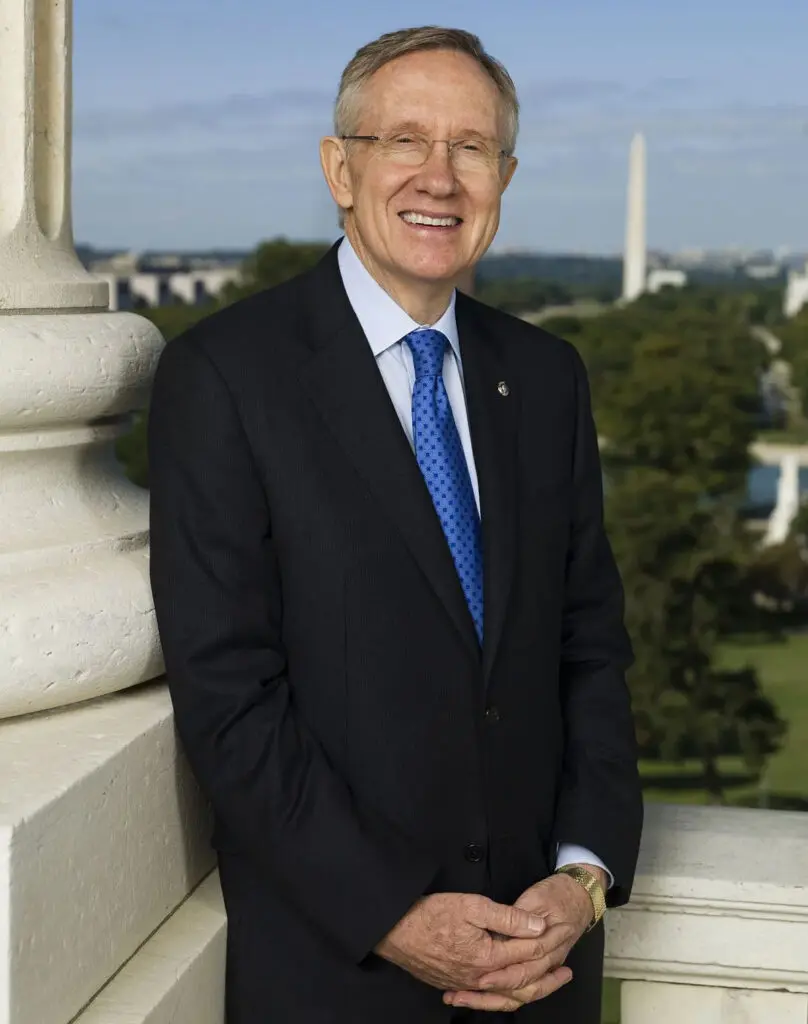
From Searchlight to the Senate
Reid’s childhood in Searchlight was closer to a Steinbeck novel than to the corridors of Washington. He grew up in a shack without indoor plumbing, the son of an alcoholic miner and a laundress who took in bordello sheets. In his memoir “The Good Fight,” he described the town as “a place of brothels, bars and cowboys,” where his mother sometimes paid the bills with gambling winnings. (Amazon)
A gifted boxer, he fought his way through high school in Henderson and college at Southern Utah State before heading to Utah State University and George Washington University Law School. In Washington he worked nights as a Capitol Police officer to pay tuition, a vantage point that gave him an early feel for the institution he would later lead. (SAGE Publishing)
Back in Nevada he served in the state legislature, then as lieutenant governor. His tenure as chair of the Nevada Gaming Commission in the late 1970s turned into a real-world thriller. Reid battled organized crime’s influence in Las Vegas casinos, survived a car bomb planted outside his family’s station wagon and once famously grabbed a casino owner by the throat during a heated hearing. (The Mob Museum)
Elected to the U.S. House in 1982 and the Senate in 1986, Reid was a workhorse rather than a showhorse. He would eventually become Senate majority leader in 2007, steering some of the most consequential legislation of the Obama era, from the stimulus package after the financial crisis to the Affordable Care Act. (Simon & Schuster)
That is the public Reid, the one memorialized in obituaries when he died of pancreatic cancer in December 2021 at the age of 82.
The UAP story begins as a side current in that larger river, fed by Nevada’s desert, nuclear weapons and a billionaire with his own paranormal research ranch.
Nevada, nukes and a senator who looked up
Reid represented a state that contains Area 51, the Nevada Test Site and wide swaths of restricted airspace. The Cold War left his home desert threaded with classified programs. As majority leader he also led the charge against turning Yucca Mountain into the nation’s nuclear waste dump, a campaign that required deep immersion in nuclear policy and the classified world around it. (unr.edu)
Somewhere along the way Reid’s curiosity about anomalous phenomena hardened into intent. In a 2018 New York Magazine interview, he insisted his interest in UAP was not about “little green men” but about science and security.
“If you’re here to talk about science, I’m happy to do that,” he told reporter Eric Benson. “I’m really glad to do that. I’m glad somebody is interested, because it’s a subject that is being terribly neglected.” (New York Magazine)
Nevada businessman Robert Bigelow, hotel magnate and founder of Bigelow Aerospace, had already been funding his own UAP and paranormal research via the National Institute for Discovery Science and later through his purchase of Skinwalker Ranch, a high-strangeness hotspot in Utah.
Bigelow and Reid were both Nevada power players. By the mid-2000s they had developed a close relationship. When military and intelligence contacts began whispering to Reid that strange things in the sky were provoking serious concern inside the Pentagon, the pieces clicked.
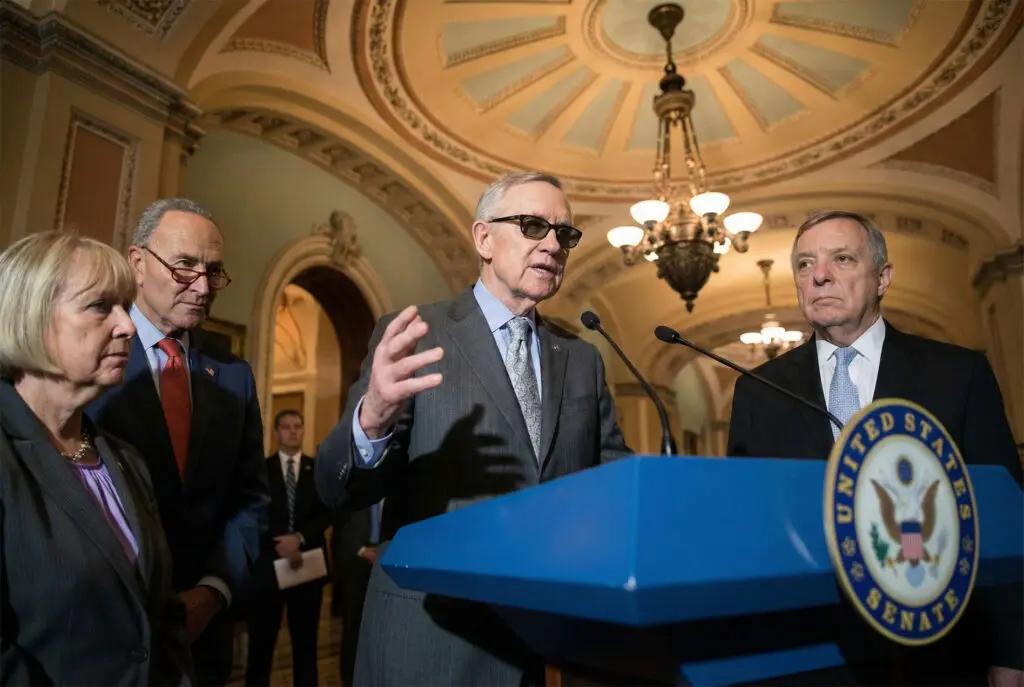
AAWSAP and AATIP: Reid’s black-budget bet
In 2007 Reid quietly worked with two senior colleagues, Republicans Ted Stevens of Alaska and Democrat Daniel Inouye of Hawaii, to carve 22 million dollars into the black budget for a new Defense Intelligence Agency line item. Publicly it was the Advanced Aerospace Weapon System Applications Program, AAWSAP. Internally, AATIP became the label more often used in Washington lore.
Most of the money went to a sole-source contract with Bigelow Aerospace Advanced Space Studies, BAASS, headquartered in Las Vegas. The company was tasked with a wide portfolio: cataloging global UAP cases, studying alleged recovered materials, analyzing physiological effects on witnesses and, in classic DIA fashion, looking for any foreign adversary capabilities that might explain or exploit the phenomenon.
Reid later said that what convinced him to act was not a single sensational case but a pattern of sensor-correlated incidents, often around nuclear assets, that convinced him something was intruding in restricted airspace in ways conventional radar and intelligence analysis could not handle. (The New Yorker)
In June 2009 he sent a classified letter to Deputy Secretary of Defense William Lynn requesting that parts of AATIP be placed under a “Restricted Special Access Program,” the most tightly held classification compartment the Pentagon has. Reid argued that the program had made “much progress” and that the technologies being studied could be “revolutionary for both civilian and military aerospace applications” if properly protected. (Defense Intelligence Agency)
The DIA ultimately rejected the request, saying it could not find adequate justification for such severe compartmentalization. (Defense Intelligence Agency)
Even without SAP status, AAWSAP generated a flood of technical papers, case files and field investigations. Some of that work, including reviews of Russian nuclear-related UAP incidents like the 1982 Byelokoroviche missile-base near-launch, would later surface in UAPedia’s own case dossiers, illustrating how Reid’s program helped pull global data into a single analytic pipeline.
AAWSAP formally ran from 2008 to 2010, but its leaner successor AATIP, associated with Pentagon official Luis Elizondo, continued UAP analysis work into the mid-2010s before Elizondo resigned and later went public.
When the New York Times story finally revealed the program in December 2017, reporters emphasized that Reid had been proud of his role and saw it as a legacy project. “I think it’s one of the good things I did in my congressional service,” he said. “I’m interested in science, and in helping the American public understand what the hell is going on.”
Public claims and media appearances
Once retired, Reid became something unusual in American politics: a former Senate leader openly encouraging serious UAP inquiry.
Highlights of his public statements include:
- On the need for transparency. When the Pentagon officially released three Navy UAP videos in April 2020, Reid tweeted that he was “glad the Pentagon is finally releasing this footage, but it only scratches the surface of research and materials available.” He added that the United States needed “a serious, scientific look at this and any potential national security implications.” (The Debrief)
- On the nature of the phenomenon. In a KLAS-TV I-Team interview, Reid warned against jumping straight to extraterrestrial conclusions. “I don’t know if there are little green men coming here,” he said, stressing instead that unidentified craft with extraordinary performance were being seen, and that was enough reason to investigate. (YouTube)
- On Lockheed Martin and alleged materials. In a 2021 New Yorker interview, later echoed in other outlets, Reid said he had for decades been told that aerospace giant Lockheed Martin possessed “some of these retrieved materials,” meaning fragments from UAP incidents. He said he tried to get access but was denied and had never personally seen proof. (Deadline)
- On hearings and oversight. In interviews with Politico, Fox News and others, Reid repeatedly urged Congress to hold hearings on what the military knew about UAP, arguing that stigma and secrecy had held back both science and national security. (Facebook)
Media interest spiked again around the 2021 Guardian profile “Ex-Senate majority leader Harry Reid on UFOs: ‘We’re at the infancy of it’,” where he framed UAP research as comparable to early aviation mysteries and said bluntly that lawmakers should take the subject “seriously, not as a joke.” (The Guardian)
Reid also appeared in UAP-adjacent documentaries and news specials, including interviews used in the documentary “The Phenomenon,” segments by journalist George Knapp, and frequent citations in discussions of Skinwalker Ranch and the book “Skinwalkers at the Pentagon,” which chronicles AAWSAP from the inside. (The New Yorker)
Known associates in the UAP ecosystem
Reid’s UAP network spanned business, the military, intelligence and journalism. Key figures include:
- Robert Bigelow. Billionaire founder of Bigelow Aerospace and Bigelow Aerospace Advanced Space Studies, the AAWSAP contractor and long-time funder of UAP and paranormal research.
- James Lacatski, Colm Kelleher and George Knapp. Lacatski, a DIA scientist, was central to AAWSAP’s creation. Kelleher was a scientist at BAASS and co-author, with Lacatski and Knapp, of “Skinwalkers at the Pentagon,” which portrays Reid as a supportive but hands-off political patron.
- Ted Stevens and Daniel Inouye. Senior senators who quietly co-signed the appropriation that created AAWSAP and shielded it from floor debate. (Wikipedia)
- Luis Elizondo and Christopher Mellon. Post-2017 public faces of AATIP and its successors, Elizondo and Mellon often credited Reid’s early support for legitimizing modern UAP inquiry inside the Pentagon. (Wikipedia)
- Leslie Kean, Ralph Blumenthal and Helene Cooper. Journalists behind the 2017 New York Times exposé. Reid’s willingness to speak on the record, and to link their story from his own social media, gave the article unusual political gravitas. (SCIRP)
- John Podesta and later UAP-focused lawmakers. Podesta, a long-time transparency advocate, frequently cited Reid’s program as proof that UAP were a legitimate policy topic. Later senators such as Kirsten Gillibrand and Marco Rubio pushed for AARO and UAP records laws in a landscape Reid had helped normalize. (Vanity Fair)
This web of relationships situates Reid not as a lone maverick but as the political fulcrum of a broader coalition interested in anomalous aerospace phenomena.
Controversies and critiques
Reid’s UAP legacy is not without friction. Critics raise three main lines of concern.
- Patronage and the Bigelow contract. Skeptics argue that routing most of AAWSAP’s funding to a single Nevada businessman and political donor looked like pork. Freedom of Information Act releases show that BAASS indeed received the bulk of the 22 million dollars, with work that extended beyond strictly aerospace threats into paranormal casefiles. (Wikipedia)
- Program opacity and mixed branding. The blurred boundary between AAWSAP and AATIP, along with later disputes over what Elizondo actually ran, has fueled claims that Reid’s program was poorly structured or used UAP branding to shield other agendas. Recent AARO historical reports emphasize that many dramatic claims about crash retrievals and nonhuman materials remain unsubstantiated in official records. (The Guardian)
- Lockheed fragments and the limits of evidence. When Reid publicly suggested that Lockheed Martin “may have” once had retrieved UAP materials, then admitted he had never seen proof, critics saw it as an example of high-ranking officials amplifying rumors rather than hard data. Supporters counter that even the possibility of such materials merits investigation and disclosure. (Deadline)
Reid himself tended to lean into that nuance. Asked about the more sensational UAP narratives, he would usually pivot back to process. The real scandal, in his view, was not that the Pentagon might be hiding alien bodies, but that pilots and radar operators were seeing things that defied current understanding while Congress mostly looked away. (New York Magazine)
Impact on the modern UAP landscape
Whatever one thinks of AAWSAP’s paranormal detours, its political effect is hard to overstate.
- The program created a paper trail inside the Department of Defense and DIA that later lawmakers could point to when demanding a permanent UAP office.
- The New York Times story that revealed it became the hinge between decades of ridicule and today’s era of congressional hearings, ODNI reports and the legally mandated UAP Records Collection at the National Archives. (SCIRP)
- Reid’s stature as a former Senate majority leader gave permission for other mainstream figures, from Barack Obama to John Brennan and Marco Rubio, to speak publicly about UAP without instantly sinking their credibility. (Vanity Fair)
In that sense, Reid functioned as a bridge figure. He was neither a full-time UAP activist nor a dismissive debunker. He was a hardened political realist who had seen enough airpower, nuclear policy and classified programs to sense that something nontrivial was in play.
Implications for UAP inquiry
Reid’s story carries several implications for how we think about UAP:
- UAP is now a policy space, not just a folklore space. The AAWSAP appropriation and subsequent laws that created AARO and a UAP Records Collection show that anomalous aerospace phenomena have migrated into the formal machinery of government.
- Elite belief does not guarantee elite knowledge. Reid’s inability to get confirmation about alleged Lockheed materials, despite decades at the apex of power, suggests that if a crash-retrieval complex exists it is compartmentalized even from senior elected officials. Or it may not exist at all, with stories propagating through what AARO later called “a self-referential, closed loop of sources.” (Defense Intelligence Agency)
- Serious UAP work needs guardrails. AAWSAP’s broad mandate, from nuts-and-bolts craft to poltergeists at Skinwalker Ranch, made it easier for critics to caricature the project. Future programs, if they want enduring legitimacy, will likely need clearer boundaries around methods, scope and deliverables.
- The phenomenon still outruns the bureaucracy. Despite Reid’s efforts, AARO’s first historical report concluded it had found no confirmed nonhuman technology in U.S. programs, even as contemporary military UAP cases continue to accumulate.
This tension between official skepticism and persistent anomalies is exactly the kind of gap Reid tried to narrow.
Claims taxonomy
Claim: Reid initiated and funded what became known as AATIP/AAWSAP, a Pentagon program to study UAP.
- Classification: Verified
- Evidence: DIA and DoD documents, including Reid’s 2009 SAP request letter, plus contemporaneous reporting in the New York Times and follow-up FOIA releases. (Defense Intelligence Agency)
Claim: AAWSAP/AATIP studied recovered materials of possible nonhuman origin.
- Classification: Probable
- Evidence: Contract language referring to “advanced aerospace” and reports of materials stored in modified Las Vegas facilities, as described by program participants and journalists. No public test data yet demonstrates nonhuman manufacture. (Reddit)
Claim: Reid’s program and advocacy were key catalysts for the current wave of UAP legislation and public hearings.
- Classification: Probable
- Evidence: Contemporary reporting and later analyses emphasize the 2017 Times story and Reid’s role as the point of origin for the Pentagon program that normalized UAP in Washington discourse, paving the way for later NDAA provisions and AARO. (Vanity Fair)
Claim: Lockheed Martin possessed fragments from a crashed nonhuman craft that Reid attempted but failed to access.
- Classification: Disputed
- Evidence: Reid’s own statements that he was told for years Lockheed had “retrieved materials,” counterbalanced by his admission that he never saw them and by AARO’s finding of no confirmed nonhuman technology in DoD programs. (Deadline)
Speculation label
Hypothesis
It is reasonable to hypothesize that Reid believed some UAP represented non prosaic technology given the kinds of cases funneled into AAWSAP and his insistence that released videos “scratch the surface.” That belief, however, is not the same as proof that nonhuman technology was confirmed inside the program. (The Debrief)
It is plausible that AAWSAP’s wide remit, from Russian nuclear incidents to Skinwalker Ranch poltergeist reports, reflected a working assumption that UAP might be connected to a broader spectrum of high-strangeness phenomena. This is an ontological stance, not yet a testable scientific model.
Readers should treat these interpretive layers as hypotheses, not established fact.
References
Cooper, H., Blumenthal, R., & Kean, L. (2017, December 16). Glowing auras and “black money”: The Pentagon’s mysterious U.F.O. program. The New York Times. (SCIRP)
Gideon, L. K. (2021, April 30). How the Pentagon started taking U.F.O.s seriously. The New Yorker. (The New Yorker)
Hastings, R. (2017). UFOs and nukes: Extraordinary encounters at nuclear weapons sites (2nd ed.). Author.
New York Magazine. (2018, March 21). Harry Reid on what the government knows about UFOs. Intelligencer. (New York Magazine)
Reid, H. M. (1998). Searchlight: The camp that didn’t fail. University of Nevada Press. (ThriftBooks)
Reid, H. M. (2008). The good fight: Hard lessons from Searchlight to Washington. G. P. Putnam’s Sons. (Amazon)
U.S. Defense Intelligence Agency. (2009). Senator Harry Reid’s request to put the Advanced Aerospace Threat Identification Program under special access protection [FOIA-released memo and attached letter]. (Defense Intelligence Agency)
U.S. Department of Defense, All-domain Anomaly Resolution Office. (2024). Report on the historical record of U.S. government involvement with unidentified anomalous phenomena, Volume I. (The Guardian)
Youn, S. (2021, June 1). Ex-Senate majority leader Harry Reid on UFOs: “We’re at the infancy of it.” The Guardian. (The Guardian)
Enigma Labs. (2023). The roots of the Pentagon UAP program: From AAWSAP/AATIP to UAPTF. (Enigma labs)
SEO keywords
Harry Reid UAP, Harry Reid AAWSAP, Harry Reid AATIP, Pentagon UAP program, Senate majority leader UFO funding, Robert Bigelow Harry Reid, Lockheed Martin UFO fragments claim, Skinwalkers at the Pentagon Reid, UAP congressional history, Harry Reid UFO hearings, Nevada senator Area 51, Harry Reid New York Times Glowing Auras, Harry Reid UAP legacy