The video is grainy, but the outline is unmistakable. A classic disc, tracked in infrared over the Afghanistan–Pakistan border in November 2020, darted through the frame with no visible wings, no exhaust, no heat signature that a conventional aircraft should show.
In June 2025, that clip hit television news and social media, accompanied by the lean, insistent commentary of filmmaker and self-described investigative journalist Jeremy Kenyon Lockyer Corbell. He said he had spent years validating the footage with military sources, that U.S. officials themselves had designated it a disc shaped UAP of unknown origin, and that the implications were “huge.” (FOX 2 Detroit)
For people inside modern UAP culture, the moment felt familiar. Corbell had already helped push several pieces of U.S. Navy UAP imagery into the public domain, including the now famous green-tinted “pyramid” video and the USS Omaha “spherical” object that appears to slip into the ocean. (Coffee or Die)
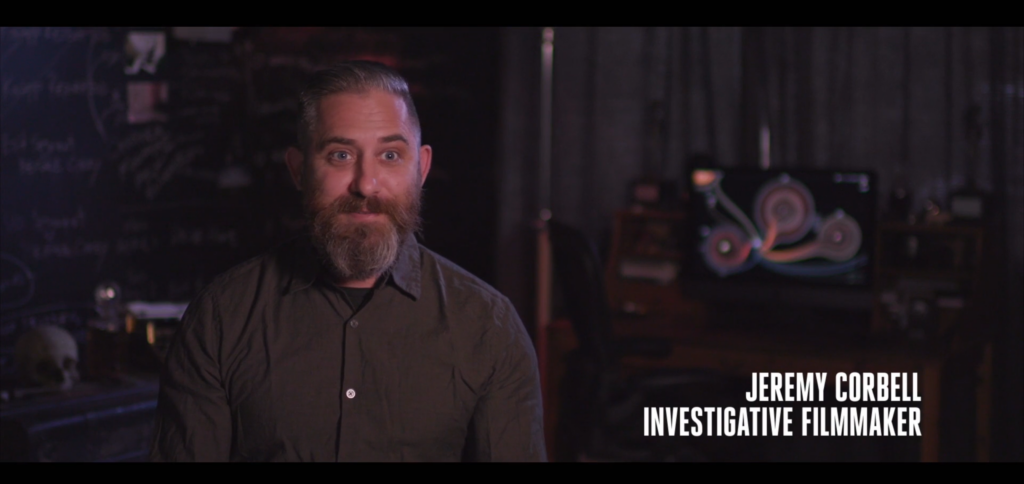
Whether you see him as a citizen journalist filling a vacuum or as a hype-driven filmmaker who sometimes outran the data, Jeremy Corbell has become one of the most visible human faces of the current UAP era.
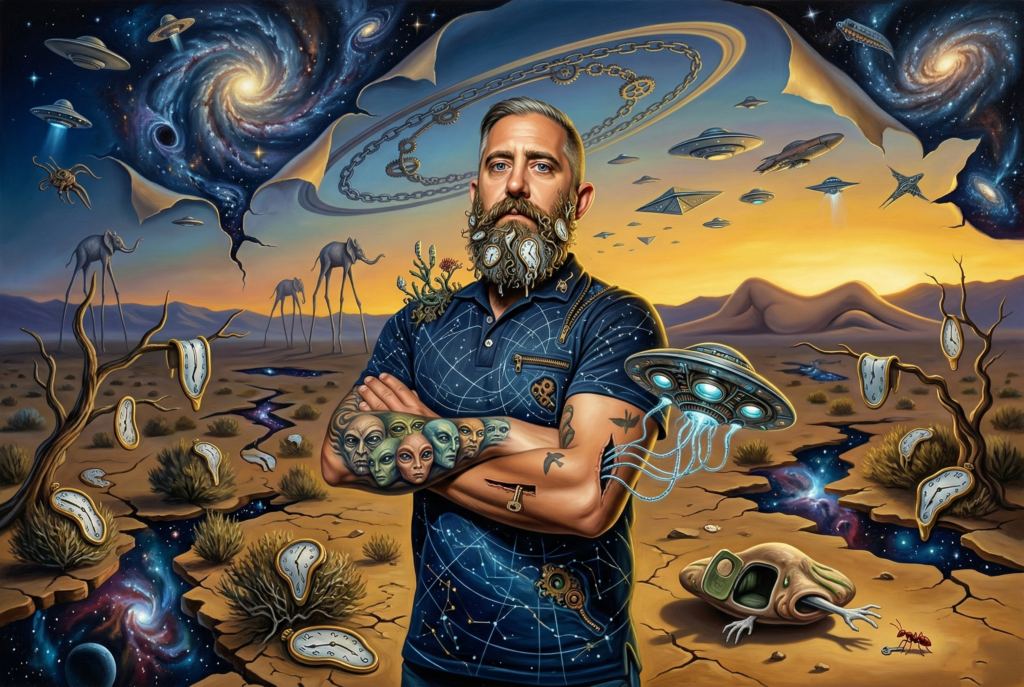
From quantum jiu-jitsu to accidental artist
Born in Los Angeles in 1977, he first built a public identity in the world of martial arts. He earned a black belt in traditional jiu-jitsu, branded his own “quantum jujitsu” system, and self-published Radiant Source: Cultivating Warrior Consciousness in 2001, framing martial practice as a path of inner transformation.
He taught jiu-jitsu and yoga at the University of California, Santa Cruz, and developed a curriculum for at-risk youth that blended martial arts, discipline and contemplative practices. County education programs in Santa Cruz highlighted his juvenile hall yoga projects as part of alternative education initiatives.
In 2004, while traveling in Nepal and India, Corbell contracted a severe fungal infection commonly known as Valley fever. The illness left him with hallucinations, distorted vision and months where martial arts were impossible. A profile later described him as an “accidental artist” who turned to mixed-media installations while recovering from the disease. (Interview Magazine)
He began salvaging early-20th-century windows and doors from Los Angeles demolitions, embedding disassembled computers and video into them. Exhibitions like Death to Life and ICON: Life Love & Style of Sharon Tate drew attention in fashion and art circles, and he was suddenly orbiting Andy Warhol retrospectives rather than dojo mats.
The through line in all of this is not UAP. It is curiosity about altered states, liminal stories and people who operate at the edge of consensus reality. That curiosity would eventually be aimed straight at the sky.
Building “Extraordinary Beliefs”
The pivot from gallery artist to anomalous-phenomena investigator took shape with his project Extraordinary Beliefs, a branded film and story series that lives on his website of the same name. (EXTRAORDINARY BELIEFS)
On the “about” page, Corbell frames the project this way:
Join investigative filmmaker Jeremy Kenyon Lockyer Corbell on a journey to explore the extraordinary beliefs of enigmatic people deep within the aerospace, military, conspiracy, extraterrestrial and underworld communities. (EXTRAORDINARY BELIEFS)
Extraordinary Beliefs became both a portfolio and a pipeline. It allowed him to:
- Develop short and mid-length documentaries about high-strangeness topics.
- Build long-term relationships with figures like Bob Lazar, John Lear, Dr. Roger Leir and others. (EXTRAORDINARY BELIEFS)
- Establish a recognizable tone: sympathetic to witnesses, confrontational toward secrecy, visually stylized, and comfortable with ambiguity.
His tagline, repeated across the site and merchandise, is simple: “Weaponize your curiosity.” (EXTRAORDINARY BELIEFS)
That phrase would later echo in his co-hosted podcast, WEAPONIZED, and has become a kind of personal brand statement for his role in the UAP scene.

UAP, implants and “off-world technology”: the documentaries
Corbell’s reputation in UAP circles rests heavily on a run of feature and series documentaries that straddle the line between character study and investigation.
Patient Seventeen (2017)
Patient Seventeen follows the late Dr. Roger Leir, a podiatric surgeon and well known figure in abduction and “implant” lore, during what would be his final surgery on an anonymous man identified only as “Patient 17.” The central question: is the small metallic object removed from the patient’s leg an example of non-human “off-world” nanotechnology. (IMDb)
Corbell documents the surgery, the materials analysis and the emotional arc of both Leir and his subject. A detailed VICE feature on the film notes that:
- Independent lab tests found unusual isotopic ratios in the object, which some participants saw as suggestive of non-terrestrial origin.
- Mainstream scientists consulted off cameras and remained unconvinced and called for further testing.
- Corbell himself stayed cautious, stating he might be “sitting on the most astounding physical evidence” or not, and that belief should not be the deciding factor. (VICE)
For UAPedia, Patient Seventeen matters as a bridge between Dr. Leir’s world of abduction implants and more recent attempts to study anomalous materials and biological effects.
Bob Lazar: Area 51 & Flying Saucers (2018)
If Corbell has a breakout title, this is it.
The film revisits the story of Bob Lazar, the man who claimed in 1989 that he worked on reverse-engineering non-human craft at a facility called S-4 near Area 51. Corbell’s documentary follows Lazar three decades later, weaving archival footage, new interviews and stylized reconstructions. (EXTRAORDINARY BELIEFS)
Key elements:
- Lazar reiterates his claims about gravity-propelled craft and exotic fuel.
- Corbell digs into Lazar’s disputed educational and employment records, attempting to shore up parts of his biography.
- The film positions Lazar as a “cosmic whistleblower” whose testimony brought Area 51 itself into popular awareness. (EXTRAORDINARY BELIEFS)
The movie landed on Netflix in 2019 and helped spark a new wave of interest in Lazar, including the viral “Storm Area 51” meme that called for thousands to rush the base perimeter in Nevada.
Skeptics argue that the film is too sympathetic and that Lazar’s claims remain unsupported by verifiable documentation. Corbell, in interviews, insists that the point is to take Lazar seriously enough to investigate, not to treat him as a joke or a closed case.
Hunt for the Skinwalker (2018)
Based on the book by journalist George Knapp and biochemist Colm Kelleher, Hunt for the Skinwalker explores Skinwalker Ranch in Utah, a widely reported hotspot of UAP and paranormal activity. (IMDb)
The documentary mixes:
- Historical accounts from ranch families who reported cryptids, UAP, poltergeist-like events and animal mutilations.
- Interviews with scientists and security staff linked to the National Institute for Discovery Science (NIDS) era of investigation.
- New access to the then-current owner and security footage.
Musician Robbie Williams, a long-time paranormal enthusiast, appears on camera as one of the rare outsiders allowed onto the property. (Apple TV)
Skinwalker Ranch sits squarely in the “high strangeness hotspot” category rather than simple lights in the sky. Corbell’s film helped cement that framing for mainstream audiences.
Other projects
Corbell’s Extraordinary Beliefs slate includes a series of shorter pieces with direct UAP or intelligence relevance:
- Immaculate Deception: The John Lear Story – a serial profile of aviator and controversial insider John Lear, released as episodes via his site. (EXTRAORDINARY BELIEFS)
- Anonymous Interview – a 22-minute film about an alleged ex-CIA operative whose “deathbed confession” on ET-related programs was later used at the 2013 Citizens Hearing on Disclosure. (EXTRAORDINARY BELIEFS)
- Moonwalker – a profile of Apollo 14 astronaut Dr. Edgar Mitchell, exploring Mitchell’s interest in consciousness, survival of death and UAP-adjacent topics. (Vocal)
Collectively, these works create a threaded narrative: secret programs, anomalous craft, non-human intelligences and human witnesses who risk career or credibility to talk about them.
The leaks: pyramids, spheres, jellyfish and discs
If the documentaries established Corbell as a filmmaker inside anomalous culture, the leaks made him a central node in the modern UAP news cycle.
The 2019 Navy imagery
Starting in 2020, Corbell began releasing stills and video he said came from briefings of the U.S. Navy’s Unidentified Aerial Phenomena Task Force (UAPTF). These included:
- A green night-vision video of triangular or “pyramid” shaped objects above the USS Russell off California in 2019.
- Stills of a “spherical” object associated with the USS Omaha, and other shapes like “acorn” and “metallic blimp.” (Coffee or Die)
In April 2021, Pentagon spokesperson Susan Gough confirmed that the images and clips were indeed captured by Navy personnel and were being used in ongoing UAPTF analysis. The confirmation covered provenance and authenticity of the recordings as military imagery, but did not endorse a particular explanation. (Business Insider)
Skeptical analysts like Mick West later argued that the apparent triangles were likely out-of-focus stars or aircraft seen through a camera with a triangular aperture, an effect known as bokeh. Corbell disagreed, continuing to frame the footage as a key puzzle piece in a larger pattern of unknowns. (New York Post)
USS Omaha “spherical” transmedium object
In May 2021, Corbell released radar and infrared footage from the USS Omaha that appears to show multiple unknown objects “swarming” the ship off the coast of California in 2019, as well as a short clip of a spherical object moving above the water before apparently descending into the ocean. (Coffee or Die)
The Pentagon again confirmed that the imagery was real Navy material under UAPTF review. The suggestion that the object might represent a “transmedium” craft, capable of moving seamlessly from air into water, remains an interpretation rather than an established fact.
The “jellyfish” UAP
In early 2024, Corbell released infrared footage of a strange, tentacled object moving above a U.S. base in Iraq in 2018, nicknamed the “jellyfish” UAP. The clip shows a roughly oval form with three dangling appendages that appear to drift and change tone. (youtube.com)
Coverage in Arabic and Western outlets reported that a former Marine based there, Michael Cincoski, confirmed multiple sightings of the object while serving at the base. Critics argued that without additional sensor data, the clip could not rule out a balloon or unmanned system. (Arab News)
The 2020 Afghanistan-Pakistan disc
Corbell’s 2025 release of disc-shaped UAP footage from the Afghanistan–Pakistan border is his clearest entry into classic “flying saucer” imagery. According to his account and subsequent news coverage:
- The U.S. military recorded the object on November 23, 2020, using a FLIR-type sensor.
- The craft is described as a near-perfect disc that displays abrupt movements and apparent intelligent control.
- Analysts noted a lack of visible heat signature or conventional propulsion.
- Corbell stated that U.S. officials themselves used “disc” language in internal discussion, and that multiple whistleblowers were ready to testify to Congress about the case. (FOX 2 Detroit)
As of late 2025 there has been no public Pentagon technical report on this specific case. It stands as one of the more striking examples of Corbell’s role as intermediary between unnamed military sources and the public.
WEAPONIZED and the mainstreaming of UAP talk
In early 2023, Corbell teamed up with veteran Las Vegas investigative journalist George Knapp to launch WEAPONIZED with Jeremy Corbell & George Knapp, a weekly podcast and video series distributed by Cadence13 and other platforms. (WEAPONIZED)
The show’s premise is simple:
Pull back the veil on the world of the known, to explore the unexplained, featuring exclusive interviews, never-before-seen footage and previously suppressed documents related to UAP, the paranormal, cutting-edge science, cover-ups and big-ticket crimes. (Apple Podcasts)
WEAPONIZED serves several functions in the modern UAP ecosystem:
- A platform for whistleblowers and insiders who prefer an independent media outlet before speaking in government hearings.
- A way to context-load Corbell’s leaks with his and Knapp’s interpretations.
- A weekly drumbeat that keeps UAP in front of a crossover audience that includes true crime fans, paranormal followers and political junkies.
Forbes described the show as a multi-platform investigative series that aims at “the unknown,” positioning it within mainstream audio culture rather than fringe radio. (Forbes)
Corbell also appears frequently on large podcasts and news programs, including The Joe Rogan Experience, Chris Cuomo’s talk show, and interviews with media founders like Shane Smith, where he walks viewers through both his footage and his broader belief that some UAP represent non-human machineries. (Spotify)
Known connections and networks
Corbell’s UAP work does not happen in isolation. His career threads through a dense network of researchers, experiencers and media figures, including:
- George Knapp – co-author of Hunt for the Skinwalker, long-time reporter on Area 51 and UAP stories at KLAS Las Vegas, and Corbell’s co-host on WEAPONIZED. (IMDb)
- Bob Lazar – central figure in Corbell’s Lazar documentary and ongoing appearances, often presented as the archetypal UAP whistleblower. (EXTRAORDINARY BELIEFS)
- Dr. Roger Leir – abduction implant surgeon whose final surgery and legacy are documented in Patient Seventeen. (Apple TV)
- Colm Kelleher and NIDS milieu – scientists and investigators tied to Skinwalker Ranch research. Corbell’s film builds on Kelleher and Knapp’s earlier book. (IMDb)
- Edgar Mitchell’s circle – through Moonwalker and related projects, Corbell touches the broader ecosystem of consciousness, psi and UAP conversation that grew around the Apollo astronaut. (Vocal)
He also collaborates indirectly with a wider disclosure network that includes journalists like George Knapp and Ralph Blumenthal, podcasters, and fellow filmmakers such as James Fox, even when they pursue different styles and evidentiary standards.
Brief timeline
Piecing together timelines across interviews, his website and external profiles, a rough arc emerges:
- 1990s–early 2000s – Martial arts focus: quantum jujitsu, teaching at UC Santa Cruz, youth programs, Radiant Source book. (Wikipedia)
- Mid-2000s – Illness and shift into art installations and photography, Los Angeles exhibitions. (Interview Magazine)
- 2010s – Launch of Extraordinary Beliefs as a film series and brand, early shorts like Anonymous Interview and Immaculate Deception; patient-zero projects on Lazar and the Nimitz Tic Tac encounter. (EXTRAORDINARY BELIEFS)
- 2017–2018 – Release of Patient Seventeen, Bob Lazar: Area 51 & Flying Saucers and Hunt for the Skinwalker, establishing him as a full-time anomalous phenomena documentarian. (IMDb)
- 2020 onward – Role as conduit for Navy and other UAP imagery, media talking head during the Pentagon UAP acknowledgement wave. (Coffee or Die)
- 2023 onward – WEAPONIZED podcast co-host, broadening from films into continuing investigations and commentary. (Forbes)
He resides in the Los Angeles area and operates JKLC Productions, which handles his films and related media projects. (Apple TV)
Controversies and critiques
A figure this visible in a field this contested naturally attracts criticism. UAPedia treats those critiques as part of the evidentiary landscape.
Style and sensationalism
Some critics, including voices inside the UAP research community, accuse Corbell of leaning toward theatrical presentation and emotionally charged narration that can blur the line between evidence and interpretation. The visual language of his films and social media posts tends to emphasize drama and urgency. This is partly a function of modern documentary storytelling, but it can also make cautious viewers wary.
Interview Magazine, in a long 2023 profile, wryly called him “the undisputed poster-child for the movement to expose what the U.S. government knows about UFOs,” highlighting both his energy and the almost messianic expectations some followers project onto him. (Interview Magazine)
Evidence thresholds
Specific points of contention include:
- The triangular “pyramid” video, where skeptical investigators argue that optical bokeh is a sufficient explanation. (New York Post)
- The interpretation of “spherical” and “swarm” events near the USS Omaha as strongly suggestive of non human craft, when official language remains non-committal. (Coffee or Die)
- The decision to foreground anecdotal or single-sensor clips like the “jellyfish” UAP before a broad technical analysis has been published. (Arab News)
None of these invalidate his work. They do underscore the tension between journalistic urgency and scientific caution.
Association with disputed witnesses
By centering figures like Bob Lazar and John Lear, Corbell also inherits their controversies. Lazar’s claimed physics credentials and employment history remain disputed; mainstream reporters and some researchers consider his story unproven, while others see him as foundational. Lear embraced a wide range of extreme claims about non-human programs.
Corbell’s defenders argue that shining light on controversial witnesses is part of the job and that audiences can make up their own minds. Critics reply that repeated framing of such witnesses as “cosmic whistleblowers” risks locking in narratives that outrun the available evidence.
Implications for UAP studies
From a UAPedia standpoint, Corbell’s significance lies less in whether every leak is ultimately “exotic” and more in how he has reshaped the media ecosystem around UAP.
- Citizen-journalist pipeline for military data
His role illustrates how leaks and briefings now travel. Instead of going straight from classified vaults to traditional newspapers, some UAP material appears first through independent filmmakers with established alternative-media audiences. This changes how quickly footage can go viral and how it is framed before official comment. (Coffee or Die) - Narrative framing of non human intelligence
Corbell rarely hedges on his personal belief that some UAP represent non-human craft or technology. His films and interviews treat that possibility as a live, even likely hypothesis. That framing nudges public expectation toward an NHI or off-world interpretation, which then shapes how new clips are received. - Pressure on institutions
By leaking materials that the Pentagon later confirms as genuine recordings, Corbell has arguably forced official acknowledgement faster than might otherwise have occurred. Even skeptical commentators often credit him with accelerating conversations that led to congressional hearings and the creation of AARO and related offices. (ABC News) - Blurring of genres
The same person who directed stylized art films now co-hosts a podcast that mixes true crime, political scandal and UAP secrecy. This blending brings UAP narratives into spaces where audiences might not seek them out, but it also imports the epistemic looseness of entertainment into what could be scientific questions.
References
Corbell, J. K. L. (n.d.). Jeremy Corbell [About page]. Extraordinary Beliefs. Retrieved 2026, from (EXTRAORDINARY BELIEFS)
Corbell, J. K. L. (n.d.). Films [Project list]. Extraordinary Beliefs. Retrieved 2026, from (EXTRAORDINARY BELIEFS)
Corbell, J. K. L. (n.d.). Bob Lazar: Area 51 & Flying Saucers [Film page]. Extraordinary Beliefs. Retrieved 2026, from (EXTRAORDINARY BELIEFS)
Edwards, C. (2021, April 16). Pentagon confirms recently released video of pyramid-shaped UFOs near San Diego is authentic. FOX 11 Los Angeles. Retrieved 2026, from (FOX 11 Los Angeles)
Evolution Media / Cadence13. (2023). WEAPONIZED with Jeremy Corbell & George Knapp [Podcast description]. Retrieved 2026, from (Apple Podcasts)
FOX 2 Detroit. (2025, June 23). Disc-shaped UAP caught on camera by the military in 2020 [Video segment]. Retrieved 2026, from (FOX 2 Detroit)
Gough, S. (2021, April 16). Pentagon confirms authenticity of certain UAP images and videos captured by Navy personnel [Statements summarized in news coverage]. See Business Insider and related outlets. (Business Insider)
Interview Magazine. (2023, December 14). Meet Jeremy Corbell, the citizen journalist blowing the whistle on UFOs. Retrieved 2026, from (Interview Magazine)
Oberhaus, D. (2017, November 27). Watch this doc on alien gangsters and the “biggest story in human history” [Patient Seventeen review]. VICE. Retrieved 2026, from (VICE)
UAPedia. (2025). Consciousness as a Channel for UAP and the Supernatural [Editorial standards excerpt]. Retrieved 2026, from (UAPedia)
Yahoo News. (2021, May 31). UFO filmmaker releases 46-second video allegedly showing swarm of objects hovering near Navy ship. Retrieved 2026, from (Yahoo)
The Sun. (2025, June 20). “Disc-shaped” UFO “spotted by US military” in eerie footage leaked to public [News report quoting Jeremy Corbell]. Retrieved 2026, from (The Sun)
SEO keywords
Jeremy Corbell biography, Jeremy Kenyon Lockyer Corbell UAP, Extraordinary Beliefs films, Bob Lazar Area 51 documentary, Patient Seventeen alien implants, Hunt for the Skinwalker movie, WEAPONIZED podcast George Knapp, Navy UAP pyramid video, USS Omaha spherical UAP swarm, Afghanistan Pakistan disc shaped UAP, jellyfish UAP Iraq, UAP whistleblower media, Jeremy Corbell leaks Pentagon confirmation, UAP disclosure citizen journalist, Skinwalker Ranch high strangeness documentary