
Travis Walton stands at the center of one of the most discussed UAP cases on record. On the night of November 5, 1975, the 22 year old Arizona logger vanished in front of six coworkers after approaching a luminous craft that had descended into a clearing in the Apache Sitgreaves National Forest. Five days later he reappeared and reported an onboard experience that helped define the public imagination of UAP contact for a generation. Whether one accepts or doubts his account, Walton’s story has had exceptional staying power, shaping media, policy discussions, and the language of modern UAP culture.
Early life and the making of a witness
An Arizona native born in 1953, Walton grew up in the small high country community of Snowflake. He took seasonal forest work as a young man and by his early twenties was part of a brush thinning contract in a tract known as Turkey Springs, about a dozen miles south of Heber. On paper the job was demanding, almost thirteen hundred acres to be thinned before a looming federal deadline. The crew’s work had already been extended into November. Those ordinary details of place and schedule would matter later when skeptics argued over motives and context.
At the time Walton worked for crew chief Mike H. Rogers. The colleagues on the truck that week were Ken Peterson, John Goulette, Steve Pierce, Allen Dalis, and Dwayne Smith. They were young men pushing to finish a contract as autumn light shortened and temperatures fell along the Mogollon Rim. The roster and ages appear in the earliest investigation materials and remain a backbone of the case record.
The encounter at Turkey Springs
At about 6:15 p.m. on November 5 the crew finished for the day and began the drive out in Rogers’s 1964 International pickup along the forest road network. As they rounded a bend they saw an intense glow through the trees. Thinking at first of a fire, they rolled toward a clearing and stopped short. What they described next was a structured object, luminous, hovering several meters above the slash, silently dominating the clearing. Walton opened the passenger door, stepped out, and walked toward it as the others shouted for him to stop. A bright blue green ray struck him and threw him backward. Rogers floored the accelerator in panic. When the others convinced him to return within minutes, the clearing was empty and Walton was gone.
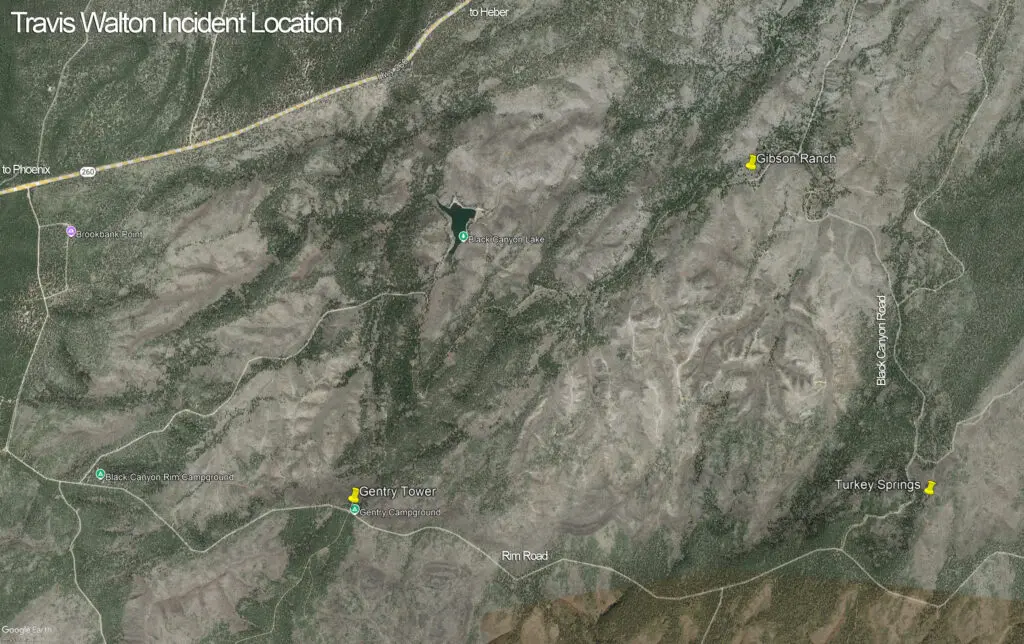
Law enforcement response was immediate. Navajo County officers L. C. Ellison, Sheriff Marlin Gillespie, and Deputy Ken Coplan interviewed the witnesses, escorted them back to the site, and organized a search into the night. In the days that followed, the search widened with volunteers and a helicopter. Investigators considered foul play and pressed the men with questions that focused less on a craft than on whether Walton had been harmed by human hands. This early period is well documented in the Aerial Phenomena Research Organization bulletin and remains crucial to understanding why the case was never just a single person’s claim.
Polygraphs for the crew
On November 10 the six remaining crew members were given polygraph examinations by Cy Gilson, an examiner frequently used by Arizona law enforcement. His questioning centered on whether they had harmed or concealed Walton and whether they had seen an unusual aerial object. Five men passed, and the sixth was recorded as inconclusive, an outcome Gilson attributed to lack of cooperation rather than deception. For the sheriff this still left a mystery, but it blunted the homicide theory that had hung over the crew. Polygraph science is imperfect, yet the point matters historically, because these were law enforcement directed tests during an active missing person inquiry.
Return and first telling
Shortly after midnight on November 11 a call reached the Snowflake home of Walton’s sister and brother in law, the Neffs. The caller’s voice was faint and confused. He said he was at a service station phone booth in Heber. Family members drove there and found Walton slumped on the floor of the booth, disoriented and nauseated. He was taken to safety, and a physician, Dr. Howard Kandell, examined him roughly fifteen hours later. Kandell noted weight loss but signs of sustenance, and he did not find the classic marks of exposure one might expect after several nights outdoors in the Rim Country. Walton himself appeared shaken and weak. These post return details originate with the contemporaneous field notes and are often lost behind later retellings.
What Walton says he experienced aboard
Walton’s first narrative, recorded soon after his return, described regaining consciousness on a table in a room suffused with dim amber light. He reported three short beings with oversized heads and large eyes, clothed in tan suits, and later described human appearing figures in tight fitting helmets. He says he left the first room in panic, entered a larger space like a hangar, and was then guided by one of the human appearing figures. The next memory was of waking on a road shoulder near Heber, in the chill of night, as a craft departed overhead. Variants of this account appear across the early case files and in his later memoir, with the core sequence remaining consistent even as wording and interpretation evolved.
Media, rewards, and immediate controversy
From the first weekend the story drew national attention. The tabloid National Enquirer publicized the case and later awarded five thousand dollars for what it called the best case of the year, a prize split between Walton and the six crewmen. This infuriated some local officials who already suspected a put up job and it fueled a long debate over whether publicity contaminated the evidence. The award itself, and front page photographs of the crew, can be traced to press clippings preserved by investigators and commentators of the period. (debunker.com)
Skeptical writers Philip J. Klass and others argued that the case fit a pattern of sensational claims born of hopes for financial rescue and fame. Klass publicized a little known polygraph administered to Walton by senior examiner Jack McCarthy soon after the return, a test McCarthy said indicated gross deception. Advocates countered with methodological critiques of that exam and with later charts by other examiners. The disagreement over which tests to trust has never fully resolved and remains a central talking point whenever the case is reopened in media. (centerforinquiry)
The book and a film that reshaped the imagery
Walton published The Walton Experience in 1978 with Berkley. He expanded the back story and set out his onboard account in full. The book would later be reissued under the title Fire in the Sky to coincide with the Paramount feature film released in 1993. The movie brought Walton’s story to a worldwide audience, though writer Tracy Tormé and the director created abduction imagery that was far more graphic than the witness says he remembers. Film histories acknowledge that the studio pressed for a more cinematic sequence than the calm clinical scenes in Walton’s narrative. (Biblio)
Later examinations, broadcasts, and public life
Through the decades Walton lectured at conferences and appeared in documentaries. A polygraph retest by examiner Cy Gilson in the early nineties has been widely cited by proponents as supportive of Walton’s sincerity, while critics note the general limits of polygraph methods. In 2008 a network game show used a simplified polygraph format and displayed an unfavorable result to the question of abduction, which in turn highlighted the unreliability of televised lie detection. The uneven record of polygraph findings does not settle the case either way, but it is part of the biography.
Walton’s story inspired a feature length documentary, Travis: The True Story of Travis Walton, which debuted in 2015 and won awards at the International UFO Congress film festival. In recent years he has helped anchor the Skyfire Summit, an Arizona gathering that uses the anniversary to revisit evidence and personal testimony. These events show how his account continues to draw audiences, while also giving platforms to new research, both sympathetic and critical. (Travis Walton the Movie)
Disputes, reconciliations, and evolving debate
In 2021 Walton’s onetime crew chief Mike Rogers briefly posted that he no longer wished to be considered a witness, then participated in a recorded call that skeptics took as an admission of a hoax. Rogers later retracted those remarks and restated that the crew saw an extraordinary craft and that Walton was taken. The episode reveals how personal rifts and decades old resentments can muddy old cases without providing conclusive new data. Researchers on all sides still debate peripheral hypotheses, including whether a distant lookout tower beam could have been misperceived in the trees, but none of those speculations engages every element of the record.
What makes the Walton case hard to dismiss
UAP historians separate memory rich abduction claims into rough tiers. Walton’s case sits in a unique class because of multiple immediate witnesses to a structured aerial object, a police documented missing person search, and early law enforcement polygraphs that focused on possible foul play rather than on exotic details. The contemporaneous APRO field chronicle captured names, times, and procedures while the ground was still cold and before any book or movie existed. That kind of early record is rare. It does not conclusively explain what the craft was or who operated it, but it narrows the range of ordinary stories one might tell about a disappearance.
At the same time the case shows how every historic UAP file becomes a magnet for culture war, profit motives, and memory distortion. Tabloid prizes did the case no favors. Skeptical outreach sometimes steered into advocacy as hard as believers did, and modern televised polygraphs added noise. Yet through each wave, the core through line remains. Seven men said they encountered a craft. One approached, was hit by a beam, and vanished. Five days later he phoned for help and reported an onboard episode. The basics have never changed.
A concise timeline
1953: Travis Walton is born in Arizona. He later settles in Snowflake and works in forestry. (Wikipedia)
Summer to fall 1975: Crew chief Mike Rogers works a Turkey Springs thinning contract with a federal deadline extended into November. (Wikipedia)
November 5, 1975: At dusk, the crew encounters a luminous craft. Walton approaches, is struck by a beam, and disappears. Officers Ellison, Gillespie, and Coplan interview the men and search that night.
November 7 to 9, 1975: A large area search fails to find Walton. The case gains regional and national attention.
November 10, 1975: State associated examiner Cy Gilson polygraphs the six remaining crew members. Five pass, one is inconclusive.
Early November 11, 1975: Walton calls family from a Heber pay phone and is recovered, confused and weak. Later that day he is examined by Dr. Howard Kandell.
1978: Publication of The Walton Experience by Berkley. (Biblio)
1993: Paramount releases Fire in the Sky, which dramatizes the abduction sequence beyond Walton’s written account. (Wikipedia)
2008: A television show uses a simplified polygraph format and announces an unfavorable result, reigniting the testing debate. (Michael Shermer)
2015 to present: Documentary screenings, podcast appearances, and the Skyfire Summit keep the case in the public eye, especially around anniversaries. (Travis Walton the Movie)
Assessment and legacy
The Walton case is a touchstone because it resists reduction to a single mundane story. The multi witness observation of a structured object, the immediate missing person investigation, and the early independent fieldwork by APRO together compose a robust primary record that any alternative theory must meet on its own terms. Even the sharpest skeptical writing about the case tends to focus more on social motive models than on specific physical counterevidence from the site. The richness of the written record is one reason archivists, documentarians, and conference organizers return to it.
There are still open questions. What exactly powered the craft and why did the beam behave the way witnesses describe. Why do some abductees, including Walton, report human appearing figures among non human crew. Which cues inside the craft were environmental and which were medical. These questions remain active in experiencer research and they keep the Walton file relevant in a post-stigma era where official UAP tasking acknowledges that not everything in the sky is misidentification. In that sense Walton’s name appears less as an outlier now than as an early point on a curve everyone is finally willing to plot. (MUFON 2025 Sedona)
References
Aerial Phenomena Research Organization, “The Travis Walton Case,” APRO Bulletin, November 1975. Primary field chronicle with law enforcement and polygraph details.
APRO Bulletin, continuation pages with return call, medical exam notes, and early interview chronology.
“Travis Walton incident,” encyclopedia overview with contracting timeline, later disputes, and media context. Use with caution, crosschecked against primary sources for factual points. (Wikipedia)
Phoenix New Times, March 3, 1993 feature on the case as film release approached, including sheriff commentary. (Phoenix New Times)
Biblio catalog entry for The Walton Experience, Berkley Publishing, 1978, confirming publication year and bibliographic data. (Biblio)
“Fire in the Sky,” film entry outlining adaptation choices that depart from the book. (Wikipedia)
CFI archive, “Profitable Nightmare of a Very Unreal Kind,” summarizing the McCarthy polygraph and media handling, representative of skeptical literature. (centerforinquiry)
“Walton Miscellany” press clippings PDF, showing National Enquirer award photos and period reporting. (debunker.com)
Michael Shermer, “Travis Walton’s Alien Abduction Lie Detection Test,” discussing the 2008 game show segment and the general limits of polygraph formats. (Michael Shermer)
Wikimedia Commons, “Travis Walton 2019” portrait, CC BY SA license. (Wikimedia Commons)
Wikimedia Commons, “Walton (reconstitution)” illustration, public domain. (Wikimedia Commons)
Sedona MUFON Skyfire Summit listings and announcements for anniversary events featuring Walton. (Visit Sedona)
SEO keywords
Travis Walton, Fire in the Sky, The Walton Experience, Snowflake Arizona UAP, Turkey Springs logging crew, Apache Sitgreaves National Forest UAP, Cy Gilson polygraph, Jack McCarthy polygraph, Mike Rogers Skyfire Summit, APRO Bulletin Walton case, UAP abduction history