
On a clear night outside Marfa, the horizon feels close enough to touch. The Chinati Mountains sit low and dark, the sky looks exaggeratedly deep, and the desert air has that peculiar stillness that makes every sound seem like it belongs to someone else.
You pull into the official viewing area about nine miles east of town on U.S. 90, step out into the cool, and notice you are not alone. People are already lined up at the rail, facing the same blank stretch of distance as if they are waiting for a curtain to rise. (Visit Marfa, “Mystery.”)
Then someone murmurs, “There,” and a point of light appears where there was nothing a moment ago.
This is how the Marfa Lights keep winning. Not because everyone agrees on what they are, but because the experience itself is structured like a reveal.
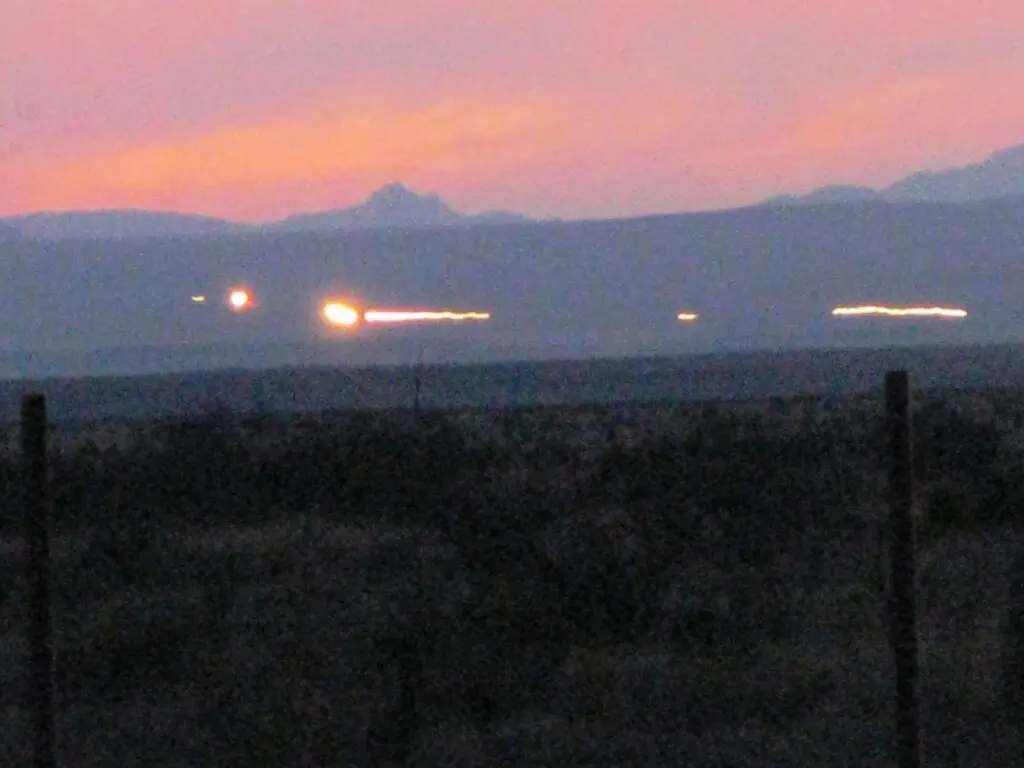
A light glows. It flickers. It seems to drift. Another one appears beside it, then fades, then returns, sometimes with a hint of color. People start narrating it in real time, not as science, but as an encounter: it moved toward us, it split, it played. If you stay long enough, you will hear the same verbs repeated by strangers who have never met, as if the place has trained human language for this exact moment.
An explainer article about the Marfa Lights has to do two things at once. It has to respect what witnesses say happened to them, including first-hand accounts that sound sober and specific. It also has to respect what careful measurement says about the viewing conditions, the geography, and the way ordinary lights behave when you watch them across miles of heat-layered desert air.
The best technical work on Marfa strongly supports a mainstream conclusion: many lights seen from the viewing area can be identified as distant vehicle headlights and small fires, sometimes made strange by atmospheric effects. (AIP Publishing)
But “many” is not the same as “all,” and it is also not the same as “therefore the story is over.” Marfa remains a high-strangeness hotspot because the reports repeat across generations, because the lights are often described as behaving in ways that feel interactive, and because even some researchers who favor prosaic explanations still treat the most unusual claims as an open question rather than a settled victory lap. (AIP Publishing)
What follows is the clearest, most source-rigorous way to hold both truths at once.
What witnesses describe, in plain language
The Texas State Historical Association’s Handbook of Texas is one of the strongest anchors for Marfa because it compresses more than a century of local reporting into a stable descriptive core.
In that entry, the lights are described as appearing between Marfa and Paisano Pass, sometimes colored, twinkling, and behaving in ways witnesses find hard to reconcile with ordinary distant lamps: they “move about, split apart, melt together, disappear, and reappear.” (donswaim.com)
That description matters because it captures the “behavior” component. Most people do not become lifelong Marfa believers because they saw a single stationary glow.
The hook is motion and transformation, especially the apparent splitting and merging. Those are the features most likely to be amplified by distance, mirage effects, and misjudged scale, but they are also the features that make people feel they are not merely seeing a faraway road.
It is also worth saying out loud what a lot of witnesses imply without stating: the Marfa Lights are not a single object. They are a category label people apply to light phenomena in a particular landscape corridor.
That is not a dismissal. It is the core complication. A category can contain multiple causes, especially in a region where highways, ranch lights, power infrastructure, aircraft, and occasional fires exist alongside powerful atmospheric refraction conditions.
The historical spine: the story before modern traffic
A common reason Marfa still generates serious discussion is that the narrative does not begin with cars. The Handbook of Texas records an early account from 1883: a young cowhand, Robert Reed Ellison, reportedly saw a flickering light while driving cattle near Paisano Pass and first assumed it was an Apache campfire.
Local settlers told him they often saw similar lights, and when people investigated, they found no clear source such as a camp and no obvious remnants. The same entry notes additional early settler reports in the mid-1880s and later searches that turned up nothing definitive. (donswaim.com)
An 1883 report does not automatically prove a non-prosaic phenomenon. In the 1880s there were plenty of human light sources other than vehicles, and there were also natural phenomena that could produce transient illumination. The reason the early history matters is different: it suggests the “mystery of light on that horizon” is older than the modern viewing area and older than the easy headline explanation. It establishes continuity of place and continuity of witness language.
Later historical color in the Handbook of Texas includes accounts of cowboys riding into the mountains in 1919 to find the source and failing, and wartime-era curiosity during World War I and World War II, including pilots reportedly looking for an origin from the air without success. (donswaim.com)
You can read those as folklore accreting around misperception, or as persistent frustration in the face of an elusive stimulus, or both.
The viewing area: a gift to observers and a trap for interpretation
The official viewing area is part of why Marfa became globally famous. It makes the phenomenon accessible and safe, and it turns a private rural story into a shared public ritual.
The Handbook of Texas notes that the Texas Department of Transportation built a roadside parking area east of town for this purpose, and that a viewing center was built there in 2003. (donswaim.com)
But the viewing area also introduces a fundamental interpretive hazard: it sits at a vantage where you can see other, ordinary light sources at long distance, including traffic corridors that are not obvious until someone explains the map. That means the site generates a built-in mix of genuine attempts to observe and accidental misattributions.
This is one reason the most careful researchers tend to separate two questions that casual visitors collapse into one. Question one is: “Do people see lights from the viewing area that look strange?” The answer is clearly yes. Question two is: “Are those lights, as observed, of uncertain origin once you trace their geometry and sources?”
The answer is often no, especially for lights appearing along the axis where Highway 67 traffic can be visible at distance.
The 2004 student investigation: the naming correction, and why it matters
One of the most referenced modern studies of the Marfa Lights was conducted in May 2004 by a group from the Society of Physics Students at the University of Texas at Dallas.
Their core approach was simple and smart: treat the lights as a correlation problem.
Measure when lights appear in the southwestern sector as seen from the viewing area, and compare that to traffic flow on U.S. 67.
Reliable summaries of that work describe conclusions including that Highway 67 is visible from the viewing location, that the frequency of observed lights correlates with the frequency of vehicle traffic, that the motion of many observed lights tracks the straight-line geometry of the road, and that controlled headlight tests could reproduce “Marfa light” appearances from the viewing area.
We take the 2004 UTD SPS conclusions as strong evidence that a large proportion of viewing-area lights in a particular direction can be explained as traffic headlights. We do not treat it as the last word on every report ever made in the wider Marfa region.
The strongest technical anchor: spectroscopy at the Marfa Light View Park
A peer-reviewed article in the American Journal of Physics: “Spectroscopy applied to observations of terrestrial light sources of uncertain origin.” The abstract and indexing records describe a 20-night field experiment in May and June 2008 at the Marfa Light View Park using a telescope and a CCD-array spectrometer. (AIP Publishing)
Their central finding is easy to summarize and hard to argue with: under careful spectroscopic observation, candidate “mystery” lights in their study window could be identified as false positives such as automobile headlamps and fires. (AIP Publishing)
This is exactly the kind of result that should reshape how a hotspot is discussed.
It does not insult witnesses. It does not deny that the lights can look remarkable. It says that remarkable-looking lights can emerge from ordinary sources when you combine distance, darkness, and tricky atmospheric conditions. It also implies something uncomfortable for believers and skeptics alike: if you want to claim a residual unknown component, you have to design observations that can rule out these false positives with high confidence.
The atmosphere: why headlights can look alive
Temperature gradients, layers of air with different refractive indices, and mirage-like conditions can make distant light sources appear displaced, shimmering, stretched, or intermittently visible. This is the same family of physics that makes roads look wet in summer and can make distant objects appear to float.
In Marfa’s case, that means a vehicle moving along a far road can appear to “rise” and “sink,” separate into multiple apparent points, or vanish behind a refractive layer and return. If you have ever watched stars twinkle violently close to the horizon, you already understand the mood of it. It is the same sky, but the atmosphere is in the way.
The spectroscopy work above effectively demonstrates that the combination of instrument and method can identify mundane sources even when the naked eye experience feels strange. (AIP Publishing)
So is it solved?
Traffic correlation studies and spectroscopic identification together build a strong case that the common lights people see are often ordinary.
The existence of an unresolved research question is not proof of a non-prosaic residual. The earlier draft sometimes leaned too hard into the vibe that “something remains” as if that remainder were already established as an evidential fact.
The best published technical work explains many observed candidates as ordinary sources and shows how easily false positives can occur. Claims of a rare, genuinely anomalous remainder exist in witness testimony and local tradition, but those claims remain unproven without stronger primary evidence captured under conditions that rule out known confounds.
A Marfa case file, told as three kinds of encounter
To keep the human texture without overstating certainty, it helps to hold Marfa’s reports in three overlapping “bins.”
First, there is the historical continuity bin. Ellison’s 1883 story and early settler reporting belong here. They establish that people were already puzzled over lights in this region long before a modern tourism economy existed. (donswaim.com)
Second, there is the viewing-area misattribution bin. This is where the 2004 UTD SPS work and the 2008 spectroscopic work both land much of what modern visitors see. The lights are real as experiences, but their sources can often be traced to highways and fires.
Third, there is the high-strangeness interpretation bin, which includes witness language that frames the lights as interactive, responsive, or agent-like. The Handbook of Texas includes a striking example of this kind of meaning-making in accounts of observers treating the lights as friendly or even helpful. (donswaim.com)
This third bin is not something spectroscopy can erase. Even if the stimulus is mundane, the encounter can still be high-strangeness, because people experience it as a relationship rather than observation. That is one reason Marfa functions like a hotspot, it is a social and psychological event that repeats, and it is repeatable enough to create a culture.
Publications and documentation, weighted by evidentiary strength
The load-bearing spine of publications is here:
- The Handbook of Texas (Texas State Historical Association) for historical framing and descriptive continuity. (donswaim.com)
- The University of Texas at Dallas Society of Physics Students investigation as strong support for traffic correlation in a defined sector, with the caveat that many readers encounter it through summaries.
- The American Journal of Physics paper and related indexing entries for the 20-night spectroscopic field experiment identifying false positives such as headlamps and fires. (AIP Publishing)
Additional technical context exists in related academic channels about luminous phenomena near Marfa.
For example, a 2011 paper indexed on ScienceDirect and ADS describes “Quantitative intensity and location measurements” of a very bright long-duration luminous object near Marfa, with discussion of possible explanations including a power-line arc, and correlation with lightning detection data. (ScienceDirect)
This does not “explain the Marfa Lights” as a whole, but it is relevant to the broader region’s luminous anomalies and to why a simple “headlights, end of story” posture can miss occasional unusual electrical events that are rare but real. (ScienceDirect)
Contextual sources, useful for color but not proof, include travel writing and popular science summaries. Those can help a reader understand what the experience feels like, but they should not be used to carry disputed factual claims.
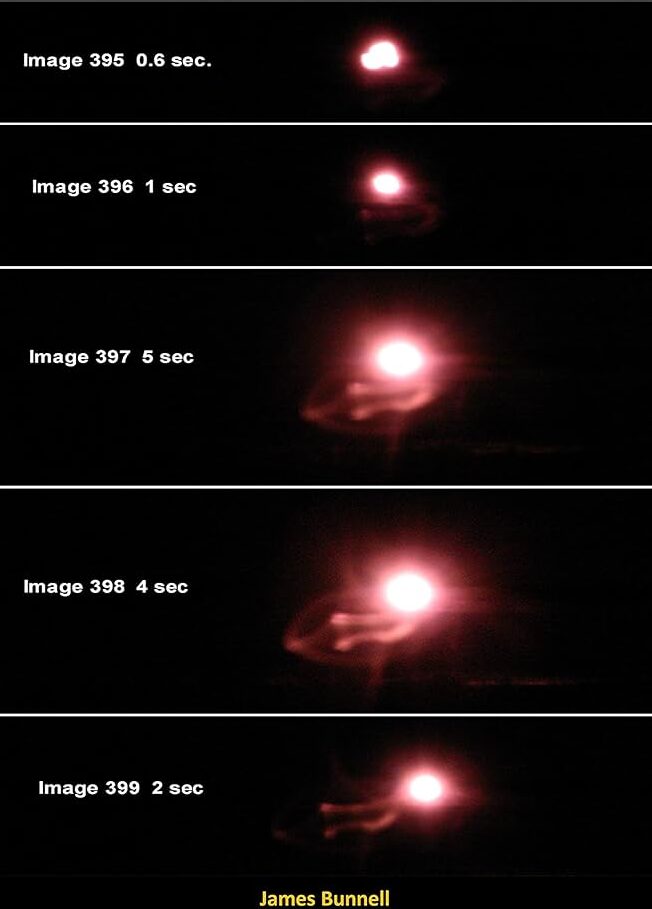
One modern contribution that complicates the “case closed” narrative is James Bunnell’s Hunting Marfa Lights. Bunnell, a retired aerospace engineer, conducted years of personal observation from multiple locations around Mitchell Flat rather than relying solely on the official viewing area. In his book, he argues that while many lights can indeed be traced to highways and other mundane sources, there remains a subset he considers inconsistent with vehicle traffic based on geometry, timing, and line-of-sight analysis. He proposes that at least some recurring lights originate within a relatively confined area of the desert itself, and he attempts to map their apparent positions and behavior over time. Critics note that his conclusions depend heavily on observational interpretation rather than peer-reviewed instrumentation, but supporters see the work as an example of sustained, methodical civilian field study. In the ecosystem of Marfa literature, Bunnell’s book sits between folklore and formal spectroscopy: more analytical than legend, less controlled than laboratory science, and emblematic of why the debate persists.
Editorial access note: some materials often cited in Marfa discussions are hosted on platforms like ResearchGate and Academia.edu. Those can be helpful for discovery, but availability can vary, versions can be preprints, and citation trails can be incomplete. Use them as pointers, not as the final authority when peer-reviewed or institutional sources exist.
Why Marfa remains a high-strangeness hotspot even under prosaic explanations
It might sound paradoxical, but one reason Marfa stays powerful is that the best explanations do not make the experience less uncanny for most people.
If you tell a visitor, “Those are headlights on a highway you cannot see,” you have not actually removed the strangeness of watching a light split, hover, dim, and return at the horizon. You have explained a source, but you have not replaced the felt sense of encounter. The desert night still does its work on attention.
This is one of the under-discussed dynamics in UAP research: a significant fraction of the field’s cultural energy comes from threshold phenomena. Things that are mundane in origin but uncanny in presentation.
Places like Marfa become training grounds for how human perception handles distance, darkness, expectation, and uncertainty. They also become story engines. People arrive as observers and leave as narrators.
The implication is not that Marfa should be dismissed. The implication is that Marfa should be used carefully. It is a reminder that witnesses can be fully sincere and still be wrong about what they saw. It is also a reminder that “wrong about the source” does not mean “lying,” and it does not mean “nothing happened.”
Controversies, tightened and source-clean
The controversies around Marfa tend to cluster around three arguments.
One is definitional: what counts as a “true” Marfa Light. The spectroscopic study’s logic implies a strict definition would require ruling out known confounds like headlamps and fires, which is harder than most casual watching. (AIP Publishing)
The second is historical: what to do with pre-automobile accounts. The best approach is not to overclaim. Early accounts establish continuity of reports; they do not, by themselves, prove a non-prosaic cause. (donswaim.com)
The third is evidentiary: photographs and videos. Some long analyses argue that certain famous photographic effects can be explained through imaging artifacts and reconstruction. Those arguments may be interesting, but unless they are peer-reviewed or anchored in directly accessible primary material, they should be treated as secondary commentary rather than a foundation.
Implications for future research
If you wanted to move Marfa closer to a true “case closure” standard, you would not start with louder claims. You would start with better instrumentation.
The best design would treat the viewing area as a public intake point, not the primary measurement site. You would place synchronized cameras at multiple locations to triangulate distance and altitude, pair them with spectroscopy, and continuously log meteorological profiles to model refraction conditions. Then you would map every observed light against traffic data and known fixed sources. Anything left over would be the remainder worth arguing about.
And if nothing remains, that would still be an important result. It would show, publicly and repeatably, how easily ordinary lights can masquerade as anomalies when the environment is doing optical tricks.
If something does remain, even rarely, then Marfa becomes the kind of hotspot that matters to the wider UAP question: a place where you can return, instrument, and potentially capture high-quality evidence under controlled conditions.
Claims taxonomy
Verified
The Marfa Lights are a long-reported West Texas light phenomenon with consistent descriptions in reputable regional historical documentation, and an official viewing area east of Marfa exists to facilitate public observation. (donswaim.com)
Probable
Many lights observed from the official viewing area, particularly in the sector aligned with distant highways, can be attributed to vehicle headlights and other ordinary light sources, with atmospheric effects contributing to apparent strange behavior. (Wikipedia)
Disputed
The claim that all historical and modern Marfa Lights reports can be reduced to traffic and other mundane sources across all locations, eras, and witness contexts. The best studies strongly explain many candidates, but they do not constitute universal proof that no anomalous remainder has ever occurred. This remains a research question, not an evidentially established residual. (AIP Publishing)
Legend
Folkloric narratives that frame the lights as ghosts, lost treasure seekers, or other supernatural agents. These stories are culturally meaningful but are presented as legend rather than testable claims. (donswaim.com)
Misidentification
Individual sightings that map to aircraft, tower beacons, ranch lights, highway headlights, or small fires, especially when observed from the viewing area without triangulation. (Wikipedia)
Speculation labels
Hypothesis
Some speculative proposals in popular coverage suggest local geology and electrical effects could play a role in rare luminous phenomena. These ideas are not established by the strongest Marfa studies and should be treated as hypotheses pending primary evidence.
Witness Interpretation
Some witnesses interpret the lights as interactive or purposeful, including reports framed as guidance or friendliness. This is part of the lived Marfa tradition and is documented in regional historical summaries. (donswaim.com)
Researcher Opinion
Researchers involved in instrumented work emphasize that false positives are common and that careful methods can identify mundane sources even when the visual experience feels extraordinary. (AIP Publishing)
References
Texas State Historical Association. (n.d.). Marfa Lights. Handbook of Texas Online. (donswaim.com)
Stephan, K. D., et al. (2009). Spectroscopy applied to observations of terrestrial light sources of uncertain origin. American Journal of Physics, 77(8), 697. Editorial access note: may require subscription on the publisher site; abstract and indexing entries are publicly reachable. (AIP Publishing)
Society of Physics Students, University of Texas at Dallas. (2004, May). Investigation of lights observed near Marfa, Texas (commonly cited student report; often accessed via secondary summaries). Editorial access note: original report can be difficult to locate in stable archival form; treat summaries as supporting rather than definitive. (Wikipedia)
Stephan, K. D., et al. (2011). Quantitative intensity and location measurements of an intense long-duration luminous object near Marfa, Texas. Journal of Atmospheric and Solar-Terrestrial Physics, 73, 1953–1958. (ScienceDirect)
Visit Marfa. (n.d.). Mystery. Editorial access note: tourism and visitor context, not a technical source.
SEO keywords
Marfa Lights, Marfa Texas UAP, West Texas lights, Marfa mystery lights, Mitchell Flat lights, Paisano Pass lights, UAP hotspot Texas, atmospheric refraction lights, mirage effect headlights, Society of Physics Students UTD Marfa study, Texas State University Marfa spectroscopy, American Journal of Physics Marfa lights, Chinati Mountains night lights, desert high-strangeness hotspot