
There’s a special kind of dread that only arrives when a narrative sounds like it is trying not to be a narrative.
H. G. Wells’ The War of the Worlds does not announce itself like a myth. It opens like a quiet record: telescopes pointed at Mars, modest English towns going about their routines, and a first-person narrator who seems to believe that if he reports everything plainly enough, the world will snap back into place.
That documentary texture is one reason the book still feels modern. It also explains why UAP researchers keep circling it, not as “a case,” but as a cultural hinge point, a late-Victorian story that borrows the era’s real astronomical debates and then turns them into a highly plausible “this happened to us” account.
This article treats Wells’ 1897 serial as part of the pre-20th-century conversation that Jacques Vallée and Chris Aubeck chart in Wonders in the Sky: a long arc of sky-anomaly reports, interpretations, and social reactions that evolve with each century’s expectations.
A serial that arrived like a monthly bulletin
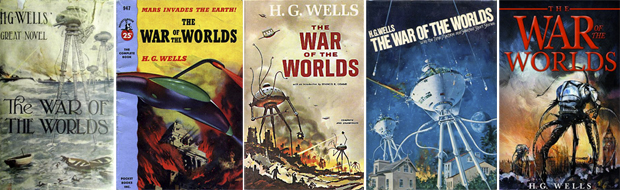
Many people see The War of the Worlds as an 1898 book and never learn that the public first encountered it in 1897 as a serial. That difference matters because serialized reading changes the psychological experience. You don’t devour an invasion in one evening; you live with it in intervals, discussing it between instalments, building expectations, and letting uncertainty linger.
The University of Calgary’s Archives and Special Collections preserve a primary artifact of that first encounter: “Part 1 of 9” in Pearson’s Magazine (UK), dated April 1897. (Digital Collections) Britannica likewise states that the story ran between April and December 1897, serialized in Pearson’s Magazine in the UK and The Cosmopolitan in the US. (Encyclopedia Britannica)
It wasn’t only the text that gave the story its “report” feeling. The serial versions were illustrated by Warwick Goble, whose images appeared alongside the narrative in the magazines which added to the realism.
A supporting detail is that later commentary on Goble notes how his early illustration work for the serial sank into obscurity in some editions, implying that the original magazine presentation was meaningfully different from later book encounters. (Victorian Web)
“Lights on Mars” were a real Victorian puzzle
Wells begins with astronomy because astronomy in the 1890s was unusually alive with public speculation. Mars, in particular, had become the planet onto which modern minds projected both hope and dread. The canal controversy, popularized maps, and better telescopes combined into a cultural moment where “intelligence on Mars” did not sound like a joke.
One concrete thread in that moment is a cluster of reported observations of bright projections or prominences near the Martian terminator during the 1894 opposition. These were discussed seriously in scientific venues.
W. W. Campbell’s 1894 paper, preserved in the Astrophysics Data System, explicitly addresses “bright projections observed on the terminator of Mars.” (Astrophysics Data System) Another 1894 discussion preserved by ADS, by E. S. Holden, references an unsigned Nature article (August 2, 1894) in the context of these projections, showing that the debate crossed institutional boundaries rather than living in a single observatory’s notes. (Astrophysics Data System)
These were not “proof” of Martian technology, and modern planetary science offers many reasons to suspect observational artifacts, atmospheric effects, contrast illusions, and instrument limits could create convincing transient features. But historically, what matters is that late-Victorian observers were seeing something they felt required explanation, and they were publishing those explanations.
That is exactly the kind of liminal zone Wells loved: a real scientific ambiguity that can be dramatized without breaking plausibility.
In UAP terms, this is a familiar pattern. Ambiguous luminous phenomena, reported by credible observers, produce a “meaning vacuum.” The vacuum gets filled by whatever interpretive models the culture has ready.
In earlier centuries it might be prodigies or divine signs. In the 1890s, it could be “signals” from Mars.
The canal mirage and a word that changed everything
A second, widely documented thread is the “canal” story itself. Schiaparelli’s canali being translated and culturally transformed into engineered “canals” created a durable mental picture: Mars as inhabited, organized, and purposeful. Later popularizers, including Lowell, reinforced the idea with maps and a confident narrative voice.
The historical canal maps, now widely reproduced and studied, show how quickly observational sketches can harden into cultural certainties. (TX Almanac) The maps are fascinating not because they “proved”, but because they show a mind trying to impose order on borderline data.
Wells’ move was to pivot from romantic engineering to ecological predation. His Martians are not canal-builders offering correspondence. They are a collapsing, desperate intelligence doing what empires do when resources tighten.
That imperial mirror reading is common in literary scholarship, but it’s still an interpretation rather than a settled fact of authorial intent. What is historically secure is that the novel emerged within a broader climate of imperial anxiety, technological acceleration, and public fascination with Mars, and it drew directly from that atmosphere.
Case study: the 1896–97 American “airship” wave
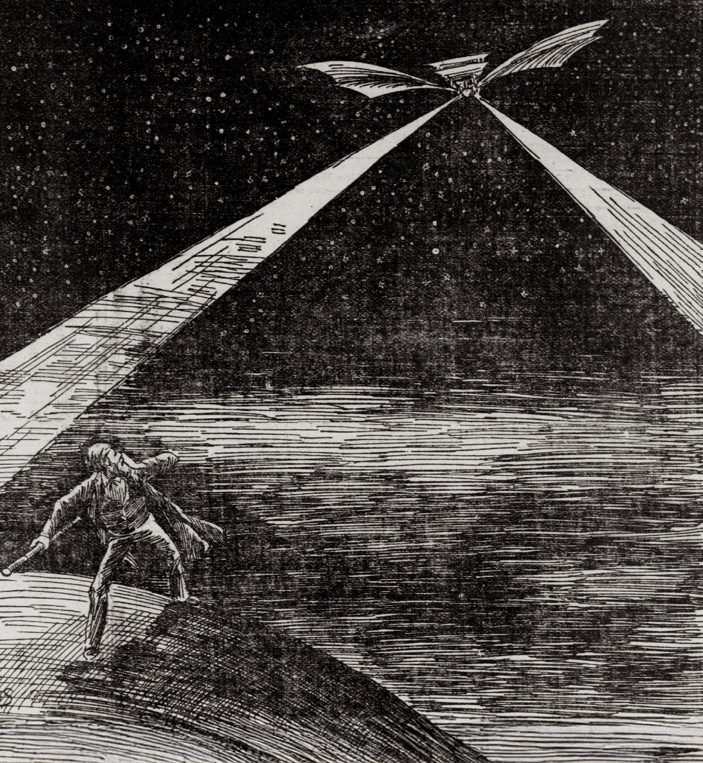
If Wells’ serialized invasion gave Britain a dramatic imagined encounter, the United States around the same time generated a different kind of strangeness: a widespread wave of “mystery airship” sightings in 1896–97.
This matters in a pre-20th-century UAP frame because it arrives before the Wright brothers’ 1903 flight and therefore sits uneasily with neat technological timelines.
A strong, source-based summary is Readex’s overview, built around U.S. historical newspaper coverage, which notes that the wave ran for months beginning in November 1896 and erupted again in the Midwest and Texas in 1897. (Readex)
Texas provides some of the densest reporting, and the Texas Almanac notes a cluster of reports between April 13 and 17, 1897, describing “38” reported sightings across “23 counties.” (TX Almanac)
What does that mean? It means the public was already primed to read aerial anomalies as structured craft with purpose and routes, even in an era that technically “shouldn’t” have had them. That priming could be technological imagination, rumor contagion, misinterpretations of bright objects, deliberate tall tales, or a complex mixture. The evidence supports a mixed ecology rather than a single clean explanation.
Aurora, Texas: naming the story and its author
Any serious discussion of the airship wave has to deal with the Aurora, Texas crash. In April 1897, the Dallas Morning News published S. E. Haydon’s front-page article “A Windmill Demolishes It,” claiming that a cigar-shaped airship crashed into Judge J. S. Proctor’s windmill in Aurora, Texas, scattering strange metal debris and killing a pilot described as “not of this world”. The body was reportedly buried with Christian rites in Aurora Cemetery, and wreckage was said to have been dumped into a nearby well . The incident occurred during the broader 1896-97 American “mystery airship” wave, a period marked by widespread reports of structured, lighted craft across multiple states, including a dense cluster in Texas. Within that larger flap, the Aurora case stood out because it escalated beyond a sighting narrative into a full crash-and-burial story, making it an early prototype of what would later be called a UAP crash retrieval .
Skeptics have long argued that the story was a publicity invention, noting Aurora’s economic struggles in the 1890s and the lack of independent physical evidence, a view reflected in modern historical summaries that treat the crash as folklore . Yet the legend persisted. In 1973, MUFON investigator Bill Case interviewed elderly residents who recalled family accounts of the crash and identified an unmarked grave allegedly linked to the pilot, though exhumation was denied and the grave marker later disappeared. Later inspections of the well beneath the former windmill site found elevated aluminum levels but no definitive artifacts. Today, the case remains unresolved: the original newspaper article is real, the airship wave is well documented, and the cemetery legend endures, but no authenticated debris, burial record, or contemporaneous investigation confirms the extraordinary claims.
1938: fear happened, nationwide “panic” is disputed
Wells’ story gained a second life when Orson Welles and the Mercury Theatre adapted it for radio on October 30, 1938, using a “news bulletin” style presentation. The question is not whether anyone was frightened. The question is how widespread that fear was, and how the legend grew.
The National Archives’ Prologue article documents letters sent to the Federal Communications Commission and preserves the institutional record of complaint and alarm, making it clear that some listeners were genuinely disturbed, angry, or frightened. (National Archives) That’s the grounded core: fear and complaint existed, and it left paperwork.
At the same time, Pooley and Socolow’s analysis argues that the later story of nationwide hysteria was exaggerated, a legend that outgrew the evidence. (Bunk History)
A careful synthesis is therefore straightforward: some listeners were genuinely frightened and wrote to authorities, but the familiar image of a whole nation stampeding into the streets is disputed and likely inflated by later retellings and competitive media framing. (National Archives)
For UAP research, this is a clean case study in how “public reaction” can become a myth of its own. Once a compelling narrative about reaction exists, it can be repeated as if it were the event, even when the underlying evidence suggests a narrower phenomenon.
Why the novel reads like a witness statement
Here is where interpretation is unavoidable, but it can still be responsibly framed.
This article argues that Wells’ most enduring achievement is not the Martians. It is the voice. He writes the invasion as if it is being reconstructed under stress, with the kinds of ordinary details that witnesses reach for when they are trying to prove to you that they are sane: the rail lines, the crowds, the weather, the way officials talk, the way rumors spread, the way certainty collapses one small contradiction at a time.
That is a literary technique, but it also resembles how many first-hand UAP narratives are structured. Witnesses often begin with a normal scene and then describe an intrusion that forces them into an awkward sequence: initial misidentification, dawning strangeness, fear or awe, then an attempt to re-stabilize meaning after the fact.
To be clear, that resemblance does not demonstrate a shared cause. It demonstrates a shared human process when perception outruns explanation.
Wells also builds an institutional drama that feels psychologically credible. Authorities respond in stages: dismissal, confident engagement, then chaos when their models fail.
That, too, parallels how societies respond to anomalies in many historical records, including the pre-1879 cases Vallée and Aubeck compiled, where officials alternately moralize, rationalize, or suppress, depending on what the event threatens.
Placing Wells inside “Wonders in the Sky” logic
Vallée and Aubeck end their core catalogue in 1879, partly because the late 19th century introduces rapidly expanding human aerial technology that complicates attribution. Wells appears just beyond that boundary, and that is exactly why he is valuable here. He is writing in the moment when older sky-wonder traditions are still culturally alive, but the modern, mechanical imagination has started to dominate.
So what does Wells contribute to a pre-20th-century UAP framing? Not evidence, but a shift in the “available metaphors.”
Once you have a widely read story of extraterrestrial cylinders landing, heat rays, official bulletins, and desperate crowds, your culture has rehearsed a particular kind of encounter script.
The next time something strange happens overhead, that script is sitting in the back of the mind, ready to supply language.
Implications for UAP historical literacy
If you’re building a serious UAP historical lens, Wells offers three practical lessons.
First, ambiguity is not a defect in the historical record; it’s a property of many sky anomalies. The Mars “bright projections” debate shows that even trained observers can end up with contested interpretations while still acting in good faith. (Astrophysics Data System)
Second, waves are often mixed. The 1896–97 airship reports contain everything from sober observations to obvious inventions. If you treat the entire wave as a single thing, you will either credulously accept too much or dismiss too much. A better method is to separate sub-cases and track which details recur across independent sources. (Readex)
Third, reaction myths are real phenomena. The 1938 broadcast shows how a dramatic format can produce genuine fear in some listeners while later retellings inflate that fear into a national legend. The myth is itself a cultural artifact worth studying because it demonstrates how societies metabolize “invasion from above” narratives. (National Archives)
Speculation labels
Hypothesis
Widely circulated invasion fiction in the late 19th and early 20th centuries helped standardize the language people used for aerial anomalies, increasing the likelihood that later witnesses reached for “craft,” “occupants,” and “signals” frameworks when describing ambiguous events.
Witness Interpretation
Some 1896-97 “airship” witnesses may have interpreted unusual lights or distant objects as structured machines because that was the nearest technological metaphor available in the press environment of the time, rather than because the objects were definitively engineered airships.
Researcher Opinion
The War of the Worlds functions as a cultural hinge between older “wonders in the sky” traditions and later aerospace-era encounter narratives, not by proving anything about the sky itself, but by making the “visitor from above” scenario feel reportable in a modern, first-person way. (This is a reasoned interpretation of media influence rather than a documented causal chain.)
Claims taxonomy
Verified
- The War of the Worlds was first encountered by many readers as an 1897 serial in Pearson’s Magazine (UK) and The Cosmopolitan (US), rather than only as an 1898 book. (Digital Collections)
- Late-19th-century astronomers published and debated observations described as bright projections or prominences near the Martian terminator during the 1894 opposition, including in venues preserved by ADS. (Astrophysics Data System)
Probable
- The 1896-97 American “mystery airship” wave represents a real, multi-month reporting episode visible across historical newspapers, with a dense Texas cluster in April 1897. (Readex)
Disputed
- The 1938 radio adaptation frightened some listeners and generated complaints recorded in federal archives, but the later story of nationwide mass panic is contested and likely exaggerated. (National Archives)
- The Aurora, Texas crash narrative originates with an April 19, 1897 story by S. E. Haydon in the Dallas Morning News, which was characterized as fictional by the Texas State Historical Association but is considered factual by expert researchers. (Texas State Historical Association)
References
Aubeck, C., & Vallée, J. (2009). Wonders in the Sky: Unexplained aerial objects from antiquity through 1879 and their impact on human culture, history, and beliefs. Tarcher/Penguin.
Campbell, W. W. (1894). An explanation of the bright projections observed on the terminator of Mars. Publications of the Astronomical Society of the Pacific. (Astrophysics Data System)
Holden, E. S. (1894). Bright projections at the terminator of Mars. Publications of the Astronomical Society of the Pacific. (Astrophysics Data System)
Potter, L. A. (2003). “Jitterbugs” and “Crack-pots”: Letters to the FCC about the “War of the Worlds” broadcast. Prologue Magazine, U.S. National Archives. (National Archives)
Pooley, J., & Socolow, M. J. (2013, October 28). The myth of the War of the Worlds panic. Slate (via Bunk History). (Bunk History)
Readex. (2014, September 12). UFO fever in America’s historical newspapers: The mysterious airships of 1896–97. (Readex)
Texas Almanac. (n.d.). When airships invaded Texas. (TX Almanac)
Texas State Historical Association. (n.d.). Author attempts to jump-start town with fictional UFO story (S. E. Haydon; Dallas Morning News, April 19, 1897). (Texas State Historical Association)
University of Calgary Digital Collections. (1897). The War of the Worlds (Part 1 of 9) in Pearson’s Magazine (UK) (April 1897). (Digital Collections)
Suggested internal crosslinks for UAPedia
SEO keywords
H G Wells War of the Worlds 1897, War of the Worlds Pearson’s Magazine April 1897, Cosmopolitan serialization 1897, Warwick Goble illustrations War of the Worlds, Victorian Mars observations bright projections 1894, Campbell bright projections Mars PASP 1894, Nature Mars terminator projections 1894, American mystery airship wave 1896 1897 historical newspapers, Texas airship sightings April 1897, Aurora Texas airship crash Dallas Morning News April 19 1897 S E Haydon, Orson Welles 1938 War of the Worlds broadcast reaction, FCC letters War of the Worlds National Archives, myth of War of the Worlds panic Pooley Socolow, pre-20th-century UAP cultural history, Wonders in the Sky Vallée Aubeck context