In the high plateaus of Tibet and the Himalayan cultural world, there are deathbed stories that do not end with a funeral. They end with a room full of witnesses watching a body behave in ways a body is not supposed to behave: shrinking, refusing to decompose “normally,” sometimes accompanied by reports of unusual lights, fragrances, and rainbows.
The tradition calls this rainbow body, in Tibetan “’ja’ lus” (often rendered jalü/jalus). It is usually presented as a rare fruition of Great Perfection practice (Dzogchen) and, in parallel ways, of Bön Dzogchen. At death, the elements of the body are said to purify into light. In some tellings the body diminishes drastically, leaving only hair and nails. In the most dramatic tellings, it disappears entirely.
A lot of articles about the rainbow body try to win you over quickly. They either treat it as a solved miracle or dismiss it as folklore. UAPedia’s approach is different: we take witness testimony seriously, we respect religious context, and we also insist on clear boundaries between what is reported, what is documented, and what is inferred.
So here’s the honest framing up front. The evidence base for the rainbow body is composed primarily of testimonial and textual sources, whose interpretation remains contested.
That does not make the topic trivial. It makes it the kind of topic that benefits from an explainer that stays close to what people actually say they saw, what investigators claim they recorded, and what modern research can and cannot evaluate.
What “rainbow body” actually means
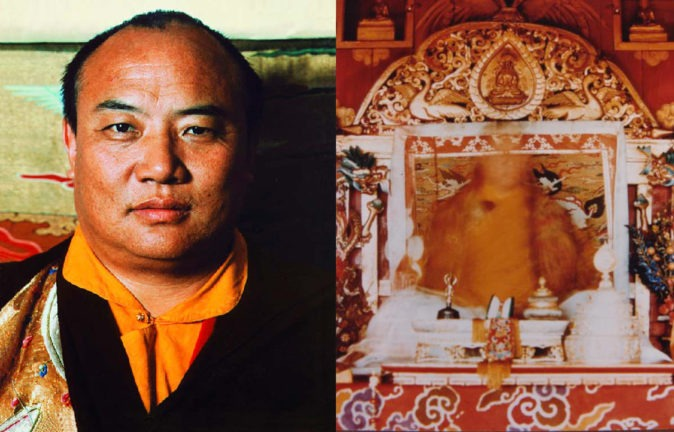
In the simplest terms, the rainbow body is the claim that extreme spiritual realization can change what happens at death so profoundly that the body does not proceed through an ordinary postmortem trajectory. Tibetan sources describe it as a transformation where the “coarse” physical body resolves into its luminous aspect, sometimes described as the “five lights” associated with the five elements.
A nuance that matters is that the rainbow body is spoken about in more than one register at once.
In an inner register, it’s about realization: the recognition that awareness and appearance are not separate, and that the world’s apparent solidity is not the final word about what reality is.
In an outer register, it is about physical signs that others might observe: shrinkage, an absence of decay, or, in the most dramatic accounts, disappearance.
That outer register is where the modern controversy lives. It is also where misunderstanding tends to breed.
Dzogchen teachers often caution that the rainbow body is not an achievement badge or a paranormal performance. Chögyal Namkhai Norbu, speaking in a published Dzogchen Community text, stresses that the rainbow body is spoken of as real within the tradition while also emphasizing how difficult it is, and how unhelpful it is to turn it into spectacle.
That caution helps explain a practical point: the very communities most likely to report rainbow bodies are also communities least likely to stage it for outsiders, instrument it, or publicize it in ways that satisfy modern evidentiary appetites. That doesn’t settle the question. It does explain why the record looks the way it does.
Deep roots: Dzogchen, Bön, and the long memory of light
The rainbow body is most commonly discussed within Tibetan Buddhism, particularly in Nyingma Dzogchen lineages, but it is also prominent in the Bön tradition.
This matters because it shows the rainbow body is not a one-off rumor. It is embedded in a detailed practice universe with vocabulary, methods, and expectations.
A key Bön Dzogchen text often referenced in modern discussions is Heart Drops of Dharmakaya, attributed to the Bön master Shardza Tashi Gyaltsen. In English-language publishing, the text is frequently introduced as a complete presentation of Dzogchen teachings within Bön and a doorway into the tradition’s “body of light” discourse. (Shambhala/Snow Lion, n.d.; Tricycle, 2000)
On the academic side, comparative scholarship has treated “light” experiences as a serious cross-cultural religious motif. The University of Chicago Press volume The Presence of Light: Divine Radiance and Religious Experience includes Matthew Kapstein’s chapter addressing the rainbow body within Tibetan esoteric tradition, framing it as part of a broader religious language of radiance and transformation.
That doesn’t verify physical dissolution, but it does establish something crucial: rainbow body is a stable, technical claim in a coherent religious system, not an improvisation. If we’re going to evaluate testimony, we should evaluate it as testimony about a known doctrinal target, not as a random anecdote.
How it is supposed to happen, in Tibetan terms
If you ask practitioners to explain the rainbow body without mystifying it, they usually return to three pillars: view, practice, fruition.
The view is that reality is already luminous, and the apparent solidity of self and world is not the final description of what is happening.
The practice, in Dzogchen terms, includes approaches commonly described (in English) as “cutting through” and “direct crossing,” which are intended to stabilize recognition of the mind’s nature and, in some presentations, cultivate experiences of light and vision as the nature of appearance reveals itself.
The fruition is the claim that at death, instead of the body following an ordinary dissolution and decay process, the practitioner’s realization is said to catalyze an unusual resolution of the elements into light.
Even inside Tibetan contexts, there are gradations. Some presentations describe shrinkage with residual hair and nails as a kind of “standard” rainbow body report, while more extreme versions are described as leaving little or no residue.
This is where outsiders often get impatient. “Okay,” the modern mind says, “show me the remains.” But the rainbow body is almost never offered as a repeatable demonstration. It is offered as a byproduct of realization, witnessed by attendants and communities, sometimes remembered for centuries, and only rarely intersecting with modern documentation.
Case file 1: Khenpo A Chö and the week the body “went away”
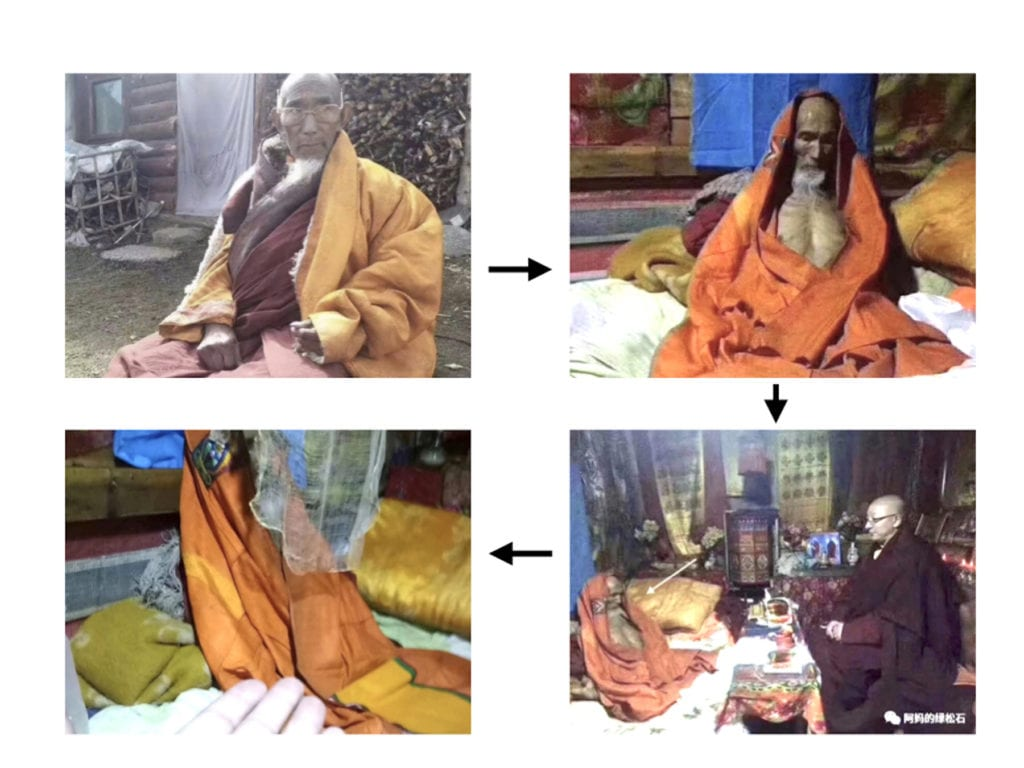
If there is a modern case that repeatedly draws investigators, it is Khenpo A Chö (1918–1998), a Tibetan monk whose death became the center of a serious, if still controversial, investigation effort.
A widely circulated narrative comes from Gail Holland’s article (originally in the Institute of Noetic Sciences Review, later archived by Snow Lion). In that account, Benedictine monk David Steindl-Rast hears Tibetan stories of bodies disappearing after death and contacts Marilyn Schlitz at the Institute of Noetic Sciences (IONS), who expresses interest in investigating within a “rigorous critical frame.”
The same piece describes how Father Francis V. Tiso becomes involved and travels to Tibet. Holland reports that Tiso recorded interviews with eyewitnesses and that witnesses described a cluster of signs: rainbows appearing, the body appearing luminous beneath a robe, shrinkage over several days, fragrances, and, after a period of days, no body remaining.
Tiso’s own lecture material from the University of Hong Kong describes his approach as fieldwork centered on narrative communities and the challenge of evaluating extraordinary death claims across cultural worlds. He reports interviewing eyewitnesses in eastern Tibet and India after first hearing of the case in 1999.
Michael Sheehy’s review of Tiso’s later book notes that the chapter on Khenpo A Chö includes fieldwork logs and interview transcripts, and he highlights the core methodological reality: you cannot recreate a deathbed transformation under controlled conditions, so you are left with anthropological methods and the integrity of informants.
You might have noticed something: the core of this case rests on reported interviews rather than publicly accessible primary artifacts, which is a constraint.
It’s also the place where earlier versions of this article can accidentally overreach. For example, some retellings mention that “local Chinese press” reported dramatic shrinkage or disappearance, or that “official investigations” produced documentation. In the sources available publicly, these claims appear as secondary reports within broader narratives rather than as primary documents that a reader can independently verify. A responsible framing is therefore: these claims are reported in secondary sources but lack publicly accessible primary documentation.
There is also an additional narrative source, the Xuanfa Institute article presenting comments attributed to Khenpo Achuk Rinpoche.
It states that local officials investigated and that documentation was produced, and it argues against the idea that disciples concealed remains.
This is valuable as a record of what insiders claim, but it is not the same as providing those official documents.
So where does that leave Khenpo A Chö?
It leaves us with a strong testimony-centered case that has attracted sustained attention, where consistent motifs appear across retellings and where an investigator claims to have recorded eyewitness interviews. It also leaves us with the limitations typical of many miracle-adjacent cases: restricted access, cultural sensitivity, and the absence of forensic verification.
One more correction matters here, because it shapes how we read “consistency.” It is true that similar motifs appear across regions and decades in rainbow body stories, but that recurrence is not automatically evidentially strong.
These recurring motifs may reflect shared doctrinal expectations rather than independent physical verification.
In other words, consistency can mean “a real pattern in reality,” or it can mean “a stable narrative template transmitted through a culture.” Both are plausible.
Case file 2: Shardza Tashi Gyaltsen and Bön’s memory vault
If Khenpo A Chö is the modern “investigation case,” Shardza Tashi Gyaltsen is the lineage anchor, especially for Bön Dzogchen.
Shardza (1859–1930s) is widely cited as a major Bön master associated with rainbow body attainment in the early twentieth century. English-language Bön contexts regularly present his attainment as a landmark event, and modern Bön organizations commemorate the anniversary.
Here the evidence is of a different type. It is community memory, calendared commemoration, lineage biography, and doctrinal continuity. That creates a strong internal record and a weak external record, at least from a modern verification standpoint.
There’s also a revealing wrinkle: the Gregorian date differs across sources. A FPYB post maps the Tibetan calendar date to 1934 and another biography places it in 1935.
This discrepancy does not disprove anything. It does remind us that converting Tibetan calendrical dating into Western dating is messy, and that secondary retellings can diverge even when the community’s central claim remains stable.
As with many religious miracle narratives, the question becomes: what kind of evidence are we actually asking for?
If we ask for community evidence, Shardza’s case is substantial. If we ask for external, contemporaneous forensic documentation, it is limited in what is publicly accessible today.
Case file 3: Nyala Pema Dudul and the “literary technology” of rainbow body
Not every important case is modern. Some are important because they show how the rainbow body functions inside Tibetan religious biography.
Nyala Pema Dudul (1816–1872) is often cited as a historical figure connected with rainbow body narratives, including a life story written about by Mipham Gyatso, and Kapstein’s scholarship addresses how such narratives work in Tibetan esoteric traditions.
Why include this in an explainer that cares about witnesses?
Because it helps separate two things that are otherwise tangled: narrative continuity and physical claims. Pema Dudul’s story illustrates how Tibetan communities encode “light at death” as both a spiritual claim and a social signal: it marks someone as fully realized and reinforces the plausibility of the path.
That makes the rainbow body a kind of cultural technology. It tells communities what spiritual success looks like.
That’s meaningful. It also complicates later evidence because narrative templates can shape perception. If a community expects specific signs, those signs can be noticed, emphasized, or remembered in ways that align with expectation. Publications that shaped modern discourse
The rainbow body is not only oral tradition. It has a publication ecosystem that makes it legible to outsiders and, importantly, makes it arguable.
Francis V. Tiso’s Rainbow Body and Resurrection (North Atlantic Books, 2016) is one of the most cited contemporary works connecting the Khenpo A Chö case to broader questions about bodily transformation and comparative mysticism. Tiso also published a methodological reflection in the Journal of Religion and Health on how to research rainbow body claims without collapsing into either naïve belief or dismissive reductionism.
Loel Guinness’s Rainbow Body (Serindia Publications) focuses on Bön contexts and positions itself as a modern study of the phenomenon’s doctrinal and historical landscape.
And then there are bridge texts: Heart Drops of Dharmakaya and related commentary help explain why practitioners think such a transformation is even plausible within their worldview, while scholarly works like Kapstein’s situate it in a broader study of religious radiance.
This ecosystem matters because it shapes how a claim is preserved, transmitted, and interpreted. It also shapes how it can be contested.
What “official studies” can tell us
Let’s be direct: there are no mainstream biomedical studies that confirm a human body dissolving into light.
However, there is an adjacent body of modern research that intersects the same cultural terrain: scientific studies of tukdam, a postmortem meditative state described in Tibetan Buddhism. Tukdam is not a rainbow body, and we should not collapse them.
But the overlap is real: both involve unusual death signs and claims of atypical postmortem processes.
A peer-reviewed article in Culture, Medicine, and Psychiatry discusses the “Tukdam Study” as a biocultural collaboration between Tibetan monastic communities and biomedical researchers, including attention to perceptual cues like warmth, skin appearance, and reported delays in decomposition.
A 2024 forensic case report in Forensic Science International: Reports documents two cases of delayed decompositional changes in indoor settings among Tibetan monastic communities in India, with systematic photography, videography, and external measures.
The authors frame their report cautiously, as a basis for hypotheses about variables influencing decomposition, not as proof of spiritual transformation.
What does this imply for the rainbow body?
It implies that at least one cluster of Tibetan postmortem claims is being approached with instrumentation and cautious biomedical framing. It does not imply the rainbow body is confirmed. It does suggest a pathway for future work: if a rainbow body case were to occur with community consent, rigorous documentation protocols could be developed drawing on the methodological lessons of tukdam research.
Skeptical lens without flattening the tradition
A fair skeptical analysis is not just a token paragraph of doubt. It asks what we know about how humans perceive, remember, and narrate extraordinary events, especially around death.
Deathbed perception is a high-bias environment. Grief can intensify meaning-making. Ritual contexts can direct attention. Memory can become communal quickly, especially in traditions where disciples share stories as devotional teaching. Even sincere witnesses can overinterpret ambiguous stimuli when those stimuli carry spiritual significance.
Expectation bias is particularly relevant here. If a community has a strong template for what rainbow body signs “look like,” then certain sensory events, a rainbow after a storm, a sweet smell from incense, a body appearing luminous under cloth in a dim room, can be interpreted through that template.
Anthropology also gives us precedent for miracle narratives. Across cultures, there are recurring motifs: light at death, incorrupt bodies, fragrances, shrinking remains, relics. The recurrence itself can mean two different things. It can mean there is a real underlying phenomenon humans occasionally observe. Or it can mean humans have a limited set of narrative tools for representing sanctity, and those tools repeat.
Then there is the practical verification problem: most rainbow body accounts do not involve controlled observation. Bodies are often wrapped, guarded, and handled according to ritual norms.
Outsiders rarely have continuous access. Cameras, if present, are not necessarily continuous or secured. Environmental variables are not systematically recorded. Even well-intentioned investigators are working in conditions that would not satisfy forensic standards.
Finally, there is the epistemic mismatch. Tibetan traditions often treat realization and its signs as meaningfully real even when they do not map neatly onto Western materialist categories. A researcher can respect that without granting physical claims more certainty than the evidence supports.
When we apply this skeptical lens to the major cases, what changes is not the fascination of the story. What changes is our confidence level. We learn to say “reported,” “claimed,” and “consistent within tradition,” rather than “confirmed.”
Why this matters for a broader map of high-strangeness
Rainbow body sits at the intersection of religious experience, anomalous light phenomena, and mind-matter boundary questions. Even if you never connect it to UAP narratives, it belongs in the wider study of how humans report luminous anomalies and transformative encounters that feel both physical and not-physical.
From a high-strangeness perspective, the rainbow body is also a reminder that “the anomalous” is not always an interruption from outside. Sometimes, in the world’s oldest traditions, the anomalous is cultivated from within through decades of disciplined practice.
That alone makes the rainbow body worth documenting carefully and conservatively.
Implications
If the rainbow body is literal in even a handful of cases, it implies that human embodiment may have edge-case plasticity not captured by current models, especially at death. That would not instantly rewrite physics, but it would demand careful, ethical research bridging contemplative traditions and forensic documentation.
If the rainbow body is not literal, but is a stable religious narrative and interpretive system, it still has real-world effects. It shapes communities, motivates practice, and constructs a vivid language for sanctity that has persisted across centuries. That is a significant cultural phenomenon even if the physical claim remains unverified.
Either way, the topic teaches an important research lesson: extraordinary claims require more than fascination. They require the patience to distinguish testimony from documentation, doctrine from measurement, and meaning from mechanism.
Claims taxonomy
Verified
Rainbow body as a defined doctrinal concept in Dzogchen and Bön Dzogchen is well-attested in contemporary explanations, lineage discourse, and published discussions. This is a verified cultural and textual claim. (Rigpa Wiki, n.d.; Kapstein, 2004)
Probable
The Khenpo A Chö (1998) case is supported by multiple converging secondary accounts and by an investigator’s claim of recorded eyewitness interviews. The reported sign cluster is consistent across retellings. However, publicly accessible primary documentation is limited, controlled observation is absent, and prosaic explanations cannot be excluded. (Holland, 2002; Tiso, 2021; Sheehy, 2018)
Disputed
Shardza Tashi Gyaltsen’s attainment is treated as historical fact within Bön communities and is regularly commemorated, but publicly accessible external documentation remains limited, and even Gregorian date conversions vary across sources. (FPYB, 2021; FPYB, 2024; Himalayan Bön Foundation, 2025 draft)
Legend
Many premodern rainbow body narratives function primarily through religious biography and lineage literature. They may preserve historical memory, but from an evidentiary standpoint they remain cultural narratives rather than independently verifiable events. (Kapstein, 2004)
Speculation labels
Hypothesis
If a small subset of rainbow body reports correspond to genuine non-standard postmortem processes, the most conservative scientific framing would begin with measurable variables rather than metaphysics.
It would ask about atypical dehydration, microbial dynamics, temperature trajectories, chemical profiles, and handling protocols, and it would treat “dissolution into light” as a cultural description that may or may not map to a physical mechanism in the way the words suggest. The tukdam forensic literature demonstrates how such an approach can be built without sensationalism. (Tidwell et al., 2024)
Witness Interpretation
In Tibetan contexts, rainbows, fragrances, and changes in the body are often interpreted as outward signs of inward realization. That interpretive lens is part of the tradition’s meaning system. A witness within that system is describing not only sensory events but spiritual significance. (Holland, 2002)
Researcher Opinion
The strongest posture today is structured humility plus better documentation. Where primary materials are inaccessible, writers should state that plainly. Where testimony is strong, it should be treated seriously but not treated as decisive proof. Where scientific research is adjacent rather than direct, it should be described as adjacent rather than used as a backdoor validation. (Tiso, 2019)
References
Guinness, L. (2021). Rainbow Body (Revised and updated ed.). Serindia Publications.
Holland, G. B. (2002). Christian-Buddhist explorations of the rainbow body (archived article). Snow Lion Publications. https://www.shambhala.com/snowlion_articles/christian-buddhist-explorations-rainbow-body/
Kapstein, M. T. (2004). The strange death of Pema the demon tamer. In M. T. Kapstein (Ed.), The Presence of Light: Divine Radiance and Religious Experience (pp. 119–156). University of Chicago Press.
Norbu, C. N. (1997/2013). Teachings on the rainbow body (published talk). The Mirror, 106. https://melong.com/wp-content/uploads/2013/11/TheMirror106c.pdf
Rigpa Wiki. (n.d.). Rainbow body. https://www.rigpawiki.org/index.php?title=Rainbow_body
Sheehy, M. (2018). Investigating the rainbow body. Lion’s Roar. https://www.lionsroar.com/investigating-the-rainbow-body/
Shambhala/Snow Lion. (n.d.). Heart Drops of Dharmakaya (publisher article). https://www.shambhala.com/snowlion_articles/heart-drops-of-dharmakaya/
Tidwell, T. L. (2024). Life in suspension with death: Biocultural ontologies, perceptual cues, and biomarkers for the Tibetan tukdam postmortem meditative state. Culture, Medicine, and Psychiatry. https://doi.org/10.1007/s11013-023-09844-2
Tidwell, T. L., et al. (2024). Delayed decompositional changes in indoor settings among Tibetan monastic communities in India: A case report. Forensic Science International: Reports, 9, 100370. https://doi.org/10.1016/j.fsir.2024.100370
Tiso, F. V. (2016). Rainbow Body and Resurrection: Spiritual Attainment, the Dissolution of the Material Body, and the Case of Khenpo A Chö. North Atlantic Books.
Tiso, F. V. (2019). Methodology in research on the rainbow body: Anthropological and psychological reflections on death and dying. Journal of Religion and Health, 58(3), 725–736. https://doi.org/10.1007/s10943-018-0733-9
Tiso, F. V. (2021). Narratives that walk: Fieldwork reflections on Tibetan death narratives (lecture PDF). University of Hong Kong. https://www.buddhism.hku.hk/wp-content/uploads/Narratives-that-walk-2021.pdf
Tricycle. (2000). Wonders of the natural mind: The essence of Dzogchen in the native Bön tradition of Tibet (review). https://tricycle.org/magazine/wonders-natural-mind-essence-dzogchen-native-bon-tradition-tibet/
Xuanfa Institute. (n.d.). Khenpo A Chö’s rainbow body (translated institutional article). https://xuanfa.net/articles/khenpo-a-chos/
Foundation for the Preservation of Yungdrung Bön. (2021). Anniversary post on Shardza Rinpoche’s rainbow body. https://yungdrungbon.co.uk/2021/05/25/anniversary-of-shardza-rinpoches-rainbow-body/
Foundation for the Preservation of Yungdrung Bön. (2024). 90th anniversary post on Shardza Tashi Gyaltsen’s rainbow body. https://yungdrungbon.co.uk/2024/05/21/90th-anniversary-of-shardza-tashi-gyaltsens-rainbow-body/
Himalayan Bön Foundation. (2025 draft). Biographical material on Shardza Tashi Gyaltsen (draft PDF hosted on Humanities Commons).
SEO keywords
Buddhist rainbow body, Tibetan rainbow body, ja lus jalü, Dzogchen rainbow body, Bön rainbow body, Khenpo A Chö rainbow body, Shardza Tashi Gyaltsen rainbow body, Rainbow Body and Resurrection, Francis Tiso rainbow body, tukdam postmortem meditation, delayed decomposition Tibetan monks, religious luminosity, deathbed light phenomena, anomalous religious experiences