
This article examines the Sanskrit corpus of Hindu civilization, specifically the Rāmāyaṇa, Mahābhārata, Purāṇas, and Vedic hymns, through the lens of comparative Unidentified Aerial Phenomena (UAP) analysis. By correlating textual descriptions of Vimānas (aerial conveyances), Astras (invoked energy weapons), and Devas (luminous entities) with documented UAP flight characteristics observed in modern times, the study explores the continuity of witness phenomena across millennia. The findings suggest that ancient Indian records describe aerial and energetic phenomena possessing performance parameters remarkably consistent with those reported by contemporary observers and sensors.
Introduction
The intersection of Indic literary tradition and anomalous aerial phenomena has long occupied the margins of both philology and scientific curiosity. Within Hindu texts, particularly the Rāmāyaṇa and the Mahābhārata, we find recurring motifs of flight, radiance, and non-ballistic motion—phenomena that defy ordinary terrestrial explanation. These accounts are not random; they display coherent internal logic, a defined technological lexicon, and behavioral consistency.
Modern UAP studies, rooted in empirical observation rather than theology, record similar patterns: instantaneous acceleration, transmedium mobility, silent operation, and apparent responsiveness to human presence. This correlation invites a re-examination of Sanskrit sources not as mythology alone, but as potential historical phenomenology, records of advanced aerial phenomena expressed in the cultural language of antiquity.
Terminological Foundations
Vimāna
The Sanskrit word Vimāna originates from the root vi-mān, meaning “to measure out” or “to traverse” (Monier-Williams, Sanskrit Dictionary). In the epics, Vimāna denotes an aerial conveyance of the gods or heroes—self-moving, luminous, and capable of vast travel. Later architectural texts applied the term to the sanctum tower of South Indian temples, preserving its semantic link with “ascent” or “vertical travel.”
Astra
Astra derives from the root as, “to throw,” denoting a projectile or missile. In epic literature, however, an Astra is invoked by mantra—controlled through sound and mental discipline. The Mahābhārata describes such weapons as capable of precise targeting, neutralization, and recall, revealing a concept of intelligent or programmable energy.
Deva
Deva stems from the Indo-European root div, “to shine.” Hence, Deva literally means “the shining one.” In the Vedic hymns, Devas are luminous intelligences traversing the sky in radiant forms (Ṛgveda 1.50). Their mobility and luminosity parallel modern descriptions of self-luminous aerial entities or “orbs.”
The Vimānas of the Epics
Pushpaka Vimāna (Rāmāyaṇa)
The Rāmāyaṇa presents the Pushpaka Vimāna as the aerial chariot of Kubera, seized by Rāvaṇa and later used by Rāma (Rāmāyaṇa 6.48.26). The vehicle is described as “self-moving” (svayam eva gacchati), capable of traversing vast distances at will (6.121.11). It carries multiple passengers and responds directly to the operator’s intent rather than to mechanical control.
A key passage states that Pushpaka “moves wherever its master desires” (Rāmāyaṇa 6.121.11), suggesting will-directed propulsion. Its luminosity and ornate construction evoke a radiant, possibly energy-based vehicle rather than a physical wheeled craft.
Correlation with modern UAP:
This description parallels modern reports of UAP exhibiting non-inertial motion and instantaneous response to human proximity; phenomena that defy aerodynamic constraints and may indicate field-based propulsion rather than thrust mechanics.
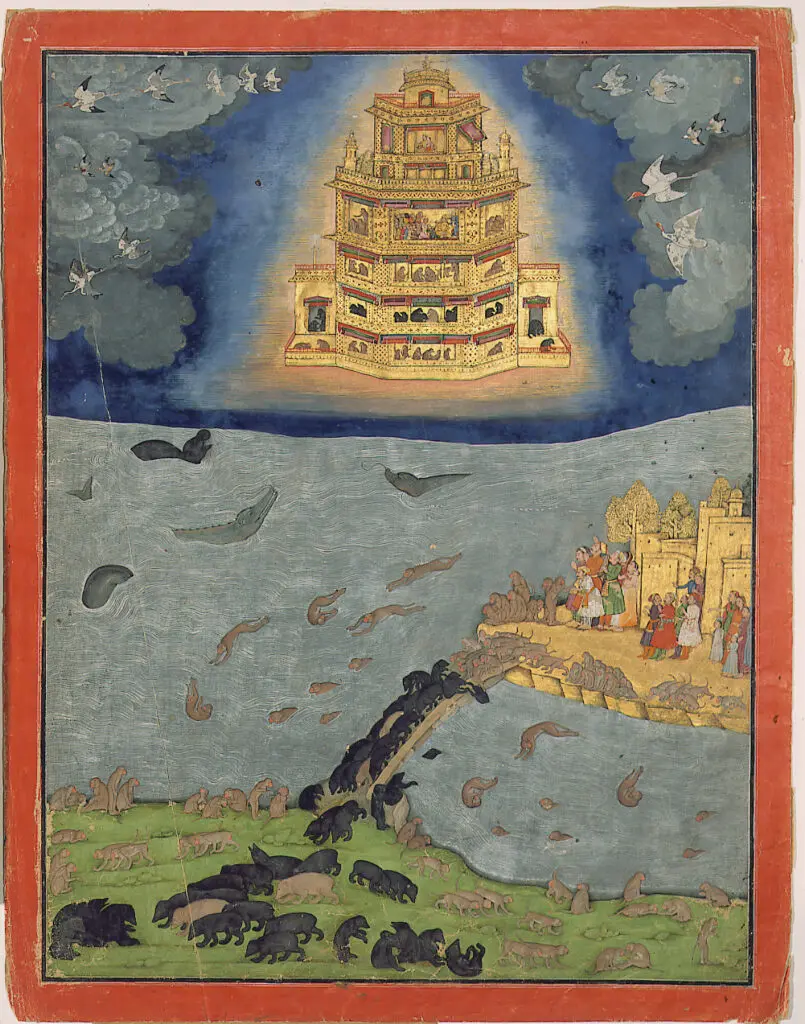
Saubha, the Aerial City of Śālva (Bhāgavata Purāṇa)
In the Bhāgavata Purāṇa, Śālva petitions Śiva for an aerial vehicle to wage war on Dvārakā. Maya Dānava constructs the Saubha, a “flying iron city” that “could travel anywhere, sometimes visible and sometimes invisible” (Bhāgavata Purāṇa 10.76.7–10.76.21). The text further records that Saubha “appeared as many identical forms and then as one,” frustrating attempts to track or attack it.

This phenomenon, simultaneous multiplicity, invisibility, and sudden relocation, maps directly onto modern radar and visual reports of UAPs that split, merge, or vanish instantaneously.
Correlation with modern UAP:
- Stealth behavior: Saubha’s invisibility mirrors radar and optical evasion.
- Multiplicity: “Many and one” corresponds to multi-return radar signatures and visual duplication reported in numerous UAP incidents.
- Dynamic deception: The reference to “Maya” (illusion-technology) may describe a form of advanced countermeasure or signature management.
Functional Typology of Vimānas
Across epics, Vimānas appear in three broad functional categories:
- Deva Vimānas – luminous, divine conveyances (Pushpaka, Indra’s car).
- Asura Vimānas – engineered aerial weapons platforms (Saubha).
- Human-accessible Vimānas – vehicles operated by chosen mortals through divine instruction.
This triadic system anticipates modern distinctions between observed craft, military platforms, and interactive phenomena.
Astras: Directed-Energy Systems in Epic Warfare
The Brahmaśiras and the Ethics of Deployment
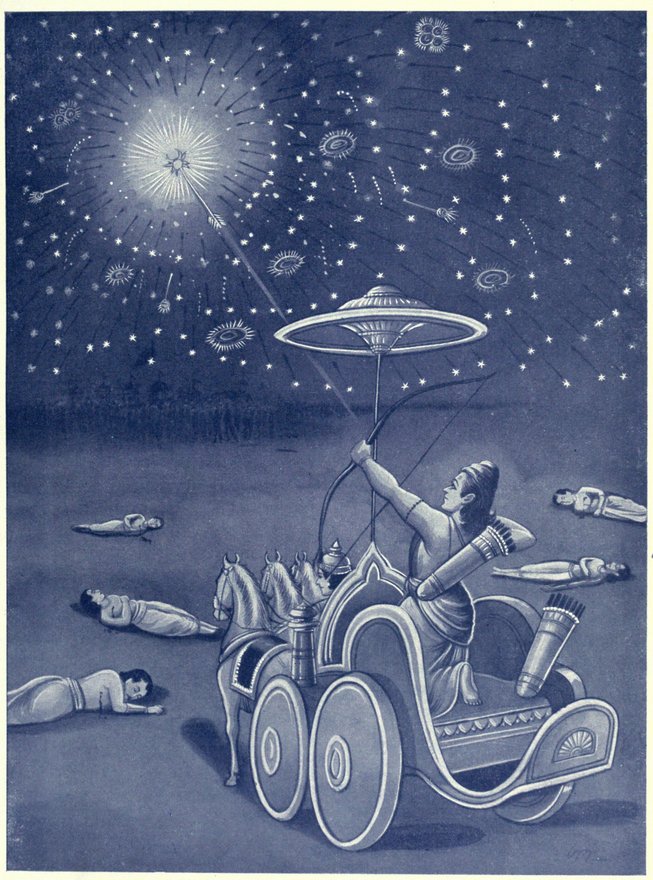
In the Sauptika Parva of the Mahābhārata, Aśvatthāman releases the Brahmaśiras Astra against the Pāṇḍavas (Mahābhārata 10.14-16). The text explicitly warns that this weapon should not be used against humans and must be withdrawn upon command. When unleashed, “the heavens blazed, meteors fell, and the earth trembled.” Two sages – Vyāsa and Nārada- intervene, commanding both warriors to withdraw their weapons. Arjuna complies; Aśvatthāman fails, causing collateral harm to unborn life (10.16–18).
Correlation with modern UAP and energy systems:
The account reads like the deployment of a high-energy or radiative weapon, complete with containment protocol and radiation-like side effects. The withdrawal mechanism suggests field collapse or containment reversal, conceptually similar to directed-energy weapon shutdown.
Categories of Astras
The epics categorize Astras as:
- Brahma-type: cosmological, capable of annihilation.
- Agneya-type: fiery, plasma-like projection.
- Varuṇa-type: aquatic or vapor-producing, capable of extinguishing fire.
- Vāyu-type: producing wind or pressure waves.
- Indra-type: thunderbolt or electromagnetic discharge.
Comparative assessment:
The energy taxonomy – heat, plasma, kinetic force, sonic pressure, electromagnetic discharge – mirrors the modern classification of non-kinetic weaponry. It reflects awareness of distinct energetic modalities governed by invocation or precise control rather than brute force.
The Luminous Devas
Etymology and Phenomenology
The Vedic Deva (from div, to shine) represents a radiant intelligence manifesting as light. Hymns to Sūrya and Indra describe luminous forms moving through the sky, “riding in chariots that flash like lightning” (Ṛgveda 1.50.8).
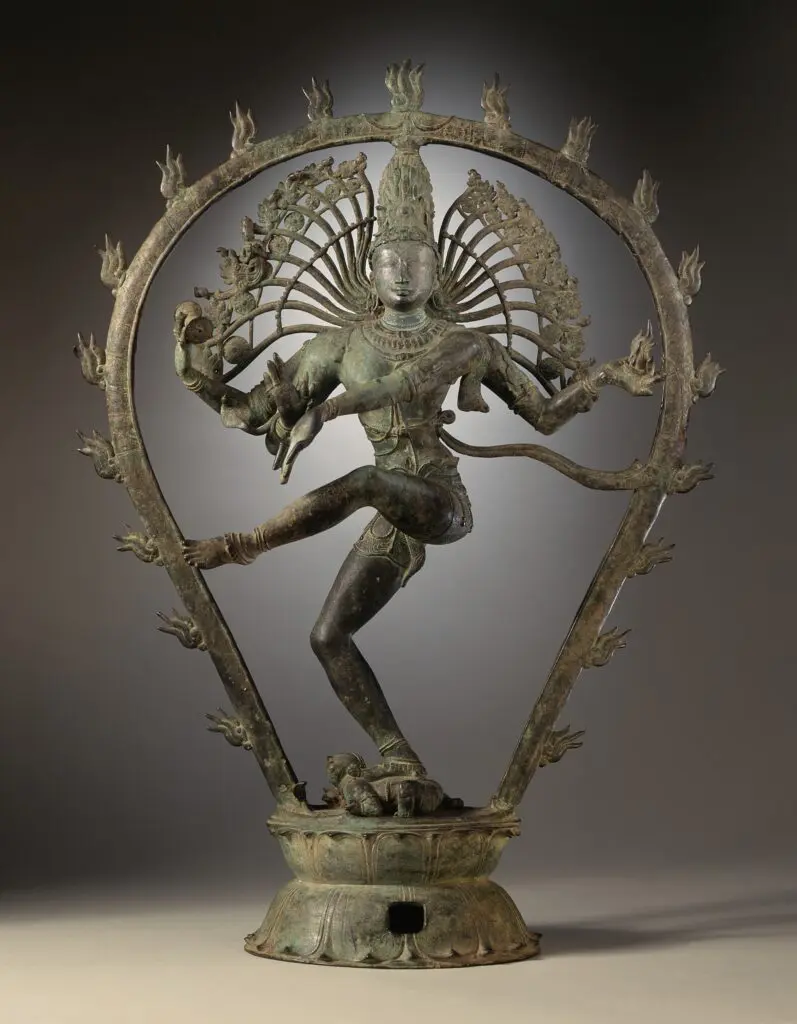
These beings appear intermittently, communicate through vision or sound, and demonstrate mastery over atmospheric and energetic domains, traits not dissimilar from luminous UAP or “orbs” reported in modern aerial observations.
Interaction Pattern
Devas in the epics do not intervene indiscriminately; they appear to specific individuals at critical junctures. Their presence often coincides with moral or cosmological inflection points, behaviorally echoing the selectivity of modern UAP encounters that occur before key human observers (pilots, astronauts, military personnel).
Cross-Epochal Correlation of Performance Characteristics
The following table correlates key performance features between Sanskrit epic accounts and contemporary UAP data.
| Feature | Sanskrit Source | Modern Correlate | Phenomenological Type |
| Instantaneous directional change | Rāmāyaṇa 6.121.11 | “Tic-Tac”–type instantaneous vector shifts | Non-ballistic flight |
| Invisibility and multiplicity | Bhāgavata Purāṇa 10.76.21 | Multi-return radar anomalies; vanishing targets | Signature management |
| Silent operation | Implicit in Vimāna narratives | Absence of sonic boom in UAPs | Acoustic stealth |
| Luminous intensity | Ṛgveda 1.50; Mahābhārata Book 1 | Radiant orbs, plasma-like glow | Photonic or plasma field |
| Transmedium capacity | Saubha’s aerial and aquatic mobility | UAPs entering/exiting oceans (USOs) | Multiphase traversal |
| Ethical or controlled use | Brahmaśiras withdrawal conditions | Non-lethal interaction patterns | Behavioral intelligence |
The congruence of parameters suggests that ancient observers and modern witnesses describe the same phenomenological class of objects—advanced aerial systems with intelligent control and field-based propulsion.
Textual Continuity and Cultural Preservation
Architectural Memory: Temple Vimānas
In South Indian Drāviḍa architecture, the term Vimāna designates the vertical tower over the sanctum (garbhagṛha). This enduring usage reflects the preservation of “ascent symbolism”, the structure as an axis between earth and sky (Britannica, “Vimāna”). The architectural term thus perpetuates an ancient conceptual link between divinity, vertical traversal, and aerial descent.
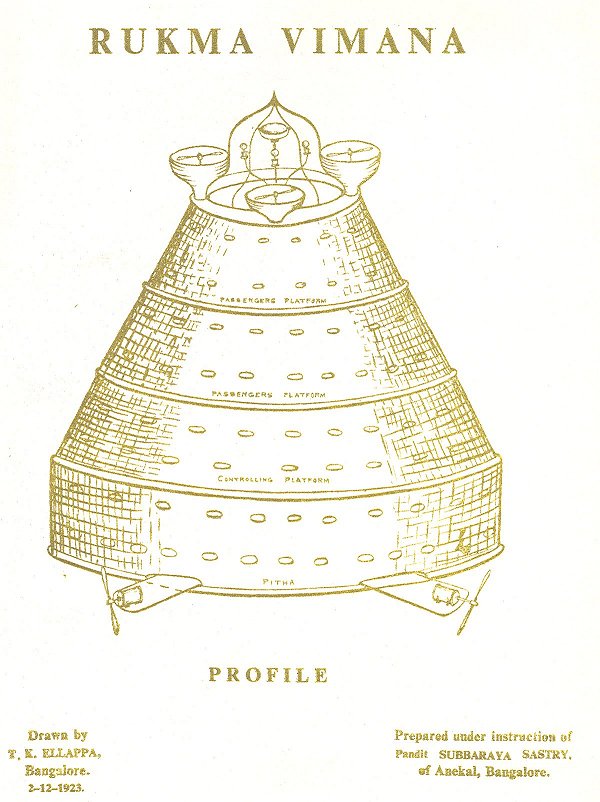
Mechanical Texts and the “Vaimānika Śāstra”
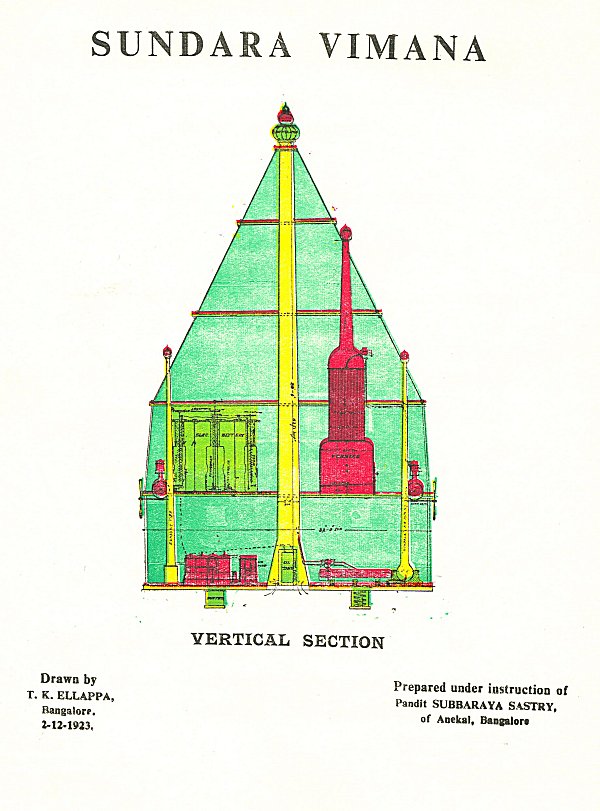
The Vaimānika Śāstra, attributed to Bharadvāja and popularized in the early 20th century, purports to describe ancient aircraft. However, a technical study by the Indian Institute of Science (Mukunda et al., 1974) determined that the designs were aerodynamically non-viable and of modern origin. The text remains a spurious artifact but demonstrates the persistence of Vimāna lore into modern consciousness.
The Samarāṅgaṇa Sūtradhāra
King Bhoja’s Samarāṅgaṇa Sūtradhāra (11th century CE) discusses automata and mechanical devices, indicating a long-standing mechanical imagination. Its brief mention of aerial mechanisms is fragmentary but significant for cultural continuity of the Vimāna concept.
Analytical Synthesis
The Sanskrit epics, stripped of devotional overlay, constitute systematic observational data framed in pre-technological language. The convergence of features, luminosity, silent motion, invisibility, multi-domain traversal, and moral engagement, suggests consistent interaction with an aerial intelligence.
The Continuity Hypothesis posits that UAP phenomena are temporally persistent and culturally adaptive manifestations of the same underlying reality. In the Indian context, that continuity expresses itself as Vimāna (vehicle), Astra (energy), and Deva (intelligence), three operational dimensions of a single integrated phenomenon.
Conclusions
The textual and historical evidence indicates that Hindu civilization preserved unusually detailed accounts of aerial and energetic phenomena that correlate closely with modern UAP performance data. The Rāmāyaṇa and Mahābhārata offer structured narratives of aerial mobility, directed energy, and intelligent agency.
While empirical proof of ancient technology remains absent, the functional equivalence between ancient and modern descriptions strengthens the likelihood that the Vedic and epic accounts stem from authentic encounters with advanced aerial systems.
These texts thus serve as both mythic theology and proto-observational science, a dual record of a phenomenon that transcends epochs.
Claims Taxonomy
Verified:
- Existence of detailed Vimāna, Astra, and Deva descriptions in primary Sanskrit sources (Rāmāyaṇa 6.121.11; Bhāgavata Purāṇa 10.76; Mahābhārata 10.14–18).
- Textual claims of invisibility, multiplicity, and will-directed motion, corresponding to known UAP behaviors.
Probable:
- Functional equivalence between epic Vimāna behavior and modern non-ballistic flight characteristics.
- Correlation between Astras and directed-energy concepts.
Disputed:
- Material existence of Vimānas as physical craft built by ancient human civilizations.
Legend:
- The theological personification of Devas as divine beings commanding aerial craft.
Misidentification:
- The Vaimānika Śāstra as authentic ancient aeronautical engineering (refuted by IISc 1974).
Speculation Labels
Hypothesis:
Ancient Indian epics encode real encounters with technologically advanced aerial systems consistent with modern UAP phenomena.
Witness Interpretation:
Sanskrit authors, lacking a scientific lexicon, interpreted observed aerial vehicles and luminous intelligences within the theological frameworks of Devas and Asuras.
Researcher Opinion:
The congruence of textual description and modern UAP flight data warrants inclusion of ancient Sanskrit sources in the broader comparative analysis of global UAP witness records.
References (Inline Citations)
- Ṛgveda 1.50.8 (Griffith translation) Sacred-Texts.com – Rig Veda, Book 1, Hymn 50
- Monier-Williams, Sanskrit-English Dictionary, entries “Vimāna,” “Astra,” “Deva.” Monier-Williams Online (LearnSanskrit.org)
- Encyclopaedia Britannica, “Vimāna (Architecture).” Britannica – South Indian temple architecture
- Mukunda, H.S. et al., A Critical Study of the Work Vymanika Shastra (Indian Institute of Science, 1974). A Critical Study of the Work “Vymanika Shastra” (PDF)
- Rāmāyaṇa — Pushpaka Vimāna referenced in Yuddha Kāṇḍa 6.48.26 and 6.121.11. (See general overview at “Pushpaka Vimana, Conceptualizing Vedic Technology & …”: https://www.robometricsagi.com/blog/aviation-case-studies/pushpaka-vimana-conceptualizing-vedic-technology-diwali) (robometricsagi.com)
- Bhāgavata Purāṇa Canto 10, Chapter 76 full text online (Sri Mad Bhagavatam): https://www.srimadbhagavatam.org/canto10/chapter76.html
- Mahābhārata — Book 10 (Sauptika Parva) Section 14 (and related) for Brahmaśiras use: https://sacred-texts.com/hin/m10/m10014.htm (Internet Sacred Text Archive)
SEO Keywords
Hindu texts UAP analysis, Vimānas and UFO parallels, Pushpaka Vimāna flight characteristics, Bhāgavata Purāṇa aerial city, Mahābhārata Astras directed energy, Devas luminous beings, Sanskrit epics UAP correlation, ancient India aerial phenomena, Rāmāyaṇa and UAP comparison, UAP in Hindu mythology, continuity hypothesis Vimānas, comparative UAP studies, Indian epic technology.