
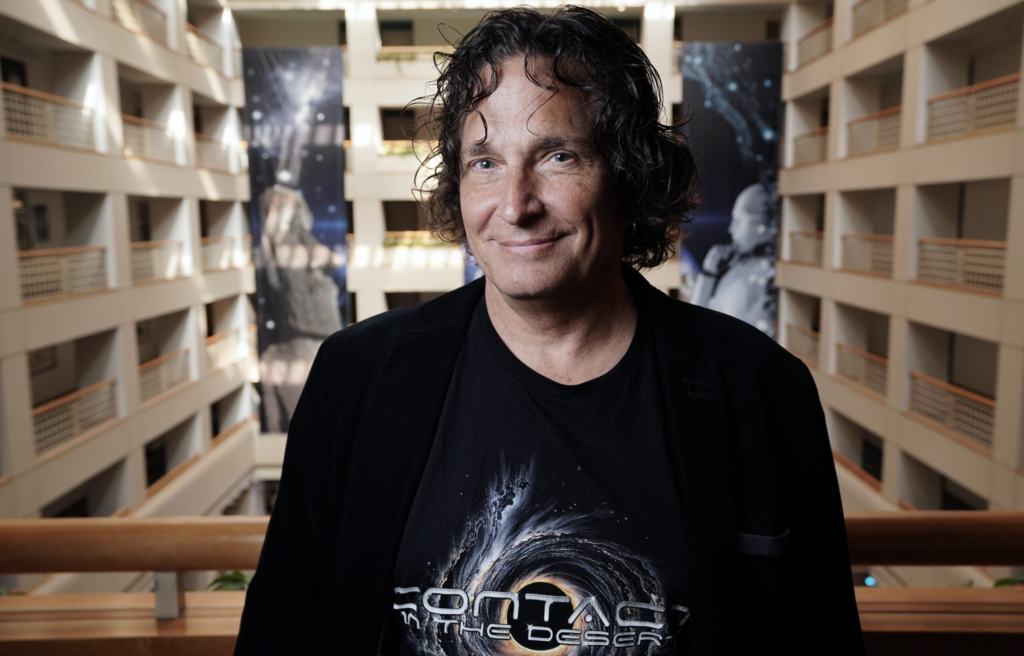
Ron Janix, better known publicly as “Captain Ron”, occupies an unusual position in contemporary UAP culture. He is not primarily associated with the investigation of a single landmark case, the development of a scientific theory or the discovery of physical evidence. His influence has instead developed through broadcasting, interviewing, conference production and the creation of spaces where investigators, witnesses, experiencers, journalists, scientists and advocates encounter one another.
As of October 2026, Janix is co-owner and executive producer of Contact in the Desert and host of the weekly podcast Beyond Contact. He is also listed by the Hollywood Disclosure Alliance among its founding UAP members, while his current individual profile identifies him as a past honorary member of the organisation’s board of directors.
Janix matters to the history of the modern UAP subject principally because he operates within its communications infrastructure. Public understanding is shaped not only by witnesses and investigators but also by broadcasters, editors and conference organisers who determine which subjects are heard, which people share platforms and how radically different interpretations are introduced to audiences. Through Contact in the Desert and Beyond Contact, Janix has become one of those intermediaries.
His career also illustrates a broader transformation in UAP culture. Earlier generations relied heavily on printed newsletters, specialist organisations and occasional radio programmes. Janix emerged in an environment of podcasts, streamed events, digital archives and large conferences, where discussion can continue throughout the year and speakers can move rapidly between live audiences and global online platforms.
Cleveland, Ohio State and an early fascination with mysteries
Janix says he was born in Cleveland, Ohio, attended Ohio State University and subsequently moved to Los Angeles. Publicly accessible sources do not establish his birth year, his field of study or whether he completed a degree, and those details should therefore remain unstated. In a May 2025 interview with Peter Robbins, Janix described a conventional middle-class upbringing and said that his parents were not particularly interested in esoteric subjects. The transcript used for these recollections is automatically generated, so precise wording should be treated cautiously, although the relevant biographical statements are clearly identifiable in the audio transcript at approximately 3:56 to 4:31.
His interest in unexplained phenomena developed gradually rather than through a dramatic childhood encounter. At around ten years old, he recalled being fascinated by In Search Of and its treatment of subjects such as Bigfoot and the Loch Ness Monster. He said that the interest remained relatively casual until his college years, when Erich von Däniken’s Chariots of the Gods? and Whitley Strieber’s Communion made a deeper impression. He later became a regular listener to Art Bell and George Noory. These details are Janix’s retrospective recollections rather than independently documented milestones, but they help explain the media environment that shaped his later career.
The influences are revealing. Bell demonstrated that unresolved and unconventional subjects could sustain serious long-form discussion outside conventional news formats. Strieber placed personal anomalous experience at the centre of a public narrative, while von Däniken offered sweeping reinterpretations of history. Janix would eventually host a much broader range of viewpoints, but the underlying attraction remained consistent: subjects that appeared unresolved, disputed or insufficiently explored.
Hollywood before the UAP circuit
Janix says that his original professional ambition was film. After moving to Los Angeles, he recalled working at CineTel Films and then becoming a personal assistant to a producer. That position led to further personal-assistant work, which he described as his primary career for roughly twenty years. In the 2025 Robbins interview, Janix said some of the people he assisted were celebrities, although he did not build his later public identity around those relationships. The relevant discussion occurs at approximately 8:26 to 10:00 in the transcript.
Public film credits independently corroborate part of this history. IMDb credits Janix as assistant to a producer on Stealth Fighter and Judgment Day, both released in 1999, and as production liaison on Desert Thunder and Supreme Sanction. It also lists him as a producer of Let Your Light Shine and the 2013 short I’ve Got Your Back, among additional production credits. IMDb is not an institutional employment record, but in this context it provides useful corroboration for Janix’s account of working behind the scenes in film production.
This background later proved relevant in ways that had little to do with cinema itself. Personal-assistant and production work requires scheduling, discretion, guest management, rapid problem-solving and the coordination of complicated events. Those same practical skills are central to conference production and broadcasting.
Janix’s route into the UAP field therefore differed from that of an academic, archivist or instrument-based investigator. His professional apprenticeship was largely organisational. He learned how to make projects involving multiple personalities and moving parts function, experience that would become increasingly important once he entered broadcasting and event production.
How “Captain Ron” began
Janix says “Captain Ron” originated as an improvised on-air nickname. In a 2026 interview, he recalled participating in an early comedy-oriented programme that also dealt with cannabis and medical subjects. The producers needed an identity for him on air, and the “Captain Ron” name emerged from that setting and remained attached to him afterwards. At approximately 2:14 in the available transcript, Janix connects that early programme directly with the origin of the nickname.
The precise chronology of his earliest broadcasting varies slightly depending on the source. Current organisational biographies date Elevate the Conversation to 2014, followed by Truth Be Told with Tony Sweet. Janix’s retrospective interviews describe experiments with broadcasting beginning somewhat earlier. The most defensible reconstruction is therefore that his public broadcasting activity developed in stages before becoming more clearly established under the 2014 programme identity.
Truth Be Told became an important transitional platform. Janix recalls Tony Sweet inviting him to co-host after the departure of another presenter. He initially regarded his own knowledge of the subject as limited, but a weekly programme forced him to read guests’ work, watch previous interviews and prepare sufficiently to sustain long-form conversations. In his telling, broadcasting itself became a form of education.
By 2025, Janix estimated that he might have interviewed around a thousand people, although organisational biographies use the more conservative description of “hundreds”. The exact total has not been independently audited. What can be established is that sustained interviewing became his primary mechanism for learning the field and building relationships across it. In the Robbins interview he explained that he rarely approached an interview without reading a guest’s book or studying previous appearances, describing the accumulation of interviews as an education in itself.
That distinction is important when assessing his authority. Janix is not principally an authority because of original laboratory or archival research. His expertise is cumulative and conversational. It comes from repeated exposure to investigators, witnesses, authors, scientists and advocates representing markedly different interpretations of the phenomenon.
The Observation Deck
The COVID-19 pandemic severely disrupted the conference ecosystem through which much of the UAP community traditionally met. In April 2021, Janix became involved in creating the Observation Deck, an online resource for speaker information and a venue for virtual events.
Sources differ over the exact terminology. Some earlier profiles say Janix “founded” the Observation Deck, while Coast to Coast AM and several later biographies describe him as a co-founder. Janix has separately recalled developing the concept with Lori Moriarty. The most cautious formulation is therefore that he helped establish and co-develop the Observation Deck during the pandemic period.
The project attempted to reproduce more than a conventional video conference. Janix has described a virtual environment in which participants could appear as avatars, attend sessions and interact in ways intended to approximate some of the social experience of a physical conference. The experiment did not permanently replace live gatherings, but it represented a significant change in his professional role. He was no longer simply interviewing people within existing media structures. He was helping create the environment in which the conversations occurred.
The Observation Deck also anticipated the increasingly hybrid nature of specialist conferences. Physical gatherings may remain central, but audiences now expect podcasts, streamed sessions, digital promotion and continuing discussion between annual events. Janix’s later work with Contact in the Desert would integrate those functions on a larger scale.
From attendee to owner of Contact in the Desert
Janix’s relationship with Contact in the Desert began as an attendee. He has recalled discovering the event and travelling alone to its original Joshua Tree setting, where he encountered figures he previously knew mainly through broadcasting and books. His first attendance was around 2015 or 2016. By 2025 he described himself as having been involved with the event since 2015, initially getting to know its previous owners and acting as a host.
The original conference was held at the Joshua Tree Retreat Center. As it expanded, it moved into the Coachella Valley and ultimately to a resort setting in Indian Wells. Recent editions have taken place at the Renaissance Esmeralda Resort & Spa. KESQ’s 2026 coverage places the twelfth annual conference there from 28 May to 1 June 2026, while 2025 reporting likewise identifies Indian Wells as the venue. Describing the modern event as having moved from Joshua Tree into the Coachella Valley, with recent editions held in Indian Wells, is therefore more precise than referring generally to Palm Desert.
The live event paused after 2019 during the pandemic period. Janix has said Gordon Pekrul subsequently moved to acquire the conference and brought him into the purchase. In a 2024 Joshua Tree Voice interview, Janix stated that their ownership officially took effect on 1 January 2023. Independent organisational profiles likewise identify Janix and Pekrul as having purchased Contact in the Desert in 2023.
The transition transformed Janix from conference participant into institutional steward. The 2024 conference featured 73 speakers according to Janix’s contemporaneous account. By the 2025 edition, he described himself and Pekrul as entering their third year of running the event, while noting that he had participated for years before ownership.
Contact in the Desert combines lectures, panels, workshops, films, live podcasts and social interaction across several days. Its programme ranges from military encounters, historical cases and questions of government transparency to consciousness studies, remote viewing, alleged contact experiences and speculative models of NHI. KESQ’s reporting on the 2026 edition described panels addressing UAP disclosure, consciousness, unusual phenomena and archaeological questions.
That range explains both the conference’s appeal and its central evidential difficulty. A military case involving sensor records and trained observers does not carry the same evidential structure as an experiencer narrative or a consciousness hypothesis. Yet all may appear within the same programme. A place on a conference stage establishes access to an audience, not independent validation of a speaker’s conclusions.
Janix has nevertheless argued publicly for greater scientific rigour within the field. In the 2025 Robbins interview, he said Beyond Contact repeatedly emphasised the need for additional research and scientific discipline. Elsewhere he has discussed the importance of examining conventional possibilities before treating an observation as genuinely anomalous. This combination of broad openness and an expressed desire for stronger methodology is one of the tensions that defines his public role.
Contact also functions as a major networking environment. Janix has described the value of attendees being able to encounter speakers, filmmakers, podcasters and other participants outside scheduled sessions. His understanding of the conference is therefore not limited to lectures. He sees the informal network created around the programme as part of the event itself.
The 2026 programme provides an example of that media function. Contact hosted a live audience event featuring George Noory and George Knapp taking questions together in an open-lines format. The available material establishes their joint appearance, but it does not identify Janix as the moderator. No moderation role should therefore be attributed to him without additional documentation.
Beyond Contact
In May 2024, Janix launched Beyond Contact as part of the iHeart and Coast to Coast AM paranormal podcast network. Apple Podcasts dates the introductory episode to 16 May 2024 and describes the programme as a weekly interview series hosted by Captain Ron.
The series rapidly became the most visible expression of Janix’s broadcasting career. By 16 October 2026, Apple Podcasts listed 126 episodes, with Episode 126 devoted to the Ariel School case and filmmaker Randal Nickerson. The catalogue spans researchers, journalists, experiencers and advocates discussing historical cases, alleged recovered materials, government disclosure, consciousness, contact claims and speculative models of NHI.
Beyond Contact represents a consolidation of Janix’s earlier development. Elevate the Conversation and Truth Be Told gave him experience conducting long-form interviews. Contact in the Desert provided access to a broad network of speakers. Beyond Contact connects the two, allowing conference relationships and wider UAP discussions to continue throughout the year.
His interviewing style is generally facilitative rather than confrontational. Guests are given considerable room to explain their claims and interpretations. That approach can reveal how researchers and experiencers understand their own material, but it also requires the audience to distinguish eloquence from verification. A confident account remains an account unless the underlying evidence independently supports it.
The programme is consequently most valuable when treated both as media and as a record of contemporary UAP discourse. It documents what influential figures are arguing, which cases are receiving attention and how the boundaries of the subject are changing.
Hollywood Disclosure Alliance
Janix has also been involved with the Hollywood Disclosure Alliance, an organisation concerned with relationships between the entertainment industry and the public discussion of UAP and NHI. HDA’s current founding-members directory lists Captain Ron Janix as co-owner, producer and host of Contact in the Desert and host of Beyond Contact. His individual profile states that he is a past honorary member of the HDA board of directors.
The affiliation fits the broader trajectory of his career. Janix has repeatedly worked at the boundary between anomalous-phenomena communities and media production. His Hollywood background, broadcasting experience and conference ownership give him a practical role in how UAP narratives move from specialist audiences into wider popular culture.
That influence should not be confused with evidential authority. An advocacy organisation can establish its own membership and organisational history, but it cannot by itself validate claims concerning UAP or NHI. The value of HDA material in Janix’s biography lies primarily in documenting his institutional relationship with the organisation.
A personal sighting, carefully bounded
Janix does not describe a long history of personal encounters. In the May 2025 Robbins interview, he initially said he normally answered “no” when asked whether he had experienced anything unexplained, then recalled a single observation while interviewing Steven Greer.
At approximately 1:01:08 in the automatically generated transcript, Janix describes seeing a small luminous object that looked to him like a miniature sun or fireball. He said it travelled overhead along what appeared to be a normal flight path. He did not describe visible structural details or establish the object’s origin.
The distinction between observation and interpretation is important. Janix observed something he did not identify. That is the evidential core of the account. The observation itself does not establish NHI, advanced technology or any other specific explanation.
This is particularly relevant because Janix’s broader conviction has strengthened considerably over time. In a May 2026 interview, he described a transition from being an “open-minded skeptic” to becoming extremely confident that NHI is interacting with human reality. That conclusion reflects his interpretation of the accumulated cases, testimony and interviews he has encountered. It is not a finding independently demonstrated through his own scientific research.
His thinking nevertheless remains broader than a conventional extraterrestrial-spacecraft model. Janix has discussed interdimensional interpretations, consciousness-related possibilities and other frameworks that attempt to account for aspects of the UAP record he regards as difficult to explain within a purely mechanical model.
This intellectual widening mirrors a larger tendency within parts of contemporary UAP culture. The conversation increasingly overlaps with questions about consciousness, perception, anomalous cognition and the nature of intelligence itself. Contact in the Desert’s programming reflects that expansion, as does the subject range of Beyond Contact.
Artificial intelligence and the probe hypothesis
One of Janix’s more distinctive speculative ideas concerns artificial intelligence. He has suggested that an advanced civilisation might be more likely to send autonomous machines across interstellar distances than vulnerable biological crews. Machines would not require food, sleep or conventional life-support systems, and long journey times would present fewer biological problems.
In a recorded discussion of AI and future contact, Janix explicitly reasoned that if humanity is considering sending intelligent probes into space, another technological civilisation might make the same choice. He further suggested that eventual communication might therefore occur between human-made AI and an artificial non-human intelligence.
The idea is logically connected to existing concepts such as robotic exploration and autonomous probes, but Janix presents it as a possibility rather than evidence about any particular UAP. No observation discussed in his interviews establishes that a specific UAP is an AI-controlled extraterrestrial or non-human probe.
The hypothesis is nevertheless revealing because it shows how Janix’s thinking has moved beyond the familiar image of biological beings piloting vehicles. His public discussions increasingly treat UAP as part of a wider question about intelligence, technology and consciousness rather than simply unidentified machines in the atmosphere.
Contribution and limitations
Janix’s most demonstrable contribution is platform-building. He has accumulated more than a decade of broadcasting experience, helped develop a virtual event environment, assumed co-ownership of a major UAP conference and produced more than a hundred episodes of a dedicated weekly interview programme. Those activities have placed him in sustained contact with a broad cross-section of the contemporary field.
His authority is therefore primarily editorial, relational and organisational. He knows many of the people producing contemporary UAP research, testimony and commentary. He is able to connect subjects and individuals that might otherwise remain within separate communities and place them before audiences already interested in unresolved phenomena.
The limits are equally important. The public record reviewed for this biography does not identify Janix as the author of a peer-reviewed UAP study, an instrumented field investigation or a major forensic case monograph. His programmes frequently provide access to claims and evidence produced by others, but presenting material is not equivalent to independently verifying it.
There is also a commercial dimension to conference production. Contact in the Desert is a ticketed event whose continued operation depends on attracting speakers, attendees and public interest. That does not invalidate its educational, archival or community functions. It does mean that promotional claims about scale, importance or speaker conclusions should remain distinguishable from independent assessment.
The deeper tension in Janix’s work is between openness and discrimination. His platforms deliberately accommodate subjects with markedly different evidential foundations. That inclusiveness makes them productive meeting grounds for ideas that might otherwise remain isolated, but it can also blur distinctions between documented events, personal testimony, interpretation and speculation.
UAPedia’s editorial standard specifically requires evidence to be distinguished from interpretation while preserving uncertainty where it genuinely exists. It also treats government sources as one evidentiary vector rather than a final arbiter and exempts biographical articles from mandatory Claims Taxonomy and Speculation Labels. The biography of Janix therefore benefits most from clear attribution rather than from forcing every statement into a formal claim classification.
A legacy still being made
Janix’s legacy remains provisional because he is still actively producing Beyond Contact and Contact in the Desert. As of October 2026, however, his career can already be read as a progression from behind-the-scenes entertainment production to broadcasting, virtual-event experimentation and eventually conference ownership.
The consistent thread is organisation. Janix brings people, stories and audiences together.
He has not produced decisive evidence resolving the origin of UAP, and his personal aerial observation does not resolve that question. His contribution is instead to the social and media architecture through which the question is discussed.
That role should neither be inflated into scientific authority nor dismissed as mere entertainment. Public understanding of unresolved phenomena is inevitably mediated by the people who select guests, organise events, frame conversations and create sustained forums for discussion. Janix has become one of those mediators.
His longer-term importance will depend partly on how the platforms he helps control handle the growing evidential complexity of the field. The challenge is to preserve the openness that has characterised his work while distinguishing more clearly between provenance and promotion, evidence and interpretation, testimony and verification.
If that balance can be maintained, Janix’s curatorial role may prove more historically significant than any individual claim discussed on his programmes. His contribution is not that he solved the UAP mystery. It is that he became one of the people organising the room in which an increasingly diverse collection of witnesses, researchers and audiences attempts to understand it.
References
Apple Podcasts. (2024, May 16). Introducing: Beyond Contact [Podcast episode]. iHeartPodcasts. Apple Podcasts episode
Apple Podcasts. (2026). Beyond Contact [Podcast series]. iHeartPodcasts. Beyond Contact catalogue
Apple Podcasts. (2026, October 16). Episode 126: UAP & the Ariel School Phenomenon with Randal Nickerson [Podcast episode]. Beyond Contact. Episode 126
Coast to Coast AM. (2026). Ron Janix [Biographical profile]. Coast to Coast AM profile
Edhlund, R. (2024, May 1). Contact in the Desert, May 30–June 3, 2024. Joshua Tree Voice. Joshua Tree Voice 2024 feature
Edhlund, R. (2025, May 23). Contact in the Desert 2025. Joshua Tree Voice. Joshua Tree Voice 2025 interview
Hollywood Disclosure Alliance. (2026). Captain Ron Janix [Biographical profile]. HDA profile
Hollywood Disclosure Alliance. (2026). UAP & ET founding members. HDA founding-members directory
IMDb. (n.d.). Ron Janix [Filmography]. IMDb credits
KESQ. (2026, May 7). 12th annual Contact in the Desert returns to Indian Wells in late May. KESQ report
Robbins, P. (Host). (2025, May 26). Meanwhile, Here on Earth: Ron Janix [Audio podcast episode]. iHeart. Transcript automatically generated; timestamps used for specific biographical recollections where practical. iHeart episode and transcript
The Michael Decon Program. (2026, May 2). Contact in the Desert: Captain Ron Janix [Audio podcast episode]. Episode transcript
The Roswell Daily Record Show. (2024, April 29). Ron Janix, co-owner, producer and host of Contact on the conference’s 10th anniversary [Audio podcast episode]. iHeart. iHeart episode and transcript
UAPedia. (2026, August 12). UAPedia Editorial Standards: Navigating the Mystery (Version 1.3). UAPedia Editorial Standards
WatchMojo’s Unveiled Podcast. (2026, May 5). Captain Ron Janix on why disclosure is real, tangible, and already happening [Audio podcast episode]. iHeart episode
SEO keywords
Captain Ron Janix, Ron Janix biography, Contact in the Desert, Beyond Contact podcast, Captain Ron UAP, UAP conference organiser, UAP broadcaster, UAP podcast host, Gordon Pekrul, Hollywood Disclosure Alliance, Observation Deck, Contact in the Desert history, Indian Wells UAP conference, UAP public figures, UAP media, UAP disclosure, non-human intelligence, NHI, UAP interviews, UAP conference producer, UAP consciousness, artificial intelligence probes, UAPedia biography