
Overview
“Reptilian” is one of the most consequential resemblance labels in modern UAP literature. It is applied to alleged beings described as scaled, clawed, unusually muscular, or possessing eyes and facial structures that witnesses associate with reptiles. The word appears in direct encounter testimony, memories developed through hypnosis, public statements by researchers and former officials, underground-installation narratives, spiritual histories, internet interview texts and reports from altered states.
Those sources do not form one evidentiary archive. A person describing a figure seen at close range is making a different kind of claim from an intermediary repeating what unnamed personnel allegedly reported. A published interview with a spiritual teacher differs again from a compiler’s account of a hidden base, and all of these differ from a dataset assembled from anonymous online reports. The sources can be compared, but comparison does not make them independent or equally reliable.
This article therefore follows three connected questions. What was reported? How did the account reach the public? What was later inferred about the alleged being’s identity, origin and intention? In a direct case, the accessible evidence may begin with what a witness says was perceived. In a secondhand case, the accessible datum is the reported description itself, not an independently observed body. Repetition can make a description familiar without adding another witness.
The companion article Serpent Beings: Ancient Traditions and the Reptilian Idea examines culturally specific serpent figures, composite beings and transformation narratives. Those traditions provide comparisons and counterexamples, but they should not be counted as another collection of modern encounters. The present article concentrates on the contemporary record and applies UAPedia’s distinction between evidence, testimony, interpretation and speculation (UAPedia, 2026).
Reptilian as morphology
Morphology means describing bodily form. In this literature, the recurring features include scales or scale-like skin, vertically oriented pupils, clawed or webbed hands, pronounced jaws, unusual cranial ridges, powerful musculature and a broadly humanoid arrangement of head, torso and limbs. These features can justify the limited statement that a witness, narrator or intermediary described a figure as reptile-like.
They do not by themselves establish evolutionary ancestry. A perceived form could hypothetically be an organism, an engineered body, protective equipment, a remotely operated proxy, a constructed image, an induced perception, a culturally shaped memory or a phenomenon that does not fit those categories. Even an independently established organism would require anatomical, genetic and environmental evidence before its lineage or place of origin could be inferred.
Appearance, identity, origin and intention must therefore remain separate. Appearance concerns the reported form. Identity concerns what produced that form. Origin concerns where or through what mode it arose. Intention concerns what the alleged agency sought to accomplish. The evidential burden increases at each step.
Fear belongs to the testimony, but it is not a biological measurement. Scales, claws or unfamiliar eyes may produce an immediate threat response even when the observed behaviour is uncertain. Conversely, a calm or human-looking presentation would not establish benevolence. A rigorous account records what the figure reportedly looked like, what it did, what the witness felt, what the witness believed it intended and what later interpreters added.
Used carefully, “reptilian” can organise descriptions. Used carelessly, it becomes a species name, genealogy, home world and moral verdict before any of those propositions has been established.
Public statements and attributed insider accounts
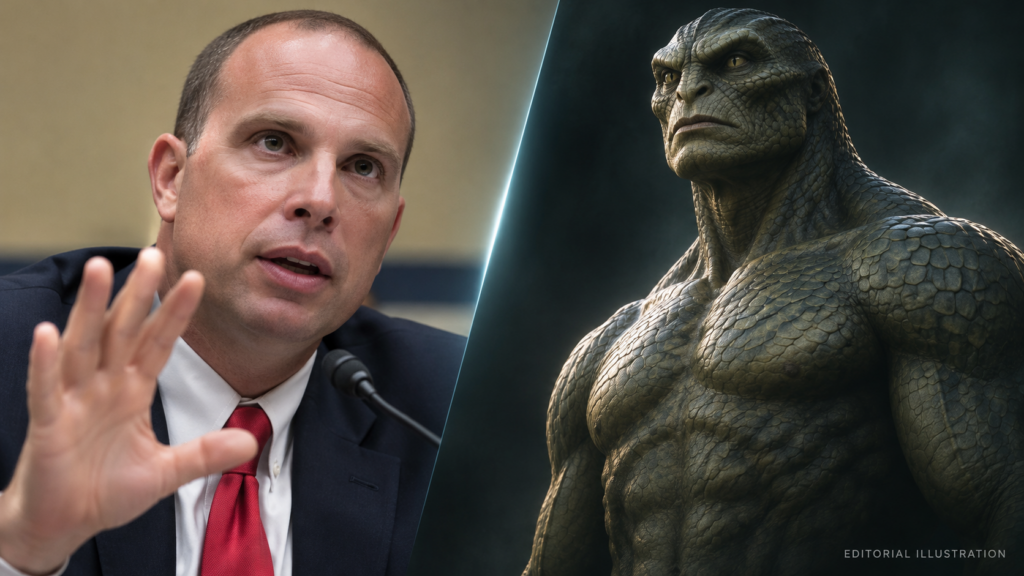
Recent public discussion has been shaped by David Grusch, Eric W. Davis and, in an earlier disclosure setting, Shawn and Clay Pickering. Their statements deserve attention because each speaker claimed access to people or programmes not available to the general public. They also demonstrate why attribution and source relationships matter.
During the 26 July 2023 congressional hearing on UAP, Grusch testified that “biologics” had accompanied some alleged recoveries and that people he characterised as possessing direct programme knowledge had assessed the material as non-human. The hearing did not identify the alleged material as reptilian, and Grusch did not testify that he had personally examined bodies. The official transcript verifies what he said under oath. Consistent with UAPedia’s policy on government-derived material, it is an evidentiary input rather than an institutional verdict on the underlying allegation (U.S. House Committee on Oversight and Accountability, 2023; UAPedia, 2025).
Grusch addressed reptilian-looking beings during his 30 September 2026 appearance on The Joe Rogan Experience. He stated that he had not personally seen such beings. He attributed the description to other people and characterised the alleged figures as more than seven feet tall, powerfully built, gorilla-like in physique and covered with scaled skin. Later in the interview, he relayed an alleged confrontation in which living reptilian-looking entities were shot after U.S. personnel perceived them as a threat. He further alleged that American personnel had been injured or killed and said he wanted the direct participants to tell the account themselves (Rogan, 2026).
The public record presently permits verification of the attribution, not the incident. The account as presented does not identify a date, location, unit, direct participant, casualty record, medical record, after-action report, authenticated image or case-specific physical specimen. These absences do not prove that the event did not occur. They prevent independent reconstruction of the event from the material currently available.
Grusch separately said he had viewed audiovisual material showing pale or bluish-white, broadly human-looking cadavers. That claim follows a different evidential path because he presented himself as the viewer of the material. It should not be merged with the reptilian account, which he attributed to others. Treating the cadaver allegation as visual corroboration for the reptilian story would create a connection that Grusch did not establish (Rogan, 2026).
A generated image circulated after the interview showing military personnel confronting reptilian figures. Lead Stories traced the earliest located post, identified a related video that its uploader labelled as an artificial rendering, and reported technical indicators including a SynthID watermark associated with generated media (Malashenko, 2026). The image is not documentary photography of the alleged event. That finding resolves the status of the circulated image, not the truth or falsity of the underlying testimony.
Physicist Eric W. Davis discussed reptilian and insectoid descriptions at the 1 May 2025 event Understanding UAP: Science, National Security & Innovation. The event was a public briefing and panel discussion held in the Rayburn House Office Building. It was not a sworn congressional committee hearing. Davis distinguished resemblance from taxonomy. He said that labels such as reptilian and insectoid referred to the way reported figures looked while they retained a broadly humanoid body plan (Anomaly Archives, 2025; Disclosure Foundation, 2025).
Davis also described figures closer to ordinary human scale and said he had not heard reports of examples seven, eight or nine feet tall. That differs from the description Grusch later relayed. The difference could reflect separate cases, different witnesses, source variation, uncertain recollection or incompatible reporting. The available public material does not justify resolving it by inventing subspecies or factions (Anomaly Archives, 2025).
Source independence is also relevant. Davis publicly stated that Jay Stratton brought him together with Grusch and Grusch’s superior and that he briefed them for approximately two and a half days. If accurate, this establishes a direct informational connection within the same investigative network. It does not show that Davis’s and Grusch’s particular reptilian descriptions came from the same witness, incident or document. It does mean that the two public statements cannot be assumed independent merely because they were delivered by different speakers (Anomaly Archives, 2025).
The Pickering interviews show a similar problem in a different period. In two New Realities broadcasts recorded in March 2009, Shawn and Clay Pickering attributed a complex contact narrative to an informant they called Source A. Their account distinguished three alleged groups: silicon-based, shape-changing “conformers”; a reptilian group; and Tall Whites. The conformers were presented as the principal contact group. The reptilians were described as a separate population that allegedly deferred to them. The brothers further said that Source A had not communicated telepathically with the particular reptilian beings he claimed to have encountered. They explicitly limited that statement to the reported group rather than treating it as a rule about every reptilian account (Steinfeld, 2009a, 2009b).
The same interviews attributed to Source A a forecast that the conformers would appear unambiguously over several cities in 2017. No publicly documented event meeting the stated description was identified for 2017. This does not by itself reveal who originated every part of the narrative, but it is a failed, time-bounded prediction and should be weighed against the source’s claimed access.
Later public debate identified Source A as Richard Theilmann and disputed his service history, credentials and reliability. Tim Printy’s SUNlite article presented an extensive challenge. Michael Salla responded that retired Navy scientist Bruce Maccabee had described Theilmann entering a secure naval facility without an escort, which Salla regarded as evidence that some credentials were genuine (Printy, 2010; Salla, 2010). These are competing attributed assessments, not an official adjudication of Theilmann’s service or legal status.
The Pickering material is therefore evidence that a specific narrative was publicly transmitted through two named intermediaries. It is not three independent testimonies merely because the narrative contains three alleged populations. The evidential chain remains Source A, the Pickerings’ recollection and presentation of his claims, the recorded interviews, and later arguments over his identity and credibility.
Dulce and the underground-base tradition
Dulce is a real community in northern New Mexico and the tribal capital of the Jicarilla Apache Nation. That geographical fact should be stated before considering the hidden-installation narrative attached to the area. Archival records also show that animal mutilation reports in the western United States became a matter of public concern during the 1970s. The FBI’s released files consist largely of correspondence and press material and note that federal jurisdiction was limited except where incidents occurred on Native lands (Federal Bureau of Investigation, n.d.; New Mexico Indian Affairs Department, n.d.; New Mexico Tourism Department, n.d.).
Those records establish that mutilation reports were discussed and that officials received requests to investigate them. They do not authenticate an underground installation, a joint human and non-human programme, or reptilian personnel. A documented investigation into one class of events cannot be transferred to a different claim without evidence connecting them.
The modern Dulce narrative was assembled through several overlapping transmissions. John Lear’s statement dated 29 December 1987 connected alleged government agreements, abductions, animal mutilations, underground facilities and non-human groups within a single account. It included a purported underground laboratory near Dulce and an alleged armed confrontation in 1979. The preserved text begins with a disclaimer and relies heavily on information Lear attributed to other people. His role in this evidential chain is principally that of a public transmitter and interpreter, not a named eyewitness to the alleged Dulce installation (Lear, 1987).
A second major source is the question-and-answer text attributed to Thomas Edwin Castello, presented as a former security officer at a multi-level base. The surviving compilation, commonly titled “A Dulce Base Security Officer Speaks Out,” describes human and non-human work areas, reptilian personnel, caste structures, alleged Draco leadership, security procedures, biological experimentation and hidden evidence. The text also contains commentary inserted by its compiler, Branton. Purported answers, editorial notes and later reproductions must therefore be distinguished rather than treated as one uninterrupted witness statement (Castello, attributed, n.d.).
The public text does not independently establish Castello’s identity, employment, access or even the interview setting. It claims that photographs, video and documents were distributed for safekeeping, but the items described have not entered a publicly authenticated chain of custody. The narrative is detailed, yet detail is not the same as provenance. A document may preserve what a purported witness was said to have claimed while leaving the witness and event unverified.
The Castello material also faces a direct source challenge. In Saucers, Spooks and Kooks, Adam Gorightly reproduced correspondence attributed to Tal LeVesque in which LeVesque reportedly said that the Castello interview had been constructed and that major parts of the Dulce story were fabricated. Gorightly presents the message as the result of a long correspondence and includes it in an appendix (Gorightly, 2021). The accessible reproduction is not an independently authenticated original email with verifiable headers and custody. It is nevertheless a substantive challenge from a person Gorightly places close to the narrative’s development.
The responsible conclusion is narrower than either total acceptance or blanket dismissal. A transmitted Castello text exists. Lear’s statement and later compilations helped join underground bases, government collaboration, abduction, mutilation and reptilian hierarchy into a durable narrative. The alleged witness and installation remain unauthenticated in the public record reviewed here, while the attributed LeVesque correspondence raises a serious authorship and construction problem.
Dulce also demonstrates how source dependence can disappear as a story travels. A later article may cite Lear, Castello and a subsequent retelling as though three accounts converge, even when the later texts borrow from the same narrative network. The number of publications is not the number of independent witnesses.
Abduction testimony and the illustrated record
An earlier published encounter account appears in Karla Turner’s 1992 book Into the Fringe. Turner described a regression session involving her husband, identified by the pseudonym Casey. She reported that the recording equipment malfunctioned, leaving no complete transcript, and that the regressionist and Casey reconstructed much of the session from memory afterward (Turner, 1992).
According to Turner’s account, Casey remembered several beings attempting to turn him face down. Turner characterised them as a reptilian type with webbed or clawed hands and vertically slit eyes. She also reported that Casey recalled an instrument with two light-like points being placed against the base of his spine. Turner acknowledged that he could not know what the alleged instrument was doing.
The publication verifies that Turner recorded and interpreted this material. It does not independently establish that an external reptilian being was physically present. This distinction does not imply dishonesty. Sincerity, emotional force, therapeutic meaning and historical accuracy are different questions.
Hypnotic regression is especially important because it can increase confidence without improving accuracy. Reviews by Krackow, Rashed and Thompson and by Leo, Bruno and Proietti found that hypnosis does not reliably recover more accurate memories and can contribute to recollection of events that did not occur, particularly when suggestion or guided imagery is involved (Krackow et al., 2025; Leo et al., 2025). Hypnosis-derived material can document imagery, emotion and personal interpretation. It should not be treated as self-authenticating historical reconstruction.
Illustration creates another layer between experience and public memory. Kevin D. Randle and Russ Estes’s 1997 book Faces of the Visitors brought together alleged contact accounts in an illustrated reference work (Randle & Estes, 1997). Bibliographic confirmation establishes the book, its authors and its format. Without inspecting a particular plate and its underlying case file, this article does not attribute a specific reptilian image to the book.
The methodological point is broader. A witness sketch made immediately after an event has a different status from a drawing produced with an artist after repeated interviews. A composite illustration may combine several accounts. A polished book image may clarify a description, but it can also standardise features that were initially uncertain. None of these objects is a biological specimen.
The same distinction now applies to generated media. A labelled reconstruction can help readers visualise testimony. An unlabelled or detached image can contaminate the record by appearing to corroborate the account that inspired it. Investigators should preserve the earliest wording, identify when images entered the case, record who directed their creation and separate conscious recollection from material developed through hypnosis, interview prompts or exposure to other reports.
Kimberly Ball examined slightly more than 200 English-language online UAP-abduction narratives and showed how forums become sites for circulation, comparison and communal interpretation. Her study documents transmission; it does not establish what caused any particular encounter or prove that repetition began online (Ball, 2010).
Reptilian worldviews and spiritual narratives
Some modern sources move beyond encounter description and present reptilian beings as actors in a comprehensive history of humanity. David Icke’s The Biggest Secret, published in 1999, developed a system involving shape-changing reptilian beings, associated bloodlines and hidden influence within political, financial and religious institutions (Icke, 1999). This is a much larger claim than a witness reporting scales or unusual eyes.

An encounter account could support the limited proposition that someone perceived or remembered a reptile-like figure. It would not independently establish shape-changing ability, hereditary non-human bloodlines, control of institutions, coordination across centuries or one planetary system of hidden influence. Each expansion requires evidence proportionate to its scope.
Religious-studies scholar David G. Robertson interpreted Icke’s reptilian thesis as a form of New Age theodicy, an explanatory system that assigns obstruction of anticipated spiritual transformation to an organised non-human adversary (Robertson, 2013). Daniel Allington and Tanvi Joshi examined one Icke lecture excerpt and 1,123 associated YouTube comments and identified antisemitic material within that bounded corpus (Allington & Joshi, 2020). Robertson’s analysis concerns the religious function of Icke’s system. Allington and Joshi’s concerns a particular lecture and audience response. Neither study establishes the cause of an experiencer’s report, and neither warrants assigning Icke’s worldview to every person who uses reptilian as a morphological label.
Credo Mutwa’s Chitauli narrative entered modern English-language circulation through a different but connected route. In a lengthy 1999 interview conducted by Rick Martin, Mutwa described the Chitauli as intelligent, reptile-like beings associated with underground settings, hidden rule, division among human populations and an inherited African history. He also distinguished them morphologically from other beings discussed in the interview and described features including scales, large heads, ridges or horns and a claw-like finger (Martin, 1999).
The interview must be read as a mediated publication rather than an untouched deposit of collective tradition. Its introduction states that David Icke helped Martin establish contact with Mutwa. Martin’s opening question already presupposed the existence of shape-changing reptilian beings and asked Mutwa to confirm their origin, leadership and agenda. Later exchanges explicitly compared Mutwa’s Chitauli material with Icke’s claims. This does not show that Mutwa simply copied Icke, but it does establish contact, framing and shared interpretive language before and during publication.
Mutwa was a named narrator whose testimony, cultural authority and personal experiences deserve to be represented accurately. His claims should not, however, be converted into an undifferentiated statement of what African peoples collectively believe. Agnieszka Podolecka’s research compares Mutwa’s broader histories of Bantu-speaking peoples with historical and religious scholarship and raises questions about which elements represent wider traditions and which may be distinctive to Mutwa’s synthesis (Podolecka, 2023). That research does not specifically decide whether the Chitauli exist. It does show why representativeness must be demonstrated rather than assumed.
The Icke and Mutwa materials also illustrate reciprocal influence. Icke facilitated access to Mutwa, the interviewer brought an existing reptilian framework, and Mutwa supplied an expansive historical and spiritual narrative that later readers could treat as confirmation of modern claims. The existence of that network does not disprove Mutwa’s testimony. It means that similarities emerging after contact cannot automatically be counted as independent convergence.
The Lacerta Files and internet circulation
The Lacerta Files present another form of comprehensive explanation. Two English-language texts circulated online in 2000 as purported interviews with a female reptilian being called Lacerta. The alleged speaker describes her population as an ancient terrestrial lineage, places it in subterranean settlements, attributes unusual mental capacities to it and offers a revisionist account of human origins, religion and Earth history (Ole K., attributed, 2000a, 2000b).
The documents can be studied as documents. Their early English transmission, translation attributions and later reposting can be partly reconstructed. The alleged meetings, original recordings, participants and precise setting have not been independently authenticated in the accessible public record. A hundred reproductions of the same text do not become a hundred witnesses.
Lacerta also adds a distinct evidential layer. The purported being does not merely appear; she explains herself and asks the reader to trust her history. Even if a meeting were someday authenticated, that would not automatically establish the speaker’s identity, expertise, honesty or access to geological and human history. The document, the alleged encounter, the substantive claims and the later reception require separate assessment.
The companion investigation The Lacerta Files: Reptilian Claims and the Question of Trust examines the texts’ transmission, internal chronology and testable claims in detail. The present overview uses Lacerta to mark a source type: an internet-era interview narrative in which an alleged non-human speaker provides a total explanation. It should not be merged with Grusch’s secondhand military allegation, Turner’s regression material, Dulce compilations or Mutwa’s spiritual history simply because all use reptilian language.
Reptilian descriptions in altered states
Reptilian and serpentine forms also appear in reports of experiences occasioned by inhaled N,N-dimethyltryptamine, or DMT. This setting matters because it offers a large body of descriptions produced under a known altered-state condition, but it does not provide a simple explanation for unrelated encounter reports.
Lawrence, Carhart-Harris, Griffiths and Timmermann analysed 3,778 experience reports drawn from 3,305 Reddit posts made between 2009 and 2018. Their coding identified entities in 1,719 reports. Within that entity-containing subset, 51 reports were coded as reptilian or serpentine and 40 as insectoid, mantis or arachnoid. These correspond to approximately 3.0 per cent and 2.3 per cent of the entity-containing reports, respectively (Lawrence et al., 2022).
The figures require careful boundaries. The unit of analysis was an online report, not a randomly selected person. The corpus was self-selected, Reddit users are not representative of all DMT users, and earlier posts or wider cultural material may have influenced the vocabulary used in later reports. The study therefore does not estimate how often all DMT users encounter reptilian beings. Nor does it establish that the reported entities were external, internally generated or produced through some interaction between the two.
A separate survey by Davis and colleagues examined selected respondents who reported DMT-occasioned entity encounters and asked about phenomenology, interpretation and enduring effects. It used a different sample and research design and should not be combined numerically with the Lawrence corpus (Davis et al., 2020).
The comparison is nevertheless useful. It shows that reptilian and serpentine morphology recurs in a reporting context different from military allegations, waking abduction narratives and underground-base texts. Researchers can compare which features recur, when they were first recorded, how much prior exposure is known and whether the descriptions contain unusual details that exceed broad cultural categories.
Similarity across states does not settle causation. It could reflect common features of human perception, shared language and expectation, a recurring neurophenomenological pattern, an external source encountered under different conditions, or some combination. The DMT dataset cannot authenticate the interface hypothesis developed in The Faces They Wear: Reptilians and the Humanoid Enigma, and it cannot reduce every waking report to drug-like experience. It provides a bounded comparative archive and a reason to formulate sharper questions.
What similarities can establish
Across these sources, several motifs recur: a humanoid body plan, scale-like skin, unfamiliar eyes, clawed hands, exceptional strength, subterranean settings, hierarchy, secrecy, mental influence and perceived threat. The recurrence is worthy of investigation. It is not yet proof that all reports concern one population.
The differences are equally informative. Grusch relayed very tall, heavily built figures; Davis discussed reports closer to ordinary human scale. The Pickerings separated reptilians from shape-changing conformers and said telepathy was absent in one reported interaction. Lacerta’s attributed speaker presents a terrestrial lineage capable of influencing perception. Dulce texts place reptilian personnel inside a joint underground system. Turner records a remembered medical encounter. Mutwa embeds Chitauli within a spiritual and historical account. DMT reports arise under a pharmacologically altered condition. A single label covers markedly different bodies, behaviours, settings and source histories.
Four broad explanatory families remain available. Some reports may concern independently existing biological beings. Some may involve constructed bodies, protective equipment, avatars or deliberately mediated presentations. Psychological, neurological, sleep-related, memory and cultural processes may shape some reports. Some experiences may involve an interaction between an external agency and consciousness. These possibilities can overlap, and different cases may have different causes.
They are not equally supported merely because they can be listed. Memory reconstruction and cultural transmission have established research literatures, but their contribution to a particular case still requires evidence. A biological hypothesis would gain support from authenticated material, repeatable measurements and independent close observation. A constructed-presentation hypothesis would need evidence that appearance varies systematically with technology, observer or recording method. A consciousness-mediated hypothesis must make predictions that distinguish it from ordinary perceptual and neurological processes.
Source independence is central to every comparison. Two witnesses who recorded unusual matching details before contact with one another carry more evidential weight than several speakers linked through one investigator, briefing, book or interview network. The question is not only whether details match, but whether they could have travelled.
Historical serpent traditions add caution rather than an automatic answer. Protective, ancestral, sovereign and ambivalent serpent beings show that reptile-like form does not carry one universal moral meaning. They may preserve culturally interpreted extraordinary experiences, but any continuity claim must trace wording, transmission and distinctive details rather than treating resemblance as ancestry.
Intent should likewise be inferred from reported behaviour. Restraint, injury, coercion or violence would be relevant if the event were established. Fear alone does not prove hostile purpose, just as beauty or familiarity does not prove benevolence. Morphology is evidence about form, not character.
What would change the assessment
The strongest improvement would come from evidence that identifies a reconstructable case. Named direct witnesses, independently interviewed before comparing accounts, could clarify who observed what. A date, location, unit, sequence of events and contemporaneous records could turn a circulating allegation into an incident that researchers can test.
Original recordings and notes would clarify transmission. They could show which details were present at the beginning, which questions were asked and which features appeared only after hypnosis, repeated interviews or exposure to other narratives. Authenticated images would require provenance, metadata, continuity of recording and controls for editing, costume, generated media and miscaptioning.
Biological or material evidence would address a different class of claim. It would require documented custody, contamination controls, independent laboratories, open methods and reproducible results. Even a verified non-human body would not by itself establish a particular home world, political faction or intention.
Predictions also matter. A claim fixed in a dated source should be assessed against what it said would occur, not reinterpreted after the deadline. The unfulfilled public-contact forecast attributed to Source A illustrates the value of a specific date. A successful prediction would increase interest only if it were precise, improbable, recorded in advance and independently confirmed.
Prospective studies could improve future cases by using neutral interviews, physiological monitoring, environmental measurements and predefined criteria. The most useful model will not merely accommodate every past account. It will predict differences that can be observed in new ones.
Progress in one case would not authenticate the whole repertoire. Verified evidence for one reptile-like organism would not prove Dulce, Lacerta, Chitauli, hidden bloodlines or every regression narrative. Each claim must earn its own evidential status.
Conclusion
Modern reptilian claims form a network of testimonies, publications, interpretations and images rather than one established biological dossier. The public record verifies that named speakers and authors made identifiable claims. It also reveals secondhand transmission, contested provenance, failed prediction, memory limitations, generated imagery and substantial differences among the beings described.
None of those limitations requires treating every witness as dishonest or every experience as conventional. Credible testimony can justify investigation, particularly when a witness has relevant access or when independent accounts converge. What testimony cannot do alone is determine species, ancestry, origin, command structure or a comprehensive theory of intention.
The enduring value of the reptilian label may be phenomenological. It identifies a recurring family of perceived or narrated forms whose causes remain unresolved and may not be uniform. The task is to preserve the experience while tracing the source, testing the transmission and resisting the expansion of resemblance into certainty.
Until stronger evidence becomes publicly testable, reptilian should remain the beginning of the investigation rather than its conclusion.
Evidence and Speculation Labels
Evidence
The evidentiary record consists of dated recordings, hearing transcripts, published books and interview texts, archival compilations, provenance investigations and a peer-reviewed altered-state dataset. These sources verify that Grusch, Davis, the Pickerings, Turner, Lear, Mutwa and other named participants made or transmitted the statements attributed to them. They also verify the publication and circulation of the Castello, Lacerta and Icke materials, the contents of the DMT corpus, and the generated status of the circulated military-reptilian image. Verification attaches to the source and its contents unless independent evidence establishes the event described.
Hypothesis
The principal hypotheses are that some reports concern independently existing reptile-like organisms; that some forms are constructed bodies, equipment, avatars or induced presentations; that psychological, neurological, sleep-related, memory and cultural processes contribute to some reports; and that some appearances emerge through interaction between an external agency and consciousness. Different cases may have different causes, and more than one process may operate within a single case.
Witness Interpretation
Witness interpretation includes Casey’s regression-derived identification of reptilian figures, Mutwa’s Chitauli account, Source A’s alleged classifications as relayed by the Pickerings, and the unnamed witnesses’ descriptions repeated by Grusch. It also includes interpretations of fear, restraint, internal communication or unusual imagery as evidence of a being’s identity or purpose. These interpretations remain part of the testimony without becoming independently verified conclusions.
Researcher Opinion
Researcher opinion includes Turner’s interpretation of Casey’s memory as an external encounter, Icke’s hidden-control system, Robertson’s analysis of that system, Podolecka’s evaluation of Mutwa’s broader historical narratives, and the competing assessments of Source A. This article’s distinction among appearance, identity, origin and intention, and its analysis of source dependence, are also researcher frameworks rather than direct observations.
Claims Taxonomy
Article-level classification: Disputed. Modern reptilian testimony and documentary traditions are sufficiently recurrent and identifiable to justify sustained investigation, but the reviewed public record does not establish one reptilian species, one origin or one coordinated presence.
Verified
The cited publications, recordings and transcripts exist and contain the claims described. Grusch publicly relayed a reptilian-looking entity account while denying personal observation. Davis publicly treated reptilian as a resemblance label. Turner published Casey’s regression narrative. The Pickering, Lear, Castello-attributed, Mutwa, Icke and Lacerta materials circulated through traceable sources. Lawrence and colleagues reported the category counts stated above.
Probable
Source networks, interviewer framing, illustration and online circulation influence how at least some reptilian claims are expressed and repeated. This classification concerns transmission, not the cause of any particular experience.
Disputed
The alleged Grusch confrontation, independent existence of reptilian NHI, Dulce installation and personnel, Source A’s contact claims, Casey’s remembered physical encounter, the Chitauli as a literal hidden population and the Lacerta meetings remain disputed. Their publication is established, but the underlying events and identities are not.
Legend
Historical serpent beings are classified as Legend when considered as claims of historical occurrence, while their texts, objects and cultural meanings remain documented. Dulce and Lacerta are modern disputed narratives whose cultural life can be studied, but narrative durability does not authenticate the events they describe.
Misidentification
The circulated image depicting U.S. personnel confronting reptilian figures is classified as Misidentification when presented as documentary photography. Available provenance and technical evidence identify it as generated media.
Hoax
Gorightly’s reproduced correspondence alleges deliberate construction of the Castello interview, but the accessible item is not an independently authenticated original email. The challenge is substantial and remains part of the disputed provenance rather than a final finding of purposeful deception.
Suggested UAPedia Internal Crosslinks
The first use of non-human intelligence should link to Non-Human Intelligence (NHI): Lifting the Veil. The first discussion of entity categories should connect to Mapping the Others: Hypothesized NHI Entity Categories, while the methodological distinction between an experience and its interpretation should connect to Contact with NHI: Reading the Experience Itself.
The Dulce section should crosslink to Dulce, New Mexico: The Making of a High-Strangeness Zone. The Randle and Estes discussion should link to Russ Estes: Turning the Camera on Abduction Research, and the hypnosis discussion should link to Witness Reliability & Cognitive Bias.
The altered-state comparison should link to DMT, UAP and NHI: The Breakthrough State, the Data, and the Contact Question and Psionics and the Consciousness Interface: How UAP Communicate. The Pickering passages can also link to the existing UAPedia transcript pages for the 3 March and 10 March 2009 New Realities interviews.
The historical comparison should link to Serpent Beings: Ancient Traditions and the Reptilian Idea. The synthesis should link to The Faces They Wear: Reptilians and the Humanoid Enigma, and the Lacerta section should link to The Lacerta Files: Reptilian Claims and the Question of Trust. Publication URLs should be inserted only after those locations are confirmed.
References
Allington, D., & Joshi, T. (2020). “What others dare not say”: An antisemitic conspiracy fantasy and its YouTube audience. Journal of Contemporary Antisemitism, 3(1), 35-54. https://doi.org/10.26613/jca/3.1.42
Anomaly Archives. (2025, May 1). Transcripts: Understanding UAP: Science, national security & innovation. https://anomalyarchives.org/collections/file/uap-hearing-20250501-understanding-uap/transcripts-uap-hearing-20250501-understanding-uap/
Ball, K. (2010). UFO-abduction narratives and the technology of tradition. Cultural Analysis, 9, 99-128. https://www.ocf.berkeley.edu/~culturalanalysis/volume9/vol9_article4.html
Castello, T. E. [Attributed]. (n.d.). A Dulce Base security officer speaks out. In Branton (Compiler), The Dulce Book (Chapter 11). https://www.bibliotecapleyades.net/branton/esp_dulcebook11.htm
Davis, A. K., Clifton, J. M., Weaver, E. G., Hurwitz, E. S., Johnson, M. W., & Griffiths, R. R. (2020). Survey of entity encounter experiences occasioned by inhaled N,N-dimethyltryptamine: Phenomenology, interpretation, and enduring effects. Journal of Psychopharmacology, 34(9), 1008-1020. https://doi.org/10.1177/0269881120916143
Disclosure Foundation. (2025, May 1). Understanding UAP: Science, national security & innovation. https://www.disclosure.org/events/understanding-uap-science
Federal Bureau of Investigation. (n.d.). Animal mutilation [FBI Vault collection]. https://vault.fbi.gov/Animal%20Mutilation/
Gorightly, A. (2021). Saucers, spooks and kooks: UFO disinformation in the age of Aquarius. Daily Grail Publishing. https://books.google.com/books?id=uuI9zgEACAAJ
Icke, D. (1999). The biggest secret. Bridge of Love Publications.
Krackow, E., Rashed, J., & Thompson, I. (2025). Does hypnosis aid memory retrieval? A review of Steven Jay Lynn’s research. International Journal of Clinical and Experimental Hypnosis, 73(3), 381-390. https://doi.org/10.1080/00207144.2025.2508410
Lawrence, D. W., Carhart-Harris, R., Griffiths, R. R., & Timmermann, C. (2022). Phenomenology and content of the inhaled N,N-dimethyltryptamine (N,N-DMT) experience. Scientific Reports, 12, Article 8562. https://doi.org/10.1038/s41598-022-11999-8
Lear, J. (1987, December 29). Statement regarding EBEs [ParaNet text file]. https://frank.3nd3r.net/pdf/textfiles/ufo/alear1.txt
Leo, D. G., Bruno, D., & Proietti, R. (2025). Remembering what did not happen: The role of hypnosis in memory recall and false memories formation. Frontiers in Psychology, 16, Article 1433762. https://doi.org/10.3389/fpsyg.2025.1433762
Malashenko, U. (2026, October 12). Fact check: Fake image of U.S. troops shooting “reptilians” is not real photo. Lead Stories. https://leadstories.com/hoax-alert/2026/10/fact-check-fake-image-of-us-troops-shooting-reptilians-is-not-real-photo.html
Martin, R. (1999, September 30). Credo Mutwa on alien abduction and reptilians: A rare, astonishing conversation [1999 interview, reproduced transcript]. The Spectrum. https://thedarkcontinent.co.za/credo-mutwa-on-alien-abduction-reptilians-a-rare-astonishing-conversation-with-rick-martin/
New Mexico Indian Affairs Department. (n.d.). Tribal directory. https://www.iad.nm.gov/nations-pueblos-and-tribes/tribal-directory/
New Mexico Tourism Department. (n.d.). Jicarilla Apache Nation. https://www.newmexico.org/native-culture/native-communities/jicarilla-apache-nation/
Ole K. [Attributed]. (2000a). The Lacerta File I (C. Pfeiler, Trans.). https://farsight.org/pdfs/FarsightPress/Support_Files/The_Lacerta_File_1and_2_Reptoid_interview.pdf
Ole K. [Attributed]. (2000b). The Lacerta File II (D. Parrish, Trans.). https://farsight.org/pdfs/FarsightPress/Support_Files/The_Lacerta_File_1and_2_Reptoid_interview.pdf
Podolecka, A. (2023). History of the Bantu peoples by Credo Mutwa: Zulu tradition or Mutwa’s invention? Rocznik Orientalistyczny/Yearbook of Oriental Studies, 76(2), 120-138. https://doi.org/10.24425/ro.2023.148344
Printy, T. (2010). An exopolitics nightmare. SUNlite, 2(4), 10-13. https://www.astronomyufo.com/UFO/SUNlite2_4.pdf
Randle, K. D., & Estes, R. (1997). Faces of the visitors: An illustrated reference to alien contact. Fireside.
Robertson, D. G. (2013). David Icke’s reptilian thesis and the development of New Age theodicy. International Journal for the Study of New Religions, 4(1), 27-47. https://doi.org/10.1558/ijsnr.v4i1.27
Rogan, J. (Host). (2026, September 30). David Grusch (No. 2560) [Video podcast episode]. The Joe Rogan Experience. https://www.youtube.com/watch?v=dYPXINFcvmI
Salla, M. (2010, May 21). Exposure of U.S. Navy source on UAP U.N. discussions omits retired Navy scientist testimony. https://www.bibliotecapleyades.net/exopolitica/exopolitics_UFOUN10.htm
Steinfeld, A. (Host). (2009a, March 3). UFO disclosure and government secrets with Shawn and Clay Pickering [Interview transcript]. New Realities. UAPedia. https://uapedia.ai/wiki/ufo-disclosure-and-government-secrets-with-shawn-and-clay-pickering/
Steinfeld, A. (Host). (2009b, March 10). Shawn and Clay Pickering on disclosure and ET races [Interview transcript]. New Realities. UAPedia. https://uapedia.ai/wiki/shawn-and-clay-pickering-on-disclosure-and-et-races/
Turner, K. (1992). Into the fringe. Berkley Books. https://www.exopoliticshongkong.com/uploads/karlaturner_intothefringe_book.pdf
U.S. House Committee on Oversight and Accountability. (2023, July 26). Unidentified anomalous phenomena: Implications on national security, public safety, and government transparency. 118th Congress, Serial No. 118-53. https://www.govinfo.gov/content/pkg/CHRG-118hhrg53022/html/CHRG-118hhrg53022.htm
UAPedia. (2025). How UAPedia treats government sources. https://uapedia.ai/wiki/how-uapedia-treats-government-sources/
UAPedia. (2026). UAPedia editorial standard: Navigating the mystery. https://uapedia.ai/wiki/uapedia-editorial-standard-navigating-the-mystery/
SEO keywords
Reptilian Alien, Draco Being, Reptilian Beings: Encounters, Testimony and the Modern UAP Debate, reptilian beings, reptilian entities, reptilian UAP encounters, non-human intelligence, NHI beings, David Grusch reptilian account, Eric Davis reptilian beings, Pickering Source A, Richard Theilmann, Dulce Base, Thomas Castello, John Lear, Karla Turner Into the Fringe, Kevin Randle, Russ Estes, Credo Mutwa Chitauli, David Icke reptilian thesis, Lacerta Files, DMT entities, reptilian encounter testimony, source independence, generated reptilian image, appearance versus identity, consciousness-mediated contact, UAP experiencers, UAPedia reptilian beings