
On paper, it can look like one strange night of “odd meteors.” In reality, February 9, 1913 played out like a full-blown UAP wave: a wide geography of witnesses, a shared core description, an immediate surge of interpretation, and a long afterlife of analysis that never quite settled into a single, universally satisfying explanation.
People across Canada and the United States looked up and reported a chain of brilliant objects moving with a calm, almost processional dignity. Not the quick slash of a typical meteor. Something slower, longer-lasting, and so oddly organized that multiple accounts describe the bodies as maintaining a “formation.” Clarence Augustus Chant, an astronomer based in Toronto, gathered and published an extensive set of observations the same year, preserving exactly those features: slow, majestic motion; multiple bodies in sequence; and a general formation that struck even experienced sky-watchers as extraordinary. (Astrophysics Data System)
That witness language matters for UAP history because it sits right on the boundary between “natural” and “machine-like” appearance. If you have ever read a modern report of a line of lights that “kept spacing,” or a luminous object that “traveled level,” the emotional texture of 1913 will feel uncomfortably familiar.
So why “phantom airships”? Because 1913 was primed for them. The early twentieth century had recently learned a new kind of sky actor: aircraft. Dirigibles had entered the popular imagination. Aeroplanes were no longer myth. Newspapers trained readers to treat strange lights as possible inventions, and possible intrusions. When the heavens produced a rare event that looked sustained and purposeful, a portion of the public did what humans often do in moments of astonishment: they translated it into the newest available technology category. That translation is not proof of a literal craft. It is proof that the interpretation happened, and it becomes part of the historical case file.
This article treats the North American phantom-airship wave of 1913 as an early twentieth-century account that belongs alongside the longer historical baseline often emphasized by Jacques Vallée and Chris Aubeck: a tradition of taking old testimony seriously while refusing to collapse observation into conclusion. (Google Books)
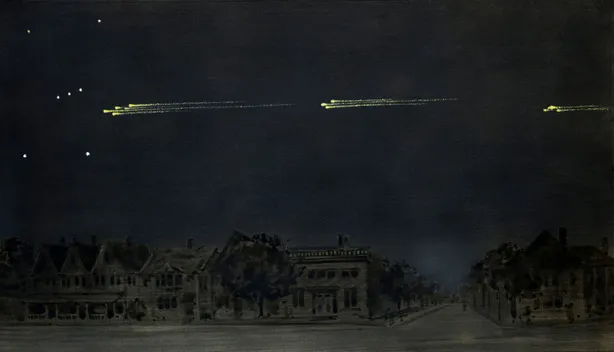
The night the sky behaved like a parade
The event most strongly associated with the 1913 wave is now widely known as the Great Meteor Procession of February 9, 1913. What distinguishes it from a normal meteor shower is not simply brightness. It is behavior.
Witnesses repeatedly described objects traveling nearly parallel to the horizon rather than diving steeply downward. Modern summaries explain that, unlike typical meteors, fragments in such a procession can move on a very shallow atmospheric path, extending visibility and producing the impression of sustained travel across huge distances. (Scientific American)
Horace A. Smith’s widely used archival synthesis (hosted by Michigan State University’s physics and astronomy department) preserves a key pattern across accounts: people frequently described multiple objects traveling together in sequence, visible for minutes, not seconds. It also reproduces Chant’s own summary passages, which are among the most important primary-source anchors for the wave’s descriptive core. (web.pa.msu.edu)
The effect on witnesses was not subtle. This was not “I saw a quick streak.” This was “the whole sky is doing something it shouldn’t.”
Why the “airship” idea was waiting in the wings
It is tempting to treat “airship” language as a quaint mistake, but in UAP history it is a diagnostic clue.
In 1913, the airship was the modern symbol of hidden capability. Even if a person had never seen one, they had read about them. They were plausible, mysterious, and associated with secrecy and prestige. In that environment, when a luminous body traveled laterally for an extended time, it could feel less like astronomy and more like transportation.
This is one of the recurring mechanics of UAP waves across eras: the sky produces an anomaly; witnesses accurately convey certain physical features; and then the mind grabs the most culturally available frame. In the 1890s, it was an “airship.” In the 1930s, in parts of Europe, it became “ghost flyers.” In the present day, it often becomes “drones.” The stimulus can change, but the interpretive reflex is remarkably stable.
That does not make witnesses unreliable. It means their testimony contains at least two layers, and responsible historical writing keeps them separate.
Chant’s investigation: an early model of disciplined collection
Clarence Augustus Chant’s work is one reason this case remains unusually strong by early twentieth-century standards. He did not merely reproduce exciting newspaper blurbs. He solicited observations, collected descriptions from multiple localities, and attempted to systematize them in the Journal of the Royal Astronomical Society of Canada. (Astrophysics Data System)
Chant also followed up later the same year with an additional piece, “Further Information Regarding the Meteoric Display of February 9, 1913,” extending the record as new reports arrived. (Astrophysics Data System)
The result is a historical archive with unusual value for UAP researchers: it captures an event while it is still fresh, with enough breadth to see patterns and enough specificity to notice contradictions.
Case vignette: Parry Sound and the “level plane”
One of the most telling witness descriptions preserved through the Chant record and later archival syntheses comes from Parry Sound, Ontario. The observer, Walter L. Haight, emphasized the “unprecedented slowness” of the object and described its path as being on a “level plane,” a phrase that reads like a quiet scream from someone trying to reconcile what they saw with what they thought the sky was allowed to do. (web.pa.msu.edu)
He also described the luminous body as having two distinct portions, with a head-like bright component and a trailing portion fading into a reddish streak. That is an observational detail, not an explanation. But it matters because it is consistent with what fragmentation and persistent trains can look like in a shallow entry, and it also shows how easily a natural event can present as segmented structure.
The evidence here supports a core descriptive claim: multiple witnesses perceived prolonged lateral motion and a structured, multi-part luminous form.
Case vignette: Western Ontario and the “formation” language
Chant’s own summary passages describe a fiery red body followed by a long tail, with observers disagreeing about whether the body was single or composed of multiple parts, and then describe the broader display as a procession of bodies that appeared to maintain a general formation. (web.pa.msu.edu)
This is exactly the sort of wording that later becomes magnetized in UAP studies: formation, sequence, steady motion. The key is to treat it correctly. It is evidence that multiple bodies were seen in a pattern that looked organized. It is not, by itself, evidence of intent or control. Those further claims belong in interpretation, not in the observation layer.
The Michigan “airship going east” report
The “phantom airship” framing often points back to a Michigan newspaper item included in the broader Chant-era reporting chain and discussed in later archival syntheses. In that report, two observers, Miss Vera Murray and Carl Schnaitman, are said to have seen the bright objects and then arrived in town reporting an “airship going east.” (web.pa.msu.edu)
This is the hinge between sky events and cultural narrative.
From a UAP-historical standpoint, the report is valuable for two reasons. First, it shows the speed with which a technological interpretation could form. Second, it demonstrates that even when an event has the unmistakable characteristics of meteors (brightness, tails, fragmentation), the unusual trajectory and duration can still drive people toward the aircraft category.
The responsible conclusion is modest but important: the “airship” language is historically real as a witness interpretation, and it helps explain why the episode can fairly be described as a phantom-airship wave even if the underlying stimulus was not a human-made craft.
Sound and bodily impact: rumble in the aftermath
Some accounts describe rumbling or thunder-like sounds after the luminous procession had passed. Sound reports in meteor events can be complicated, sometimes delayed, sometimes unevenly perceived, and sometimes mixed with local conditions. Still, the recurrence of “distant thunder” language in the historical record contributes to why witnesses experienced the event as an intrusion rather than a purely visual spectacle. (web.pa.msu.edu)
This is also a recurring theme in UAP reports across eras: the event is not just “seen,” it is felt. A rumble, a vibration, a pressure change, or the sense that something passed overhead can anchor the memory more deeply than light alone.
Later studies: why the puzzle stayed alive
The 1913 procession did not vanish into a single year of excitement. It remained alive as a technical and historical problem for decades.
A. D. Mebane’s 1956 paper in Meteoritics compiled U.S. observations and expanded the data set by contacting newspapers along the projected route to recover overlooked accounts. That approach looks like an early form of distributed-sensor reconstruction, using the media archive as an imperfect but powerful detection network. (Astrophysics Data System)
William H. Pickering, writing in Popular Astronomy in 1922, incorporated shipboard observations, helping constrain the track over the Atlantic and reinforcing how far-reaching the procession appeared to be. (Astrophysics Data System)
John A. O’Keefe later used the 1913 procession as an example in technical discussion of shallow, satellite-like atmospheric entries, even drawing parallels to re-entry phenomena in the early satellite era. (NASA Technical Reports Server)
And in more recent popular-scientific synthesis, Donald Olson and Steve Hutcheon’s archival work is often referenced for extending the established track using newly identified ship reports. Summaries note that the fragments traveled nearly parallel to Earth’s surface and that the reconstructed track length can exceed 6,000 miles and is often cited as exceeding 7,000 miles in compiled reconstructions. (Scientific American)
This long publication trail is important for UAP history. It shows that the event’s strangeness is not merely a newspaper sensation. It is a durable anomaly within meteoritics and observational astronomy, the kind that invites recurring re-analysis.
What modern science says, and what it does not say
The dominant explanatory framework today is that the 1913 wave was driven by a rare meteor procession: a body or cluster entering at a shallow angle, fragmenting, and producing long-lasting luminous trains that appear to move laterally across great distances. This model explains several headline features at once: the unusual duration, the multiple bodies in sequence, and the “formation” impression. (Scientific American)
It also explains why even careful observers could be shocked. Most people’s mental model of meteors is calibrated to be fast, steep, and brief. A shallow procession violates that model and makes the sky feel mechanical.
At the same time, the meteor-procession explanation does not erase the value of the witness record. It clarifies one layer of the event while leaving others open to careful historical work: how reports spread, how interpretations formed, and how public imagination about aircraft shaped the resulting narrative.
The “phantom airship wave” in UAP terms
Describing this as a “phantom airship wave” should not be taken to mean that a dirigible was proven to be flying over North America in 1913. The case file does not support that. What it supports is subtler, and arguably more useful.
It supports that a rare aerial event occurred and was widely witnessed. It supports that many observers described slow, formation-like motion and multi-minute visibility. It supports that at least some witnesses and newspapers interpreted the display as an airship or craft-like phenomenon. It supports that competent investigators collected and analyzed reports in a structured way, producing a primary-source backbone strong enough to keep the episode alive for decades.
In UAP history, that combination is exactly what makes a wave a wave: not simply an anomaly in the sky, but an anomaly that triggers a shared social response.
Framing within the Vallée-style historical approach
Vallée and Aubeck’s Wonders in the Sky popularized, for many readers, a disciplined respect for historical aerial-anomaly reports: an insistence that older cases are part of the same human encounter history, and that the challenge is to treat the record as data without flattening it into either credulity or dismissal. (Google Books)
The 1913 case is particularly instructive in that spirit because it shows how even an event with a strong natural candidate can behave, socially and phenomenologically, like a UAP wave. It forces modern readers to practice a skill UAP research desperately needs: separating the witness description of behavior from the witness’s guess about what the object was.
If you want a modern analogy, this is an early template for how “mystery drone” waves work. A stimulus appears. It has features that feel purposeful. The public narrative locks onto the most current technology. The reporting itself becomes part of the phenomenon.
Implications that travel forward in time
The 1913 phantom-airship wave suggests three implications for modern UAP work, and they can be held without overreaching.
First, formation-like appearance is not a guarantee of technology. Fragmentation dynamics and perspective can mimic coordination. That is a caution, not a debunk. It helps keep analysts honest.
Second, cultural context is an active ingredient, not a footnote. In 1913, “airship” was the freshest technological frame. Today, “drone” often is. The sky can present an anomaly, and the era supplies the name.
Third, archival work is a form of instrumentation. Mebane’s letter-writing campaign to newspapers may sound quaint, but for historical cases it is one of the closest equivalents we have to triangulation. The more independent accounts converge, the more the case shifts from anecdote toward structured record. (Astrophysics Data System)
None of these implications require you to pretend the case proves a literal craft. They require only that you take witness testimony seriously and treat interpretation as a separate layer, which is exactly the discipline that keeps historical UAP research credible.
Claims taxonomy
Verified
A widespread, highly unusual aerial luminous display occurred on February 9, 1913 and was witnessed across a broad region, with multiple independent accounts describing slow, lateral motion, extended duration, and multiple bright bodies in sequence. (Astrophysics Data System)
Probable
The underlying stimulus is consistent with a rare meteor-procession style event, involving shallow atmospheric entry and fragmentation that can produce long-lived, near-horizontal fireball trains. (Scientific American)
Disputed
The “phantom airship” dimension of the 1913 wave is best understood as cultural anchoring to early aviation imagination, triggered by a rare, long-duration, shallow-trajectory luminous event that naturally produced formation-like visuals. (Scientific American)
Misidentification
Claims that the display was a literal airship are best treated as misinterpretations of an extraordinary luminous procession through the lens of early aviation expectations, rather than as evidence of a demonstrated structured craft. (web.pa.msu.edu)
Speculation labels
Witness Interpretation
Some observers, and some newspapers, translated the procession into “airship” language because the motion appeared steady and lateral and because the event lasted long enough to feel like a vehicle in transit rather than a brief astronomical flash. (web.pa.msu.edu)
Researcher Opinion
The primary value of the 1913 case file for UAP studies is methodological. It demonstrates how to preserve a high-quality observation layer while allowing multiple explanatory models to compete, and it shows how an aerial anomaly can become a wave through social processing as much as through physics. (Astrophysics Data System)
Hypothesis
Precise reconstructions of the full track length depend on incomplete historical coverage and assumptions about continuity; while later archival work strongly extends the path with ship reports, any single mileage figure should be treated as an approximate reconstruction rather than an instrument-grade measurement. (Phys.org)
References
Chant, C. A. (1913a). An extraordinary meteoric display. Journal of the Royal Astronomical Society of Canada, 7(3), 145–215. NASA ADS full text: https://adsabs.harvard.edu/full/1913JRASC…7..145C (Astrophysics Data System)
Chant, C. A. (1913b). Further information regarding the meteoric display of February 9, 1913. Journal of the Royal Astronomical Society of Canada, 7, 438–444. NASA ADS full text: https://adsabs.harvard.edu/full/1913JRASC…7..438C (Astrophysics Data System)
Mebane, A. D. (1956). Observations of the great fireball procession of 1913 February 9, made in the United States. Meteoritics, 1(4), 405–421. NASA ADS full text: https://adsabs.harvard.edu/full/1956Metic…1..405M (Astrophysics Data System)
Pickering, W. H. (1922). The meteoric procession of February 9, 1913, Part I. Popular Astronomy, 30, 632–637. NASA ADS full text: https://adsabs.harvard.edu/full/1922PA…..30..632P (Astrophysics Data System)
O’Keefe, J. A. (1960). Technical note on satellite-like re-entry and tektite orbits (includes discussion of the 1913 procession). NASA Technical Reports Server PDF: https://ntrs.nasa.gov/api/citations/19980227350/downloads/19980227350.pdf (NASA Technical Reports Server)
Smith, H. A. (2012). The great meteor procession of February 9, 1913 (PDF). Michigan State University, Dept. of Physics & Astronomy. https://web.pa.msu.edu/people/smith/feb1913.pdf (web.pa.msu.edu)
Ouellette, J. (2013, January 28). Forensic astronomer cracks the case of historic meteor procession. Scientific American. https://www.scientificamerican.com/blog/cocktail-party-physics/forensic-astronomer-cracks-the-case-of-historic-meteor-procession/ (Scientific American)
Phys.org. (2013, January 24). Celestial sleuths track historic meteor procession (Olson & Hutcheon ship-report extensions). https://phys.org/news/2013-01-celestial-sleuths-track-historic-meteor.html (Phys.org)
Royal Astronomical Society of Canada. (n.d.). Meteor procession 1913 (archival context and Chant/JRASC production notes). https://www.rasc.ca/meteor-procession-1913 (RASC)
Vallée, J., & Aubeck, C. (2010). Wonders in the sky: Unexplained aerial objects from antiquity to modern times. New York, NY: Jeremy P. Tarcher/Penguin. (Publication details and previews) https://books.google.com/books/about/Wonders_in_the_Sky.html?id=XINLC2ubHqwC (Google Books)
SEO keywords
North American phantom airship wave 1913, Great Meteor Procession 1913, Clarence Augustus Chant meteoric display, JRASC 1913 meteor procession, Vera Murray Carl Schnaitman airship going east, A. D. Mebane 1956 Meteoritics fireball procession, Pickering 1922 Popular Astronomy meteor procession, Olson Hutcheon ship reports 1913 procession, early twentieth century UAP history, airship interpretation UAP wave