
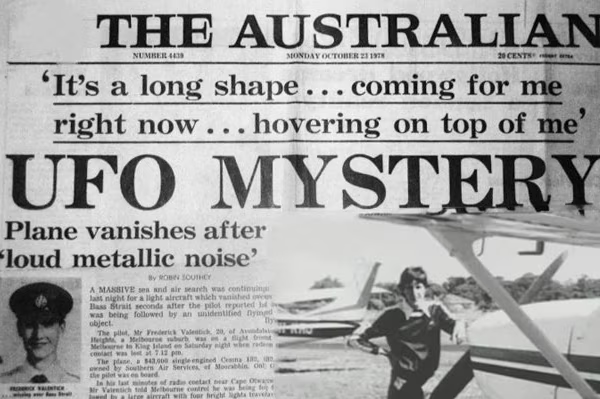
On the evening of 21 October 1978, a young Australian pilot named Frederick Valentich took off from Moorabbin Airport in a Cessna 182L, registration VH-DSJ, and headed south toward Bass Strait. The plan, on paper, was simple: a night VMC flight to King Island. The outcome was anything but. Within an hour, Valentich was reporting an unknown aerial presence to Melbourne Flight Service, describing lights and manoeuvres he could not reconcile with ordinary traffic. Minutes later, the transmissions ended. The aircraft never arrived. No wreckage was recovered during the official search. And the formal conclusion, preserved in the Department of Transport investigation summary, remains stark: the reason for the disappearance “has not been determined” (Department of Transport, 1982).
That phrase is why this case refuses to settle. Aviation history is full of tragedies where the mechanism is understood but the details are lost. The Valentich disappearance is inverted: the details are vivid because we have a contemporaneous radio exchange, but the mechanism remains open because the aircraft was not found. The result is a case that sits permanently on the border between two worlds: the world of known aviation hazards and the world of reported UAP encounters, where witness testimony and uncertainty have to carry more weight than anyone would prefer.
This is also an era story. The late 1970s and early 1980s were part of a Cold-War atmosphere in which “unknowns” in the sky could be interpreted as everything from misperception to intrusion, and where UAP reporting was increasingly shaped by modern media and the growing sense that official institutions were documenting more than they explained. In retrospective analysis, the Valentich case has often been placed alongside other Cold-War era narratives in which pilots, military personnel, or official channels documented anomalous aerial observations, though the evidentiary structure of each case differs significantly.
The sky in the Cold War, and why people listened differently
During the Cold War, the sky was not neutral. It was monitored, contested, and culturally charged. Civil aviation expanded rapidly, military aviation matured into a high-speed, radar-driven enterprise, and public awareness of airspace vulnerability rose with every geopolitical flashpoint. In that climate, an anomalous report could feel like a technical puzzle or a security concern depending on who was listening.
At the same time, the public narrative around UAP was changing. In the 1970s, mass-sighting waves and widely reported close encounters were circulating internationally through newspapers, TV, and radio, and the subject was becoming mainstream entertainment as well as contested public discourse. In that cultural environment, a pilot’s report of an unknown object was more likely to be interpreted as part of a broader pattern, at least by some audiences, even when the evidence supported multiple interpretations.
This is the interpretive backdrop against which Valentich’s radio calls landed. They were not isolated words in a vacuum. They entered a world already primed to ask, sometimes too quickly, whether the extraordinary had occurred.
Who was Frederick Valentich?
Frederick Valentich was 20 years old and held a private pilot licence. According to the official investigation summary, he had logged about 150 hours total flying time and held a Class Four instrument rating permitting night flight under visual meteorological conditions (Department of Transport, 1982). He was not a brand-new student pilot, but he was also not highly experienced, particularly for a night overwater route where visual cues are limited and workload can rise suddenly.
Later reporting adds biographical colour that has shaped public readings of the case. A Flight Safety Australia feature states that investigators were told Valentich had a strong interest in UAP material and that his family described him as collecting related books and articles (Wilson, 2025). The same article reports a recollection from his girlfriend suggesting he “wasn’t himself” shortly before the flight, along with a remark interpreted as fascination with extraordinary possibilities (Wilson, 2025). These details are often treated as significant because expectation can influence perception, especially in ambiguous environments. They do not establish deception or delusion. They simply remind us that observers arrive in the cockpit with a psychology, not just a checklist.
A routine plan with small oddities
The Department of Transport summary records that Valentich attended the Moorabbin briefing office, obtained meteorological information, and filed a flight plan for a night VMC trip from Moorabbin to King Island and return (Department of Transport, 1982). He planned to cruise below 5,000 feet, with estimates of 41 minutes to Cape Otway and 28 minutes onward to King Island. The aircraft was refuelled to capacity, and endurance was listed as 300 minutes (Department of Transport, 1982).
Two small details became recurring points of debate. Valentich carried four life jackets (Department of Transport, 1982). That can be read as prudent preparation for a water crossing, or as unusually deliberate. He also did not arrange for King Island aerodrome lighting to be illuminated for his arrival (Department of Transport, 1982). That omission has been interpreted in multiple ways: a simple oversight, a sign of poor planning, or something more suggestive. The official summary does not speculate on intent. It simply records the facts.
At 1819 hours, Valentich departed Moorabbin. He established two-way radio communications with Melbourne Flight Service. At 1900, he reported from Cape Otway (Department of Transport, 1982). Up to that point, the flight unfolded as expected.
Then, at 1906, the tone shifted.
The exchange that became the case
The official investigation summary preserves the pivotal radio dialogue and notes that some bracketed words may be open to interpretation, signalling the limits of transcription and audio clarity (Department of Transport, 1982). Despite those limits, the main structure of what was said is clear.
At 1906:14, Valentich asked Melbourne Flight Service whether there was any known traffic below 5,000 feet. He was told there was no known traffic. Valentich then reported that he seemed to have a large aircraft below 5,000 (Department of Transport, 1982). At first, this sounds like routine situational awareness. He is checking whether what he sees matches known traffic.
What follows is the part that made the case endure. Valentich described four bright lights, “like landing lights,” and said the object passed over him at least a thousand feet above (Department of Transport, 1982). When asked whether it was military, Flight Service replied there were no known aircraft in the vicinity (Department of Transport, 1982). Valentich said the object was approaching from the east and described it as “playing some sort of game,” passing over him repeatedly at speeds he could not identify, as he perceived them (Department of Transport, 1982).
Then he said, “It’s not an aircraft” (Department of Transport, 1982).
He reported he was at 4,500 feet. He said he was orbiting and that the object was orbiting on top of him, as he perceived it. He described a green light and something metallic and shiny on the outside, as reported in the transcript (Department of Transport, 1982). He said the object vanished and later reappeared from the southwest. He reported his engine was rough idling and “coughing.” He again said the object was hovering on top of him, again as a description of what he believed he was observing, and repeated that it was not an aircraft (Department of Transport, 1982).
After that, the communications ended. The official summary notes 17 seconds of open microphone and no further transmissions (Department of Transport, 1982). A Flight Safety Australia feature adds that there was silence for 17 seconds followed by an unidentified staccato noise, and that the transmission ended abruptly (Wilson, 2025). The Department of Transport summary does not describe that noise, but it is consistent across sources that an open-mic interval occurred and that no further communication followed.
The crucial editorial discipline here is simple: Valentich described behaviour that sounded interactive, but the transcript is still a record of perception and reporting, not independently confirmed object behaviour. The case is powerful precisely because the reporting is contemporaneous, but it remains reporting.
Weather, twilight, and the disappearing horizon problem
The Department of Transport summary describes the weather around Cape Otway as clear with a trace of stratocumulus at 5,000 to 7,000 feet, scattered cirrus at 30,000 feet, excellent visibility, and light winds. It also notes the end of daylight at Cape Otway was 1918 hours (Department of Transport, 1982). That timing places the radio exchange in a transitional light environment. In aviation, twilight over water is notorious for reducing usable visual cues even when the weather is technically good.
This matters because one of the most persuasive “ordinary” explanations for the case is not that Valentich invented anything, but that he may have been drawn into a high-workload perceptual trap. If a pilot begins manoeuvring while fixated on lights outside the cockpit, with a dimming horizon and limited reference points, spatial disorientation can develop rapidly. The pilot can sincerely believe he is flying level or performing a controlled orbit while actually entering an increasingly unstable attitude. This is a known hazard mechanism, and it is one reason the Valentich case is frequently discussed in aviation safety terms, not only UAP terms.
The challenge is that this hazard mechanism can coexist with an unusual stimulus. A pilot could be disoriented because he is chasing something real, something misperceived, or something that is a mix of both. The official record does not adjudicate that question.
The official response, and why “no trace” doesn’t mean “no story”
Search and rescue procedures moved quickly. The alert phase was declared at 1912, and when the aircraft failed to arrive at King Island by 1933, the distress phase was declared and search action began (Department of Transport, 1982). An intensive air, sea, and land search continued until 25 October 1978, and no trace of the aircraft was found during that effort (Department of Transport, 1982). The official conclusion remains: cause undetermined (Department of Transport, 1982).
The “no trace” outcome is both common and psychologically potent. Overwater losses can leave little recoverable evidence, particularly if the likely impact area is uncertain or the sea disperses debris. The absence of wreckage keeps multiple narratives alive because it removes the anchor point that would usually constrain interpretation.
Case studies in interpretation
Aviation-focused reconstruction: perception, lights, and disorientation
A prominent skeptical analysis by McGaha and Nickell proposes that Valentich may have misinterpreted bright celestial objects and lights as a nearby aircraft or structured object, and that his language about “orbiting” could be consistent with a dangerous spiral descent driven by spatial disorientation (McGaha & Nickell, 2013). The authors further suggest that the reported “green light” could have been his own aircraft’s navigation light or its reflection on the windshield, perceived as part of the external phenomenon (McGaha & Nickell, 2013).
This reconstruction appeals because it attempts to explain multiple transcript elements without requiring an unknown craft. It also matches known aviation hazards: twilight, overwater conditions, fixation on external lights, and manoeuvring. However, it remains a reconstruction, not a definitive closure, because the official cause is undetermined and the aircraft was not recovered (Department of Transport, 1982).
UAP-oriented reading: an unknown presence reported in real time
The UAP-oriented reading begins with the strongest element the case offers: contemporaneous reporting. Valentich described an object with multiple lights, unusual motion as he perceived it, and a metallic appearance, and repeatedly stated it was not an aircraft (Department of Transport, 1982). In UAP research, that kind of real-time pilot report is treated as higher-value testimony than retrospective storytelling, even while acknowledging that pilots can misperceive under certain conditions.
This reading remains bounded by an evidentiary limit: there is no confirmed multi-sensor corroboration in the publicly accessible official summary. The transcript documents what Valentich reported. It does not, on its own, confirm the physical characteristics or intent of what he believed he observed. The disciplined position is that the encounter remains unidentified within the available record.
The debris question, handled transparently
Later discussions of the case sometimes mention possible debris or partial physical evidence, but the literature is not perfectly consistent about details.
The Tasmanian Aviation Historical Society report discusses an engine cowl flap washing ashore on Flinders Island and notes investigators concluded it matched a Cessna 182 within a serial-number range that included Valentich’s aircraft, while also recognising the limitation of such matching without definitive chain-of-custody confirmation to VH-DSJ (Dearing, 2020).
A Flight Safety Australia feature reports an aircraft-part discovery in the years after the disappearance and also mentions that search aircraft may have seen, but then lost, a debris field during the original search effort (Wilson, 2025). In secondary retellings, the location of the later part is sometimes described differently across summaries. Taken together, the responsible phrasing is straightforward: sources differ on whether a relevant fragment is associated with Flinders Island or King Island in later reporting, and the public record available in these summaries does not conclusively establish the fragment as belonging to VH-DSJ (Dearing, 2020; Wilson, 2025).
That is not a satisfying answer, but it is an honest one. The debris discussion slightly increases the plausibility of an ocean loss while not eliminating the encounter question. It also demonstrates why the case continues to generate interpretation: fragments without full provenance do not close a disappearance, they merely reshape its probability contours.
Why the case persists, and what it teaches
The Valentich disappearance persists because it is a collision between vivid testimony and absent physical resolution. It offers a rare contemporaneous narrative of an unknown aerial observation, preserved in an official investigation summary, and then it offers a clean drop into silence.
For UAP research, the case highlights the central methodological problem: uncertainty is not a failure, it is the condition under which most cases must be evaluated. The strongest claims require converging evidence: multiple witnesses, multiple sensors, recoverable records, or physical materials with clear provenance. Valentich’s case has strong contemporaneous testimony and strong official documentation of the flight timeline and search response, but it lacks the additional converging elements that would let investigators confidently classify the phenomenon.
For aviation, it highlights a different truth: even clear weather can conceal lethal perceptual traps, and fixation plus manoeuvring plus twilight over water is a dangerous mix. If the stimulus that captured Valentich’s attention was a UAP, the lesson is that anomalous encounters can create high-risk cockpit workload. If the stimulus was misperceived, the lesson is that human perception can manufacture urgency from ambiguity, with catastrophic results. Either way, the cockpit remains a place where interpretation can become fate.
Claims taxonomy
Verified
Valentich departed Moorabbin at 1819 on 21 October 1978 in Cessna 182L VH-DSJ, reported over Cape Otway at 1900, reported an unidentified object from 1906 onward, and transmissions ceased after a 17-second open microphone interval. An intensive search continued until 25 October 1978, and the official cause was undetermined (Department of Transport, 1982).
Probable
The aircraft was lost at sea in Bass Strait following an in-flight event involving high pilot workload, visual fixation on an unidentified stimulus reported by Valentich, and reported engine roughness. The stimulus may have been misidentified conventional sources, an external anomaly, or a combination, and the record does not allow a definitive conclusion (Department of Transport, 1982; Wilson, 2025).
Disputed
The claim of abduction or deliberate hostile action by a non-human intelligence is not supported by recoverable evidence in the official record and competes with plausible aviation accident mechanisms (Department of Transport, 1982).
The claim that Valentich staged his disappearance remains unproven and is challenged by published accounts suggesting possible debris consistent with loss at sea, while acknowledging that fragment identification and location details vary across sources (Dearing, 2020; Wilson, 2025).
Speculation labels
Hypothesis
Valentich encountered compelling lights at dusk and, while manoeuvring and communicating, entered a disorienting turn or tightening spiral over water leading to loss of control and ocean impact. Engine roughness could have been perceived during unusual attitude, throttle changes, or stress, without requiring external interference (Department of Transport, 1982; McGaha & Nickell, 2013).
Hypothesis
Valentich encountered an external UAP in close proximity, described as metallic and manoeuvring as he perceived it, and the resulting workload and stress contributed to loss of control or a forced manoeuvre with fatal outcome. This remains unverified without corroborating sensor data in the public record (Department of Transport, 1982).
Witness Interpretation
Valentich interpreted the lights and motion as an aircraft at first, then reported “it’s not an aircraft,” describing a green light and metallic sheen, and describing it as orbiting and hovering above him, as recorded in the transcript (Department of Transport, 1982).
Researcher Opinion
Claims of staged disappearance or extraordinary capture scenarios rely heavily on evidentiary gaps and have not been resolved by publicly documented primary materials. They should be treated as disputed interpretations rather than conclusions (Dearing, 2020).
References
Department of Transport. (1982, April 27). Aircraft accident investigation summary report: Cessna 182L, VH-DSJ (Frederick Valentich) (Reference No. V116/783/1047). Australian Government archive copy hosted by the Australian Transport Safety Bureau. https://www.atsb.gov.au/sites/default/files/media/5226347/197802563.pdf
Dearing, W. (2020, July). Mysteries of aviation: Frederick Valentich and VH-DSJ (TAHS Report No. 2020.0002.0). Tasmanian Aviation Historical Society. https://tahs.org.au/wp-content/uploads/2020/07/TAHS-2020.0002.0_Mystery-VH-DSJ.pdf
McGaha, J., & Nickell, J. (2013, November/December). The Valentich disappearance: Another UAP cold case solved. Skeptical Inquirer, 37(6). https://skepticalinquirer.org/2013/11/the-valentich-disappearance-another-ufo-cold-case-solved/
Wilson, R. (2025, February 24). Leaving this world. Flight Safety Australia. https://www.flightsafetyaustralia.com/2025/02/leaving-this-world/
ABC Radio National. (2023, March 16). Uncanny: The disappearance of Frederick Valentich. ABC Listen. https://www.abc.net.au/listen/programs/uncanny/the-disappearance-of-frederick-valentich/102103360
SEO keywords
Valentich disappearance, Frederick Valentich, VH-DSJ, Bass Strait UAP, 1978 pilot disappearance, Moorabbin Airport, King Island flight, Cape Otway UAP report, Melbourne Flight Service transcript, Australian aviation mystery, Cold-War UAP sightings, Cessna 182L disappearance