
In the 1920s and 1930s, Australia didn’t have “flying saucers” as a ready-made label, and they didn’t have a 24-hour news cycle to turn every report into a global meme, so they called them phantom planes among other names. What they did have was a sky that still felt local and legible: if something moved above the treeline, you could often hear it, track it, and argue about it over the fence by sunset. When something in that sky refused to fit the known catalogue of aircraft, balloons, planets, clouds, or “someone’s prank,” the language of the day took over. Witnesses reached for “airship,” “Zeppelin,” and “mystery aeroplane.” Editors leaned into “phantom planes.” Officials offered the quietest explanation available.
And yet, the underlying pattern feels familiar. People report an object with specific shape or behaviour. Others corroborate. Authorities investigate, sometimes publicly, sometimes not. Then the record splits: one thread becomes “probably X,” another insists it was not, and a residue remains that won’t resolve cleanly even after decades of hindsight.
This is a magazine-style walk through Australia’s interwar UAP material from 1920 to 1940, with emphasis on first-hand or near-contemporaneous accounts and the official posture that framed them. Where interpretation enters, it is clearly separated from evidence.
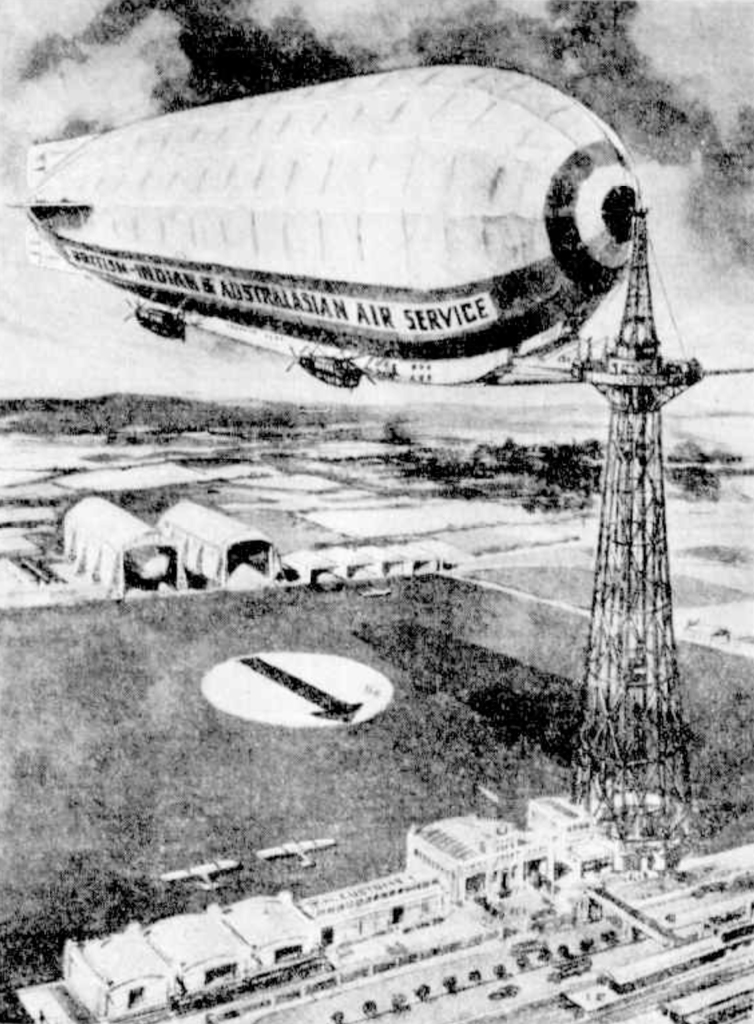
The interwar sky: why Australia was primed for UAP stories
Between 1920 and 1940, Australian aviation expanded, but unevenly. Major cities hosted air meets and scheduled services, while vast rural regions still went weeks without a confirmed flight overhead. That mismatch created a perfect environment for mystery. In places where aircraft were rare, any unusual aerial presence felt momentous. In places where aircraft were common, an unexpected arrival or a strange flight profile still stood out sharply.
The period also carried a rising anxiety about foreign air power. Even when newspapers joked about “mystery” aircraft, the humour often sat on top of genuine strategic concern. That tension matters because it shaped how witnesses interpreted what they saw, and how officials responded. The same report could be treated as romance, menace, or embarrassment depending on who was speaking.
Case study: The Myall “Zeppelin” (Northern Victoria, March 1925)
If you want a single interwar Australian case with a strong narrative spine, start at Myall, near Kerang in northern Victoria.
According to reporting compiled and quoted by historian Brett Holman, Mr and Mrs G. Cockcroft were walking to church around 3 p.m. on Sunday 22 March 1925 when they noticed “a large cigar-shaped object in the sky,” described as similar to a Zeppelin, at an altitude reported around 2,000 feet. They said it travelled at high speed, initially heading north, then taking an “erratic course” which suggested it had “got out of control,” and continuing toward the New South Wales side of the Murray.
What makes this account particularly valuable is that it quickly becomes a multi-witness story. A third witness, Mr McLean of Myall, reportedly added that the object was “like a big cigar in shape,” though his view was partly blocked by trees.
Then the language hardens. In a later published statement, Cockcroft escalated from “similar to a Zeppelin” to “exactly like a Zeppelin,” adding a detail that forces any reader to make a decision about credibility: he claimed they could “even see the suspended observation cars.”
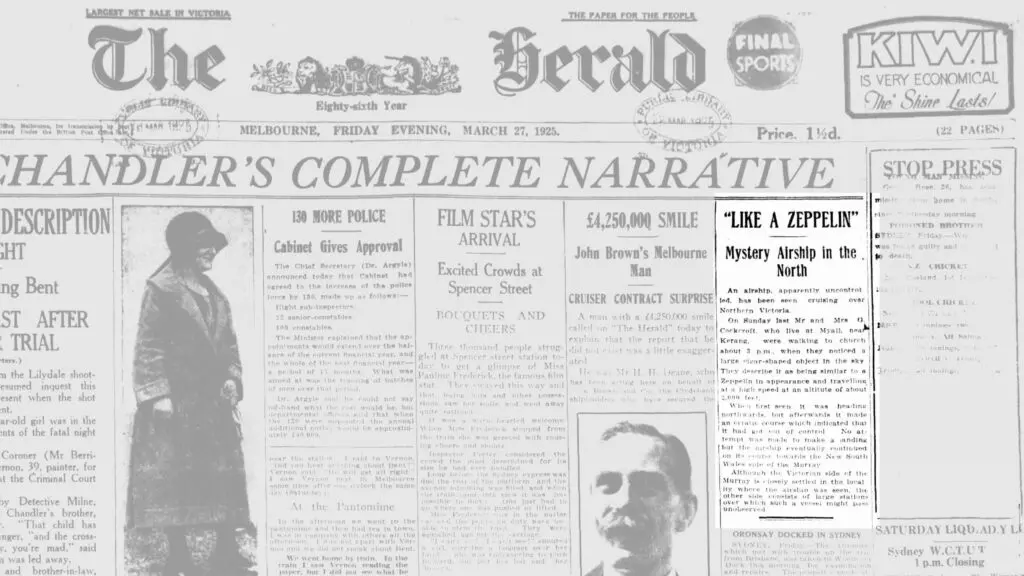
(The Herald – Melborune)
At this point, the case becomes less about whether the witnesses were impressed, and more about whether their observation can be plausibly reduced to a simple misidentification. Cockcroft argued that a bank of cloud would not behave as described, and that high wind would break it up faster than the time they had it in view. He also insisted the object “sunk behind the trees,” a detail that (if accurate) implies a coherent object moving below their line of sight rather than a patch of cloud drifting behind a horizon.
Official reaction, as preserved in the same historical reconstruction, was cautious to the point of dismissal. Air Board officials, despite overseeing the RAAF, were reported as “sceptical,” with an “accepted theory” that the airship was “probably a bank of clouds.”
That exchange is the heart of the Myall case. It’s not just “people saw something.” It’s a collision between detailed testimony and an institution that chose the lowest-temperature explanation.
It’s also worth remembering that “Zeppelin” was the era’s most available mental template for a large, structured aerial craft. Airships and imperial air routes were widely discussed in period media, which likely influenced the comparison witnesses reached for without necessarily explaining what prompted the sighting.
Myall remains, at minimum, a robust example of an early Australian report that does not resolve neatly into a simple light, a clearly identified aircraft, or a single agreed prosaic cause.
The “mystery aeroplane” years: Tasmania and the social life of an intruder (1938)
By the late 1930s, Australian “mystery aeroplane” stories were not confined to rural roadsides. They became a civic conversation.
A notable example is a Hobart column in The Mercury (13 August 1938), presented as playful commentary but anchored in the claim that the aircraft’s existence was not in doubt: “There can be no doubt of the existence of the aeroplane. Many people saw it…”
This kind of text is not a sworn statement, and it does not preserve clean first-hand descriptions. It is, however, a cultural indicator. It tells us that something enough people considered real, or at least report-worthy, had entered the public bloodstream. The column treats the “mystery aeroplane” as romance, and then pivots to strategic unease, joking about whether it might be Japanese and whether leaders should greet it with tourist brochures or something harsher.
For UAP research, Hobart 1938 is important less as a single solved case and more as an example of how “unknown aircraft” became a social object: discussed, embellished, and interpreted through the period’s anxieties.
Darwin’s “mystery plane” flap (February–March 1938)
Darwin is where interwar “mystery aeroplane” talk most clearly brushes up against official concern, while still leaving us with frustratingly sparse observational detail in the easily accessible record.
A report dated 9 February 1938 states that “Unidentified aeroplanes have flown over Darwin twice in the past six days,” and that “aviation authorities” were “puzzled about their origin and destination.” Another item the next day keeps the uncertainty alive, noting the town’s agitation while suggesting authorities were cautious about giving the reports full endorsement.
Then, on 5 March 1938, coverage described recurrence and renewed inquiry: “Once again the mystery plane… has flown over Darwin,” adding that “Civil Aviation authorities are again” investigating.
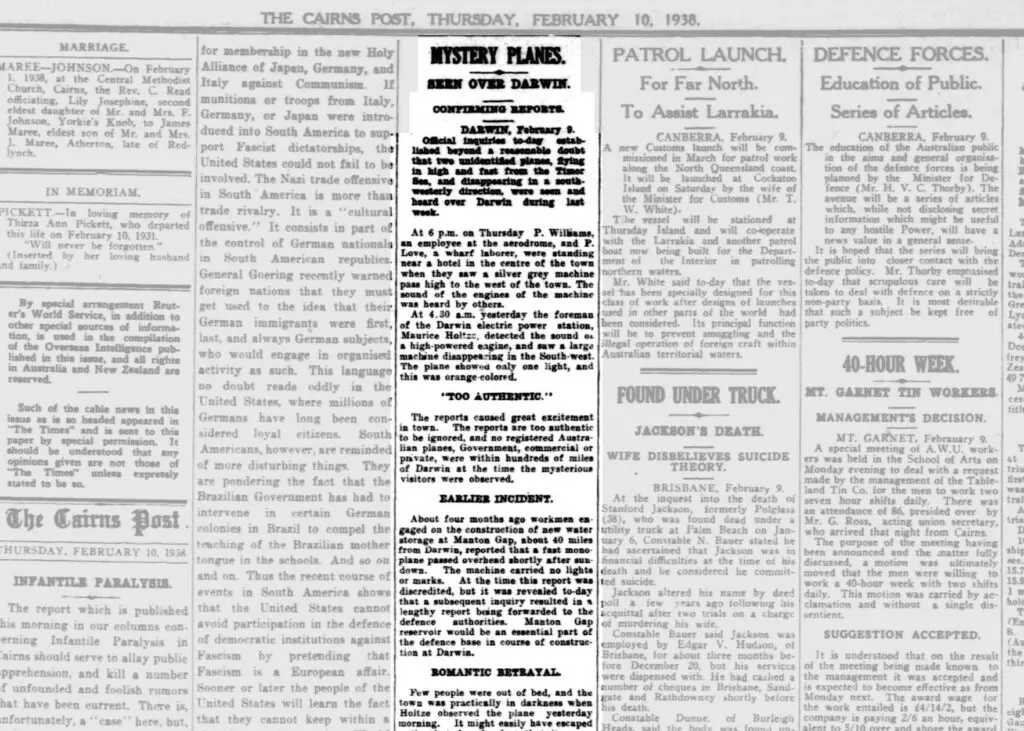
What those items do give us is the institutional posture: repetition, public attention, and officials acknowledging the reports as a matter for inquiry. What they do not reliably preserve, at least in the form most readers can easily verify now, is the kind of descriptive data that would let us compare the object to a specific aircraft type, a balloon, or an astronomical source.
That lack matters enough to treat Darwin 1938 as a borderline historical UAP entry: important as an example of repeated “unknown aircraft” reporting and investigation, but too thin in preserved observation detail to lean on as a high-quality descriptive case.
Narromine and Wellington, New South Wales (May 1939): when mystery may be routine
Not every interwar “mystery aircraft” report is best treated as a high-strangeness case, and the record itself shows why.
In a set of incidents collected and analysed by Holman, Wellington’s local reporting described aircraft activity under conditions that made identification hard: a heavy morning mist, a plane flying toward Sydney, and later another aircraft seen at high altitude that swooped down, circled as if seeking a landing place, and then departed. Narromine reportedly experienced “three night visits,” with an aircraft heard and seen flying low over the aerodrome before roaring away.
The same historical treatment also captures the local and official pull toward conventional explanations. Training flights were suspected. Richmond Aerodrome officials reportedly suggested the aircraft might have been an Avro Anson engaged in exercises.
This cluster is useful precisely because it demonstrates how “mystery plane” reports can arise from the overlap between public uncertainty and ordinary aviation activity, especially at night or in poor visibility.
Francis Chichester and the late-entering aviator testimony (1931)
Aviator testimony is often treated as premium currency in UAP discussion, and sometimes for good reason. Pilots are trained observers, and they understand aircraft performance and appearance better than most of the public. But interwar Australian material also teaches a caution: pilot testimony can arrive late, and late testimony changes the evidentiary posture.
Francis Chichester’s 1931 trans-Tasman venture is well documented as an aviation feat in contemporaneous reporting. In UAP literature, he is associated with a reported encounter with an “airship” or anomalous object during this broader period. Holman notes that the story is “relatively famous,” but adds key qualifiers: Chichester appears to have reported it only decades later, and even then he did not clearly claim it was an airship.
Further discussion of the case highlights date confusion around the commonly repeated timing, reinforcing that even the basic chronology is not stable in the secondary record.
For publication-quality standards, those features place the Chichester encounter firmly in the disputed lane unless a contemporaneous logbook entry, letter, or near-date interview emerges.
Salamaua, 1940: Venus, balloons, and missing photographs
Near the edge of our timeframe sits a case that reads like a miniature of modern UAP controversy, complete with competing explanations and a missing key piece of evidence.
Holman’s collected material describes an incident at Salamaua (then in the Australian-administered Territory of New Guinea) where a government official reportedly saw a “brilliant white light” in the sky at midday, interpreted it as incoming parachutists, grabbed rifles and ammunition, and even chartered an aircraft to search. The town reportedly turned the event into laughter as the alarm looked increasingly misplaced.
One explanatory thread resolves the event to astronomy: Venus can be visible in daylight under certain conditions, and the story is presented as an example of fear making a planet look like an invasion.
But a second strand complicates the neatness. A later account described aviators insisting the object was a balloon with a small basket beneath it, that it was photographed, and that additional balloons were seen in subsequent days, including one described as black rubber with a small basket. Holman notes he was unable to locate the photographs.
This is where responsible UAP writing has to resist the urge to “pick a winner” for narrative convenience. Venus is plausible. Balloons are plausible. The record, as preserved, holds both.
What the interwar Australian record does, and does not, establish
Evidence in this era is uneven. Some cases preserve close-range, shape-based testimony (Myall). Some preserve social consensus without clean observational detail (Hobart). Some show repeated reports and official attention but limited descriptive data in accessible excerpts (Darwin). Some likely collapse into known aviation activity (Narromine/Wellington). Some are credible but late-entering (Chichester). Some are split by competing explanations and missing documentation (Salamaua).
What we can responsibly say, based on the material cited here, is that Australians repeatedly reported aerial anomalies that were not clearly identifiable within known aviation activity at the time they were observed, and that these reports sometimes prompted institutional attention rather than immediate closure.
What we should not say, without stepping beyond evidence, is that these episodes prove a single underlying cause or a continuous “presence.” Interwar UAP history is best treated as a patchwork: a mixture of misidentifications, conventional aircraft operating beyond public awareness, and a smaller residue of reports that remain unresolved.
Claims Taxonomy
Myall “Zeppelin” (Myall, Victoria, 22 March 1925): Disputed. Multiple witnesses described a cigar-shaped object similar to a Zeppelin; Air Board officials favoured a cloud explanation.
Hobart “Mystery Aeroplane” (Tasmania, 1938): Disputed. Contemporary commentary asserts many people saw the aircraft, but surviving reviewed material does not preserve enough first-person observational detail to elevate beyond dispute.
Darwin “Mystery Plane” flap (Northern Territory, Feb–Mar 1938): Disputed. Contemporary reports describe repeated unidentified aircraft over Darwin and state that aviation or Civil Aviation authorities were puzzled and investigating, but the accessible record lacks preserved details such as shape, altitude, or structured-object descriptors.
Narromine/Wellington activity (New South Wales, May 1939): Misidentification (probable re-attribution). Reporting and later historical analysis point toward training or military aircraft, with an Avro Anson engaged in exercises offered as a likely explanation.
Francis Chichester encounter (Australia/New Zealand route context, 1931): Disputed. Strong witness profile, but memoir-era reporting, date ambiguity, and lack of contemporaneous corroboration in the reviewed sources keep it disputed.
Salamaua “brilliant white light” and later balloon narrative (Territory of New Guinea, Aug 1940): Disputed. One strand resolves to Venus; another claims balloons with baskets and photographs that have not been located in the reviewed sources.
Speculation Labels
Hypothesis
A minority of interwar Australian cases could represent a genuine anomalous aerial presence operating with profiles not readily attributable within the aviation norms of the day. This is motivated by structured-object testimony like Myall and by recurring “intruder” framing, but it is not established by decisive physical evidence in this period.
Witness Interpretation
“Zeppelin” language in 1925 likely reflects an honest attempt to map an unfamiliar structured object onto the most culturally available template, rather than proof that a Zeppelin was present. “Parachutists” at Salamaua reflects wartime anxiety projecting invasion imagery onto a bright stimulus.
Researcher Opinion
The most productive way to read Australia 1920–1940 is as an early chapter of the same problem modern investigators face: testimony and partial documentation create a residue of unresolved cases, while social fear and institutional caution shape what gets recorded, what gets dismissed, and what remains open.
Relevant links
The Myall incident (analysis with embedded contemporaneous quotations): https://airminded.org/2021/08/16/the-myall-incident/
Hobart “Passing Notes” (13 Aug 1938): https://trove.nla.gov.au/newspaper/article/25488919
Darwin unidentified aeroplanes (9 Feb 1938): https://trove.nla.gov.au/newspaper/article/29204258
Darwin still a puzzle (10 Feb 1938): https://trove.nla.gov.au/newspaper/article/231115475
“Mystery aeroplane heard again” (5 Mar 1938): https://trove.nla.gov.au/newspaper/article/25498270
Australian mystery aircraft miscellany (incl. 1939 and Salamaua 1940): https://airminded.org/2022/10/03/a-miscellany-of-australian-mystery-aircraft-1903-1940-iii/
Chichester date uncertainty (secondary discussion): https://ufos-scientificresearch.blogspot.com/2018/05/aviator-francis-chichesters-classic.html
References
Holman, B. (2021, August 16). The Myall incident. Airminded. https://airminded.org/2021/08/16/the-myall-incident/
Holman, B. (2022, October 3). A miscellany of Australian mystery aircraft, 1903–1940 — III. Airminded. https://airminded.org/2022/10/03/a-miscellany-of-australian-mystery-aircraft-1903-1940-iii/
Passing notes. (1938, August 13). The Mercury (Hobart, Tas.). Trove, National Library of Australia. https://trove.nla.gov.au/newspaper/article/25488919
Unidentified aeroplanes over Darwin. (1938, February 9). Trove, National Library of Australia (newspaper record). https://trove.nla.gov.au/newspaper/article/29204258
Darwin’s aircraft still a puzzle. (1938, February 10). Trove, National Library of Australia (newspaper record). https://trove.nla.gov.au/newspaper/article/231115475
Mystery aeroplane heard again. (1938, March 5). Trove, National Library of Australia (newspaper record). https://trove.nla.gov.au/newspaper/article/25498270
UFOs Scientific Research. (2018, May). Aviator Francis Chichester’s classic sighting: Is the date… https://ufos-scientificresearch.blogspot.com/2018/05/aviator-francis-chichesters-classic.html
SEO keywords
Australian UAP 1920-1940, interwar UAP Australia, Myall airship 1925, Myall Zeppelin sighting, Darwin mystery plane 1938, unidentified aeroplanes Darwin 1938, Hobart mystery aeroplane 1938, Narromine mystery aircraft 1939, Wellington NSW mystery plane 1939, Salamaua UAP 1940, Francis Chichester UAP 1931, early twentieth century UAP accounts Australia, phantom airship Australia, pre-1947 UAP history Australia