There is a particular kind of UAP story that rarely makes it into the highlight reels. No triumphant “I knew what I saw.” No clean ending. Instead, a witness gets home, sits down, and realizes something is wrong. Their head feels like it is swelling from the inside. The room tilts, even though the floor is flat. The stomach lurches. Light becomes painful. The sound becomes sharp. They are not just frightened. They are sick.
For decades, investigators have collected these accounts under the unglamorous label “physiological effects.” In technical language, they fall under field effects on witnesses: reports where proximity to an anomalous object is reported to coincide with sudden, body-level consequences. Among those consequences, migraine-like headaches and nausea show up so often that they have become a pattern worth discussing carefully, without pretending the pattern automatically explains itself.
This is an explainer about that pattern. We are going to keep three layers separate, because UAP writing often tangles them together: what medicine says migraine and nausea are, what witnesses and case literature say happened around UAP encounters, and what official or semi-official reviews can and cannot responsibly claim.
Migraine is not “just a headache”
Start with the medical baseline, because without it, everything else gets distorted.
Migraine is a neurological condition that often happens with nausea, vomiting, and extreme sensitivity to light and sound. It can last hours to days, and it can be disabling. (Mayo Clinic, n.d.)
There is also a subtype that maps neatly onto many “field effects” descriptions: vestibular migraine. It can involve vertigo, imbalance, motion sensitivity, and nausea, and it can occur with or without headache. The American Migraine Foundation describes vestibular migraine as the second-most common cause of vertigo in adults. (American Migraine Foundation, n.d.)
That matters because it prevents a lazy shortcut in either direction. Migraine biology can explain why some witnesses experience nausea, dizziness, and sensory overload during a frightening event. At the same time, migraine biology does not explain why some case narratives place onset tightly inside the encounter window, or why symptoms in some reports coincide with burns, heat, or other alleged physical effects. (Mayo Clinic, n.d.)
So the medical truth is simple: migraine-like clusters are common enough that they are not automatically diagnostic of anything exotic. The investigative question is different: why do so many close-approach UAP narratives report sudden migraine-like illness timed to the encounter itself?
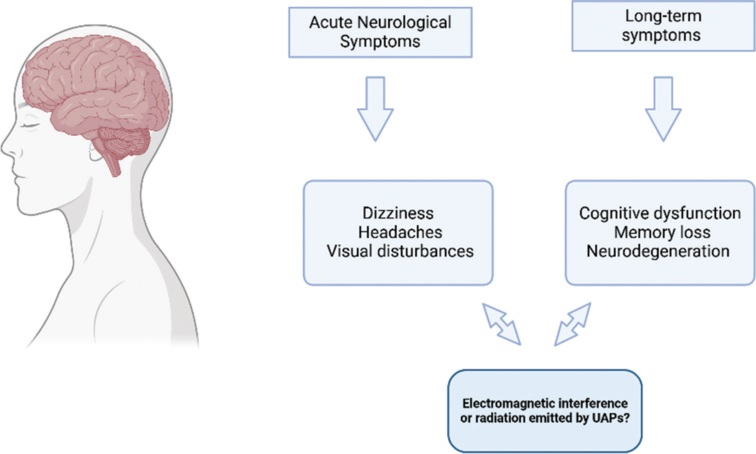
Source: Neurological Effects of Encounters with Unidentified Aerial Phenomena
Matrix Science Medica9(3):63-66, Jul-Sep 2025.
Why “field effects” became a category
UAP researchers have long tried to sort cases by how deeply the reported event seems to intrude into the physical world. A useful historical anchor is the 1976 Congressional Research Service summary that discusses Hynek’s close encounter framework and the distinction between purely visual reports and cases involving reported physical effects. (Congressional Research Service, 1976)
This matters because it shows that “effects” were not tacked on recently as a modern storytelling flourish. Very early in the public record, investigators were already treating physical traces and reported physiological impacts as part of the classification problem. (Congressional Research Service, 1976)
For publication-level clarity, the boundary should always remain visible: witnesses report symptoms; investigators look for patterns; mechanisms often remain unresolved.
Case file: Falcon Lake and the fast-arriving “after”
If you want to understand why migraine and nausea are discussed as field effects, start with Falcon Lake.
In 1967 near Falcon Lake, Manitoba, Stefan Michalak reported a close-range encounter involving heat and a grid-like pattern of burns. For the migraine-and-nausea thread, what matters is the physiological cascade preserved in Chris Rutkowski’s detailed writeup.
Rutkowski’s paper supports a sequence in which Michalak returns to the site and “immediately” feels nauseous while headache pain surges, followed by worsening headache, worsening nausea, cold sweat, weakness and dizziness, and repeated vomiting as he leaves the area. (Rutkowski, 1994)
Analysis (signposted): read on its own terms, that timing and clustering resembles an acute onset episode rather than a delayed stress reaction. Resemblance is not proof of cause, but it is one reason Falcon Lake remains central to discussions of “too close” encounters. (Rutkowski, 1994)
Case file: Cash–Landrum, and why the sourcing must stay explicit
Cash–Landrum is frequently discussed in terms of burns, helicopters, and litigation. Underneath the headlines is a quieter through-line: the witnesses’ descriptions of neurological distress, including headaches and waves of nausea.
The CUFON document commonly cited here is a posted transcript of a Bergstrom Air Force Base interview. It is useful for understanding what was said in that setting, but it is not the same thing as a government-hosted archival audio file or contemporaneous medical charts. It should be treated as a secondary-access transcript with stated limitations. (CUFON, 1981)
To establish the case’s wider public footprint, it is fair to cite mainstream coverage. A Houston Chronicle (Chron.com) piece shows that the case has existed in public media discourse, including television re-investigation efforts. (Wukman, 2008)
For symptom language in the ufological record, John F. Schuessler’s compilation describes worsening headache and “waves of nausea” within the Cash–Landrum narrative as presented in his physiological-effects catalog. (Schuessler, 1996)
To represent the skeptical challenge correctly, Skeptical Inquirer is the appropriate citation specifically for the critique that the case lacks solid independent evidence sufficient to substantiate key claims, and for its argument that the “classic” case unravels under scrutiny. (Sheaffer, 2014)
Analysis (signposted): Cash–Landrum is a good example of why UAPedia separates “reported symptoms” from “confirmed mechanism.” The symptom cluster may be consistent across retellings, but the evidentiary ladder for medical causation remains incomplete in the public record, while skeptical critiques dispute the case’s corroboration strength. (Sheaffer, 2014; Schuessler, 1996)
Brazil’s OVNI archive and the “many witnesses, uneven medicine” problem
Brazil’s National Archives maintains a dedicated OVNI fonds (Fundo Objeto Voador Não Identificado) and explicitly describes it as composed of 743 records, including reports, questionnaires, photographs, drawings, audio, video, and press clippings. (Arquivo Nacional, 2018)
This matters for migraine and nausea because large flaps generate large volumes of testimony about bodily effects, but rarely as uniform clinical datasets. A national archive can preserve a broad paper trail of reporting while still leaving many individual medical specifics unresolved. (Arquivo Nacional, 2018)
The important publishing posture is restrained: the archival existence validates recordkeeping and seriousness of collection, not the medical mechanism behind any single report.
What official studies actually say, and what they refuse to say
Two documents commonly referenced in these discussions sit in very different worlds: the DIA-hosted field-effects review and the NIH anomalous health incidents research.
The DIA field-effects review
The DIA-hosted document Anomalous Acute and Subacute Field Effects on Human Biological Tissues is best described as a review and hypothesis-building exercise. It explicitly states, “We make no attempt herein to validate any claims.” (Defense Intelligence Agency, 2010)
The report discusses symptom categories overlapping with migraine and vestibular disturbance, including headaches, dizziness/vertigo, nausea, and vomiting, while framing its interest around potential exposure to strong fields in advanced aerospace or weapon-related contexts. (Defense Intelligence Agency, 2010)
Analysis (signposted): the responsible takeaway is not “DIA proved UAP causes migraines.” The responsible takeaway is that an official-adjacent analytic review treated reported symptom patterns as worth summarizing and explored plausible mechanisms, while explicitly refusing to validate the underlying claims. (Defense Intelligence Agency, 2010)
NIH anomalous health incidents research as a reality check
In March 2024, NIH reported that participants in anomalous health incident studies experienced severe symptoms, while the research found no evidence of MRI-detectable brain injury or biological abnormalities that explained those symptoms. (National Institutes of Health, 2024)
This belongs here because it demonstrates something both compassionate and bracing: intense symptoms can be real and disabling even when standard imaging and biomarker approaches do not yield a clean causal signature. (National Institutes of Health, 2024)
The body-language of exposure, and why these symptoms cluster
Why do migraine-like headaches and nausea recur in close-approach narratives?
Some of the answers are ordinary and human. Fear and adrenaline can churn the stomach. Sensory overload can precipitate migraine in susceptible people. Heat stress can cause nausea and headache. Odors can trigger migraine. None of this explains or negates a UAP sighting, but it explains why the symptom set is not automatically diagnostic of anything exotic. (Mayo Clinic, n.d.)
And yet witnesses often describe something more specific than generalized panic: onset that feels immediate, imposed, and synchronized to proximity, sometimes alongside alleged burns or intense heat. Falcon Lake is a strong example of how that claim tends to be narrated: nausea and headache appear rapidly, intensify, and travel with the witness’s movement away from the site. (Rutkowski, 1994)
Analysis (signposted): this is why “field effects” remains a live category. Migraine and nausea alone are common. Migraine and nausea reported in tight temporal proximity to intense light and heat and other alleged anomalies are harder to dismiss as purely coincidental, even though coincidence remains possible in any single case. (Mayo Clinic, n.d.; Rutkowski, 1994)
The radiation comparison, kept careful
Because some field-effect cases include burns and gastrointestinal symptoms, writers often reach for “radiation-like” language. This is rhetorically risky because those symptoms are nonspecific.
Still, it is legitimate to note a limited overlap: the CDC lists nausea, vomiting, headache, and diarrhea among symptoms associated with acute radiation syndrome scenarios. This overlap does not identify cause and does not substitute for dosimetry or clinical workups. (Centers for Disease Control and Prevention, n.d.)
Controverters: the skeptical pressure test and the documentation trap
A publishable explainer has to confront the controverters directly.
One controversy is source quality. Many physiological-effect claims are preserved in investigator catalogs, interviews, and case files rather than peer-reviewed clinical case reports. Schuessler’s catalog is compilation work, not clinical adjudication. (Schuessler, 1996)
Another controversy is independent corroboration. Skeptical Inquirer’s Cash–Landrum critique is a reminder that dramatic narratives do not automatically come with strong independent evidence. (Sheaffer, 2014)
Then there is the documentation trap: privacy law, stigma, and the social cost of reporting can reduce medical follow-up or limit access to records, leaving investigators with an uneven paper trail. That reality tends to force careful language in any responsible writeup, especially around causation. (Defense Intelligence Agency, 2010)
Practical implications for investigation
Taking migraine and nausea seriously in UAP work changes the questions investigators ask.
Instead of only “What did it look like?”, the better question is “What changed in your body first?” Was it head pressure before fear? Was it vertigo before recognition? Did multiple witnesses share the same symptoms at the same time? These questions are not sensational. They are how you separate narrative flourish from physiological signals. (Mayo Clinic, n.d.)
The NIH anomalous health incidents work also reinforces a humane point: severe symptoms can exist even when common imaging does not reveal obvious injury. That does not prove exotic causation, but it does argue against dismissing sufferers because a scan is quiet. (National Institutes of Health, 2024)
Claims taxonomy
Verified
Migraine often involves nausea, vomiting, and sensitivity to light and sound; vestibular migraine is described as the second-most common cause of vertigo in adults. (Mayo Clinic, n.d.; American Migraine Foundation, n.d.)
Brazil’s National Archives maintains an OVNI fund described as 743 records, establishing a real archival backbone for Brazilian UAP reporting. (Arquivo Nacional, 2018)
Probable
In the Falcon Lake case literature, the witness is reported as describing rapid-onset nausea, escalating headache, cold sweat, dizziness, and repeated vomiting in the immediate aftermath. The symptom sequence is strong in the published narrative even though the causal pathway remains unresolved. (Rutkowski, 1994)
Disputed
In Cash–Landrum, reported headaches and “waves of nausea” are supported by case literature and witness documentation, while the completeness of medical corroboration and the underlying cause remain contested in the public record, including skeptical critique. (Schuessler, 1996; Sheaffer, 2014; CUFON, 1981)
The broader claim that UAP “field effects” are a confirmed biomedical phenomenon is not established by the DIA review, which explicitly does not validate claims, and remains unresolved without consistent, instrumented clinical datasets tied to specific UAP events. (Defense Intelligence Agency, 2010)
Speculation labels
Hypothesis
In a subset of close-range encounters, the migraine-nausea cluster reflects acute exposure to one or more environmental stressors associated with the reported event, such as intense light, heat, acoustic energy, or electromagnetic effects. This is consistent with how the DIA review frames possible mechanisms, but it is not confirmed by that review. (Defense Intelligence Agency, 2010)
Witness Interpretation
Many witnesses interpret sudden head pressure, vertigo, and nausea as something “emanated” by the UAP, especially when symptoms intensify with proximity or coincide with other claimed physical effects. (Rutkowski, 1994)
Researcher Opinion
A careful middle position is that migraine-like illness is both a plausible ordinary neurological response and a plausible indicator of unusual exposure in certain cases. The symptom overlap requires case-by-case discipline and language that does not upgrade a pattern into proof. (Mayo Clinic, n.d.; Defense Intelligence Agency, 2010)
References
American Migraine Foundation. (n.d.). What to know about vestibular migraine. https://americanmigrainefoundation.org/resource-library/vestibular-migraine/
Arquivo Nacional (Brasil). (2018). Conheça o fundo sobre OVNIs do Arquivo Nacional. https://www.gov.br/arquivonacional/pt-br/canais_atendimento/imprensa/noticias/conheca-o-fundo-sobre-ovnis-do-arquivo-nacional
Centers for Disease Control and Prevention. (n.d.). Acute radiation syndrome (ARS). https://www.cdc.gov/radiation-emergencies/signs-symptoms/acute-radiation-syndrome.html
Congressional Research Service. (1976). CRS archival report summarizing Hynek’s close-encounter framework (archival PDF). https://digital.library.unt.edu/ark%3A/67531/metadc993849/m2/1/high_res_d/76-52SP_1976march9.pdf
CUFON. (1981). Transcript, Cash-Landrum interview (Bergstrom AFB) (posted transcript PDF). https://www.cufon.org/cufon/cashlani.pdf
Defense Intelligence Agency. (2010). Anomalous acute and subacute field effects on human biological tissues (PDF). https://www.dia.mil/FOIA/FOIA-Electronic-Reading-Room/FileId/170026/
Mayo Clinic. (n.d.). Migraine: Symptoms and causes. https://www.mayoclinic.org/diseases-conditions/migraine-headache/symptoms-causes/syc-20360201
National Institutes of Health. (2024, March 18). NIH studies find severe symptoms of “Havana Syndrome,” but no evidence of MRI-detectable brain injury or biological abnormalities. https://www.nih.gov/news-events/news-releases/nih-studies-find-severe-symptoms-havana-syndrome-no-evidence-mri-detectable-brain-injury-or-biological-abnormalities
Rutkowski, C. (1994). The Falcon Lake case: Too close an encounter (PDF). NICAP. https://www.nicap.org/articles/670520falconlake_JUFOS.pdf
Schuessler, J. F. (1996). UFO related human physiological effects (Public PDF edition). Internet Archive. https://archive.org/download/36311975-shuessler-ufo-related-human-physiological-effects-1996/36311975-Shuessler-UFO-Related-Human-Physiological-Effects-1996_text.pdf
Sheaffer, R. (2014). The “classic” Cash-Landrum case unravels. Skeptical Inquirer, 38(2), 28–30 (PDF). https://skepticalinquirer.org/wp-content/uploads/sites/29/2014/03/p28.pdf
Wukman, A. (2008, July 16). UFO Hunters TV show seeks to reopen Cash-Landrum case. Houston Chronicle (Chron.com). https://www.chron.com/neighborhood/eastex/news/article/UFO-Hunters-TV-show-seeks-to-reopen-Cash-Landrum-9393577.php
SEO keywords
UAP field effects, UAP witness migraine, UAP nausea, vestibular migraine, Falcon Lake nausea headache vomiting, Cash Landrum waves of nausea, biological effects of UAP encounters, DIA field effects review, NIH anomalous health incidents, Brazil OVNI archive 743 records