
On a quiet road, the modern world is fragile. An engine turns, a radio hums, a dashboard glows. Then, without warning, the car sputters. Headlights dim. The radio dies. For a few seconds the vehicle is not a vehicle, but a heavy, silent object rolling through darkness on momentum alone.
This is the “EMP story” people tell after certain UAP encounters. Not always with the acronym. Sometimes it’s described as “everything went dead,” “the motor cut out,” or “the instruments blanked.” In the most striking accounts, the failure behaves like a switch being thrown: systems collapse as the UAP approaches, then recover the moment it leaves.
But here is the investigative problem: true electromagnetic pulse (EMP) is a technical term with specific physics. Most witness reports are not instrumented, and “EMP” is often being used loosely to mean “electromagnetic interference,” “radiation-like exposure,” or “some kind of field effect.”
This article does both: it separates what is observed and documented from what is inferred, maps UAP-linked “EMP-like” reports onto known electromagnetic effects, and highlights where the record is strongest, where it is weakest, and what would actually settle the question.
What “EMP” means in engineering, and why UAP witnesses use the term differently
In infrastructure and defense contexts, “EMP” most often refers to high-altitude nuclear EMP (HEMP), typically discussed in three components:
- E1: very fast, high-amplitude fields that can disrupt unshielded electronics (often described as tens of kV/m).
- E2: closer to lightning-like conditions (up to around 100 V/m).
- E3: slow geomagnetic-style effects that can induce currents in long conductors (grid-scale impacts).
That framework is useful because it gives us orders of magnitude and expected failure modes. It is also not what most UAP witnesses are describing. UAP “EMP” reports are usually localized (a car, an aircraft, a small area), often range-dependent, and frequently self-reversing when the phenomenon departs. That behavior fits better with:
- Near-field coupling (strong fields close to a source)
- Broadband radio-frequency interference
- Induced currents from time-varying fields
- Electrostatic or plasma-related effects
- Directed energy exposure (in a minority of cases where biological injury is central)
So, for accuracy, this article uses:
- EMP = the witness term (what people say happened)
- UAP-EMI / EM effects = the broader technical bucket: interference, induced currents, and field exposure that can include pulses
How often do EM effects show up in aviation reports?
One of the most useful attempts to quantify UAP-linked electromagnetic effects is a NARCAP technical report by Richard F. Haines and Dominique F. Weinstein (2001).
They reviewed 1,300 pilot reports and identified 57 involving alleged electromagnetic effects (about 4.4%). Of those, 27 cases met their highest acceptance criteria, containing 52 distinct EM effects. In this subset, the most frequently affected “fundamental system” was electrical (40 cases; 77%), followed by smaller counts involving power plant and onboard radar. Among electrical effects, radio function and compass errors were prominent.
Two points matter here:
- Even in a conservative filter, EM effects are not rare. They are a recurring sub-genre of close-approach aviation encounters, not an anecdotal one-off.
- The failure types cluster. Communications disruption and navigation anomalies dominate, which is exactly what you would expect if a strong field is coupling into wiring, antennas, avionics, or magnetically sensitive instruments.
This does not “prove” a UAP-generated EMP. It does establish a measurable reporting pattern: “UAP near aircraft” and “electrical anomalies” show up together often enough to deserve serious instrumentation.
A reality check from lab testing: how hard is it to stall a vehicle with EM fields?
When investigators hear “my engine died,” the first question is whether an electromagnetic effect is even plausible.
A relevant benchmark comes from the Commission to Assess the Threat to the United States from EMP Attack (often called the EMP Commission).
In testing reported in its critical infrastructures volume, the Commission described 37 automobiles (model years 1986–2002) exposed to increasing simulated EMP fields. They reported that the most serious observed effect was engine stall in three cars at roughly 30 kV/m or above, generally requiring drivers to restart.
They also reported one case of dashboard electronics damage requiring repair, and many nuisance effects like blinking lights. They concluded that below about 25 kV/m they would “expect few automobile effects,” while at higher levels a noticeable fraction could experience serious effects.
This matters for UAP investigation because it gives a calibration point:
- If a UAP encounter truly produces a localized “shutoff bubble” that stalls engines reliably, the implied fields could be intense, or the coupling unusually efficient, or both.
- If the effect is selective (some vehicles fail, others do not), that is also consistent with real-world susceptibility differences, shielding, wiring geometry, and electronics design variability.
This does not settle causality in any specific case. It does tell us that electromagnetic fields can, under some conditions, plausibly produce “engine stall” and “temporary reboot” behavior.
Field report 1: Levelland (Texas) and the classic “vehicle interference” signature
A cornerstone case for UAP-associated vehicle shutdown reports occurred near Levelland, Texas, on November 2-3, 1957. In a detailed retrospective analysis, Antonio F. Rullán summarizes that seven independent witnesses saw an oval/ball of light approach their vehicles and reported that engines stopped and headlights shut off, within a tight time window.
NICAP’s case materials further record the scale of reporting that night, including an officer noting the volume and intensity of calls, and additional accounts of vehicles experiencing sputtering or headlight dimming.
Witness testimony (documented statements and summaries)
- Multiple motorists described a luminous object near road level and a sudden, temporary loss of vehicle function (engine and/or lights).
- Police reporting includes a high number of excited calls and at least one account of headlights dimming and engine sputtering during a sighting.
Investigative note: why Levelland still matters
Levelland is not persuasive because it is “old.” It is persuasive because it is structured:
- multiple witnesses
- similar failure mode (engine/lights)
- similar “return to normal” timing
- localized geography over hours rather than weeks
That shape is exactly what you would want if you were trying to distinguish a true environmental effect from a single mechanical breakdown.
Witness Interpretation
Witnesses commonly interpreted the failure as caused by the nearby object, because recovery correlated with its departure.
Researcher Opinion
Levelland reads like a genuine physical-effect case, not simply a “light in the sky,” because the core claim is not appearance. It is interaction.
Field report 2: Tehran (1976) and aviation systems going dark at range
If Levelland is the ground-vehicle archetype, Tehran is the aviation archetype.
In a U.S. government-related message describing the 19 September 1976 Tehran incident, an Iranian F-4 interceptor crew reportedly approached a brilliant object and, at roughly 25 nautical miles, “lost all instrumentation and communications (UHF and intercom).” When the aircraft turned away, it “regained all instrumentation and communications.”
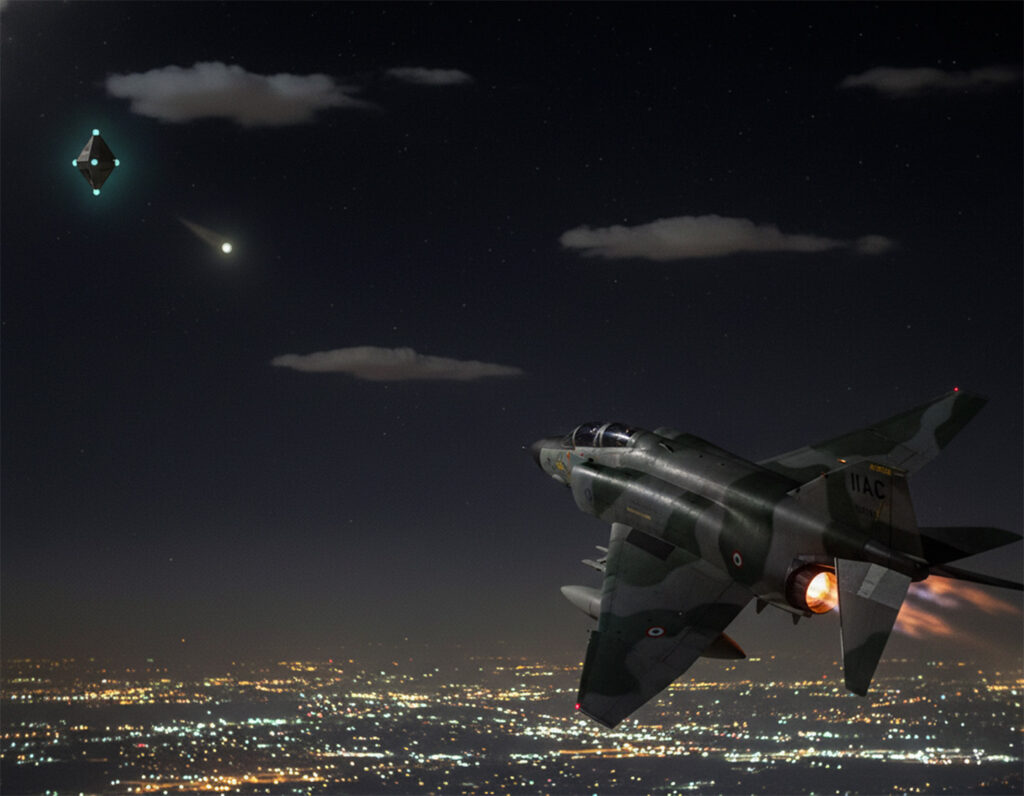
Whatever one thinks the object was, the failure described here has three properties investigators care about:
- It is range-linked (failure on approach, recovery on withdrawal).
- It is multi-system (instrumentation plus multiple comms paths).
- It is operationally recorded (not just remembered years later).
Witness testimony (operational account)
- The incident report explicitly describes a total loss of instrumentation and communications during intercept, and restoration after breakoff.
Hypothesis
A broadband EM emission (intentional or incidental) could plausibly disrupt comms and avionics if coupling thresholds are exceeded, especially if geometry or antenna alignment becomes favorable at a particular range.
Researcher Opinion
Tehran is a key data point because it shows the “EMP-like” story can occur in a high-performance aviation context, not only in cars on rural roads.
Biological effects: when “EMP” talk blends into exposure and injury
Some UAP cases do not stop at electronics. They include physiological consequences: burning sensations, nausea, eye irritation, skin lesions, temporary weakness, and in rare narratives, longer-lasting impairment.
This is where sloppy terminology becomes dangerous. If a person experiences symptoms after a close encounter, the causal bucket might include:
- thermal injury from radiofrequency energy
- photochemical injury from intense light
- electrical shock-like sensations from induced currents
- stress responses and somatic effects
- environmental toxins unrelated to the UAP
A medical reference point comes from clinical guidance on radiofrequency radiation overexposure. The Joint Trauma System’s RF overexposure guideline notes that RF energy absorption is often greatest in more superficial layers of the body, and it discusses penetration depths that vary by frequency (centimeter-scale in some microwave bands).
This is not “UAP evidence.” It is a mechanistic anchor: if witnesses report burns and heat without a conventional heat source, RF exposure is one plausible category to evaluate rather than guessing blindly.
What symptoms in UAP reports resemble known RF/EM effects?
Across case literature, reported symptoms sometimes include:
- sudden facial or skin heat
- sunburn-like redness
- blistering in severe accounts
- eye irritation
- headaches, dizziness, nausea
- transient weakness or numbness
Clinical guidance on RF injury emphasizes heating and burn risk in certain exposure conditions, which aligns with the “burning/heat” cluster found in some close-range UAP injury narratives.
A safety implication people miss: implanted electronics
If strong EM fields exist near an encounter, implanted or wearable medical electronics are an obvious concern. The FDA notes that some cellular phones placed very close to implanted pacemakers can cause interference under some conditions.
The FCC similarly notes that pacemakers can be susceptible to electromagnetic signals and advises caution.
UAP reports are not “cell phones close to pacemakers.” The comparison is directional: if relatively weak consumer emitters can cause interference at very close distances, a genuinely intense UAP-associated field could be medically relevant.
Field report 3: Colares and the “injury wave” problem
For investigators, the Colares events (Pará, Brazil, late 1970s) sit at the intersection of social panic, repeated light phenomena, and claims of physiological harm.
Two points can be stated carefully with documentation:
- Brazil’s National Archives has publicly described a dedicated archival collection (“Fundo Objeto Voador Não Identificado”) with hundreds of records including reports, questionnaires, photographs, videos, audio, and clippings spanning decades.
- Reporting and secondary documentation around the Colares period repeatedly emphasizes treatment of burn-like injuries by local medical personnel, and investigation by outside parties.
For example, journalist-sourced material hosted via The Black Vault describes interviews with the local doctor (Wellaide Carvalho) stating she was treated on the order of dozens of people reporting burns during the flap.
Witness testimony (medical and civilian)
- Accounts attributed to the island’s physician describe treating numerous patients with burn-like injuries during the events.
Investigative caution
Colares is difficult to “score” because much of what circulates online is degraded through retellings. The correct approach is to treat:
- archival existence as confirmed (Brazilian National Archives context)
- injury narratives as serious testimony that requires medical record-level corroboration where possible
Hypothesis
If the injuries were real and exposure-linked, mechanisms could include high-intensity RF, other electromagnetic exposure, or non-EM causes (photothermal, chemical, biological). “EMP” is not the right word for this class of claim.
What counts as evidence in UAP-EM cases? A data-first rubric
To investigate “EMP effects” rather than merely repeat stories, UAPedia uses a simple principle:
If the phenomenon interacts with technology or tissue, it should leave measurable structure in time, space, or hardware.
Here is a practical rubric for future reporting and case review, adapted from patterns in the aviation EM-effects dataset and infrastructure EMP knowledge:
1) Timing signature
- Did the failure begin on approach and end on departure?
- Did it occur in pulses (on/off), or as a smooth degradation?
This “range-linked, self-reversing” signature is exactly what makes Tehran and many pilot accounts analytically valuable.
2) System clustering
Which of these were affected?
- communications (radio, intercom, cell)
- navigation (compass anomalies, heading errors)
- power (engine stall, electrical reboot)
- sensors (radar dropouts, instrument blanking)
NARCAP’s dataset suggests communications and compass-related anomalies are recurring in higher-quality cases.
3) Distance estimate and geometry
Even rough estimates matter. Near-field coupling strength can change dramatically with distance and orientation. If “it failed at 200 meters” in one report and “it failed at 10 meters” in another, those are not the same class of event.
4) Hardware aftermath
In true high-field interactions, sometimes there is residue:
- blown fuses
- corrupted logs
- damaged components
- magnetization changes
- repeated failures after the event (less common, but notable)
The EMP Commission’s vehicle testing shows both transient and (rare) damage outcomes under strong fields.
Speculation labels
Evidence (pattern statements supported by sources)
- A defined subset of pilot reports includes alleged EM effects on aircraft systems, with electrical systems and communications frequently affected.
- A credible operational account from Tehran describes loss of instrumentation and communications on approach and recovery on withdrawal.
- Vehicle electronics can exhibit nuisance malfunctions and occasional engine stall under sufficiently strong simulated EMP fields in lab testing.
- RF overexposure guidance recognizes superficial absorption and burn risk in certain exposure contexts.
Witness Interpretation (how witnesses often frame it)
- “The object shut my car off.”
- “It was like a pulse.”
- “It aimed something at us.”
These interpretations are understandable because the timing feels intentional, but interpretation is not mechanism.
Hypothesis (mechanisms that could fit the pattern)
- Broadband RF emission / pulsed microwave-like effects: could disrupt electronics and cause heating injuries in extreme cases. (Mechanistic plausibility anchored by RF overexposure guidance and known EM coupling principles.)
- Strong magnetic fields: could induce currents, affect compasses, and disrupt certain systems, matching some aviation anomalies.
- Plasma sheath / ionized air effects: could generate RF noise and interference, potentially explaining comms disruption without a “classic EMP.”
Researcher Opinion (assessment stance)
The most conservative and most useful stance is this:
- Many “EMP” stories are likely real electromagnetic effects, not merely narrative decoration, because they recur with consistent structure across decades and contexts.
- The term EMP is often imprecise. The phenomenon described is usually better investigated as localized UAP-linked EM interference or exposure.
Implications: why UAP-associated EM effects are not a side detail
Aviation safety is the front line
If even a small fraction of close encounters correlate with comms loss, compass errors, or instrument anomalies, that is a serious hazard category. NARCAP’s work is essentially a safety dataset in disguise, and its strongest contribution is showing repeated, classifiable system effects.
Critical infrastructure risk is not hypothetical
EMP research on infrastructure emphasizes that modern electronics are a vulnerability multiplier.
UAP “EMP” reports are typically localized, but if the underlying capability exists, the question becomes: localized by choice, or by limitation?
Medical and public health protocols need a template
Where witnesses report burns, vision issues, or neurological symptoms, investigations should include:
- basic exposure history
- dermatologic documentation
- ophthalmologic evaluation when indicated
- and a structured differential diagnosis that includes RF exposure as a category, not a conclusion
The reporting standard is behind the phenomenon
We cannot keep treating UAP-EM cases like campfire tales when the same failure signatures show up in structured pilot reporting.
Claims taxonomy
Claim: A subset of pilot UAP reports includes alleged electromagnetic effects on aircraft systems, with recurring clustering in electrical/communications and compass anomalies.
Classification: Probable (patterned reporting with structured methodology; not generally instrument-verified)
Claim: In the Tehran (19 Sep 1976) incident report, an F-4 crew lost instrumentation and communications on approach and regained them on withdrawal.
Classification: Verified (documented in an official relayed message; mechanism unresolved)
Claim: In Levelland (Nov 1957), multiple motorists reported temporary engine and headlight failure in association with a nearby luminous object.
Classification: Probable (multiple witnesses and consistent failure mode; limited instrumentation)
Claim: Strong EMP fields (tens of kV/m) can cause nuisance malfunctions and occasional engine stall in automobiles under lab conditions.
Classification: Verified
Claim: Acute RF overexposure can produce superficial heating/burn injuries under certain conditions, and medical guidance exists for evaluation.
Classification: Verified
Claim: Some UAP waves include credible testimony of burn-like injuries potentially consistent with EM/RF exposure mechanisms.
Classification: Disputed (credible testimony exists; medical-record-grade corroboration varies widely by case)
Relevant links
NARCAP TR-03 (Haines & Weinstein, 2001) PDF:
earthworm-owl-l76t.squarespace.com/s/narcap_TR-3_2001.pdf?utm_source=uapedia.ai
EMP Commission – Critical National Infrastructures (vehicle test results inside):
www.empcommission.org/docs/A2473-EMP_Commission-7MB.pdf?utm_source=uapedia.ai
HEMP overview slide deck (E1/E2/E3 field magnitudes):
overbye.engr.tamu.edu/wp-content/uploads/sites/146/2021/12/Overbye_SGC_webinar_Dec1_2021_Final.pdf?utm_source=uapedia.ai
U.S. DOE CESER – HEMP Waveform Application Guide:
www.energy.gov/sites/default/files/2023-08/CESER-Waveform-Application-Guide-2023-07_0.pdf?utm_source=uapedia.ai
Tehran (1976) relayed message (NSA-hosted PDF):
www.nsa.gov/portals/75/documents/news-features/declassified-documents/ufo/us_gov_iran_case.pdf?utm_source=uapedia.ai
Levelland (1957) NICAP materials:
www.nicap.org/reports/571102levell_hynek.htm?utm_source=uapedia.ai
Levelland analysis (Rullán PDF):
www.nicap.org/reports2/Levelland_Sightings_Rullan.pdf?utm_source=uapedia.ai
Brazil National Archives note about its OVNI/UAP archival collection:
www.gov.br/arquivonacional/pt-br/canais_atendimento/imprensa/noticias/conheca-o-fundo-sobre-ovnis-do-arquivo-nacional?utm_source=uapedia.ai
Operation Prato / Colares journalistic compilation (Pratt, via The Black Vault PDF):
documents.theblackvault.com/documents/MUFON/Pratt/prato.pdf?utm_source=uapedia.ai
Clinical guidance: Radio Frequency Radiation Overexposure (Joint Trauma System):
jts.health.mil/assets/docs/cpgs/Radio_Frequency_Radiation_Overexposure_24_Aug_2024_ID46.pdf?utm_source=uapedia.ai
FDA: Cellular phone interference with implanted pacemakers (EMC):
www.fda.gov/radiation-emitting-products/electromagnetic-compatibility-emc/electromagnetic-compatibility-cellular-phone-interference?utm_source=uapedia.ai
References
Commission to Assess the Threat to the United States from Electromagnetic Pulse (EMP) Attack. (2008). Report of the Commission to Assess the Threat to the United States from Electromagnetic Pulse (EMP) Attack: Volume 2, Critical National Infrastructures.
Haines, R. F., & Weinstein, D. F. (2001). A Preliminary Study of Fifty Seven Pilot Sighting Reports Involving Alleged Electro-Magnetic Effects on Aircraft Systems (NARCAP TR-03). National Aviation Reporting Center on Anomalous Phenomena.
Joint Trauma System. (2024). Radio Frequency Radiation Overexposure Clinical Practice Guideline.
National Security Agency. (n.d.). U.S. Government and “The Iran” Case (PDF release).
Overbye, T. (2021). HEMP Time Frames (E1/E2/E3) and impacts (webinar slide deck).
Rullán, A. F. (2000/1999). The Levelland Sightings of 1957: Analysis of the Evidence and Evaluation of the Ball Lightning Hypothesis (PDF).
Arquivo Nacional (Brazil). (2018; updated 2020). Conheça o fundo sobre OVNIs do Arquivo Nacional (public archive description).
U.S. Department of Energy, CESER. (2023). High-Altitude Electromagnetic Pulse Waveform Application Guide.
SEO keywords
UAP EMP effects, electromagnetic pulse UAP, UAP electromagnetic interference, UAP engine stall, UAP avionics failure, Tehran 1976 UAP instrumentation loss, Levelland 1957 vehicle interference, UAP radio blackout, UAP compass anomalies, Operation Prato Colares injuries, UAP radiation exposure, pulsed microwave hypothesis, UAP biological effects, EM field effects UAP