
Eight months after the better known Roswell incident, another crash legend was quietly born in the high desert of northwest New Mexico.
This one did not begin with military press releases or front-page headlines.
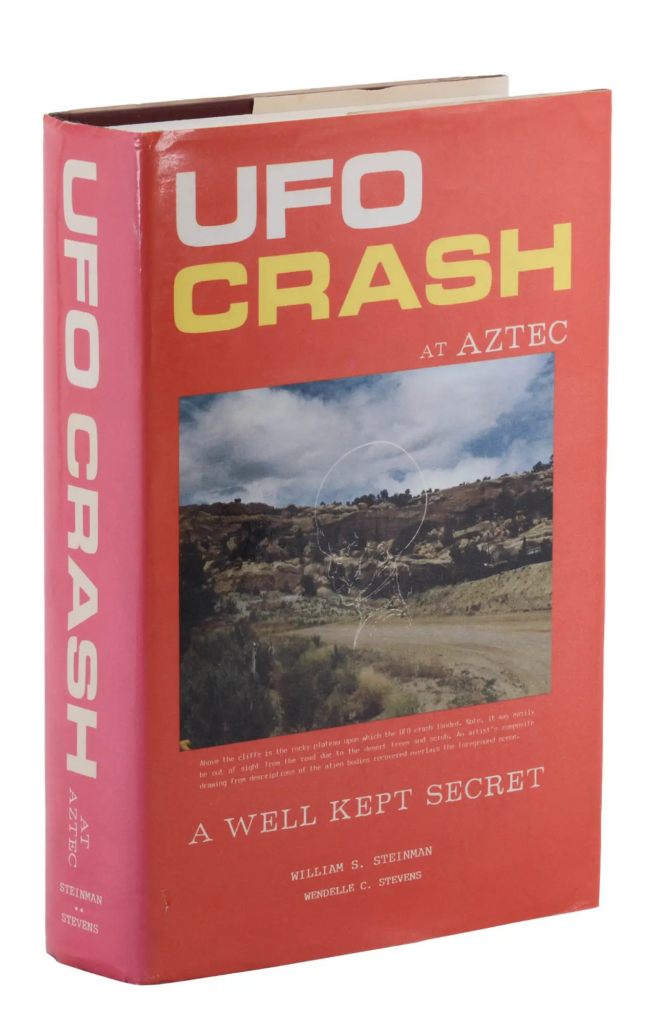
It began with Hollywood gossip, an oilman with “doodlebug” gadgets, an anonymous “Dr. Gee,” and eventually a bestselling book that claimed a 100-foot disc had come down near the town of Aztec on 25 March 1948, loaded with at least sixteen small humanoid bodies.
For mainstream reference works, this is the “Aztec crashed saucer hoax,” dismissed as a sales pitch concocted by two con men, Silas Newton and Leo A. Gebauer, then cemented in the skeptical literature as a cautionary tale about credulity.
Yet decades later, researchers like Scott and Suzanne Ramsey and Frank Thayer would spend more than thirty years, eighteen U.S. states, and hundreds of thousands of dollars chasing witnesses, documents, and physical traces in and around a scrubby mesa northeast of Aztec. (The Aztec Ufo Incide)
From a UAP data standpoint, Aztec 1948 is not a single “event” but a layered construct:
- A 1948 crash claim with no known contemporary press coverage.
- A 1950 book that popularized the story with striking technical detail.
- A 1952–1956 journalistic debunking that tied it to financial fraud.
- A 1950 FBI memo that echoed key elements of the story and later became internet-famous. (Federal Bureau of Investigation)
- A late 20th and early 21st century re-investigation that foregrounded local testimony and site-based evidence. (The Aztec Ufo Incide)
What follows is an investigative walk through that layered record, using a data-first approach that fits UAPedia’s editorial stance: government files are one stream of evidence, not the final word; credible testimony is treated as legitimate data; and hoax claims are weighed, but not taken as an automatic solvent for every anomaly.
The story as first told: Frank Scully and the 100-foot disc
The Aztec crash did not enter public consciousness until writer Frank Scully began dropping hints in his columns for Variety in 1949, then laid out the full narrative in his 1950 bestseller “Behind the Flying Saucers.” (WebJunction)
According to Scully’s account:
- Date and place
- A disc-shaped craft came down in March 1948 near Aztec, New Mexico, eventually resting on a mesa in what is now known as Hart Canyon, roughly 12 miles northeast of town. (Wikipedia)
- Craft characteristics
- The craft was approximately 99 feet in diameter, circular with a raised center section.
- The hull material was described as metallic, lightweight, and resistant to cutting or drilling.
- Scully reported that every dimension of the craft was “divisible by nine,” implying a kind of numerological design.
- Entry and interior
- With no obvious doors, scientists allegedly inserted a pole through a small opening and accidentally triggered a concealed mechanism that opened an access hatch. (openminds.tv)
- Inside, the disc supposedly contained complex instrumentation, “magnetic” propulsion components, food wafers, and “heavy water” for drinking. (Wikipedia)
- Occupants
- Sixteen humanoid bodies, three to four feet tall, were found dead inside, some described as charred, all dressed in close-fitting metallic clothing.
- Origin and technology
- Scully’s sources claimed the craft came from Venus and operated on advanced magnetic principles, outrunning terrestrial aircraft and ignoring conventional aerodynamics.
Scully’s book was marketed as a kind of insider scoop that contradicted the then-skeptical line coming from the U.S. Air Force. It became an early anchor point for what later researchers would call “crash retrieval” narratives, predating the major publicization of Roswell by decades.
Crucially, Scully did not claim to have been at Hart Canyon himself. He attributed his information to two key informants:
- Silas M. Newton, a wealthy oil prospector.
- “Dr. Gee,” an anonymous scientist later linked to Leo A. Gebauer, a radio-electronics specialist. (openminds.tv)
Their story was that advanced radar in New Mexico interfered with several craft, including the Aztec disc, which they said was recovered largely intact and taken under tight secrecy for study. (openminds.tv)
Doodlebugs, fraud, and the J. P. Cahn investigations
If the story had stayed in metaphorical Hart Canyon, it might have remained folklore. Instead, it intersected with money.
Newton and Gebauer spent the late 1940s and early 1950s traveling across the Southwest selling “doodlebug” devices that they claimed could find oil, gas, and minerals. Their sales pitch: the gadgets were based on alien technology recovered from a crashed disc.
San Francisco journalist J. P. Cahn became suspicious. In 1952, he published “The Flying Saucers and the Mysterious Little Men” in True magazine, a meticulously documented piece which:
- Obtained metal samples Newton claimed were exotic and had them independently analyzed as ordinary aluminum.
- Dug into Newton’s background, finding accusations of misrepresentation in oil ventures.
- Linked “Dr. Gee” to Leo A. Gebauer, a technician whose credentials fell far short of the “multiple doctorates” Scully repeated. (openminds.tv)
Cahn followed up in 1956 with “Flying Saucer Swindlers,” after additional victims of Newton and Gebauer came forward. One of those victims, millionaire Herman Flader, pressed charges, and both Newton and Gebauer were eventually convicted of fraud in 1953, though for their oil-related schemes rather than for anything directly tied to Aztec. (Wikipedia)
From a data perspective, these facts are solid and well documented in court records and institutional histories. They demonstrate that two of the key storytellers in the Aztec narrative were willing to deceive investors for money. That’s important context. It does not, on its own, prove that every crash narrative they ever repeated was invented, but it significantly downgrades their evidentiary weight.
Aztec written off, then resurrected
After Cahn’s work, the Aztec crash was widely treated as a debunked case, even within ufology. Standard encyclopedias and skeptical references still describe it simply as “the Aztec crashed saucer hoax,” emphasizing the Newton–Gebauer angle and treating Scully as, at best, a gullible conduit.
For roughly two decades, mainstream UAP authors avoided Aztec entirely. That changed in the 1970s and 1980s, when:
- Leonard Stringfield, a pioneering crash-retrieval researcher, began circulating reports of stored alien bodies and retrieved craft, sometimes weaving in Aztec-like elements.
- Robert Spencer Carr publicly claimed that bodies from an Aztec crash were stored at the mythical “Hangar 18” at Wright-Patterson Air Force Base, a claim which prompted official denials and helped popularize the Hangar 18 motif in books and film.
These stories layered new, largely secondhand material onto Scully’s original framework and began to decouple the Aztec narrative from Newton’s doodlebug salesmanship.
Hart Canyon as a physical place
Whatever one thinks of the crash itself, Hart Canyon is very real. The alleged impact and landing zone is now accessible via a hiking and biking loop known as the Alien Run Trail, a roughly 9-mile circuit that circles the claimed 1948 crash site. (Aztec New Mexico)
At the mesa top, visitors encounter a plaque that reads in part:
“On or about this site on March 25, 1948, a spacecraft of origins unknown crashed or landed on this mesa. It is alleged the Los Alamos Radar Station in nearby El Vado, New Mexico, tracked the errant landing to this site. A high security recovery operation led by the Air Force and 5th Army Division was responsible for the removal of this craft.” (Aztec New Mexico)
That marker was installed in the 2000s with the involvement of researcher Scott Ramsey, who also helped promote tours of the site and the now-defunct Aztec UFO Symposium, a yearly fundraiser for the town library which ran from the late 1990s to around 2011. (WebJunction)
From a strict evidentiary standpoint, the plaque proves only this: local stakeholders have embraced the crash story as part of their historic and tourism identity. It is not, in itself, proof that a non-human craft came down. But it does anchor the legend to a specific topography, which matters when we turn to modern witness testimony.
The Ramsey–Thayer investigation: boots on the ground
Beginning in 1988, salesman Scott Ramsey stumbled onto the Aztec story during a business trip and became intrigued enough to investigate. Joined by Suzanne Ramsey and later by journalism professor Frank Thayer, the team spent over three decades tracking documents and witnesses. (The Aztec Ufo Incide)
Their work culminated in a series of books, notably:
- “The Aztec UFO Incident: The Case, Evidence, and Elaborate Cover-Up of One of the Most Perplexing Crashes in History” (2012; revised 2015). (eBay)
- “The Aztec Incident: Recovery at Hart Canyon” (earlier version, now harder to find). (The UFO Chronicles)
The Ramseys and Thayer claim to have:
- Traveled to 18 U.S. states.
- Conducted dozens of interviews with alleged witnesses or their relatives.
- Obtained thousands of pages of archival material, including FBI documents related to Newton and associated figures. (The Aztec Ufo Incide)
Their website summarizes the core scenario this way:
- A rancher sees a silver disc wobbling overhead at dawn, scraping a cliff and coming to rest on a mesa.
- Witnesses converge, including ranchers, oil field workers, police, a county commissioner, and a preacher.
- They find a nearly 100-foot craft with a small puncture in its dome. An oilfield worker uses a pole to trigger an internal mechanism, opening the craft and revealing at least two visible dead beings, later said to be part of a total of up to sixteen bodies. (The Aztec Ufo Incide)
This is, essentially, Scully’s story retold, but with an emphasis on specific named witnesses and concrete geography rather than anonymous scientists and Venusian origins.
Witness accounts: what people say they saw
Doug Noland and Bill Ferguson
One of the key first-hand witnesses highlighted by the Ramseys is Doug Noland, who in 1948 was a nineteen-year-old employee of the El Paso Gas Company. According to interviews reported by both pro-case authors and neutral journalists:
- Noland received word of a brush fire near company drip tanks in Hart Canyon early on March 25, 1948.
- He picked up his boss, Bill Ferguson, and drove toward the site to help protect the tanks. (Timothy Street)
- Upon arrival, they found other oilfield workers already present, who told them the fire was under control and then led them to a large disc-shaped object resting near the mesa. (Sheryl Glick)
- Noland described an object broadly consistent with the Scully narrative: a large metallic disc, apparently intact, with small windows and an access point later opened with a pole, revealing small bodies inside. (openminds.tv)
Noland’s testimony surfaced decades after the fact. Some reviewers, such as Jerome Clark writing in the Journal of Scientific Exploration, note that by the time Ramsey interviewed him he had suffered several strokes, which could affect memory reliability. (Journal of Scientific Exploration)
At the same time, Clark acknowledges that Noland’s account is detailed and consistent in many respects with earlier versions of the story, raising the possibility that he either genuinely experienced something unusual or deeply internalized the narrative over the years. From a UAPedia perspective, this is classic high-ambiguity testimony: rich in detail, but temporally distant and potentially contaminated by prior exposure.
Ken Farley
Another important witness is traveling salesman Ken Farley, whose recollections were reported by Ramsey and summarized by OpenMinds. Farley claimed that:
- On 25 March 1948 he was driving from Durango, Colorado to California and stopped near Aztec to visit a friend.
- After hearing of emergency vehicles heading into the desert, he and his friend investigated and eventually reached a mesa where a large disc sat next to the cliff.
- Several oilfield workers and a couple of police officers were present. The craft appeared largely undamaged.
- They were eventually told to leave by law enforcement. (openminds.tv)
Farley’s account, if accurate, provides an independent line of testimony that aligns with Noland’s brush-fire narrative and the general Hart Canyon location. However, as with Noland, the report was collected many years after the alleged event, and surviving documentation of Farley’s original interviews is limited.
Unnamed locals and secondhand stories
The Ramsey–Thayer work also includes numerous secondhand recollections:
- Residents who recall talk of a cordoned-off area northeast of Aztec in the late 1940s.
- Stories of military convoys and large loads being hauled away under tarps.
- Anecdotes about “government men” quieting discussion afterward. (openminds.tv)
These are suggestive but fall squarely in the hearsay category. They are useful for mapping how the legend circulated, but they do not independently confirm a non-human craft.
The Guy Hottel memo: three discs and nine small bodies
No modern discussion of Aztec is complete without the Guy Hottel FBI memo, dated 22 March 1950 and addressed to Director J. Edgar Hoover. (Federal Bureau of Investigation)
According to the memo, an FBI agent relayed a story from a third party who said an Air Force investigator had reported that:
- Three circular objects with raised centers, approximately 50 feet in diameter, had been recovered in New Mexico.
- Each disc contained three bodies of “human shape” about three feet tall, dressed in metallic cloth and bandaged like high-speed test pilots. (Federal Bureau of Investigation)
- The discs allegedly crashed after high-powered radar interfered with their controlling mechanisms. (Federal Bureau of Investigation)
For obvious reasons, many UAP researchers saw in this memo a tantalizing echo of Aztec: small bodies, discs, New Mexico, and radar interference. Researchers such as Timothy Good and later Nick Redfern flagged the memo as potential corroboration of a crash retrieval narrative. (openminds.tv)
The FBI itself, however, issued a 2013 explainer emphasizing that:
- The memo is second- or third-hand.
- The bureau never investigated the claim further.
- There is “no information to verify” whether the story reflected a hoax already circulating at the time. (Federal Bureau of Investigation)
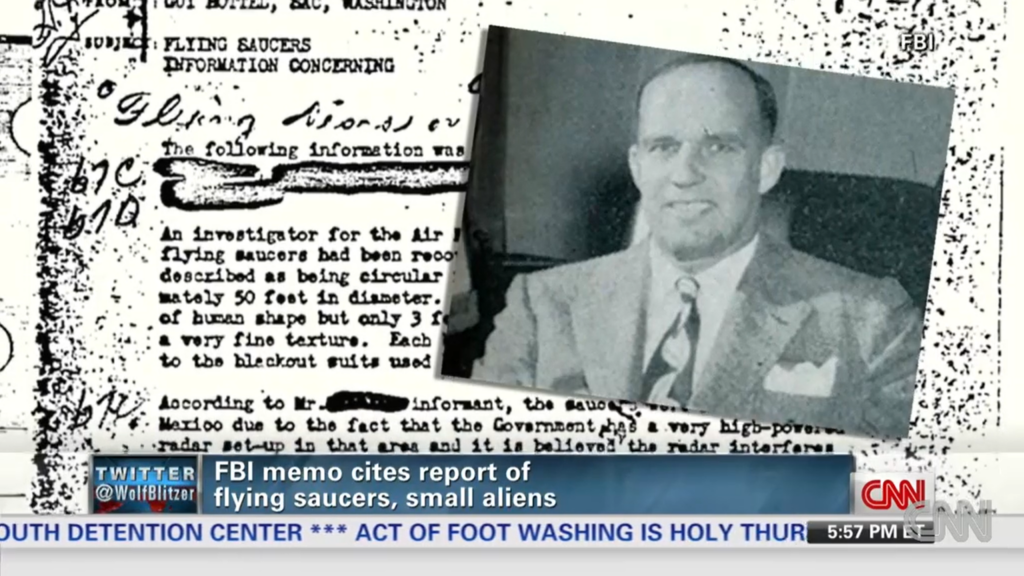
Independent analysis has traced the content of the Hottel memo to a story that appeared in a Kansas legal newspaper, the Wyandotte Echo, whose author seems to have been repeating, again, elements originally popularized by Scully.
From UAPedia’s editorial perspective, the Hottel memo is a data point, not a smoking gun. It demonstrates that by 1950, crash stories involving small bodies and radar-induced failures were circulating widely enough to filter into FBI files. It neither proves nor disproves that any craft of non-human origin actually crashed in New Mexico.
Skeptical scrutiny: Benjamin Radford and others
Among modern investigators, Benjamin Radford’s treatment of Aztec in “Mysterious New Mexico” stands out as a systematic skeptical review. Radford applies historical research and on-site investigation to several New Mexico legends, including a chapter titled “The Great Aztec UFO Crash.” (Benjamin Radford)
Key points from Radford’s analysis include:
- Lack of contemporary 1948 press or official documentation for a large crash recovery near Aztec, despite the presence of media and military installations in the broader region.
- The heavy dependence of early narratives on Newton and Gebauer, whose credibility is questionable given their fraud history. (openminds.tv)
- Concerns about late-emerging witnesses whose memories may have been shaped by decades of reading and hearing about the case. (Journal of Scientific Exploration)
Radford concludes that the evidence for an actual crash is extremely weak, and that Aztec is best understood as a constructed legend that grew out of a commercial scam. (Benjamin Radford)
Other critical voices, including Monte Shriver and Kevin Randle, have raised similar issues, particularly around the handling of witness testimony in the Ramsey–Thayer books and the difficulty of verifying some claimed physical traces. (Kevin Randle’s Blog)
Media, books, and podcasts: where the case lives today
The Aztec narrative now occupies a hybrid space between local heritage, crash-retrieval lore, and skeptical folklore studies. A non-exhaustive map of current discussion:
Books
- Frank Scully, “Behind the Flying Saucers” (1950 and later updates). The foundational popular text for the Aztec crash, detailing the 99-foot disc, sixteen bodies, and “magnetic” propulsion.
- Scott & Suzanne Ramsey and Frank Thayer, “The Aztec UFO Incident: The Case, Evidence, and Elaborate Cover-Up of One of the Most Perplexing Crashes in History” (2012/2015), and earlier “The Aztec Incident: Recovery at Hart Canyon.” A pro-case re-investigation focused on new witnesses, site work, and archives. (eBay)
- Benjamin Radford, “Mysterious New Mexico: Miracles, Magic, and Monsters in the Land of Enchantment” (2014). A skeptical case study that frames Aztec as a legend deconstructed via document tracing and fieldwork. (Benjamin Radford)
Podcasts and audio
- “Aztec UFO Crash: Another Roswell” on Night Dreams Talk Radio, featuring Scott and Suzanne Ramsey discussing their decades of research. (Apple Podcasts)
- “Aztec UFO Crash” (Episode 1) of the Strangers in the Sky podcast, presenting both crash and hoax interpretations for a general audience. (Goodpods)
- “Aztec UFO Crash” on Mysteries with a History, hosted by Cristina Gomez and Jimmy Church, exploring the case’s controversies, including the Hottel memo and Ramsey’s work. (Audible.com)
- Various YouTube and audio documentaries, such as The Shadow Frequency’s “Aztec, New Mexico, 1948,” that retell the narrative with a mix of dramatization and commentary. (YouTube)
These media sources shape contemporary public understanding, often blending direct citation of Scully and the Ramseys with more speculative material about Hangar 18, radar weapons, and technological back-engineering.
Data-first synthesis: what can we actually say?
When we apply a “data first” lens to Aztec, the evidentiary landscape looks like this:
Hard documentary anchors
- Scully did publish a bestselling book in 1950 describing a crash near Aztec with sixteen small bodies, a 99-foot disc, and magnetic propulsion. (Wikipedia)
- Newton and Gebauer were real individuals, connected to oil prospecting and doodlebug devices, and were convicted of fraud in 1953, although for financial scams rather than for the crash story itself. (Wikipedia)
- The FBI Hottel memo exists, describing a third-hand rumor of three discs and nine small bodies in New Mexico, and the FBI has explicitly said it never investigated or verified this claim. (Federal Bureau of Investigation)
- Hart Canyon contains a modern plaque and trail explicitly commemorating a 1948 crash or landing, and Aztec hosted an annual UAP symposium for years, showing institutionalization of the story at the local level. (Aztec New Mexico)
Testimony and oral history
- Named witnesses like Doug Noland and Ken Farley, interviewed decades later, describe a brush-fire response, a large disc on a mesa, small bodies, and the arrival of authorities. Their accounts are mutually reinforcing but appear after many public retellings of the case. (openminds.tv)
- Local oral histories recall military presence and roadblocks northeast of Aztec around the relevant period, but specifics are often sparse and timing can be fuzzy. (openminds.tv)
Analytical work
- Skeptical analyses highlight the absence of contemporaneous 1948 reporting, the proven fraud history of Newton and Gebauer, and the issues of memory and contamination in late-collected witness testimony. (Wikipedia)
- Pro-case researchers emphasize the sheer volume of documents and interviews they have assembled and the internal consistency they see across multiple witnesses and records. (The Aztec Ufo Incide)
From a pure data standpoint, Aztec 1948 does not reach the standard that UAPedia would classify as “Verified” or “Probable” for a non-human crash retrieval.
The absence of any known 1948-era newspaper, military, or independent archival record of a large crash cleanup in Hart Canyon is a serious gap.
At the same time, dismissing the entire edifice as “nothing but a hoax” underestimates the complexity of the testimony and the way later local memory diverges from Newton and Gebauer’s sales pitches.
Claims taxonomy
Applying our Claims Taxonomy to the main elements of the case:
Claim: Frank Scully reported a March 1948 disc crash near Aztec with sixteen small bodies and advanced technology.
- Classification: Verified
- Basis: Primary publication record in “Behind the Flying Saucers,” contemporary reviews, and later summaries. (Wikipedia)
Claim: Silas Newton and Leo Gebauer possessed alien technology that powered their doodlebug devices.
- Classification: Hoax
- Basis: Cahn’s metal tests showing ordinary aluminum, exposure of false scientific claims, and their fraud conviction for related schemes. (openminds.tv)
Claim: A disc of non-human origin crashed or made a controlled landing at Hart Canyon on 25 March 1948 and was recovered by U.S. forces.
- Classification: Disputed
- Basis: Supported by late-collected testimonies, local tradition, and pro-case research; opposed by skeptical analyses and lack of contemporary documentation. (openminds.tv)
Claim: Sixteen non-human bodies were recovered from the Aztec craft.
- Classification: Legend
- Basis: Persistent across Scully, pro-case researchers, and local lore, but entirely dependent on layered testimony and secondary sources, with no physical or contemporaneous documentary confirmation. (Wikipedia)
Claim: High-powered radar from a New Mexico installation interfered with and brought down the craft.
- Classification: Probable (as part of narrative structure), not as established fact
- Basis: Repeated motif in Scully, the Hottel memo, and later literature, but no independent technical documentation of such radar incidents has been produced. (openminds.tv)
Claim: The Hottel memo provides independent FBI corroboration of the Aztec crash.
- Classification: Misidentification
- Basis: The memo clearly records an unverified rumor; FBI explicitly states it never investigated and suggests it likely echoes a circulating hoax. It may reflect the spread of Aztec-style stories rather than an independent event. (Federal Bureau of Investigation)
Claim: No unusual event occurred near Aztec on or around 25 March 1948, and the entire story is purely fictional.
- Classification: Disputed
- Basis: While the hoax hypothesis is strong, especially at the Newton–Gebauer level, the existence of multiple converging testimonies and enduring local tradition means that a small kernel of real but prosaic events (brush fire, accident, military exercise) could have been reinterpreted rather than entirely invented. (openminds.tv)
Speculation labels
To keep clean boundaries between evidence and interpretation, we flag the following as speculative:
Hypothesis
Aztec represents a genuine non-human crash retrieval, and the later exposure of Newton and Gebauer as fraudsters was leveraged to bury an inconvenient reality. This is a common position among pro-crash authors, but it rests heavily on circumstantial connections and does not currently meet UAPedia’s threshold for “Probable” on the core crash claim. (Hangar1publishing)
Witness Interpretation
Noland, Farley, and others may have encountered some combination of military activity, experimental aircraft, or even a conventional crash and interpreted it through the lens of emerging flying-saucer culture. Given the timing, it is plausible that any striking hardware or presence of armed personnel would be retrospectively “saucerized” in memory. (openminds.tv)
Researcher Opinion
Skeptical authors tend to regard Aztec as a textbook case of how financial fraud can seed long-lasting legends. Pro-case researchers present it as one of the most important, yet misunderstood, UAP recovery events in American history. Both positions rely on weighting certain evidentiary streams more heavily than others, and both are influenced by prior beliefs about government transparency and the prevalence of non-human craft.
UAPedia’s role is not to flatten these differences but to keep them properly labeled so that readers can see where data ends and interpretation begins.
Why Aztec still matters in UAP research
Even if one remains agnostic or skeptical about the core crash claim, the Aztec incident is important for several reasons:
- It is one of the earliest fully developed crash-retrieval narratives with bodies, hardware, and secret transport to a laboratory facility, predating the wide publicization of Roswell by decades.
- It demonstrates how financial scams, local lore, and emerging UAP culture can intertwine and produce stories that persist for generations, long after the original actors are gone. (The Saucers That Time Forgot)
- It illustrates the need to treat government documents as evidence with context rather than as absolute arbiters. The Hottel memo is a perfect example: a single page that has been hailed as proof, denounced as hoax echo, and ultimately sits as ambiguous data that tells us as much about rumor circulation as about UAP themselves. (Federal Bureau of Investigation)
- It highlights how local communities, like Aztec, can appropriate UAP narratives into identity, tourism, and civic projects, such as the library-fundraising symposiums and the Alien Run trail. (WebJunction)
For crash-retrieval researchers, Aztec is a stress test case. Any methodology that cannot grapple with its mix of hoax indicators, sincere testimony, government mentions, and enduring tradition is unlikely to handle more data-rich modern cases well.
Deep Truth analysis

Please see here our “Deep Truth” analysis on the case.
References and further links
Books
Ramsey, S., Ramsey, S., & Thayer, F. (2015). The Aztec UFO incident: The case, evidence, and elaborate cover-up of one of the most perplexing crashes in history. Red Wheel/Weiser. (www.theaztecincident.com?utm_source=uapedia.ai )
Scully, F. (1950). Behind the flying saucers. Henry Holt. (www.barnesandnoble.com/w/behind-the-flying-saucers-the-truth-about-the-aztec-ufo-crash-updated-edition-frank-scully/1100045812?utm_source=uapedia.ai )
Radford, B. (2014). Mysterious New Mexico: Miracles, magic, and monsters in the Land of Enchantment. University of New Mexico Press. (benjaminradford.com/mysterious-new-mexico/?utm_source=uapedia.ai)
Cahn, J. P. (1952). The flying saucers and the mysterious little men. True magazine. Scanned discussion: (www.physics.smu.edu/pseudo/UFOs/Scully/Cahn2.pdf?utm_source=uapedia.ai)
Online articles and documents
FBI. (2013, March 25). UFOs and the Guy Hottel memo. (www.fbi.gov/news/stories/ufos-and-the-guy-hottel-memo?utm_source=uapedia.ai)
OpenMinds.tv – Rojas, A. (2020, August 3). Alleged UFO crashes in the U.S. other than Roswell: Aurora, Aztec, and Kecksburg. (openminds.tv/alleged-ufo-crashes-in-the-u-s-other-than-roswell-aurora-aztec-and-kecksburg/?utm_source=uapedia.ai)
Aztec crash site info and trail map:
(www.aztecnm.com/aztec/ufocrashsite.html?utm_source=uapedia.ai)
(www.aztecnm.com/aztec/ufo/UFOCrashSiteMap.pdf?utm_source=uapedia.ai)
Hangar 1 Publishing – Torres, V. (2025). The UFO crash at Aztec: The truth behind the infamous hoax. (hangar1publishing.com/blogs/ufos-uaps-and-aliens/ufo-crash-at-aztec?srsltid=AfmBOop3cE0X7Vba-7K6AKIvOSYXvIZzH2w9dkaJ-nZO4xiBcZLXWPVq&utm_source=uapedia.ai)
Podcasts
Night Dreams Talk Radio – “Aztec UFO Crash: Another Roswell (Scott and Suzanne Ramsey)” (music.amazon.com/podcasts/00ddfeca-9157-4409-a347-4c9ac412faf7/episodes/0e10db0d-794d-49ba-9ef6-85283ba8b2f3/night-dreams-talk-radio-forbidden-realms-aztec-ufo-crash-another-roswell-scott-and-suzanne-ramsey?utm_source=uapedia.ai)
Strangers in the Sky Podcast – Episode 1: “Aztec UFO Crash” (goodpods.com/podcasts/strangers-in-the-sky-podcast-702920/1-aztec-ufo-crash-96600522?utm_source=uapedia.ai)
Mysteries with a History – “The Aztec UFO Crash” (www.audible.com/podcast/aztec-ufo-crash-mysteries-with-a-history-B09RV2D8BQ?utm_source=uapedia.ai)
SEO keywords
Aztec UFO incident; Aztec UAP crash; Hart Canyon New Mexico; Guy Hottel memo; 1948 saucer crash; Scott Ramsey Aztec; Frank Scully Behind the Flying Saucers; Aztec UFO Symposium; New Mexico crash retrieval; 16 alien bodies Aztec; UAP crash cases 1940s; radar interference UFO; Wright-Patterson Hangar 18; Aztec UFO trail; Aztec UFO podcasts