
The strongest VASCO evidence now points to real flashes of light on historical plates. The harder question is what, exactly, flashed.
In the black-and-white sky photographs of the 1950s, stars are supposed to behave. They should sit where the laws of celestial mechanics put them, burn steadily across decades, and reappear in later surveys unless they are too faint, too fast, or too mundane to notice. The old glass plates from the first Palomar Observatory Sky Survey were not built for modern anomaly hunting. They were made to map the heavens. Yet, seventy years later, those same plates have become the center of a deeply unusual scientific fight: whether brief points of light seen before the first artificial satellite were merely the scars of photographic chemistry, or whether some were genuine, transient light sources in the sky.
That distinction matters. A plate defect is a historical nuisance. A real pre-Sputnik optical transient is a scientific problem. A real pre-Sputnik transient that behaves like a sunlit glint, avoids Earth’s shadow, clusters in time, and appears near nuclear test windows becomes something more provocative. Not proof of alien probes. Not proof of secret human spacecraft. But a demand for better explanations.
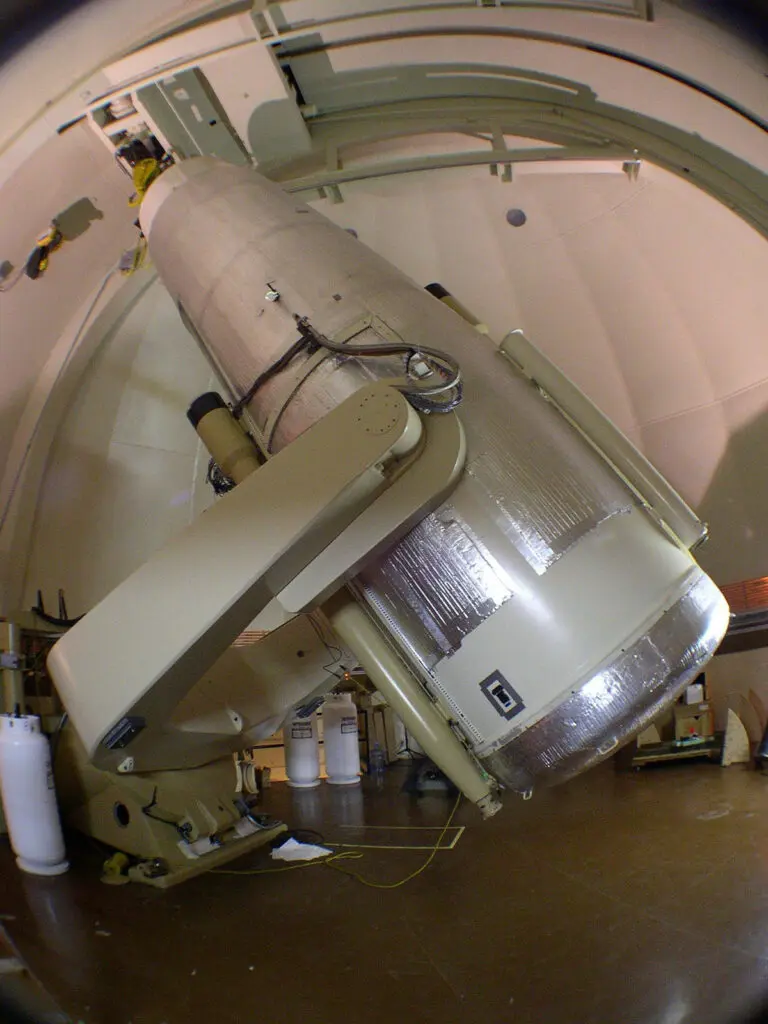
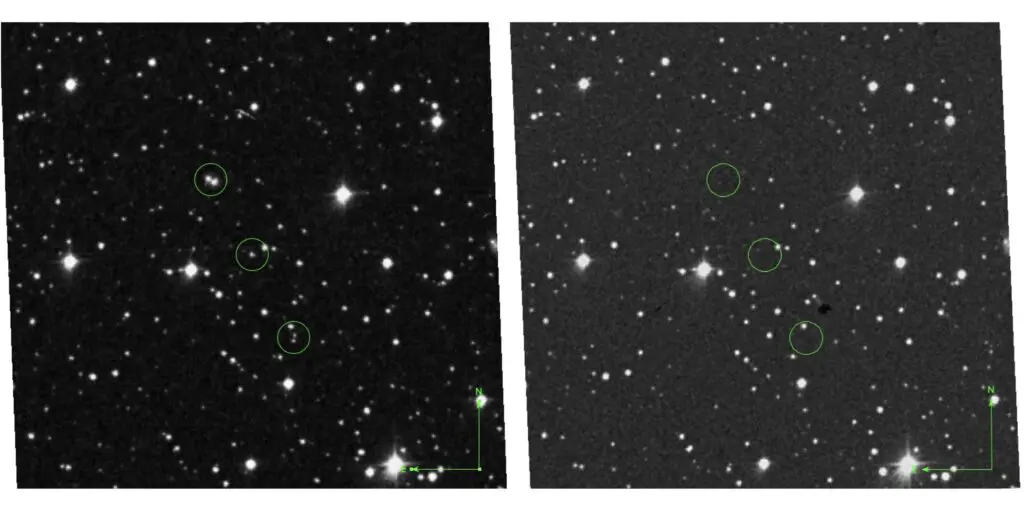
The VASCO project, short for Vanishing and Appearing Sources during a Century of Observations, began with a deceptively simple idea: compare old photographic sky surveys with modern digital surveys and look for things that were there once, then gone. In its 2020 Astronomical Journal paper, the team compared roughly 600 million objects from the USNO-B1.0 catalog, derived from historical plates, with Pan-STARRS DR1, a much deeper modern survey. After automated filtering and visual inspection, the team reported about 100 red-plate point sources that appeared in one historical epoch and lacked a modern counterpart. The authors framed the search broadly, including exotic astrophysical transients and possible technosignatures, but the key result was narrower: a small population of candidate objects that did not behave like ordinary persistent stars. (arXiv)
The pre-Sputnik setting gives the story its voltage. The first Palomar Observatory Sky Survey used the 48-inch Oschin Schmidt telescope and exposed red and blue photographic plates across much of the northern sky. Most of the POSS-I material was taken between 1949 and 1956, with a small remainder extending into 1958, and the survey’s limiting magnitudes reached roughly twentieth magnitude on red plates and twenty-first on blue plates. That means many of these images were taken before Sputnik 1, launched on October 4, 1957, created the modern satellite age.
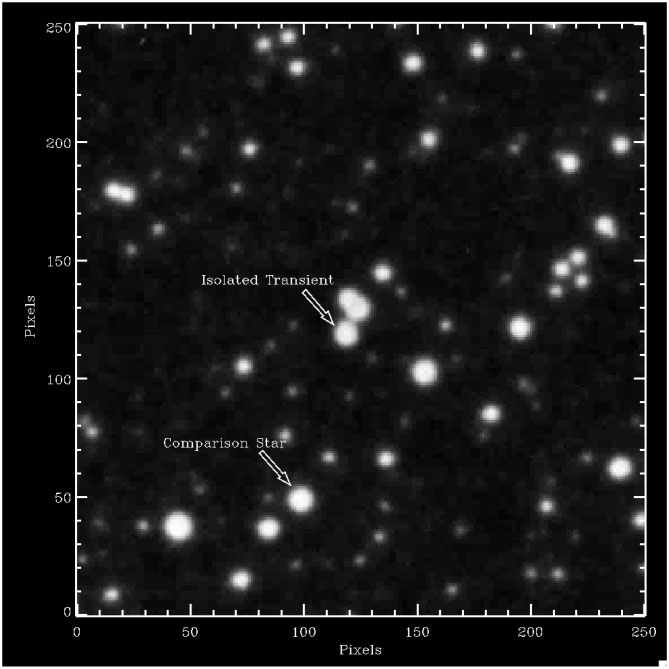
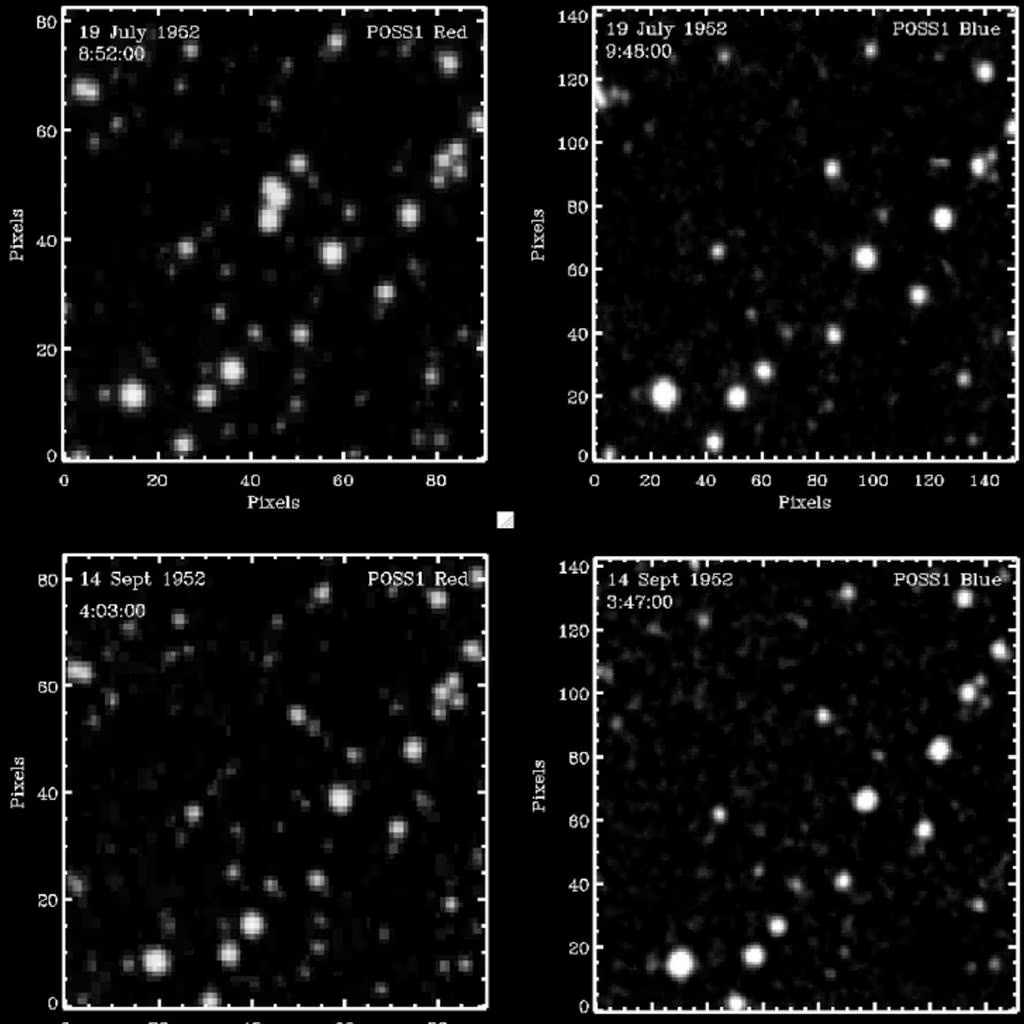
In 2021, the VASCO team turned one case into a scientific set piece. A Scientific Reports paper described nine point-like sources that appeared on a red POSS-I plate from April 12, 1950, but not on a blue exposure taken roughly half an hour earlier, not on a red exposure six days later, and not in later sky surveys. The authors argued that meteors, asteroids, and ordinary stellar variability struggled to explain simultaneous, short-lived, star-like points. Still, the paper did not close the case. Photographic plates are messy. Dust, scratches, emulsion flaws, scanner artifacts, contamination, and copy defects can all masquerade as celestial objects. The mystery depended on whether the dots were light or merely damage. (Nature)
The argument became serious
A 2022 Monthly Notices of the Royal Astronomical Society paper led by Enrique Solano scaled the search up. Using Virtual Observatory tools, the team searched POSS-I red plates for sources absent in Pan-STARRS DR2 and Gaia EDR3. Out of hundreds of thousands of initially interesting historical detections, most were matched to other archival sources or classified as known objects, high-proper-motion stars, asteroids, variables, or artifacts. But 5,399 unidentified transients remained. The authors also made a larger archive of optically absent infrared sources available for follow-up. This was not a claim that thousands of alien machines had been found. It was a claim that, after conservative sorting, a stubborn population of historical “there-once” detections remained.
Then came the skeptics’ best shot. In 2024, Nigel Hambly and Andrew Blair critically examined VASCO’s putative transients using SuperCOSMOS data, morphology statistics, and machine-learning classification. Their conclusion was blunt: the candidates likely reflected photographic emulsion artifacts, perhaps introduced through the copying process, rather than real astronomical events. That critique mattered because it attacked the foundation of the entire subject. If the marks were not optical images formed by the telescope, the rest of the speculation collapsed. (arXiv)
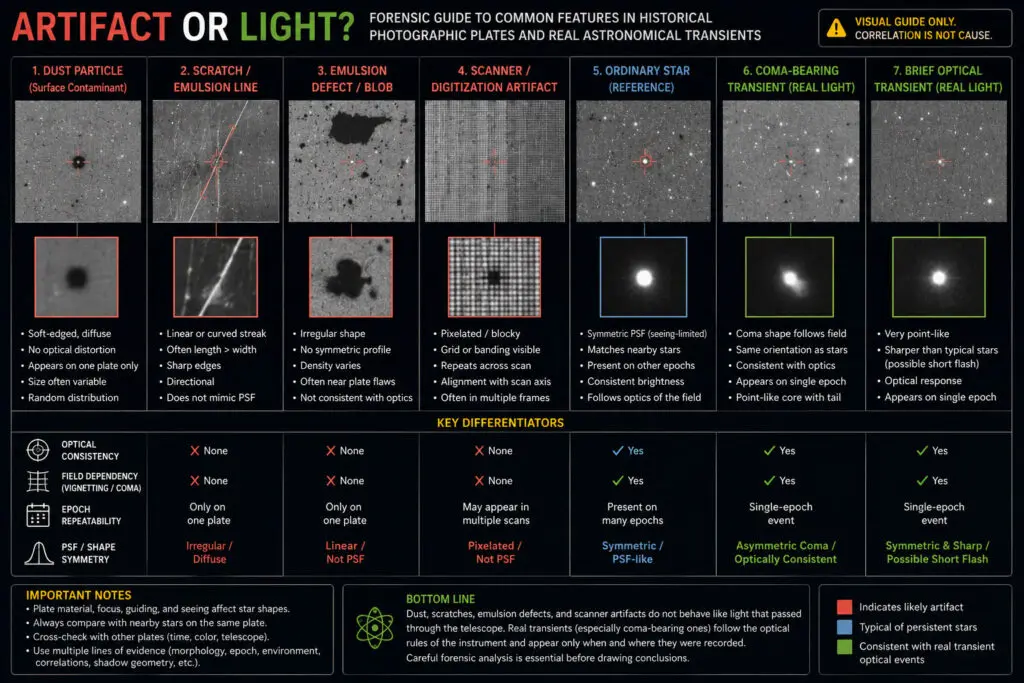
The VASCO team’s response was not just rhetorical. In a 2025 preprint, Beatriz Villarroel, Solano, and Geoffrey Marcy argued that the very profile differences emphasized by Hambly and Blair could be expected if the sources were extremely brief flashes. Long-exposure stars are blurred by seeing, guiding errors, wind shake, and tracking imperfections over many minutes. A sub-second flash, by contrast, would sample a much shorter atmospheric and instrumental interval, so it could look sharper and rounder than ordinary stars on the same plate. In that view, the suspiciously narrow profiles were not necessarily signs of emulsion defects. They could be signatures of short optical flashes. (arXiv)
The newest evidence is why the debate has shifted again. The July 2026 Liberation Times article by Christopher Sharp and Christopher Scott Carson spotlighted a just-published arXiv paper by retired NASA software engineer Ivo Busko, calling it a major blow to the “plate defect” explanation for a specific class of pre-Sputnik transients. The article is written with a sense of breakthrough, but its central point is worth separating from the rhetoric: Busko claims that eleven transients on historical Hamburg Observatory plates exhibit coma, an optical aberration expected from off-axis point sources passing through a telescope. A random emulsion defect can imitate a dot. It should not naturally reproduce the field-dependent optical distortion of real light entering a particular telescope. (Liberation Times)
Busko’s paper is cautious but consequential. Using APPLAUSE digitizations of Hamburg Observatory plates, he searched for short-lived transients in paired exposures and then inspected whether candidate images carried the same optical coma expected for stars at their plate positions. His conclusion was not that the objects were extraterrestrial. It was that these eleven events showed the optical behavior of light that passed through the telescope, making ordinary plate-defect explanations inadequate for those cases. He explicitly described the work as preliminary and visually selected, not a final statistical census of all historical transients. That nuance is essential. Busko does not prove the VASCO catalog is pure. He strengthens the claim that at least some VASCO-like events are not mere blemishes. (arXiv)
That is the emerging center of gravity: not “all transients are real,” but “some apparently are real enough to deserve physical explanation.” Busko’s paper reports eleven transients with magnitudes ranging from roughly 7.1 to 11.9, based on Hamburg archival material rather than the original Palomar set. In its conclusion, the paper states that the events show coma signatures consistent with optical point sources, occur in a dataset independent of POSS-I, and resist several artifact hypotheses. It also leaves open atmospheric, solar-glint, and other explanations. (arXiv) (arXiv)
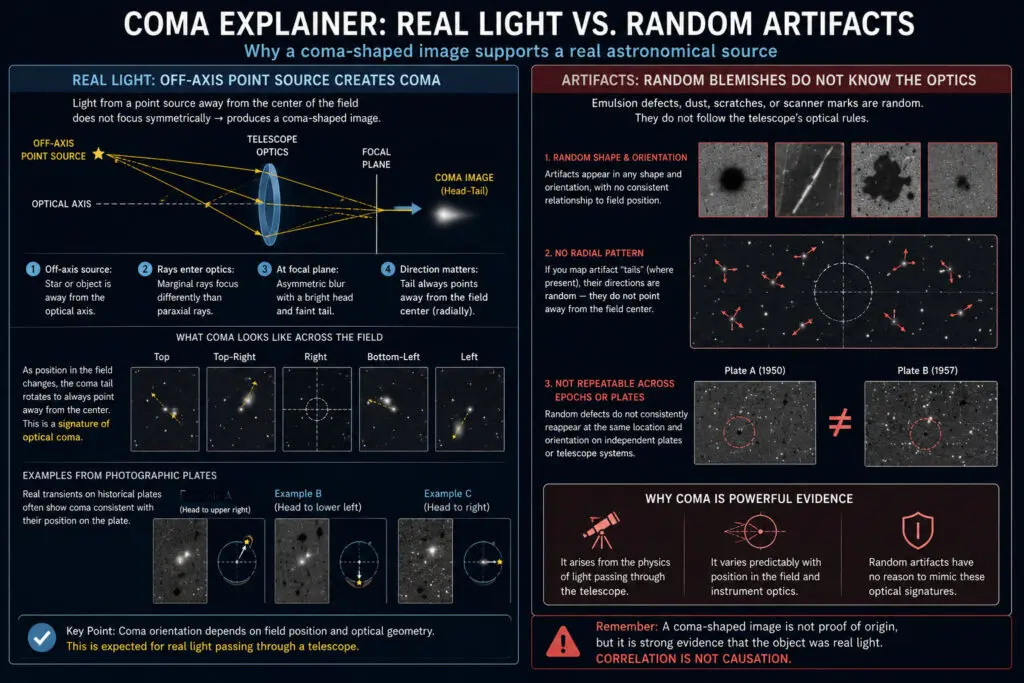
This is the point where skepticism should become more disciplined, not less. The old easy dismissal, “it is just bad emulsion,” is less satisfying for the coma-bearing cases. But the jump from “real optical transient” to “artificial object” remains large. Astronomers know many things can flash: meteors, satellites, aircraft, high-altitude debris, cosmic-ray-like detector events, atmospheric phenomena, stellar flares, plate handling artifacts, and chance alignments. Pre-Sputnik plates rule out ordinary cataloged satellites, but they do not automatically rule in exotic technology. They create a negative space in the evidence.
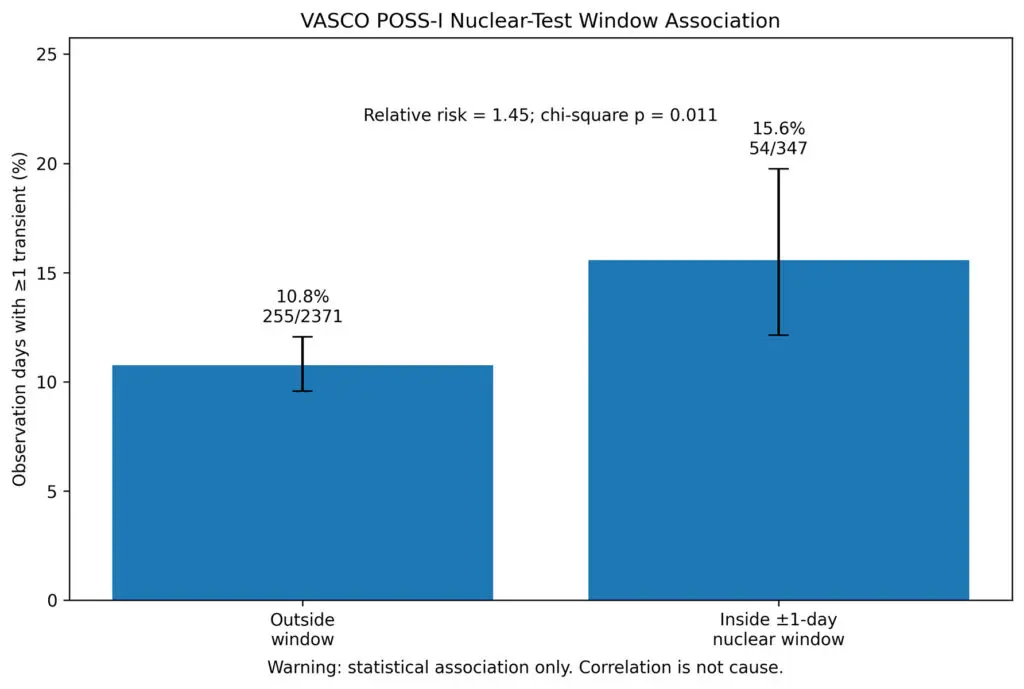
The VASCO team has been trying to illuminate that negative space with population-level tests. One of the strangest is the reported relationship between transients and nuclear weapons testing. In a 2025 Scientific Reports paper, Stephen Bruehl and Villarroel examined 2,718 days before Sputnik and reported that transients were 45 percent more likely to occur within one day of a nuclear test. They also reported a correlation between the number of historical unidentified aerial phenomenon reports on a given date and the number of transients, while emphasizing that correlation is not causation. The same paper lists conventional explanations and admits the evidence is not definitive. Still, the result is difficult to ignore because it makes a risky statistical prediction: if the transient dates are random artifacts, they should not know anything about nuclear-test calendars. (Nature)
The counterargument arrived quickly. A 2026 critique by Watters and colleagues argued that the nuclear-test signal becomes insignificant when normalized by relevant observation days and is largely driven by Palomar’s observing schedule. The same critique challenged the claimed Earth-shadow deficit and warned that VASCO datasets contain catalog stars, scan artifacts, plate defects, edge effects, clusters, voids, and other contamination problems. Their criticism was not merely “we dislike the conclusion.” It was that the statistical architecture may be resting on an imperfect and uneven dataset. (arXiv)
Villarroel and coauthors responded that Watters and colleagues conflated object-level validation with ensemble-level inference, used a heavily reduced sample for a different purpose, and weakened statistical power for the very tests under discussion. The dispute is technical, but the stakes are simple. If the catalog is too contaminated, correlations can be illusions. If the catalog still carries real signals through the noise, the correlations become part of the evidence that the transients are not random photographic accidents. (arXiv)
Independent replication
In 2026, Brian Doherty released an independent replication using the original VASCO data and newly written code. Doherty reproduced the nuclear-window association with a relative risk of 1.45 and p = 0.011, then used negative-binomial regression with controls for precipitation, cloud cover, lunar illumination, and other observing conditions. In those models, the transient rate remained higher near nuclear tests, and the effect became stronger when restricted to sunlit-only candidates. Doherty also reproduced an Earth-shadow deficit: only about 0.46 percent of VASCO candidates fell inside the Earth’s shadow, far below a simple geometric expectation. His conclusion was careful: the statistical results appear robust, but the physical interpretation remains open. (arXiv)
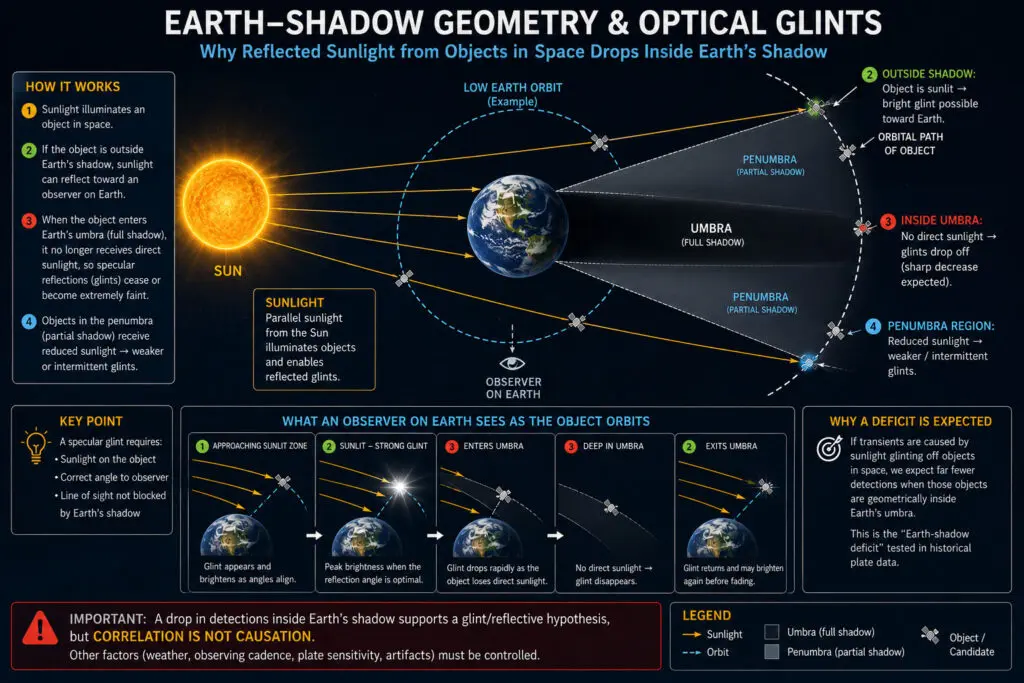
The shadow result is especially evocative because it points toward reflected sunlight. A passive object in Earth orbit can glint only when sunlight reaches it. If candidates avoid Earth’s shadow more than expected, and if the effect strengthens for candidates classified as more likely real, then one explanation is that at least some transients are reflections from objects in space. That is the bridge from anomaly astronomy to SETA, the search for extraterrestrial artifacts. It is also where the risk of overinterpretation peaks. Sunlit glints are a mechanism, not an identity. A glint tells you about geometry, reflectivity, and illumination. It does not tell you who built the reflector, or whether anyone built it at all.
A separate 2025 Publications of the Astronomical Society of the Pacific paper pushed the glint idea into a geometric search. The authors looked for multiple point-like transients aligned along narrow bands on pre-space-age plates, as might be expected from rapidly glinting reflective objects. They shortlisted alignments, reported one candidate at about 3.9 sigma, and found a deficit of candidates inside Earth’s shadow. Yet they also noted that rare optical ghosting could not be fully excluded and described the study as an initial exploration. (iac.es)
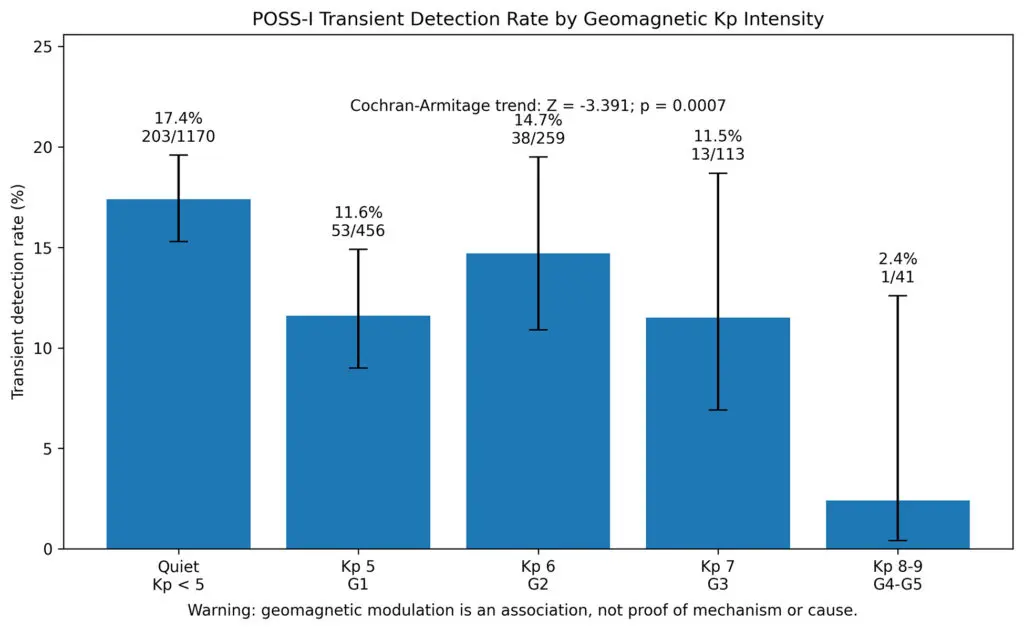
Another 2026 preprint, by Kevin Cann, examined geomagnetic activity through the Kp index, a standard measure used to characterize geomagnetic disturbance. Cann reported that transient rates vary with Kp, dropping from higher rates during quiet geomagnetic conditions to lower rates during strong storms, and argued that controlling for Kp and lunar variables strengthens the nuclear-transient correlation. That does not settle the mechanism. It does, however, add another environmental variable that the simplest plate-defect explanation would not predict. (arXiv)
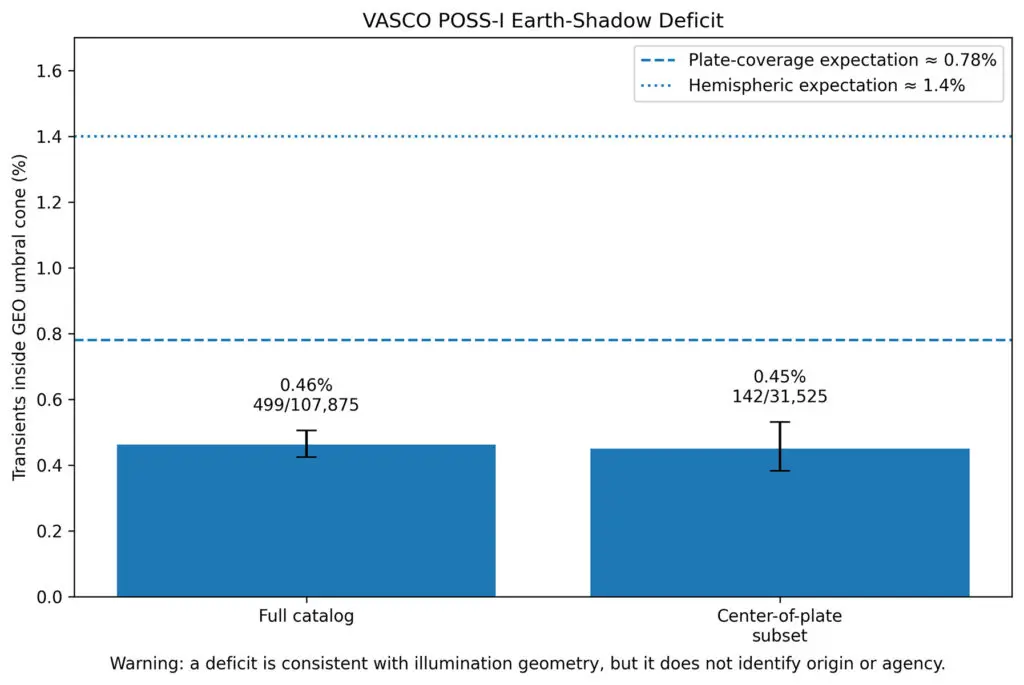
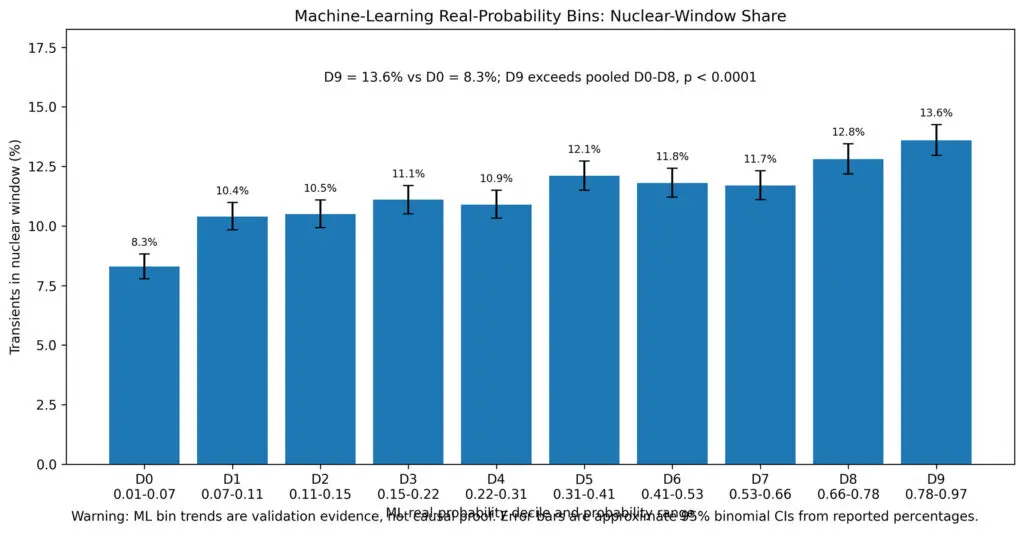
Machine learning has also entered the fight, as both a tool and a battleground. A 2026 preprint by Bruehl, Doherty, Streblyanska, and Villarroel trained models on image pairs visually classified as real or defective, then assigned real-probability scores to 107,875 candidate transients. The authors reported that the nuclear-window association persisted after controlling for machine-classified artifacts, and that the Earth-shadow deficit was strongest among the highest-probability real candidates. Machine learning does not magically remove bias, especially when labels come from human judgment and historical plates are heterogeneous. But if the reported pattern holds under independent reanalysis, it would mean the most star-like candidates carry the strongest physical signal. (arXiv)
The investigative bottom line is therefore sharper than it was a few years ago. The strongest recent work does not prove alien probes. It does not even prove that most VASCO candidates are real sky events. But it increasingly undermines the idea that every important case can be dismissed as emulsion damage. The Busko coma analysis is the cleanest example because it focuses on optical morphology rather than calendar correlations. A mark that behaves like an off-axis optical image has crossed a threshold. It is no longer merely a dot on a plate. It is a candidate record of light.
The implications unfold in layers
The first implication is for astronomy itself. Historical photographic plates are not dead archives. They are time machines with defects. Their value lies in the century-long baseline they provide, but their danger lies in the same material history that makes them precious. Every plate has chemistry, handling, copying, scanning, cataloging, and calibration issues. VASCO has forced the astronomical community to confront how much information still sits inside these archives, and how hard it is to extract anomalies responsibly. The right response is not to laugh the subject away. It is to build better plate-forensics pipelines.
The second implication is for transient science. Modern surveys such as ZTF, Pan-STARRS, Gaia, LSST-era programs, and all-sky cameras are designed to catch changing skies, but many are not optimized for sub-second optical flashes, especially specular glints from small objects. A flash lasting milliseconds or less can look like a point source on a long exposure and then vanish without trace. This is exactly the kind of event that can fall between standard astronomical categories. If VASCO-like flashes are real, they may represent a population of short-duration optical events that conventional transient pipelines undercount.
The third implication is for the study of near-Earth space before Sputnik. The phrase “pre-Sputnik” has become shorthand for “before ordinary satellites,” but it does not mean the near-Earth environment was empty of all possible reflectors. Natural dust, meteoroids, high-altitude phenomena, unknown debris, or rare atmospheric events remain possible. Still, the absence of known human satellites is a powerful constraint. Any model involving orbiting reflectors must either invoke natural bodies, secret pre-Sputnik technology, observational error, or non-human artifacts. Each option carries problems. That is why the subject refuses to die.
The fourth implication is cultural and institutional. VASCO sits at the uncomfortable intersection of astronomy, UAP studies, and technosignature research. For decades, SETI mostly meant listening for radio signals. SETA, by contrast, asks whether physical artifacts might exist in the Solar System. Robert Freitas argued in the 1980s that the absence of known extraterrestrial artifacts nearby was not a settled observational fact because humanity had not searched very hard. Gregory Benford later argued that co-orbital and nearby stable locations are attractive places to look for “lurkers,” hypothetical probes or artifacts that might persist over long timescales. (rfreitas.com) (arXiv)
VASCO does not prove those ideas. It gives them an observational hook. The 2026 MNRAS paper on cost-effective searches for extraterrestrial probes makes this explicit by proposing methods such as looking for pre-Sputnik glints, using space-borne telescopes, studying reflectance spectra and reddening, and treating Earth’s shadow as a filter. Its proof-of-concept search with ZTF found uncatalogued events near the shadow center but emphasized that triangulation and spectroscopy would be needed to identify candidates. That is exactly the right standard. A transient dot is not enough. A repeatable observing strategy is needed.
The fifth implication is about nuclear history. The reported nuclear-test association is the most sensational and the most fragile part of the case. It is sensational because it suggests the transient rate may rise near human nuclear activity. It is fragile because historical observing schedules, weather, sky coverage, selection effects, and cultural reporting biases can mimic patterns. If future work confirms the association in independent archives, such as Hamburg plates, Harvard plates, Sonneberg plates, or other observatory collections, it would become far more important. If it appears only in Palomar-derived samples and disappears under stricter controls, it will weaken. This is a testable claim, and that is its virtue.
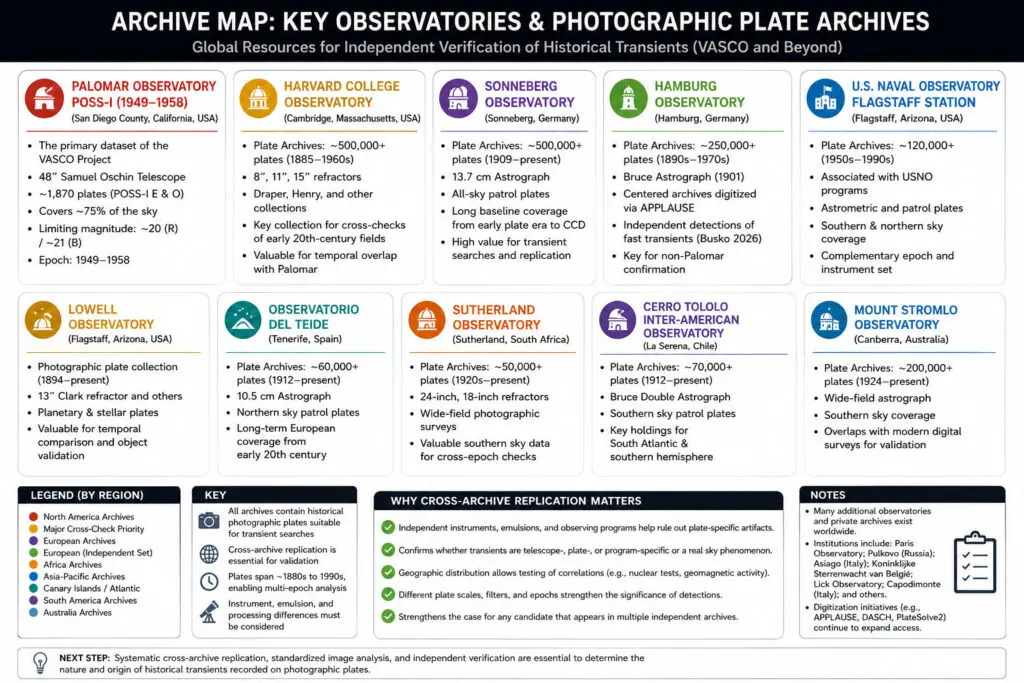
What would close the case? Not another suggestive dot. Not another p-value alone. The field needs original plate inspection where possible, not only scans or second-generation copies. It needs blind labeling of candidate and control images. It needs independent observatories, independent pipelines, and pre-registered statistical tests. It needs physical modeling of glints from natural and artificial objects across plausible distances and altitudes. It needs modern observing campaigns designed to capture sub-second flashes with simultaneous multi-site imaging so parallax can determine distance. It needs spectroscopy when possible. It needs to know whether the flashes are in the atmosphere, near Earth, cislunar space, the Solar System, or beyond.
The claim that “there is little gap for skepticism” is too strong. Skepticism still has work to do. But it has to be the useful kind, the kind that makes predictions and tests alternatives, not the lazy kind that waves away awkward evidence with a single word: artifact. The better formulation is this: the gap for dismissiveness has narrowed. Recent evidence, especially coma-bearing transients in independent archival plates, makes it increasingly plausible that at least some pre-Sputnik mystery lights were real optical events recorded by telescopes. Their origin remains unresolved.
The old plates are not whispering a simple answer. They are asking a better question. Before Sputnik, before the official satellite era, before near-Earth space became crowded with known machines, something flickered on glass. Maybe it was an overlooked natural phenomenon. Maybe it was an unrecognized population of brief reflections. Maybe it was a defect that has not yet been modeled well enough. Or maybe, at the far edge of responsible speculation, it was something built.
The next step is not belief. It is pursuit.
Claims Taxonomy
Article-Level Classification
Disputed, with Probable subclaims.
The existence of published VASCO-related datasets and candidate detections is Verified. The claim that at least some candidates are real optical transients is now Probable, especially for object-level cases such as Busko’s coma-bearing Hamburg plate transients. The claim that these events represent artificial pre-Sputnik objects, UAP, or extraterrestrial probes remains Disputed and should be treated as a Hypothesis, not as established fact.
Claim-by-Claim Classification
| Claim | Classification | Rationale |
| The VASCO project searches historical sky surveys for sources present in older plates but absent in modern surveys. | Verified | Established by the 2020 Astronomical Journal VASCO paper and subsequent work. |
| POSS-I and related archival plates contain candidate single-epoch sources that are absent from later surveys. | Verified | Multiple papers document candidate detections, including the 2020 AJ paper, 2021 Scientific Reports paper, and 2022 MNRAS search. |
| The 2021 April 12, 1950 case involves nine point-like sources appearing on one red POSS-I plate and absent from comparison imagery. | Verified as reported | The event is published in Scientific Reports, but explanations remain contested. |
| Solano, Villarroel, and Rodrigo’s 2022 Virtual Observatory search left 5,399 unidentified POSS-I red transients after filtering. | Verified | The number and filtering workflow are reported in MNRAS. |
| Hambly and Blair’s 2024 critique argues many VASCO candidates are likely emulsion or copy-plate artifacts. | Disputed as conclusion | Their peer-reviewed RAS Techniques and Instruments paper makes this argument, but later papers challenge its interpretation. |
| Very brief optical flashes can appear sharper than long-exposure stellar images. | Probable | This is physically plausible and argued by Villarroel, Solano, and Marcy, though not universally accepted as sufficient explanation for all candidates. |
| Busko’s 2026 Hamburg plate work provides independent evidence of VASCO-like transients in non-Palomar archival plates. | Probable | The work uses a separate archive and telescope system, but remains preprint-stage and partly visual in methodology. |
| Busko’s coma analysis supports the claim that at least some candidate transients are real optical images formed by telescope optics, not random plate blemishes. | Probable | This is the strongest object-level support so far, but it remains based on a small sample and a preprint pending broader replication. |
| VASCO transient rates increase near atmospheric nuclear test dates. | Disputed | Bruehl and Villarroel report this in Scientific Reports, Doherty reports replication, but Watters et al. contest the statistical framing and dataset validity. |
| VASCO candidates show a deficit inside Earth’s shadow, consistent with reflected sunlight. | Probable | Reported in VASCO-related work and replicated by Doherty, but challenged by Watters et al. based on dataset and background-distribution concerns. |
| Machine-learning classification supports a real population of historical plate transients. | Probable | Bruehl et al. report ML support, but the paper is a preprint and depends on training labels and catalog construction. |
| The transients are artificial objects in orbit before Sputnik. | Disputed / Hypothesis | Reflected-glint geometry is plausible for some cases, but no recovered object, orbit, spectrum, parallax, or direct identification exists. |
| The transients are evidence of non-human intelligence or extraterrestrial probes. | Disputed / Hypothesis | SETA and “lurker” frameworks make the interpretation scientifically discussable, but the evidence does not yet establish origin, manufacture, intent, or agency. |
| All VASCO transients are plate artifacts. | Disputed / Improbable | Catalog contamination is real, but the strongest object-level coma cases weaken a blanket artifact explanation. |
| VASCO proves surveillance of nuclear tests. | Disputed / Probable hypothesis, not established | The nuclear association is contested, and even if real, it would not by itself identify the source or intention. |
Speculation Labels
Evidence
Historical astronomical plates contain candidate transient sources reported by VASCO and related researchers. Peer-reviewed papers have documented candidate single-epoch detections, including the 2020 AJ VASCO survey, the 2021 nine-transient Scientific Reports case, the 2022 MNRAS Virtual Observatory search, the 2025 Scientific Reports nuclear-correlation study, the 2025 PASP alignment study, and the 2026 MNRAS search-method paper. Independent preprints by Busko, Doherty, Cann, and Bruehl et al. add further analysis, but several remain unreviewed.
Witness Interpretation
Not central to this article. Historical UAP report databases appear in some correlation studies, but this article does not rely on individual eyewitness testimony. Any UAP report correlation should be treated as a dataset-level association, not as direct confirmation that witnesses observed the same phenomena recorded on astronomical plates.
Researcher Opinion
Hambly and Blair interpret many apparent transients as likely photographic or copy-plate artifacts. Villarroel, Solano, Marcy, Bruehl, Doherty, Busko, and Cann argue that at least some candidates behave more like real optical events than defects. Watters et al. argue that dataset contamination, background nonuniformity, and observing-schedule effects undercut several technosignature-related claims. These are competing expert interpretations, not settled facts.
Hypothesis
The following ideas should be clearly marked as hypotheses:
- Some VASCO-like transients may be sub-second optical flashes.
- Some may be specular reflections from reflective objects in near-Earth, geosynchronous, cislunar, or more distant Solar System locations.
- Some may represent a previously unrecognized natural atmospheric, near-Earth, or astrophysical phenomenon.
- Some may be artificial objects predating Sputnik.
- Some may be related to SETA or “lurker” probe scenarios.
- Some may be unrelated classes of events mistakenly grouped together by catalog methods.
The extraterrestrial or non-human intelligence interpretation remains speculative and should not be presented as established.
The strongest defensible claim is narrower: the evidence increasingly supports the possibility that at least some pre-Sputnik plate transients are real optical events whose origin remains unresolved.
Reference Section
Primary Scientific Literature
Villarroel, B., Soodla, J., Comerón, S., Mattsson, L., Pelckmans, K., López-Corredoira, M., et al. (2020). The Vanishing and Appearing Sources during a Century of Observations Project. I. USNO Objects Missing in Modern Sky Surveys and Follow-up Observations of a “Missing Star.” The Astronomical Journal, 159(1), 8. doi:10.3847/1538-3881/ab570f. (Instituto de Astrofísica de Canarias)
Villarroel, B., Marcy, G. W., Geier, S., Streblyanska, A., Solano, E., Andruk, V. N., Shultz, M. E., Gupta, A. C., & Mattsson, L. (2021). Exploring nine simultaneously occurring transients on April 12th 1950. Scientific Reports, 11, 12794. doi:10.1038/s41598-021-92162-7. (Nature)
Solano, E., Villarroel, B., & Rodrigo, C. (2022). Discovering vanishing objects in POSS I red images using the Virtual Observatory. Monthly Notices of the Royal Astronomical Society, 515(1), 1380-1391. doi:10.1093/mnras/stac1552. (OUP Academic)
Hambly, N., & Blair, A. (2024). On the nature of apparent transient sources on the National Geographic Society-Palomar Observatory Sky Survey glass copy plates. RAS Techniques and Instruments, 3(1), 73-79. doi:10.1093/rasti/rzae004. arXiv:2402.00497. (arXiv)
Solano, E., Marcy, G., Villarroel, B., et al. (2024). A bright triple transient that vanished within 50 min. Monthly Notices of the Royal Astronomical Society, 527(3), 6312-6320. doi:10.1093/mnras/stad3422. (OUP Academic)
Villarroel, B., Solano, E., & Marcy, G. W. (2025). On the Image Profiles of Transients in the Palomar Sky Survey. arXiv:2507.15896. (arXiv)
Bruehl, S., & Villarroel, B. (2025). Transients in the Palomar Observatory Sky Survey (POSS-I) may be associated with nuclear testing and reports of unidentified anomalous phenomena. Scientific Reports, 15, 34125. doi:10.1038/s41598-025-21620-3. (Nature)
Villarroel, B., Solano, E., Guergouri, H., Streblyanska, A., Bruehl, S., Andruk, V. M., Mattsson, L., Bär, R. E., Mimouni, J., Geier, S., Gupta, A. C., Okororie, V., Laggoune, K., Shultz, M. E., & Freitas, R. A., Jr. (2025). Aligned, Multiple-transient Events in the First Palomar Sky Survey. Publications of the Astronomical Society of the Pacific, 137(10), 104504. doi:10.1088/1538-3873/ae0afe. (Instituto de Astrofísica de Canarias)
Watters, W. A., Dominé, L., Little, S., Pratt, C., Knuth, K. H., & Szenher, M. (2026). Critical Evaluation of Studies Alleging Evidence for Technosignatures in the POSS1-E Photographic Plates. arXiv:2601.21946. Accepted for Publications of the Astronomical Society of Australia. (arXiv)
Villarroel, B., Streblyanska, A., Bruehl, S., & Geier, S. (2026). A Response to paper Critical Evaluation of Studies Alleging Evidence for Technosignatures in the POSS1-E Photographic Plates by Watters et al. (2026). arXiv:2602.15171. (arXiv)
Bruehl, S., Doherty, B., Streblyanska, A., & Villarroel, B. (2026). Machine Learning Supports Existence of Previously Unrecognized Transient Astronomical Phenomena in Historical Observatory Images. arXiv:2604.18799. (arXiv)
Busko, I. (2026a). Searching for Fast Astronomical Transients in Archival Photographic Plates. arXiv:2603.20407. (arXiv)
Busko, I. (2026b). Fast Astronomical Transients in Archival Photographic Plates: Using optical aberrations as a tool for discerning real images, from plate artifacts. arXiv:2606.08319. (arXiv)
Doherty, B. (2026). Independent Replication of Nuclear Test-Transient Correlations and Earth Shadow Deficit in POSS-I Photographic Plates. arXiv:2604.00056. (arXiv)
Cann, K. (2026). Geomagnetic storm suppression of photographic plate transient detections in the POSS-I archive: an independent physical variable strengthening the nuclear test correlation. arXiv:2604.04950. (arXiv)
Villarroel, B., Watters, W. A., Streblyanska, A., Solano, E., Geier, S., & Mattsson, L. (2026). A cost-effective search for extraterrestrial probes in the Solar system. Monthly Notices of the Royal Astronomical Society, 546(2), article staf1158. doi:10.1093/mnras/staf1158. (OUP Academic)
SETA, Technosignature, and “Lurker” Context
Freitas, R. A., Jr. (1983). The search for extraterrestrial artifacts (SETA). Journal of the British Interplanetary Society, 36, 501-506. (arXiv)
Freitas, R. A., Jr., & Valdes, F. (1985). The search for extraterrestrial artifacts (SETA). Acta Astronautica, 12(12), 1027-1034. doi:10.1016/0094-5765(85)90031-1. (ScienceDirect)
Benford, J. (2019). Looking for Lurkers. arXiv:1903.09582. (arXiv)
Benford, G. (2019). Gregory Benford: Further Thoughts on “Lurkers.” Centauri Dreams. (Centauri Dreams)
Secondary and Journalistic Sources
Sharp, C., & Carson, C. S. (2026, July 7). Before Sputnik: The Mystery Lights That Refuse to Die. Liberation Times. (Liberation Times | Reimagining Old News)
SEO Keywords
VASCO pre-Sputnik transients, VASCO Project, pre-Sputnik transients, Palomar Observatory Sky Survey, POSS-I transients, vanishing stars, astronomical photographic plates, unexplained sky flashes, Beatriz Villarroel, Ivo Busko coma analysis, UAP astronomy, technosignatures, extraterrestrial probes, POSS-I mystery lights, 1950 Palomar transients, April 12 1950 transients, Hamburg Observatory plates, APPLAUSE archive, Earth shadow deficit, nuclear test correlation, photographic plate artifacts, emulsion defects, fast optical transients, sub-second flashes, specular reflections, geosynchronous orbit glints, unidentified anomalous phenomena, SETA, search for extraterrestrial artifacts