
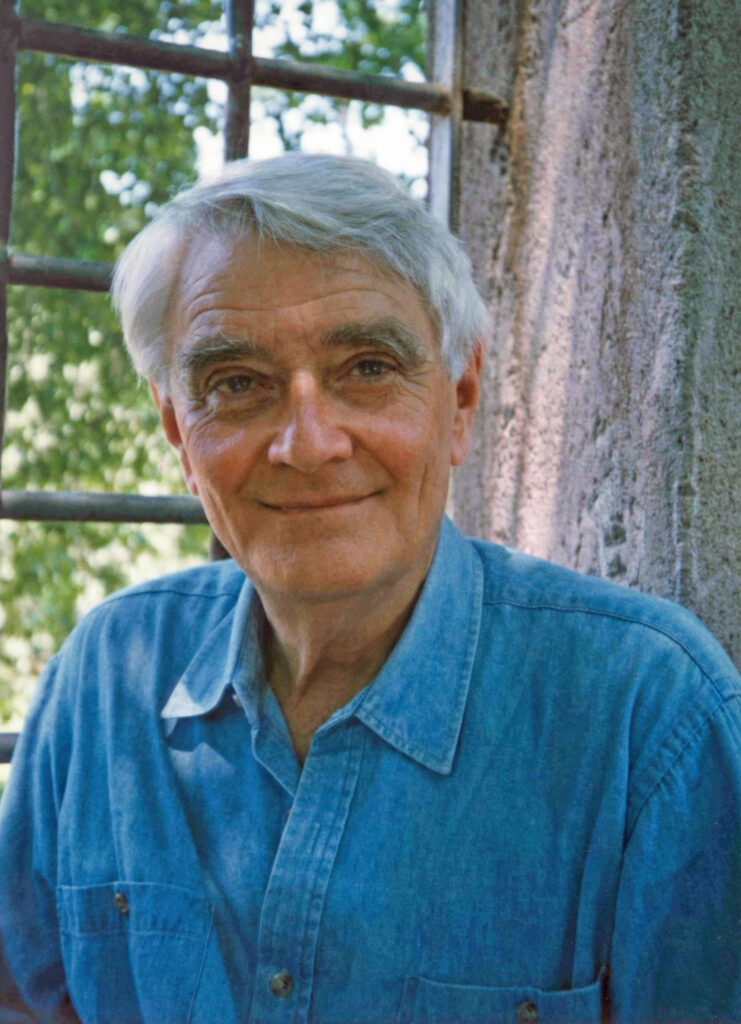
Before he became the name everyone in the abduction world had an opinion about, Budd Hopkins was a respected abstract expressionist with work hanging in some of the most prestigious museums on Earth.
Born Elliot Budd Hopkins in Wheeling, West Virginia, on 15 June 1931, he survived childhood polio, spent long months recovering, and passed the time building ship models out of clay. That enforced stillness turned into a lifetime obsession with form, geometry and, eventually, the collision between the rational and the impossible. (Mike Minder)
He graduated from Linsly Military Institute in 1949 and earned a degree in art history from Oberlin College in 1953, where a lecture by Robert Motherwell opened the door to gestural abstraction.
After college he moved to New York, embedded himself in the post-war art scene, and personally knew giants like Franz Kline, Willem de Kooning, Mark Rothko and Robert Motherwell. His paintings and sculptures eventually entered the permanent collections of the Museum of Modern Art, the Whitney, the Guggenheim and other major institutions, and in 1976 he received a Guggenheim Fellowship for painting.
By any normal metric, that could have been the whole story. Then came a daytime UAP over Cape Cod.
In August 1964, Hopkins and two friends saw a dark, elliptical object hovering and then accelerating away against the wind over Truro, Massachusetts. He later told PBS NOVA that the sighting lasted about three minutes and that the object’s motion instantly convinced him some previously unknown factor was at work in the world. (PBS) When he reported it to nearby Otis Air National Guard Base and got a perfunctory brush-off, his curiosity was piqued rather than satisfied.
That single sighting quietly redirected the trajectory of an already successful life. Within twenty years, Budd Hopkins would be called the “father of the abduction movement”, for better and for worse.
From New York galleries to North Hudson Park
Hopkins’ entry into UAP investigation was gradual and strangely domestic. Living in Manhattan, he heard from a neighbor, George O’Barski, who claimed that one night in the 1970s he had seen a craft land in North Hudson Park, New Jersey, and observed small figures collecting soil samples before taking off again. Hopkins investigated and wrote the story for The Village Voice, which was later picked up by Cosmopolitan. (Vanity Fair)
Abduction accounts, at that point, were rare and usually tied to road-side encounters like the Betty and Barney Hill case. Hopkins began to notice another pattern in letters and stories that reached him after the article: people who had seen a UAP, experienced intense fear or missing hours, and then tried to forget it.
He started keeping notes. Then case files. Then entire filing cabinets.
By the late 1970s he was collaborating with psychiatrists and psychologists to use regression hypnosis with witnesses who reported “missing time”, nightmares and fragmentary memories around close encounters. Hopkins himself was not clinically trained, but he sat in on sessions conducted by skeptical professionals such as Robert Naiman, Aphrodite Clamar and Girard Franklin, and slowly developed his own techniques.
Writing the abduction canon: Missing Time, Intruders and Witnessed
If you strip Budd Hopkins’ legacy down to the books that outlived him, three titles define his impact:
- Missing Time: A Documented Study of UFO Abductions (1981)
- Intruders: The Incredible Visitations at Copley Woods (1987)
- Witnessed: The True Story of the Brooklyn Bridge UFO Abductions (1996)
Plus two later works that frame his ideas - Sight Unseen: Science, UFO Invisibility, and Transgenic Beings (2003, with Carol Rainey)
- Art, Life and UFOs: A Memoir (2009)
Missing Time crystallized a concept that experiencers still use. Hopkins argued that gaps in memory around a UAP encounter, coupled with anxiety, phobias or recurring nightmares, were often the surface layer of an abduction experience that had been deliberately masked. The book pulled together several cases where regression hypnosis seemed to reveal detailed narratives of being taken aboard craft, examined, and returned with little or no conscious recollection.
Intruders raised the stakes. Based on the long-running “Copley Woods” case, Hopkins concluded that many abductions revolved around reproductive procedures and the creation of hybrid beings. The book became a New York Times paperback bestseller for several weeks, and in 1992 CBS aired a prime-time mini-series, “Intruders”, inspired by Hopkins’ work, which helped cement the imagery of “the Greys” and hybrid children in popular culture.
With “Witnessed”, Hopkins turned to what he saw as the crown jewel: the 1989 Brooklyn Bridge case of “Linda Cortile” (later revealed as Linda Napolitano). Linda reported being levitated from her 12th-floor Manhattan apartment into a craft in front of multiple witnesses, including two bodyguards and, allegedly, a high-ranking international figure widely believed to be former U.N. Secretary-General Javier Pérez de Cuéllar. (Vanity Fair)
Hopkins saw in that case the closest thing to a “perfect storm” of corroboration: an experiencer, outside witnesses, physical after-effects and a potential world-level political witness. Critics, as we will see, saw something quite different.
Sight Unseen and Art, Life and UFOs broadened the lens. The former, co-authored with his third wife Carol Rainey, explored ideas about UAP invisibility and transgenic beings.
The latter intertwined his art career, sighting, and abduction research into one long narrative and is often recommended, even by skeptics, as essential reading for understanding both the man and the modern abduction era. (Better World Books)
The Intruders Foundation and the rise of abductee culture
In 1989 Hopkins formalized his work by founding the Intruders Foundation (IF) in New York, a nonprofit dedicated to research, public education and support for people who believed they had been abducted.
Through IF he ran:
- Monthly support groups in Manhattan, which drew everyone from pilots and police officers to therapists and airline staff. He described participants as “veterans of trauma”, and the groups blended social evenings with serious processing of high-strangeness experiences.
- Regression sessions with individual experiencers, often recorded on audio or video.
- A psychological testing program in collaboration with Elizabeth Slater and other professionals, which Hopkins argued showed no major psychopathology in abductees as a group. (PBS)
- Outreach and research publications, including participation in the famous Roper poll that tried to estimate how many Americans were having abduction-like experiences based on a set of key symptoms such as sleep paralysis, missing time and puzzling scars. (Vanity Fair)
In public talks and interviews he hammered a consistent message: abductees are usually sane, often reluctant to come forward, and their stories, across continents and cultures, are remarkably similar in sequence and detail. (PBS)
Public appearances and the making of a UAP media figure
Hopkins’ visibility was not limited to small conferences. Over three decades he became one of the most media-savvy figures in the UAP world.
Highlights include:
- Talk-show circuits: Appearances on mainstream programs such as Sally Jessy Raphael, Charles Grodin, and other syndicated shows exposed wider audiences to abduction narratives and to Hopkins’ concept of missing time.
- PBS NOVA “Kidnapped by UFOs?” (1996): The documentary featured Hopkins running a regression session and explaining his evidence, and paired his views with skeptical voices such as Carl Sagan and psychologist Richard McNally. (PBS)
- Larry King Live (2005): Hopkins joined other guests to discuss UAP sightings and abductions in a prime-time CNN setting.
- 1992 MIT Abduction Study Conference: Hopkins was a key presenter at this landmark event organized by physicist David Pritchard and psychiatrist John Mack, where academics and investigators debated the evidence and the methods, including Hopkins’ own survey work. (Vanity Fair)
- International UAP congresses and MUFON symposia: He was a regular speaker at conferences throughout the 1980s and 1990s, often presenting case material and arguing that abductions had a “core of reality” that science could not ignore.
- Sci Fi Channel’s “Taken”: According to his publisher, Hopkins served as a public spokesperson for the channel’s Steven Spielberg–produced miniseries “Taken”, which dramatized abduction themes for a new generation. (Simon & Schuster)
This media presence helped tens of thousands of viewers put language to their own odd experiences. It also gave critics a large target.
Known associates and the abduction research network
No abduction researcher operates alone, and Hopkins’ network shows how the modern experiencer landscape was built.
Key associates include:
- John E. Mack, Harvard psychiatrist. Mack met Hopkins in 1990 after being introduced through consciousness-research circles. Reading Hopkins’ case files helped persuade Mack that his own patients’ accounts deserved serious consideration. Mack later said his cases “amply corroborated” the work of Hopkins and fellow investigator David Jacobs, especially the emphasis on reproductive procedures and hybrids. (Vanity Fair)
- David M. Jacobs, historian and abduction researcher. Hopkins and Jacobs exchanged ideas frequently and often ended up with parallel conclusions about a long-running hybridization program. Their close association later tied Hopkins to controversies surrounding Jacobs’ methods as well.
- Whitley Strieber, author of Communion, whose own abduction narratives intersected with Hopkins’ work and helped normalize the iconic “Grey” imagery that Intruders also popularized.
- Carol Rainey, writer and documentary filmmaker, his third wife and co-author on Sight Unseen. She collaborated closely on cases, filming interviews and helping to shape Witnessed, before later becoming one of his most vocal critics.
- Leslie Kean, investigative journalist and later author of UFOs: Generals, Pilots, and Government Officials Go On the Record. She became Hopkins’ partner late in his life and helped organize aspects of his work.
Other connections included mainstream folklorists such as Thomas Bullard, psychologists like Elizabeth Slater, and organizations such as MUFON and CUFOS, who debated his methods even while mining his data.
Methods, evidence and worldview
Hopkins’ investigative toolkit rested on three pillars: structured interviews, regression hypnosis, and physical or circumstantial traces.
Narrative patterns and “tightly imagined testimonies”
Hopkins argued that the most compelling evidence came from the way independent narratives echoed one another in structure and detail. Across hundreds of cases he saw the same sequences: the presence of a nearby UAP, a sense of paralysis or “frozen time”, transport through walls or windows, medical examinations (often reproductive in focus), and the presentation of hybrid children. (PBS)
He emphasized that this pattern turned up not only in media-saturated American cities but also in reports from rural or illiterate witnesses worldwide, which he believed argued against simple cultural contagion. (PBS)
Hypnosis as a key to “missing time”
Because many witnesses initially came to him with only fragmentary memories, Hopkins used hypnosis to explore the “missing time” intervals. He insisted that he had learned from trained clinicians and that his approach was careful and non-leading, although he acknowledged he was not a licensed therapist.
To mainstream psychologists, this was the most controversial part of his work. Hypnosis is notoriously prone to suggestion and confabulation, and several critics argued that Hopkins’ expectations could shape what witnesses “remembered”.
Physical marks and environmental traces
In interviews such as his PBS NOVA segment, Hopkins often pointed to recurring physical marks as corroboration: small “scoop marks” removing layers of skin, straight incision-like marks that appeared overnight without normal healing behavior, and unusual bruises, particularly on the inner thighs, that resembled the use of medical stirrups. He also cited ground traces, broken branches and other site anomalies at alleged landing sites. (PBS)
He fully accepted that the physical evidence was rarely decisive. For him the convergence of trauma, narrative patterning and recurring marks across many individuals was the real signal.
At the worldview level, Hopkins saw abductions as a program run by an advanced non-human intelligence focused on genetics and hybridity. He rejected both “savior” and simple “invader” storylines. In one NOVA answer he likened humanity’s position to indigenous cultures confronted by a technologically superior colonizer who operates by its own agenda, neither purely demonic nor benevolent. (PBS)
Government and institutional touchpoints
Hopkins never held an official government role, and he was often suspicious of official silence. His interactions with institutions took different forms:
- MIT Abduction Study Conference (1992): By bringing case material into a prestigious technical institution, Hopkins and his colleagues forced physicists, psychologists and philosophers to grapple directly with abductee testimony. The conference proceedings, later published as Alien Discussions, remain a key document in the field. (IUCAT)
- Roper poll on abduction-like experiences: Hopkins helped interpret a 1991 Roper survey that asked nearly 6,000 Americans about specific anomalous experiences. Depending on how strictly one reads the data, the poll suggested anywhere from hundreds of thousands to millions of Americans might have had abduction-type episodes. (Vanity Fair)
- Linda Napolitano and the United Nations allegation: In “Witnessed”, Hopkins argued that the Brooklyn Bridge case involved an important international figure, widely interpreted as U.N. Secretary-General Pérez de Cuéllar. When asked decades later, Pérez de Cuéllar gave a non-committal response that neither confirmed nor clearly denied any such incident. (Vanity Fair)
UAPedia’s editorial stance treats such claims as one data stream among many. Official silence or ambiguity neither proves nor disproves the events, but it does show how Hopkins’ work intersected with the symbolic architecture of power.
Controversies, critiques and internal dissent
From early on, Hopkins’ work drew fire, not only from dedicated skeptics but from colleagues, ex-partners and some experiencers themselves.
Use of hypnosis and risk of suggestion
Psychologists like Robert Baker and others warned that regression hypnosis, especially in the hands of non-clinicians, can generate vivid but inaccurate memories. The PBS NOVA documentary showcased laboratory work suggesting that people who reported abductions showed elevated physiological responses to their memories, similar to trauma victims, which Hopkins took as validation but which skeptics argued could also apply to constructed narratives that felt real. (PBS)
The Linda Napolitano case
Perhaps no single case has divided the UAP community more than Linda Napolitano’s. While Hopkins regarded it as the best-ever abduction case, other investigators, including Joseph Stefula, Richard Butler and George Hansen, published detailed critiques arguing that key elements could not be independently verified and that some claimed witnesses might have been hoaxers. (Academia)
For Hopkins, the multiplicity of witnesses and the alleged involvement of a world figure made the case compelling. For critics, the very cinematic quality of the narrative and the lack of solid documentation raised red flags.
Carol Rainey’s “Priests of High Strangeness”
In 2011 Hopkins’ ex-wife and former collaborator Carol Rainey published a long essay titled “The Priests of High Strangeness”, later widely circulated online, in which she alleged serious methodological flaws in both Hopkins’ and David Jacobs’ work. She claimed, among other things, that:
- Some of Hopkins’ star cases were not adequately vetted and contained obvious exaggerations.
- He ignored or minimized disconfirming evidence that weakened a dramatic narrative.
- Abductees were sometimes guided, consciously or unconsciously, toward stories that fit existing hybridization themes.
Skeptical Inquirer columnist Robert Sheaffer used Rainey’s account, combined with the “Emma Woods” controversy around Jacobs, to argue that “abductology” as practiced by Hopkins, Jacobs and Mack had essentially self-destructed, largely due to poor research standards and overconfidence.
From a UAPedia perspective, Rainey’s critique is an important insider document. It calls attention to ethical responsibilities toward experiencers and to the dangers of working in isolation without peer review or institutional oversight.
Impact on abduction narratives and experiencer identity
Criticisms aside, it is hard to overstate how deeply Hopkins shaped the modern abduction conversation.
- He named it “missing time”. That phrase became shorthand for a core experiential pattern and helped countless people contextualize otherwise baffling gaps in memory.
- He normalized the idea that abductions could happen in bedrooms, not just lonely highways. Early cases like the Hills involved isolated roads at night. Hopkins’ work in the 1980s brought abductions into domestic spaces, shifting the fear locus from “out there” to the seeming safety of home.
- He pushed the hybridization theme into the foreground. While some earlier accounts included reproductive elements, Intruders and later work made the idea of an ongoing genetic program central, influencing everyone from Whitley Strieber to John Mack. (Wikipedia)
- He built a community. The Intruders Foundation support groups provided one of the first semi-structured, ongoing spaces where abductees could share experiences without ridicule. Many later experiencer networks trace their roots back to Hopkins’ model. (Wikipedia)
- He forced mainstream engagement. Whether at MIT, in Harvard debates over Mack’s work, or in NOVA documentaries, Hopkins’ prominence meant that scientists, ethicists and journalists had to decide where they stood on the abduction question.
Even those who reject his conclusions usually acknowledge that he surfaced a genuine human mystery: why would so many otherwise ordinary people report such similar, deeply affecting experiences, often at significant personal and social cost?
Claims taxonomy and speculation labels
To keep Budd Hopkins’ legacy aligned with UAPedia’s claims framework, it is useful to map his core positions, as below.
Verified
- Hopkins was a nationally recognized abstract artist with work in major museum collections and a Guggenheim Fellowship.
- He personally investigated hundreds of experiencer cases and documented many in books, interviews and Intruders Foundation files.
- Support groups and regression work run by Hopkins were real events attended by people from many professions, as documented in contemporary journalism.
Probable
- Regression hypnosis, when carefully handled, can help some experiencers access emotionally meaningful material that they subjectively experience as real, regardless of its ultimate ontology. (Inference from Hopkins’ case histories and independent trauma research.)
- Media coverage of Hopkins’ books likely contributed to an increase in reported abduction narratives, both by reducing stigma and by providing language for otherwise confusing experiences.
Disputed
- Claim: A large fraction of “missing time” cases represent literal physical abductions by non-human intelligences carrying out a reproductive program.
- Many experiencers, Hopkins and allied researchers affirm this as literal reality. (PBS)
- Skeptics argue that hypnosis, cultural imagery and psychological factors can generate similar narratives without external agents. (PBS)
- Speculation label: Researcher opinion. UAPedia treats Hopkins’ conclusion as a live hypothesis, not an established fact.
- Claim: The Brooklyn Bridge / Linda Napolitano case is one of the strongest abduction cases ever recorded.
- Hopkins and some colleagues regard it as a near-ideal convergence of witnesses and narrative detail. (gb.readly.com)
- Other investigators have documented inconsistencies and unverified elements and consider the case unproven or severely compromised. (Academia)
- Speculation label: Witness interpretation and investigator advocacy.
Legend
- The idea, sometimes repeated in lore, that Hopkins personally uncovered definitive physical implants of non-human origin remains unsupported by publicly verifiable evidence. Hopkins himself acknowledged that purported implants had not yet provided the “smoking gun” he hoped for. (PBS)
Misidentification
- Some experiences brought to Hopkins almost certainly involved sleep paralysis, hypnagogic states or other well-documented neurophysiological phenomena. The challenge, even today, is drawing the line between those and cases with genuinely anomalous features. Speculation label: UAPedia inference.
Implications for UAP research
If Budd Hopkins was even half right, then a large-scale, multi-generational set of interactions between humans and a non-human intelligence is underway, with a focus on genetic and perhaps psychological modification. That would demand a total re-think of human history, biology and future trajectory.
If he was mostly wrong about the literal nature of abduction, his work still exposes something profound:
- There exists a sizable, cross-cultural population of experiencers whose lives are reshaped by encounters that feel invasive, often reproductive, and otherworldly.
- These narratives appear long before most experiencers immerse themselves in UAP media and recur across cultures, with local variations.
- Traditional psychological models have struggled to fully explain the combination of high trauma markers, internal consistency and occasional external correlates, without invoking at least some anomalous factor.
In either reading, Hopkins’ legacy keeps pressure on a lazy default assumption that “it is all easily explained” by misperception or fantasy. The data, even critics admit, are more complicated than that.
End of life
Budd Hopkins died in New York City on 21 August 2011 from complications of cancer, aged 80. At the time he was in a relationship with journalist Leslie Kean and remained active in both painting and abduction research.
His ashes rest on a planet where tens of thousands of people still quietly mark nights when the clocks do something strange, and where the phrase “missing time” has become part of global UAP vocabulary.
References
Hopkins, B. (1981). Missing Time: A Documented Study of UFO Abductions. New York: Richard Marek. www.goodreads.com/book/show/684504.Missing_Time?utm_source=uapedia.ai
Hopkins, B. (1987). Intruders: The Incredible Visitations at Copley Woods. New York: Random House. www.amazon.com/Intruders-Incredible-Visitations-Copley-Woods/dp/0394560760?utm_source=uapedia.ai (Amazon)
Hopkins, B. (1996). Witnessed: The True Story of the Brooklyn Bridge UFO Abductions. New York: Pocket Books. www.amazon.com/Witnessed-Story-Brooklyn-Bridge-Abductions/dp/0671569155?utm_source=uapedia.ai (gb.readly.com)
Hopkins, B., & Rainey, C. (2003). Sight Unseen: Science, UFO Invisibility, and Transgenic Beings. New York: Atria. (publisher listing) www.simonandschuster.com/authors/Budd-Hopkins/702623?utm_source=uapedia.ai (Simon & Schuster)
Hopkins, B. (2009). Art, Life and UFOs: A Memoir. San Antonio: Anomalist Books. www.barnesandnoble.com/w/art-life-and-ufos-budd-hopkins/1017248734?utm_source=uapedia.ai (Amazon)
Key interviews and documents:
PBS NOVA. (1996). Kidnapped by UFOs? Interview with Budd Hopkins. www.pbs.org/wgbh/nova/aliens/buddhopkins.html?utm_source=uapedia.ai (PBS)
Intruders Foundation website (archived version and modern blog).
Archive: web.archive.org/web/20120418083558/http://www.intrudersfoundation.org/?utm_source=uapedia.ai (Wayback Machine)
Blog: intrudersfoundation.org/?utm_source=uapedia.ai (intrudersfoundation.org)
Blumenthal, R. (2013). Alien Nation: Have Humans Been Abducted by Extraterrestrials? Vanity Fair. www.vanityfair.com/culture/2013/05/americans-alien-abduction-science?utm_source=uapedia.ai (Vanity Fair)
Sheaffer, R. (2011). Abductology Implodes. Skeptical Inquirer, 35(3). skepticalinquirer.org/wp-content/uploads/sites/29/2011/05/p25.pdf?utm_source=uapedia.ai
“The Priests of High Strangeness” by Carol Rainey (2011), discussion and reproductions. rr0.org/time/2/0/1/1/01/15/rainey_thepriestofhighstrangeness/?utm_source=uapedia.ai (rr0.org)
Biographical and art-career background:
“Budd Hopkins” entry and bibliography. Wikipedia. en.wikipedia.org/wiki/Budd_Hopkins?utm_source=uapedia.ai (Wikipedia)
“Wheeling Native Budd Hopkins — Visionary Artist and UFO Researcher.” Ohio Valley history blog. www.mikeminder.com/ohio-valley-history-blog/wheeling-native-budd-hopkins-visionary-artist-and-ufo-researcher-born-on-this-day-june-15-1931?utm_source=uapedia.ai (Mike Minder)
SEO keywords
Budd Hopkins biography, Budd Hopkins abduction researcher, Missing Time Budd Hopkins, Intruders Copley Woods, Brooklyn Bridge abduction Linda Napolitano, Intruders Foundation abductee support, Budd Hopkins hypnosis controversy, Carol Rainey Priests of High Strangeness, John Mack and Budd Hopkins, David Jacobs hybrid program, UAP abduction missing time, genetic hybridization UAP, Budd Hopkins art career UFOs, Brooklyn Bridge UAP case, Budd Hopkins NOVA Kidnapped by UFOs