
On a cold Nevada night in the mid 1990s, a small group of visitors steps out of a van onto Highway 375. The desert is silent, the only light a razor-sharp moon. At the roadside, a man in a hat with earflaps waits beside a telescope aimed at the sky. He introduces himself as Chuck Clark, an amateur astronomer who has more or less given his life over to two questions:
What is flying around the perimeter of Area 51, and why is the United States government so nervous about anyone watching it? (Los Angeles Times)
For several decades Clark has been one of Rachel, Nevada’s most persistent skywatchers and perhaps the best-known civilian cartographer of the strange boundary zone around the Groom Lake test facility. His story threads through tourist buses, late-night stargazing sessions, a homemade field guide, a buried ring of motion sensors, a federal criminal case, and an elusive UAP video that some have called a “holy grail” while others dismiss it as a hoax. (Internet Archive)
This biography follows Clark’s trajectory as a desert watcher, local guide, reluctant protagonist in a government overreach case, and long-term custodian of one of the most debated pieces of UAP footage never properly released.
Early life and the 1957 sighting that never left him
Biographical data on Chuck Clark is sparse, which is itself very Rachel. What we can say with reasonable confidence is that he was born in the late 1940s in the United States, that he developed a passion for aviation and astronomy early, and that a single afternoon in 1957 lodged UAP permanently in his mental sky.
In an interview reproduced in the British newspaper The Independent, Clark recalls being 11 years old when he and others watched small, silent disc-like objects in broad daylight. At first they assumed they were conventional jets. The illusion broke only when two F-84 fighters attempted to intercept them and the group realised the discs were much smaller than airplanes yet completely silent. (The Independent)
Psychology Today later describes Clark mentioning another cluster of nine anomalous objects he saw in California in 1957. (Psychology Today) Those early encounters gave him what many life-long UAP investigators share: not a vague interest in mysteries, but a precise, unshakable memory of something that should not have been there and yet was.
Throughout adulthood he cultivated skills that intersect naturally with UAP watching. He became an “aviation enthusiast and amateur astronomer,” comfortable with the night sky, familiar with aircraft behaviour, and at ease operating telescopes and cameras. (Quod Lib.)
By the early 1990s, with Bob Lazar’s Area 51 claims ricocheting through American media, Clark was exactly the sort of person who would feel magnetised toward the most secret airspace in the country.
Moving to Rachel: choosing the edge of the map
Clark relocated to Rachel, Nevada around 1994. Multiple accounts describe him explicitly as an “amateur astronomer” who moved there for the dark skies, only to find himself pulled into the gravitational field of Area 51. (Psychology Today)
Rachel, population roughly 50 to 100 depending on the year, sits on the northern edge of the Nellis Test and Training Range. This is the civilian outpost closest to the Groom Lake complex that the public calls Area 51. (Quod Lib.)
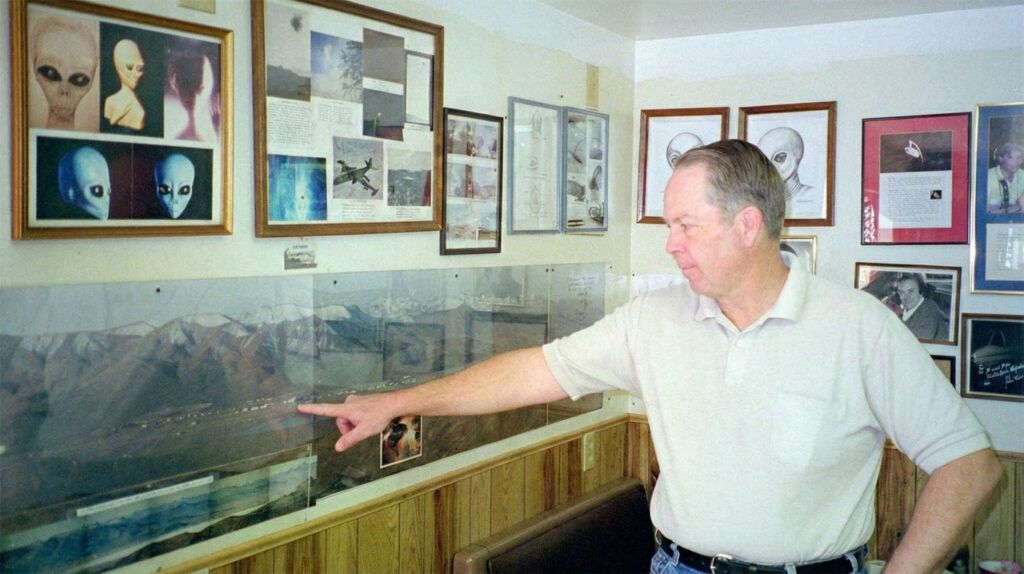
Once there, Clark slid almost naturally into the role of local skywatch guide. Articles in the Los Angeles Times and Washington Post describe him waiting on the roadside with a telescope for tour groups, pointing out Venus, the direction of the base, and recounting his latest sightings. (Los Angeles Times)
He also became a fixture at the Little A’Le’Inn, Rachel’s famous alien-themed bar and motel. Glenn Campbell, founder of the Area 51 Research Center and one of Clark’s most vocal critics, wrote in his zine The Groom Lake Desert Rat that Clark “hangs out at the Inn” and is presented as the in-house Area 51 expert. (Internet Archive)
From the perspective of UAP history, Clark’s relocation to Rachel marks the shift from “interested witness” to “embedded observer.” He was no longer just watching the sky; he was part of the ecosystem that grew up around Area 51 in the 1990s, where locals, tourists, media, and black-budget aviation collided.
The Area 51 & S-4 Handbook: field notes for the curious
Clark’s most tangible contribution to UAP culture is a spiral-bound guide titled The Area 51 & S-4 Handbook. The booklet is self-published, first appearing around 1995–1996 and running to about 58 pages. (Internet Archive)
The handbook offers maps, directions to viewing spots like “Mailbox Road,” safety guidance for staying on the legal side of the border, and commentary on what visitors might see. Copies were sold at the Little A’Le’Inn and occasionally change hands online today, including a 2009 updated edition with black-and-white photos and maps. (eBay)
In tone, Clark’s handbook fits into UAPedia’s “field manual” tradition. It does not try to prove a grand unified theory of UAP. Instead it teaches people how to be present on the ground in a liminal place. Where to park. Which ridge actually gives you a line of sight. Why you should treat the border signs like a tripwire.
A feud in the desert
The handbook also lands Clark in one of his earliest public controversies. Glenn Campbell, whose own Area 51 Viewer’s Guide preceded Clark’s work, accused the Little A’Le’Inn and Clark of producing a derivative “rip-off” guide and pirated souvenir patches without permission. In a 1995 issue of The Groom Lake Desert Rat, Campbell mockingly lists Clark as one of his “Top Ten Declared Enemies” and refers to him as a “daffy astronomer” who tells visitors that aliens are time travellers from our future. (Internet Archive)
It is important to note that these are Campbell’s characterisations, written in a deliberately satirical house style. They illustrate how the tiny ecosystem around Rachel could turn fractious, but they do not serve as neutral biographies. UAPedia treats such personal disputes as context rather than fact about the underlying phenomena.
For readers today, the more enduring point is that two competing, self-published field guides emerged from Rachel at the height of Area 51’s media moment. Clark’s Area 51 & S-4 Handbook has since been cited in academic and journalistic works on Dreamland and is remembered fondly by many visitors as part of the era’s material culture. (Internet Archive)
Watching the watchers: motion sensors and the federal case
If Clark’s handbook made him part of the tourist infrastructure, his next chapter collided directly with the security infrastructure.
Mapping the hidden surveillance ring
An essay in The Michigan Quarterly Review recounts what it calls “the cautionary tale of Chuck Clark.” It describes Clark as an aviation enthusiast and amateur astronomer who moved to Rachel for its dark skies, then became interested in the buried motion sensors that ring the public land around Area 51. (Quod Lib.)
Believing that such devices, when placed far out on public land, amounted to unlawful surveillance of citizens traveling legally, he began systematically finding and mapping them. He eventually estimated there were 75 to 100 sensors, some miles from the official boundary. (Quod Lib.)
To publicise what he had found, Clark brought a Las Vegas television crew to the desert and showed them several of the devices. Within a week, according to that same account, Air Force security personnel visited his trailer, seized his laptop and photographs, and the FBI interviewed him. (Quod Lib.)
The 2003–2005 prosecution
The legal consequences surfaced later. In 2003 federal prosecutors charged Clark, then 58, with “malicious interference with a communications system used for the national defense” after holding him responsible for the disappearance of one of the wireless motion sensors. (The Register)
According to reporting in The Register, Clark entered a one-year pretrial diversion agreement in early 2004. He agreed either to return the missing sensor or pay for it, and to meet other conditions. After he complied, prosecutors formally dismissed the case in January 2005. (The Register)
Friends quoted in later pieces find it hard to believe he would have deliberately stolen a sensor, interpreting the prosecution instead as punishment for exposing the surveillance network on national television. (Quod Lib.) In public, Clark has mostly declined to revisit the episode.
From a research analyst perspective, this episode is less about proving who removed a piece of hardware and more about documenting how aggressively the state can respond when civilians start instrumenting the environment around secret test sites. In line with our approach to government sources, we treat the indictment, press statements and dismissal as one stream of evidence, weighed against well-reported accounts from journalists and observers who were close to the case. (UAPedia)
The “1995 video”: holy grail or mirage?
Clark’s most debated UAP-related legacy is not something he filmed himself, but a VHS tape that passed through his hands in the mid 1990s and has remained stubbornly elusive ever since. In contemporary discourse it is often called “the 1995 video” or simply “the Chuck Clark tape.”
How the tape reached Clark
In a 2023 interview published on Medium, Clark explains that he received the video around 1995 from a cameraman at a major Hollywood-area network news bureau who had done a piece with him on Area 51 the year before. The cameraman had, in turn, obtained a copy from two acquaintances who went out to the base as tourists and captured something extraordinary near the famous “black mailbox” viewpoint. (Medium)
Clark agreed to evaluate the footage but promised not to copy or disseminate it. He says he kept that promise, allowing selected individuals to view the tape in person while refusing to release it publicly. (Medium)
What the footage allegedly shows
The tape, according to Clark’s description, is a typical mid-90s tourist video that hits all the usual spots: the original Extraterrestrial Highway sign at Crystal Springs, the junction near Rachel, the Groom Lake Road boundary with security guards on the hill, and exterior shots of the Little A’Le’Inn. The anomalous segment appears later that night as the tourists leave the inn and stop near the black mailbox. (Medium)
Clark estimates that about 45 seconds of the three-minute clip are truly compelling. He describes a luminous object nearly overhead, close enough that its light casts moving shadows inside the car as the occupants panic, whispering that they think they are going to die. (Medium)
He showed the tape to at least two friends who were NASA-connected engineers, including an engineer who had worked on the Saturn V program. Both reportedly felt the footage was probably genuine. (Medium)
Crucially, Clark argues that the state of computer graphics in the mid 1990s makes a sophisticated hoax unlikely outside a major studio environment. He notes the awkward, inconsistent camerawork and lack of clean edits as signs of genuine amateurs. (Medium)
Enter James Fox and Logan Paul
Documentary filmmaker James Fox has spoken publicly about seeing the tape in Clark’s presence and has described it as one of the most compelling pieces of UAP footage he has encountered, sometimes even calling it a potential “holy grail” of evidence. (BroBible)
In 2023 articles and social media debates, Fox recounts that YouTuber and boxer Logan Paul also visited Clark with UAP watchdog Royce Meyers, viewed the tape, and allegedly made a covert recording of it using hidden equipment. (Medium) Paul has since acknowledged seeing the tape and flirted with releasing his recording, though as of this writing no full, high-quality version has entered the public record.
The result is a kind of modern myth: a VHS tape locked in the possession of a desert astronomer, a documentary filmmaker who swears by it, an internet celebrity who may have smuggled out a copy, and a UAP community divided between anticipation and exasperation.
Skepticism and the problem of inaccessible evidence
Not everyone is impressed. Some commentators who have seen still frames or low-quality leaked snippets online consider the footage underwhelming and have accused those invoking it of hype or opportunism. (Reddit)
From an evidential standpoint, the tape occupies an awkward place in the UAP landscape. It is:
- Potentially instrumented, multi-minute footage of a luminous object displaying anomalous motion and close-range interaction effects.
- Vouched for by at least one seasoned UAP documentarian and two NASA-linked engineers, if Clark’s account is accurate. (Medium)
- Yet effectively non-existent to the research community because it has never been released in a form that allows independent analysis.
Claims taxonomy: the 1995 video
Claim type: Instrumental UAP evidence (video) held in private custody
- Primary claimant: Chuck Clark (custodian and evaluator)
- Supporting witnesses: James Fox; two unnamed NASA-linked engineers; various individuals who viewed the tape in Rachel; possibly Logan Paul via covert recording. (Medium)
- Evidence status: High potential evidential value but inaccessible for independent verification. No known chain-of-custody documentation.
- Assessment: “Unreleased instrumental dataset”. Not suitable as foundational proof, but highly relevant as a case study in how potentially important data can be trapped in private hands and transformed into story rather than analysis.
Sightings, philosophy, and a cautious take on abductions
Separate from the tape, Clark has his own observational record.
The Independent and Los Angeles Times both document a dramatic event he describes from early 1990s Rachel. He was watching near Highway 375 when he saw what looked at first like a descending flare over a ridge. The object then moved laterally approximately 4.8 miles in under two seconds, came to an instant stop, hovered about 20 feet above the ground, and then vanished without any audible sonic boom. (The Independent)
Clark interprets such craft as potentially “inter-dimensional” or “other dimensional,” possibly involving time travellers or beings operating from adjacent realities rather than classic extraterrestrials from a distant planet. (CBS News) This places him inside the broader UAP discourse that sees non-human intelligence as something more complex than a straightforward alien civilisation.
He also points out a geopolitical oddity that many Rachel observers echo. The airspace around Area 51 is among the most restricted on Earth. Yet these luminous craft seem to move freely through it with no visible interception. He infers that their presence is at least tolerated, perhaps coordinated, by whoever runs the range. (The Independent)
On abduction narratives, Clark is notably conservative. He has expressed skepticism toward people who claim elaborate contact experiences that include grandiose messages for humanity, saying that his “wacko flag” goes up when abductees present prophetic teachings. (The Independent) That places him closer to a physical-phenomena focus than to the “contactee” tradition.
Claims taxonomy: personal observations
Claim type: Close-range visual UAP encounters, single-witness and small-group, with unusual kinematics
- Events: 1957 daylight discs in California; later multi-object sightings; 1990s high-speed, silent object near Rachel. (The Independent)
- Observables: Hovering at low altitude, extreme acceleration, right-angle turns without inertia effects, absence of sonic boom.
- Evidence status: Testimonial only. No known photographs or instrument data from these specific events.
- Assessment: “High-interest anecdotal cases” that match kinematic patterns seen in better-instrumented incidents, but limited by lack of physical data.
Media appearances and public profile
Clark’s style is low-key and somewhat camera shy, yet he has appeared repeatedly in media narratives about Area 51 and UAP.
- Print and magazine features: He is quoted or profiled in the Los Angeles Times, the Independent, the Washington Post, CBS News online, Psychology Today, and regional papers covering Nevada’s rebranding of Highway 375 as the “Extraterrestrial Highway.” (The Independent)
- Documentary work: An IMDb entry lists a Chuck Clark credited in productions such as Where Are All the UFO’s? (1996) and UFOs: 50 Years of Denial? (1997). (IMDb) These align with the timeline when he was most active as a local expert.
- TV news segments: Clark mentions that the cameraman who gave him the 1995 tape had previously shot a network news piece with him about Area 51, focused on the base rather than explicitly on aliens. (Medium)
- Podcast and modern retellings: The Weaponized podcast with Jeremy Corbell and George Knapp has revisited his motion-sensor saga as a key example in the modern Storm Area 51 era, framing him as the man who mapped the invisible surveillance fence and paid the price. (Snipd)
Together these appearances form a consistent portrait: Clark as the quiet, technically minded local who knows every ridge and wash, provides context for visiting crews, and occasionally reveals that his personal experiences are wilder than the B-roll.
Work history and “ex-military” labels
The public record does not offer a detailed CV for Clark before Rachel. Most mainstream coverage simply calls him an aviation enthusiast and amateur astronomer. (Quod Lib.)
Some secondary sources describe him as former military personnel or even a former Air Force captain, and a Nevada tourism write-up for an Area 51 tour mentions an “ex-Air Force Captain Chuck Clark” as guide. (Travel Nevada) However, these claims have not yet been corroborated through independent documentation.
We therefore treats “ex-military” as a plausible but not fully verified element in his background. If accurate, it would add another layer of irony: a former insider turned civilian gadfly at the edges of a different secret program.
Controversies and points of contention
The guidebook rivalry
As noted earlier, Clark’s Area 51 & S-4 Handbook provoked strong resentment from Glenn Campbell, who saw it as derivative of his Area 51 Viewer’s Guide and accused Clark of helping the Little A’Le’Inn profit from pirated patches and replicated concepts. (Internet Archive)
- Impact: The spat illustrates the competitive, sometimes ego-driven nature of early civilian Area 51 research culture. It also underlines that Clark was influential enough in Rachel that rival researchers considered him a threat to their own brands.
- Our label: “Community-level controversy”, with minimal bearing on the objective reality of UAP but useful for understanding the social context of data collection.
The motion sensor case
Clark’s discovery and mapping of buried motion sensors led directly to a federal prosecution that could have ended with a felony conviction. (The Register)
- Government narrative: A sensitive communications device used to protect a national defence installation was stolen, and Clark was responsible, warranting serious charges. (The Register)
- Civilian narrative: Clark exposed a sprawling, arguably unlawful surveillance network on public land. The subsequent raid, seizure of equipment and prosecution look like an attempt to intimidate a high-profile critic rather than a measured reaction to an actual theft. (Quod Lib.)
Per our editorial approach, both narratives are recorded. The dismissal of the case after pretrial diversion is an uncontested fact. Whether the original allegation was proportionate or retaliatory remains in the interpretive zone. (The Register)
The ethics of withholding the 1995 tape
Clark’s decision not to release the 1995 video, despite its potential evidential value, has drawn criticism from within the UAP community. Some argue that his promise to the now-deceased intermediary should yield to the public interest. Others suggest that decades of teasing an unseen tape invites skepticism by default. (Medium)
Clark’s own position is clear: he sees his word of honour as binding and uses the unreleased details of the footage as a kind of shibboleth to filter out hoaxes. (Medium)
- Our label: “Custodial ethics controversy” rather than evidence fraud. There is no direct indication that Clark has fabricated the tape’s existence; plenty of corroborating witnesses say they have viewed something. The problem is that his custodial choice converts potential data into folklore.
Broader implications
Even without definitive proof attached to his name, Clark’s life in Rachel radiates out into several important themes in UAP studies:
- Civilian instrumented observation: His work demonstrates how much can be learned about a classified test range using consumer-grade optics, scanners and methodical fieldwork, long before drones and cheap high-resolution satellites. (Los Angeles Times)
- State-civilian friction: The motion-sensor case shows that when citizen sensing brushes against sensitive programs, the state can respond through criminal law rather than public dialogue. That tension is central to any honest conversation about UAP transparency and national security. (The Register)
- Custody of evidence: Clark’s stewardship of the 1995 tape illustrates how UAP evidence can be bottlenecked by trust, promises and personal ethics. In the age of smartphones and instant uploads, his story is a reminder of how much pre-internet data may still sit in boxes, attics and private vaults. (Medium)
In the larger UAP narrative, Chuck Clark is not a mass-sighting witness or a whistleblower for a crash retrieval program. He is something quieter and arguably just as important: a desert astronomer who refused to stop paying close attention, who mapped the invisible systems watching the watchers, and who still holds a piece of the puzzle that the rest of the community has yet to see in full.
Later printings and sales records indicate at least one updated spiral-bound edition in 2009 with photos and maps. (eBay)
Claims taxonomy
Below is a structured view of Clark’s main UAP-relevant claims and actions.
| Domain | Specific claim or action | Evidence type | Current evidential weight | UAPedia classification |
|---|---|---|---|---|
| Childhood sighting (1957) | Observed multiple small, silent discs intercepted by F-84 jets in California | First-person testimony reported decades later (The Independent) | Moderate (lifetime consistency but no contemporaneous record) | Anecdotal visual case with aviation corroboration (jets scrambled) |
| Rachel flare-turned-flyer | Object descended like a flare, then moved ~4.8 miles in under 2 seconds without sound, stopped instantly, later vanished | First-person testimony; echoed in multiple journalistic sources (The Independent) | Moderate | High-strangeness kinematics consistent with “six observables” profile |
| Inter-dimensional hypothesis | UAP near Area 51 may be inter-dimensional or time-shifted rather than purely extraterrestrial | Philosophical inference from observed performance and placement in restricted airspace (CBS News) | Low to speculative | NHI framework hypothesis, compatible with broader inter-dimensional models |
| Cooperation with military | Craft operating freely in restricted Groom Lake airspace imply at least tacit permission from U.S. authorities | Geopolitical inference based on restricted airspace norms (The Independent) | Low to moderate | “Cooperative UAP-military coexistence” hypothesis |
| Motion-sensor mapping | Extensive hidden sensor network (75–100 units) deployed on public land around Area 51 | Direct physical detection, mapping and on-camera demonstrations; indirectly corroborated by government prosecution that presupposes existence of such sensors (Quod Lib.) | High | Established example of large-scale surveillance of public access routes to UAP-linked facility |
| 1995 UAP tape | VHS recording of close-range UAP near Area 51; 45 seconds particularly compelling; likely authentic, not CGI for era | Private video seen by Clark, James Fox, NASA-linked engineers, Logan Paul and others; detailed verbal description; partial stills online (Medium) | Medium potential, low practical value until released | “Unreleased instrumental dataset” with unresolved authenticity; key lore node in modern UAP culture |
Speculation labels
Because UAPedia does not shy away from informed speculation, we can ask: if Clark’s experiences and actions are taken at face value, what are the possible long-term implications?
- Speculation label: “Unreleased keystone dataset”
If the 1995 tape is as good as some witnesses claim and is eventually released, it could become a keystone visual case from the pre-digital era, showing close-range UAP performance over a highly restricted military test range. Until then, it is a Schrödinger object: simultaneously legendary and unusable. - Speculation label: “Boundary walker between black-budget tech and non-human craft”
Clark spent years differentiating flares, stealth aircraft and experimental jets from genuinely anomalous objects above one of the world’s prime black-budget testing grounds. His testimony contributes to the argument that not all high-performance UAP near Area 51 can be written off as classified human technology, especially when they show silent, instantaneous accelerations that exceed performance envelopes of known aircraft of the era. (The Independent) - Speculation label: “Case study in state reaction to civilian sensing”
His motion sensor saga offers a vivid example of what can happen when a technically minded citizen begins to instrument and map a sensitive region on public land. From a future UAP transparency perspective, Clark’s experience might be seen as early evidence of the frictions that arise when grassroots sensing meets national security infrastructure. (Quod Lib.)
References
Graham, P. (1995, June 4). On the road to nowhere: “Extraterrestrial Alien Highway”. Los Angeles Times. (Los Angeles Times)
“For UFO buffs, the truth is out there on Highway 375.” (1995, December 25). Los Angeles Times. (Los Angeles Times)
“Nevada’s UFO heaven: Prying eyes look in on secret air base.” (1995, May 29). The Washington Post. (The Washington Post)
A town like Rachel. (1996, June 2). The Independent. (The Independent)
A night at the Little A’Le’Inn. (2000, May 3). CBS News. (CBS News)
Poulsen, K. (2005, January 28). Area 51 “hacker” charges dropped. The Register. (The Register)
“The passion of sheepdogs.” Michigan Quarterly Review. (Quod Lib.)
SignalsIntelligence. (2023, May 9). A conversation with Chuck Clark regarding the ‘1995’ video. Medium. (Medium)
Charles, D. (2023, May 3). Filmmaker says he has seen the “most compelling” UFO video ever, and Logan Paul has copy of it. BroBible. (BroBible)
Clark, C. (1996). The Area 51 & S-4 Handbook (1st ed., approx. 58 pp.). Rachel, NV: Chuck Clark. (Google Books)
SEO keywords
Chuck Clark, Chuck Clark Area 51, Chuck Clark biography, Area 51 & S-4 Handbook, Rachel Nevada UFO, Rachel Nevada UAP, Little A’Le’Inn, Extraterrestrial Highway UAP, 1995 Chuck Clark UFO video, holy grail UFO footage, James Fox Chuck Clark tape, Logan Paul UFO video, Area 51 motion sensors, Area 51 surveillance network, amateur astronomer Rachel Nevada, UAP near military bases, UAP video VHS, UAPedia Chuck Clark profile