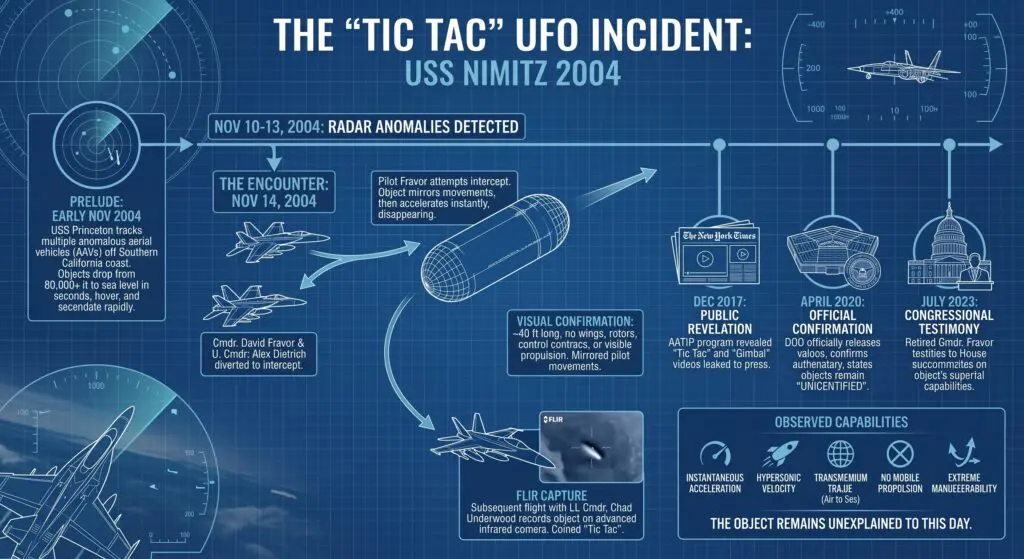
In November 2004, four naval aviators flying over the Pacific looked down at an area of disturbed white water and saw a smooth, white object moving above it.
Commander David Fravor later testified that, as he descended in a circular approach, the object changed its orientation, aligned itself with his aircraft and began climbing towards him. To Fravor, its movement appeared responsive.
The object did not speak, flash a greeting or transmit a decipherable message. Yet the encounter felt interactive because it seemed to react to his manoeuvre.
Fravor’s written testimony describes two F/A-18F aircraft carrying four aviators, a small white elongated object without visible wings or rotors, disturbed water beneath it, apparent movement in relation to his descent and a rapid departure. He was subsequently told that radar personnel had detected a contact near the combat air patrol point. (Fravor, 2023)
Ten years earlier, on a school playground in Ruwa, Zimbabwe, contact appeared to take a very different form.
On 16 September 1994, dozens of children at Ariel School reported seeing one or more unusual objects and figures beyond the school grounds. Several described an intense focus on the figures’ eyes. Some later reported that thoughts or images entered their minds without spoken language, often involving environmental destruction or concern about technological development.
Elsewhere, contact is reported as a voice seemingly heard inside the mind, a vivid dream with unusual continuity, paralysis accompanied by an intruder-like presence, automatic writing, a sensation of being observed, an image produced during remote viewing, or a light that appears after group meditation.
Some experiences begin with a visible UAP. Others contain no reported exterior object at all.
Calling every one of these experiences “contact” immediately creates a scientific problem. They may share motifs, interpretations and emotional effects, but they do not necessarily share a cause. A radar-associated observation, a childhood encounter, a sleep-transition episode and a trance communication cannot be investigated with one instrument or reduced to one explanatory model.
Contact is not a single claim. It is a research territory.
Contact is a research programme, not a verdict
A contact modality is the channel through which an interaction is reported to occur. The channel may be visual, auditory, tactile, neurological, dreamlike, telepathic, symbolic, technological or some combination of these.
“Modality” is useful because it describes how an experience appears to arrive without deciding in advance what produced it.
The first scientific task is to separate four questions that are frequently compressed into one.
The first question is whether a documentable event occurred. Was an object observed, an image recorded, a physiological reaction measured, a message written down or a witness interviewed? This level concerns records.
The second question is whether the person underwent a genuine experience. A person can sincerely experience paralysis, communication, presence, terror or altered time without the investigator yet knowing its cause. This level concerns phenomenology, psychology and physiology.
The third question is whether information or apparently responsive behaviour crossed a boundary. Did a UAP alter course in a way contingent upon an aircraft’s movement? Did an experimental participant describe concealed information above chance? Did a purported message contain specific facts unavailable through ordinary means? This level concerns contingency, information transfer and experimental controls.
The fourth question concerns causation. Was the event produced by human technology, an environmental process, a neurological state, a psychological mechanism, an unknown physical phenomenon, a non-human intelligence, or an interaction involving more than one of these?
These propositions are not interchangeable.
A witness may be sincere while mistaken about causation. A camera may record an object without showing that it is communicating. A statistically unusual experimental result may reveal an anomaly without identifying its mechanism. Even reproducible information transfer would not, by itself, establish who or what was responsible.
This layered approach does not weaken contact research. It protects its strongest evidence from conclusions that the evidence cannot yet support.
How contact claims are classified
A claim is classified as Verified when the specific underlying fact is established through accessible records, converging testimony, reproducible measurement or clearly documented publication. Verification of a report means that the report exists and was recorded. It does not automatically verify the witness’s interpretation of its cause.
A claim is classified as Probable when strong but incomplete evidence converges. For an apparently external UAP stimulus, this should ordinarily include independent witnesses or instruments, temporal synchronisation, reasonable exclusion of identified aircraft and astronomical objects, consideration of sensor artefacts, known measurement uncertainty and an adequate chain of custody.
A claim is Disputed when credible sources conflict, experimental controls are inadequate, interpretation depends heavily on inference, or the evidence does not distinguish between competing causes.
Legend applies to historical, cultural or religious narratives presented as traditions rather than independently verified events.
Misidentification applies when a reported anomaly has been convincingly reattributed to a known source.
Hoax applies when purposeful deception or manufactured evidence is established.
These labels apply to individual propositions rather than automatically to an entire case or witness. A case may contain a verified interview, a probable external stimulus, a disputed interpretation and a misidentified detail.
From Hynek to the sensor era
Astronomer J. Allen Hynek developed the original close-encounter classification to organise reports by proximity and observable effects.
A close encounter of the first kind concerned a nearby visual observation. A second-kind encounter included reported physical or electromagnetic effects. A third-kind encounter included reported occupants or entities.
The categories were descriptive. They did not identify the origin of the phenomenon.
Close encounters of the fourth and fifth kinds were later additions and have never been completely standardised. The fourth kind became associated with reported abduction or forced transport.
The Center for the Study of Extraterrestrial Intelligence, founded by Steven Greer in 1990, used “close encounter of the fifth kind” for deliberate human attempts to establish communication with what the organisation interpreted as extraterrestrial intelligence. Greer’s publications and later documentary work helped popularise this contemporary meaning, which commonly involves meditation, mental visualisation, structured tones, group intention and observation of the night sky.
That meaning was not part of Hynek’s original system. Researchers must therefore specify which version they are using. The distinction is explored further in CE-1 to CE-5: Contact Protocols and Typologies.
Academic engagement with UAP declined substantially following the University of Colorado study directed by physicist Edward Condon. The 1968 report concluded that further extensive investigation was unlikely to contribute significantly to science.
Atmospheric physicist James E. McDonald challenged that conclusion. He argued that several cases discussed within the Colorado study remained scientifically difficult and that the report’s broad verdict did not adequately reflect all of its own case material.
The disagreement concerned a recurring problem in UAP research: how unresolved evidence should influence future investigation.
In 1997, a workshop organised by Stanford physicist Peter Sturrock examined physical evidence associated with selected UAP reports. Its panel did not find convincing proof of extraterrestrial intelligence or violations of known natural laws. It nevertheless concluded that some reports involving physical evidence deserved careful study and that scientifically acquired new data could be valuable.
“The evidence does not establish an extraordinary cause” is not the same statement as “there is nothing worth investigating.”
The NASA Unidentified Anomalous Phenomena Independent Study Team Report, published in 2023, did not investigate telepathy, abduction, channeling or consciousness-mediated contact. Its relevance lies in its methodology.
NASA identified poor sensor calibration, incomplete metadata, inadequate baseline information and a lack of multiple or corroborating measurements as central barriers to analysis. It recommended systematic reporting, improved data collection and efforts to reduce the stigma surrounding reports.
NASA is not the final authority on the identity or origin of UAP. Its report is useful because it identifies weaknesses that also affect civilian and consciousness-oriented contact research.
The Galileo Project’s paper, The Scientific Investigation of Unidentified Aerial Phenomena Using Multimodal Ground-Based Observatories, proposes optical, infrared, acoustic, radio-frequency, radar and environmental monitoring designed to collect data under scientific control.
The observatory concept emphasises multispectral instruments, independent sensor modalities and methods for recognising artefacts.
Neither NASA’s study nor the Galileo observatory paper establishes consciousness-mediated contact. Both provide part of the infrastructure needed to test it.
The other part is measurement of the human participant.
Case study: Nimitz and apparent responsive motion
The 2004 USS Nimitz encounter is not usually classified as a contact event. No spoken message, telepathic exchange or entity was reported.
Its relevance lies in the simplest possible contact modality: apparent behavioural reciprocity.
In his congressional statement, Fravor described seeing a white elongated object moving above disturbed water. As he descended in a circular manoeuvre, he reported that the object pointed towards his aircraft and appeared to mirror his descent before climbing. When he attempted to intercept it more directly, the object accelerated away.
Fravor later said he was informed that a contact had appeared near the prearranged combat air patrol point. (Fravor, 2023)
His testimony is important evidence. He was an experienced military aviator, three other aviators were involved, and the event occurred within a broader operational and reported sensor context.
It is not the complete evidential record.
The full raw radar data, system configuration, calibration information, atmospheric measurements and complete platform telemetry required for independent reconstruction have not been made publicly available.
The contact-like feature is not simply the object’s reported speed. It is a contingency. Fravor changed his flight path, and the object appeared to change its behaviour in relation to him.
That creates an inference of agency, but apparent contingency must be measured rather than merely experienced.
An unknown object might seem responsive because of perspective, coincidental motion, autonomous navigation, deliberate control, sensor geometry or incomplete situational awareness. Distinguishing those possibilities would require synchronised trajectories from several platforms, uncertainty estimates, aircraft telemetry, radar configuration records and a predefined criterion for what counts as a response.
The scientific question is not simply, “Did it look intelligent?”
It is, “Was the object’s behaviour physically and statistically contingent upon the aircraft’s behaviour?”
That reformulation turns a powerful witness impression into a testable proposition without stripping the account of what makes it unusual.
Case study: Ariel School and the science of meaning
The Ariel School encounter presents an almost opposite evidential configuration.
No publicly available radar record, calibrated image or physical sample establishes what was present near the school grounds. The case’s importance rests on collective testimony, drawings, emotional response and reported message-like experience.
The reported event occurred on 16 September 1994 during a school break. Teachers did not witness the central episode.
BBC Zimbabwe correspondent Tim Leach visited Ariel School on 19 September and filmed interviews with pupils and members of staff. UAP investigator Cynthia Hind visited the following day, interviewed children and asked them to produce drawings of what they recalled seeing.
The surviving Leach footage and Hind material are among the earliest available records. They establish that children described unusual objects, figures, prominent eyes and abnormal movement. They do not show that every child gave an identical account or that all pupils present reported seeing the same thing.
The provenance of the drawings requires care. Images attributed to Ariel pupils have been reproduced repeatedly in documentaries, books and online collections. Researchers should distinguish original sheets, contemporary copies, later reproductions and images whose custody cannot be reconstructed.
Psychiatrist John E. Mack and researcher Dominique Callimanopulos visited the school in November 1994, approximately two months after the reported event.
Callimanopulos wrote that they interviewed twelve children over two days. Her account appeared in the Spring/Summer 1995 issue of CenterPiece. (Callimanopulos, 1995)
A 2008 retrospective newspaper report hosted by the John E. Mack Institute also states that Mack visited the school and filmed interviews in November 1994. (Coan, 2008)
The chronology matters because the environmental-message material is especially associated with Mack’s later interviews.
Several of the children he interviewed described thoughts or images involving pollution, damaged trees, technological danger or a troubled future. Not every child reported such impressions, and the descriptions were not identical.
The environmental theme should therefore be presented as testimony from a subset of witnesses rather than as a message independently verified as having been transmitted by the reported figures.
Retrospective interviews show that the event remained meaningful to many witnesses for decades. They provide evidence of enduring memory and impact, not independent confirmation of every detail recorded in 1994.
The 2023 documentary series Encounters included a former pupil, Dallyn Vico, who alleged that the episode began when he described a distant shiny rock as an unusual object. The programme also included witnesses who continued to affirm that they had observed an extraordinary event. Vico’s account conflicts with other testimony and has not been independently demonstrated as the origin of the wider incident. It therefore remains disputed. (Netflix, 2023; VICE, 2023)
The most defensible conclusion is that a substantial group of children reported a striking event and that it had a lasting effect on many of them.
It is reasonable to conclude that many were responding to a shared stimulus or shared episode rather than independently creating unrelated narratives. The nature of that stimulus remains disputed.
The claim that a non-human intelligence transmitted an environmental warning is a witness interpretation supported by some testimony. It is not a verified causal finding.
Ariel demonstrates why contact investigations need three records created as early as possible: an independent statement from each witness, an objective environmental record and a separate account of the meanings each witness assigns to the event.
When these layers are blended, later investigators cannot reliably determine whether a motif originated during the experience, through group discussion, during questioning or over years of reflection.
Further context is available in Ariel School Encounter, Zimbabwe, 1994: A Dossier and Encounters Suggestive of Non-Human Intelligence.
Memory, sleep and the clinical laboratory
Contact experiences often arrive with extraordinary emotional force. That force matters clinically, but it does not establish external causation.
John E. Mack’s major contribution was to argue that people reporting extraordinary encounters should not automatically be treated as deceptive or psychotic.
He described being impressed by the consistency, sincerity, emotional intensity and self-doubt of many experiencers he interviewed. Mack eventually proposed that some encounters might involve physical, psychological and spiritual dimensions.
That was Mack’s interpretation. It was not an institutional conclusion of Harvard University or a settled finding of psychiatry.
The narrower clinical lesson is better supported: unusual testimony should be approached without ridicule, and the absence of obvious psychosis neither proves nor disproves an external event.
Experimental psychologists Susan Clancy, Richard McNally and their colleagues investigated mechanisms relevant to some abduction and contact memories.
In a 2002 laboratory study, participants who reported recovered or repressed memories of alien abduction displayed greater false recall and false recognition in a word-list task than control participants.
The result documented a group difference in one sample and one memory paradigm. It did not demonstrate that every autobiographical event reported by every participant was false. (Clancy et al., 2002)
A 2004 study measured heart rate, skin conductance and facial muscle responses while participants listened to scripts describing their reported encounters and other emotional experiences.
Participants showed strong physiological responses to the abduction scripts. The result demonstrated that recollections of highly improbable events can carry intense and measurable emotional reality. It did not establish the external truth of those memories. (McNally et al., 2004)
McNally and Clancy also examined the relationship between sleep paralysis and alien-abduction reports.
During sleep paralysis, a person may regain waking awareness while rapid-eye-movement muscle inhibition remains active. Dream imagery can intrude into the waking state, producing a sensed presence, pressure, figures in the room, buzzing sounds, fear, apparent bodily restraint or levitation sensations.
Sleep paralysis and related hypnagogic or hypnopompic phenomena plausibly explain some bedroom-based contact reports.
They do not, by themselves, explain independently recorded objects, prolonged daytime events or multi-witness encounters. That limitation does not make such cases extraordinary by default. It simply defines the range of experiences to which sleep paralysis is relevant.
Hypnotic regression requires similar caution.
Research on forensic hypnosis has found a trade-off between the quantity of information recalled and its reliability. Hypnosis and suggestive questioning can increase the production of details and confidence in recollections without ensuring that those details are historically accurate. Once confidence has increased, witnesses and investigators may find it difficult to distinguish accurate recall from plausible confabulation. (Wagstaff, 2008)
Material recovered only through hypnosis should therefore be separated from conscious pre-hypnosis memory. Investigators should preserve the original account, record complete sessions, identify leading questions and seek corroboration that does not depend on the regression narrative.
A humane scientific approach can hold two ideas simultaneously.
Memory is reconstructive and vulnerable to influence.
Experiencers may also be reporting sincere, life-altering events that deserve careful investigation.
Neither statement cancels the other.
What experiencer surveys establish
One of the largest published surveys of people identifying as contact experiencers was conducted by the Dr. Edgar Mitchell Foundation for Research into Extraterrestrial and Extraordinary Experiences, commonly known as FREE.
The study comprised two survey phases containing 554 questions in total. Phase 1 included 3,256 participants, while Phase 2 included 1,919 participants who had also completed Phase 1. Results derived from the second phase therefore describe a smaller subset rather than all 3,256 initial respondents. (Hernandez et al., 2018)
Participants described physical and non-physical encounters, apparent telepathy, out-of-body states, thoughts or voices attributed to NHI, observations of unusual craft and changes in worldview.
Depending on the subgroup and question analysed, approximately one-half to three-fourths of respondents described a positive impact, while roughly 15 to 20 percent reported negative effects.
Many respondents described increased concern for others, reduced materialism, greater interest in spirituality or a changed sense of human identity. Respondents also reported non-physical modalities, sometimes more frequently than conventional onboard-abduction narratives.
These findings matter because impact is data.
Researchers can study changes in relationships, anxiety, sleep, social functioning, religious outlook and identity even when the cause of an experience remains unknown.
A reported contact event that reorganises a person’s life is socially and clinically consequential whether its source is external, neurological, symbolic or mixed.
The FREE survey does not establish that NHI caused the experiences.
Participants were recruited from a population already identifying with contact experience. The sample was self-selected, was not representative of the general population, relied upon self-report and did not include objective personality assessment.
The appropriate interpretation is neither dismissal nor proof.
The study maps reported phenomenology and impact within a targeted experiencer population. It is useful for generating hypotheses and designing future research. It is not a population-prevalence study and does not authenticate the identity of perceived communicators.
A stronger future study would recruit experiencers and matched controls, use validated psychological and sleep measures, collect relevant medical histories, record experiences prospectively and repeat assessments over several years.
Where participants expect recurring contact, researchers could combine diaries and wearable physiological sensors with environmental monitoring. Investigators could then examine whether reported episodes cluster around sleep transitions, physiological arousal, unusual electromagnetic events, identifiable aircraft, satellite passes or independently recorded aerial anomalies.
Remote viewing and anomalous information
Remote viewing enters contact research through the claim that information can sometimes be obtained without ordinary sensory access.
It does not require a visible UAP and should not automatically be equated with communication from NHI. It remains relevant because many contact modalities involve images, impressions or apparent knowledge that witnesses believe arrived through non-sensory channels.
The most frequently cited official review is the 1995 American Institutes for Research evaluation of the U.S. government-sponsored remote-viewing programme associated with Stargate.
Statistician Jessica Utts and psychologist Ray Hyman reviewed portions of the laboratory record. Both recognised statistical departures in parts of that record, while disagreeing sharply over whether the findings established anomalous information transfer.
Utts argued that the cumulative evidence supported an anomalous effect. Hyman maintained that statistical departures did not establish remote viewing as the cause and that methodological alternatives had not been adequately eliminated.
The overall evaluation acknowledged unusual laboratory findings but concluded that their cause had not been established. It also found that operational reports were generally too vague, inconsistent and dependent on subjective interpretation to provide reliable, actionable intelligence. (American Institutes for Research, 1995)
This disagreement offers a useful model for contact research.
“A statistical effect was observed” is not identical to “remote viewing exists exactly as described.”
Neither statement establishes that the source was NHI.
A rigorous experiment involving apparent telepathic contact would require concealed target information, random selection, protection against sensory leakage, recording before feedback, independent judging and prespecified scoring.
Every trial, including failures, would need to be retained.
The strongest evidence would not be a poetic statement that appears meaningful only after interpretation. It would be specific, low-probability information obtained repeatedly under conditions that block ordinary access.
Trance, automatic writing and the source problem
Channeling and automatic writing are often dismissed because they are subjective. Yet subjective experiences can have measurable physiological and neurological correlates.
A 2012 PLOS ONE study examined ten Brazilian practitioners of psychography, a form of automatic writing. Five were highly experienced and five were less experienced.
Researchers used single-photon emission computed tomography to measure regional cerebral blood flow during trance writing and ordinary writing.
The experienced practitioners showed reduced activity in several brain regions during trance, even though their texts were rated as more complex than their control writing. (Peres et al., 2012)
The study was extremely small and culturally specific. Its results require replication in larger and more diverse samples.
The finding suggests that practised trance can involve a distinctive cognitive state. It does not establish that an external entity authored the text.
Neural measurement can characterise how an experience is implemented in the brain. It does not necessarily identify the source of the information experienced.
Every ordinary perception also has a neural correlation. Finding brain activity does not prove that an experience is imaginary. Finding unusual brain activity does not prove that an external intelligence is present.
A stronger channeling experiment would assess both state and content.
Researchers could record electroencephalography, heart-rate variability, respiration and speech timing while independently evaluating whether the communication contains accurate information unavailable to the participant.
The most persuasive targets would be facts unknown to both the participant and the supervising researcher, secured against ordinary access and scored by blinded judges.
Meaningful philosophy, emotional comfort and literary complexity may be important outcomes. They are not source authentication.
Human-initiated contact as an experimental claim
Contemporary CE-5 groups attempt to initiate interaction rather than wait for it.
Practices vary, but commonly include meditation, emotional coherence, visualisation of one’s location, tones, group intention and sustained observation of the night sky.
Steven Greer and CSETI played a prominent role in defining and promoting CE-5 as deliberate human-initiated contact. Greer’s later publications, training expeditions and the 2020 documentary Close Encounters of the Fifth Kind: Contact Has Begun extended the term to a much wider audience.
This establishes a history of the terminology and its promotion. It does not establish that the proposed procedure produces external contact.
Participants sometimes report lights that brighten, change direction, appear after a request or repeat a pattern.
The central scientific claim is causal: an intentional human procedure caused or influenced an external event.
That claim has not been established through a substantial public record of preregistered, independently replicated controlled experiments.
This does not establish that the method is ineffective. It means the available public evidence usually cannot distinguish a genuine response from aircraft, satellites, meteors, atmospheric effects, camera artefacts, coincidence, expectation or selective reporting.
The design problem is straightforward.
A group enters the field expecting contact and scans a complex night sky. When an unusual light appears, the night is remembered and shared. When nothing appears, the null session may never be published.
A light that brightens after a spoken request is treated as a successful response, but unsuccessful requests are rarely included in the denominator.
A credible experiment would reverse that structure.
The protocol would be registered in advance. It would specify observation dates, active and control periods, predicted response types, sensor settings, exclusion criteria and the statistical definition of success.
Some sessions would use the complete contact procedure. Others would use a neutral or sham procedure. Session order would be randomised. Analysts reviewing the data would remain blind to which sessions involved the active protocol.
Each site would use synchronised visible-light and infrared cameras with calibrated fields of view. Where feasible, the network would add passive radio-frequency monitoring, magnetometers, acoustic recording, weather data and passive radar.
Aircraft transponder records, satellite trajectories, launches and astronomical events would be logged.
Original files, timestamps and metadata would be preserved.
Subjective and objective endpoints would be recorded separately. A participant’s sense of presence, mental image or internally perceived message would be a subjective endpoint. A time-correlated unexplained track recorded by independent instruments would be an objective endpoint.
Both could be studied. They answer different questions.
Most importantly, all sessions would be published.
Three remarkable sessions among five trials would be very different from three remarkable sessions among five hundred. Without the complete denominator, a collection of striking videos cannot demonstrate causation.
Sky-directed lasers should not be used. Illuminating an aircraft or its flight path creates a serious aviation hazard and may constitute a criminal offence. Passive observation and aviation-safe methods remove an unnecessary risk. See 18 U.S.C. § 39A.
A properly controlled trial might produce a null result. That would still improve the field by identifying common misinterpretations and clarifying whether outcomes depend upon particular conditions.
A positive result replicated at independent sites would carry far more evidential weight than an isolated clip.
The witness and environment must be studied together
Traditional UAP investigations point instruments towards the sky.
Traditional consciousness studies point instruments towards the participant.
Contact research requires both.
Imagine that a participant reports a sudden internal image at 10:43 p.m. At the same moment, an infrared camera records an object, a magnetometer registers a transient change and two distant observers independently identify the same direction.
That time-locked convergence would be more significant than either the subjective report or sensor event alone.
The inverse would also be informative.
If reported contacts repeatedly occurred during rapid-eye-movement transitions, sleep deprivation or predictable dissociative states, this would strengthen certain neurological interpretations. If effects clustered around identifiable aircraft or satellites, attribution would improve.
If no environmental correlate appeared, the experience might remain psychologically real while its externality remained unverified.
The ideal research unit is not simply the witness or the object.
It is the coupled system of witness, environment, instruments, timing and context.
Contact research can therefore draw from neuroscience, sleep medicine, anthropology, clinical psychology, atmospheric science, information theory, aviation analysis and sensor engineering.
No single discipline can measure every layer.
Safety and ethics are part of the evidence
Contact practices are often presented as harmless meditation. For many participants they may be calming, meaningful or socially supportive.
Intensive contemplative practices can nevertheless produce difficult experiences, including anxiety, altered perception, disturbed sleep, changes in self-experience and impaired functioning.
The Varieties of Contemplative Experience study identified 59 categories across seven domains: cognitive, perceptual, affective, somatic, motivational, sense of self and social. Reported effects ranged from brief and manageable to severe and lasting. (Lindahl et al., 2017)
This evidence comes from research involving Western Buddhist practitioners and meditation-related challenges. It did not investigate CE-5 groups or UAP contact protocols.
Its relevance is indirect and ethical rather than diagnostic. Practices involving prolonged meditation, altered attention, sleep disruption or intense expectation should not be assumed to be risk-free merely because they are described as spiritual.
Contact-group participants should receive clear information about possible emotional effects. Facilitators should not guarantee contact, assign cosmic identities, encourage dependency or tell distressed participants that every frightening experience proves hostile interference.
Persistent insomnia, panic, paranoia, severe fear or loss of ordinary functioning should prompt a pause in the practice and access to qualified clinical support.
Privacy is equally important.
Reports may include medical history, trauma, sexuality, religious belief, military service or allegations involving relatives. Consent to participate in a study is not automatic consent to public identification.
Children require particularly strict safeguards. They should be interviewed individually, promptly and with neutral language. Investigators should not show them other witnesses’ drawings before documentation, reward extraordinary answers or repeatedly ask questions that assume entities, craft or messages.
Ethics is not an obstacle to discovery. It improves evidence by reducing pressure, suggestion and dependency.
Where the real controversy sits
The deepest argument is often presented as a choice between an external event and an internal event.
That division may be too simple.
A real external anomaly could produce sleep disruption, fear, symbolic dreams and psychological transformation. A neurological event could be interpreted through UAP imagery. A person might observe an ordinary aerial light while simultaneously entering a profound altered state.
Should a responsive external intelligence exist, it might theoretically interact through sensory channels, technology, cognition or several modalities at once.
These possibilities cannot be distinguished by declaring that every experience is purely mental or that every intense experience is externally caused.
The sensor-first position is correct that major causal claims require independent measurement, controls and replication.
The experiencer-centred position is correct that consciousness, physiology, meaning and long-term transformation are part of the reported phenomenon rather than irrelevant noise.
The productive scientific position combines them.
Testimony presents another controversy.
Witness evidence is vulnerable to perception errors, memory reconstruction and social influence. It is not therefore worthless.
Aviation investigations, courts, medicine and accident inquiries routinely assess testimony by examining opportunity to observe, consistency, expertise, motivation, timing and corroboration.
UAP research should do the same.
The choice is not between believing every witness and discarding every witness. It is between disciplined evaluation and reflexive judgement.
Reducing stigma does not mean suspending analysis. It means making honest reporting safer so that analysis has better material.
Implications: What would count as a breakthrough?
The first major breakthrough may not be proof of NHI.
It may be a reliable method for separating contact modalities.
A validated clinical instrument might distinguish common sleep-transition experiences from prolonged waking encounters without dismissing either. A prospective registry could show which experiences recur, how they affect health and whether they coincide with instrumented UAP activity.
A controlled anomalous-information experiment could determine whether information transfer exceeds chance. A multisite initiated-contact trial could test whether intentional procedures alter the rate or behaviour of unexplained aerial events.
Negative results would matter. They would narrow the field, reduce false attribution and protect experiencers from exaggerated promises.
A reproducible positive result would carry much greater implications.
Demonstrated anomalous information transfer would challenge existing models of perception and communication. A repeated correlation between human intention and independently recorded UAP behaviour would raise questions about agency, cognition and interaction.
Confirmation that an external non-human intelligence was participating would affect neuroscience, astrobiology, law, religion, diplomacy, national security and ethics.
That is precisely why the evidential standard must remain high.
The goal is not to make the mystery disappear.
It is to make the evidence strong enough that the mystery no longer depends upon allegiance to a worldview.
Claims Taxonomy
Verified
It is verified that witnesses have reported multiple proposed contact modalities, including apparent responsive movement, entity encounters, telepathic impressions, trance communication, remote viewing, sleep-related intruder experiences and deliberate contact attempts. This verifies the existence of documented reports, not the causes attributed to them.
It is verified that David Fravor submitted first-hand written testimony describing the 2004 Nimitz encounter, including four aviators, a white elongated object, disturbed water and motion he interpreted as responsive.
It is verified that dozens of Ariel School pupils reported an unusual event and that a subset later described message-like impressions. This verifies the documented testimony and its broad content, not the identity of the figures or an external source for the impressions.
Laboratory and clinical research has documented elevated false-memory susceptibility in one recovered-memory sample, strong physiological responses in another sample, and sleep-paralysis phenomena capable of producing some abduction-like experiences. These findings apply to the studied samples and mechanisms. They do not establish one unified explanation for the contact-experiencer population.
It is verified that the FREE project’s first survey phase recorded responses from 3,256 participants and that its second phase included 1,919 participants who had completed the first phase. This verifies what respondents reported, not that NHI caused their experiences.
It is verified that many respondents in self-selected experiencer surveys report durable psychological, spiritual or social change. The prevalence of such change across the wider experiencer population is unknown.
It is verified that the 1995 AIR remote-viewing evaluation identified statistical departures in parts of the laboratory record while concluding that the cause was unestablished and the operational output was not reliably actionable.
It is verified that NASA and Galileo Project researchers have advocated calibrated, metadata-rich and multimodal observation as foundations for serious UAP study.
Probable
It is probable that some prominent UAP encounters involve an objective external stimulus when the evidence includes independent witnesses or instruments, temporal synchronisation, reasonable exclusion of identified sources, consideration of sensor artefacts, measurement uncertainty and an adequate chain of custody.
Whether any particular case satisfies this standard must be assessed individually.
Disputed
Telepathic communication between humans and NHI remains disputed.
The claim that human intention or CE-5 procedures cause UAP to appear or respond remains disputed, what would settle this to probable would be to have controlled experiments performed by an independent credible third-party.
The external origin of the environmental impressions reported by some Ariel School witnesses remains disputed.
The existence and mechanism of remote viewing remain disputed despite statistical anomalies in portions of the research record.
The claim that channeling or automatic writing transmits information from an independent external intelligence remains disputed.
Literal external interpretations of abduction narratives, particularly information recovered mainly through hypnosis, remain disputed.
Legend
Ancient, religious and folkloric accounts of sky beings, visionary journeys and divine communication should be presented as cultural or religious narratives unless independent evidence connects them to a specific modern UAP mechanism.
Their research value lies in comparative motifs, historical continuity and human meaning, not automatic technological identification.
Misidentification
Some reported contact events can be attributed to sleep paralysis, dream intrusion, suggestive interviewing, aircraft, satellites, rocket activity, astronomical objects, atmospheric lights, camera artefacts or expectation-driven interpretation.
A demonstrated explanation should be applied to the event it explains. It should not be expanded into a universal explanation for dissimilar cases.
Speculation Labels
Hypothesis
Some contact events may be coupled phenomena in which an external anomaly and an altered state of consciousness occur together.
In this model, sensor effects, unusual perception, telepathic impressions and later transformation would be different expressions of one interaction rather than mutually exclusive explanations.
Testing this hypothesis would require prospective monitoring of recurring experiencers, synchronised environmental sensors, physiological measurement and preregistered criteria for time-locked correlation.
Available evidence does not establish this model.
Witness Interpretation
Fravor interpreted the Nimitz object’s motion as responsive and technologically extraordinary.
Several Ariel School witnesses interpreted internally perceived images as communication from the figures they reported seeing.
FREE survey respondents attributed voices, thoughts and apparent telepathic exchanges to NHI.
These interpretations are important testimony. The identity and intention of the perceived source have not been independently demonstrated.
Researcher Opinion
The most promising approach is dual-track contact science.
One track instruments the external environment.
The other documents perception, physiology, cognition and impact.
Research combining witness testimony, clinical assessment and environmental instrumentation is likely to discriminate between competing explanations more effectively than any single method, but this remains a methodological judgement rather than an established evidentiary probability.
Neither track should overrule the other before the records are synchronised and compared.
Contact is best treated as an anomalous-interaction problem rather than merely a category of belief.
References
American Institutes for Research. (1995). An evaluation of remote viewing: Research and applications. https://nsarchive2.gwu.edu/NSAEBB/NSAEBB438/docs/doc_57.pdf
Callimanopulos, D. (1995, Spring/Summer). Exploring African and other alien encounters. CenterPiece, 10–11. https://johnemackinstitute.org/1995/03/exploring-african-and-other-alien-encounters/
Clancy, S. A., McNally, R. J., Schacter, D. L., Lenzenweger, M. F., & Pitman, R. K. (2002). Memory distortion in people reporting abduction by aliens. Journal of Abnormal Psychology, 111(3), 455–461. https://doi.org/10.1037/0021-843X.111.3.455
Coan, S. (2008, April 16). The day the aliens landed. The Witness. https://www.johnemackinstitute.org/images/2008_0416_TheWitness_Ariel_School.pdf
Condon, E. U. (Ed.). (1968). Scientific study of unidentified flying objects. University of Colorado.
Fravor, D. (2023). Statement before the U.S. House Committee on Oversight and Accountability. https://oversight.house.gov/wp-content/uploads/2023/07/David-Fravor-Statement-for-House-Oversight-Committee.pdf
Greer, S. M. (1999). Extraterrestrial contact: The evidence and implications. Crossing Point Publications.
Greer, S. M. (Presenter). (2020). Close encounters of the fifth kind: Contact has begun [Film]. 1091 Pictures.
Hernandez, R., Davis, R., Scalpone, R., & Schild, R. (2018). A study on reported contact with non-human intelligence associated with unidentified aerial phenomena. Journal of Scientific Exploration, 32(2), 298–348. https://doi.org/10.31275/2018.1282
Hind, C. (1996). UFOs over Africa. Horus House Press.
Hynek, J. A. (1972). The UFO experience: A scientific inquiry. Henry Regnery Company.
Leach, T. (Reporter). (1994, September 19). Ariel School witness interviews [Television news recording]. BBC Zimbabwe.
Lindahl, J. R., Fisher, N. E., Cooper, D. J., Rosen, R. K., & Britton, W. B. (2017). The varieties of contemplative experience: A mixed-methods study of meditation-related challenges in Western Buddhists. PLOS ONE, 12(5), e0176239. https://doi.org/10.1371/journal.pone.0176239
Mack, J. E. (1994). Abduction: Human encounters with aliens. Scribner.
McDonald, J. E. (1969). Science in Default: Twenty-Two Years of Inadequate UFO Investigations. Paper presented at the American Association for the Advancement of Science symposium. https://kirkmcd.princeton.edu/JEMcDonald/mcdonald_aaas_69.pdf
McNally, R. J., & Clancy, S. A. (2005). Sleep paralysis, sexual abuse, and space alien abduction. Transcultural Psychiatry, 42(1), 113–122. https://doi.org/10.1177/1363461505050715
McNally, R. J., Lasko, N. B., Clancy, S. A., Macklin, M. L., Pitman, R. K., & Orr, S. P. (2004). Psychophysiological responding during script-driven imagery in people reporting abduction by space aliens. Psychological Science, 15(7), 493–497. https://doi.org/10.1111/j.0956-7976.2004.00707.x
National Aeronautics and Space Administration. (2023). Unidentified anomalous phenomena independent study team report. https://science.nasa.gov/wp-content/uploads/2023/09/uap-independent-study-team-final-report.pdf
Netflix. (2023). Believers. In Encounters [Television series, Season 1, Episode 2]. Amblin Television, Boardwalk Pictures, and Vice Studios. https://www.netflix.com/title/81489034
Peres, J. F. P., Moreira-Almeida, A., Caixeta, L., Leão, F., & Newberg, A. (2012). Neuroimaging during trance state: A contribution to the study of dissociation. PLOS ONE, 7(11), e49360. https://doi.org/10.1371/journal.pone.0049360
Sturrock, P. A., et al. (1998). Physical evidence related to UFO reports: The proceedings of a workshop held at the Pocantico Conference Center, Tarrytown, New York, September 29–October 4, 1997. Journal of Scientific Exploration, 12(2), 179–229.
Tung, L. (2023, October 23). Documentary explores the UFO sighting that changed the course of 62 children’s lives. WHYY, The Pulse. https://whyy.org/segments/documentary-explores-the-ufo-sighting-that-changed-the-course-of-62-childrens-lives/
VICE. (2023, October 4). A 1994 UFO sighting by children changed lives. What if one kid made it up? https://www.vice.com/en/article/encounters-netflix-zimbabwe-ufo-sighting/
Wagstaff, G. F. (2008). Forensic hypnosis. In M. R. Nash & A. J. Barnier (Eds.), The Oxford handbook of hypnosis: Theory, research, and practice (pp. 517–550). Oxford University Press. https://hull-repository.worktribe.com/output/439049/forensic-hypnosis
Watters, W. A., et al. (2023). The scientific investigation of unidentified aerial phenomena using multimodal ground-based observatories. Journal of Astronomical Instrumentation, 12(1), 2340006. https://doi.org/10.1142/S2251171723400068
SEO keywords
scientific perspectives on contact modalities, UAP contact research, contact and abduction experiences, contact modality science, CE-5 scientific evidence, human-initiated contact research, telepathic communication claims, UAP and consciousness, Ariel School encounter, USS Nimitz responsive UAP, David Fravor testimony, John Mack experiencer research, FREE contact survey, remote viewing research, Stargate evaluation, channeling neuroscience, automatic writing research, trance brain imaging, sleep paralysis and contact, abduction memory research, hypnotic regression memory accuracy, UAP witness testimony, anomalous information transfer, meditation contact protocols, UAP multimodal sensors, Galileo Project UAP, NASA UAP study, non-human intelligence contact, contact experiencer psychology, UAP research methodology, consciousness-mediated contact, contact claims taxonomy, scientific study of UAP contact, ethics of initiated contact, UAPedia Contact Modalities