Steven Spielberg’s Disclosure Day thriller fulfills the symbolic promise identified in our pre-release analysis. Its eye, weather broadcast, interrupted language, crop geometry, childhood threshold, religious imagery, contractor archive, and global transmission form a coherent system about who controls reality. Yet the final command, “Listen,” turns proof of non-human intelligence (NHI) from an epistemic victory into an ethical demand.
| Rating | Score |
|---|---|
| UAPedia Cinema Rating (UCR) | 21/25 |
| UAPedia verdict | Major UAP film |
Quick Facts
| Title | Disclosure Day |
| Year | 2026 |
| Director | Steven Spielberg |
| Screenplay | David Koepp |
| Story | Steven Spielberg |
| Cinematography | Janusz Kamiński (Amblin Official Site) |
| Principal cast | Emily Blunt as Margaret Fairchild; Josh O’Connor as Dr. Daniel Kellner; Colin Firth as Noah Scanlon; Eve Hewson as Jane Blankenship; Colman Domingo as Hugo Wakefield; Wyatt Russell as Jackson; Elizabeth Marvel as Sister Maura |
| Runtime | 145 minutes |
| Country and language | United States; English |
| Genre | Science fiction, mystery, thriller, drama, action |
| Distributor | Universal Pictures |
| Release status | Released theatrically in the United States on June 12, 2026 |
| Source material | Original story, informed by contemporary UAP discourse rather than adapted from one documented case |
Introduction and Thesis
Disclosure Day does not spend much time asking whether NHI exists. It begins from the premise that contact, crash recovery, concealed archives, and reverse-engineering programs are real within its fictional world. Its central question is political and ethical: Who has the right to possess proof that would alter humanity’s understanding of itself?
That distinction makes the film unusually relevant to the present UAP conversation. Where earlier contact films frequently concentrated on sightings, arrival, or invasion, Disclosure Day focuses on custody of information. The decisive battleground is not outer space but a contractor’s archive, a whistleblower network, and a local television newsroom.
Spielberg has said that the 2017 reporting on military UAP incidents triggered the story, that he wrote it from scratch, and that he conceived it as a summation of his long cinematic engagement with extraterrestrial intelligence. He also states that he had no government contact in making the film and emphasizes that it is a work of imagination rather than a documentary. David Koepp likewise describes extensive research being subordinated, when necessary, to the demands of storytelling. (StarTalk)
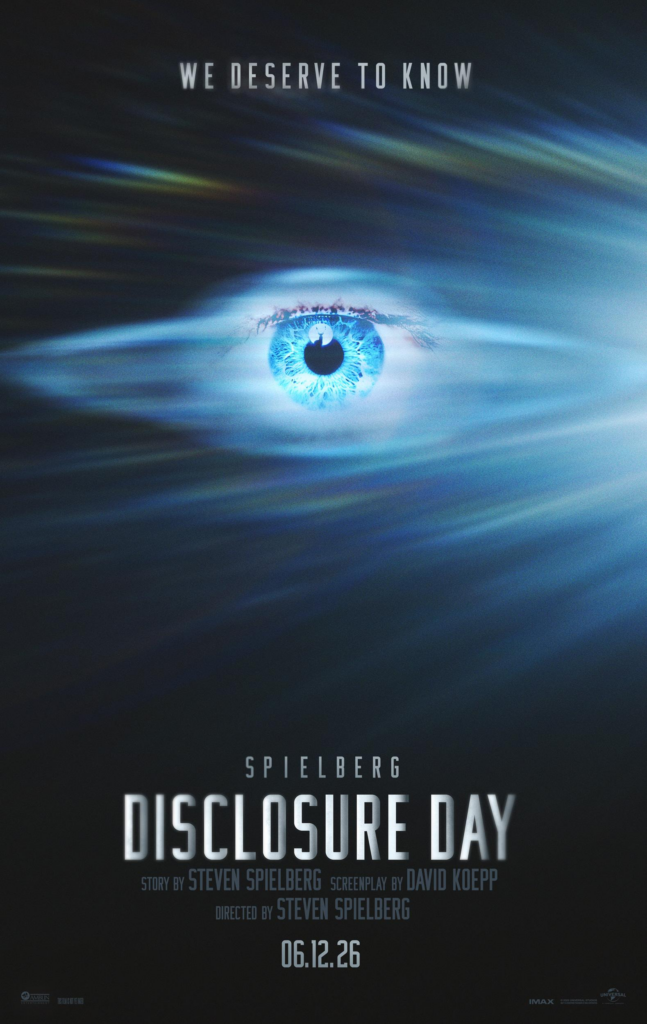
UAPedia’s pre-release analysis argued that Disclosure Day appeared to be about information before entities, apocalypse as unveiling, and the question of which institution would be permitted to narrate reality first. The completed film substantially confirms that interpretation. Daniel Kellner’s stolen archive, Wardex’s contractor-controlled secrecy, Margaret Fairchild’s interrupted weather broadcast, and the climactic global transmission make the custody and mediation of proof the central dramatic conflict.
The film nevertheless adds a final layer that its marketing could not fully reveal. The campaign’s recurring eye gives way to an auditory imperative. Humanity is shown the archive, confronted with a living NHI, and then instructed to listen. The movement from sight to hearing is the film’s deepest symbolic progression. Disclosure is not complete when concealed evidence becomes visible. It becomes meaningful when humanity recognizes another intelligence as a subject rather than an artifact, threat, possession, or source of technology.
Empathy should therefore not replace the pre-release article’s unveiling thesis. It should be presented as its ethical consequence. The film begins by asking whether humanity has a right to see what has been hidden. It ends by asking whether humanity has developed the moral capacity to receive what the hidden intelligence might say.
The Film in the Record
The official credits identify Spielberg as director and story author, Koepp as screenwriter, and Kamiński as cinematographer. Koepp has clarified that reports of 42 drafts refer to drafts and sets of revisions rather than 42 complete rewrites. Spielberg had developed a substantial treatment, after which the two refined the material over approximately two years. (Amblin Official Site)
The production is not a dramatization of Roswell, the 2004 USS Nimitz encounters, the 2023 congressional hearing, or any single whistleblower account. It is an original synthesis of several cultural narratives: legacy crash-retrieval allegations, private-contractor secrecy, classified archives, experiencer aftereffects, psi-like communication, suppressed imagery, and the possibility of catastrophic or transformative disclosure.
Spielberg has connected the film directly to the modern disclosure environment. He points to the 2017 reporting as his catalyst, cites the consistency he perceives across decades of testimony, and describes the inequity of a small group possessing knowledge that affects everyone. These are his interpretations and convictions, not independently verified findings. (The Singju Post)
Critical reception has been favorable but not unanimous. Rotten Tomatoes reports an 80 percent critics’ score from 420 reviews and a 70 percent verified-audience score from more than 5,000 ratings. Metacritic reports 74 from 63 critics, while its user score is a more divided 5.3 from 408 ratings. The split suggests that the film’s craftsmanship and humanism have landed more consistently with professional critics than its density, sentimentality, and disclosure mythology have with all viewers. (Rotten Tomatoes)
Its commercial reach is already substantial. Box Office Mojo lists approximately $112.5 million domestic, $117.7 million international, and $230.1 million worldwide as of this review. That scale matters to the Cultural Impact score because few UAP-related films place current whistleblower, contractor, ontological-shock, and consciousness themes before such a large mainstream audience. (Box Office Mojo)
Its awards history remains too young for a durable judgment.
The Film as Cinema
The available footage and critical record indicate that Spielberg treats the material primarily as a chase thriller. The opening drops Daniel into an operation already collapsing around him, and the film runs on four converging tracks involving Daniel, Margaret, Hugo, and Noah. This gives the narrative urgency while withholding the slower procedural development that a more investigative treatment might require. (Roger Ebert)
Direction and visual construction appear to be the strongest elements. Reviews consistently describe fluid camera movement, tactile action, a major vehicle-and-train sequence, and an elaborate crop-circle set piece. AP’s review emphasizes the recognizably Spielbergian use of light, smoke, wet streets, silhouettes, and practical staging. The strongest reported sequences combine kinetic filmmaking with vulnerable human reaction, especially the quiet boxcar scene after the train pursuit. Koepp says Spielberg added that aftermath because an escape from extreme danger should have emotional consequences. (Roger Ebert)
The screenplay’s design is intelligent but crowded. Koepp and Spielberg reportedly examined major scenes from each principal character’s point of view, allowing even Noah’s anti-disclosure argument to retain some plausibility. Yet critics have also noted that the film sometimes rushes explanations, relies on expository dialogue, and moves so relentlessly that its theological and social implications receive less time than its action mechanics. (The Singju Post)
Emily Blunt is the critical consensus choice as the film’s emotional center. Reviews particularly praise the challenge of portraying Margaret as both an unwilling public messenger and an involuntary conduit for other people’s memories and emotions. O’Connor reportedly supplies nervous physicality rather than conventional action-hero control; Domingo gives Hugo a stabilizing moral authority; Firth makes institutional repression feel weary and rationalized rather than merely theatrical. These performance judgments remain provisional here because a complete screening was unavailable. (Rotten Tomatoes)
The communication design is conceptually stronger than generic electronic “alien” sound. Margaret produces unfamiliar clicking vocalizations, while Daniel experiences or decodes the same information mathematically. Koepp says the language was designed from quasi-human sounds and mathematical structures, with Spielberg and sound designer Gary Rydstrom shaping its audible form. This is not linguistically demonstrated science, but it gives the contact mechanism an internal logic. (The Singju Post)
The final NHI figure, codenamed “In Vivo” during production, was reportedly realized as a practical mechanical effect rather than an entirely digital creation. That choice is aesthetically and ethically important. A physical presence permits the actors, camera, and audience to relate to the being as a vulnerable subject rather than merely as spectacle. (EW.com)
Symbolism from the eye to “Listen”
The eye, the veil, and the limits of seeing
The pre-release article correctly identified the campaign’s partially obscured blue eye as a symbol of witness, surveillance, awakening, exposure, and vulnerability. It also recognized the image’s reversal of the ordinary contact question: humanity is not only looking into the unknown but may itself be under observation or judgment.
The completed film deepens that reading by making vision morally ambiguous. Eye contact is associated with Margaret’s empathic access to other people, but altered eyes also indicate Scanlon’s invasive control over Jane. The eye can disclose another person, but it can also penetrate, appropriate, or dominate them. The film therefore distinguishes between seeing and respecting. One can observe another being without recognizing its autonomy.
The final word corrects this imbalance. “Listen” moves the film beyond visual proof. Seeing can remain passive, voyeuristic, or coercive. Listening requires attention, patience, and the possibility that the other possesses meaning not reducible to our existing categories. The campaign promises that everything will be disclosed, but the ending asks whether disclosure can produce relationship rather than another form of possession.
Margaret as meteorologist and mediator
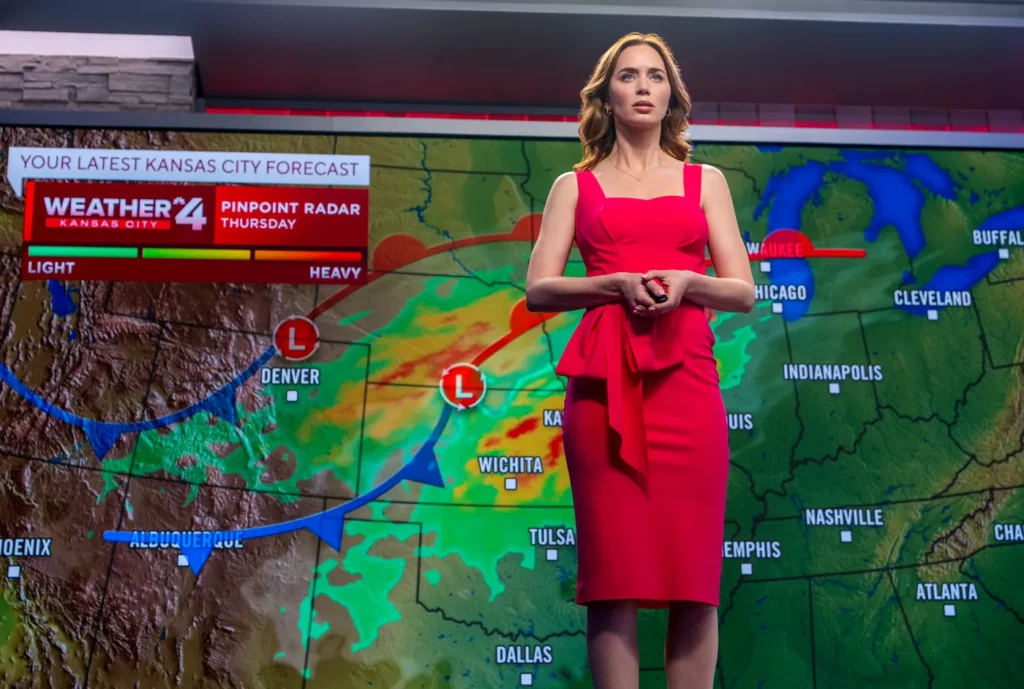
The pre-release review’s strongest symbolic observation was that a meteorologist already serves as a public translator of the sky. Margaret stands between atmospheric data, uncertainty, institutional trust, and an audience that depends on her to make the heavens intelligible. Her profession turns the weather studio into the film’s first threshold between the ordinary sky and the anomalous one.
Her initial interruption reverses that relationship. She is no longer interpreting the sky. The unknown uses the sky’s interpreter to address humanity. What appears first as neurological violation later becomes conscious participation. Margaret begins the film as an involuntary conduit but ends it as a willing public messenger.
This gives her character a precise symbolic arc. She moves from meteorologist to mediator, from forecasting probabilities to announcing a reality that overturns every previous forecast of human history. The return to her local television station in the climax is therefore not merely plot convenience. She reclaims the site of her first public loss of control and converts it into a place of chosen testimony.
Interrupted language and consciousness-mediated contact
The pre-release article compared Margaret’s vocal interruption with channeling and other reports of externally mediated speech. The finished film supports the broader consciousness-contact interpretation: Margaret receives or expresses unfamiliar languages and emotions, while Daniel has the complementary capacity to recognize mathematical and linguistic structure. The final NHI communication again moves through a human chain, from the being to Daniel, from Daniel to Margaret, and from Margaret to the global audience.
The post-release article should nevertheless tighten the epistemic labeling. The film does not establish that Margaret is practicing channeling in the sense claimed by any particular real-world contact figure. Nor does resemblance to Darryl Anka’s performances establish a common origin or mechanism.

Crop circles and geometric inscription
The pre-release reading of crop formations as “revelation encoded spatially” remains appropriate. Their geometry signifies intention, intelligence, and communication expressed through physical arrangement rather than ordinary language. They connect Daniel’s mathematical aptitude with a larger symbolic vocabulary in which information can be written into landscape, bodies, memory, and sound.
The completed film does not, however, fully explain the crop-circle sequence’s causal or strategic purpose. The review should preserve that as a criticism. The image carries considerable cultural and mythic meaning, but its narrative function remains underdeveloped. Symbolic force should not be mistaken for explanatory completeness.

Animals, childhood contact, and the reconstructed house
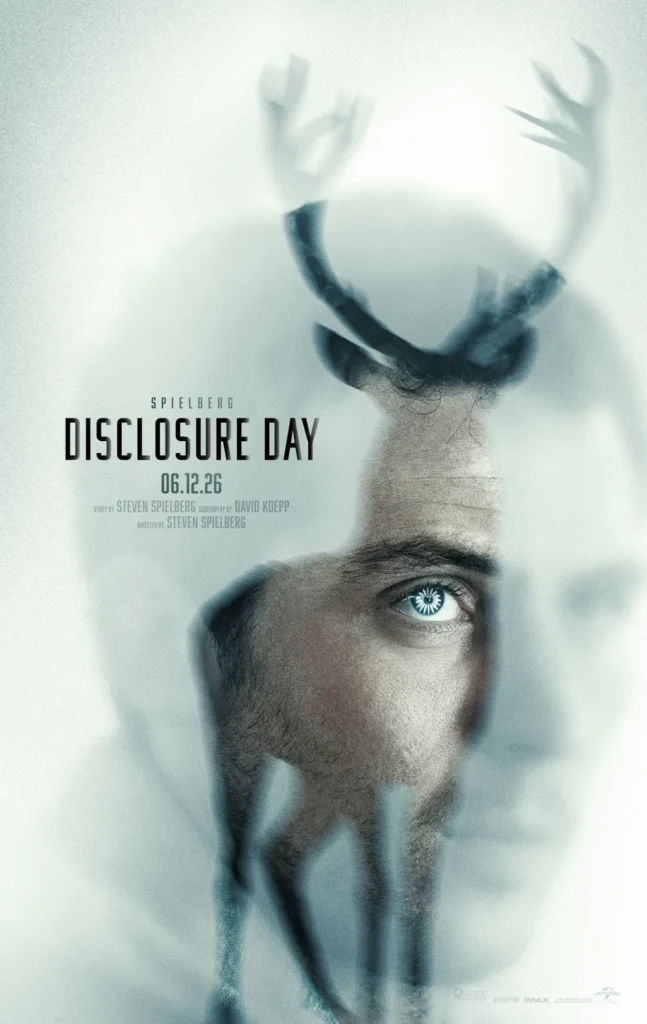
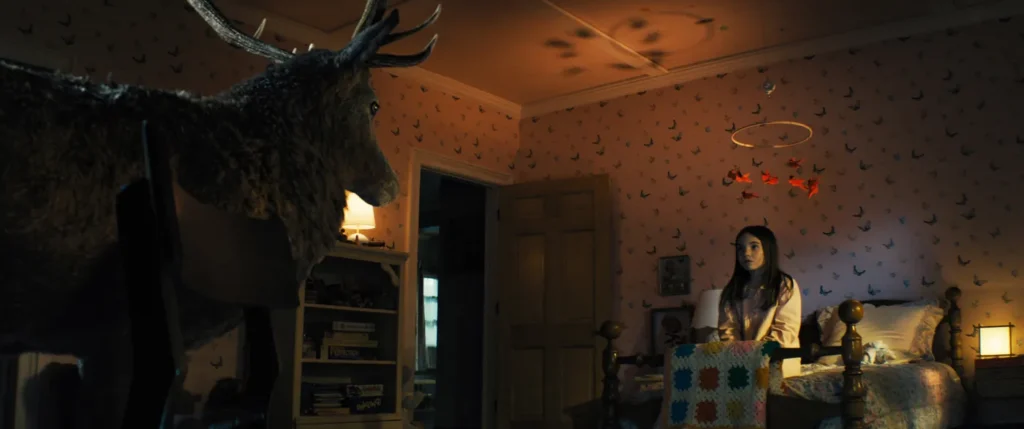
The cardinal, deer, snow, and illuminated house were interpreted before release as threshold imagery connecting contact narratives, fairy tales, initiation, and the concept of screen memory. The finished film strongly supports the threshold and memory components. Margaret and Daniel’s abilities are tied to childhood encounters and abduction, and the reconstructed house becomes the means through which Margaret accesses what had been psychologically inaccessible.
The house should now be interpreted as both refuge and portal. It is a familiar domestic structure containing an encounter that exceeds the child’s capacity to understand it. Its brightness offers apparent safety while concealing a rupture in ordinary reality. The reconstructed version later functions like a materialized memory palace, an artificial environment designed to recover an experience that survives in symbolic fragments.
Catholic imagery, annunciation, and consent
The pre-release article read the nuns and crucifix through annunciation, apocalypse, and religious destabilization. The finished film confirms the importance of that imagery but complicates the initial prediction that faith would be merely reactive or threatened.
Jane’s religious history, the crucifix, the convent community, prayer during the broadcast, sign-of-the-cross gestures, and stigmata-like bodily imagery give the film a specifically Catholic symbolic vocabulary. These images serve not only as signs of fear but as means of resistance, solidarity, sacrifice, and moral orientation.
Margaret’s arc can be understood as an annunciation narrative complicated by consent. Her first public transmission is involuntary. Her body and voice are overtaken before she understands the nature of the message. Her final transmission is chosen. She stands before the world knowingly and accepts the role of messenger. The movement from compelled annunciation to voluntary proclamation parallels her movement from experiencer vulnerability to public agency.
The review should also avoid treating the film’s Catholic register as a comprehensive representation of “religion.” The film explores one prominent Christian symbolic system. It does not substantially dramatize Jewish, Islamic, Hindu, Buddhist, Indigenous, secular-humanist, or other responses to NHI. That narrowness is a legitimate limitation in a story presenting disclosure as a planetary event.

Roswell as the original concealment
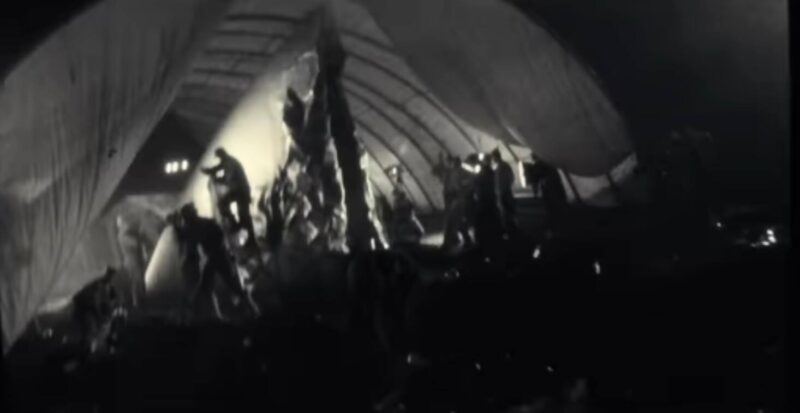
The pre-release article correctly anticipated that Roswell would function as more than a reference. In the film’s fictional history, 1947 becomes the beginning of an inherited secrecy system involving recovery, custody, exploitation, and the construction of a contractor-controlled archive.
Symbolically, Roswell functions as the institutional original sin of the narrative. The first decisive human response to NHI is not dialogue but possession. A recovered being or technology is classified, controlled, studied, and withheld. Every later act of coercion descends from that first decision.
Prometheus and the planetary commons
The pre-release analysis described the whistleblower motif as Promethean. The completed film validates that interpretation. Daniel takes guarded knowledge and technology from an institution that claims exclusive authority over them, risking punishment to return them to humanity.
The Promethean “fire” is not merely advanced technology. It is the right to know that another intelligence exists and that human institutions have already entered into an undisclosed relationship with it. Daniel’s act therefore challenges both secrecy and ownership. The archive is treated as a planetary inheritance improperly converted into contractor property.
The review should preserve the pre-release phrase “democratized revelation” and connect it to the finished film’s local-newsroom climax. The truth passes out of a protected corporate system through an ordinary civic medium. A Kansas City broadcast becomes more legitimate than a transnational secrecy structure because its authority comes from public witness rather than classified possession.
One factual cleanup is advisable. Marketing materials are inconsistent about whether the truth “belongs to seven billion” or “eight billion” people. UAPedia’s pre-release article and several campaign copies use seven billion, while NBCUniversal’s current official page transcribes the trailer with eight billion. The symbolism is planetary inclusion, not the number itself. Quote a numerically specific version only after verifying the exact trailer or film audio being cited.

Silence, whisper, and listening
The pre-release article treated the silence surrounding the craft as a form of presence. That motif becomes more significant after release. The film’s communication system progresses from silence to disturbance, from disturbance to clicking language, from language to mathematical interpretation, and finally from interpretation to an intimate whisper.
The climax makes the smallest sound carry the largest meaning. A global revelation begins with a living NHI whispering to one person. Daniel conveys the message to Margaret, and Margaret begins to convey it to the world. The public and geopolitical scale of disclosure still depends upon vulnerable, embodied, interpersonal contact.
“Listen” therefore resolves the pre-release sound symbolism. It is simultaneously an instruction to hear the NHI, to attend to experiencers, to acknowledge suppressed testimony, to recognize the suffering of another being, and to communicate across political and cultural division. Blunt and O’Connor have both described the final word as potentially complete in itself while also serving as the beginning of a longer message.
Spoiler Notice
The following sections reveal the film’s major plot developments, childhood-contact material, disclosure broadcast, and final scene.
Plot in Focus
Cybersecurity specialist Daniel Kellner has stolen an extensive archive from Wardex, a government contractor that has concealed decades of human interaction with non-human intelligence (NHI). The film opens in a professional-wrestling arena with Daniel already being pursued, his materials seized, and his girlfriend Jane held as leverage. Hugo Wakefield, a Wardex defector, is coordinating a larger mutiny intended to place the archive before the public. (AP News)
Margaret Fairchild is a Kansas City meteorologist who wants to do more consequential journalism. After an anomalous encounter involving a cardinal, she begins speaking languages she does not consciously know, perceiving personal information through eye contact, and vocalizing a clicking language that Daniel can interpret through mathematics. Her transformation functions simultaneously as contact experience, trauma recurrence, and call to public witness. (AP News)
Wardex director Noah Scanlon pursues Daniel and Margaret while arguing that sudden disclosure could destabilize governments, religions, economies, and an already dangerous international situation. The film does not make Noah morally equivalent to the whistleblowers, but it gives him a serious premise: information can be true and still be socially explosive.
Margaret and Daniel eventually learn that their complementary abilities arise from childhood encounters. Hugo reconstructs Margaret’s childhood home to help her recover the relevant memories, turning a film set into a technology of psychological access. Their remembered contact explains why Margaret can transmit the message and Daniel can decode it. (The Guardian)
The group reaches Margaret’s local television station and begins transmitting Daniel’s archive. Wardex cuts the electricity, but Margaret activates an NHI device that restores power. The broadcast spreads globally, presenting decades of images and records while the world is already near nuclear crisis. The film’s disclosure strategy is cumulative: no single image must carry the whole burden because the archive, witnesses, institutions, and live events arrive together. (EW.com)
Hugo’s group then brings a living NHI into the newsroom. The being whispers to Daniel, who relays the message to Margaret. Facing the camera, she begins with one word: “Listen.” The film cuts before explaining whether this is an ethical request, an instruction, a warning, the opening of a longer communication, or some form of influence. Koepp has said the story’s mission was to get the truth out, not to map every consequence afterward. (EW.com)
UAP and NHI Analysis
The film’s explanatory model
| Model | Status in the film |
|---|---|
| Extraterrestrial | Primary explicit model |
| Consciousness-mediated | Central to communication, memory, language, and empathy |
| Crash retrieval and reverse engineering | Treated as historical fact within the fictional world |
| Guided disclosure | Strongly implied by the childhood selection of Margaret and Daniel |
| Interdimensional or ultraterrestrial | Not established, though psi-like effects leave the ontology less closed than the extraterrestrial label suggests |
| Hostile NHI | Not the dominant model |
| Unambiguously benevolent NHI | Also not established |
| Multiple-origin model | Possible but undeveloped |
| Military or contractor explanation | Applies to the secrecy apparatus, not to the ultimate origin of the beings |
The film uses an explicitly extraterrestrial vocabulary within its plot, including off-world visitors, recovered beings, advanced vehicles, and multiple NHI forms. Its communication model, however, remains ontologically more open than a purely material extraterrestrial framework. Memory activation, empathic access, altered perception, nonverbal information transfer, mathematical cognition, and mental intrusion suggest that consciousness is not incidental to contact but one of its principal media. The film therefore combines an extraterrestrial origin model with a consciousness-mediated interaction model. It does not establish an interdimensional, spiritual, or ultraterrestrial origin, although it leaves enough perceptual ambiguity to prevent those possibilities from being completely excluded.
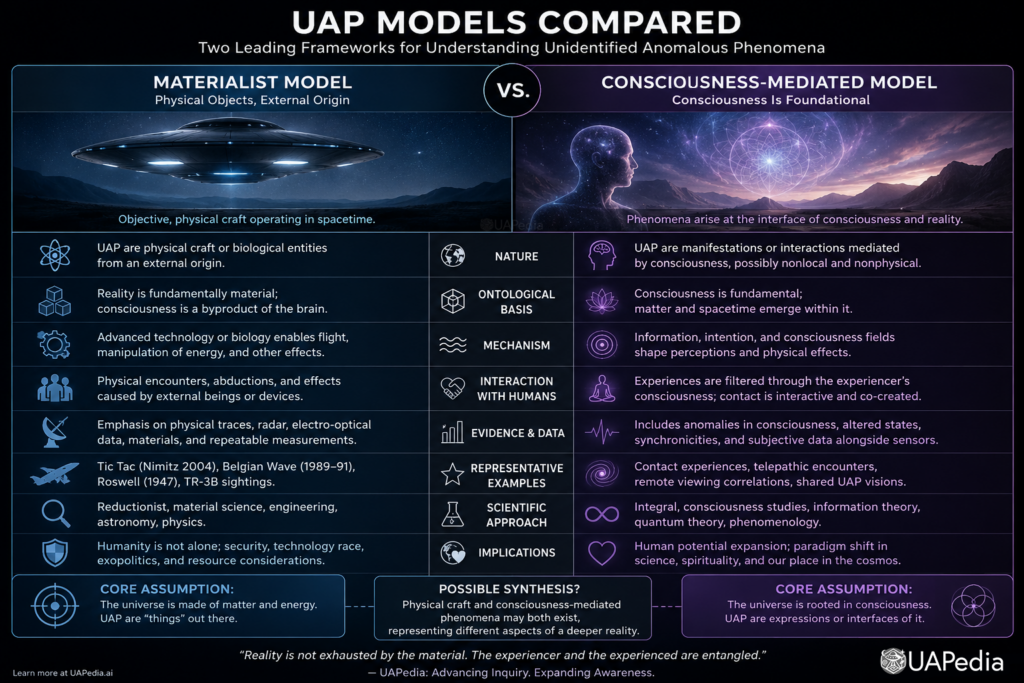
That fusion reflects a genuine division within UAP research. Some investigators emphasize sensors, materials, aerospace performance, records, and chain of custody. Others emphasize altered states, telepathy, synchronicity, missing time, spiritual transformation, and the apparent interaction between the phenomenon and human perception. Disclosure Day refuses to choose between them.
Its NHI are technologically advanced but physically vulnerable. The archive includes footage of a being subjected to brutal human interrogation or medical treatment. Koepp describes this as a deliberate reversal of the omnipotent invader: advanced beings can crash, suffer, and become victims of human cruelty. (The Singju Post)
This is one of the film’s most consequential UAP ideas. It shifts the central ethical question from “What might they do to us?” to “What might we already have done to them?”
Thematic Analysis
Who owns proof?
Wardex represents the contractorized secret: knowledge lodged beyond ordinary public scrutiny and partly insulated from elected government. Spielberg explicitly contrasts elected officials, who operate amid turnover and leaks, with contracted organizations that may sustain secrecy more effectively. (The Singju Post)
This resembles real crash-retrieval allegations without verifying them. In written testimony to Congress, David Grusch stated that he had been informed during his official duties of a multidecade UAP crash-retrieval and reverse-engineering program to which he was denied access. His statement is consequential testimony from a person with relevant professional background and substantial personal exposure, but its publicly available core is largely secondhand concerning the alleged program. (House Oversight Committee)
AARO’s 2024 historical report presents the contrary institutional assessment. It says it found no empirical evidence that the United States government or private companies had reverse-engineered extraterrestrial technology and argues that named programs were unrelated, misidentified, unapproved, or disestablished. That is an official investigative conclusion, not automatic proof that no concealed activity could exist. Equally, sworn testimony establishes that a claim was seriously made and accepted into a congressional record, but does not independently authenticate the claimed materials or program. (AARO)
Disclosure Day takes the disputed proposition and removes the uncertainty. This makes the thriller possible, but it also risks teaching viewers that a dramatically coherent version of a claim is equivalent to a documented one.
Disclosure in the deepfake era
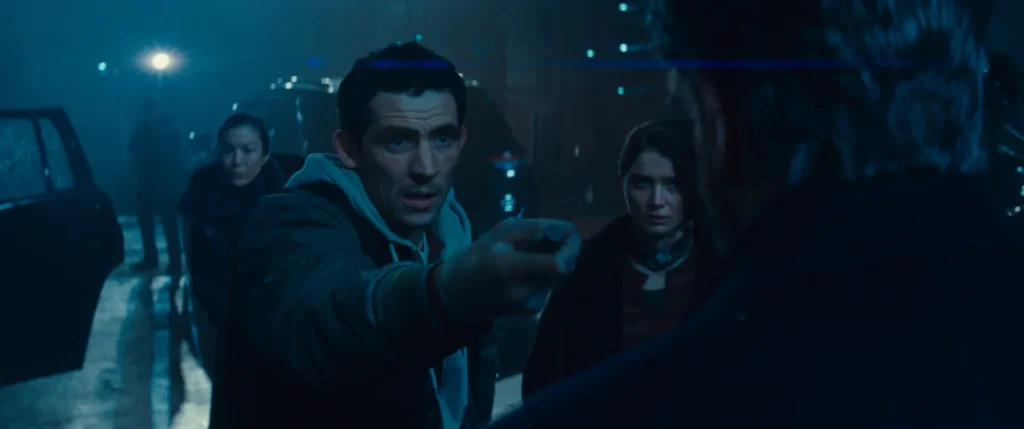
The film understands that contemporary disclosure would be an authentication crisis. Viewers in the film immediately ask whether the images are fabricated. Koepp explains that the local newsroom was chosen partly because people may trust a recognizable nearby institution more than a vast remote one. His dramatic solution is to release so much interconnected information that denial becomes unsustainable. (The Singju Post)
That is compelling cinema but incomplete epistemology. Volume is not the same as provenance. A large archive could contain authentic records, manipulated media, sincere misinterpretations, duplicate claims, planted disinformation, or material stripped of sensor metadata.
The public UAP record points toward a more difficult standard. The 2021 ODNI assessment stated that most reports it reviewed probably represented physical objects and that a majority registered across multiple sensors. It also emphasized possible sensor error, spoofing, observer misperception, and the likelihood of multiple explanations. The Department of Defense separately authenticated the provenance of three Navy videos while continuing to describe the observed phenomena as unidentified. Neither action established NHI. (ODNI)
NASA’s independent study report similarly concluded that the peer-reviewed literature contained no conclusive evidence for an extraterrestrial origin of UAP. It called for calibrated sensors, metadata, baseline data, reproducibility, and systematic reporting. Eyewitness testimony can identify patterns and guide investigation, but by itself usually cannot establish provenance. (NASA Science)
The film gets the information-war problem right, then resolves it through a cinematic shortcut.
Experiencer dignity
Margaret is not treated as ridiculous, delusional, or morally defective. Her anomalous experiences frighten and disorient her, but they also carry information that other characters gradually learn to respect. Daniel’s nervousness and Margaret’s loss of control are presented as human responses to extraordinary pressure rather than proof of unreliability.
This matters because ridicule can directly degrade the evidence base. NASA’s study identified stigma as an obstacle to reporting and noted that fear of disbelief or professional harm can cause data attrition. Respecting witnesses does not require accepting every interpretation. It means documenting the report, examining ordinary explanations, seeking corroboration, and avoiding humiliation as a substitute for analysis. (NASA Science)
Disclosure Day handles that distinction better than much popular UAP entertainment. It believes Margaret before it completely understands her.

Ontological shock
The film portrays disclosure not as one homogeneous global emotion but as a collision among belief, fear, practical distraction, geopolitical crisis, and institutional self-preservation. Spielberg has explicitly discussed ontological shock as the destabilization of a person’s underlying conception of reality. (The Singju Post)
Noah’s argument is therefore not absurd. Even accurate information can generate market volatility, military miscalculation, cultic interpretation, religious conflict, opportunistic propaganda, or attempts to monopolize new technology. His moral failure is not recognizing risk. It is treating permanent secrecy and coercion as the only legitimate response.
Disclosure as an ethical event
The film’s deepest claim is that disclosure is not complete when the public learns that NHI exists. It is complete only when humanity recognizes an ethical relationship with another intelligence.
The suffering being in the archive and the living NHI in the newsroom transform proof into encounter. The final imperative, “Listen,” asks the audience to move from looking at evidence to receiving another subject. The distinction is central: an artifact can be owned; a person or intelligent being cannot ethically be reduced to an artifact.

What the Film Gets Right, Interprets, and Invents
| Category | Assessment |
|---|---|
| Gets right | Secrecy could be distributed through compartments, contractors, access controls, legal agreements, and institutional distrust rather than controlled by one publicly visible authority. |
| Gets right | Testimony, professional credentials, sensor data, records, provenance, and physical materials carry different evidentiary weights. |
| Gets right | A deepfake environment would make even authentic disclosure difficult to verify. |
| Gets right | Stigma can damage witnesses and suppress potentially useful reporting. |
| Gets right | Disclosure would be an ethical, religious, psychological, political, and scientific event, not only an aerospace announcement. |
| Interprets | The film condenses approximately 80 years of alleged contact into one internally coherent archive held by a single dominant organization. |
| Interprets | It moves rapidly from UAP ambiguity to definite extraterrestrial NHI, recovered bodies, reverse engineering, and consciousness-based contact. The real public record has not established that chain. |
| Interprets | It assumes that overwhelming imagery, plus a living being, can quickly defeat disinformation and global fragmentation. Even extraordinary evidence would require authentication, biological assessment, independent access, replication, and sustained public explanation. |
| Interprets | The global consequences are compressed into the timescale of a chase thriller. Actual disclosure would likely unfold unevenly across states, cultures, markets, scientific institutions, and religious communities. |
| Invents | Wardex, Margaret, Daniel, Noah, Hugo, their childhood encounters, the NHI device, the reconstructed house, and “In Vivo” are fictional creations. |
| Uses disputed lore as fictional fact | Roswell as an NHI crash, long-running crash retrieval, hidden bodies, reverse-engineered technology, and psi-like contact are presented as true inside the story even though their real-world status remains disputed or unverified. |
Religious, Mythic, and Consciousness Layers
Documented narrative elements
Jane is a former Catholic novice, and Sister Maura embodies an institutional religious response to the possibility of NHI. Margaret speaks languages she has not learned, becomes a public messenger, and undergoes a revelation connected to childhood selection. The film therefore places explicitly religious imagery alongside contact and disclosure rather than treating science and faith as automatically incompatible. (Roger Ebert)
Structural similarities
Margaret’s experience resembles several religious and mythic structures without proving a direct theological identity:
- Her involuntary multilingual speech resembles glossolalia or miraculous speech.
- Her childhood selection resembles prophetic election.
- The recovery of buried memory resembles initiation or return to a sacred origin.
- The newsroom broadcast resembles public proclamation.
- The final command to listen resembles revelation that demands ethical response rather than passive observation.
- “Disclosure” itself carries the older meaning of apocalypse: an unveiling of what was concealed.
These are structural comparisons, not evidence that the film’s NHI are angels, demons, gods, or spirits. No verified filmmaker statement located for this review identifies them that way.
Religion after contact
The film sometimes implies that confirmed NHI could place religion under severe pressure. That is plausible for some communities and doctrines, but religious collapse is not an inevitable outcome. Ted Peters’ published work on the implications of extraterrestrial intelligence concluded, based on his survey, that confirmation would not necessarily cause terrestrial religion to collapse. Contemporary astrotheology likewise includes positions under which extraterrestrial life can be incorporated into existing doctrines of creation, even while challenging ideas about human uniqueness, incarnation, salvation, and moral status. (PubMed)
The more credible forecast is plural response: adaptation, resistance, reinterpretation, denial, new religious movements, renewed traditionalism, and attempts to classify NHI within existing cosmologies.
Consciousness-mediated contact
The film’s communication system does not depend primarily on radio or translated speech. It operates through eye contact, emotion, memory, unfamiliar vocalization, and mathematics. Hardware carries the archive, but consciousness completes the contact.
Evidence label: These mechanisms are documented elements of the fictional narrative.
Hypothesis label: NHI might interact through cognition, altered states, or consciousness rather than solely through conventional electromagnetic communication.
The hypothesis appears in experiencer and researcher literature, but no reproducible mechanism has been publicly established. The film’s treatment should therefore be read as speculative modeling, not scientific confirmation.
Researcher Opinion: The ending can be interpreted in two ways. In the optimistic reading, “Listen” is a plea for empathy and reciprocal recognition. In the darker reading, the contact process may also involve influence over human cognition. The film leaves enough uncertainty that ethical persuasion and anomalous compulsion cannot be completely separated.
UAPedia Cinema Rating (UCR)
| Category | Score | Explanation |
|---|---|---|
| Phenomenon Fidelity | 4.0/5 | Strong correspondence with current discourse about contractor secrecy, whistleblowers, legacy archives, experiencer stigma, information control, and the need for corroboration. Based on proof the fidelity falls short when the film turns disputed claims into one settled history, but, experiencers narratives match the plot details. |
| Mythic and Religious Depth | 4.0/5 | The eye and veil, apocalypse as unveiling, Promethean theft, compelled and voluntary annunciation, stigmata-like imagery, animal guides, sacred geometry, childhood initiation, recovered memory, and the final imperative to listen form a coherent symbolic system. The film treats disclosure as an epistemological, religious, and moral transformation rather than merely a scientific announcement. The score remains 4.0 rather than 4.5 because its explicit religious vocabulary is predominantly Catholic, several motifs are introduced more fully than they are developed, and the relationship between NHI, consciousness, and transcendence remains suggestive rather than rigorously examined. |
| Secrecy and Institutional Realism | 4.0/5 | The private-contractor model, compartmentalization, access control, whistleblower retaliation, media distrust, and public authentication problem are highly relevant. Wardex’s near-total control and the decisive power of one broadcast are cinematic simplifications. |
| Experiencer Empathy | 4.5/5 | Margaret and Daniel are treated as psychologically affected witnesses rather than caricatures. The film recognizes involuntary experience, memory fragmentation, stigma, bodily loss of control, emotional aftermath, and the difficulty of translating anomalous perception into public testimony. Margaret’s movement from involuntary conduit to willing messenger gives her agency without denying her initial vulnerability. The score stops short of 5 because the characters’ extraordinary abilities ultimately validate them so decisively that the ambiguity and prolonged social isolation faced by many real experiencers are partly bypassed. |
| Cultural Impact | 4.5/5 | Spielberg’s stature, the film’s wide release, substantial box office, and explicit use of modern disclosure terminology give it exceptional reach. It is too early to judge its lasting influence, so a perfect score would be premature. (Rotten Tomatoes) |
Total UCR score: 21/25
UAPedia verdict: Major UAP film
Overall Verdict
Disclosure Day is one of the most culturally important UAP-related studio films of the modern disclosure period. It takes ideas previously confined to hearings, documentaries, specialist reporting, experiencer literature, and online debate, then places them inside a large-scale Spielberg adventure.
Disclosure Day fulfills our prediction that the modern disclosure narrative would center on uncontestable proof rather than simple arrival. Inside its fictional world, Spielberg supplies that proof through a stolen archive, global transmission, recovered history, and a living NHI. Yet the film also exposes the limit of proof. At the moment when visual evidence appears complete, explanation is withheld and humanity receives an instruction instead.
The finished film therefore over-explains what happened while preserving uncertainty about what contact means. It settles Roswell, crash retrieval, contractor custody, reverse engineering, and NHI presence within its fictional history, but it refuses to settle the visitors’ full origin, motives, relationship to consciousness, or final message.
That ambiguity keeps the film compatible with the pre-release analysis rather than overturning it. The eye of the campaign promised that all would be disclosed. The final word asks whether humanity can receive what disclosure makes visible. The deepest test is no longer whether the public will believe in NHI. It is whether knowledge will produce empathy, reciprocity, and responsible attention rather than renewed possession, domination, and secrecy.
As UAP cinema, Disclosure Day is therefore best understood as a progression:
from secrecy to visibility,
from visibility to recognition,
from recognition to listening.
That is the bridge between the pre-release article’s unveiling thesis and the post-release review’s empathy thesis.
Claims Taxonomy
The classifications below apply to real-world claims invoked by the film, not to fictional plot events.
Claim: Some military UAP reports were registered by multiple sensors and remained unidentified
Classification: Verified
Rationale: ODNI reported that a majority of cases in its 2021 review registered across multiple sensor systems and that most probably represented physical objects. The Department of Defense authenticated the provenance of three Navy videos while continuing to classify the observed phenomena as unidentified. This verifies the reports, recordings, and unresolved status. It does not verify an NHI origin. (ODNI)
Claim: The United States government or private contractors possess and reverse-engineer NHI vehicles
Classification: Disputed
Rationale: Grusch submitted written testimony stating that he was informed of a multidecade retrieval and reverse-engineering program and reported the matter through official channels. No publicly authenticated vehicle, biological specimen, or complete program record has resolved the dispute. Grusch’s professional background, formal testimony, and personal risk increase the importance of investigating his claim, but they do not by themselves verify the underlying materials. (House Oversight Committee)
Claim: The 1947 Roswell incident involved a crashed NHI vehicle and bodies
Classification: Disputed
Rationale: The Air Force’s official conclusion attributes the recovered debris to Project Mogul and later body stories to conflated test-dummy and accident accounts. Researchers and witnesses have continued to contest the adequacy of that explanation, and the case remains culturally influential. No publicly authenticated NHI material from Roswell has been established. The official account is substantial evidence, but an institutional conclusion alone should not be treated as automatic proof if relevant testimony or records remain contested. (U.S. Air Force)
Claim: Unresolved UAP establish the presence of extraterrestrial NHI
Classification: Disputed
Rationale: Some cases remain unresolved, including reports with multiple forms of observation. NASA nevertheless found no conclusive peer-reviewed evidence that UAP have an extraterrestrial origin. “Unidentified” describes the present state of attribution; it is not a positive identification as NHI, foreign technology, atmospheric phenomena, sensor effects, or any other specific category. (ODNI)
Speculation Labels
Evidence
Official film credits, release and reception data, authenticated government records, documented testimony, and the publicly confirmed provenance of particular military videos.
Witness Interpretation
A witness or experiencer’s conclusion that an anomalous observation, missing-time episode, communication, or psychological effect resulted from NHI contact. Such interpretation may be sincere and evidentially relevant without being independently verified.
Researcher Opinion
This review’s interpretation is that Disclosure Day transforms disclosure from an evidentiary event into an ethical encounter and that its final scene contains both empathic and potentially coercive readings.
Hypothesis: NHI could communicate through consciousness, memory, emotion, mathematics, or altered cognition. The film dramatizes this model, but no publicly reproducible mechanism establishes it.
References
Amblin Entertainment. (2026). Disclosure Day: About the film. (Amblin Official Site)
Bahr, L. (2026, June). Disclosure Day review: Steven Spielberg makes a classic Steven Spielberg adventure. Associated Press. (AP News)
Box Office Mojo. (2026). Disclosure Day. Figures retrieved July 16, 2026. (Box Office Mojo)
Grusch, D. C. (2023, July 26). Opening statement for the House hearing on unidentified anomalous phenomena. U.S. House Committee on Oversight and Accountability. (House Oversight Committee)
Kojonen, E. V. R. (2024). On astrotheology as natural theology. Religious Studies. (Cambridge University Press & Assessment)
Mancuso, V. (2026, June 15). Disclosure Day writer David Koepp on working with Spielberg, those 42 drafts, and using “we see” in screenplays. Backstage. (Backstage)
Metacritic. (2026). Disclosure Day reviews. Retrieved July 16, 2026. (Metacritic)
National Aeronautics and Space Administration. (2023). Unidentified anomalous phenomena independent study team report. (NASA Science)
Office of the Director of National Intelligence. (2021). Preliminary assessment: Unidentified aerial phenomena. (ODNI)
Peters, T. (2011). The implications of the discovery of extra-terrestrial life for religion. Philosophical Transactions of the Royal Society A: Mathematical, Physical and Engineering Sciences, 369(1936), 644–655. (Royal Society Publishing)
Rotten Tomatoes. (2026). Disclosure Day. Retrieved July 16, 2026. (Rotten Tomatoes)
Spielberg, S. (Director). (2026). Disclosure Day [Film]. Universal Pictures and Amblin Entertainment. (Amblin Official Site)
StarTalk. (2026, June 16). Disclosure Day with Steven Spielberg and David Koepp [Podcast episode]. (StarTalk)
Stenzel, W. (2026, June 12). Disclosure Day ending explained: Emily Blunt, Colman Domingo, and more break down the final moments. Entertainment Weekly. (EW.com)
Tallerico, B. (2026, June 9). Disclosure Day. RogerEbert.com. (Roger Ebert)
U.S. Air Force. (n.d.). The Roswell Report: Case Closed. (U.S. Air Force)
U.S. Department of Defense. (2020, April 27). Statement on the release of historical Navy videos. (U.S. Department of War)
U.S. House Committee on Oversight and Accountability. (2023, July 26). Unidentified anomalous phenomena: Implications on national security, public safety, and government transparency. (House Oversight Committee)
SEO keywords
Disclosure Day review, Disclosure Day rating, Steven Spielberg, Emily Blunt, Josh O’Connor, UAP cinema, NHI, disclosure, alien contact, UAP whistleblower, crash retrieval, reverse engineering, Wardex, government contractors, UAP and consciousness, astrotheology, religion and extraterrestrial life, experiencer empathy, ontological shock, UAPedia UCR