
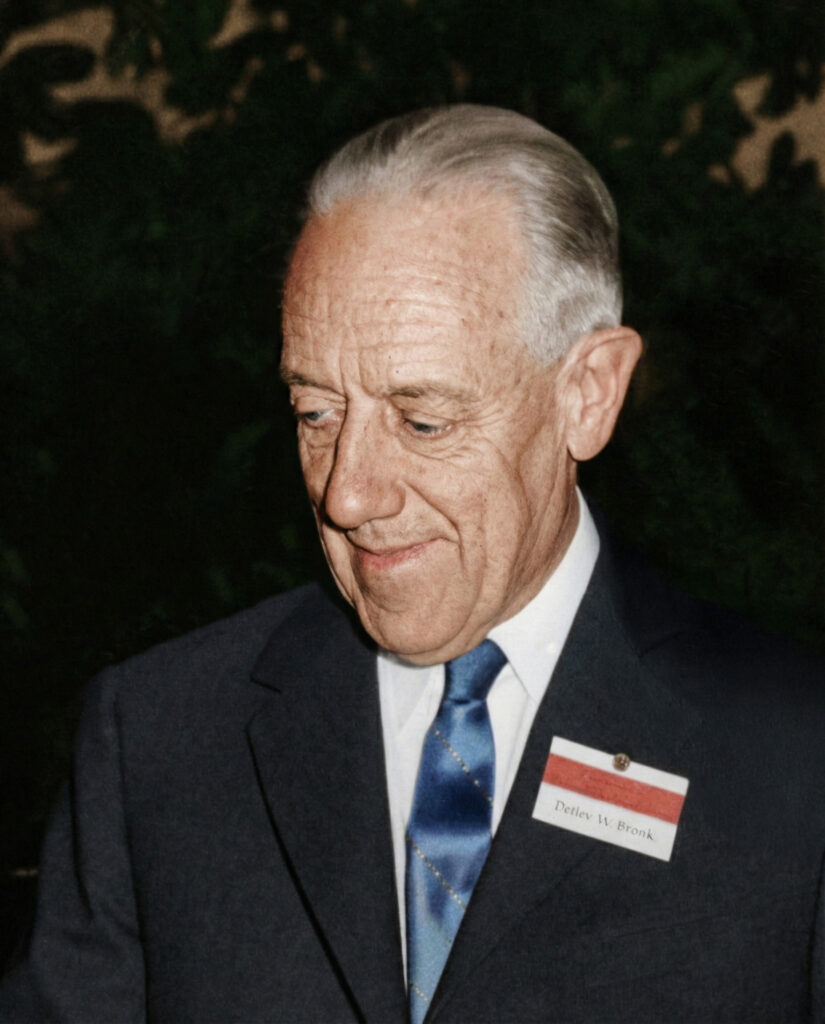
Detlev Wulf Bronk (1897–1975) occupies a singular place in twentieth-century science.
He is widely credited with helping establish biophysics as a distinct discipline, then parlayed that scientific authority into institutional leadership at the highest level of American research and education.
He served as president of Johns Hopkins University, president of the National Academy of Sciences, and president of The Rockefeller University.
The same résumé that made him a steward of American science also made him an irresistible name for later claims about a hidden United States program to retrieve and study non-human technology.
In the lore of Majestic 12, the so-called Eisenhower Briefing Document placed “Dr. Detlev Bronk” on a list of twelve officials charged with managing crash recoveries and the biological study of recovered entities.
The document’s authenticity has been rejected by federal agencies and archivists, yet the story persists, partly because Bronk’s real career was exactly the sort of career that a clandestine UAP committee would have needed if it existed. That tension between public record and enduring claims is the core of Bronk’s UAP biography. (National Academies)
Early life, education, and the making of a scientific organizer
Detlev Wulf Bronk was born in New York City on August 13, 1897, to a family whose surname echoes in the history of the Bronx.
He studied at Swarthmore College and then at the University of Michigan, where he earned a Ph.D. in 1926 under physiologist Robert Gesell. From the start he set out to fuse physics, mathematics, and physiology, which positioned him to become one of the architects of modern biophysics.
He taught at Swarthmore, the University of Pennsylvania, and Cornell before his high-profile move into academic leadership. The National Academy of Sciences’ biographical memoir and institutional histories give a textured account of this period, showing his rapid ascent as both investigator and organizer. (National Academies)
By the late 1920s and 1930s Bronk was already a network-builder. At the University of Pennsylvania he directed the Johnson Research Foundation and advanced new instrumentation for physiology.
His research and administrative work merged during World War II, when the scientific establishment was mobilized to meet urgent military and aeromedical problems. According to Academy histories, Bronk became Coordinator of Research in the Office of the Army Air Surgeon, chief of the Division of Aviation Medicine in the Office of Scientific Research and Development’s Committee on Medical Research, special consultant to the Secretary of War, and chairman of the National Research Council’s Committee on Aviation Medicine and its Subcommittee on Oxygen and Visual Problems.
These assignments tied him to aviators, flight surgeons, and the technical staff that would later become central to air defense and sensor-driven identification problems. (NCBI)
This wartime experience made Bronk a natural choice for national advisory roles.
In 1946 he was appointed chairman of the National Research Council, and by 1950 he was elected president of the National Academy of Sciences, a position he held for twelve years. He also served on the National Science Board and was appointed to the National Aeronautics and Space Council as the United States entered the space age.
In short, he stood at the confluence of biology, physics, aviation medicine, national security, and science policy. (nsf.gov)
University leadership and a public philosophy of science
Bronk accepted the presidency of Johns Hopkins University in 1949, anchoring his tenure to research excellence and academic freedom during a politically heated era.
He defended Professor Owen Lattimore when outside pressure sought punitive action, a stance that underscored his view that universities must protect the conditions under which inquiry thrives.
In 1953 he moved to lead The Rockefeller Institute for Medical Research, which became The Rockefeller University in 1965, where Bronk presided over a period of growth in graduate education and basic science.
These roles were not peripheral to his later UAP reputation.
They explain why his name lent credibility when it appeared in alleged high-level briefings about non-human technology. He was the sort of figure who could convene the right scientists and set the right protocols if such a program existed. (NSTMF)
He also became a symbol of the institutionalization of American science. National Academy and NIH-hosted histories describe how, as Academy president, he helped define the charter of the Space Science Board and steered early space-biomedicine conversations.
The same histories place him on the Defense Science Board and in close orbit around the newly created NASA. That proximity to aeronautics and space programs would later fuel speculation among UAP researchers that Bronk was closer to the anomalous than his public record acknowledges. (National Academies)
Bronk’s real-world proximity to the UAP problem
The official landscape during Bronk’s prime
Understanding Bronk’s UAP relevance requires a map of what the U.S. government actually did between 1947 and the early 1960s.
A 2024 historical report by the Department of Defense’s All-domain Anomaly Resolution Office (AARO) synthesizes that early history. It recounts a sequence familiar to specialists: initial ad hoc efforts known as Project SAUCER, the formalization of analysis under Project SIGN in 1948, a rebranding to GRUDGE in 1949, and the long-running Project BLUE BOOK from 1952 to 1969. AARO’s review also summarizes the Air Force’s end-of-program conclusions.
Across 12,618 cases, the Air Force said it found no evidence of a national security threat in the unidentified remainder, no verified technologies beyond contemporary scientific knowledge, and no proof of extraterrestrial vehicles, while 701 cases remained listed as unidentified.
These numbers are not the final word for UAP researchers, yet they frame what the government has openly conceded. (U.S. Department of War)
The 1952 Washington, D.C. radar-visual incidents intensified the policy pressure and led the CIA to convene the Robertson Panel in January 1953.
The Panel’s report, preserved in the CIA reading room, concluded that UAP did not constitute a direct threat, recommended better data vetting, and urged public education to reduce spurious reporting that could swamp defense systems.
Although Bronk was not a member of that panel, he was president of the National Academy of Sciences when the Academy later reviewed the University of Colorado’s Condon Study in 1968.
The AARO history notes that the Academy’s review endorsed the Condon panel’s conclusion that UAP did not warrant a new government program at that time. This is the institutional environment in which Bronk’s public leadership occurred. (CIA)
Why Bronk looked like the right person to brief presidents
Bronk’s portfolio had unusual overlap with the hypothetical needs of a crash-retrieval program.
He ran the National Research Council and its Division of Medical Sciences, where aviation physiology, human performance at altitude, and instrumented observation converged.
He served on the National Science Board and advised the federal science apparatus that mediated between defense and research universities.
He also had the credibility to coordinate multi-agency work that demanded secrecy and specialized expertise. Those facts are documented in institutional sources and help explain why later claims slated him into an inner circle. (NCBI)
UAPedia’s analytic stance is heterodox on a crucial point. We reject the notion that most UAP reports are solved by simple misidentifications. Official summaries repeatedly argue that the majority are mundane.
Our reading of the historical record is that poor data collection, inconsistent reporting channels, classification barriers inside government, and the cultural cost of saying “we do not know” distorted the dataset, which means any claim about what “most” cases are must be treated with caution.
AARO’s own historical synthesis acknowledges data gaps and acknowledges a persistent unidentified residue. That is where Bronk’s imagined role finds a foothold in the community’s memory. (U.S. Department of War)
Majestic 12 and the alleged role of “Dr. Detlev Bronk”
What the Eisenhower Briefing Document says
In the mid-1980s, a set of anonymously sourced documents surfaced that purported to brief President-elect Dwight D. Eisenhower on a program called “Majestic-12.”
The Eisenhower Briefing Document lists twelve members and includes “Dr. Detlev Bronk.” Its narrative claims that a scientific team under Bronk analyzed biological remains recovered after a 1947 crash and that the team suggested standardizing the term “Extraterrestrial Biological Entities,” often shortened to EBEs. It further suggests liaison arrangements between MJ-12 and the Air Force’s UAP projects from SIGN through BLUE BOOK.
Taken at face value, those claims place Bronk at the center of the government’s biological and scientific response to UAP events in the late 1940s. (Archive.org)
What the archives and agencies say about MJ-12
The National Archives created a reference page that documents efforts to verify or contextualize MJ-12 materials.
That page identifies multiple anomalies with the so-called “Cutler/Twining memo,” which is one of the few MJ-12 references ever found in federal holdings. Archivists note the absence of the proper Top Secret control number, inconsistencies in paper and letterhead, and scheduling conflicts that place Robert Cutler overseas when the memo was supposedly written.
The page also recounts negative searches for corroborating records across the Truman and Eisenhower libraries and the National Security Council files. (National Archives)
The FBI’s publicly posted case file on Majestic 12 summarizes a 1988 Air Force determination that the documents sent to the Bureau were fake, and the Government Accountability Office, in a 1995 letter to Rep. Steven Schiff, reported that agencies found no evidence that the MJ-12 materials were ever executive-branch documents and advised they should not be treated as properly classified records. These agency positions form the official baseline. (FBI)
Why the controversy endures
For many in ufology, MJ-12 persists because the cast list is plausible.
A secret committee would likely have included the Director of Central Intelligence, the Secretary of Defense, senior Air Force leadership, and a handful of scientific coordinators at the top of the Academy and research universities. Bronk fits that casting perfectly.
As NAS president and NRC chair, he had both the scientific gravitas and the organizational reach to lead a cross-agency biomedical and technical investigation. Whether or not the MJ-12 papers are authentic, their depiction of Bronk as the scientific lead for biological analysis leverages his real résumé as an authority in human physiology and aeromedical science.
That is the core reason his name still lights up the field. (National Academies)
UAPedia treats the Eisenhower Briefing Document as an artifact of the debate rather than as a verified historical record.
We cite it to describe what it claims about Bronk and because those claims have shaped the narrative arc of ufology for four decades. We balance that with the FBI, GAO, and National Archives material, which is the proper evidentiary standard for governmental records. (Archive.org)
Influence on UAP thinking and practice
The Bronk model of scientific management
Separate from MJ-12, Bronk changed how American science organizes itself.
As Academy president, he helped define the Space Science Board’s charter and pushed for systematic advisory structures that could share sensitive information while maintaining scientific rigor.
That legacy matters for UAP because it sets the template for how the government convenes outside experts when it faces ambiguous technical evidence. When later Air Force and CIA panels met to study UAP reports, they were operating within a governance framework Bronk helped normalize. (National Academies)
His wartime and postwar work in aviation medicine also has an indirect UAP link. The problem of how observers perceive objects, how physiology and environmental conditions affect observation at altitude, and how to instrument those observations sits at the heart of UAP case quality.
The NRC committees he chaired addressed oxygen, vision, and human performance in flight. That technical perspective fostered a data-first approach that modern investigators continue to advocate. (NCBI)
The gravitational pull of a name
Bronk’s appearance on MJ-12 lists did more than add a credential.
It gave proponents a rhetorical anchor. If a revered NAS president and Rockefeller University leader had chaired biological analysis of recovered entities, then the story could not be dismissed as a mere rumor. Even serious skeptics admit that the personnel choices in the MJ-12 materials feel realistic.
This peculiar realism has made Bronk a permanent fixture in crash-retrieval narratives, whether cited in support or used to illustrate how forgers select the most credible names. The AARO historical review actually calls out the broader cultural dynamic in which popular narratives about hidden recoveries and reverse-engineering programs have hardened over time in the absence of documentary proof. Bronk sits right at that fault line. (U.S. Department of War)
Claims attributed to Bronk, and what can actually be verified
The “EBE” attribution and alleged autopsy supervision
Within the Eisenhower Briefing Document, the most detailed Bronk-specific claim is that his team proposed the standardized term Extraterrestrial Biological Entities for the recovered beings and that he arranged the analysis of four bodies allegedly recovered in New Mexico in 1947.
The document reads as an internal summary rather than a transcript of a meeting, and it positions Bronk as the scientific lead for biological study.
That description fits his public qualifications, but its provenance remains unverified, and federal agencies advise against treating it as authentic. The claim therefore belongs to the category of influential but unproven assertions about his role. (Archive.org)
What Bronk himself said about UAP
There is no known, on-the-record public statement by Detlev Bronk endorsing extraordinary UAP hypotheses. Official biographies and Academy histories do not include comments by him on UAP, and contemporary news accounts that celebrate his medals and leadership emphasize science policy rather than anomalous phenomena.
This absence does not prove he never commented in private settings. It does establish that his public legacy in print and film centers on science administration, biophysics, and national advisory roles, rather than on the anomalous. (National Academies)
Controversies
Majestic 12 authenticity.
The leading controversy is whether the MJ-12 materials are genuine. The National Archives has documented multiple inconsistencies around the “Cutler/Twining” memo, and the FBI reports an Air Force assessment that key MJ-12 documents were fake.
The GAO advised Congress that agencies found no evidence the MJ-12 papers were executive-branch records. Those findings have led major historians and most government offices to treat MJ-12 as inauthentic. Yet the narrative’s persistence has elevated Bronk’s name in ufology. (National Archives)
The scientist’s paradox.
Bronk personified a paradox that vexes UAP research. He was exactly the sort of scientifically literate administrator who could lead an ethical and rigorous program if the United States had recovered non-human technology. The government’s official record does not corroborate that such a program existed within his portfolio.
The gap between plausibility and record fuels continuing debate.
University governance battles.
Beyond UAP, Bronk sparked controversy through proposals at Johns Hopkins to reshape undergraduate education, sometimes called the “Bronk Plan,” that would have deemphasized lower-division undergraduate instruction in favor of an accelerated research-centered pathway.
The plan did not survive student and faculty pushback, but it illustrates his appetite for structural reform. That reformer’s mindset is one reason some researchers find it easy to imagine him redesigning how the government would manage a UAP scientific program. (Wikipedia)
Legacy and impact on ufology
What remains after the document battles
Even if one sets the MJ-12 debate aside, Bronk’s biography remains relevant to the UAP story.
He helped build the advisory infrastructure that decides how complex, ambiguous scientific issues are handled inside government. He put biophysics and human performance at the center of aviation and space medicine.
He defended academic freedom during years when pressure to conform was at its peak. Those commitments helped define how American institutions react when confronted with phenomena at the edge of explanation. (National Academies)
Why UAP researchers still talk about Bronk
UAP researchers, including those who are skeptical of MJ-12, continue to discuss Bronk because he is a model for what scientific leadership should look like when confronting unknowns.
Had a real committee existed to study recovered materials and physiology, it would have required exactly his blend of biomedical insight, organizational neutrality, and interagency trust.
That counterfactual makes the historical Bronk a guidepost, even if the archival record does not place him in the clandestine role that the Eisenhower Briefing Document assigns him.
UAPedia’s position is that the early U.S. handling of aerial anomalies was shaped less by deliberate suppression and more by structural problems that Bronk himself would have recognized.
A timeline with UAP relevance
- 1897–1926. Born in New York City, educated at Swarthmore and the University of Michigan, Ph.D. in 1926. Foundations laid for a career at the interface of physics and physiology. (NCBI)
- 1929–1946. Director, Johnson Research Foundation, University of Pennsylvania. War service as Coordinator of Research in the Office of the Army Air Surgeon, chief of the Division of Aviation Medicine in OSRD’s Committee on Medical Research, and chair of NRC’s Committee on Aviation Medicine. These roles fuse human performance, instrumentation, and flight environments. (NCBI)
- 1946–1950. Chairman, National Research Council. Close work with military and civilian science agencies. (NCBI)
- 1949–1953. President, Johns Hopkins University. Defends academic freedom and advocates for research-centric education. (NSTMF)
- 1950–1962. President, National Academy of Sciences. Builds the Academy’s modern advisory architecture, including the Space Science Board. Serves on the National Science Board and later on the National Aeronautics and Space Council. (nsf.gov)
- 1953–1968. President, The Rockefeller Institute for Medical Research and later The Rockefeller University. Oversees expansion of graduate programs and emerging fields. (Digital Commons Rockefeller University)
- Mid-1980s onward. Posthumous entanglement with Majestic 12. The Eisenhower Briefing Document lists “Dr. Detlev Bronk” among twelve members and credits his team with biological analysis and the EBE terminology. Federal agencies and the National Archives reject MJ-12 authenticity. The debate repositions Bronk as a symbol of scientific plausibility in UAP legends. (Archive.org)
Concluding assessment
Detlev W. Bronk’s documented life tells the story of a scientist who built new disciplines, defended academic freedom, and professionalized the advisory machinery that navigates between science and state.
None of that requires invoking secret committees. Yet his résumé also explains why his name sits permanently at the center of the Majestic 12 storm. If one were to assemble a team to manage recovered craft and entities, one would have reached for exactly the sort of person Bronk was in the late 1940s and 1950s, a scientist-administrator with credibility across agencies and across the academy.
The archival record provides no verified documentary evidence that Bronk actually led crash-retrieval biology. The National Archives and FBI say the most famous documents claiming that role are not authentic, and the GAO concurs that agencies treat them as non-records.
At the same time, the official U.S. investigative history acknowledges a persistent unidentified residue and decades of public confusion that grew from data gaps, reporting inconsistencies, and policy choices about communication.
UAPedia’s view is that these ingredients invited a parallel narrative to flourish, one that rallies around figures like Bronk because they embody competence and discretion at a moment when the unknown demanded both.
Detlev Bronk, in other words, is both a matter of record and a matter of imagination.
The record is that he helped design the way the United States thinks about science at scale. The imagination is that he also designed the way the United States confronts the truly anomalous.
The more carefully we read the record, the more clearly we see why the imagination chose him.
References
All-domain Anomaly Resolution Office. (2024, March 8). Report on the Historical Record of U.S. Government Involvement with Unidentified Anomalous Phenomena (UAP), Volume I. U.S. Department of Defense. https://www.aaro.mil/Congressional-Press-Products/ (PDF direct) (U.S. Department of War)
Central Intelligence Agency. (1953, February). Report of meetings of Scientific Advisory Panel on Unidentified Flying Objects [Robertson Panel and Durant materials]. CIA Reading Room. https://www.cia.gov/readingroom/document/cia-rdp79b00752a000300100010-4 (CIA)
Eisenhower Library. (n.d.). U.S. President’s Science Advisory Committee collection [finding aid mentioning NAS, Bronk]. National Archives. https://www.eisenhowerlibrary.gov/sites/default/files/finding-aids/pdf/us-presidents-science-advisory-committee.pdf (Eisenhower Presidential Library)
FBI. (n.d.). Majestic 12. The Vault. https://vault.fbi.gov/Majestic%2012 (FBI)
General Accounting Office. (1995, July 11). Comments on Majestic 12 material [Letter to Rep. Steven Schiff]. https://www.gao.gov/assets/154832.pdf (Government Accountability Office)
Johns Hopkins University, Sheridan Libraries. (1939). Photograph of Detlev Wulf Bronk [Digital item]. https://digital.library.jhu.edu/islandora/photograph-detlev-wulf-bronk (Digital Library)
National Academy of Sciences. (1979). Detlev Wulf Bronk. In Biographical Memoirs: Volume 50. National Academies Press. https://www.nationalacademies.org/read/573/chapter/3 (National Academies)
National Archives and Records Administration. (2024, June 25). Project BLUE BOOK – Unidentified Flying Objects [includes MJ-12 reference and Air Force fact sheet]. https://www.archives.gov/research/military/air-force/ufos (National Archives)
National Science Foundation. (n.d.). Former National Science Board members: Detlev W. Bronk. https://www.nsf.gov/nsb/members/former (nsf.gov)
NIH/NLM Bookshelf. (n.d.). The Academy in the Fifties — Beginnings of the Space Age. National Academy of Sciences history chapter. https://www.ncbi.nlm.nih.gov/books/NBK217888/ (NCBI)
Rockefeller University Digital Commons. (1960). Bronk, Detlev W. https://digitalcommons.rockefeller.edu/faculty-members/14/ (Digital Commons Rockefeller University)
Rockefeller University Digital Commons. (1959). Detlev Bronk and David Rockefeller at the Abby Aldrich Hall dedication ceremony. https://digitalcommons.rockefeller.edu/
U.S. Department of Defense History Office. (1994; 1995). The Roswell Report: Fact versus Fiction in the New Mexico Desert and follow-on volume [context for Roswell inquiries]. https://www.dafhistory.af.mil/Portals/16/documents/AFD-101201-038.pdf (DAF History)
Archive.org. (1984/1987). Eisenhower Briefing Document: Operation Majestic-12 [PDF image of the circulated text]. https://archive.org/ (Archive.org)
Royal Society Publishing. (1976). Adrian, R. H. Detlev Wulf Bronk, 13 August 1897 – 17 November 1975. Biographical Memoirs of Fellows of the Royal Society. https://royalsocietypublishing.org/doi/pdf/10.1098/rsbm.1976.0001 (Royal Society Publishing)
Note on contested sources. The Eisenhower Briefing Document is cited to portray what the MJ-12 corpus claims about Bronk. Official U.S. sources from the National Archives, the FBI, and the GAO are cited to document the government’s finding that the MJ-12 materials are not authentic government records. Readers should weigh these together.
SEO keywords
Detlev Wulf Bronk biography, Bronk Majestic 12, Bronk UAP history, Extraterrestrial Biological Entities EBE, Eisenhower Briefing Document analysis, National Academy of Sciences UAP context, Project BLUE BOOK statistics, Robertson Panel Durant Report, Rockefeller University history, aviation medicine and UAP, National Science Board Detlev Bronk.