
On a summer day in 1995, in a small surgical suite in Thousand Oaks, California, a podiatric surgeon did what surgeons do. He numbed a patient’s foot, opened the skin, and went looking for a foreign body that showed up on X-ray.
What Dr. Roger Leir says he found there, a small metallic object wrapped in a tough biological membrane with no obvious entry wound or inflammation – would drag him out of conventional medicine and into the deep end of the UAP world. (Soul:Ask | Unlock your mind and soul)
By the time he died in 2014, Leir had become one of the most polarizing figures in abduction research. To supporters he was the calm, credentialed surgeon who finally brought “hard evidence” to a field dominated by testimony. To critics he was a true believer who over-interpreted mundane fragments as artifacts of a non-human program.
Either way, you cannot tell the story of “alien implants” without telling the story of Dr. Roger K. Leir.
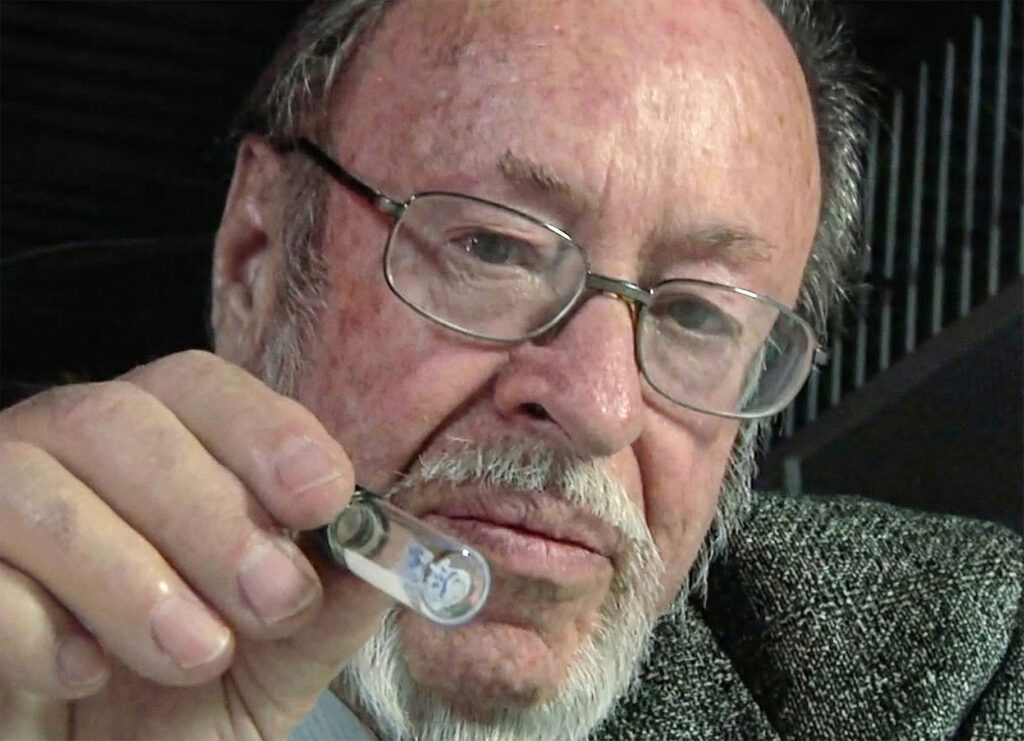
Early life and medical career
Roger Krevin Leir was born in the San Francisco Bay Area on 20 March 1935 and moved to southern California in his early teens. He described a childhood imagination filled with flight and space travel, a theme that would later make his pivot into UAP investigation feel almost inevitable. (Scribd)
He took a very terrestrial path first. Leir earned a Bachelor of Science from the University of Southern California in 1961 and qualified as a Doctor of Podiatric Medicine in 1964. (ijsred.com) He spent more than four decades in Ventura County as a practicing podiatric surgeon, eventually serving as chief of podiatry at multiple Southern California hospitals and running a private clinic in Thousand Oaks. (Openminds.tv)
In colleagues’ accounts, this part of his life looked entirely conventional. He did reconstructive foot surgery, treated diabetic complications, and built a reputation as a careful, hands-on clinician. Nothing about his résumé predicted that he would wind up presenting at UFO conferences or arguing about isotopic ratios on late-night radio.
From MUFON volunteer to implant pioneer
Leir’s on-ramp into the UAP community came in the late 1980s, when he joined the local chapter of MUFON, the Mutual UFO Network. He wrote for the Ventura, Santa Barbara chapter’s publication The Vortex, covering sightings and abduction claims that crossed his desk. (ijsred.com)
The turning point arrived in 1995. At a MUFON event he was shown X-rays of two Texas experiencers who reported abduction narratives and had odd metallic densities in their extremities. As he later told interviewer L. A. Marzulli, his first reaction was ridicule; he assumed the images showed ordinary surgical hardware. (Scribd)
Instead of walking away, he agreed to help. Working with Houston-based investigator Derrel Sims and a volunteer surgical team, Leir performed the first two “implant” removals on 19 August 1995 at his Thousand Oaks clinic. (Medium)
According to their joint account:
- One patient, a Texas woman, had two small objects in her left great toe.
- A second patient had a similar object in his hand, removed by a general surgeon colleague. (Scribd)
The pathology reports were already odd enough for Leir to take notice. Lab analysis reported a lack of typical inflammatory response around the objects and the presence of nerve fibers where they would not normally be expected around a foreign body. (Scribd)
The objects themselves looked entirely unremarkable to many observers: tiny metallic fragments and rodlike pieces that might fit any emergency department’s catalog of “stuff people step on.” But for Leir the combination of patient narratives, imaging and tissue response suggested something more deliberate.
A&S Research, FIRST and the “implant surgeries”
To formalize the work, Leir helped found FIRST, the Fund for Interactive Research and Space Technology, with Sims as co-founder and lead investigator. (Medium) FIRST coordinated screening of possible abductees, imaging, and pre-surgical work-ups, while Leir headed the operating room.
He also created a separate non-profit, A & S Research Inc., specifically to coordinate scientific analysis of the removed objects. (Openminds.tv)
Across roughly two decades, different summaries give slightly different totals, but all agree this became an extended program rather than a one-off curiosity:
- Open Minds and A & S Research materials state that Leir’s team conducted fifteen surgeries on alleged abductees, removing sixteen objects that they interpreted as implants. (Openminds.tv)
- Other retrospective write-ups count seventeen objects from sixteen surgeries over about nineteen years. (UFO Insight)
What they claimed to find:
- Metallic objects typically 6–10 mm long, often near bone and close to the skin rather than deep organs. (UFO Insight)
- Some were covered in a tough, greyish biological membrane that resisted cutting with a surgical scalpel. (Scribd)
- In several cases, pathology reports allegedly showed little to no inflammatory response and unexpected nerve tissue integration. (Scribd)
According to A & S Research, multiple mainstream laboratories examined the samples, including Los Alamos National Laboratory, New Mexico Tech, Seal Laboratories, Southwest Labs, the University of Toronto, York University, and the University of California San Diego. (Openminds.tv)
Reported anomalies included:
- Metallic compositions similar to meteoritic iron, sometimes with unusual crystalline inclusions.
- Isotopic ratios that the group described as “not of this world.”
- Alleged radio-frequency emissions in the “deep space” band from certain objects pre-removal. (Scribd)
Independent corroboration of these specific claims is limited. The New Mexico Institute of Mining and Technology, for example, analyzed early samples and reported that they were composed of common elements such as iron or aluminum, noting only that some elements resembled those found in meteorites. Leir took that meteorite comparison as support for an extraterrestrial origin; the lab itself did not endorse that conclusion.
Books, case studies and a growing platform
By the late 1990s, Leir had become a fixture in abduction circles and began publishing his findings.
The Aliens and the Scalpel
His first major book, The Aliens and the Scalpel: Scientific Proof of Extraterrestrial Implants in Humans (Granite Publishing, 1998; reissued by Book Tree in 2005), lays out early surgeries, lab reports and speculation that the implants function as some kind of nano-transmitter. (Google Books)
In interviews he argued that about 15 percent of abductees might carry such devices and compared his work to wildlife biologists tagging animals for study. (Scribd)
Casebook: Alien Implants
Casebook: Alien Implants (Dell, 2000) expanded the narrative with eight detailed patient histories and X-ray imagery, published under Whitley Strieber’s “Hidden Agendas” imprint. (Bookshop.org)
The marketing copy is blunt: it calls the objects “hard evidence” that “did not come from Earth,” a framing that solidified Leir’s reputation as the surgeon who dared to say the quiet part out loud.
UFO Crash in Brazil
In 2003 Leir traveled to Varginha, Brazil, to investigate eyewitness claims that a non-human craft had crashed there in 1996 and that entities were recovered by the Brazilian military. (Openminds.tv) He published his reconstruction in UFO Crash in Brazil: A Genuine UFO Crash with Surviving ETs (Book Tree, 2005). (Google Books)
The book assembles testimony from local witnesses, police and military sources and argues that at least one non-human entity survived for a time under Brazilian custody. These claims remain hotly debated and contrast with official denials and more prosaic explanations from Brazilian authorities. (Openminds.tv)
UFOs Do Not Exist: The Greatest Lie That Enveloped the World
Published in 2014, UFOs Do Not Exist: The Greatest Lie That Enveloped the World pushes beyond case reports to a thesis: that governmental and institutional actors have systematically denied a demonstrable UAP reality. The book includes a foreword by Apollo 14 astronaut Edgar Mitchell, who had spoken publicly about his belief that some UAP cases involve non-human intelligence. (Amazon)
The title is deliberately ironic. “UFOs do not exist” are the words of official denials; Leir’s counterclaim is that the implants, crash cases and enduring witness testimony collectively undermine that line.
Media presence and public appearances
Once his implant work became known, Leir was frequently in demand as a guest and speaker.
- He appeared repeatedly on Coast to Coast AM with Art Bell and later George Knapp, often alongside Whitley Strieber, to discuss abduction narratives and implant surgeries. (Coast to Coast AM)
- He was a regular speaker at conferences, including the International UFO Congress in 2013, where he was photographed presenting the latest implant data. (Openminds.tv)
- New Zealand media covered his 2007 appearance at a UFOCUS conference, noting that even some believers in the audience struggled with aspects of his presentation. (NZ Herald)
- In 2013 he testified at the “Citizen Hearing on Disclosure” at the National Press Club in Washington, D.C., offering implant cases and the Varginha investigation as part of a broader argument for serious official inquiry into UAP. (Openminds.tv)
Even after his death, his presence continued in reruns and archive shows. Coast to Coast regularly rebroadcasts his late-1990s and early-2000s programs as “Somewhere in Time” specials, preserving his style and arguments for new audiences. (Coast to Coast AM)
The Turkey case: up close with an anomalous craft
Beyond implants, the other major pillar of Leir’s UAP legacy is the Kumburgaz, Turkey case.
Between 2007 and 2009, a night watchman named Yalçın Yalman filmed a series of anomalous objects over the Sea of Marmara near Kumburgaz, producing hours of zoomed-in footage. The videos appear to show a structured, dark object with a bright rim, sometimes with a “port” through which humanoid shapes seem visible.
Leir traveled to Turkey and was present during some of the 2009 filming sessions. He later stated publicly that he watched the object through binoculars as Yalman recorded, and that in his view the footage is “100 percent real” and shows non-human occupants. (youtube.com)
The footage was analyzed by TÜBİTAK, the Turkish state Scientific and Technology Research Board, which concluded that the images were not computer animation, models or studio effects and that the objects qualified as “unidentified flying objects” in the strict descriptive sense. (turkeyufocase.blogspot.com)
Subsequent analyses by independent researchers and skeptics have proposed cruise ships, mirages and model work as alternatives, while others, including Jacques Vallée, have argued that the footage deserves to be treated as “genuine” in the sense that the object captured remains unexplained. (Reddit)
Leir’s firm advocacy for the Turkey case as visual proof of non-human craft reinforced his role as a physical-evidence maximalist within the UAP community.
Known connections and collaborative ecosystem
Although Leir’s name is most tightly linked to implants, he operated within a dense network of researchers, experiencers and media figures:
- Derrel Sims – Abduction investigator and co-founder of FIRST, Sims provided many of the early patients and served as chief investigator on multiple cases. (Medium)
- Whitley Strieber – The Communion author partnered with Leir on Casebook: Alien Implants and hosted him on radio and conference stages, helping mainstream the implant narrative among abduction readers. (Bookshop.org)
- Edgar Mitchell – The Apollo 14 astronaut wrote the foreword to UFOs Do Not Exist, lending his name to Leir’s broader argument about institutional denial. (Amazon)
- George Knapp and Art Bell – As hosts of Coast to Coast AM, they re-framed Leir’s surgical stories for mass late-night audiences and later worked with him on coverage of the Turkey case. (Coast to Coast AM)
- Jeremy Kenyon Lockyer Corbell – The filmmaker behind Patient Seventeen centered his 2017 documentary on one of Leir’s later surgeries and the mystery of a single object removed from “Patient 17.” (IMDb)
This web of relationships situates Leir inside a broader UAP research ecosystem: physical-evidence advocates, abduction chroniclers, sympathetic scientists and documentary storytellers.
Patient Seventeen and the posthumous mystery
Patient Seventeen documents what became Leir’s final implant surgery, on an anonymously identified man who believed he had been subject to repeated contact. The film follows the surgical removal of a small object from the patient’s leg and the subsequent lab analyses. (Apple TV)
Corbell’s documentary highlights some intriguing results: unusual isotopic ratios, traces of elements associated with meteorites, and complex internal structure. At the same time, outside experts consulted in the film, including a UCLA meteorite specialist, are cautious and stress that more testing is needed before any claim of non-terrestrial origin could be made. (VICE)
The plot twist worthy of a UAP case file comes after Leir’s death, when his close collaborator Steve Colbern temporarily disappears from contact with both Corbell and the patient while in possession of the object. Corbell later recovered it and has discussed plans for renewed testing.
Controversies and skeptical responses
From early on, Leir’s work drew sharp criticism.
Skeptical investigator Joe Nickell reviewed implant claims in his book Real-Life X-Files and subsequent articles. He argued that all alleged “alien implants,” not just Leir’s, are consistent with ordinary foreign bodies: shards of glass, bits of metal, carbon fibers and other debris that become embedded through accidents or barefoot walking, then encapsulated in scar tissue.
Nickell and others also faulted what they saw as poor scientific process, noting that:
- Requests from independent forensic institutions for direct access to specimens or high-quality imagery were sometimes refused by investigators associated with Leir’s circle, particularly in earlier cases.
- Lab reports cited as evidence of non-terrestrial isotopic ratios or exotic structure were rarely published in peer-reviewed venues or released in full for scrutiny. (Creation.com)
Even within the UAP community, not everyone was persuaded. A report from a New Zealand conference in 2007 described audience members as unconvinced by aspects of Leir’s presentation about implants. (NZ Herald)
Leir, for his part, became increasingly combative about critics. In interviews he dismissed “so-called skeptics” as non-investigators who offered proclamations instead of engagement with data, and he believed some were effectively paid debunkers. (Scribd)
This hardened stance contributed to a polarization that still surrounds his name. For some, he was an early martyr of scientific gatekeeping. For others, he was a case study in how enthusiasm can outrun methodology.
Claims taxonomy: how we classify Roger Leir’s key assertions
Claim 1: Some surgically removed metallic objects are manufactured non-human devices placed by a technologically advanced intelligence.
- Type: Physical artifact claim.
- Evidence cited: Surgeries on 15–16 patients; objects lacking inflammatory response; alleged neural integration; lab reports suggesting unusual isotopic ratios and meteoritic or exotic features. (Openminds.tv)
- Counter-evidence / alternative views: At least one lab (New Mexico Tech) reported ordinary terrestrial composition; skeptical investigators argue all such objects are consistent with accidental foreign bodies but with minimal peer-reviewed analyses.
- Status: Disputed – physical evidence claim.
Claim 2: These implants function as radio-frequency transmitters or monitoring devices.
- Type: Functional hypothesis.
- Evidence cited: Reports of RF emissions in deep-space bands from some objects; descriptions of nano-scale structure; analogies to wildlife tagging. (Scribd)
- Counter-evidence / alternative views: RF measurements are not fully documented; other explanations (instrument noise, environmental signals) are proposed; no widely replicated demonstration of data transmission.
- Status: Hypothesis – requires replication and open data.
Claim 3: The 1996 Varginha case represents a genuine crash of a non-human craft with surviving entities captured by Brazilian authorities.
- Type: Historical incident reconstruction.
- Evidence cited: Multi-witness testimony gathered in UFO Crash in Brazil; local press reports; later ufological investigations. (Google Books)
- Counter-evidence / alternative views: Official denials; explanations involving misidentified humans and routine military activity; lack of publicly released physical evidence. (Openminds.tv)
- Status: Controversial case – non-prosaic possibility not excluded, but evidence remains contested.
Claim 4: The Kumburgaz, Turkey videos show a non-human craft with visible occupants and are “100 percent real” in that sense.
- Type: Instrumental (video) evidence claim.
- Evidence cited: Hours of footage filmed over three years; simultaneous visual observation by multiple witnesses including Leir; TÜBİTAK determination that footage is not a studio hoax; analyses rejecting some prosaic explanations. (turkeyufocase.blogspot.com)
- Counter-evidence / alternative views: Competing analyses propose distant ships or mirage effects; limited resolution and lack of corroborating sensor data; some video artifacts consistent with digital zoom limits. (Reddit)
- Status: Persistent anomaly – prosaic explanations remain plausible, but UAP classification is not excluded.
Claim 5: “UFOs do not exist” is a false narrative maintained by authorities despite decisive evidence to the contrary.
- Type: Institutional behavior / secrecy claim.
- Evidence cited: Long-term patterns of denial; implant claims; crash narratives like Varginha; insider statements highlighted by Leir and contemporaries such as Edgar Mitchell. (Amazon)
- Counter-evidence / alternative views: Governments and militaries exhibit mixed behavior ranging from denial to partial acknowledgement of UAP; “decisive evidence” is still debated within science; some secrecy is plausibly tied to defense classification rather than a single global lie.
- Status: Partially supported systemic secrecy claim – documented under-reporting and stigma exist, but the strength of evidence for a unified “greatest lie” remains unproven.
Implications and impact
- If even one implant is truly non-terrestrial, biomedical contact has already occurred.
Speculation label (Hypothesis): A single confirmed non-human device integrated into human tissue would imply an ongoing, technology-mediated study or management of human populations by some form of non-human intelligence. - Implant narratives may be an under-explored subset of contact phenomena.
The broader UAPedia taxonomy already tracks physical injuries, physiological effects and “implant detection” as recurring motifs in contact reports. Leir’s work, whether ultimately vindicated or not, helped move “objects under the skin” from the fringes into the main analytical frame. - Experimental design in UAP research must harden.
Whatever one thinks of his conclusions, Leir’s projects show the stakes of methodology. Chain of custody, open publication of lab data, and pre-registered analyses are the minimum standard if future implant cases are to be decisive rather than endlessly argued. Speculation label (Researcher opinion). - Public imagination and stigma.
Leir’s surgeries, conference talks and the Patient Seventeen documentary helped crystalize the “alien microchip” image in popular culture. That likely has a feedback effect on abduction narratives and may influence how experiencers interpret ordinary medical conditions.
Selected publications and media
- Leir, R. K. (1998/2005). The Aliens and the Scalpel: Scientific Proof of Extraterrestrial Implants in Humans. Granite Publishing / Book Tree. (Google Books)
- Leir, R. (2000). Casebook: Alien Implants (Whitley Strieber’s Hidden Agendas). Dell. (Bookshop.org)
- Leir, R. K. (2005). UFO Crash in Brazil: A Genuine UFO Crash with Surviving ETs. Book Tree. (Google Books)
- Leir, R. (2014). UFOs Do Not Exist: The Greatest Lie That Enveloped the World. Book Tree. (Indigo)
- Audio – Reality UFO Series: Alien Implants (Audible original lecture). (audible.com)
- Documentary – Patient Seventeen (2017), dir. Jeremy Kenyon Lockyer Corbell. (Apple TV)
- Turkey case hub – “National Observatory report” on the Kumburgaz case (unofficial English translation of TÜBİTAK report). (turkeyufocase.blogspot.com)
References
Bates, G. (2021). Are alleged alien implants really extraterrestrial in nature? Creation.com. (Creation.com)
Book Tree. (2005). UFO Crash in Brazil: A genuine UFO crash with surviving ETs: A thorough investigation (R. K. Leir). San Diego, CA: Book Tree. (Google Books)
Corbell, J. K. L. (Director). (2017). Patient Seventeen [Documentary film]. (Apple TV)
Leir, R. K. (2005). The Aliens and the Scalpel: Scientific proof of extraterrestrial implants in humans. San Diego, CA: Book Tree. (Google Books)
Leir, R. (2000). Casebook: Alien Implants. New York, NY: Dell. (Bookshop.org)
Leir, R. (2014). UFOs Do Not Exist: The greatest lie that enveloped the world. San Diego, CA: Book Tree. (Amazon)
McClellan, J. (2014, March 17). A leader in the field of alleged alien implant research passes. Open Minds TV. (Openminds.tv)
Nickell, J. (2001). Real-life X-Files: Investigating the paranormal. Lexington, KY: University Press of Kentucky. (Deadnet)
“Roger Leir.” (n.d.). Wikipedia. Retrieved 2024. (Wikipedia)
Turkey UFO Incident: The Kumburgaz case 2007–2009. (n.d.). Turkey UFO Case. (turkeyufocase.blogspot.com)
SEO keywords
Dr Roger Leir biography, Roger Leir alien implants, UAP abduction implants, A&S Research alien implant surgery, FIRST Fund for Interactive Research and Space Technology, Kumburgaz Turkey UFO case occupants, Varginha Brazil crash Roger Leir, Patient Seventeen documentary implant, UFOs Do Not Exist Greatest Lie That Enveloped the World, The Aliens and the Scalpel scientific proof of extraterrestrial implants, Casebook Alien Implants Whitley Strieber Hidden Agendas, UAP physical evidence researcher, alien implant radio frequency emissions, Turkey TÜBİTAK UFO report, UAPedia experiencer research investigators