
There are UAP stories that feel like campfire tales, all vibes and no paperwork. Then there are UAP stories that come with signatures, timestamps, military routing notes, and the kind of reluctant language used by people whose jobs depend on not embarrassing themselves.
The Exeter Incident is firmly in the second category.
It is also, in a strange way, a story about how modern America learned to talk about anomalous things in the sky. Not just “What did you see?”, but “Who are you?”, “What’s your training?”, “What would you lose by lying?”, and “Why does the official explanation keep changing while the witnesses stay oddly consistent?”
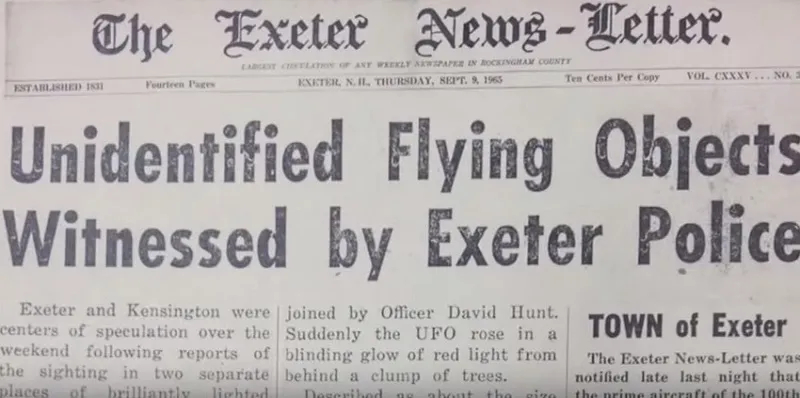
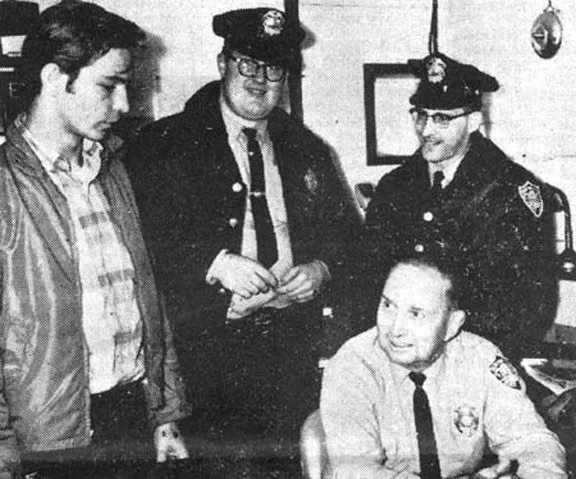
On an early-September night in 1965, in the fields and back roads just outside Exeter, New Hampshire, a young man hitchhiking along Route 150 reported a cluster of intense red lights. Within minutes, at least one Exeter police patrolman, and then another, would see the same lights at close range. One of those officers would later describe dropping to the ground and reaching for his service weapon as the lights advanced. Farm animals, the officer added, erupted into noise.
And then came the familiar second act: the institutional machine that tried to translate a raw event into a neat category. The Pentagon’s public line leaned on atmospheric effects and “stars and planets.” Project Blue Book hinted at a Strategic Air Command operation called “Big Blast,” and still hedged. Meanwhile, an Air Force officer at nearby Pease Air Force Base filed a conclusion that reads like a man refusing to pretend: he could not identify what the witnesses saw, and he considered them stable and reliable, especially the patrolmen. (Center for UFO Studies)
Exeter is not just a “sighting.” It is a case study in credibility under pressure, in how testimony behaves when it is cross-examined by authority, and in how a small-town event can become a national argument about reality.
If you want the original documents and the long paper trail, start with NICAP’s Exeter case materials and supporting documents. (NICAP)
The night Exeter turned red
Let’s put you on that road.
It’s around 2:00 a.m. in the early hours of September 3, 1965. A young man, Norman J. Muscarello, is hitchhiking on Route 150 roughly three miles southwest of Exeter. His signed statement to the Air Force begins with a simple, almost procedural clarity: five bright red lights appear over a house about 100 feet away, aligned in a line at about a 60-degree angle. (Center for UFO Studies)
The lights are not distant pinpricks. He says they are so bright they “lighted up the area.” They move out over a field and drift in an irregular way he compares to “a floating leaf.” At points they dip behind trees or a house and then reappear, keeping the same angled alignment. The lights pulse in a specific sequence: 1,2,3,4,5,5,4,3,2,1. He watches about fifteen minutes. At one moment they seem to come so close he dives into a ditch to avoid being struck. Then they seem to drop behind trees into a field. He gets a ride to the Exeter Police Station and reports what he saw. (Center for UFO Studies)
That sequence matters. It is one of the details that would later become the hinge for competing explanations, because it is both very specific and oddly “engineered.” Random natural lights do not often present themselves as counting up and down.
Now the second voice enters the record: Patrolman Eugene F. Bertrand Jr.
In his signed statement, Bertrand describes being on patrol earlier that night when he stops to check on a parked automobile. Inside is a woman who says she is too upset to drive. She claims a light had been following her and had stopped over her car. Bertrand stays with her for about fifteen minutes but cannot see anything himself. (Center for UFO Studies)
Back at the station he encounters Muscarello, hears the report, and decides to take him back to the location.
This is the moment Exeter becomes what it remains today: not a lone witness story, but a converging testimony event.
At the location, Bertrand parks, turns off the cruiser lights, and initially sees nothing unusual. He and Muscarello step out with a flashlight and begin walking into the field. About fifty feet in, a group of five bright red lights emerges from behind nearby trees. Bertrand emphasizes intensity: “extremely bright,” flashing one at a time. (Center for UFO Studies)
The lights begin moving around over the field. Bertrand says they come so close that he falls to the ground and starts to draw his gun. There is no sound or vibration. But the farm animals are “upset” and making “a lot of noise.” When the lights begin coming near again, he and Muscarello run for the car. Bertrand radios another patrolman, David R. Hunt. Hunt arrives within minutes and also observes bright red lights flashing in sequence over the field, estimating them about half a mile away and roughly 100 feet in altitude before they move off and disappear. (Center for UFO Studies)
We can debate distance and altitude estimation, because humans are notoriously weak at both in darkness. But something else is harder to wave away: the way the witnesses behave in their own accounts. These are not people performing a story for an audience. The written statements read like men who want their night to stop being weird.
And that tone is part of the evidence.
Exeter wasn’t “one light,” it was a cluster
One reason Exeter got traction is that it didn’t arise in a vacuum. Investigators arriving afterward found a local pattern, a corridor of repeated reports, and a community already nervously aware that something odd was happening “out there” on those roads.
Raymond E. Fowler, working as a NICAP investigator in New England, documented multiple reports and the broader context. In his field reporting and interviews, he encountered witnesses describing recurring sightings along the routes outside Exeter, sometimes multiple nights per week, especially near the junctions of Route 88 and Route 101C. (Center for UFO Studies)
One case he recounts involves a woman and her teenage daughter describing an encounter in late July 1965, including a structured object impression at close range and recurring activity in what locals were already calling a kind of “UAP alley” outside town. Whatever you ultimately decide about any single one of those reports, the sociological point matters: by early September, Exeter was primed. People were looking. People were calling the police. The police were hearing enough to take calls seriously. (Center for UFO Studies)
This also complicates the “single misidentification” style of explanation. If Exeter were only one moment, one witness, one night, you could treat it as a perceptual glitch. But when a region accumulates repeated, independent reporting, the analytical problem shifts. You are no longer just explaining a stimulus. You are explaining a recurring pattern that seems to recruit multiple unrelated observers into similar descriptions.
That does not automatically prove a non-human origin. It does, however, raise the evidentiary bar for prosaic dismissal.
What the Air Force wrote down, and what it didn’t dare claim
Within the official record, the most telling document is not a press release. It is the quieter internal reporting.
An Air Force officer at Pease Air Force Base, in the report forwarded into the Project Blue Book pipeline, concluded: he could not arrive at a probable cause. He assessed the three observers as stable and reliable, especially the two patrolmen. He inspected the area and found nothing that could account for the sighting. He also noted that although Pease had B-47 aircraft flying in the area during that period, he did not believe they had any connection with the sighting. (Center for UFO Studies)
That’s an extraordinary paragraph, partly because of what it implies about the internal culture. If you are a base officer writing up a report that will travel through Air Force channels, you have every incentive to avoid the word “unidentified” unless forced. You are safer attributing it to aircraft, balloons, planets, or “insufficient information.”
Instead, this report does something rarer: it puts witness credibility on the record.
The same official material includes follow-on communications about refueling routes and checks of whether aerial refueling operations occurred in the area and time window. In other words, someone did attempt to ground the investigation in operational reality, not just public relations. (Center for UFO Studies)
But the public story that emerged was less careful.
The Pentagon’s explanation problem
By late October 1965, the Pentagon issued an explanation that leaned on two familiar pillars: military activity in the area and atmospheric effects.
In a press account reproduced in the documentary trail, a Pentagon spokesman described “multiple objects” in the area tied to a Strategic Air Command exercise out of Westover, Massachusetts, and added “weather inversion” effects that cause “stars and planets to dance and twinkle,” concluding that what people saw were stars and planets in unusual formations. (Center for UFO Studies)
It is hard to overstate how mismatched this is to the police testimony.
“Stars and planets” do not rise from behind trees fifty feet away, flood a field with red light, trigger panic in trained officers, or generate a sequential pulsing pattern that can be counted like a machine. Temperature inversions can produce optical distortions near the horizon, and they can create strange apparent motion. But the inversion explanation only sounds plausible if you strip away the close-range, low-altitude framing and treat the case as “lights in the sky, probably far away.”
That stripping-away is not a neutral act. It changes the case.
And the officers noticed.
In a reply to Project Blue Book after the Pentagon’s “final evaluation,” Bertrand and Hunt described the ridicule they faced and pushed back on the mismatch between what they reported and what was being publicly claimed. They emphasized that they saw the object at close range, confirmed between themselves that it was not a conventional aircraft, and took pains to verify conditions like clear weather and lack of wind. They also pointed out a basic procedural inconsistency: Blue Book wrote them saying it was still making a final evaluation, yet a final evaluation had already been released publicly. (Center for UFO Studies)
In February 1966, the Air Force’s Office of Information sent a letter stating that, based on additional information the officers submitted, they had been unable to identify the object observed on September 3, 1965. (Center for UFO Studies)
So in the span of months, the “answer” moved from stars and planets, to military aircraft and inversions, to “unable to identify.”
If you are trying to understand why public trust in official UAP handling eroded, Exeter is a clean example. The record does not show a single coherent conclusion. It shows an institutional desire to end the story, and a set of witnesses who refused to cooperate with that ending.
For broader context on how Project Blue Book managed data, categorizations, and public communication, see UAPedia’s Blue Book archive overview. (UAPedia)
Exeter goes to Congress
One of the most underappreciated aspects of Exeter is that it didn’t stay local, and it didn’t stay in the “just civilians” bucket.
In the 1966 House Armed Services Committee hearings on unidentified flying objects, Exeter appears in the documentary flow. The hearing record includes a letter from Raymond E. Fowler submitting the Massachusetts subcommittee file on Exeter and explicitly citing the case’s national publicity, including coverage connected to NICAP-supported reporting in mainstream magazines. (ia600300.us.archive.org)
The same hearing material includes press excerpts describing the incident in terms that match the witnesses: a large object, a red glow or halo, silent movement, and police involvement. (ia600300.us.archive.org)
Pause on what that means historically.
This was the mid-1960s. The country was deep in Cold War infrastructure, nuclear posture, and air defense anxiety. For a local UAP event to rise to the level of being included in congressional hearings, you need a mix of public pressure and credible-seeming testimony. Exeter, with police officers in the chain of observation, provided that.
It’s also a reminder that UAP history is not just about lights. It is about governance. Exeter is part of the thread that leads to later hearings, later scientific panels, and later debates about whether government studies were truly designed to investigate or merely to contain. (Internet Archive)
The journalist who made Exeter impossible to forget
Modern readers often meet Exeter through a book title: John G. Fuller’s Incident at Exeter.
Fuller did not just report the story. He embedded himself in the town, recorded interviews, and helped shape how the case would be remembered. In Fowler’s recounting of events, Fuller approached the case skeptically and insisted on reinvestigating it personally before writing. The story then moved through a very specific pipeline of 1960s mainstream media: a Saturday Review column, then a Look magazine feature, then a Reader’s Digest condensation, and finally the commissioning of a full book by G. P. Putnam. (Ondřej Procházka)
That trajectory matters because it shows why Exeter became more than an “interesting police report.” It became a national narrative at a time when print media still had the power to create shared realities.
If you want to hear the era in its own voice, there is also archival audio of Fuller reading from and discussing his work in 1966. (American Archive)
This is also where the case’s long-term controversy begins, because once you cross into mass media, you inherit both amplification and distortion. A reporter can preserve testimony, but can also harden a story into a canonical version that later investigators treat as scripture, even when the original documents are more cautious.
Exeter is one reason serious UAP research tends to insist on primary sources. You want the signed statements, the dates, the routing notes, and the correspondence. Not just the story people tell about the story.
The controversy: can Exeter be “explained” as an aircraft?
Any honest treatment of Exeter must wrestle with the strongest prosaic alternative explanations, not as a reflex, but as a stress test.
One of the most cited modern skeptical proposals comes from Joe Nickell and retired Air Force pilot James McGaha, published in Skeptical Inquirer (2011). Their key claim is that the witnesses’ distinctive light sequence matches the underside “boom” lighting of a KC-97 aerial refueling tanker, with five bright red lights flashing in a 1-to-5 and back pattern. McGaha also argues that the refueling boom, hanging at an angle, could appear to flutter or sway, echoing the “floating leaf” language. (Center for Inquiry)
Why does this explanation have traction?
Because it grabs the most “mechanical” detail in the case and offers a specific mechanical system that could generate it. That is better than hand-waving about “planets,” which does not even attempt to match the pattern.
But does it fully close the case?
Not cleanly.
First, the Air Force documentation itself shows internal checking of refueling routes and reports that no refueling operations were conducted in the New England area during the time in question, at least according to the records consulted in the investigative chain. (Center for UFO Studies)
Second, the police testimony emphasizes an absence of aircraft signatures: no engine noise, no vibration, no rush of air, and the impression of a low altitude over a field. (Center for UFO Studies)
Third, the behavior described is not a simple flyover. The lights appear from behind trees close by, maneuver around over a field, advance toward observers, retreat, and then depart. Aircraft can create surprising illusions at night, especially with landing lights or specific approach angles, but “advancing toward two men on foot in a field until one drops and reaches for his gun” is a high bar for a misperception story. (Center for UFO Studies)
A reasonable critic can reply: in darkness, distance collapses; aircraft seen head-on can appear to hover; a moving aircraft can seem to “approach” if the observer is stationary and startled.
That’s fair. And yet the case persists precisely because Exeter does not behave like a fragile story. It has multiple witnesses, including police, and it includes a record of official back-and-forth that ends not in certainty, but in “unable to identify.” (Center for UFO Studies)
In UAP research, that combination is the stubborn core: testimony strong enough to force the system into ambiguity.
The deeper implication Exeter leaves behind
If Exeter were only about whether a tanker flew by at the wrong moment, it would be a niche debate for aviation hobbyists. Instead, it’s one of the cases that helped define the modern UAP problem: credible witnesses report a structured anomaly; official channels respond with shifting explanations; public confidence erodes; and the event becomes a touchstone.
Exeter also highlights something uncomfortable: the role of ridicule as a tool of containment. The patrolmen’s letter makes clear that whatever they saw, the social punishment for reporting it was real. Their concern was not abstract. Their professional credibility was on the line. (Center for UFO Studies)
That dynamic is why figures like J. Allen Hynek matter in the Exeter story, even when he is not the protagonist in the field that night. Hynek’s broader career is, in part, a record of what happens when trained observers report anomalies and institutions respond with dismissal instead of method. (UAPedia)
Exeter therefore becomes a lens through which to view later developments: the push for better data, the insistence on taking testimony seriously, and the recognition that UAP are not only “objects,” but a friction point between lived experience and institutional narratives.
For a wider look at the closure-era framing of UAP by official science panels, the Condon Report remains a key historical node, regardless of how one evaluates its conclusions. (UAPedia)
Exeter’s cultural afterlife: from stigma to civic identity
The story didn’t die when the lights vanished.
Over decades, Exeter gradually transformed the incident from an embarrassment into a strange kind of civic signature. By the 21st century, the town and the surrounding region began hosting the Exeter UAP-themed festival as a fundraiser, drawing researchers, skeptics, and the curious, while keeping a family-friendly tone. (AP News)
Even the police department has leaned into the history in a modern, community-facing way, including commemorative patches sold in connection with festival events, with proceeds supporting programs like a police comfort dog initiative. (Granite Geek)
This matters because it shows how UAP events age.
At first: panic, disbelief, ridicule.
Later: paperwork, debate, re-investigation.
Eventually: local mythology that is still anchored to the fact that, in 1965, two patrolmen signed statements saying they saw something they could not explain. (Center for UFO Studies)
That arc is not unique to Exeter, but Exeter is unusually clean as an example because the witness set includes law enforcement, and the official response is recorded in a way that reveals institutional uncertainty.
Claims taxonomy
Probable
The Exeter Incident is best categorized as Probable. The case features converging eyewitness testimony from multiple observers, including two police patrolmen, alongside official documentation and investigative correspondence. At the same time, the absence of publicly available multi-sensor confirmation leaves room for unresolved conventional explanations, including aircraft-based interpretations that match some aspects of the light pattern. (Center for UFO Studies)
Speculation labels
Hypothesis
Exeter represents a structured, intelligently controlled UAP operating at low altitude. The “counting” light sequence, close-range maneuvering, and apparent responsiveness to observers fit a pattern seen in other high-strangeness, close-encounter-style cases, even when the underlying mechanism remains unknown. This hypothesis treats the lights as part of a craft-like system rather than an incidental lighting configuration. It remains a hypothesis because Exeter lacks instrumented data such as radar tracks, photographs, or recovered material in the public record. (Center for UFO Studies)
Witness Interpretation
The police officers and the hitchhiking witness described the phenomenon as not resembling conventional aircraft behavior, emphasizing silence, low altitude over a field, and intense illumination. Their statements also capture fear responses that suggest perceived proximity and threat, including taking cover and reaching for a weapon. (Center for UFO Studies)
Researcher Opinion
Investigators connected to NICAP treated the case as significant enough to compile extensive documentation and to push it into national visibility and even into congressional materials. The broader Hynek-era critique, echoed across UAP research history, is that dismissive explanations that do not match the core witness claims function more as narrative management than investigation. (ia600300.us.archive.org)
References
Associated Press. (2015, September 4). New Hampshire town celebrates notable ’65 UAP sighting. (AP News)
Fuller, J. G. (1966). Incident at Exeter: The story of unidentified flying objects over America today. G. P. Putnam’s Sons. (Google Books, Internet Archive)
Nickell, J., & McGaha, J. (2011). “Exeter Incident” Solved! A classic case, forty-five years “cold”. Skeptical Inquirer. (Center for Inquiry)
National Investigations Committee on Aerial Phenomena (NICAP). (1965–1966). Exeter, New Hampshire (Muscarello/police witness case) report and documents. (NICAP)
U.S. House of Representatives, Committee on Armed Services. (1966). Unidentified flying objects: Hearing… (Includes Exeter-related submissions and exhibits.) (ia600300.us.archive.org)
UAPedia. (n.d.). Project Blue Book Records & Data Archives. (UAPedia)
UAPedia. (n.d.). Dr. J. Allen Hynek, the Scientist Who Made the Study of UAP Possible. (UAPedia)
UAPedia. (n.d.). The Condon Report. (UAPedia)
SEO keywords
Exeter Incident 1965, Exeter New Hampshire UAP, Norman Muscarello, Eugene Bertrand, David Hunt, Route 150 UAP, Pease Air Force Base UAP, Project Blue Book Exeter, Operation Big Blast, NICAP Exeter report, Raymond Fowler Exeter, John G. Fuller Incident at Exeter, congressional hearing UAP 1966, police witness UAP case, red lights UAP, classic UAP encounter, New England UAP flap