
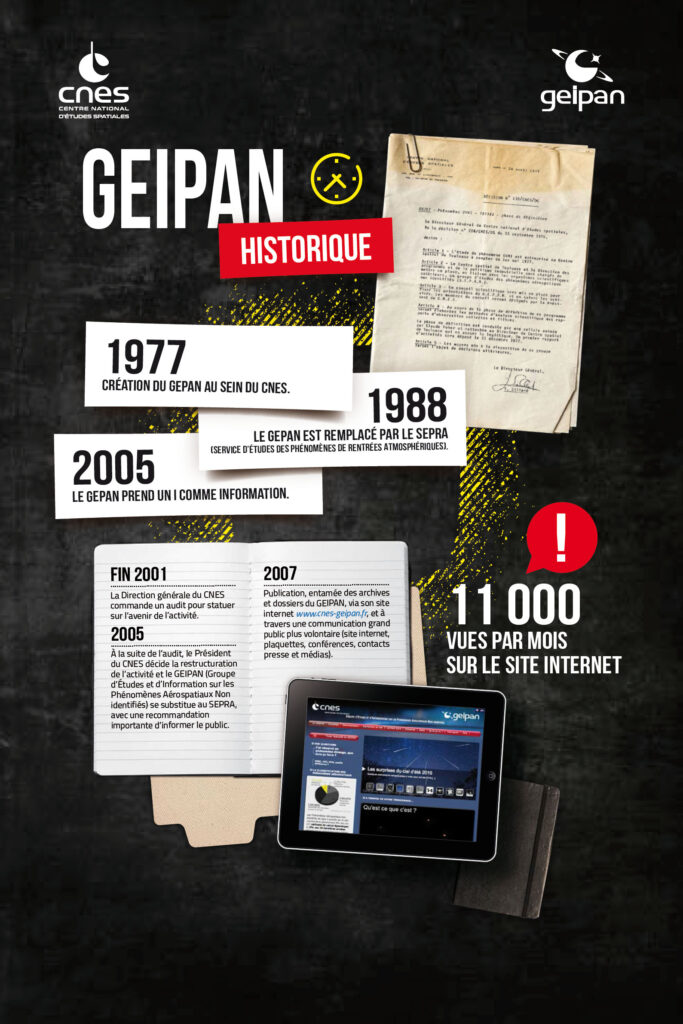
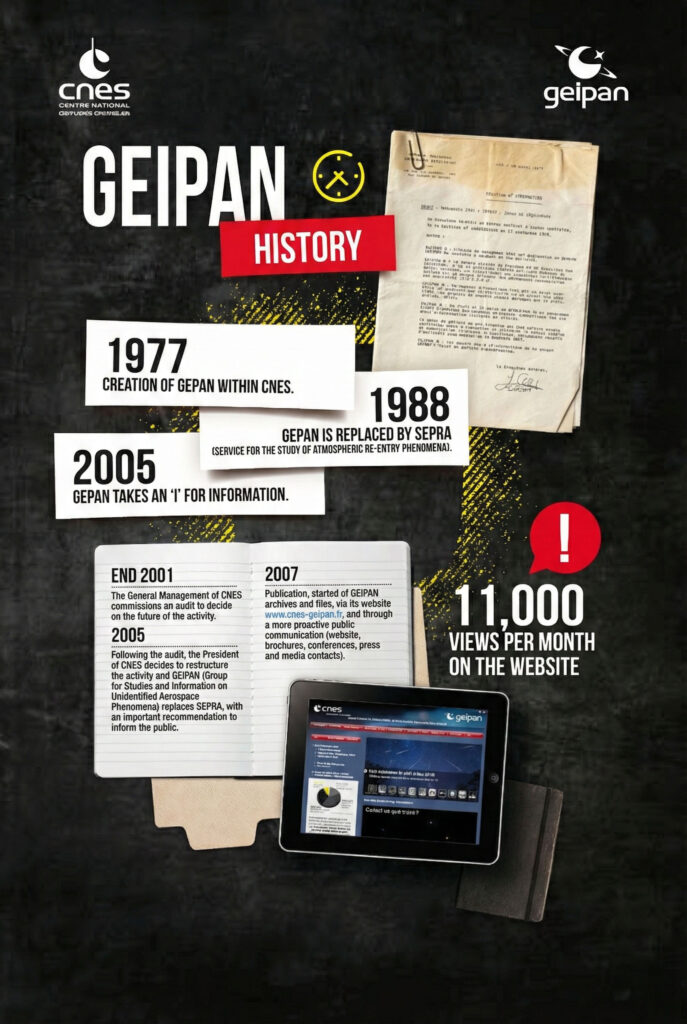
France is the only major spacefaring nation that has maintained a continuous, state-backed UAP function for nearly five decades. Housed inside CNES (the French Space Agency), the program began as GEPAN in 1977, evolved into SEPRA in 1988, and, after reforms, relaunched as GEIPAN in 2005. Its remit is practical and procedural: collect, analyze, archive, and publish UAP (PAN, in French) cases while coordinating with civil/military partners and protecting witness privacy. GEIPAN today operates a searchable, public case database with A/B/C/D1/D2 classifications, a clearly documented methodology, and working agreements with the Gendarmerie Nationale, the Air & Space Force, civil aviation (DGAC), and Météo-France, among others. cnes-geipan.fr
Mandate: what GEIPAN is, and isn’t
Core mission threads
- Collection. GEIPAN receives reports directly through its online questionnaire and via police/gendarmerie reports. Telephone or casual e-mail isn’t sufficient; the intake requires a structured technical questionnaire to enable analysis. cnes-geipan.fr
- Analysis & investigation. A seven-step reproducible methodology governs case handling: intake, case creation, first analysis, deeper investigation, classification (A/B/C/D1/D2), anonymization, and witness notification & publication. On-site investigations occur when warranted; radar and other data can be requested from partner entities. cnes-geipan.fr
- Archiving & publication. GEIPAN publishes the testimony documents and investigation conclusions on its website with witness anonymity preserved. Publication may be skipped for trivial cases explainable without investigation; otherwise a case file is posted. cnes-geipan.fr
- Coordination. GEIPAN has conventions allowing rapid access to concrete information from Gendarmerie Nationale, Armée de l’air et de l’espace, DGAC (civil aviation), Météo-France, and scientific partners (CNRS, universities). A multi-agency steering committee includes reps from the Air & Space Force and Gendarmerie. cnes-geipan.fr
- Public information. Beyond cases, GEIPAN runs educational content, hosts scientific workshops (e.g., CAIPAN 2014 & 2022), and publishes methodological papers and case reports. cnes-geipan.fr
What GEIPAN explicitly is not
- Not a “belief” office. GEIPAN’s own pages stress it is not a specialist of “the phenomenon” itself in the sense of promoting any single cause; its job is to explain observations using known aerospace and environmental phenomena when possible. cnes-geipan.fr
- Not a secrecy silo. Its model defaults to publication, after anonymization, with a living statistics page and downloadable material for many cases, including full “compte rendu d’enquête” (investigation reports). cnes-geipan.fr
The database: structure, scope, and how to use it
Access & search
GEIPAN’s public Case Search interface lets you filter by classification (A, B, C, D, D1, D2), region/department, observation type (aeronautical/maritime/ground), date, and whether photos/videos are available. The listings include new and revised cases and provide map views for metropolitan France and overseas territories. cnes-geipan.fr
The Statistics section provides dynamic, rolling metrics that update with the published corpus. As of August 21, 2025, GEIPAN reported 3,239 cases in its statistical base with the following breakdown:
- A (Perfectly identified): 27.2% (881 cases)
- B (Probably identified): 38.7% (1,254 cases)
- C (Insufficient data): 30.9% (1,002 cases)
- D (Unidentified after investigation): 2.16% (102 cases)
- D1 (Unidentified, medium consistency): 0.99%
- D2 (Unidentified, strong consistency): 0% (Note: D and D1/D2 percentages are shown separately; D2 can be zero in a given dynamic slice.) cnes-geipan.fr
These public stats align closely with figures shared on the CNES project page (“chiffres clés”), which frames D-class cases at ~3% in wider historical summaries and emphasizes the predominance of A/B identifications. CNES
File contents & downloads
Many entries include a PDF investigation report detailing witness accounts, geometry, sky models, star charts, radar requests, and elimination testing, e.g., Pointel (61) 29.04.2025 (classified A: military aircraft), and other technical annexes showing how meteors, aircraft, or celestial bodies are discriminated using simple kinematic and photometric checks. Geipan
The case search page advertises CSV files aggregating cases and testimonies, which facilitates external analysis (e.g., by year, region, or classification) a quietly powerful open-data-lite feature for a national UAP office. cnes-geipan.fr
Classifications (evidence-first taxonomy)
- A – Perfectly identified phenomenon
- B – Probably identified phenomenon
- C – Unidentified due to lack of data
- D – Unidentified after investigation
- D1 – Unidentified after investigation; medium consistency
- D2 – Unidentified after investigation; strong consistency
The expanded D1/D2 scheme (in use since 2008) balances weirdness against consistency (quality/coherence of data), a recognition that “strangeness” alone is not an evidence grade. cnes-geipan.fr
Methodology and tools: from intake to publication
GEIPAN’s 7-step workflow is the backbone of its reproducibility:
- Collect testimony (questionnaire or police/gendarmerie deposition).
- Create record (case file).
- First analysis (plausibility, immediate matches to known phenomena).
- Investigation & processing (data gathering, site visits if needed, expert inputs).
- Classification (A/B/C/D1/D2).
- Anonymization (privacy by design).
- Inform witness & publish (unless trivial, in which case a direct answer may suffice and no publication is made). cnes-geipan.fr
Data sources typically include:
- Astronomical ephemerides (planets, bright stars, satellites);
- Aviation data (flight plans, military activity via CAPCODA and Air & Space Force channels);
- Meteorology (Météo-France datasets, wind profiles for balloons/lanterns);
- Radar returns (requests via Air & Space Force CNOA);
- Imaging forensics (still/video EXIF, lens modeling, trajectory, motion blur). Recent GEIPAN news confirms IPACO as its preferred image/video authentication suite. cnes-geipan.fr
On-site investigations occur in roughly ~10% of cases, and GEIPAN periodically re-audits older “D” cases using improved tools; in 2017, fifty “D” cases were re-investigated and re-explained, an instructive indicator that D is not a final verdict but a moving boundary as data improves. cnes-geipan.fr
Transparency and privacy: how “open” is GEIPAN?
Transparency norms (publication by default)
- Case reports and conclusions are placed online, with documents and images when releasable.
- Dynamic statistics are public and time-stamped; the page indicates how the numbers are computed and what’s excluded (e.g., unfinished files). cnes-geipan.fr
Privacy norms (GDPR-aligned anonymization)
- Anonymization is an explicit step before publication. Personal data is removed, locations may be coarsened to department-level, and sensitive attachments are handled conservatively. cnes-geipan.fr
- France’s data-protection authority (CNIL) regularly issues GDPR guidance; while not specific to GEIPAN, its 2024–2025 recommendations reinforce minimization, prompt anonymization/pseudonymization, and clear notice, all approaches consistent with GEIPAN’s workflow. CNIL
Partners and oversight
- Formal conventions with the Gendarmerie, Air & Space Force, DGAC, and Météo-France enable quick access to radar, air traffic, and weather data. The steering committee includes uniformed and scientific representatives who can recommend improvements and ensure interoperability with state systems. cnes-geipan.fr
Conferences & community interface
- GEIPAN convened the CAIPAN workshops, Paris 2014 and Toulouse 2022, as open, cross-disciplinary forums on collection and analysis methods, featuring technical papers (e.g., Rospars on 1970s cases) and talks (e.g., Vallée on witness-centered parameters). Proceedings and slides are publicly hosted. cnes-geipan.fr
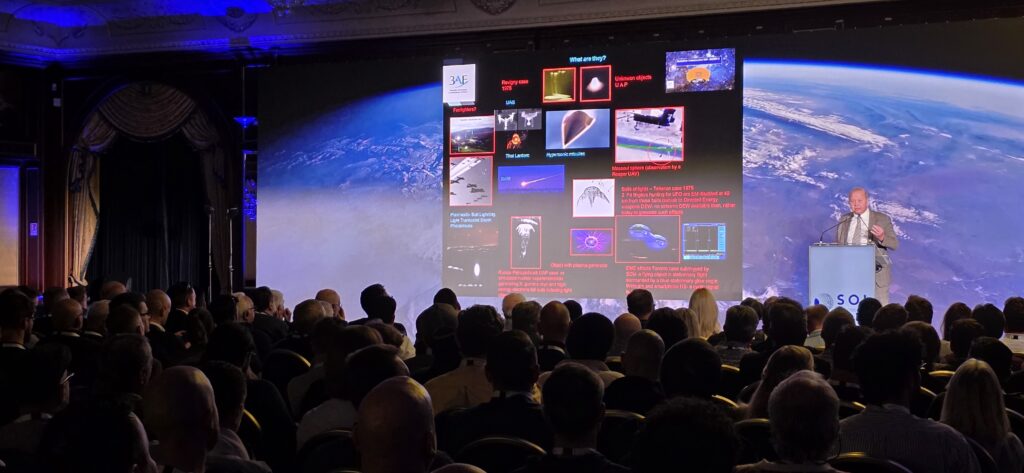
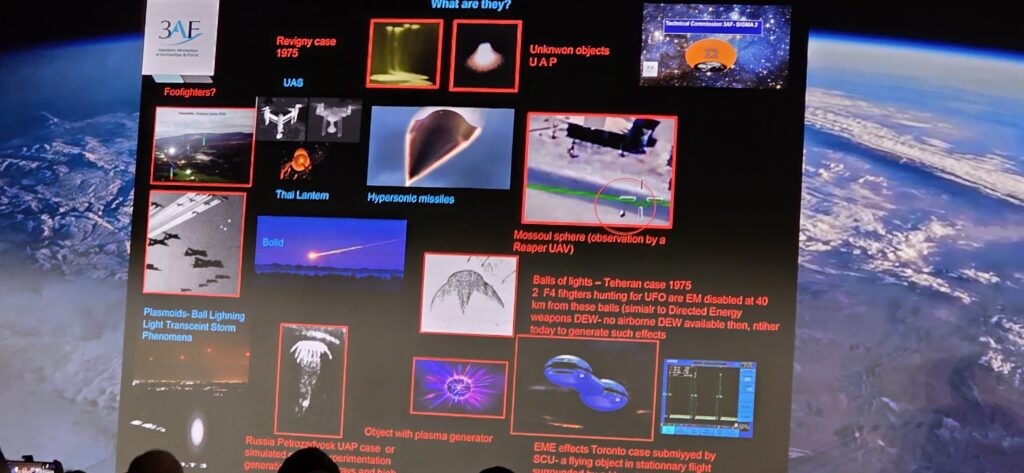
- Third-party professional groups (e.g., 3AF/SIGMA2) attend and publish their own summaries, further embedding GEIPAN into France’s aerospace research ecosystem. 3af.fr
What the numbers say (and don’t say)
Throughput and disposition
Recent interviews and coverage indicate GEIPAN now receives 800–1,000 reports per year, with triage to answer obvious, high-confidence explanations quickly and forward ambiguous cases to investigators. Over the long arc, the proportion of unexplained tends to shrink when old cases are revisited, one manager cited about ~1% unexplained per year, and roughly ~6% across four decades (trending down with better tools). The public dynamic stats currently show ~2–3% “D” within the published corpus. Numerama
Geographic and phenomenological spread
The database allows regional and departmental breakdowns, as well as distribution by phenomenon type (astronomical, atmospheric, aerospace, ground-level artifacts, etc.). An earlier statistics page (2007–2012) organized “identified” phenomena by altitude/origin to support pattern recognition, while excluding C and D from that specific display to avoid misinterpretation. cnes-geipan.fr
Limits of inference
GEIPAN’s published D is a residual class: “unidentified after investigation.” That’s not a synonym for “unknown origin craft”, it is a statement about the evidentiary record for that particular case at that moment. Conversely, A/B classifications aren’t merely hand-waving; the compte-rendus show deliberate hypothesis testing (e.g., known aircraft geometry/speeds, meteor trail angular velocities, sky models). Geipan
How GEIPAN compares internationally
- Publication: While other governments have episodically investigated UAP, France uniquely publishes a case-by-case archive with methodology, PDFs, and dynamic stats. This elevates external replicability and makes it easier for academics to study the corpus. cnes-geipan.fr+1
- Interagency plumbing: GEIPAN’s pre-agreed data channels (radar, aviation, weather, policing) turn anecdote into multi-sensor opportunity when facts allow. cnes-geipan.fr
- Scientific convening: Through CAIPAN, GEIPAN cultivates methods rather than mythology, an important cultural signal to the scientific community. cnes-geipan.fr+1
Crash-retrievals vs. records, French edition (brief context)
France hosts famous legacy cases (e.g., Trans-en-Provence, historically investigated by CNES under SEPRA/GEPAN) that are frequently revisited in international debates. GEIPAN’s current posture is procedural rather than proclamatory: case-by-case, evidence-based, publish what you can after anonymization, and re-open old files with new tools. The office does not endorse sweeping claims about nonhuman craft; its operational goal is ground truth per file, not a singular grand conclusion. (See GEIPAN’s FAQs and project pages for framing.) cnes-geipan.fr
Implications for UAP research & policy
- Method before metaphysics. GEIPAN’s 7-step pipeline and A/B/C/D1/D2 rubric foreground data sufficiency and consistency, a sober antidote to claim-first discourse. Its insistence on anonymization + publication models an audit-ready approach that other states could adopt. cnes-geipan.fr
- Interagency cooperation is everything. Without the Gendarmerie, Air & Space Force, DGAC, and Météo-France, most cases would stall in “C”. GEIPAN’s conventions demonstrate that plumbing beats punditry: authorities must be able to request radar, pull flight tracks, and compare against weather quickly. cnes-geipan.fr
- Dynamic statistics = adaptive truth. The re-audit of D cases and “dynamic” dashboards show that explanations accumulate over time. Science isn’t a snapshot; GEIPAN operationalizes that by re-classifying when better data arrives. cnes-geipan.fr+1
- Privacy-compatible openness is possible. GDPR poses no barrier to publishing case files when anonymization and data minimization are built-in. GEIPAN’s practice aligns neatly with the CNIL’s guidance trajectory (prompt anonymization/pseudonymization, clear public information). CNIL+1
- From anecdotes to instruments. By publicizing methods (e.g., IPACO for imaging; radar tasking; sky modeling), GEIPAN nudges the field toward instrumented observations and pre-planned collection, the only way to upgrade D1/D2 into cross-sensor events with high evidentiary weight. cnes-geipan.fr
Practical tips for researchers and journalists
- Use the filters. Start at Case Search, bracket your observation dates, and restrict to D/D1/D2 for candidate unknowns. Then pivot to A/B to study confounders (lanterns, planets, aircraft, meteors). cnes-geipan.fr
- Pull the PDFs. Work through the method sections of each report; note how investigators derive angular speeds, durations, line-of-sight geometries, and meteor/aircraft discriminants, then reuse those templates in your own fieldwork. Geipan
- Cross-check radar & weather. The reports often list who was asked for what (e.g., Air & Space Force CNOA radar returns). Reproduce those calls, where lawful, for independent verification. cnes-geipan.fr
- Respect privacy. Remember that anonymization is not optional; if you obtain independent witness info, align with CNIL/GDPR ethics around minimization and pseudonymization. CNIL
Where the field is heading (France + EU)
- Instrumentation. Expect more pre-planned collection (EM spectrum, thermal, optical) and automated sky-watch nodes. The CAIPAN literature repeatedly encourages moving beyond anecdote to instrumented monitoring, an approach now spreading Europe-wide. ResearchGate
- ML triage. With standardized D1/D2 labels and CSV case exports, Europe could pilot text-mining classifiers to prioritize high-consistency reports for rapid, sensor-rich follow-up. Academia
- Policy diffusion. GEIPAN’s procedural transparency provides a model for any country seeking to balance national security, public right-to-know, and scientific integrity.
Claims Taxonomy
Verified
- Institutional lineage & mandate: CNES has hosted a UAP office since 1977 (GEPAN → SEPRA → GEIPAN/2005). Current remit: collect, analyze, archive, publish; coordinate with state partners. cnes-geipan.fr
- Methodology: A documented 7-step process culminating in classification and anonymized publication. cnes-geipan.fr
- Database & stats: Public case search, download links, and dynamic statistics with live counts and percentages (A/B/C/D1/D2). cnes-geipan.fr
- Partnerships & oversight: Formal conventions with Gendarmerie, Air & Space Force, DGAC, Météo-France; steering committee with uniformed reps. cnes-geipan.fr
- Conferences: CAIPAN 2014 (Paris) and CAIPAN 2022 (Toulouse) convened by GEIPAN/CNES; proceedings and summaries available. cnes-geipan.fr
Probable
- Stigma reduction through transparency: GEIPAN’s publish-first culture and clear intake rules likely improve report quality and witness follow-through relative to opaque models. (Inference from procedural openness and volume trends.) Numerama
- Downward trend in “unexplained” over time: Re-audits and tooling improvements (IPACO; better radar/ATC access) plausibly explain the decline in D proportion across decades. (Supported by manager interviews and re-audit notes.) cieletespace.fr
Disputed
- Absolute rarity of high-consistency unknowns: While dynamic stats sometimes list 0% D2, some analysts argue that strong cases may be under-counted or under-reported due to privacy, professional risk, or classification. (Debate exists; GEIPAN’s published stats are authoritative for their corpus.) cnes-geipan.fr
Legend
- “Secret French crash-retrieval office” embedded in GEIPAN: The office’s public posture, routine publication, and civil-science framing contradict this portrayal; GEIPAN is not a hidden retrieval program. (Cultural narrative, not in records.)
Misidentification
- Treating “D” as “nonhuman craft.” GEIPAN’s D/D1/D2 labels reflect investigative outcome under available data, not a claim about origin. Investigation PDFs show mundane-phenomenon fits are often found upon deeper analysis. Geipan
Speculation labels
Hypothesis: D1/D2 stratification could enable machine-assisted triage of “high-consistency” anomalies
Why it matters: With CSV access and consistent metadata, D1/D2 language could be harnessed by text-mining/ML pipelines to forecast which new reports deserve on-site collection or instrumented monitoring—a way to scale scarce investigator time. (Speculative; partially inspired by external research on GEIPAN text-classification.) Academia
Witness Interpretation: GEIPAN’s rarity of D2 means “truly exotic” events are exceedingly uncommon
Context: The dynamic stats periodically show 0% D2 in the visible slice and ~2–3% D overall, consistent with managers’ claims that are unexplained are few per year and tend downward with re-analysis. (Interpretation anchored to stats and interviews.) cnes-geipan.fr
Hypothesis: France’s “publish-by-default” model reduces stigma and increases scientific signal
Why it matters: Open case files, dynamic stats, and reproducible methods encourage outside replication (academics, citizen scientists), likely raising the quality of future reports (witnesses learn what data matters) and nudging cross-border method convergence. (Speculative inference based on GEIPAN’s transparency features.)
Researcher Opinion: Europe could formalize a multi-national UAP data hub using GEIPAN as the template
Why it matters: France already integrates police/military/aviation/weather and publishes outcomes. A Schengen-scale or EASA-adjacent hub could harmonize radar/ATC/meteor pulls and produce EU-level statistics with privacy-by-design. (Forward-looking policy notion; no official EU mandate yet.)
References
GEIPAN Mission/History/Methodology/Classification/Statistics/Case Search (CNES-GEIPAN official). cnes-geipan.fr
Witness intake rules (questionnaire/police report; no phone/email processing). cnes-geipan.fr
Partners & conventions (Gendarmerie, Air & Space Force, DGAC, Météo-France; steering committee membership). cnes-geipan.fr
CNES project overview (“GEIPAN”) (fr/en) and key figures. CNES
Dynamic stats (2025-08-21) 3,239 cases; A 27.2%, B 38.7%, C 30.9%, D 2.16%, D1 0.99%, D2 0%. cnes-geipan.fr
Recent investigation PDFs (examples illustrating classification logic and data pulls). Geipan
CAIPAN 2014 & CAIPAN II (2022) program pages, papers, and post-event summaries. cnes-geipan.fr
Gendarmerie feature on handling “strangeness in the sky” (gatekeeping role; proximity to the public). Gendarmerie Nationale
GDPR/Privacy CNIL guidance on anonymization/pseudonymization and data handling; complements GEIPAN’s Step 6. CNIL
Interviews & reportage quantifying annual intake and “unexplained” proportions over time. Numerama
GEIPAN homepage (English/French), including mission, methodology, classification, and cases. cnes-geipan.fr
Case Search (filters, maps, CSV links). cnes-geipan.fr
Dynamic Statistics (updated, with precise counts and percentages). cnes-geipan.fr
Methodology (7 steps; anonymization & publication rules). cnes-geipan.fr
Partners & conventions (Gendarmerie, Air & Space Force, DGAC, Météo-France). cnes-geipan.fr
Mission & results (history, workload, re-audits). cnes-geipan.fr
CNES project page on GEIPAN (overview & key figures). CNES
CAIPAN 2014 & 2022 (workshop summaries, papers/slides). cnes-geipan.fr
Recent investigation PDFs (how an “A” or “D” is derived in practice). Geipan
IPACO notice, GEIPAN’s preferred media-forensics tool. cnes-geipan.fr
SEO keywords
CNES GEIPAN, French UAP agency, PAN France, GEIPAN database, GEIPAN classification A B C D1 D2, CAIPAN workshop, Gendarmerie UAP reporting, DGAC radar UAP, Météo-France UAP, GEIPAN methodology, IPACO image analysis, UAP statistics France, CNIL anonymization UAP, SEPRA GEPAN history, European UAP transparency, CNES UAP archive.