
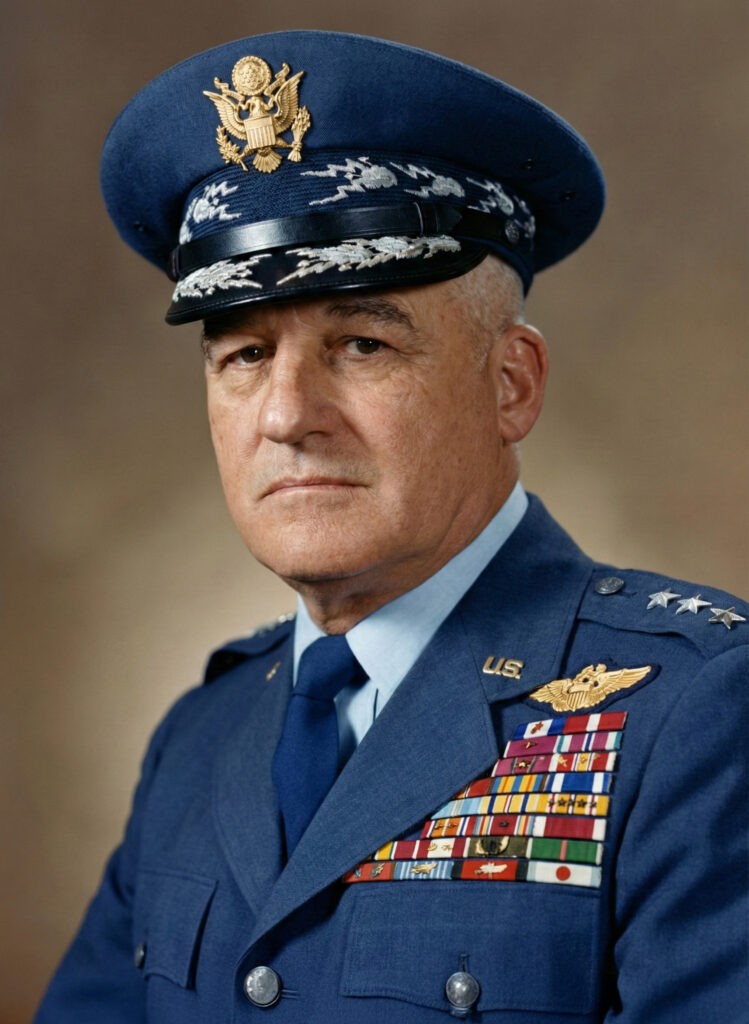
General Nathan Farragut Twining occupies a uniquely important place at the crossroads of American airpower history and the origins of official UAP inquiry.
He rose from National Guard private to four-star general, led combat air forces in two theaters of the Second World War, served as Chief of Staff of the United States Air Force from 1953 to 1957, and then became the third Chairman of the Joint Chiefs of Staff from 1957 to 1960.
Inside UAP history, he is best known for a pivotal memorandum of September 23, 1947, written while he commanded Air Materiel Command at Wright Field.
That document asserted that the “flying discs” being reported were “something real,” recommended a structured investigation, and effectively set the tone for the first wave of formal United States military study of unidentified aerial phenomena.
Later, when the controversial Majestic 12 documents surfaced in the 1980s, Twining’s name appeared among the alleged members, which deepened his place in UAP debates.
The authenticated government record places Twining at the administrative birth of official UAP study. It also shows that federal agencies have rejected the famous MJ-12 papers that include his name. (Air Force)
Early life, training, and ascent through airpower
Twining was born in Monroe, Wisconsin, on October 11, 1897. He joined the Oregon National Guard while still a teenager, saw border service in 1916, and gained an appointment to the United States Military Academy the following year.
After accelerated wartime graduation in 1918, he moved from the Infantry into flying, completing Primary and Advanced Flying School in Texas in the early 1920s, and transferring into the Air Service in 1926.
His interwar career mixed instructor duty, staff work in Washington, and field assignments in the continental United States and Hawaii, punctuated by professional education at the Air Corps Tactical School and the Command and General Staff School. These milestones are established in the official U.S. Air Force biography and in the Joint Chiefs of Staff historical profile. (Air Force)
World War II placed Twining on a steeper trajectory. He went to the South Pacific as Chief of Staff to the theater air commander, then in January 1943 took command of the Thirteenth Air Force. Later that year he became Commander, Aircraft, Solomon Islands, one of the first combined air commands with tactical control across Army, Navy, Marine, and Allied air arms.
In late 1943 Twining shifted to the Mediterranean to command the Fifteenth Air Force and the Mediterranean Allied Strategic Air Forces, helping direct strategic bombing of Axis targets in southern Europe. After Germany’s defeat he returned to the Pacific to command the Twentieth Air Force, which flew B-29 operations against Japan. The JCS historical profile notes that aircraft under his command dropped the atomic bombs as the war reached its end. (Joint Chiefs of Staff)
After the war, Twining commanded Air Materiel Command (AMC) at Wright Field, the Air Force’s nexus for engineering, logistics, technical intelligence, and materiel. With the creation of the independent U.S. Air Force in 1947, he briefly led the new Alaskan Command, returned to Washington as Vice Chief of Staff in 1950, then became Chief of Staff of the Air Force from 1953 to 1957.
President Dwight D. Eisenhower selected him as Chairman of the Joint Chiefs of Staff in 1957. The JCS timeline emphasizes his leadership during the missile and Sputnik shocks of 1957 and his work to integrate nuclear strike planning across bombers and the emerging missile forces. (Air Force)
The 1947 Twining memorandum and the birth of formal UAP inquiry
On September 23, 1947, as commander of Air Materiel Command, Twining signed a three-page letter for Brig. Gen. George F. Schulgen, the Army Air Forces Assistant Chief of Staff for Intelligence.
The subject line reads “AMC Opinion Concerning ‘Flying Discs.’”
The memo states that the “phenomenon reported is something real and not visionary or fictitious” and proceeds to summarize operating characteristics seen in credible reports. The letter lists high rates of climb, unusual maneuverability “particularly in roll,” level flight speeds above 300 knots, circular or elliptical shapes, domed tops, metallic or light-reflective surfaces, and typically no associated sound.
It also calls for the Army Air Forces to issue a directive assigning a priority, security classification, and code name for a detailed study and proposes a complete, interagency circulation of data across the Army, Navy, Atomic Energy Commission, RAND, NACA, and related bodies.
This document, preserved in the National Archives and widely reproduced, bears Twining’s signature block and AMC file markings.
The Twining memo mattered for three reasons.
First, it acknowledged the reality of an observed phenomenon while disclaiming certainty about origin.
Second, it urged the creation of a centralized, methodical project to analyze cases and exchange findings across government and scientific partners.
Third, it put Wright Field’s AMC at the center of that analytic effort by default, given its technical intelligence, engineering laboratories, and ties to the Air Institute of Technology.
Within months the Air Force created Project Sign, with AMC’s Air Technical Intelligence Center as a key node. Contemporary government histories, including the All-domain Anomaly Resolution Office’s (AARO) consolidated report, place the 1947 to 1949 period as the foundational moment for U.S. military UAP analysis and trace the succession from Sign to Grudge to Blue Book. (U.S. Department of War)
The Twining memo also shows what investigators did not have in 1947.
It explicitly notes the lack of physical evidence “in the shape of crash recovered exhibits” and flags the possibility of rare natural phenomena, as well as the possibility of domestic or foreign programs unknown to AMC and Air Staff intelligence. In short, the letter balanced a clear call to investigate with an honest appraisal of uncertainty about cause.
Twining’s senior leadership years and UAP policy context
Twining’s rise to Chief of Staff in 1953 and Chairmanship in 1957 put him at the top of a national security system that still grappled with UAP reports.
In January 1953 the Central Intelligence Agency convened a Scientific Advisory Panel headed by physicist H. P. Robertson to assess the phenomenon after a summer of high-profile sightings.
The declassified “Durant Report,” the CIA’s record of the panel’s work, concluded that UAP did not present a direct national security threat and emphasized potential indirect risks to air defense through the clogging of reporting channels.
The panel recommended an educational program to reduce misidentifications and proposed improved screening of reports. The panel’s conclusions shaped the posture that the Air Force would carry into the Blue Book era, which formally closed in 1969.
During Twining’s years as Chief and Chairman, the service refined this approach in step with the broader Cold War focus on strategic deterrence, missiles, and nuclear command and control. (CIA)
The AARO historical synthesis confirms the basic arc. It highlights how Project Sign began in 1948, how the rumored “Estimate of the Situation” that allegedly favored an interplanetary explanation was not adopted, and how Project Grudge and later Blue Book carried the work forward with increasing standardization.
At closure, the Air Force recorded 12,618 cases, 701 of which remained unidentified by contemporary standards. (U.S. Department of War)
Majestic 12 and Twining: documents, judgments, and historiography
What the MJ-12 materials allege
Twining’s name appears among the alleged members in the so-called “Briefing Document: Operation Majestic 12,” dated November 18, 1952, one of several papers that emerged in the mid-1980s.
A companion one-page “Cutler to Twining” memorandum dated July 14, 1954, also appears in those collections and refers to an “NSC/MJ-12 Special Studies Project.” These items have circulated for decades and spurred extensive investigation and debate. (Wikisource)
What federal repositories and investigators concluded
The public position of the U.S. National Archives and Records Administration (NARA) is unambiguous.
After extensive searches across Air Force, Joint Chiefs of Staff, National Security Council, and presidential library records, NARA reported negative results for MJ-12 except for the single “Cutler to Twining” sheet. NARA then listed multiple reasons that the document is problematic.
It bears no Top Secret register number in a series filed by those numbers.
It lacks standard White House letterhead or the expected watermarks used in the Eisenhower period.
The “Top Secret Restricted Information” marking is anachronistic for that era.
There is no NSC meeting record matching the briefing it references.
Eisenhower’s appointment books contain no entry for such a session.
Finally, Robert Cutler was overseas on the day the memo is dated. (National Archives)
The FBI’s FOIA-released “Vault” file on Majestic 12 records the Bureau’s conclusion, based on an Air Force inquiry, that the MJ-12 materials provided to the FBI were “completely bogus.”
The Government Accountability Office, in a 1995 note associated with its Roswell records audit, reported that relevant entities found no evidence MJ-12 originated in the executive branch and that a related message was determined to be a forgery.
These institutional judgments remain the most authoritative assessments in the public domain. (FBI)
Where that leaves Twining and MJ-12
The MJ-12 papers link Twining to a secret committee. The record held by NARA, the FBI, and the GAO does not support the authenticity of those papers.
Twining’s verified archival footprint is immense, including official military biographies and the JCS historical profile, which make no mention of MJ-12. This does not disprove the existence of highly compartmented programs that might never surface in standard record groups, but it sets the evidentiary bar.
Any claim that Twining served on MJ-12 rests on contested documents that federal custodians have rejected. (Air Force)
What Twining actually said about UAP
Unlike many figures whose names are invoked in UAP lore, Twining left us a signed, dated, declassified statement that directly addresses the phenomenon.
The 1947 AMC memo is the clearest example. He described the reported objects as real, recorded their common descriptions as “metallic or light reflecting,” often circular or elliptical, and sometimes capable of speeds above 300 knots in level flight.
He recommended a directed, interagency, priority study to collect and analyze all available data. He also flagged the lack of crash-recovered hardware, a point that framed expectations for further inquiry.
The memo is reproduced in multiple reputable archival repositories and bears National Archives copy markings.
Beyond that letter, there is no authenticated public speech or published statement by Twining that advances specific claims about the origin of UAP.
As Chief and then as Chairman, his official focus was the broad architecture of American defense. His 1966 book, Neither Liberty nor Safety, critiques U.S. strategy in the nuclear and missile age rather than addressing anomalous phenomena.
The Library of Congress finding aid and contemporary reviews confirm the nature of that volume. (Library of Congress Handle)
Influence and legacy in UAP history
He catalyzed the first formal program
The most direct influence Twining had on UAP history is administrative and catalytic.
His 1947 analysis and recommendations helped legitimize the need for an organized government response when the modern wave of sightings began. Project Sign followed, then Grudge and Blue Book. Whatever one’s view of those programs’ thoroughness or biases, the lineage traces back to AMC’s call for a structured approach.
The AARO historical report codifies that timeline and confirms the scale of the effort through 1969. (U.S. Department of War)
He set a tone that mixed curiosity with rigor
Twining’s memo strikes a balance that resonates today.
It accepts that pilots and sensors were reporting something that justified attention. It inventories performance characteristics that demanded serious engineering scrutiny. It recommends sharing information across the military, science, and industry to accelerate understanding.
It also states that natural phenomena or unknown domestic and foreign programs might account for some cases and that no crash-recovered evidence had been obtained.
The memo models sober curiosity, which is arguably the healthiest posture for any government confronted by anomalous aerospace observations.
He became a touchstone for authenticity debates
Twining’s name is tethered to the Cutler to Twining memorandum in the MJ-12 set and to the Eisenhower Briefing Document. Because his real 1947 memo carries such weight, later attempts to forge Twining-related papers had a ready-made aura.
That makes the institutional analyses by NARA and the FBI especially important. For historians, the contrast between an authenticated, operational document from 1947 and contested papers from the 1980s illustrates the value of provenance, context, and markings in document authentication. (National Archives)
He influenced the environment in which UAP policy matured
As Chief of Staff and then Chairman, Twining presided over an Air Force and a joint apparatus dominated by nuclear deterrence, missile development, and air defense modernization.
The CIA’s Robertson Panel and the Air Force’s post-1953 posture toward UAP reflected this environment, which prioritized clearing the radar picture and avoiding distraction from real threats. Blue Book’s eventual closure and the Air Force’s standing fact sheet on UAP would formalize that position for decades.
Twining’s strategic priorities helped frame how UAP were treated across the 1950s. (CIA)
Controversies
Did Twining’s 1947 memo endorse a specific extraordinary hypothesis?
No. The letter describes a real phenomenon and calls for a rigorous investigation.
It does not ascribe a definitive origin to that phenomenon.
The AARO history addresses the later, rumored “Estimate of the Situation” that allegedly endorsed an interplanetary explanation and observes that senior leadership rejected it as unproven.
Confusing the balanced tone of the Twining memo with any singular extraordinary claim misreads the record. (U.S. Department of War)
Was Twining a member of a secret crash retrieval committee?
The only documents that explicitly say so are the MJ-12 materials that federal agencies have assessed as inauthentic.
The National Archives documents multiple anomalies in the Cutler to Twining paper. The FBI records the Air Force assessment that the briefing document was a fake.
The GAO reported no evidence of MJ-12 in executive branch files during its audit work. Absent authenticated records, historians treat claims of Twining’s MJ-12 membership as unproven. (National Archives)
Did the Air Force underplay UAP because of institutional bias during Twining’s tenure?
Project Grudge has long been criticized for an attitude that many researchers view as dismissive.
The AARO history acknowledges assertions that Grudge possessed a debunking bias while also highlighting the scale and complexity of the broader effort across two decades.
Blue Book’s own published totals show that hundreds of cases resisted explanation at the time, yet the Air Force concluded there was no demonstrated national security threat or evidence of exotic technology beyond contemporary science.
The policy judgments can be debated, but the program’s documentation is extensive and publicly accessible at the National Archives. (U.S. Department of War)
A UAP-focused reading of Twining’s career
A heterodox analysis of the Twining record does not require inflating contested evidence. It requires looking squarely at what the authenticated documents say and then asking what they imply.
In 1947, the commander of AMC had access to engineering expertise, intelligence summaries, and lab-level discussions of aeronautical performance. With that vantage, he concluded the phenomenon was real, that some reports described performance outside the envelope of known aircraft, and that a formal, interagency investigation was warranted. He did not have crash-recovered material.
He did not endorse an extraordinary origin. He did insist on seriousness, coordination, and sustained reporting. That framing remains useful today.
Twining’s later senior roles also matter.
As the Air Force professionalized around jets, ICBMs, and a global air defense net, the institution tended to interpret UAP through the lenses of strategic warning, sensor fidelity, and misidentification management.
The CIA’s Robertson Panel recommended education and filter improvements, which aligned with a deterrence-first mindset. The result was a durable doctrinal posture that kept UAP within the intelligence and scientific periphery and outside the center of defense planning. Twining was one of the principal architects of that overall environment. (CIA)
For ufology, Twining’s legacy operates on two tracks. The first is evidentiary. His 1947 memo is a rare case where a senior commander told the Air Staff that something anomalous was being observed and that it needed an organized response. That sentence still anchors many arguments that the U.S. military recognized the phenomenon’s reality very early.
The second is symbolic. Once MJ-12 materials began to circulate, attaching Twining’s name to them offered an irresistible hook, since he was both a founder of official inquiry and later the nation’s top military officer. The symbols are powerful, but the historian’s task is to prefer authenticated records over magnetizing narratives.
Selected timeline
- 1897. Born in Monroe, Wisconsin. (Joint Chiefs of Staff)
- 1916–1918. Oregon National Guard service and accelerated graduation from West Point. (Air Force)
- 1923–1926. Flying training at Brooks and Kelly Fields; transfer to the Air Service. (Air Force)
- 1942–1943. Chief of Staff, South Pacific area, then Commander, Thirteenth Air Force and Commander, Aircraft, Solomon Islands. (Joint Chiefs of Staff)
- 1943–1945. Commander, Fifteenth Air Force and Mediterranean Allied Strategic Air Forces; then Commander, Twentieth Air Force in the Pacific. (Joint Chiefs of Staff)
- October 1945. Takes command of Air Materiel Command at Wright Field. (Air Force)
- September 23, 1947. Signs “AMC Opinion Concerning ‘Flying Discs’,” calling the phenomenon real and recommending a formal program.
- 1950–1953. Vice Chief of Staff, then Chief of Staff of the Air Force from June 30, 1953. (Air Force)
- January 1953. CIA Robertson Panel convenes; its conclusions and the Durant Report shape U.S. UAP policy. (CIA)
- August 15, 1957–September 30, 1960. Chairman of the Joint Chiefs of Staff. (Joint Chiefs of Staff)
- 1966. Publishes Neither Liberty nor Safety. (Library of Congress Handle)
- 1982. Dies at Wilford Hall Medical Center, Lackland AFB, Texas. (Joint Chiefs of Staff)
- 1984–1987. MJ-12 documents emerge, later judged inauthentic by federal agencies. (FBI)
Balanced conclusions
Nathan F. Twining’s place in UAP history is secure even when one filters out later, contested documents.
In 1947 he left a precise, operationally focused record that accepted the reality of a fraction of well-attested sightings and demanded a serious, data-driven program to resolve them. That memo seeded a lineage of Air Force projects that defined the official approach to UAP for the next two decades.
As Chief and Chairman he then helped shape the Cold War defense environment in which UAP were managed, monitored, and often minimized as a priority compared to nuclear and missile realities.
On Majestic 12, Twining’s name is prominent, yet the authenticated government evidence does not validate those papers. Researchers who build around the MJ-12 corpus must reckon with the National Archives’ detailed critique of the Cutler to Twining sheet and the FBI’s “completely bogus” judgment.
The historian’s through-line is therefore clear. Twining’s proven impact lies in what he wrote in 1947, the institutions he built, and the investigative posture he modeled.
From a UAPedia perspective that resists the reflex to explain away the unexplained, Twining’s dossier is both bracing and instructive. It shows that at the very moment the modern UAP era began, a senior commander with unmatched technical reach told the Air Staff that something anomalous was present in the sky, that it deserved priority study, and that the United States should bring the full weight of its scientific and military apparatus to bear. That is a foundation worth building on with new data, new methods, and new transparency.
References
All-domain Anomaly Resolution Office. (2024, March 8). Report on the historical record of U.S. government involvement with unidentified anomalous phenomena, Vol. 1. Department of Defense. https://media.defense.gov/2024/Mar/08/2003409233/-1/-1/0/DOPSR-CLEARED-508-COMPLIANT-HRRV1-08-MAR-2024-FINAL.PDF (U.S. Department of War)
Central Intelligence Agency. (1953). Report of meetings of Scientific Advisory Panel on Unidentified Flying Objects [Durant Report]. CIA Reading Room. https://www.cia.gov/readingroom/docs/DOC_0005516124.pdf (CIA)
Federal Bureau of Investigation. (n.d.). Majestic 12 [FBI Vault]. https://vault.fbi.gov/Majestic%2012 (FBI)
Joint Chiefs of Staff. (n.d.). Chairman: General Nathan Farragut Twining. https://www.jcs.mil/About/The-Joint-Staff/Chairman/General-Nathan-Farragut-Twining/ (Joint Chiefs of Staff)
National Archives and Records Administration. (2024, June 25). Project BLUE BOOK – Unidentified Flying Objects [includes MJ-12 reference report and notes on Cutler-to-Twining memo]. https://www.archives.gov/research/military/air-force/ufos (National Archives)
Twining, N. F. (1947, September 23). AMC opinion concerning “flying discs.” National Archives copy reproduced via DocumentCloud. https://s3.documentcloud.org/documents/20797978/twining-memo.pdf
U.S. Air Force. (n.d.). General Nathan F. Twining [official biography]. https://www.af.mil/About-Us/Biographies/Display/Article/105367/general-nathan-f-twining/ (Air Force)
U.S. Air Force. (n.d.). Unidentified Flying Objects and Air Force Project Blue Book [fact sheet]. https://www.af.mil/About-Us/Fact-Sheets/Display/Article/104590/unidentified-flying-objects-and-air-force-project-blue-book/ (Air Force)
U.S. Government Accountability Office. (1995, July 28). Comments on Majestic 12 material. https://www.gao.gov/assets/154832.pdf (Government Accountability Office)
Twining, N. F. (1966). Neither liberty nor safety: A hard look at U.S. military policy and strategy. Holt, Rinehart and Winston. Bibliographic record: https://books.google.com/books/about/Neither_Liberty_Nor_Safety.html?id=K3xBAAAAIAAJ (Google Books)
Note on MJ-12 sources: Researchers often consult copies of the “Eisenhower Briefing Document” and the “Cutler to Twining” memo that circulate online. These are cited here only via official custodial assessments. The National Archives reference report and the FBI Vault represent the current institutional positions. (National Archives)
SEO keywords
Nathan Twining biography; Nathan F. Twining UAP; Twining memo 1947; AMC Opinion Concerning “Flying Discs”; Majestic 12 Twining; MJ-12 authenticity; Project Sign origins; Air Materiel Command Wright Field; Robertson Panel Durant Report; Project Blue Book statistics; Chairman of the Joint Chiefs of Staff Twining; Cutler to Twining memo; AARO historical report UAP; early military UAP investigations