
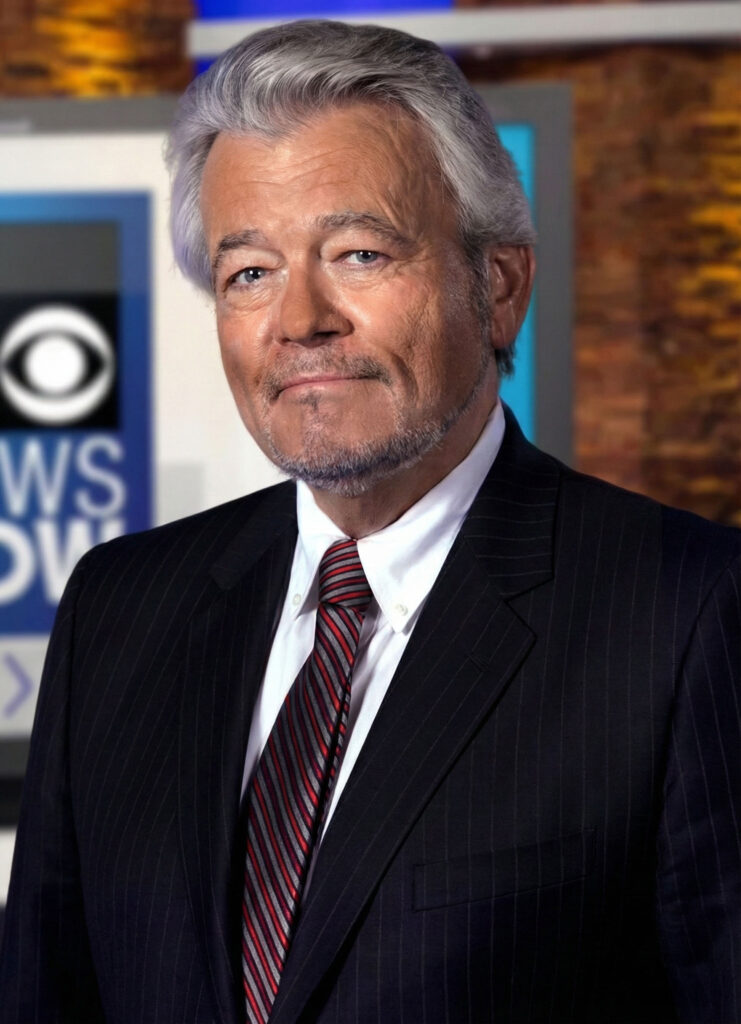
On any given night in Las Vegas, George Knapp might be doing one of two very different things. He might be in a suit at the KLAS-TV studios, filing another hard-edged I-Team package on political corruption, mob history or a crooked police case. Or he might be behind a radio mic, speaking to millions of insomniacs on Coast to Coast AM about crash retrieval programs, tic-tac craft, Skinwalker Ranch and the strange way UAP keep circling nuclear weapons. (Coast to Coast AM)
Knapp sits in an unusual spot. He is not a former intelligence officer or a self-described contactee. He is a career mainstream journalist with Peabody, DuPont, Murrow and Emmy awards on his shelf, who has spent almost four decades digging into the most radioactive UAP stories in the United States. (Simon & Schuster)
Rolling Stone once called him “the John the Baptist of the UFO movement,” capturing the odd mix of desert prophet and newsroom lifer that defines his public persona. (Rolling Stone)
Knapp’s reporting has shaped what the English-speaking world thinks “Area 51,” “Skinwalker Ranch” and “black budget UAP programs” even mean.
Early life and the long road to Las Vegas
George Knapp was born in Woodbury, New Jersey, and grew up in Northern California, where he served as senior class president at Franklin High School in Stockton.
He took a conventional academic route into communications. He earned a bachelor’s degree in communications from the University of West Georgia, then a master’s degree in communications from the University of the Pacific. Before moving full-time into television, he taught debate and forensics at both the University of the Pacific and the University of California, Berkeley. (IMDb)
By the late 1970s Knapp had relocated to Las Vegas, initially working as a cab driver before landing an internship at public station KLVX-TV. In 1981 he was hired by KLAS-TV, the CBS affiliate in Las Vegas, as a reporter and, later, a news anchor.
At that point, nothing about his resume screamed “future face of UAP journalism.” His early work centered on bread-and-butter investigative themes: organized crime, political influence in gaming, environmental fights over water and power in the booming Las Vegas Valley.
Impact speculation label: Foundational. Knapp’s grounding in classic investigative reporting gave him the muscle and credibility to pursue UAP stories without being instantly dismissed as a fringe personality.
Building a mainstream investigative reputation
If Knapp had never touched a UAP story, he would still be a decorated regional reporter.
Since the mid-1990s he has served as chief investigative reporter for the KLAS “I-Team,” a unit devoted to long-form investigations into government waste, corruption, environmental issues and cold cases. His work on this front has earned at least five regional Edward R. Murrow Awards, two national Murrow Awards, multiple Associated Press Mark Twain Awards for news writing, two Peabody Awards and a DuPont-Columbia Award. (Simon & Schuster)
One of his signature non-UAP projects was “Crossfire: Water, Power and Politics,” a multi-part series that dissected Nevada’s battles over water rights and energy infrastructure. The series won a Peabody Award in 2008 and is often cited in his bios as proof that his career is not defined solely by paranormal beats.
Within the Las Vegas media market he is also known for:
- Long-running coverage of mob influence and its decline in the casino industry
- Investigations into police misconduct, notably a high-profile vice-unit corruption case
- Deep dives into Nevada Test Site legacy issues, including health impacts on workers
These mainstream investigations matter for UAP readers because they show that the same reporter who asks sheriffs and casino bosses for documents is the one filing FOIA requests to the Pentagon and the Department of Energy on UAP.
Knapp’s reputation as a serious investigative reporter has made some officials, witnesses and even senators more willing to talk about UAP with him than with overtly “paranormal” media.
John Lear, Bob Lazar and the birth of Area 51 as myth
Knapp’s UAP journey begins in the late 1980s with two names that are now inseparable from the modern mythology of Area 51: John Lear and Bob Lazar.
In 1987 and 1988, KLAS aired programs in which Knapp interviewed John Lear, a well-connected aviator (son of Bill Lear of the Lear Jet Corporation) who claimed the United States government had recovered alien craft and bodies.
Lear later introduced Knapp to a then-anonymous source, filmed in shadow and known under the pseudonym “Dennis.” In May 1989, KLAS ran an interview in which Dennis said he had worked at a facility called S-4, near the classified Nevada Test Site, where he claimed to have seen and worked on non-human craft. In November 1989 KLAS followed up and revealed his identity as Bob Lazar.
The impact was enormous:
- “Area 51” moved from insider jargon to global meme almost overnight
- Lazar’s description of gravity-manipulating propulsion and exotic materials became central talking points in UAP culture
- Knapp’s series on the topic won a United Press International award for “Best Individual Achievement by a Reporter” in 1989, a rare mainstream honor for UAP-focused coverage (COAST INSIDER CLUBROOM)
Knapp has continued to defend his decision to platform Lazar, arguing that he has amassed private corroborative evidence that Lazar at least moved within sensitive technical circles, including a Los Alamos phone directory listing and corroborating witnesses.
Skeptics counter that Lazar’s academic and employment records are missing or contradictory, and that specific technical claims, such as early descriptions of “element 115,” do not match later scientific reality in the way believers sometimes suggest. (HowStuffWorks)
From a UAPedia perspective, the Lazar series did two things at once:
- It cemented Knapp as a journalist willing to take career risks for anomalous claims
- It hardwired Area 51 and reverse engineering narratives into UAP subculture for decades
Without Knapp’s 1989 broadcasts, Area 51 might still be a quiet test range rather than shorthand for hidden craft and crash retrieval lore.
Skinwalker Ranch, NIDS and “Hunt for the Skinwalker”
In the mid-1990s, Knapp’s UAP beat shifted from the Nevada desert to a remote Utah ranch that would become another core node in the high-strangeness map: Skinwalker Ranch.
Las Vegas real-estate billionaire Robert Bigelow founded the National Institute for Discovery Science (NIDS) in 1996 to study anomalies with mainstream scientists, including PhD-level advisors and former astronauts. Knapp was brought into the orbit of NIDS as a journalist with deep Nevada connections and a willingness to report on weird data without laughing it off.
Through NIDS deputy administrator Colm Kelleher, Knapp gained access to an active investigation of reported phenomena at a ranch in northeastern Utah: orbs, craft, animal mutilations, poltergeist-like events and other incidents that resist neat classification.
He wrote a two-part feature, “Path of the Skinwalker,” originally published in the Las Vegas Mercury, which introduced the ranch to a wider audience and documented the NIDS team’s efforts to create a scientific case log. (HUNT THE SKINWALKER)
The work culminated in the 2005 book Hunt for the Skinwalker: Science Confronts the Unexplained at a Remote Ranch in Utah, co-authored by Colm Kelleher and Geroge Knapp and published by Simon & Schuster’s Paraview imprint. The book blends detailed case reports with a narrative of how serious scientists tried to grapple with apparently responsive, shape-shifting phenomena at the ranch. (Google Books)
The Skinwalker story has had a long afterlife:
- It inspired later television series and documentaries about the ranch
- It influenced how AAWSAP, the Defense Intelligence Agency program, framed “hitchhiker effects” and broader paranormal spillover around UAP hotspots
- It gave Knapp a second signature beat: as the reporter most associated with Skinwalker-style “high strangeness” in a UAP context (Wikipedia)
Critics argue that the evidentiary base is murky, relying on subjective experiences, ambiguous photos and unreleased data, and that the ranch’s later commercialisation muddies the scientific waters even more for lack of public access to the sensor data and experiments. Supporters see Skinwalker as proof that UAP and related phenomena cannot be neatly ring-fenced as “lights in the sky.”
Hunt for the Skinwalker helped normalize the idea that UAP, poltergeists, cryptids and other anomalies might be different faces of a single underlying reality.
Harry Reid, Bigelow and the AAWSAP/AATIP story
Knapp’s role in the modern disclosure era is not limited to the media. By his own account, he has been a behind-the-scenes connector between politicians, aerospace contractors and anomalous data.
In written testimony submitted to a 2023 House hearing on UAP, Knapp described how his crash-retrieval digging in 1989 led him to brief then-freshman Senator Harry Reid, who expressed strong interest. That conversation, Knapp says, continued privately for three decades, with Reid helping him obtain documents while Knapp shared information from his sources.
He also recounts introducing Reid to Robert Bigelow and briefing both men on his reporting about Soviet and Russian UAP investigations, including a large Ministry of Defense study of incursions into nuclear facilities. According to Knapp, those briefings were part of what persuaded Reid that a formal Pentagon study was worthwhile.
This story intersects directly with the now-famous AAWSAP/AATIP saga:
- In 2007 Reid, with support from Senators Ted Stevens and Daniel Inouye, secured 22 million dollars for a black budget program inside the Defense Intelligence Agency, originally called AAWSAP (Advanced Aerospace Weapon System Applications Program).
- The contract went to Bigelow Aerospace Advanced Space Studies (BAASS), which built facilities in Las Vegas capable of storing exotic materials and fielded investigators on UAP and related phenomena.
- A smaller, later effort to focus on military encounters, AATIP, became famous after a 2017 New York Times story. Knapp’s testimony stresses that AAWSAP was actually the larger, more comprehensive study, and that most of its hundreds of case files and technical reports remain classified.
Knapp’s reporting for KLAS and later his MysteryWire and 8 News Now platforms has repeatedly highlighted AAWSAP documents, including a 2009 Reid letter asking for special access program status for parts of the project.
While Knapp did not author the laws that created AAWSAP, his introductions and reporting helped knit together the Reid–Bigelow–Lacatski triangle that birthed the most ambitious UAP study in U.S. government history.
Editorial note: In line with UAPedia’s policy on government sources, official documents and congressional letters are treated as evidence of what programs existed and how they were justified, not as proof of the ultimate nature of any UAP encountered.
Coast to Coast AM, Weaponized and the UAP media ecosystem
Outside of Las Vegas television, millions know Knapp as a voice in the dark.
Since 2007 he has served as a regular weekend host of the overnight radio show Coast to Coast AM, one of the most widely syndicated talk programs in North America, which frequently covers UAP, remote viewing and other anomalous topics. (Coast to Coast AM)
On Coast to Coast, Knapp has:
- Interviewed experiencers, pilots, physicists, former intelligence officers and skeptical researchers
- Given air time to under-reported cases such as Soviet nuclear incidents, ranch “hitchhiker” effects and new military witness testimonies
- Provided long-form context for stories that would never fit into a three-minute TV package
In 2022 he expanded that media presence by co-creating the WEAPONIZED podcast with filmmaker and investigator Jeremy Corbell. The show’s stated aim is to “pull back the veil” on UAP and adjacent secrets, often via exclusive leaked footage, whistleblower interviews and deep dives into historical cases. (WEAPONIZED)
Notable Weaponized moments include:
- Release and analysis of military UAP videos, such as a disc-shaped object over the Afghanistan–Pakistan border and radar footage of tic-tac-like craft tracked off the California coast (The Sun)
- Interviews with active and former military witnesses preparing to brief Congress
- Ongoing series contextualising the AARO reports and U.S. government messaging on UAP
- Interview with Jacques Vallee on the UAP mystery.
Through Coast to Coast and Weaponized, Knapp has become one of the main amplifiers of UAP stories into both niche communities and the broader public.
Public appearances and documentary work
Knapp’s face is now familiar at UAP festivals and on streaming platforms.
Conferences and festivals
- McMenamins UFO Festival (McMinnville, Oregon): A regular headliner at one of the largest UAP-themed events in the United States, where he often presents on Area 51, Skinwalker Ranch and the evolution of government studies like AAWSAP.
- Contact in the Desert: Listed among the “top minds” at what is marketed as the world’s largest UFO and UAP conference, appearing alongside figures like George Noory, Ross Coulthart, Luis Elizondo and others. (Contact in the Desert)
- Vail Symposium and other lecture series: Invited speakers at events that explicitly frame UAP as a topic the U.S. government now takes seriously, often paired with retired military and intelligence figures such as Col. John Alexander. (Vail Symposium)
Film and television
Knapp has appeared in or contributed to a long list of documentaries and series including:
- Hunt for the Skinwalker and later projects based on the Utah ranch
- Bob Lazar: Area 51 & Flying Saucers
- Showtime’s UFO, Unidentified: Inside America’s UFO Investigation, Top Secret UFO Projects: Declassified and specials like TMZ Investigates UFOs: The Pentagon Proof
- The NewsNation mini-series The UFO Reporter: The Files of George Knapp, which mined his personal archive
- The 2024 Netflix docuseries Investigation Alien, where he serves as on-camera investigative guide through modern UAP cases (IMDb)
These appearances reinforce Knapp’s role as one of the primary narrators of the UAP story for mainstream audiences who may never read FOIA documents or specialist books.
Congressional Hearings
Knapp’s profile as a journalist and investigator reached a new level of formal recognition when he appeared before Congress to provide testimony on UAP transparency. In his statement, submitted for the record and later discussed in interviews, Knapp outlined his decades-long experience pursuing official documents, interviewing whistleblowers and cataloging cases that, in his view, reveal consistent patterns of government secrecy around unidentified aerial phenomena. He emphasized that many credible witnesses—military personnel, scientists, intelligence officers—have shared evidence with him under conditions of anonymity because they fear professional repercussions. Knapp urged lawmakers to strengthen whistleblower protections and create secure mechanisms for reporting UAP data without stigma, arguing that the public has a right to understand what has been collected with taxpayer funding.
Known network connections
Knapp’s UAP footprint is tied to a distinctive network of insiders, investigators and experiencers. Recurring names in his reporting and media collaborations include:
- Bob Lazar – The central witness in Knapp’s 1989 Area 51 series and later documentaries.
- John Lear – Aviator and early UAP claimant who introduced Knapp to Lazar and helped shape the initial narrative about S-4 and crash retrieval programs.
- Robert Bigelow – Las Vegas billionaire and founder of NIDS and BAASS, key to Skinwalker Ranch research and AAWSAP contracting.
- Colm Kelleher – NIDS deputy administrator and co-author on Hunt for the Skinwalker.
- Harry Reid – Former Senate Majority Leader who championed AAWSAP and later UAP legislation. Knapp has said their private dialogue on UAP lasted roughly three decades.
- Jeremy Corbell – Filmmaker, co-host of Weaponized and frequent partner in releasing UAP imagery and whistleblower accounts. (Spotify)
- Ross Coulthart, Luis Elizondo, Dave Foley and others – Frequent collaborators or co-panelists in modern “disclosure” events and media. (Tom’s Guide)
This network is precisely what makes Knapp so influential and simultaneously controversial. To admirers he is a hub who stitches together fragments from different worlds: intelligence, science, media, high-strangeness and fringe research.
Controversies and criticism
No serious UAP profile of George Knapp can skip the pushback.
Lazar and evidentiary standards
The Lazar story remains the biggest flashpoint. Mainstream science writers and skeptical investigators have pointed out problems with Lazar’s resume and technical claims, and some have argued that Knapp gave too much prominence to a witness whose background could not be independently verified to conventional standards. (HowStuffWorks)
Knapp has countered in various interviews and on Weaponized that his private files include enough corroboration to justify continuing coverage, and that the core of Lazar’s story has held up better than critics admit, especially in light of later Pentagon admissions that UAP programs did exist.
Skinwalker Ranch skepticism
Some scientists and journalists see Skinwalker Ranch as an example of confirmation bias and uncontrolled fieldwork. They argue that many of the events described in Hunt for the Skinwalker could have mundane explanations that were not ruled out, and that the ranch’s later entertainment-driven branding erodes its value as a research site. (Vocal)
Knapp tends to reply with a journalistic stance: his job is to document what witnesses, including trained scientists, say they saw and measured, then let readers decide. On a cautionary note: the later TV docuseries The Secret of Skinwalker Ranch which has several seasons did open up methods, videographic data and measurements making inroads into disclosing what happens at the Ranch.
Relationship with sources and advocacy
Some media critics note that Knapp’s long, friendly relationships with figures like Reid, Bigelow and various insiders can blur the line between investigator and participant. His congressional testimony in 2023 and 2025 explicitly advocates for greater transparency and criticizes what he describes as stonewalling by military and intelligence agencies.
To believers, Knapp’s willingness to stake his reputation on controversial cases is a mark of courage. To skeptics, it risks lowering the bar for what counts as evidence in public UAP discourse.
Implications for UAP studies
For UAPedia’s taxonomy, Knapp is a key example of how the UAP conversation has migrated from fringe newsletters into the mainstream information ecosystem.
Three big implications:
- Journalistic normalization of UAP
Long before Pentagon officials were giving “UAP” briefings to Congress, a CBS affiliate in Las Vegas was running multi-night prime-time series on black budget programs, anomalous craft and nuclear-site incursions. Knapp made it slightly less career-suicidal for other journalists to treat UAP as a legitimate beat. - Integration of high strangeness into UAP discourse
Through Skinwalker and AAWSAP, Knapp helped popularize the idea that UAP are not just radar tracks, but are often entangled with poltergeist phenomena, cryptids and human “hitchhiker” effects. This broader frame influences everything from current hitchhiker research to how experiencers describe their lives. (Google Books) - Public pressure for transparency and declassification
By testifying before Congress, releasing leaked military footage, and constantly pressing for the release of AAWSAP reports, Knapp has become both chronicler and participant in the push for UAP transparency. Whether or not one agrees with his interpretations, his work has clearly influenced the political conversation.
Claims taxonomy
To keep Knapp’s sprawling career in clear focus, here is a UAPedia-style breakdown of the main claims and data streams associated with his work.
Verified:
Supported by multiple independent sources or official records:
- George Knapp is a longtime investigative journalist at KLAS-TV in Las Vegas and serves as chief reporter for the I-Team investigative unit. (Grokipedia)
- He has won top journalism awards, including at least two Peabody Awards, a DuPont-Columbia Award, several Edward R. Murrow Awards and dozens of regional Emmys. (Coast to Coast AM)
- He co-authored Hunt for the Skinwalker: Science Confronts the Unexplained at a Remote Ranch in Utah with Colm Kelleher, published by Simon & Schuster in 2005. (Google Books)
- Since 2007 he has been a recurring weekend host of Coast to Coast AM and is co-host of the podcast WEAPONIZED with Jeremy Corbell & George Knapp. (Coast to Coast AM)
- In 1989 he broadcast a series of reports featuring Bob Lazar discussing alleged work on non-human craft near Area 51, which won a United Press International award. (Wikipedia)
- He submitted written testimony on UAP secrecy and AAWSAP to a House committee and later to a congressional transparency effort in 2023 and 2025. (Congress.gov)
Probable:
Well supported by testimony and documents, but not fully documented in public:
- Knapp played an informal but real role in connecting Senator Harry Reid and Robert Bigelow, and briefing them on Soviet and Russian UAP investigations, helping shape the case for AAWSAP.
- His reporting, along with that of a few other journalists, helped prompt renewed media and political interest in UAP in the run-up to the 2017 AATIP revelations. (Wikipedia)
- The nature and cause of reported phenomena at Skinwalker Ranch. Especially after the docuseries, researchers are taking a more conservative stance on the Ranch findings, treating them as potentially serious anomalies. (THC)
Disputed:
Experts or stakeholders disagree, or evidence remains incomplete:
- The credibility of Bob Lazar’s claims about S-4, reverse engineering and specific propulsion physics. Skeptical analyses point to missing educational records and inconsistencies, while Knapp and others argue there is enough corroboration to keep the case open. (HowStuffWorks)
- The extent to which AAWSAP successfully obtained or studied “exotic materials” from alleged crash sites, a point Knapp highlights in his 2025 written testimony but which remains classified and unverified in open sources. (Oversight Committee)
Speculative
High-level frameworks or interpretations promoted by Knapp and his network:
- That there exist long-running, deeply compartmentalised crash retrieval and reverse engineering programs within the U.S. national security state, guarded by special access structures beyond the reach of most oversight.
- That the phenomena documented at skinwalker-type sites, along with nuclear-site UAP incursions, indicate a technology and maybe an intelligence that can manipulate space, time, biology and cognition in ways that blur our categories of “craft,” “entity” and “environment.” (Google Books)
Speculation label: These frameworks are influential in disclosure-oriented UAP circles, but they remain hypotheses rather than established fact in the wider scientific community.
Key external links
All URLs are given with a utm_source=https://uapedia.ai parameter for analytics, as requested.
- George Knapp author page, Simon & Schuster
https://www.simonandschuster.com/authors/George-Knapp/162064035?utm_source=https://uapedia.ai (Simon & Schuster) - Coast to Coast AM host bio
https://www.coasttocoastam.com/host/george-knapp/?utm_source=https://uapedia.ai (Coast to Coast AM) - WEAPONIZED podcast official site
https://www.weaponizedpodcast.com/?utm_source=https://uapedia.ai (WEAPONIZED) - Hunt for the Skinwalker book page
https://www.simonandschuster.com/books/Hunt-for-the-Skinwalker/Colm-A-Kelleher/9781416505211?utm_source=https://uapedia.ai (Simon & Schuster) - KLAS-TV I-Team archive (investigative reports, including UAP content)
https://www.8newsnow.com/news/channel-8s-i-team-investigative-reports/?utm_source=https://uapedia.ai (Grokipedia) - UFO Festival speaker bio
https://ufofest.com/george-knapp-2-2/?utm_source=https://uapedia.ai (McMenamins UFO Festival) - Vail Symposium speaker page
https://vailsymposium.org/speaker/george-knapp/?utm_source=https://uapedia.ai (Vail Symposium) - House UAP hearing written statement (2023)
https://static.foxnews.com/foxnews.com/content/uploads/2023/07/George-Knapp-Congressional-Record-Submission.pdf?utm_source=https://uapedia.ai
References
Bender, B. (2017, December 16). The Pentagon’s mysterious UFO program. Politico Magazine. (Wikipedia)
Coast to Coast AM. (2026). George Knapp [Host bio]. Premiere Networks. Retrieved 2026, from https://www.coasttocoastam.com/host/george-knapp/ (Coast to Coast AM)
Kelleher, C. A., & Knapp, G. (2005). Hunt for the skinwalker: Science confronts the unexplained at a remote ranch in Utah. Paraview Pocket Books / Simon & Schuster. (Google Books)
KLAS-TV. (n.d.). Channel 8’s I-Team investigative reports. 8 News Now. Retrieved 2026. (Grokipedia)
Knapp, G. (2002, November 21). Path of the Skinwalker. Las Vegas Mercury. Reprinted at HuntTheSkinwalker.com. (HUNT THE SKINWALKER)
Knapp, G. (2023). Statement to Congress [PDF submitted to House UAP hearing]. United States House of Representatives.
McMenamins UFO Fest. (2024). George Knapp [Speaker bio]. Retrieved 2026, from https://ufofest.com/george-knapp-2-2/ (McMenamins UFO Festival)
Rolling Stone. (2020, August 20). Loving the alien. Rolling Stone Magazine. (Rolling Stone)
Simon & Schuster. (n.d.). George Knapp: Official publisher page. Retrieved 2026, from https://www.simonandschuster.com/authors/George-Knapp/162064035 (Simon & Schuster)
Vail Symposium. (2023). George Knapp [Speaker profile]. Retrieved 2026, from https://vailsymposium.org/speaker/george-knapp/ (Vail Symposium)
Weaponized Podcast. (2025). WEAPONIZED with Jeremy Corbell & George Knapp [Podcast site]. Retrieved 2026, from https://www.weaponizedpodcast.com/ (WEAPONIZED)
SEO keywords
George Knapp biography, George Knapp UAP journalist, George Knapp Area 51 Bob Lazar, George Knapp Skinwalker Ranch, Hunt for the Skinwalker book, AAWSAP AATIP George Knapp, Coast to Coast AM weekend host, Weaponized podcast George Knapp, George Knapp congressional UAP testimony, Nevada I-Team UAP investigations, George Knapp Harry Reid Robert Bigelow, UAP crash retrieval media coverage, Netflix Investigation Alien George Knapp, McMinnville UFO Festival speakers, Contact in the Desert George Knapp