
For most of human history, the sky has been a chapel ceiling.
Before telescopes, radar, satellites, and flight trackers, “unidentified” was not an embarrassment, it was the default. When something extraordinary appeared above a village, a battlefield, or a pilgrimage site, people reached for the most powerful interpretive technology they had: religion.
That does not mean every account is automatically “explained away” as belief, nor does it mean every account is automatically “proof.” It means the response is part of the data.
This article is a historical, data-first overview of how major religious traditions, institutions, and publics have reacted to UAP-like phenomena across time: from sacred “sky stones,” to medieval debates about aerial “ships,” to mass-vision events like Fátima, to modern theological fault lines around crash retrieval and alleged reverse-engineering programs.
Along the way we track a recurring pattern: the UAP stimulus stays strange, but societies build meaning-making machinery around it.
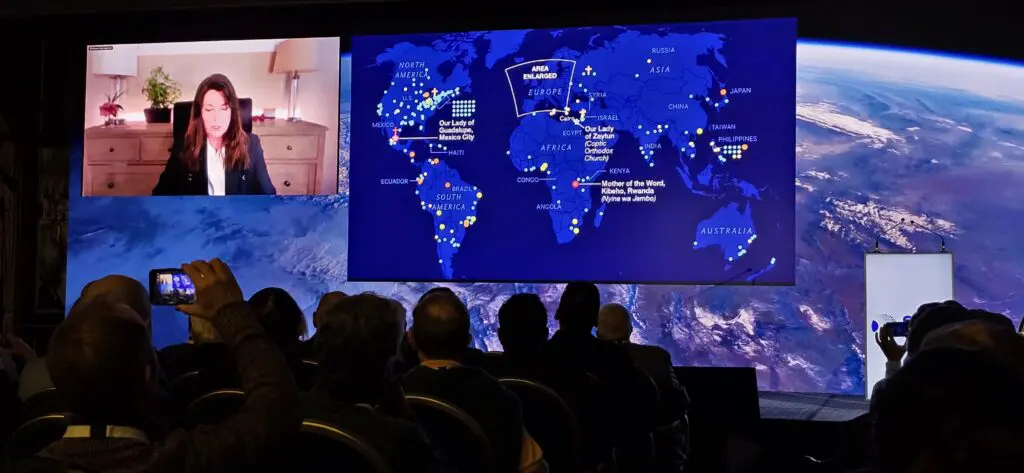
What “data-first” means in a religious history of UAP
A rigorous UAP history of religion has to treat “belief” as an output, not a dismissal.
Methodology
This overview draws from four types of sources:
- Primary historical documents (broadsheets, chronicles, religious polemics, canon law materials). For example, Agobard of Lyon’s On Hail and Thunder (9th century) is a direct window into how a bishop tried to suppress popular stories about “ships in the clouds.” (Internet History Sourcebooks)
- Curated case catalogs that explicitly compile pre-modern anomalies. Jacques Vallée and Chris Aubeck’s Wonders in the Sky describes a selection of more than 500 reports from antiquity to 1879, emphasizing how each era interpreted phenomena through local religious and political language. (Jacques Vallée)
- Institutional “discernment systems” that show how religious authorities decide what is spiritually meaningful, what is dangerous, and what is fraudulent. A modern example is the Vatican’s 2024 norms for evaluating alleged supernatural phenomena. (Vatican)
- Modern ethnography and sociology of religion, which treats UAP as a living belief ecology. Diana Walsh Pasulka’s American Cosmic is explicitly framed as a multi-year ethnographic study of UAP-related belief, technology culture, and religious meaning-making. (Oxford University Press)
The recurring “religious response” pattern
Across centuries, religious responses cluster into five repeating behaviors:
- Portent logic: the sky event is treated as warning, judgment, or omen (especially during social stress).
- Messenger logic: the sky event is treated as an intelligence, angelic presence, or “otherworldly visitor.”
- Ritual capture: the community builds a practice around the anomaly (pilgrimage, relic, shrine, feast day).
- Executive filtering: authorities decide what counts (bishops, jurists, councils, priesthoods, elders).
- Material escalation: when physical residue is claimed, it becomes a sacred object, or a forbidden object, or both. In modern UAP culture this becomes crash retrieval debris and reverse-engineering narratives.
That last one is where “ancient religion” and “modern secrecy culture” unexpectedly rhyme.
Crash retrieval before crash retrieval: sacred stones from the sky
If you want the earliest template for “crash retrieval,” do not start in New Mexico. Start with rocks.
Baetyls: “houses of god” as fallen objects
In the ancient Mediterranean and Near East, sacred stones (sometimes believed to have fallen from the sky) were venerated as containers of divine presence. The historical category is often discussed under “baetyls,” though scholars debate how broadly that label should be applied. (Wikipedia)
This matters because it gives a repeatable social mechanism:
- something falls or appears from “above”,
- authorities secure it, and
- the object becomes a legitimacy engine.
The Black Stone of the Kaaba
The Black Stone (al-Ḥajar al-Aswad) is an Islamic relic set in the Kaaba, associated with tradition tracing back to Adam in popular narratives, and embedded in the Hajj ritual life of the community. (Encyclopedia Britannica)
From a UAP-history lens, the key detail is not “what it is,” but what it does socially:
- It anchors a global ritual circuit.
- It concentrates meaning into materiality.
- It survives historical rupture (including historical reports of removal and return). (Encyclopedia Britannica)
Was it a meteorite?
That remains disputed. Britannica describes the stone primarily through its religious-historical role rather than a confirmed geologic origin. (Encyclopedia Britannica) Scholarly discussion exists around meteorite versus terrestrial stone hypotheses, including a 1974 proposal that it is likely not a meteorite (suggesting agate). (Astrophysics Data System)
The fact is, the Kaaba has not been analyzed with modern techniques, so scientific origin remains speculative.
What this shows, historically, is a stable cultural behavior: the “retrieved object” becomes more powerful than the “explanation.”
Cybele’s “black stone” and the transport of the sacred
Ancient sources and later scholarship discuss sacred stones associated with deities (for example, stones moved with ceremony into imperial centers).
A modern summary of baetyl traditions notes that the Roman cult of Cybele involved a stone effigy that was brought with great ceremony, and suggests meteoritic origin as a possibility, though not always confirmable. (Wikipedia)
UAPedia takeaway: the “crash retrieval” social pattern is ancient: elite custody, public awe, political use.
Medieval Europe: when bishops argued with “airship” folk religion
Agobard of Lyon and the ships of Magonia
In the 9th century, Agobard, bishop of Lyon, wrote On Hail and Thunder, attacking a popular belief that weather disasters were caused by human magic and that “ships” came from a region called Magonia to collect crops. (Internet History Sourcebooks)
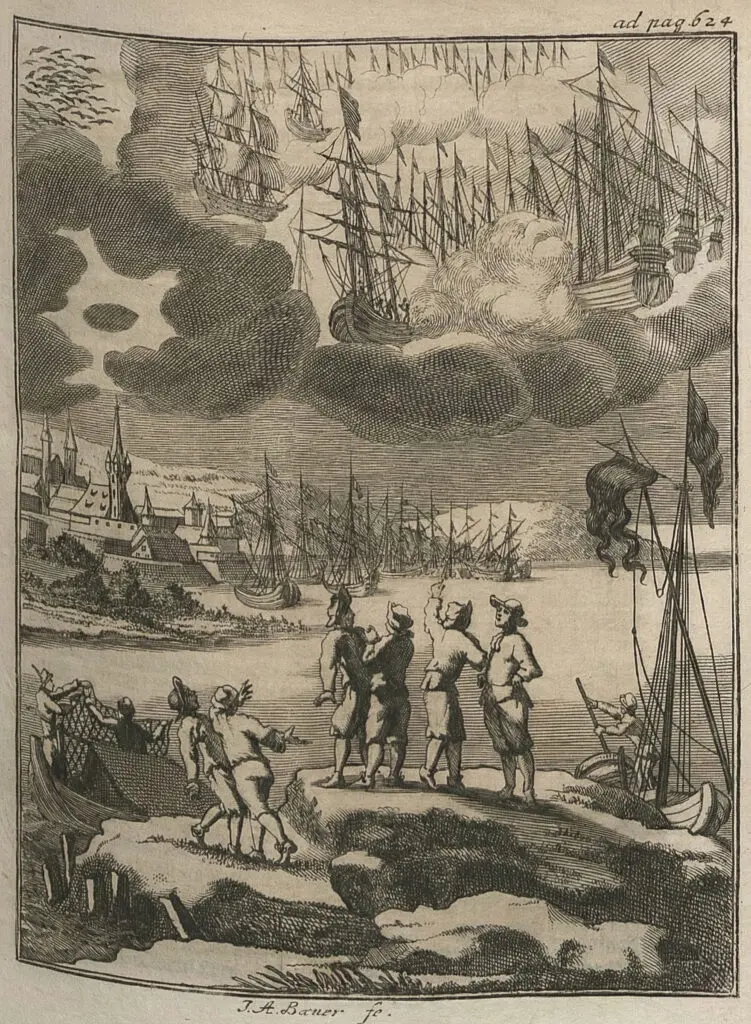
Read it as a micro-history of UAP meaning-making:
- The populace is already telling a “nonhuman visitors” story.
- The institutional executive (Agobard) treats it as dangerous nonsense.
- The conflict is not about physics, it is about authority: who gets to define the invisible.
This is one of the cleanest early examples of “religious executive filtering” applied to aerial anomaly narratives.
The printing press era: sky battles as warnings during social rupture
When pamphlets and broadsheets became mass media, UAP-like reports scaled with them.
Nuremberg 1561: a broadsheet of aerial conflict
In April 1561, an illustrated broadsheet by Hans Glaser described a dawn spectacle over Nuremberg featuring objects (spheres, rods, crosses, crescents) apparently “fighting,” followed by a large dark shape. The document survives and is associated with the Zentralbibliothek Zürich collection. (The Public Domain Review)
The Public Domain Review’s writeup emphasizes the key historical fact: Glaser produced a broadsheet with image and narrative, and the event was framed as a moral admonition to repent. (The Public Domain Review)
Religious response pattern: portent logic. The text is not neutral reportage. It is sky spectacle as sermon.
Modern interpretive split:
Some modern readers argue UAP craft conflict; others point to atmospheric optics (for example, sundogs/parhelia) as a candidate. Contemporary historians treat the broadsheet genre itself as part of the interpretive distortion. (Wikipedia)
Basel 1566: another “battle,” another omen economy
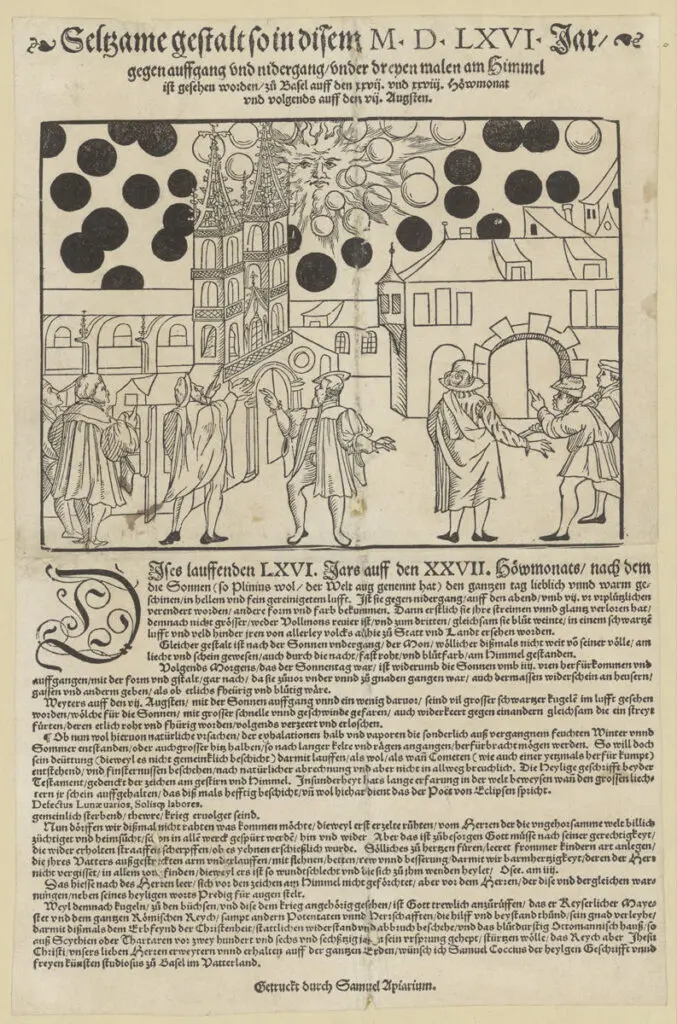
A Swiss National Museum article details how printers Samuel Apiarius and Samuel Coccius produced a broadsheet memorializing “otherworldly events” in Basel, including red and black spheres that appeared to clash in the sky. (Swiss History Blog)
Again, the key is not only the sighting. It is the publication pipeline:
- witnesses report
- printers monetize and disseminate
- religious meaning saturates the interpretation
This is the early-modern ancestor of today’s social-media UAP amplification.
1917 Fátima: mass witness, mass meaning, permanent infrastructure
If you want the clearest example of ritual capture around a sky anomaly, Fátima is unavoidable.
Britannica reports that on October 13, 1917, a crowd estimated at about 70,000 gathered at Fátima and witnessed what has been described as a “miraculous solar phenomenon,” often called the “Miracle of the Sun.” (Encyclopedia Britannica)
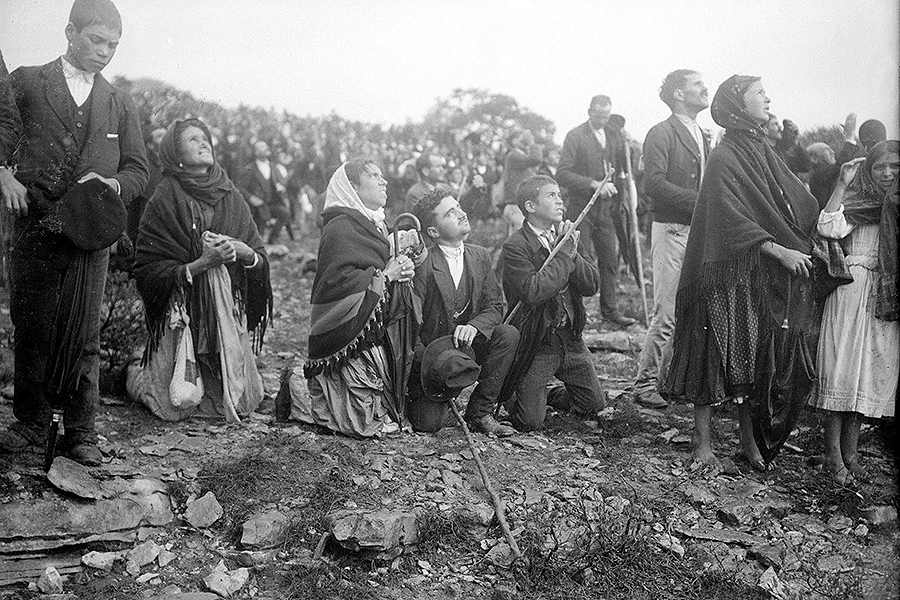
From a UAP-history standpoint, Fátima is extraordinary for three reasons:
- Scale: tens of thousands present. (Encyclopedia Britannica)
- Publicity: newspapers reported witness testimony (including accounts by a journalist from O Século, per standard summaries of the event’s documentation). (Wikipedia)
- Institutional processing: the Catholic Church treated it through investigatory mechanisms, and the wider religious system converted it into enduring devotional practice. (Wikipedia)
Whether one interprets the solar behavior as miracle, localized atmospheric optics, perceptual effects, or something else, Fátima demonstrates a durable sociological truth:
a high-emotion, high-attendance anomaly can generate a permanent religious economy.
Pilgrimage, museums, calendars, theology, politics. A brief sky event becomes a centuries-long institution.
Crash retrieval enters modern religious space: from Texas burials to Vatican headlines
Aurora, Texas (1897): an alleged “not-of-this-world” burial
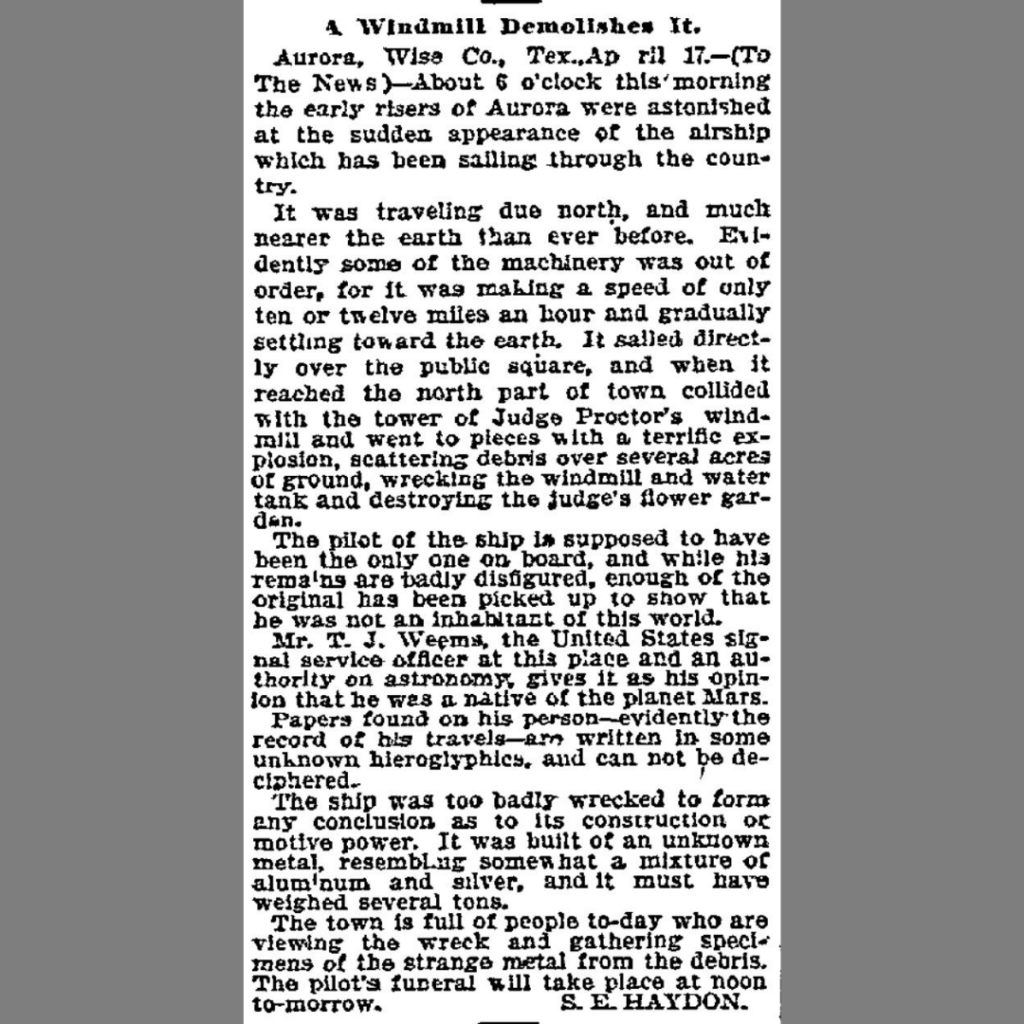
The Aurora story claims an airship crashed and a pilot was buried with Christian rites. It is a vivid example of how communities absorb an anomaly into existing ritual structures (burial, cemetery, clergy). (Wikipedia)
But it is also heavily contested. The Texas State Historical Association describes the Aurora report as a fictional “news” story released by S. E. Haydon to revive interest in the town. (Texas State Historical Association)
So Aurora is useful in two ways:
- As a model of religious assimilation (even alleged NHI gets a Christian burial).
- As a warning about media fabrication in UAP culture, which religious institutions have historically been forced to manage.
The Vatican and the 1933 Magenta, Italy crash claim
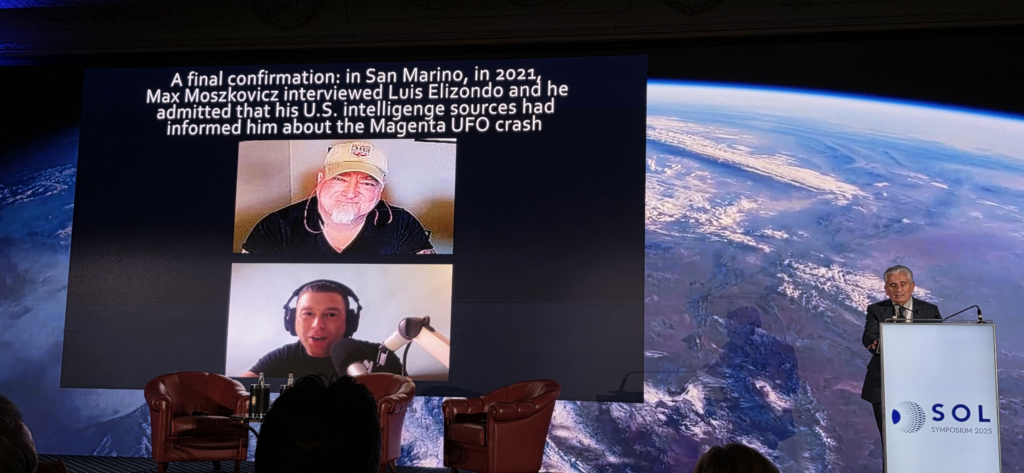
In 2023, former U.S. intelligence official David Grusch publicly claimed that a craft recovered in Magenta, Italy (1933) involved Vatican awareness and “backchanneling.” Catholic News Service reported the claim and also reported a Vatican archives official disputing that the archives contain documentation about extraterrestrial life, discouraging such searches. (USCCB)
This is a modern collision of:
- crash retrieval narrative
- religious executive authority (the Church as gatekeeper of archives and legitimacy)
- media amplification
Popular Mechanics covered the broader “1933 Italy crash” research claims as part of the modern UAP discourse ecosystem. (Popular Mechanics)
Important: this is not a “verified” historical event in the public record. It is a probable claim circulating in the modern UAP space after the release of the investigation of Roberto Pinotti in the case, with several official verified with clear chain of custody documents about the craft but no verifiable hard evidence of the involvement of the Vatican.
Reverse engineering as modern alchemy: why religions care
Reverse engineering narratives are not just technical. They are theological, even when the people telling them do not think of them that way.
When a culture believes:
- nonhuman craft exist
- physical materials exist
- hidden programs exist to study them
…then the culture has effectively reinvented a sacred-object tradition, but with labs instead of temples.
The “relic” logic of UAP debris
Dr. Dianna Pasulka’s work is relevant here not because it “proves” materials, but because it documents how UAP narratives generate:
- sacred geographies (sites where people go to find “pieces”)
- sacred objects (materials treated as transformative)
- new priesthoods (scientists, insiders, credentialed experiencers) (Oxford University Press)
This is the modern echo of baetyl culture, translated into aerospace and the intelligence community.
Religious risk models
A significant subset of Christian thought interprets UAP not as extraterrestrial biology but as spiritual deception (often framed as demonic).
While popular articles exist, there is also scholarly treatment of “alien demonology” as a modern religious motif, including analysis of how Christian categories shape “malevolent alien” narratives. (ScienceDirect)
In that framework, “reverse engineering” becomes morally radioactive: forbidden knowledge, an inversion of divine order, or a temptation story.
The executives: who decides what the sky “means”?
In UAP history, executives are not only CEOs and generals. They are bishops, jurists, theologians, curators of archives, and the custodians of doctrinal boundaries.
Catholicism: centralized discernment in the internet age
In 2024, the Vatican published updated norms for discerning alleged supernatural phenomena, explicitly approved by Pope Francis and effective May 19, 2024. (Vatican)
Key operational implications (relevant to UAP-adjacent “apparitions,” lights, and visions):
- Local bishops have constrained authority; the central doctrine office has structured involvement. (Reuters)
- The process discourages rapid, definitive “supernatural” declarations, emphasizing caution and protection against exploitation. (AP News)
This is the institutional form of Agobard’s impulse: control the narrative channels that can hijack belief.
Catholic scientific posture: extraterrestrial life is not automatically heresy
In 2008, Vatican Observatory director Fr. José Gabriel Funes was reported (Reuters and other outlets) as saying belief in “extraterrestrial brothers” does not conflict with Christian faith. (Reuters)
In 2009, Vatican-linked scientific discussion of extraterrestrial life (through conferences and commentary tied to the Pontifical Academy of Sciences and Vatican Observatory ecosystem) entered mainstream coverage. (The Guardian)
The executive point: major religious institutions are already preparing conceptual “ports” for nonhuman life, even while remaining cautious about claims.
New religions as “UAP responses”: when the anomaly becomes the scripture
Historical religious response is not only about old traditions. It is also about new ones born directly from UAP narratives.
Heaven’s Gate
Oxford Academic coverage of the 1997 Heaven’s Gate event notes the group believed a spacecraft was traveling behind the Hale-Bopp comet, and members took their own lives seeking to reach an extraterrestrial “Kingdom of Heaven.” (OUP Academic)
The lesson is severe: UAP as religion can scale into lethal certainty.
Raëlism
A neutral factsheet summary describes Raëlism as a UAP-based new religious movement founded in the 1970s, centered on alleged contact with advanced beings and a “message” for humanity. (Religion Media Centre)
These movements matter historically because they show a full conversion:
- UAP is not a sign inside religion
- UAP becomes the religion
Implications: what historical religion teaches a future “planetary response”
If credible, high-confidence NHI evidence became public tomorrow, religion would not be a side show. It would be core infrastructure.
Religion can stabilize panic, or amplify it:
- Stabilizing pathway: doctrinal frameworks that place nonhuman life inside creation and ethics (seen in Catholic openness to the possibility of extraterrestrial life). (Reuters)
- Amplifying pathway: deception frameworks that interpret UAP as spiritual attack, which can radicalize communities against scientific and political institutions. (ScienceDirect)
Crash retrieval narratives are socially explosive because they imply elite custody of “relics”
The ancient baetyl pattern tells us what happens when societies believe elites possess sky-fallen objects: legitimacy struggles, pilgrimage economies, political myths, and contested priesthoods. (Wikipedia)
Modern “reverse engineering” claims plug directly into that ancient circuitry, but with national security added.
The most practical near-term need is interfaith contact ethics
Even without definitive NHI proof, UAP discourse is already shaping belief and behavior. Institutions that ignore it surrender the field to the loudest interpreters.
A mature “planetary response” would likely require:
- interfaith protocols for public messaging (to reduce sectarian conflict)
- psychological first aid and anti-exploitation safeguards (mirroring why modern discernment norms emphasize protection against manipulation) (AP News)
- humility about interpretation: witnesses see something, then culture narrates it
Claims taxonomy
Because this is an overview spanning many eras, the taxonomy applies to clusters of claims, not one single case.
Verified
Religious institutions maintain formal discernment systems for alleged supernatural events, updated in 2024 by the Vatican with specific procedures and cautions. (Vatican)
Fátima’s October 13, 1917 event drew a crowd estimated around 70,000 and generated enduring institutional and devotional infrastructure. (Encyclopedia Britannica)
Probable
Early modern “sky battle” broadsheets reflect a mix of reported observation and genre-driven moral messaging, meaning the religious framing is intrinsic and not an afterthought. (The Public Domain Review)
Disputed
The physical origin of the Black Stone as meteorite versus terrestrial stone remains unresolved publicly; claims exist but modern analysis is not available. (Wikipedia)
The alleged 1933 Italy crash retrieval and Vatican involvement claims are contested and not established in the public record, with explicit Vatican-archives pushback reported. (USCCB)
Legend
“Magonia ships” in medieval folk belief are historically attested as beliefs reported by Agobard, but not evidence of literal craft; they represent a cultural narrative about aerial intelligences. (Internet History Sourcebooks)
Misidentification / Hoax:
The Aurora, Texas (1897) story is widely treated as fabricated in historical commentary, even though it remains influential in UAP lore. (Texas State Historical Association)
Speculation labels
Hypothesis
A persistent “single phenomenon” may underlie a subset of historical sky-encounter traditions, with cultures translating encounters into angels, djinn, gods, or omens depending on available language and power structures. Catalog-based approaches explicitly highlight how interpretation changes by epoch. (Apple)
Witness Interpretation
In mass events such as Fátima, witness testimony can describe extraordinary solar behavior while diverging on details, and many interpret the meaning through existing devotional expectations. (Wikipedia)
Researcher Opinion
Some researchers argue that modern crash retrieval claims involving religious institutions (for example, Vatican awareness of the alleged 1933 Italy recovery) represent a hidden interface between religious archives and state secrecy. At present, this remains disputed, with institutional denials and no public chain-of-custody evidence. (USCCB)
References
Agobard of Lyons. (9th century). On Hail and Thunder (De grandine et tonitruis). Medieval Sourcebook, Fordham University. (Internet History Sourcebooks)
Aubeck, C., & Vallée, J. (2010). Wonders in the Sky: Unexplained Aerial Objects from Antiquity to Modern Times. (Summary and catalog descriptions). (Jacques Vallée)
Catholic News Service. (2024, June 18). Reporting on claims about Vatican archives and UAP-related narratives, including Vatican-archives responses. (USCCB)
Dicastery for the Doctrine of the Faith. (2024, May 17). Norms for proceeding in the discernment of alleged supernatural phenomena. Vatican.va. (Vatican)
Encyclopaedia Britannica. (2025, Nov 10). Our Lady of Fátima. (Encyclopedia Britannica)
Encyclopaedia Britannica. (2025, Nov 20). Black Stone of Mecca. (Encyclopedia Britannica)
Partridge, C. (2004). Alien demonology and Christian roots of malevolent alien imagery. Religion (abstract listing). (ScienceDirect)
Pasulka, D. W. (2019). American Cosmic: UAP, Religion, Technology. Oxford University Press (publisher description). (Oxford University Press)
Reuters. (2008, May 14). Vatican scientist comments on compatibility of belief in God and extraterrestrial life. (Reuters)
Robinson, W. G. (1997). Heaven’s Gate case overview. Journal of Computer-Mediated Communication. (OUP Academic)
Swiss National Museum. (2024, July 30). The celestial event over Basel in 1566 and its broadsheet publication context. (Swiss History Blog)
Agobard of Lyons, “On Hail and Thunder” (Fordham Medieval Sourcebook): https://sourcebooks.web.fordham.edu/source/Agobard-OnHailandThunder.asp?utm_source=uapedia.ai
Public Domain Review on the 1561 Nuremberg broadsheet: https://publicdomainreview.org/collection/celestial-phenomenon-over-nuremberg-april-14th-1561/?utm_source=uapedia.ai
USCCB / Catholic News Service: Vatican archives and UAP claims reporting: https://www.usccb.org/news/2024/angels-or-aliens-some-researchers-say-vatican-archives-hold-ufo-secrets?utm_source=uapedia.ai
Harvard ADS entry: Dietz & McHone (1974) “Kaaba Stone: Not a meteorite, probably an agate”: https://adsabs.harvard.edu/full/1974Metic…9..173D?utm_source=uapedia.ai
Suggested internal crosslinks
SEO keywords
Historical religious responses to UAP, UAP and religion, UAP theology, NHI and faith, Fátima miracle of the sun UAP, Nuremberg 1561 UAP, Basel 1566 UAP, Vatican UAP archives, crash retrieval religious impact, reverse engineering UAP cultural effects, sacred stones meteorites religion, baetyls sky stones, UAP new religious movements, Heaven’s Gate UAP, Raëlism UAP, interfaith disclosure protocol